AN EMPIRICAL STUDY ON THE FIVE CORE
COMPONENTS OF HIGHLY EFFECTIVE TEAMS
Rute Nunes Pinheiro
Dissertation submitted as partial requirement for the conferral of Master of Science in Human Resource Management
Supervisor:
Ph.D., Ana Margarida Soares Lopes Passos, ISCTE Business School Department of Human Resource and Organizational Behaviour
September 2016 Lisbon, Portugal
iii resilience and discipline are important.
First, I want to thank to Professor Ana Passos to have represented my greatest support for the realization of this thesis. With her I learned the value of rigor and that everything is done when we really wants. Despite she being always involved in huge projects she never stopped supporting me. What else I needed she was always available for listen to me. I also thank you the time, attention and dedication.
I want to thank our team - Ana, Mariana and Miguel - good job! Thank you for everything!
A very special thanks to my friend Ana Drupret who also helped me in the most difficult moments of this dissertation. Thank you for hours we spent together to writing the dissertation! I learned a lot with you!
Thank you very much Soraia Mendes for your shining eyes, for the counsels, for being present and for making me laugh constantly!
To all my aunts but especially Aunt Rosa Sousa, for all the love and fado that you forced me to hear since I came to Lisbon! Thank you for being with me (now gone five years) for being my nurse and for always giving me a hand when I need without having to ask you anything.
At my cousin Telma Duarte is a fundamental pillar of my life. One of the people who encouraged me not to stop studying. Thank you for your example of kindness, charity, study and work hard. Thank you for take care of me since I born!
My dear Ângelo Torani that is always by my side. Thank you for all the love. Thank you also for all the times that you brought me dinner and all the way you treat everything so well while I dedicated to the dissertation. Thank you also for being so
iv And finally, my dear Mother, Father, Brother and Grandmother.
Brother, thank you for everything. For protect me, for wanting my good. I love our relationship and I'm so proud of you . You are a beautiful soul!
Grandmother, thank you for your unconditional love and for be always present in my life. Thank you for wish me a happy night every night and for pray for me everyday. Thank you for the values that you passed me, resilience, work and never give up!
Mum and Dad, Thank you for the values of discipline, honesty and resilience that you teach me. Thank you for the sacrifices yhat you make every day for me and my for brother. I am so grateful and so happy about you being my parents! Thank you for all the unconditional love, care, support and advice you gave me along this route. Thank you for all the opportunities and possibilities that you give me to study and learn. Thank you for believing and trust me so much! I love you so much.
v Human resources departments cross daily challenges that can only be successfully overcome if the teams formed to solve are effective. Salas et al. (2005) described five core components that would be crucial to the effectiveness of the team. My main goal throughout the study was to see if each one of these components (Team Leadership, Adaptability, Mutual Performance Monitoring, Backup Behaviour and Team Orientation) contributed to the effectiveness of teams applied to more specifically the hostel tourism units.
This study was carried out by a master’s student team. We made a quasi-experimental research where we use questionnaires. These questionnaires were applied to 22 hostel in Lisbon which involving 99 people.
All hypotheses were confirmed in this study and therefore the conclusion is that in fact the big five components defined by Salas et. al (2005) have each one a positive impact on the efficiency of the team. Finally, it are made a set of theoretical and practical implications of the study which are also presented suggestions for future studies.
Key words: Teams, Effectiveness of team,s Five Core Components, Hostel
JEL Classification System-Numbers: D23 Organizational Behavior;
O15 Human Resources
vi Os departamentos de recursos humanos atravessam desafios diários que só podem ser superados com sucesso se as equipes formadas para os resolver forem eficazes. Salas et al. (2005) descreveu 5 componentes que seriam determinantes para a eficácia da equipa. O meu objetivo ao longo do estudo foi perceber se cada uma desses componentes (Team Leadership, Adaptability, Mutual Performance Monitoring, Backup Behaviour and Team Orientation) contribuía para a eficácia das equipas aplicadas às unidades de turismo mais concretamente aos hostel.
Este estudo foi levado a cabo por uma equipa de mestrandos. Fizemos uma pesquisa quasi-experiemental onde usamos questionários. Estes questionários foram aplicados a cerca de 22 hostel em Lisboa o que envolvendo 99 pessoas.
Todas as hipóteses deste estudo foram confirmadas e por isso a conclusão é que de facto as grandes cinco componentes definidas por Salas et. al (2005) tem cada uma delas um impacto positivo na eficácia da equipa. Por fim são feitas um conjunto de implicações teóricas e práticas do estudo onde também são apresentadas sugestões para futuros estudos.
Palavras-Chave: Equipas, Eficácia das equipas, Five Core Componentes, Hostel Números de classificação do sistema JEL: D23 Comportamento Organizacional; O15
ACKNOWLEDGEMENTS... iii ABSTRACT... v RESUMO... vi Chapter I 1. Introduction... 10 Chapter II 2. Definitions • Team;Teamwork and Taskwork... 11
• Team performance; Team Effectiveness... 12
• The IPO Model and the IMOI Model ………...………….. 13
A Temporally Based Framework and Taxonomy of Team Process..……... 21
o Recurring Phase Model of Team Process……… 23
Chapter III 3. A Model of Teamwork: The Five Core Components of Teamwork • Introduction...24
• Definition of The Five Core Components... 25
(Team Leadership, Adaptability, Mutual Performance Monitoring, Backup Behaviour and Team Orientation) • Coordinating Mechanisms ...29
• Share-Mental Models ...29
• Closed-Loop Communication...30
• Mutual Trust ...31
Chapter IV 4. Testing the Five Core Components • The model proposed... 32
Chapter V 5. Methodology Sample ...34
Procedure...34
8 Chapter VI 6. Results ...38 Discussion...39 Pratical Implications...41
Limitations and suggestions for future research...42
Bibliography...44 Appendixes...47
Table Index
Table 1………...….38Figures Index
Figure 1………...…....24 Figure 2………...33Abbreviation Index
IMOI – Input-Mediator-Output-Input
9
[THIS PAGE WAS INTENTIONALY LEFT IN BLANK]
10 Chapter I 1. Introduction
The globalization, the fast way that things change, the new technologies it turns the markets more more exigent. Everything is happening at the same time. Teams need to be fast, productive and efficient. The daily work is now more sophisticated and obligates a constantly update of the information and knowledge’s. For this also the individual and the team work it is a huge challenge.
It is so interesting as the people in general have, what Salas et al., (2009) call by wisdom of collectives that basically is the concept of the efforts and the extremely capacity to perform in various areas by the interactions between each other. Together it is possible do more and better and more, be effective as a team.
Salas et al (2005) identified five core components which, according to the authors these are the essential components for the teams to become effective. These dissertation will emphasize if empirically these components are truly determinants of the effectiveness of the team. We will aplly this study to the hostels. It is a recent concept of accommodation. This hostels teams present us some challenges because of the size of the teams or also because of the size of the business. This make that in most hostels there is no a structure management in terms of human resource practices at least consciously.
Crossing this study there is the opportunity to get know better about the basics concepts and models (IPO and IMOI models) that are studied for the teams and team effectiveness (The Big Five Core Components) (Chapter II, III and IV) and the the practical application and the results (V and VI).
To understand how are the teams "transformed" into effective teams, it is important to review some concepts that I will explore further.
11 Chapter II 2. Definitions Team What is a team?
All of us know that the nature of the human is, some how, never being alone. We all know how strong we can be; how wonderful things we can do if we work together. It is difficult sometimes but the team and the teamwork worth. Marks et al., (2001) defined teams in a such simple and practical way such as, teamwork is: “people working together to achieve something beyond the capabilities of individuals working alone.” Marks et al., (2001) p.356. Still in the definition of team, it is also possible define team such as a “distinguishable set of two or more people who interact dynamically, interdependently, and adaptively toward a common and valued goal/objective/mission, who have each been assigned specific roles or functions to perform, and who have a limited life-span membership” Salas, et.al., (1992), p.4.
When working in a team there is “this diversity of expertise that creates the potential for teams to complete work outside the scope of any one individual’s capabilities. The social dynamics of effective teamwork are necessary to realize this potential” Salas et al, (2009) p. 39.
Is also important refer that “teams provide diversity in knowledge, attitudes, skills and experience, whose integration makes it possible to offer rapid, flexible and innovative responses to problems and challenges, promoting performance and improving the satisfaction of those making up the team” Rico et al, (2011) p.57.
For this definition it is possible to define a certain interdependence between the team members how Saavedra et al, 1993 suggest. Because of this interdepended but also a diversity in the teams that are created the potential “for teams to complete work outside the scope of any one individual’s capabilities. The social dynamics of effective teamwork are necessary to realize this potential” Salas et al. (2009) p.40-41.
12 members Salas et al. (2009).
Taskwork is “everything” that an individual member can contribute with, it can be “knowledge, skills, attitudes, and other characteristics (KSAOs) used to accomplish individual task performance; the application of these skills does not require interdependent team.” Salas et al.,(2009) p.41. By this, “teamwork competencies are the KSAOs necessary for members to function within an interdependent team.
“Therefore, team members must possess not only individual-level expertise relevant to the technical performance of their own individual tasks but also expertise in the social dynamics of teamwork” Salas et al. (2006) cited by Salas et al., (2009) p.41.
In general teamwork definition is the process of enacting teamwork KSAO’s competencies. Salas et al., (2009) p.41
Team Performance
Usually lot of us look at the team performance as the result of the teamwork, however this idea is wrong. “Team performance is conceptualized as a multilevel process (and not a product) arising as team members engage in managing their individual and team-level taskwork and teamwork processes, Kozlowski and Klein, (2000) cited by Salas et al. (2009) p.41.
By this, team performance is the process not the result. Campbell, (1990) cited by Salas et al., (2009) p.41.
Team Effectiveness
Team effectiveness, “is an evaluation of the outcomes of team performance processes relative to some set of criteria. It is a judgment of how well the results of performance meet some set of relatively objective (e.g.. metrics of productivity) or subjective (e.g., supervisor or observer ratings) standards”. Salas et al., (2009) p.41.
There standards refered “are ideally aligned with the goals of the team and organization” Salas et al., (2009) p.41.
13 The IPO Model and the IMOI Model
Over the year’s lot of studies are been doing about the teams and how they work. Also this studies gave especially attention when studying the effectiveness of this teams. This happens because “(…) teams have come to be considered as a central element in a functioning of organisations” Rico et al (2011) p.57.
However the technologies, the generations, the people, the ways of think and working, everything is changing so quickly and in a such sophisticate way that there is a need to “(…) develop new business models in dynamic, uncertain and complex environments and the need for innovation that have led to demand to adapt work structures traditionally revolving around individuals and to adopt organisational designs geared to change and based on teams” Lawler and Worley, (2006); West and Mankiewicz, (2004) cited by Rico at al (2011) p. 57.
"Thus, the success of organisations and the overall productions of knowledge depend to a large extent on the effectiveness of teams" Wuchty, Jones and Uzzi, (2007) cited by Rico et al (2011), p.57.
After the researchers and the companies understand that the teams and the way that teams work together was the most important for the effectiveness of the organisations, “ (…) the research aimed at the development of methods and theories for measuring the effectiveness of work teams” Salas et al, (2009) cited by Rico et al, (2011) p.57, increased.
The IPO Model
In most studies that have been done and “despite some differences between them, they can all be considered to have been based on the Input-Processes-Output (IPO) model McGrath (1964) cited by Rico et al. (2011) p.58. This model identifies the composition, structure and processes of teams and the key antecedents to their effectiveness” Rico et al (2011) p.58. This model show us that “the organisational domain has shown some shift from questions of what predicts team effectiveness and viability to more complex questions regarding why
14 some groups are more effective than others”. Rico et al (2011) p.58.
So, IPO Model “describe teamwork through relationships between input variables (e.g., individual and team characteristics, task characteristics), process variables (e.g., mutual performance monitoring, communication, coordination, leadership), and outcome variables (e.g. performance outcomes, productivity, and satisfaction)” Salas et al. (2009) p.48-49.
Input Process Outcome
“Classic Works of Steiner (1972), McGrath (1984), and Hackman (1987) expressed the nature of team performance in classic systems models ways in which inputs lead to processes that in turn lead to outcomes (the input-process-output, I-P-O, model)” Ilgen et al (2005) p. 519.
However, this IPO Model became insufficient to describe teams, Moreland (1996) cited by Ilgen (2005). It is possible identify more “three specific ways” where IPO shows be not sufficient, Ilgen (2005).
First, there is a general difficulty to identify the processes, in which way that “many of the
mediational factor that intervene and transmit the influence of inputs to outcomes are not processes” Ilgen (2005) p.520.
Second, “an I-P-O framework limits research by implying a single-cycle linear path from
inputs through outcomes (...)” this means that the classic I-P-O is consider, some how, a static model in a dynamic context (which is the teams and the processes to get effectiveness inside the organizations). Ilgen (2005) p.520
The third, “the I-P-O framework tends to suggest a linear progression of main effect influences proceeding from one category (I, P, O) to the next: However, much of the recent research has moved beyond this. Interactions have been documented between various inputs and processes (I x P), between various processes (PxP), and between inputs or processes and emergent states (ES)” Ilgen (2005) p.520
15 For this, the I-P-O Model have been considered not complete. A new model appears.
The IMOI Model (input – mediator – output – input)
“Substituting “M” for “P” reflects the boarder range of variables that are important mediational influences with explanatory power for the explaining variability in team performance and viability. Adding “I” at the end of the model explicitly invokes the notion of cyclical causal feedback” Ilgen (2005) p.520.
Basically, Ilgen et al. (2005) propose that the team work is such a dynamic reality that is impossible to define this realty in a model so static as I-P-O.
As Rico et al. (2011) refer the IMOI model created by Ilgen et al. (2005) show us “highlights the cyclical nature of feedback processes, so that a team’s output at a given moment represent new inputs for subsequent activity” Rico et al. (2011) p.58.
To more easily understand of the IMOI Model, next I will explain it across each letter that represent the name of the model. Starting with “I” of input.
Input
“Inputs represent the teams set of resources, both external (e.g., rewards from the organization, organizational culture) and internal (team composition, mainly the knowledge and skills of its members, as well as the group structure and task design); (…) these resources can be considered at different levels (members, group and organizational resources).” Rico et al. (2011) p.59.
Rico et al. (2011) in his approach define three types of inputs according with the context where they are developed: organizational context, task and team context and team composition.
16 In the inputs related with the Organizational Context are included the tools of the human resources management of the organizations, such as rewards or training policies for example.
Also an “organizational design that permits inter-relationships between work teams and between teams and the organization as a whole, articulates support, providing resources and removing obstacles”. Rico et al. (2011) p.59.
Still, an “organizational climate of support for teams and organizational culture” Rico et al. (2011) p.59 are inputs that can promote the effectiveness of the teams.
(2) “Task design and Team context”
In this topic of inputs that Rico et al. (2011) present was autonomy, interdependence, virtuality and leadership. These are characteristics truly relevant for the team effectiveness. “Autonomy refers to the extent to which a team has the capacity to make decisions about different aspects of its work (methods, timetables, roles, etc.)” Rico et al. (2011) p.60; Stewart (2006) cited by Rico et al. (2011) p.60 conclude that an “increased autonomy and intrateam coordination corresponds with higher performance, but the effect varies depending on task type”.
Interdependence, this is referred to the interdependence of the tasks. “Task interdependence
is the extent to which the members of a team depend on each other and interact to achieve their objectives. Goal interdependence is the degree to which team members share goals in their activity”, Rico et al. (2011) p.60. Through the studies of some authors is possible conclude that this interdependence in the tasks promotes some “helping behaviours” such as trust or communication for example, Rico et al. (2011). In other hand through his study about the autonomy and the interdependence of the teams, demonstrate a direct relation between
the interdependence of the team and the good performance of the team Langfred, (2005)
17 “team performance was influenced by the combination of team-level and individual-level autonomy” in the team; but “the optimal combination may depend on the level of task
interdependence in the team”.
Virtuality is defined “on the basis of three dimensions: members dependence on information
and communications technologies for coordinating and executing team processes, types of information and communications technologies for coordinating and executing team processes, types of information provided by technology, and synchrony in communications between members, Kirckman and Mathieu, (2005) cited by Rico et al. (2011) p.60.
According to Rico et al. (2011) p.60 “working regularly in conditions of high virtuality limits
the social contextual signals present in face-to-face communication, reduces the depth of the discussion and analysis of alternatives, and increases the time needed for making collective decisions”. So, Rico et al. (2011) advised to reduce the levels of virtually when a
team is with a complex and/or interdependent task in hands.
Leadership. In last years’ lot of studies are been doing about leadership. During these years’
leadership “have been characterized by three pivotal aspects: the consideration of leadership as something external to the team, coaching and shared leadership. External leadership embodies the traditional paradigm in the study of team leadership, and is based on the influence of a figure external to the team and responsible for its performance” Rico et al. (2011) p. 60-61. The leader is considered someone that is external to the team but at the same time is between the team and other hierarchical superior.
Rico et al. (2011) present us a new perspective of leadership. Leadership is seen as an input that really affects team processes, emerging states and team performance.
In the coaching there is the perception that this one is important in terms of the function of the teams however the “research is not conclusive about its effects on team performance” Wageman, (2001) cited by Rico et al. (2011) p.61.
18
Shared Leadership. Shared Leadership “is the transference of the leadership function among
team members to take advantage of member strengths (e.g., knowledge, skills, attitudes, perspectives, contacts, and time available) as dictated by either environmental demands or the development stage of the team” Burke, Fiore and Salas (2004), p.105.
Rico et al. (2011) in his research found that in some empirical research is possible to find a positive influence of shared leadership on team performance.
(3) “Team composition”
Team composition is how the team is created in terms of number of people who participate in the team and the characteristics of this “participants” Rico et al. (2011).
In terms of the size Wheleen (2009) found that “work-group size is a crucial factor in increasing or decreasing both group development and productivity”. (...) “Groups containing 3 to 4 members were significantly more productive and more developmentally advanced on a number of measures than groups with 5 to 6 members” Wheleen (2009) cited by Rico et al. (2011) p.61.
Regarding with the team characteristics the “diversity in teams has been identified as a facilitating element in processes of innovation, decision–making and problem solving Tjosvold, Hui, Ding and Hu,(2003) cited by Rico et al. (2011), p.62.
Mediators: Processes and Emergent States
Mediators are the crucial part of the “expansion” of the IPO model and IMOI model across the years. Mediators are a “new” approach. “The exchange of the P (i.e., process) for M (i.e., mediator) indicates that there are more factors than team processes that influence team outcomes (e.g., emergent states).” Salas et al., (2009). According to Rico et al., (2011) “mediators consist in a set of psychosocial mechanisms that permit team members to combine the available resources for performing the work assigned by the organization, overcoming the
19 difficulties involved in the coordination and motivation of their members” Rico et al., (2011) p.64.
(1) Processes
Team’s processes are defined as “members’ interdependent acts that convert inputs to outcomes through cognitive, verbal, and behavioural activities directed toward organizing taskwork to achieve collective goals” Marks et al. (2001), p.357; “(…) team processes are the means by which members work interdependently to utilize various resources, such as expertise, equipment (…) to yield meaningful outcomes (e.g product development, rate of work, team commitment, satisfaction).
Marks et al., (2001) also distinguish team process from taskwork. “Team process are used to direct, align, and monitor task work” Marks et al., (2001) p.357, in turn taskwork “represent what teams are doing” Marks et al., (2001) p.357. This taskwork is a very important factor in way that team effectiveness truly depends on the success of the taskwork. Marks et al. (2001).
Still in Marks et al. (2001) they also refer the member’s interactions as part of the processes. In their study they believe that “the essence of the construct lies in team interaction and that different forms of team processes describe the types of interactions that take place among team members during the course of goal accomplishment” Marks et al. (2001),p.357.
The focus here is about the team process because this one is the responsible to coordinate and organize all the taskwork. Let’s say that to have an almost perfect or a perfect taskwork is necessary, first, have a good teamwork (coordination of the activities). Never forgetting that a brilliant outcome is the main goal for the teams. However, the teams use different types of processes to get this optimum goals/ outcomes. Marks et al. (2001).
20 Emergent states is what “describe cognitive, motional, and affective states of teams, as opposed to the nature of their member interaction (…) for example, teams with low cohesion (an emergent state) may be less willing to manage existing conflict (the process), which, in turn, may create additional conflict that lowers cohesion levels even further”. Marks et al., (2001) p.357-358
The emergent states give us an important warning advising that are not the representation of the team interactions or team action that finalize in the outcomes of the team. This emergent states are “not processes in and of themselves, because they do not describe the nature of member interaction”. Marks et al., (2001) p.358
An important note to do that make us understand better this definition of Marks et al. (2001). When they refer that usually in the old times (IPO model times) this emergent states were inserted on the processes with some variables such as “collective efficacy, potency, cohesion, and situational awareness”. This type of variables are no longer consider as process but as an emergent states. Marks et al (2001).
To conclude the emergent state definition is important to refer that “emergent states and other trait and characteristics serve as inputs and influence the execution of teamwork processes and taskworks (…)” Marks et al. (2001) p.358.
(3) Mixed Mediators
There is a group of mediators that is not one hundred percent classified as process or emergent states Rico et al. (2011). Rico et al. (2011) studied 2 categories of this mediators: the team learning and the transactive memory systems. In a summary, they classify team learning as “a continuous process of reflection and action through which teams acquire, share, combine and apply knowledge” Edmondson, (1999) cited by Rico et al.,(2011) p. 66. About the transactive memory systems this “are made up of the knowledge and skills contributed by different members of the team, as well as the knowledge they posses on the
21 distribution of that knowledge they posses on the distribution of that knowledge and skills among them (who knows what in the team)” Rico et al., (2011) p.66.
Team Outcomes
Collectivism have a certain wisdom Salas et al., (2009). This wisdom is considered the “wisdom of the collective” that basically reflects on the fact that a team get better results/outcomes that one single person. Thus, teams are together to achieve better outcomes. All teams are together and initiate all the processes (with the inputs) with the outcomes on mind. The outcomes are the reason to a team exists. Salas et al.,(2009).
However, and also as Salas et al. (2009) referred all collectives are not equal. Not all teams are able to leverage their team member expertise effectively”.
Is important to underline the main idea of this model is the fact that contraire to the IPO Model be considered static (because the end is on outcomes and nothing more) in the IMOI the outcome is not the end at all. “The addiction of the extra I indicate an increased emphasis on the cyclical nature of team performance wherein outputs of one performance episode are translated into inputs for future performance.” Salas et al.,(2009). In other hand the teams are so dynamic and interactive that not make sense anymore use the IPO because “these interactions change the teams, team members, and their environments in ways more complex than is captured by simple cause effect perspectives.” Ilgen et al., (2005).
A Temporally Based Framework and Taxonomy of Team Process
Beyond the IPO and the IMOI Model exist another models to study the effectiveness such as a new approach of Marks et al., (2001) that come out with a “temporally based framework and taxonomy of team process”.
Marks et.al., (2001) starts giving us the definition of the of team process and the definition of taskwork as distinguish concepts. About team process Marks et al., (2001) p.356 refers that
22 “team processes are used to direct, align, and monitor taskwork” while taskwork “represent what teams are doing” Marks et al. (2001) p.356. They also refer that “taswork is critical to team effectiveness and depends heavily on member competence as well as team processes” Marks et al. (2001) p.356-357.
However, the focus of their study was “the team processes that enable teams to orchestrate taskwork activities for accomplishment”. Marks et al., (2001) p.357.
In this study Marks et al., (2001) also refer the differences between processes and emergent states as an important distinction to stuffy the “temporal nature of the activities” Marks et al., (2001) p.357. They consider emergent states as variables “that characterize properties of the team that are typically dynamic in nature and rary as a function of team context, inputs, processes and outcomes” Marks et al., (2001) p.357-358. “The emergent states are not processes in and of themselves, because they do not describe the nature of member interaction”. Marks et al., (2001) p.358.
So, the main idea here is that “processes guide the execution of taskwork” Marks et al., (2001) p.358.
A model with a recurring phases: Marks et al., (2001) p.358 refer that “time-based act to shape how teams manage their behaviour”.
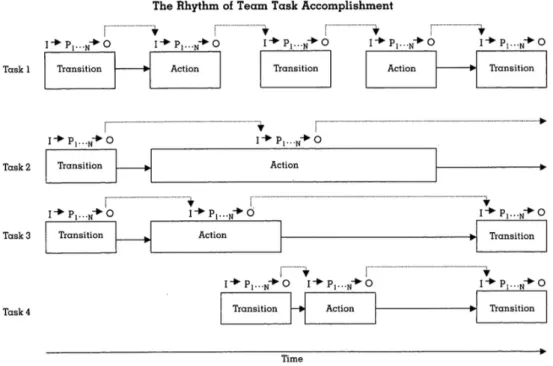
This framework that Marks et al., (2001) present us the “episodes” idea that represent the “teams perform in temporal cycles of goal-direct activity”. Marks et al. (2001) p. 359. In this idea of episodes every time that one episode is conclude, this end is the beginning of another one. In other hand the episodes represent the “rhythms of the task performance for the team” Marks et al. (2001) p. 359. To conclude about the episodes, this are also “distinguishable periods of time over which performance accrues and feedback is available” Mathieu and Button, (1992) cited by Marks et al.,(2001) p. 359.
23 (2001) p.359-360 refers that the duration and the timming of the episodes influences the productivity of the team because of the coordination of the teams that becomes better.
Recurring Phase Model of Team Processes
This model will delineate the role of processes in performance episodes that we previously referred. This model that the authors, Mark et al. (2001) suggest are a “life-time-team” cycle descriptive, is a model beyond IPO Model that consider that the episodes are static. Here “outcomes from initial episodes often become inputs for the next cycle. Processes are likely to vary in importance across episodes” Mark et al.(2001) p.360.
During teams activities there is different phases, those where the teams are restricted to complete a certain task or goal, and in other moments the teams are more focused on the past or on planning the future Marks et al. (2001). Because of this the authors defined two different phases. The Action Phase and the Transition Phase. By the definition of the authors, “Action Phases are periods of time when teams are engaged in acts that contribute directly to goal accomplishment (i.e., taskwork).; and Transaction Phases are periods of time when teams focus primarily on evaluation and/or planning activities to guide their accomplishment of a team goal or objective. These refer to the times when teams take inventory of how well they performed during the previous episodes and prepare for the upcoming episodes.” Marks et al. (2001) p.360.
24
Figure 1: The Rhythm of Team Task Accomplishment
This image show that “processes occur over and over again during team episodes, influenced by inputs (including emergent states) and influencing proximal outcome (also including emergent sates) within action and transition phases and across tasks and time as teams move towards goal accomplishment.” Marks et al. (2001) p. 361.
As we can see on the figure “transition and action phases are not always separate periods and frequently blend into one another” Marks et al. (2001) p.361. Also, the same authors referred that “identifying salient performance episodes is critical to understanding not only what but when team processes become critical to goal accomplishment”. Marks et al. (2001) p.361
Chapter III
3. A Model of Teamwork: The Five Core Components of Teamwork
Salas et al. (2005), projected a model based on five components of teamwork. The authors refer that according with the team and with the context of each team, each component won a different weight. So, Salas et al (2005) defined the following components:
25 2) Adaptability
3) Mutual performance monitoring 4) Backup behaviour
5) Team orientation
To complete this components, Salas et al. also defined three coordinating mechanisms, such as:
1) Share mental models 2) Close-loop communication 3) Mutual trust
This three coordinating mechanisms “facilitate the enactment of the five teamwork components by ensuring that information is distributed in an appropriate and timely manner”. Salas et al. (2009) p.45.
The Five Core Components Team Leadership
Nowadays this is one of the most popular themes. Leadership, as Salas et al. (2009) referred is seen in a functional approach. Also Salas, Burke, & Stagl, (2004), p.343 cited by Salas et al. (2009) p.43, defined leadership as “social problem solving that promotes coordinated, adaptive team performance by facilitating goal definition and attainment”. The authors referred that leaders are capable to solve these “social problems” because of this four types of actions: “(1) search and structuring of information; (2) the use of information in problem solving; (3) the management of personnel resources; and (4) the management of material resources” Salas et al. (2009) p.43.
The hurry, the need to be efficient, the required to constantly meet the needs of the consumers leave the need to leaders share their leadership. Shared Leadership is the “transference of the
26 leadership function among team members to take advantage of member strengths (e.g., knowledge, skills, attitudes, perspectives, contacts, and time available) as dictated by either environmental demands or the development stage of the team” Burke, Fiore, & Salas, (2004) p.105 cited by Salas et al. (2009) p. 43. This kind of leadership will permit that the team members with their strengths identified could be more quickly and useful Salas et al (2009). Consequently “the shared leadership teams” will be more efficient when come out the need to solve the problems urgently because they are prepared with the best that they have. Salas et al. (2009).
Adaptability
“Adaptability can be characterized as the team’s ability to change team performance processes in response to cues from the environment in a manner that results in functional team outcomes” Burke et al.(2006); Entin & Serfaty, (1999), cited by Salas et al. (2009) p.43. Is crucial for a team be adaptable to new challenges, new ways of work and thinking. Adaptability “is an essential component of teamwork, especially for teams operating under dynamic conditions” Salas et al. (2009) p.43. In addictions Salas et al (2005) p. 582 adds that “the ability of a team to maintain a culture of adapatibilty requires that there is a global perspective of the team task, of how changes may alter team member’s roles in the team task, and of the ability to recognized that changes are occurring”.
Mutual Performance Monitoring
Mutual performance monitoring is defined as the ability to “keep track of fellow team member´s work while carrying out their own … to ensure that everything is running as expected and... to ensure that they are following procedures correctly McIntyre &Salas, (1995), p.23 cited by Salas et al. (2009) p. 44.
Salas et al. (2005) p.576, consider that the mutual performance monitoring becomes very important to the effectiveness of the team because when working together team members give
27 feedback to each other and identify errors that working individually it would be not possible identify such errors. Naturally, this will contribute directly to the team effectiveness.
Also Salas et al. (2005) p.576 argue that “mutual performance monitoring affects team effectiveness through effective backup behaviour”. For this to happen, all team members have to be in same level of “task understanding and team responsibility”. The team should share the same mental model in order to anyone know what everybody inside the team are doing. “If the team doesn’t share the same mental model for how the team should be performing, performance monitoring becomes ineffective, and any feedback that could potentially be given becomes inconsequential” Salas et al. (2005) p.577.
So, if the team could develop a share mental model this would create the perfect conditions to mutual performance monitoring be successful. “Team members must understand normative aspects of the team, task, and equipment to detect deviations from normal or expected conditions. Knowing what should be happening is a necessary condition to obtaining useful information from observations of what is happening at any one point in time.” Salas et al. (2009) p.44.
Backup Behaviour (or support behaviour)
Salas et al. (2005), used Porter et al., (2003), p.391-392, definition where assumes that backup behaviour is “the discretionary provision of resources and task-related effort to another… (when) there is recognition by potential backup providers that there is a workload distribution problem in their team” Salas et al. (2005) p.579.
This component is directly related with the mutual performance monitoring. According with Salas et al. (2009), p.44 “backup behaviour is necessary to leverage mutual performance monitoring into performance gains.”
28 keys ways of providing backup behaviours, they are: First, backup behaviour allows team members to give and receive feedback and coaching in order to improve the performance;
Second, backup behaviour allows team members help each other during the taskwork; Third,
“backup behaviour allows the team complete a task for the team member when an overload is detected”.
What Marks et al (2001) proposed are affords that permits the team have more capacity to adapt when there is the need to shifting responsibilities and tasks.
The importance of backup behaviour represents more than team effectiveness of the team. “Backup behaviour affects team processes to allow greater team adaptability in changing situations and environments”. Salas et al (2005) p.579.
“Backup behaviours affects team performance directly by ensuring that all aspects of the team task are completed” Salas et. al (2005) p.579.
In other hand, when a team have a “backup philosophy” the members ask for themselves help to colleagues, this, will naturally increase team effectiveness. Salas et al. (2009) p.44.
Team Orientation
This component is described by Salas et al. (2009) p.45 as the component that intrinsically depends on the patterns of behaviour of each team member that is crucial for the effectiveness team. For the team be more effective is necessary that individually each member should be able to work in team and consider the importance of the team. Each one should recognize what could gain with team work. So a team member that have team orientation “have a preference for working within the team versus working in isolation as an individual. “It is the propensity to coordinate, evaluate, and use the task inputs of fellow teammates” Driskell & Salas, (1992) cited by Salas et al. (2009) p.45.
29 within the team, individual satisfaction, the cooperation and coordination between members and facilitate the overall of the team performance. This environment creates a more task involvement as the share of the same goals inside the company Salas et al. (2005).
“Therefore, some ways in which management can facilitate the development of a team orientation is by providing feedback about team success and cooperation; by focusing on expectations of workload sharing, communication, and accountability; and by creating a norm for cooperative behaviour through reward systems” Eby & Dobbins, (1997) cited by Salas et al. (2009) p. 45.
Coordinating Mechanisms
Shared Mental Models, Closed-loop Communication and Mutual Trust
At this point it appears to us the idea if only the five major components contribute to the effectiveness of the team. In research conducted by Salas et al. (2005) p.564, we realize that the five principal components displayed by itself becomes insufficient, or there must be a set of mechanisms to coordinate these components.
These mechanisms are used by Salas et al (2005) are: • Share-mental models
• Closed-Loop Communication • Mutual Trust
“These coordinating mechanisms facilitate the enactment of the five core components by ensuring that information is distributed in an appropriate and timely manner” Salas et al. (2009) p. 45.
Shared Mental Models
Definition: “An organizing knowledge structure of the relationship among the task the team is engaged in and how the team members will interact”. Salas et al. (2005) p.565.
30 “sharedness” or distribution allows team members to interpreted incoming information in a similar or compatible manner and thereby facilitates effective coordination” Salas et al. (2009) p.45. In the teams where share mental models happen “team members coordinate by anticipating and predicting each others needs through common understandings the environment and expectations of performance” Salas et al. ( 2005) p.565.
“This shared understanding or representation of team models, individual team member’s tasks, and the coordination of the team to achieve common goals is frequently referred to as mental models Cannon-Bowers et al. (1995) cited by Salas et al. (2005) p.565. Is also possible distinguish two types of mental models the team related mental models (related with team function an expected behaviours) and the task-related mental models “contain information regarding the materials needed for the task or the manner in which the equipment is used” Salas et al. (2005) p.565.
Share mental models are so important for the “teams that share similar mental models communicate more effectively, perform more teamwork behaviours, are more willing to work with team members on the future” (Rentsch & Klimoski, 2001 cited by Salas et al. (2005) p. 566.
In other hand, is interesting see how across the time teams that are working together could develop a share mental model related with the time that they work together. This time will make that the teams develop close-loop communication and a mutual trust that promotes the development of the share mental models across the team. Salas et al. (2009).
Closed-loop Communication
Definition: “The exchange of information between ascender and a receiver irrespective of the medium”. McIntyre & Salas, (1995); Salas & Cannon-Bowers, (2000) cited by Salas et al. (2005) p.567.
31 In other hand is also possibly describe closed-loop communication “a specific pattern of communication that enables effective teamwork” Salas et al. (2009) p.46.
Communication is a crucial mechanism that can determine the success, the effectiveness and the productivity of a team. “Effective teams are able to shift between implicit and explicit communication in response to changing environmental demands and task constraints Entin & Serfaty,(1999); Espinosa, Lerch, & Kraut, (2004) cited by Salas et al. (2009) p.46.
One of the most common things that happens is the misunderstood and lack of communication inside the teams. Lot of times team members receive different messages according with different factors such as misunderstood, noise or interruptions. It is important guarantee that all the team is working according with the same plans and goals. That’s way closed up communication it becomes so important Salas (2005).
Cited by Salas et al. (2009) p.46, Smith-Jentsh et al., (1998), found four types of behaviours that contributes to a good team communication.
• First, the teams that have a specific language between them and are able to be more quickly and effective on their communication;
• Second, all the team members should be able to communicate all intern and extern information;
• Third, the unnecessary information should be retained; Fourth, every team members must ensure that they communicate in such a clear way that they are listened and understood.
To conclude this topic of closed-loop communication, “teams that are trained on communication dimensions tended to perform better than did teams that were not trained on communication dimensions” Seigel and Federman, (1973) cited by Salas et al. (2005) p.568.
32 Mutual Trust
Definition: “The shared belief that team members will perform their roles and protect the interests of their teammates.” Salas et al. (2005) p. 568-569.
The influence of the feeling of trust between members of a team is a crucial point to success of a team. Defining team trust, Webber, (2002), p.202 cited by Salas et al. (2009) p.47, argue that “the shared perception… that individuals in the team will perform particular actions important to its members and… will recognize and protect the rights and interests of all the team members engaged in their joint endeavour” .
Also inherently to trust is important referred is this feeling of trust that allows team works interdependently. Trust is so necessary that team members “must be willing to accept certain amount of risk to rely on each other to meet deadlines, contribute to the team task, and cooperate without subversive intentions”, Salas et al. (2005) p.569.
The trust between the team that will support all the others components, the core components more precisely, Salas et al. (2005). In other hand is also interesting see that is also the trust that will influence how team members interpret others behaviours Simons & Peterson, (2000) cited by Salas et al. ( 2005) p.569.
Chapter IV 4. Testing the Five Core Components
Study Objectives
Human resources departments cross daily challenges that can only be successfully overcome if the teams formed to solve are effective. The effectiveness of the team is therefore a topic that interests me particularly.
After study about the effectiveness theme and read some papers which describe the components required to have an effective team I decided I would empirically study on the five key components that are reported in the The wisdom of collectives in organizations: An Update of the Teamwork
33 Competencies, Salas, E., Rosen, M.A., Burke, CS., and Goodwin,G.F. (2009).Which I had the opportunity to explain above. In sum, my main goal is to do an empirical study on the five core components of highly effective teams. Some adjacent objectives to this study is to verify the weight that each of the five components has, in different teams and the relationship that they have.
The present study is focused on team effectiveness in the context of tourism Hostels units of the district of Lisbon. The main goal of this study is understand which components are truly decisive for teamwork effectiveness and how this effectiveness is transferred to the service of the hostels in terms of the perception of the clients.
To realize this project it was organized by the Professor Doctor Ana Passos a team of researchers. We did a work group where which one of the member could contribute through the delivery of the surveys in the multiple Lisbon Hostels.
The research question that I will address regarding the “test” of the five core components is:
The five components listed as critical to the effectiveness of a team are actually, in practice, the decisive components?
If so, what the proportions in which these components are important to the effectiveness of the teams?
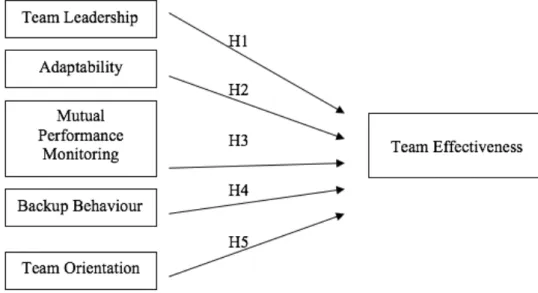
To answer this questions, I define a the follow model of analyses:
34 With this model the main goal are the analyses of the hypothesis below:
Hypothesis 1: Team leadership influence positively team effectiveness. Hypothesis 2: Adaptability influences positively team effectiveness.
Hypothesis 3: Mutual performance monitoring influences positively team effectiveness. Hypothesis 4: Backup behavior influences positively team effectiveness.
Hypothesis 5: Team orientation influences positively team effectiveness.
Chapter V
5. Methodology
Sample
The sample of our study comprises a universe of 22 hostels in Lisbon and 99 individuals’. From the 99 participants 46,5% were male and 53,5% were female. The average of the age of this 99 participants were 30 years old with the ages comprising the 19 and 62 years old with a SD=8,15.
The average of the seniority of the elements in our sample are about 2 years with a SD = 1,16. We can also see that each team of a Hostel has around 7 elements. In other words, as standard a Hostel of Lisbon has a team consisting in 7 employees who form a team with an SD = 3.63.
Procedure
This study was conducted in along with a team of master colleagues. We were a team of 5 elements.
wee start with the surveys. The survey was composed for 12 questions where which respondent had to point out the answer that was more appropriate through a scale that was given in each question (for example from “totally disagree” to “ totally agree”).
35 At the end of the questionnaires were made general framework of questions such as age, gender, their function, the position occupied and for how long have you worked at the hostel.
Then the delivery of the surveys. To make it possible to concretize the delivery of questionnaires by the several Hostels in Lisbon we decided to split the deliveries by regions. Each element would have to deliver questionnaires in about 10 Hostels for we can have a reasonable sample. However, and over the delivery of many Hostels that initially would want to participate in the study they chose not to.
In the process of delivery of the questionnaires was personally explained to each hostels which was the aims of our study. If they showed interested in participating, we handed a questionnaire for each member of the team. The main goal would be that every person who worked at the hostel, independently of their function, filled the questionnaire.
After delivered the questionnaires were given 1 month to each hostel to answer the questionnaires. Once past that month each member of the working group returned to the Hostel to the gathering.
Following this, each element entered the data in an online database that was created for this purpose and which contains all the answers that the group managed to get in the study.
Still, all questionnaires were delivered in envelopes to maintain the anonymity of respondents.
Measures
In order to study the effectiveness and what variables influence the effectiveness on the teams we study the five components: team leadership, adaptability, mutual performance monitoring, backup behaviour and team orientation. The questionnaires were made in a Likert scale (totally disagree to totally agree).
According with the way that was exposed the components on the questionnaire it follows:
Team Leadership – group of questions (12) with 15 itens; Team Orientation – group of questions with 3 itens;
36 Mutual Performance Monitoring – group of questions with 3 questions (10,11 and 12); Backup Behaviour - group of questions with 3 questions (16,17 and 18).
Operationalization of variables
Team Leadership. Team leadership it was operationalized using the Morgeson, DeRue, and Karam, E. P. (2009) definitions. To evaluate this variable it was used a Likert scale, from 1 to 7 where 1 represent “totally disagree” and the 7 “totally agree”. To approach this variable on the questionnaire it was exposed questions like “Review relevant performance results with the
team; Provides positive feedback when te team performs well; Communicates what is expect of the team; Maintains clear standards of performance”. In this variable the standard
deviation is .89 and internal consistency of indict resulted in .90.
Team Orientation. The team orientation component was operationalized using the Campion, Medsker and Higgs (1993) references. To evaluate this variable was also used the Likert scale ( 1 – Totally Disagree and 7- Totally Agree) .For this component it was present on questionnaire questions as “I’m more confortable working by myself than others; If given a
choice, I’d choose to work in a team rather than by myself; The teams are more productive than the same people would be working alone”. To assess the internal consistency of this
variable we use the Alfa Cronbach which was .92. Already the standard deviation resulted in .81.
Adaptability. To measure the variable adaptability use Fugate and Kinicki, (2008) concepts. In our questionnaire this component was represented by the fifth question where it was listed questions as “I feel changes generally have positive implication; I feel that I am generally
accepting of changes ; I would consider myself open to changes ; I can handle changes effectively; I am able to adapt to changing circumstance”.
Similar to the other variables we used the Likert scale ( 1 – Totally Disagree and 7- Totally Agree) to evaluate this component. For adaptability α= .88 and SD=.65.
37 Mutual Performance Monitoring. Mutual Performance Monitoring was operationalized using the Marks, Mathieu, and Zaccaro, (2001). To evaluate this variable was also used the Likert scale ( 1 – Totally Disagree and 7- Totally Agree) .
In our questionnaire this component was represented by questions as “ Regularly monitor how
well we are meeting our team goals; Monitor and manage our resources (e.g., financial, equipment, etc.)?” For the Mutual Performance Monitoring the α= .86 and SD= .81.
Backup Behaviour. Backup Behaviour was operationalized using the Marks, Mathieu, and Zaccaro, (2001). To evaluate this variable was also used the Likert scale (1 – Totally Disagree and 7- Totally Agree) . The questions on questionnaire for this component was for example
“Develop standards for acceptable team member performance?; Balance the workload among our team members?” The internal consistency of this variable is α=.87 . The standard
deviation resulted in .68.
Perceive Team Effectiveness. The team effectiveness variable was operationalized according with González-Romá,Fortes-Ferreira and Peiró, (2009) and Hackman,. (1987). To evaluate this variable was also used the Likert scale ( 1 – Totally Disagree and 7- Totally Agree).Were evaluate questions as “The team that works in the Hostel has a good performance; Customers
of this Hostel are satisfied; My team in this Hostel is effective”. The perceive team
effectiveness assume values as α=0.9 and SD=.52.
Average (client’s perception). We find it interesting to understand the perception of customers regarding the effectiveness of the teams of hostels. This scale was measured through the website scale "Hostels World". The data were taken at the beginning of June and within that range include the score for the staff, cleanliness, atmosphere, security, location, value of money. With these variables was made a measure that we named "Average." The SD is .60.
38 6. Results Aggregation
The main goal of this research is to study the components not individually but as group. In order to do that we aggregate the data proceeding the RWG index (J) analysis (James, Demaree, & Wolf, 1983). For each variable the range is between 0 and 1, which the closest value to 1 means the strongest agreement intra-team. The Rwg (j) in which component is:
Team Leadership: .84; Adaptability: .79; Mutual Performance Monitoring: .80; Backup Behaviour: .74; Perceive Team Effectiveness: .87.
Hypothesis Test
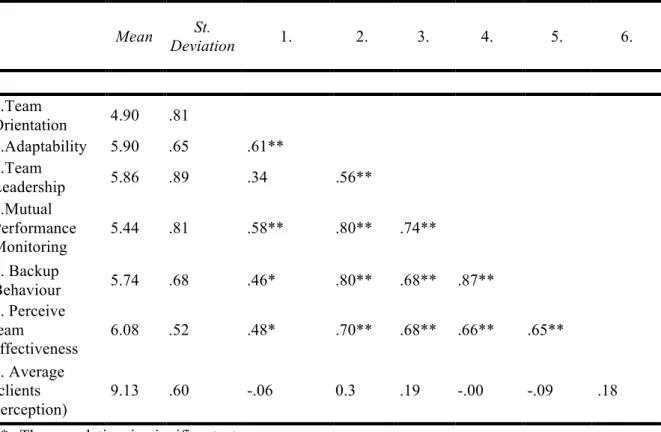
In the table 1 we can verify the correlations between the variables that are in study. Also the table presents the mean and the standard deviations of each variable.
In geral the variables are correlated between them and this correlation is significant. The only variable that doesn’t show a truly significance is the average of clients perception.
Mean St. Deviation 1. 2. 3. 4. 5. 6. 1.Team Orientation 4.90 .81 0,614** 0,337 0,578** 0,456* 0,482* 2.Adaptability 5.90 .65 .61** 3.Team Leadership 5.86 .89 .34 .56** 4.Mutual Performance Monitoring 5.44 .81 .58** .80** .74** 0,872** 0,664** 5. Backup Behaviour 5.74 .68 .46* .80** .68** .87** 6. Perceive team effectiveness 6.08 .52 .48* .70** .68** .66** .65** 7. Average (clients perception) 9.13 .60 -.06 0.3 .19 -.00 -.09 .18 **. The correlation is significant at
the 0.01 level (bilateral) .
* . The correlation is significant at the 0.05 level (bilateral) .
39 Through the SPSS Program it was introduced the data of the questionnaires. Therefore, the command regression gave us the possibility to analyse the following hypothesis:
Hypothesis 1: Team leadership influence positively team effectiveness. Concerning the first hypothesis it is possible to verify the direct effect of leadership in the effectiveness of the team (β=.68; p<.001). The level of confidence in the regression of this hyphotesis is truly significant (p<.001). In other hand we can see that around 46%(r^2=.46) of the effectiveness (dependent variable) in a team is directly related with the leadership of this team. The first hypothesis was verified.
Hypothesis 2: Adaptability influences positively team effectiveness. The second hypothesis is also verified. The values for this correlation was β=.70 and p=.00. This result is very significant in way that adaptability can “explain” 49% (r^2=.48) of the variance of the dependent variable, the effectiveness.
Hypothesis 3: Mutual performance monitoring influences positively team effectiveness. Just like previous assumptions also the third hypothesis is confirmed. The values for this correlation was β=.66 and p=.00. The mutual performance monitoring can explain in 44%(r^2=.44) the variance of the effectiveness.
Hypothesis 4: Backup behavior influences positively team effectiveness. This hypothesis is also confirmed. Also in this variable is possible to observe a direct effect of backup behavior in the dependent variable (team effectiveness), around 43% (.43). For this hypothesis the results are β=.65 and p=.00.
Hypothesis 5: Team orientation influences positively team effectiveness. This hypothesis is confirmed. Comparing with the other components team orientation is the one that only influences in 23% (r^2=.23) the team effectiveness. Where the results are β=.48 and p=.01. Discussion
This study is intended to understand if the 5 core components that Salas et al (2005) suggested actually influence the effectiveness of the teams applied to Hostels. The hypothesis
40 confirmed the model of the Big Five.
More specifically it is possible to say that team leadership, adaptability, mutual performance monitoring, backup behaviour and team orientation is direct connect with the variance of team efficacy.
In case of the hypothesis 1 it was shown that if there is a variance of the team leadership the team effectiveness will “feel it”. This result shows us that team effectiveness is dependent on team leadership. Remembering that, according with Salas et al. (2009) p.43, is “social problem solving that promotes coordinated, adaptive team performance by facilitating goal definition and attainment.” In the case of the Hostels is possible to see that this is a concept that truly matters to the team have effectiveness.
Concerning with adaptability and the hypothesis 2 and comparing with other components/hypothesis this is the component where a variance its more significant for the team effectiveness. The results shows us that 70% of the team effectiveness is explained by the adaptability of the team. We can conclude that the capacity of the members adapt to the changes is truly important in the Hostels analysed for the team effectiveness. “The ability of a team to maintain a culture of adaptability requires that there is a global perspective of the team task, of how changes may alter team member’s roles in the team task, and of the ability to recognize that changes are occurring.” Salas et al. (2005) p. 582.
In similarity of the assumptions described above, also the hypotheses 3 and 4 were confirmed and with quite identical values. This similarity can show us that a relationship between these hypotheses is possible (mutual performance monitoring and backup behaviour influencing team effectiveness). According to the study of Salas and colleagues in 2005, they had as one of prepositions that describing the following: "mutual performance monitoring affects team effectiveness through effective backup behaviour." According our results in this study it is possible to affirm that both the mutual performance monitoring as the backup behaviour are crucial to team effectiveness.
41 Additionally it should be noted that when we do the regression with all the components we note that the mutual performance monitoring negatively influences the effectiveness (β = -.17). However, and individually the mutual performance monitoring positively influence the team effectiveness (hypothesis 3).
The last hypothesis is also confirmed. Team orientation positively influence team effectiveness.
With this, the model that Salas et al (2005) constructed is in a practical way verify – the Big Five Core Components truly contribute for the team effectiveness, in our sample.
Practical Implications
This study is undoubtedly a practical application primarily on hostels.
The study results allow us to state that for a team to be effective in this context, should adopt management practices that encourage team leadership, the team adaptability, the mutual performance monitoring, backup the behaviour and team orientation. This independently of the components that contribute most to the team's effectiveness are the lead (β= .68) and adaptability (β= .70)
However, and when we add all components in the same linear regression, we realized that in such a component that contributes to the effectiveness of these teams is leadership (β= .45) and adaptability (β= .42). Moreover, all of these those which are contribute less mutual monitoring performance (β= -. 17) and back behaviour (β= .10).
So we emphasize that the hostel management teams should take into account their leadership (Salas et al (2005) practices. The managers of the hostels should also encourage their teams to adapt (adaptability) to the change because these are the components that contribute most to the team's success.
42 rooted in cities around the world. Lisbon is not exception. This is a concept where the accommodation price factor is at stake and so this is an extremely strong constraint to management practices that are applied to these business. Do much with little is the most important.
Get as many people and these pay really low prices. It's what distinguishes a Hostel.
On the other hand these are also very targeted to young people who plan to travel a lot with little money that makes the "rules" management also become more informal. Associated with this concept then comes a set of limitations to our study.
On the one hand we intend to study the teams but we know that this context is special. The teams are very small and everyone within the team is a little bit of everything on the turn despite having a function in concrete.
Still, there we noticed the existence of a strategy of concrete and planned human resources. Many of them being small businesses are also familiar and motivation comes from having to maintain their own jobs and be profitable.
The effectiveness in real terms is transmitted in fact be able to do everything in time for the next customer reach and more cheap and simple way.
Lastly, still associated with the birth of this new concept our sample proved to be very small. This is because although initially selected terms about 50 hostels to be surveyed only 22 is that agreed to participate. If we had a larger sample the results could be more significance. Hence we withdrew a suggestion for future studies that will spread the regions covered by adding other cities to study.
Another suggestion would be very interesting study that was to do a study also testing the Big Five Core Components but associate to Hotels and Hostels compare with.
43