AMCIS 2006 Proceedings
Americas Conference on Information Systems
(AMCIS)
December 2006
Connecting the Americas Through an
E-Government Capacity-Building Network
Luiz Joia
Brazilian School of Public and Business Administration of the Getulio Vargas Foundation and Rio de Janeiro State University
Follow this and additional works at:
http://aisel.aisnet.org/amcis2006
This material is brought to you by the Americas Conference on Information Systems (AMCIS) at AIS Electronic Library (AISeL). It has been accepted for inclusion in AMCIS 2006 Proceedings by an authorized administrator of AIS Electronic Library (AISeL). For more information, please contact
Recommended Citation
Joia, Luiz, "Connecting the Americas Through an E-Government Capacity-Building Network" (2006). AMCIS 2006 Proceedings. 19.
Connecting the Americas Through an
E-Government Capacity-Building Network
Luiz Antonio Joia
Brazilian School of Public and Business Administration of the Getulio Vargas Foundation
and Rio de Janeiro State University
[email protected]
ABSTRACT
Increasingly, the deployment of e-government initiatives in the Public Administration arena has become mandatory. However, the adoption of this new paradigm needs to be followed up with training processes involving all the professionals within public organizations. In this context, one solution that has emerged lies in the creation of regional capacity-building networks in e-government. The objective of this paper is therefore to develop and present an analytical framework that enables the creation and deployment of a regional capacity-building network in e-government. In order to accomplish this goal, a Focus Group was created and Hierarchical Cluster Analysis was used. The findings from this research show that specific hierarchical and professional profiles within public administration deserve different e-government training endeavors. Further steps are outlined in order to consolidate a regional capacity-building network in e-government, taking the recent creation of an Inter-American Capacity-Building Network in e-Government by way of example.
Keywords
Digital Government; Capacity-Building Network in e-Government; Inter-American Network; E-Government Training
INTRODUCTION
Increasingly, the deployment of e-government initiatives in the Public Administration arena has become mandatory. However, the adoption of this new paradigm needs to be followed up with training processes involving all the professionals within public organizations.
In a general way, fragmentation can be perceived between these two endeavors (Biasiotti & Nannucci, 2004), i.e., the demand for government projects has increased more rapidly than the training of public administration personnel. Thus, as e-government initiatives have been undertaken without taking into account the skilled civil servants required, public institutions have been obliged to outsource external consultancies (Kaiser, 2004).
One solution that has arisen lies in the creation of regional capacity-building networks in e-government, as is the case of the Scandinavian Network in e-government (see, for instance, Elovaara et al., 2004). In this context, an Inter-American Capacity-Building Network in e-government is gradually taking shape, sponsored by the Inter-American Agency for Cooperation and Development of the Organization of American States (IACD/OAS) and the Inter-American Development Bank (IADB). The major challenge that still remains to be addressed is to determine who requires training – among the diversity of profiles within public administration – and to establish what content must be delivered to which group and with what workload. Thus, the objective of this paper is to develop and present an analytical framework that enables the efficient and effective creation and deployment of a regional capacity-building network in e-government. In order to achieve this, the Inter-American Network outlined below is used as proof-of-concept of the framework developed by the researcher in order to clarify how to create homogeneous training groups of professionals, as well as how to define the necessary training content appropriate for each group.
BIBLIOGRAPHICAL REVIEW
The Impact of Information and Communication Technology on the Public Sector
According to Venkatraman (1994), the contribution of Information and Communication Technology (ICT) to business was permeated with skepticism in the early 1990s due to its failure to achieve the promised results. In view of this perception, the
automation logic, cost reduction and internal operation efficiency-based logic, which had prevailed until that time and might conceivably no longer constitute relevant parameters.
The observations presented above are a clear indication of the pressing need for new business models – irrespective of the size and nature of organizations – that enable greater convergence between the physical world of producing goods/services and the virtual world based on information and connectivity (Gulati & Garino, 2000; Porter, 2001).
This phenomenon is not just a characteristic of businesses, as it has a tremendous impact on government as a whole, since actions can be developed to use ICT to improve the quality of public services, through what is already widely known as e-government.
E-Government is still an exploratory knowledge field and it is consequently difficult to define it precisely. Moreover, it encompasses such a broad spectrum that it is difficult to find one expression that encapsulates accurately what e-government really represents.
According to Zweers & Planqué (2001, p. 92), one can say that: “E-Government concerns providing or attainment of
information, services or products through electronic means, by and from governmental agencies, at any given moment and place, offering an extra value for all participant parties”.
On the other hand, Lenk & Traunmüller (2001, p. 64) choose to see e-government as a collection of four perspectives:
• Citizen Perspective – aiming to offer public services to citizens;
• Process Perspective – seeking to rethink and redesign the modus operandi of current productive processes within public administration at its various levels, such as bidding processes to purchase products and services, namely e-procurement.
• Cooperation Perspective – aiming to integrate the many public agencies among themselves as well as with business and non-business organizations (NGOs), so as to streamline the decision process without prejudicing quality, while also avoiding fragmentation, redundancies, etc., currently established in the relationships among these various actors.
• Knowledge Management Perspective – aiming to allow government, at its many levels, to create, manage and make available the knowledge both developed and accumulated by its organizations in adequate databases.
Other authors define e-government in a broader sense (see, for instance, Perri 6, 2001 and Kraemer & Dedrick, 1997). For them, government encompasses a broad gamut of activities, from digital data and electronic public service to online pool, e-democracy and e-governance. Yet, the most recent definitions see e-government as the use of information technology to support government operations, engage citizens, and provide government services (Dawes, 2002). In other words, e-government is the achievement of public ends by digital means (Osorio, 2002).
In this respect, governmental organizations are striving to adopt the same modernization tools used in the private sector, mainly new business models where communication through the Internet plays a vital role (Kubicek & Hagen, 2001; Lenk & Traunmüller, 2001) and new skills associated with technological change (Autor et al., 2003).
The Need for e-Government Competencies in Public Administration
The benefits from the implementation and use of e-government hinge on the presupposition that qualified and skilled public administration personnel are on hand to deal with this new modus operandi (Lips, 2001, p. 89) According to Dujisin (2004, p.28), it is not so much the challenge of having external specialists hired by government, but the need to envisage permanent training policies addressing the different knowledge fields embedded in e-government, as well as ensuring integration between them.
On the other hand, it is necessary to understand that e-government is far more than mere technology (Lau, 2004, p. 243). According to Biasiotti & Nannucci (2004), a mix of several disciplines must be created, encompassing not only Information and Communication Technology and Administrative Science, but also Social, Human and Legal Sciences, among others. Several endeavors are underway to train civil servants in e-government (see, for instance, Augustinaitis & Petrauskas, 2004; Elovaara et al., 2004; Biasiotti & Nannucci, 2004). However, the training models are very much centered on the content and duration of the courses (Augustinaitis & Petrauskas, 2004; Kaiser, 2004; Lau, 2004), avoiding classification of the civil servants into specific training groups, according to the current hierarchy, so as to deliver different skills to different players within the public administration arena. To a certain extent, Biasotti & Nannucci (2004), Kaiser (2004) and Lau (2004), to
name but a few, touch on this issue en passant, though without presenting the rationale that led them to their findings and conclusions.
Augustinaitis & Petrauskas (2004, p.454), for instance, focus their efforts on proposing training content, suggesting the following content modules for a masters degree program in e-governance:
• Public Administration;
• Knowledge Management and Knowledge Society;
• Information Technology;
• Governance (including governance, democracy; data security and protection; regulatory frameworks and e-services).
Conversely, Lau (2004, p. 238) understands that four facets must be developed in an e-government training initiative, namely: Information Technology; Information Management; Information Society and Management.
Consequently, it becomes clear that there is a pressing need to link all the aspects involved in e-government training efforts into a single integrated framework, so as to allow capacity-building endeavors to achieve the efficiency and effectiveness sought by policy-makers. However, according to Elovaara et al. (2004, p. 459), e-government is so expansive and interdisciplinary that there is a need for countries to network in order to get a better overview of what they are actually attempting to develop. Moreover, this network must take into account the cultural, social, and economic national differences of the countries involved (Banerjee & Chau, 2004).
RESEARCH DESIGN
The increasing importance of Information and Communication Technology (ICT) on the work of public administration highlighted the need for the creation of regional networks for e-government capacity-building institutions to allow them to pool their efforts.
The concept of a network – not an organization per se, but a group of committed institutions – was devised in order to enhance the capacity of civil servants and explore new financing mechanisms that would promote the development of modern academic programs to train public servants in e-government. For this purpose the Inter-American Agency for Cooperation and Development of the Organization of American States (IACD/OAS) and the Inter-American Development Bank (IADB) scheduled a meeting to contribute to the creation of a network of this kind. The event, which took place on April 20-21, 2004, brought together sixteen (16) representatives active in e-government from different countries, universities, regional organizations and the United Nations. The presentation of various experiences in e-government led the participants to a diagnosis of the current situation in Latin America and the Caribbean, as well as to an evaluation of public sector needs in terms of human resources for the implementation of e-government strategies.
The methodology applied by the researcher in this research, with a view to developing a framework to create the desired network, drew upon focus groups created by the sponsors during the aforementioned meeting. Thus, the participants invited were divided into groups in order to address the essential issues relating to the creation of a regional network.
According to Berg (1989), a focus group may be defined as an interview style designed for small groups. Using this discussion-based approach, researchers strive to learn about conscious, semi-conscious, and unconscious psychological and socio-cultural characteristics and processes among various groups. So, focus group interviews take the form of guided discussions addressing a particular topic of interest or relevance to the group and the researcher.
The sixteen (16) participants were divided into three different focus groups. Each one was supposed to discuss concurrently one specific issue under the guidance of a facilitator from one of the sponsors’ organizations, usually called the moderator, and then present the results to the whole group for discussion.
The issues discussed by each group were:
• Regional diagnosis
• Analysis of the needs for formation
After the discussions mediated by officials from IACD/OAS and IADB, a framework developed by the researcher, called W2 (Who-What), was presented to the group, in order to support the capacity-building network, specifically addressing the following questions:
a) Who must be trained?
b) What must the content/workload of the training for each specific group be?
After taking note of the statements and numerical output from the focus groups, the researcher conducted a triangulation exercise using both qualitative and quantitative analysis (Patton, 1990). The former analysis aimed at recognizing patterns in the material collected in order to answer: “Who must be trained?” and “What must the content/workload of the training for each specific group be?” The latter analysis collected numerical tables and tested the outcomes using Hierarchical Cluster Analysis.
A research method limitation of this research that should be emphasized is that this paper assumes that a group of sixteen (16) e-government experts invited by the IADB and IACD/OAS and gathered together in a workshop for a 2-day period may do a reasonably good job of identifying what is needed to strengthen e-Government throughout the Americas. Obviously, this is not necessarily the case and depends to a great extent on how qualified the participants are, though, at this juncture, the author is not at liberty to reveal the names of the participants.
QUALITATIVE DATA ANALYSIS
Regarding the discussions of the three focus groups, some comments were singled out by the researcher and set forth below: a) “Regional Diagnosis” Focus Group
- “The main challenge to e-government implementation is perception of ICT by civil servants, who must see it as a tool rather
than a threat in order to convert it into a bridge between local and governmental realities. Clearly formulated objectives and methods are essential premises for the formation of ‘state reformers’.” – Venezuelan representative
- “The demands of the public sector vary according to the actors involved and their hierarchical position. Legislators,
politicians, public managers, civil servants and ICT specialists have different perceptions, priorities and degrees of reluctance to ICT implementation. The private sector plays a fundamental role in e-government development because it can give examples of gains organizations can make using ICT.”- Uruguayan representative
In the two statements above, it becomes abundantly clear that major concerns with Change Management and Productive Processes – as deployed by the business sector and considered benchmarking for public administration – are contents to be addressed in a capacity-building network. The need to create taxonomy to classify the players in the public sector, in order to prepare adequate training endeavors is also apparent from the statements. Moreover, the proposed taxonomy encompasses legislators, politicians, public managers, civil servants and ICT experts in public organizations.
b) “Analysis of the Needs for Formation” Focus Group
- “Cooperation between the Latin American and Caribbean countries has a huge potential because they have similar
problems that are not shared by most industrialized countries, although national situations differ. One of the usual problems is the lack of genuine interest from politicians. E-government implementation has to take into account both the technical issues and the idiosyncratic organizational context (‘change management’).” - Argentinian representative
- “Mexico succeeded in putting a great part of its government activities on the Internet over the past few years, but
capacity-building remains to be done regarding the perception of ICT’s strategic value. High-level governmental officials, who usually possess strong management and communication skills, generally see e-government as a technical problem that can be solved by specialists – forgetting that those specialists lack their management and communication competences. E-government specialists must not only be familiar with ICT, but also need skills for negotiation processes, institutional change and juridical knowledge in order to tackle information protection issues.” – Mexican representative
- “In Canada, e-government supposed a global change of attitude by public administrators, who reconfigured governmental
management’ approach, using workshops aiming at bringing people of different services, profiles and organizational cultures (technologists, program managers, etc) to mutual understanding and to foresee the possibility of integrating the different governmental services.”- Canadian representative
- “Capacity-building has to be developed according to the country’s own reality and cultural factors, which contribute to its
needs and abilities to integrate ICT in governmental activities. Abilities for managing projects and communicating ICT issues to other actors are essential for the public managers.”- Chilean representative
From these observations, the need to establish a specific training model for developing countries, while taking their diversities into account, becomes evident. On the other hand, the statements above stress the need to broaden the training scope from mere technical issues to encompass topics such as: legal issues, citizen (quoted as “customer” by the participant) relationship management, change management, negotiation and project management. In line with this rationale, the ICT people can play a key role in whether their knowledge frontiers can be enlarged. By the same token, disappointment associated with the way politicians deal with e-government can be clearly detected. It is therefore of paramount importance to make these players aware of the potential benefits of e-government.
c) “Analysis of Existing Capacity-Building Programs in e-Government” Focus Group
- “The MIT Media Labs ‘Net Growth Education Program’ seeks to provide ‘rising stars’ from developing countries with the training and experience they need to grow their country’s ICT strategy and environment. Many of those projects are innovative and cost-effective and could contribute to add an entrepreneurial dimension to public administrations.”- US
representative
- “Budget limitation led the province of Quebec to create e-government strategies in partnership with the private sector.
Public servant capacity-building involves universities, public sector representatives and a private firm. The length and content of formations is adapted to their level and availability of public servants, shorter formulas being dispensed to high government officials.“- Canadian representative
- “In Brazil, universities have a key role to play in e-government development as they are in a good position to lead research on the topic, which must come before any capacity-building strategy. An efficient ICT strategy has to be based on a solid infrastructure. The content of the network is also important, as well as training of its users to take advantage of
it.”-Brazilian representative
Clear training potential in the developed countries (Canada and USA), constrained by financial budgets, can be observed, which stresses the pressing need for building partnerships, alliances and networks for training projects. Besides, a multi-cultural capacity-building network seems to be highly desirable, due to the possibility of interaction among different realities. Indeed, this is also the position supported by Elovaara et al. (2004, p. 459), who states that: “E-government is so expansive
and interdisciplinary that we need to network in order to get a better overview of what we are actually attempting to develop”, when talking about the creation of a Scandinavian Network of Competence in e-Government. From the declarations
above, it becomes apparent that awareness initiatives might be more profitable to the highest ranked players in the public arena than ordinary training efforts. It is also important to point out the very need for courses addressing context analysis and legal issues, as each country has its own peculiarities.
Hence, using the W2 model associated with interpretative analysis of the conclusions of the focus groups (Klein & Myers, 1999), the following findings can be inferred:
Who must be trained?
The focus groups concluded that Public Administration personnel must be divided into groups according to a specific taxonomy, so as to schedule the most adequate training for the most suitable players. The following taxonomy was used:
• Legislator
This group encompasses representatives of the Legislative and Judiciary System in the Public Administration environment. Thus, the aim is to deal with those individuals who create/change the laws and regulatory frameworks, as well as those in charge of interpreting and applying them.
This group encompasses the highest representatives of the Executive Sector, such as Ministers, State Secretariats and their direct assistants. Most of these professionals are tenure-track civil servants, being subject to administrative position change, dependent upon the alteration of government party.
• Top Management Civil Servant
Civil servants with tenure playing the highest roles in the executive sector of public administration, according to the political choice of the government in office.
• Staff-Level Civil Servant
Civil servants with tenure that may occupy higher positions in the executive sector in future governments.
• ICT-Related Civil Servant
Civil servants with tenure involved in ICT-based activities.
What must the content of the training for each specific group be?
The courses were split into general and context-based programs. The former courses address contents that are similar for participants from all countries taking part in the network, whereas the latter – although following a general framework – must be customized in line with the different realities of each country, as it cannot be taken for granted that the content will be equal for all countries.
Pursuant to discussions within the group, statements by participants and interpretive analysis of focus group conclusions (see Klein & Myers, 1999) subsequently conducted and already included by the researcher in his comments on the quotations transcribed above, the following areas detailed below were considered by the experts to be important aspects to be addressed during training as global courses (i.e., the same content for all countries involved in the Capacity-Building Network):
• Process Management
According to Davenport (1993, p.5), a process is “the specific ordering of work activities across time and space, with a beginning and end, and clearly identified inputs and outputs”. Consequently, as e-government deals with processes, the aim of this course is to show the professionals the important role that processes play in the e-government realm, as well as how to map and manage them.
• Customer Relationship Management
As in the business arena, which has changed its focus from product-centric to customer-centric (Dutta et al., 2002), it is important to explain the importance of citizens as customers of public administration to the professionals.
• Information and Communication Technology
In this dimension, the aim is to deliver basic concepts about Internet technology (including intranet and extranet), back-office technologies (including Enterprise Systems), information security and web-services.
• Change Management
The introduction of e-government processes generates change (Joia, 2004). Consequently, it is important to understand user resistance to new information systems and technologies (Markus, 1983), and the imperative need for a new modus operandi. By the same token, it is important to know how to manage the above changes (see, for instance, Plant, 1987; Edosomwan, 1989; Orlikowski & Robey, 1991).
• Knowledge Management
One of the major potentials of e-government is to enable public administration to manage its knowledge (Lenk & Traunmüller, 2001). So, this aspect aims at developing skills about how knowledge is generated, stored and accessed, as well as the role ICT plays in this context.
• Organizational Design
Public organizations traditionally present functional and bureaucratic designs, which are rarely flexible enough to adapt to changes in the environment (Ciborra, 1993). Therefore, in this module, the principal structural typologies are presented, as well as the organizational schools that generated them (Volberda, 1999), enabling the participants to understand better the interaction between ICT and organizational structure (see, for instance, Markus, 1983).
• Project Management
E-government initiatives are, by nature, projects that need to be well managed. The management of time, cost, scope, risk, communication, human resources, quality, acquisition, and integration of e-government enterprises is analyzed in this module.
According to discussions within the group and statements made by participants, the following knowledge areas were selected as requiring customized contents according to each country’s peculiarities, being considered specific rather than general courses:
• Context Analysis
Initiatives of e-government depend on political, economic, social and cultural factors specific to each country (see, for instance, Traunmüller et al., 2004). It is therefore important to know a country’s own reality – at local, regional and national level – in order to establish the best e-government solutions. This module aims at training the professionals of each member country of the regional capacity-building network in these issues.
• Legal Issues
Public activity is severely limited by regulatory, legal and constitutional constraints (see, for instance, Galindo, 2004). The development of e-government policy demands the changing of some of these frames of reference. Issues such as privacy, data protection and sensitivity, digital signatures, electronic documentation, copyright, among others, are analyzed in this course.
QUANTITATIVE DATA ANALYSIS
After defining who should be trained in what kind of content, the sixteen (16) representatives then established an incidence matrix that set forth very clearly the level of priority of each training course within an e-government capacity-building network encompassing the entire public administration. In order to achieve this, Table 1 – based on the W2 (Who-What) framework – was generated and the consolidated outcomes are presented therein.
Each of the 16 participants set a grade for every professional profile in public administration, according to the content to be delivered to each one. After this step, the average for each professional/content was calculated. Finally, the general average for each professional profile was calculated. The results are given in Table 1 below.
‘WHO?’–PLAYERS(*)
Legislator Politician Manager Staff Technicians
Process Management 1 3 10 8 8 CRM 5 4 10 10 10 ICT 2 1 8 8 10 Change Management 6 8 10 7 8 Knowledge Management 2 6 10 9 9 Organizational Design 1 1 9 8 5 Project Management 1 1 10 10 10 Context Analysis 7 9 9 4 6 Legal Issues 10 9 8 4 4 ‘WHAT?’ DIVERSITY OF CONTENTS (**) Averages 3.9 4.7 9.3 7.6 7.8
Table 1 – W2Framework (Who-What)
(*) Value scale: (-) 0 — > 10 (+)
A score of 10 indicates that the topic is of maximum importance to that specific player and therefore the curriculum for that player should include all content on that topic. By the same token, a value of 0 indicates that the topic is not relevant for that player and the curriculum to train that player should therefore not include any content related to the topic.
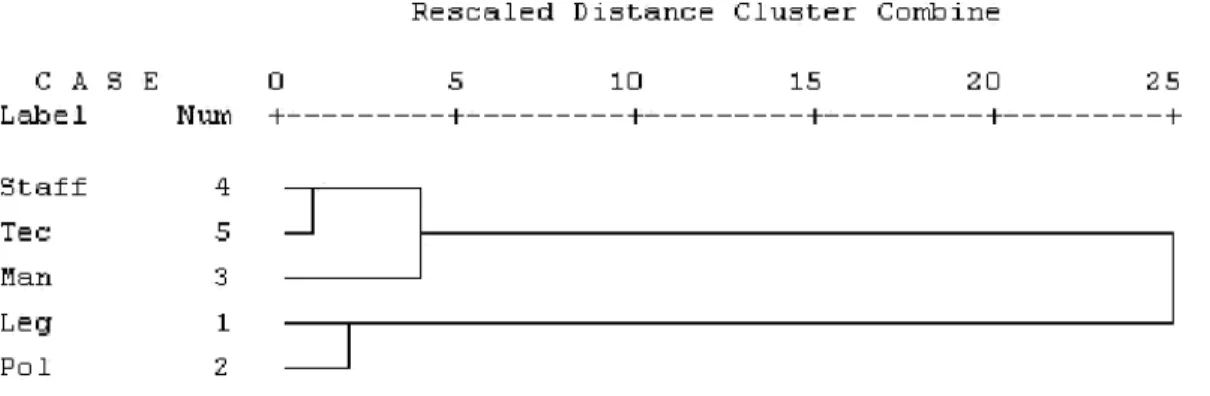
The next step was to analyze the data in Table 1. Hierarchical Cluster Analysis (Hair et al., 1998) was used in order to establish how many different groups of players could be created from the focus group outcomes. The results obtained in the SPSS software (version 10.0) are presented in Table 2 and in the dendogram depicted in Figure 1.
Cluster Combined
Stage when Cluster First Appears
Stage Cluster 1 Cluster 2 Coefficients Cluster 1 Cluster 2 Next Stage
1 4 5 18,000 0 0 3
2 1 2 31,000 0 0 4
3 3 4 55,000 0 1 4
4 1 3 319,500 2 3 0
Table 2 - Agglomeration Schedule and Average Linkage (Between Groups)
Figure 1 – Dendogram of the Hierarchical Cluster Analysis
It can be seen that there are two groups of players, as well as two different types of courses that need to be delivered to these groups, namely:
i) Legislators and Politicians; ii) Managers, Staff and Technicians.
Interestingly, it becomes apparent that the most important player in public administration for the success of e-government policy implementation is the Manager. The importance of ICT personnel, close on the heels of Managers, can also be seen. The Legislators and Politicians – although important – need to be submitted to awareness endeavors via workshops, rather than long, formal training programs. These results confirm the qualitative perceptions of the focus groups, as presented earlier in this paper.
Definition of course workload per group
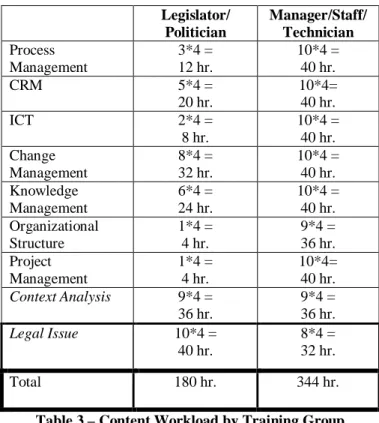
By consensus, the focus groups agreed that a complete course addressing a specific subject should have a workload of 40 hours for players whose grade in respect to this subject were the highest, namely grade 10. The workload for the other players should be calculated using a linear proportion. Hence, a score of 1 requires a workload of 4 hours. As there are groups that encompass more than one type of player, the highest score among the players for a specific course was used, for the sake of security. Using this rationale and the scores given by the participants, Table 3 below was then generated.
Table 3 shows that the Staff group – although in the second group – should be over-trained, for the sake of security. The rationale for this lies in the constant changes to which public administration is subject, i.e. a current member of the Staff can
be promoted to Senior Manager under a new administration, or even during the same administration, while a Manager may revert to being a normal member of Staff.
Legislator/ Politician Manager/Staff/ Technician Process Management 3*4 = 12 hr. 10*4 = 40 hr. CRM 5*4 = 20 hr. 10*4= 40 hr. ICT 2*4 = 8 hr. 10*4 = 40 hr. Change Management 8*4 = 32 hr. 10*4 = 40 hr. Knowledge Management 6*4 = 24 hr. 10*4 = 40 hr. Organizational Structure 1*4 = 4 hr. 9*4 = 36 hr. Project Management 1*4 = 4 hr. 10*4= 40 hr. Context Analysis 9*4 = 36 hr. 9*4 = 36 hr. Legal Issue 10*4 = 40 hr. 8*4 = 32 hr. Total 180 hr. 344 hr.
Table 3 – Content Workload by Training Group
CONCLUDING REMARKS AND FURTHER STEPS
The creation of regional e-government capacity-building networks requires international sponsors and patrons to spearhead the undertaking.
First of all, meetings with representatives of the regions involved are necessary in order to create focus groups. From the conclusions of these focus groups, qualitative analysis can be undertaken, defining “Who must be trained?” and “What must the content of the training to be delivered be?”
Concomitantly, quantitative analysis can also be conducted using numerical tables filled out by the representatives gathered at the meeting. This analysis is important to establish whether different players in the public administration realm can be in the same group with respect to e-government training, as well as to define the workload of each training unit. All of this was done using the W2(Who-What) Framework.
In the case of an Inter-American e-Government Capacity-Building network, it was decided that Legislators and Politicians belong to the same group, while Managers, Staff and Technicians belong to another. Furthermore, it was seen that awareness rather than training efforts are more adequate for the former group, as the latter group needs to be trained in a more intensive way.
Interestingly, managers are the most important players in e-government initiatives, followed by the ICT people. This conclusion duly complies with Fountain’s statement: “Public Managers in a networked environment are the central enactors
of technology in the state. They can no longer afford the luxury of relegating technology matters to technical staff” (Fountain,
2001, p. 1999).
However, an important conclusion is that e-government implementation cannot be reduced to a merely technical issue. It requires several organizational changes in which skills in management, communication and legal issues play a key role. Thus,
it is in this context that both senior managers and ICT specialists were identified as the priority targets for e-government capacity-building provided by the network, followed by the civil servant staff. Legislators and Politicians will also need to be trained and the capacity-building content must be adapted for each of the target groups, as presented in Table 3.
The next steps should then be: the development of general training content for each of the two groups of players identified; the development of local training content, by each representative of a country involved in the regional network; the choice of how the training is meant to be delivered; and the implementation of a proof-of-concept endeavor to test and consolidate the findings from this research, involving both Managers, ICT personnel and staff within a public organization.
Finally, it is hoped that this e-government capacity-building network can be linked to others already deployed, mainly in the EU realm, such that experiences can be exchanged and the scope of the program can be broadened and consolidated in a sustained fashion.
REFERENCES
1. Augustinaitis A. & Petrauskas R. (2004). “ Master Studies on e-Governance Administration: The First Experience in Lithuania, Proceedings of the Third International Conference, EGOV 2004, Traunmüller R. (ed.), Zaragoza, Spain, August/September, pp. 453-456.
2. Autor D., Levy F. & Murnane R. (2003) – “The Skill Content of the Technology Change”, Quarterly Journal of
Economics, November, Vol. 118, No. 4, pp. 1279-1333.
3. Banerjee P. & Chau P.Y.K. (2004) – “An Evaluative Framework for Analysing e-Government Convergence Capability in Developing Countries”, Electronic Government, vol. 1, no. 1, pp. 29-48, Inderscience
4. Berg, B. L. (1989). Qualitative research methods for the social sciences. Boston: Allyn & Bacon.
5. Biasiotti M.A. & Nannucci R. (2004). “Teaching e-Government in Italy”. Proceedings of the Third International
Conference, EGOV 2004, Traunmüller R. (ed.), Zaragoza, Spain, August/September, pp. 460-463
6. Ciborra C. U. (1993). Teams, Markets and Systems. Cambridge University Press, Cambridge, U.K. 7. Davenport T.H. (1993). Process Innovation, Harvard Business School Press, Boston, MA
8. Dawes, S. (2002). The Future of E-Government. University at Albany / SUNY, June 24, 5 p., available in http://www.ctg.albany.edu/publications/reports/future_of_egov/future_of_egov.pdf, accessed on December 27, 2004 9. Dujisin R.A. (2004). “Tres Perspectivas para Observar el Gobierno Electrónico”, In: Dujisin R.A. & Vigón M.A.P. (eds.)
- América Latina Puntogob, FLACSO/AICD-OEA.
10. Dutta S.; Evgeniou T.; Anyfioti V. (2002). “Customer Relationship Management in a Networked World”; Working
Paper 2002/06/TM/RISE, INSEAD, Fontainebleau, France.
11. Edosomwan, J. (1989). “A Framework for Managing Change in a Market-Driven Enterprise”, IM, September-October, pp.12-15.
12. Elovaara P.; Eriksén S.; Ekelin A.; Hansson C.; Nilsson M.; Winter J. (2004). “Educational Programs in e-Government – An Active, Practice and Design-Oriented Network?”, Proceedings of the Third International Conference, EGOV 2004, Traunmüller R. (ed.), Zaragoza, Spain, August/September, pp. 464-467.
13. Fountain J. E. (2001) –Building the Virtual State, Brookings Institution Press, Washington, D.C.
14. Galindo F. (2004). “The LEFIS Network”, Proceedings of the Third International Conference, EGOV 2004, Traunmüller R. (ed.), Zaragoza, Spain, August/September, pp. 436-442.
15. Gulati R. & Garino J. (2000). “Get the Right Mix of Bricks & Clicks”. Harvard Business Review, Boston, v. 78, n. 3, pp. 107-114, May-June.
16. Hair J.F.; Anderson R. E.; Tatham R. L.; Black W. C. (1998). Multivariate Data Analysis, 5th. Edition, Upper Saddle River, New Jersey, Prentice Hall, pp. 469-518.
17. Joia, L. A. (2004). "Developing Government to Government Enterprises in Brazil: a heuristic model drawn from multiple case studies", International Journal of Information Management, 24 (2), Elsevier, Exeter, U.K., pp. 147-166.
18. Kaiser S. (2004). “Qualification Requirements in e-Government: The Need for Information Systems in Public Administration Education”. Proceedings of the Third International Conference, EGOV 2004, Traunmüller R. (ed.), Zaragoza, Spain, August/September, pp. 464-467.
19. Klein H. & Myers M.(1999). “A Set of Principles for Conducting and Evaluating Interpretive Field Studies in Information Systems”. MIS Quarterly, v.33,1, pp.67-94, March.
20. Kraemer K.L. & Dedrick J. (1997). "Computing and Public Organizations", Journal of Public Administration Research
and Theory, v.7, n. 1, pp. 89-112.
21. Kubicek H & Hagen M. (2001). “Integrating E-Commerce and E-Government: The Case of Bremen Online Services”; In: Designing E-Government, Prins J.E.J. (ed.), pp. 177-196, Kluwer Law International, The Hague, The Netherlands. 22. Lau E. (2004). “Principaux Enjeux de l’Administration Électronique dans les Pays Membres de l’OCDE”, Revue
Française d’Administration Publique, no. 110, École Nationale d’Administration, Paris, p. 225-244.
23. Lenk K. & Traunmüller R. (2001). "Broadening the Concept of Electronic Government", In: Designing E-Government, Prins J.E.J. (ed.), Kluwer Law International, pp. 63-74.
24. Lips M. (2001). “Designing Electronic Government around the World”, In: Designing E-Government, Prins J.E.J. (ed.), Kluwer Law International, pp. 75-89.
25. Markus L.M. (1983). “ Power, Politics and MIS Implementation”, Communications of the ACM, v 26, No. 3, pp. 430-444, June.
26. Orlikowski W.J. & Robey D. (1991). “Information Technology and the Structuring of Organizations”, Information
Systems Research, Vol. 2, No. 2. pp. 143-169.
27. Osorio C.A (2002). “Public Ends by Digital Means: some thoughts on e-government and the creation of public values”,
NSF Digital Government Workshop, available and accessed at
http://www.ksg.harvard.edu/cbg/dgworkshop/osorio_white.pdf on July 11, 2005
28. Patton, M. (1990). Qualitative Evaluation and Research Methods. 2nd. ed. Newbury Park: Sage.
29. Perri 6 (2001). "E-governance. Do Digital Aids Make a Difference in Policy Making?", In: Designing E-Government, Prins J.E.J. (ed.), Kluwer Law International, pp.7-27
30. Plant, R. (1987). Managing Change and Making it Stick, Fontana/Collins.
31. Porter M. (2001). “Strategy and the Internet”. Harvard Business Review, Boston, pp. 63-78, March.
32. Traunmüller R.; Chutimaskul W.; Karning B. (2004). “ Regional Developments in Global Connection”, Proceedings of
the Third International Conference, EGOV 2004, Traunmüller R. (ed.), Zaragoza, Spain, August/September, pp.
538-542.
33. Venkatraman N. (1994). “IT – Enable Business Transformation: From Automation to Business Scope Redefinition”, Sloan Management Review, Cambridge, pp. 73-87, v 35, No. 2, Winter.
34. Volberda H.W. (1999). Building the Flexible Firm, Oxford University Press
35. Zweers K & Planqué K. (2001) - "Electronic Government. From an Organizational Based Perspective Towards a Client Oriented Approach", In: Designing E-Government, Prins J.E.J. (ed.), Kluwer Law International, p. 92