Determination of ochratoxin A content in wheat bread samples collected
from the Algarve and Bragança regions, Portugal: Winter 2007
J.M.V. Bento
a, A. Pena
a, C.M. Lino
a,⁎
, J.A. Pereira
baGroup of Bromatology, Center of Pharmaceutical Studies, FCT, University of Coimbra, 3000-295, Coimbra, Portugal
bCIMO/Escola Superior Agrária, Polytechnic Institute of Bragança, Campus de Santa Apolónia, Apartado 1172, 5301-855, Bragança, Portugal
a b s t r a c t
a r t i c l e
i n f o
Article history:
Received 20 October 2008 Accepted 22 October 2008 Available online 12 November 2008
Keywords:
Ochratoxin A Wheat bread EDI Algarve Bragança
Ochratoxin A (OTA) is a mycotoxin produced by fungi such asPenicillium verrucosumandAspergillium spp. and has been found to have a variety of potentially deadly toxic effects. The favoured substrate for fungal growth and OTA production appears to be cereals andflour-based products, including bread. Due to the dietary relevance of bread for the Portuguese population, it is imperative that its OTA content remains well within safe quantities. As such, bread samples collected from commercial surfaces across the Algarve region and from the city of Bragança during the winter of 2007 were tested for OTA through extraction with immunoaffinity columns and quantification by liquid chromatography coupled withfluorescence detection. Although OTA content was found to be above the limit of quantification in approximately 60% and 50% of the analysed samples from Algarve and Bragança, respectively, all samples were found to be compliant with European Commission. OTA content reached maximums of 0.49 ng/g in Algarve and 0.43 ng/g in Bragança, and was thus below the maximum limit established by European legislation for bread of 3 ng/g. The results of the present study put the estimated daily intake of OTA from bread at approximately 0.26 ng/kg bw/day in Algarve and 0.38 ng/kg bw/day in Bragança,circa1.5% and 2.0% of the TDI established by either the EFSA or the FAO/WHO, or over 4.5% and 6.5% if we consider the FAO/WHO advised bread consumption of 250 g/day. These results seem to suggest that, in these two Portuguese regions, OTA contamination is well under control and unlikely to represent a threat to consumer health.
© 2008 Elsevier B.V. All rights reserved.
1. Introduction
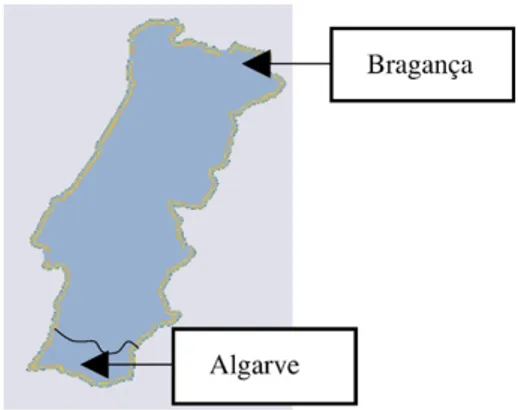
Despite their almost opposite geographical positioning in the coun-try, Portugal's Algarve—the southernmost region—and Bragança—one of the north-easternmost towns—regions (Fig. 1) are famous holiday destinations. Bragança derives much of its tourist trade from its prox-imity to Spain, its typical crafts and nearby natural preserve, while Algarve's beaches fuel the tourist industry by attracting people from all over the world.
According to the Köppen–Geiger climate classification, Algarve falls under the Csa class (wet temperate, with warm dry summer) while Bragança is classified as a Csb (wet temperate, with temperate dry summer)[1].
Despite these seemingly close environments, temperature differ-ences are quite noticeable throughout the year, with Bragança signif-icantly cooler than Algarve. A significant part of the tourist trade, for both regions, is the typical Portuguese cuisine, which generally includes sig-nificant amounts of bread, whether as an ingredient, an entry, or a com-plement to the main dish. One of its possible contaminants is OTA (structure inFig. 2).
OTA is an UV-decomposable mycotoxin produced by fungi such as Penicillium verrucosumand variedAspergilliumspecies, especially in cold and wet climates[2]. Production continues while the cereals are stored, especially under improper storage conditions, and processing methods are insufficient for their efficient detoxification, resulting in OTA-bearing cereal-derived products, such as contaminated bread. OTA has been proven to have a variety of toxic effects, including nephrotoxic—having been linked to the Balkan Endemic Nephropathy
[3]—immunotoxic[4], carcinogenic[5]and teratogenic[6], while also being a possible genotoxic. In the last ten years some work has indicated that its mode of carcinogenicity is‘genotoxic’[7]. However, OTA's genotoxicity is not certain, and recent work funded by Directorate-General (DG) XII of the EU has demonstrated that DNA binding of OTA is not detectable with sensitive analytical methods, and is unlikely to represent a mechanism for OTA-induced tumour formation[8].
The by far largest source of dietary OTA intake in Europe are cereals and their derived products, which account for around half of said intake, with wine and coffee taking a paltry second and third places, contributing about 10 and 9%, respectively[9]. To ensure the safety of the consumers, the EC has put the maximum permitted OTA level of cereals at 5 ng/g and of their derived products at 3 ng/g[10]and OTA's Tolerable Weekly Intake (TWI) at 120 ng/kg bw/week[11].
–
⁎Corresponding author.
E-mail address:[email protected](C.M. Lino).
0026-265X/$–see front matter © 2008 Elsevier B.V. All rights reserved. doi:10.1016/j.microc.2008.10.004
Contents lists available atScienceDirect
Microchemical Journal
In Portugal, bread serves an important role, in both agricultural production, as its cereal counterparts, mainly wheat—over 300,000 tons of this cereal are produced per year, and dietary component—as of 1994, bread consumption by Portuguese population was 32 kg/person/year, or 88 g/person/day[12], below WHO's advised intake of 250 g/day.
A previous study on the same topic, focused on the city of Coimbra, has found OTA incidence in wheat bread to be very low and the con-tent negligible[13]. However,flour source and storage conditions have great weight in the OTA content of thefinished product, and thus bread from different regions is likely to present wildly varying OTA content rates.
The goal of this study was to obtain data concerning the OTA content of wheat bread collected from multiple commercial surfaces in the Algarve and Bragança regions during the winter of 2007 so as to ascertain their potential contribution to the regions' populations' OTA intake.
2. Experimental
2.1. Chemicals
Two different grades of reagents were used. Those of HPLC grade were toluene (Barker Analysed, J.T. Barker, Holland), benzene (HACH Co., USA), methanol (Panreac Química Sau, Barcelona, Spain), and ace-tonitrile (Carlo Erba, Milan, Italy).
Analytical grade reagents were comprised of sodium chloride from Baker, Ltd., (Pagenham, England); chloridric acid, sodium hydroxide, potassium chloride, potassium dihydrogenphosphate, and anhydrous disodium hydrogenphosphate from Merck (Darmstadt, Germany); and acetic acid from Sigma-Aldrich (Laborchemikalien, Germany).
Sample filtration was through filter paper Whatman No. 4 (150 mm, Whatman International Ltd., Maidstone, England), while for the mobile phase polyamide membranefilters (0.2 µm, 50 mm, Whatman GmbH, Dassel, Germany) were used.
Water was purified with a Milli-Q System (Millipore, Bedford, MA, USA).
The OTA standard was obtained from Sigma Chemical Co. (St. Louis, MO, USA) with≥98% purity, and the OTB standard solution at 50 µg/mL from Supelco (Bellefont, PA, USA).
2.2. Apparatus
Sample preparation involved a Moulinex blender 700 W (230– 240 V, 50–60 Hz, Barcelona, Spain) and a Braun MR 5000 M mul-tiquick/minipimer 500 W (220–230 V, 50–60 Hz, Esplungues del Llobregat, Spain). For solution preparation, a magnetic stirrer (Agimatic-S, Selecta, Barcelona, Spain) was used for homogenisation, while a Sonorex RK 100 ultrasonic bath (Berlin, Germany) was em-ployed in their degassing.
OTA clean-up required a vacuum-manifold (Macherey–Nagel, USA) and a Dinko pump (mol. D-95, 130 W, 220 V) to drive the liquidified sample through Ochratest immunoaffinity columns (IACs) (Vicam, Watertown, MA, USA).
Dried samples were reconstituted with the help of a Retsh vortex mixer (Haan, Germany).
The LC-FD instrumentation consisted of a spectrofluorimeter (Perkin-Elmer Model LS45, Perkin-Elmer, Beaconsfield, UK) connected to a HPLC system constituted by a pump (Model 307, Gilson Medical Electronics, Villiers-le-Bel) and a 20 µL Rheodyne injector which forced the reconstituted samples through a Hichrom Ltd., HI-173 guard col-umn (30mm × 4 mm, i.d., England), and then through a Hichrom C18
column (5 µm, 250mm × 4.6 mm, i.d.). Fluorescence was recorded by a Hewlett-Packard 3390A integrator (Philadelphia, PA, USA).
2.3. Solutions
Phosphate-buffered saline (PBS) solution was prepared by diluting the following amounts per litre of distilled water: 0.2 g each of potas-sium chloride and potaspotas-sium dihydrogen-phosphate, 1.2 g anhydrous disodium hydrogen phosphate, and 8 g sodium chloride. pH was ad-justed to 7.4 with recourse to 0.1 M HCl and 0.1 M NaOH.
The OTA standard stock solution was prepared by diluting OTA fromA. ochraceuswith toluene:acetic acid (99:1) at 250 µg/mL, and stored at−20 °C. It was then used as a starting point to prepare inter-mediate solutions at 10 µg/mL and 1 µg/mL, in toluene:acetic acid, and working standard solutions at 0.1 µg/mL and 0.01 µg/mL, in mobile phase. To draw the calibration curves, additional solutions were pre-pared at the concentration range of 1 to 10 ng/mL, also in mobile phase. The OTB standard stock solution was acquired at 50 µg/mL and used to prepare an intermediate solution at 10 µg/mL in benzene:acetic acid (99:1), which was then evaporated and reconstituted in mobile phase in order to obtain a 100 ng/mL working solution. A second working solution was prepared from thisfirst one at 25 ng/mL.
An OTA/OTB joint standard solution was prepared, in mobile phase, at 5 ng/mL and 25 ng/mL, respectively, by mixing appropriate amounts of working solutions.
The mobile phase was a vacuum-filtered solution of acetonitrile/ water/acetic acid (49.5:49.5:1.0, v/v/v).
All LC reagents were submitted to a 15 min sonic bath for degassing. Glassware was decontamination byfirst washing it with a sodium hypochlorite solution, immersing it 4 mL/L H2SO4, andfinally returning
it to pH neutrality with distilled water.
2.4. Sampling
A total of 30 samples were purchased across Algarve and another 20 in Bragança and its outskirts in commercially available size during the Winter of 2007. Milled subsamples of 100 g each were stored in plastic bags at−20 °C until analysis.
All information on the samples was obtained from the labels. The milled samples were analysed as quickly as possible after purchase, being stored at−20 °C in the interim.
Fig. 1.Map of Portugal indicating the Algarve and Bragança regions.
2.5. Sample processing and analysis
The method used was previously described by Juan et al.[13]and is as follows.
An aliquot (20 g) of each sample was extracted with 100 mL PBS/ methanol (50:50, v/v) using the Braun Minipimer homogeniser for 5 min; the mixture wasfiltered by gravity through a Whatmanfilter paper. A 20 mL aliquot of thefiltered was then diluted with 30 mL PBS and the resulting solution run through a IAC column for clean-up using a vacuum manifold. The column was washed with 10 mL of water before elution of OTA with 3 mL of methanol. The eluted was dried at ±50 °C under a gentle nitrogen stream and stored until needed at−20 °C.
Prior to injection, the residue was reconstituted in 250 µL of mobile phase by mixing. Injection volume in the LC system was of 20 µL, and flow was a constant 1 mL/min. Excitation wavelength was 333 nm and emission wavelength 460 nm, both with a 10 nm bandwidth.
2.6. Revalidation assays
Revalidation of the method was achieved by, during the course of three days, spiking samples in triplicate with 0.1, 0.5, and 2.0 ng/g of OTA. Before the above protocol was performed, samples were left to stand in the dark for 15 min.
The same procedure was employed to evaluate OTB recoveries, at the concentration levels of 2.0 and 5.0 ng/g.
2.7. OTA confirmation procedure
The process for OTA presence confirmation was similar to that described by Guillamont et al.[14]and Pena et al.[15], based on the conversion of OTA into its methyl ester form. The procedure used in this study differed from that used in the studies above in that a higher
volume of boron trifluoride methanol solution was used, 600 µL instead of the described 150 µL.
3. Statistical analysis
All statistical analyses were carried out with using the data analysis software system STATISTICA (v.7) from StatSoft, Inc. (2004). The t test was used to evaluate the significance of the differences observed between groups. Whenever p≤0.05 (two-tailed), differences were considered to be statistically significant. For statistical analysis, if the concentration was below the limit of quantification (LOQ) it was set to 50% of that limit when the mean and SD were calculated.
4. Results and discussion
4.1. Revalidation assays
Method linearity was verified through the drawing of the calibra-tion curve and applying the linear least squares regression method to peak area versus four concentration levels, ranging from 1 to 10 ng/mL. This resulted in a correlation coefficient (r2) of 0.9998, con
firming linearity for that concentration range.
Recoveries ranged between 76.7 and 103.7% for fortification levels at 2.0 and 0.1 ng/g, respectively. Exactitude and intra and inter-day repeatability were found to be fully compliant with EC directives[16], as shown inTable 1.
Chromatograms of one solution of OTA and OTB standards at 5 and 25 ng/mL, respectively, a wheat bread sample contaminated with both ochratoxins, and OTA methyl ester of one bread sample contaminated with OTA are shown inFig. 3.
Some of the tested samples presented a fluorescence peak at around 7 min, in addition to that of OTA (Fig. 3b). The injection of an OTB standard solution confirmed the suspicion that said peak was due to the presence of that substance in the samples. Attempts were made to quantify the OTB content, but recovery assays showed recoveries of around 50%, revealing this method to be inadequate for such purpose. This is probably due to the fact that the immunoaffinity columns used contained monoclonal antibodies, therefore granting them high specificity for OTA.
Nevertheless, OTB peak area was, as a rule, greater than OTA peak area. This, combined with the low recovery rates, indicates that the Table 1
OTA recovery, intra and inter-day repeatability for different fortification levels
Fortification (ng/g) Recovery (%) R.S.D. intraday (%) R.S.D. interday (%)
0.1 103.7 14.4 10.8
0.5 83.3 3.6 7.2
2.0 76.7 4.5 12.9
Fig. 3.Representative integrator print-outs resulting of the injection of 20 µL of: a) an OTB/OTA standard at 25 and 5 µg/mL, respectively; b) a bread sample contaminated with OTB and OTA; c) OTA methyl ester of one bread sample contaminated with OTA. Retention times were 6.82, 11.39, and 27.31 for OTB, OTA, and OTA methyl ester, respectively.
samples were contaminated with OTB (Table 2). Fortunately, and even thoughin vitrotoxicity is similar, OTB, lacking OTA's chlorine group, is quickly metabolised and rapidly eliminated whenin vivoconditions. This results in a lack of toxicity and therefore OTB seems to present no health risk[17].
4.2. Limit of quantification (LOQ)
LOQ was determined as the lowest OTA concentration that could be used to spike a blank sample and still originate repeatable and accurate results when the experimental procedure was applied to the referred sample. This value was revealed to be 0.1 ng/mL, which was considered sufficient for an accurate hazard evaluation.
4.3. OTA content in real sample
OTA quantification results are summarised inTable 3. Its analysis shows that, independently of origin, 74% of the samples were contaminated, revealing a widespread presence of ochratoxin A in theflour. This suggests that legislation concerning its storage should either be rethought or more tightly enforced.
Also, many samples featured OTA content above the LOQ determined for this study. However, since the LOQ is relatively low when compared to the legal limit, this is not particularly worrisome. The maximum OTA levels for samples from both regions were similar, 0.49 and 0.43 ng/g for Algarve and Bragança, respectively, roughly one-seventh to one-sixth of the legal limit.
Although mean OTA content in the samples from the two areas does not present a significant statistical difference, with a p value of 0.35, those from Bragança feature, in average, a 33% higher mean contamination. This difference only becomes more pronounced if only the samples above the LOQ are taken into account, in which case the average contamination of the Bragança samples is a full 50% higher. These greater bread contamination levels may be due to the fact that Bragança is significantly colder than Algarve, which favours fungal OTA production. In all instances, the contamination levels remain far below the legal limit, and thus should present no health risk.
Standard deviations, however, are fairly high, in one instance even surpassing its corresponding mean value. This signifies that OTA content values are distributed over a large range, and even though the maximums, too, are below the legal limit, this indicates that storage conditions vary greatly within the same region, further emphasising the need for better surveillance.
As previously mentioned, one study acquired data concerning the OTA content of both wheat and maize bread in the Portuguese city of Coimbra[13]. Since maize and maizeflour are much more vulnerable to fungal contamination than their wheat counterparts, comparing their results for that type of bread with those obtained here is of
arguable relevance, and will therefore not be undertaken. However, comparing the results for wheat bread from all three sources, Coimbra's bread, 0.02 ng/g, is far less contaminated than that from Algarve, 0.2 ng/g, and Bragança, 0.3 ng/g. Incidence in Coimbra is roughly one-fourth of Bragança's and one-fifth of Algarve's. The maximum value of OTA content for that city, 0.26 ng/g, is nearly half of that of the other two, while its mean is sixth of Algarve's and one-eighth of Bragança's.
On the other hand, studies have been performed that determined the OTA content of wheat bread in other countries[9,18,19]. The data collected from those studies is presented below, inTable 4.
Incidences run the gamut from far inferior to our own (Morocco) to substantially greater, with the majority falling in the later case.
Mean OTA content also varies greatly. Switzerland, Brazil, and Austria all feature means far below our own[18]. Brazil, however, falls mostly in the A class climate zone, and possesses therefore a far warmer climate than Portugal, which is not favourable to OTA production. Switzerland and Austria, on the other hand, are both Dfb classed, and are thus slightly colder than Portugal. However, Portugal's coastal location modifies its Csb characteristics, giving it less rainfall than both those European countries, which could explain the difference.
The closest values to our own can be found in Belgium, Germany, and Tunisia[18]. Both Belgium and Germany, though falling under the C class as well, belong to the fc subclass and are therefore subartic or subpolar, with wetter summers and drier winters than Portugal. Thus, lower temperatures coexist with drier weather and higher tempera-tures with wetter weather than their Portuguese counterparts.
Tunisia, on the other hand, falls mostly under the BWh class,i.e., a desert which coldest month averages above 0 °C. Its northern areas, however, where its capital of Tunis and a few other high-population cities are located, are, due to Mediterranean influence, Cs-classed— just like Portugal. It is in these areas, especially just south of Tunis, that most of Tunisian agriculture takes place, and is therefore of little surprise that similar values of OTA contamination are obtained.
Most other countries inTable 4 feature similar contamination levels, all higher than those found by the present study, and fall under too many different climates to be properly evaluated. The United States[18] alone features more than five different climatic classes within its borders. Spain [18] and Morocco [19], however, have particular relevance for comparison purposes due to three similarities with Portugal: they are located in the same general geographical region, both fall under the Cs class, and they are both in contact with the Mediterranean, which further influences climate [1]. Both countries show markedly higher OTA content than either Portuguese region evaluated. The reasons for this are unknown, though it could very well be due to differences in agricultural practices and storage conditions of cereal grains and derived products.
Table 2
OTB incidence in the analysed samples
Sample origin Incidence Percentage
Algarve 15/30 50%
Bragança 7/20 35%
Table 3
Results of OTA quantification by LC-FD in wheat bread samples from the Algarve and Bragança regions of Portugal
Sample origin
Sample size
Incidence NLOQ OTA range (ng/g)
Meana± RSD (ng/g)
Meanb± RSD (ng/g)
pvalue
Algarve 30 24 (80%) 18 (60%) n.d.−0.49 0.12 ± 0.12 0.2 ± 0.1 0.350 Bragança 20 13 (65%) 10 (50%) n.d.−0.43 0.16 ± 0.17 0.3 ± 0.14 aAll samples.
bSamplesNLOQ only.
Table 4
Incidence and mean values of OTA content of wheat bread from different countries [18,19,20]
Country Incidence (%) Mean (ng/g)
Spain 93/93 (100%) 0.45
Holland 29/29 (100%) 0.39
U.S.A. 24/24 (100%) 0.41
Switzerland 20/20 (100%) 0.07
Brazil 15/15 (100%) 0.09
France 14/14 (100%) 0.25
Italy 12/12 (100%) 0.34
Germany 11/11 (100%) 0.35
Ireland 9/9 (100%) 0.36
Austria 9/9 (100%) 0.08
Tunisia 9/9 (100%) 0.30
Belgium 7/7 (100%) 0.23
Morocco 48/100 (48%) 13.00
Germany 897/986 (91%) 0.17
4.4. OTA confirmation procedure
Thefigures presented above are reproductions of the integrator print-outs for the ochratoxins' standards (Fig. 3a), an ochratoxin-contaminated bread sample (Fig. 3b), and a sample containing OTA and subsequently esterified (Fig. 3c). Not only is the OTA peak both isolated and well-defined in both the standard and the sample, but it is also replaced by one at approximately 27 min after the sample has been subjected to methyl esterification, thus further confirming OTA presence and identity.
4.5. OTA Estimated Daily Intake (EDI)
To calculate the EDI of OTA from the obtained results, two assumptions were made: one, that the average weight of the Portuguese population is the same 65 kg as reported by Miraglia and Brera in their SCOOP report of 2002 [9], and two, that the average per capita consumption of bread by the Portuguese people has remained at the same level since 1994, that is, 32 kg/year, or 88 g/day[12].
These two assumptions, along with the data obtained in this study, result in an EDI of 0.26 ng/kg bw/day for the Algarve region and one of 0.38 ng/kg bw/day for Bragança and its outskirts, values correspond-ingly roughly to 1.5% and 2.0%, respectively, of the Tolerable Daily Intake (TDI) established by EC regulation[11]. However, the assumed bread consumptionper capitafalls far behind that advised by the WHO, 250 g/day. If the 88 g/day are replaced by the advised 250 g/day, the EDI would be 0.75 and 1.10 ng/kg bw/day, instead, which would be, for their part, 4.5% and 6.5% of TDI value established by EC.
The aforementioned SCOOP report contained data concerning the bread-derived EDI for three European countries, namely Spain (0.77 ng/kg bw/day), Germany (0.36 ng/kg bw/day), and Denmark (0.19 ng/kg bw/day). These would put the Portuguese people in line with their European counterparts in OTA EDI terms, with those from Bragança ingesting roughly as much as the Germans and those from Algarve half-way between the German and the Danish.
The SCOOP report also indicates the total Portuguese OTA EDI as being 0.81 ng/bw kg/day, and the cereals and cereal-derived products fraction of the diet as contributing half of that value. Though it is unknown how much of that fraction corresponds to bread, if we assume a not unreasonable 75%, we will end up with a total OTA EDI of 0.69 ng/kg bw/day in Algarve, and 1.01 ng/kg bw/day in Bragança. The average of these values is 0.85 ng/bw kg/day, which is very close to the national average reported by SCOOP.
5. Conclusions
Wheat bread from Bragança is noticeably more contaminated than that from Algarve. However, Bragança also features a colder climate which promotes OTA production. Most samples were contaminated, suggesting a widespread, potentially dangerous fungal growth in stored foodstuffs. On the other hand, none of those samples was found to be above the legal limit; furthermore, both mean and incidence values and the extrapolated EDI place those two regions below the European average, and in line with the expected national total intake. Therefore, OTA contamination of bread in the two studied regions seems to be well under control and unlikely to pose a threat to
consumer health. This, however, does not implicate that the current numbers can't or shouldn't be improved upon, nor that regular retesting should not be performed to monitor the situation.
Acknowledgments
This study was supported by the Portuguese Science and Technology Ministry, through the FCT under the project heading PTDC/AGR-ALI/65528/2006, and by FEDER/POCTI.
References
[1] M.C. Peel, B.L. Finlayson, T.A. McMahon, Updated world map of the Köppen-Geiger climate classification, Hydrol. Earth Syst. Sci. 11 (2007) 1633–1644.
[2] M. Eskola, 2002. Study of trichothecenes and ochratoxin A in Finnish cereals: occurrence and analytical techniques (Dissertation). EELA Publications. Helsinki. [3] T. Vrabcheva, T. Petkova-Bocharova, F. Grosso, I.N. Chernozemsky, M. Castegnaro, S.
Dragacci, Analysis of Ochratoxin A in foods consumed by inhabitants from an area with Balkan Endemic Nephropathy: a 1 month follow up study, J. Agric. Food. Chem. 52 (2004) 2404–2410 2004.
[4] R.B. Harvey, M.H. Elissalde, L.F. Kubena, E.A. Weaver, D.E. Corrier, B.A. Clement, Immunotoxicity of ochratoxin A to growing gilts, Am. J. Vet. Res. 53 (10) (1992) 1966–1970.
[5] IARC, IARC Monographs on the evaluation of carcinogenic risks to humans, some naturally occurring substances: food items and constituents, heterocyclic aromatic amines and mycotoxins, vol. 56, Lyon, 1993, pp. 489–521.
[6] P.B. Wangikar, P. Dwivedi, N. Sinha, A.K. Sharma, A.G. Telang, Teratogenic effects in rabbits of simultaneous exposure to ochratoxin A and aflatoxin B1 with special reference to microscopic effects, Toxicology 215 (1–2) (2005) 37–47.
[7] V. Ehrlich, F. Darroudi, M. Uhl, H. Steinkellner, M. Gann, B.J. Majer, M. Eisenbauer, S. Knasmuller, Genotoxic effects of ochratoxin A in human-derived hepatoma (HepG2) cells, Food Chem. Toxicol. 40 (8) (2002) 1085–1090.
[8] A. Mally, Ochratoxin A: lack of formation of covalent DNA adducts, Chem. Res. Toxicol. 17 (2) (Feb 2004) 234–242.
[9] SCOOP, Assessment of dietary intake of ochratoxin A by the population of EU Member States, Reports on tasks for scientific cooperation, Task 3.2.7, January 2002.
[10] EC, Commission Regulation (EC) No 1881/2006 of 19 December 2006 setting maximum levels for certain contaminants in foodstuffs, Off. J. Eur. Communities L364 (2006) 5–24.
[11] EFSA, Opinion of the scientific panel on contaminants in the food chain on a request from the commission related to ochratoxin A in food, The EFSA Journal (2006) 365.
[12] Instituto Português do Consumidor (IPC), 2005. Available atwww.consumidor.pt. [13] C. Juan, A. Pena, C. Lino, J.C. Moltó, J. Mañes, Levels of ochratoxin A in wheat and maize bread from the central zone of Portugal, Int. J. Food Micro. 127 (2008) 284–289.
[14] E.M. Guillamont, C.M. Lino, M.L. Baeta, A.S. Pena, I.N. Silveira, J. Mañes, A comparative study of extraction apparatus in HPLC analysis of ochratoxin A in muscle, Anal. Bioanal. Chem. 383 (2005) 570–575.
[15] A. Pena, F. Cerejo, C. Lino, I. Silveira, Determination of ochratoxin A in Portuguese rice samples by high performance liquid chromatography with fluorescence detection, Anal. Bioanal. Chem. 382 (2005) 1288–1293.
[16] EC, Commission Regulation (EC) No 401/2006 of 23 February 2006 laying down the methods of sampling and analysis for the official control of the levels of mycotoxins in foodstuffs, Off. J. Eur. Communities L 70 (2006) 12–34.
[17] A. Mally, W. Keim-Heusler, A. Amber, Biotransformation and nephrotoxicity of ochratoxin B in rats, Tox. App. Pharm. 206 (1) (2004) 45–53.
[18] T.M. Legarda, P.A. Burdaspal, Occurrence of ochratoxin A in samples of bread marketed in Spain and twelve other countries, Alimentaria 321 (2001) 89–96. [19] A. Zinedine, C. Juan, L. Idrissi, J. Mañes, Occurrence of ochratoxin A in bread
consumed in Morocco, Microchem. J. 87 (2007) 154–158.
[20] E. Miraglia, C. Brera, Assessment of dietary intake of ochratoxin A by the population of EU member states. Report on Tasks for Scientific Cooperation, Directorate-General Health and Consumer Protection (2002).