Drosophila
relics
hobo
and
hobo
-MITEs transposons as raw material for new
regulatory networks
Elgion L.S. Loreto
1,2, Maríndia Deprá
3, José F. Diesel
2, Yanina Panzera
4and Vera Lucia S.
Valente-Gaiesky
1,31
Programa de Pós-Graduação em Genética e Biologia Molecular, Universidade Federal do Rio Grande do
Sul (UFRGS), Porto Alegre, RS, Brazil.
2
Departamento de Bioquímica e Biologia Molecular (CCNE), Universidade Federal de Santa Maria
(UFSM), Santa Maria, RS, Brazil.
3Departamento de Genética, Universidade Federal do Rio Grande do Sul (UFRGS), Porto Alegre, RS,
Brazil.
4
Departamento de Genetica, Universidad de la República de Uruguay (UDELAR), Montevideo, Uruguay.
Abstract
Hypermutable strains ofDrosophila simulans have been studied for 20 years. Several mutants were isolated and characterized, some of which had phenotypes associated with alteration in development; for example, showing ectopic legs with eyes being expressed in place of antennae. The causal agent of this hypermutability is a non-autonomoushobo-related sequence (hoboVA). Around 100 mobilizable copies of this element are present in the D. simulans genome, and these are likely mobilized by the autonomous and canonical hobo element. We have shown thathoboVA has transcription factor binding sites for the developmental genes, hunchback and even-skipped, and that this transposon is expressed in embryos, following the patterns of these genes. We suggest that hobo and hobo-related elements can be material for the emergence of new regulatory networks.
Keywords:hobo, transposable elements,cis-regulatory sequences,Drosophila..
Received: March 10, 2017; Accepted: August 1, 2017.
Introduction
The eukaryotic genomes sequenced thus far have shown that substantial portions of them are formed by transposable elements (TEs). These elements are extremely variable, and usually, the genomes are composed by dozens of different TE families, which are often represented by de-generated and inactive copies (review in Wicker et al., 2007). TEs have parasitic characteristics, harboring mecha-nisms that enable them to self-multiply faster than the “host genome”. Furthermore, TEs are an important source of ge-netic variability to drive evolution. There are many ways that TEs can generate variability; for example, promoting mutations in coding or regulatory regions of genes, chro-mosome rearrangements, epigenetic alterations and others (reviews in Biémont and Vieira, 2006; Hua-Van et al., 2011).
Recently, a growing body of evidence indicates that TEs are involved in rewiring gene regulatory networks
(Feschotte, 2008). TEs typically carry a collection of regu-latory elements, such as promotors, cis-regulatory se-quences, enhancers, insulators, splice and poly(A) sites, usually used for their own expression. Also important in gene regulation involving TEs are those using miRNAs in the pre-translation process or in heterochromatin formation (Feschotte and Gilbert, 2012; Rebolloet al., 2012; Chuong
et al., 2017).
This review will focus oncis-regulatory sequences, in particular on the potential ofhoborelics elements to pro-vide sequences for producing mutations in developmen-tally regulated genes or sequences in which developmental genes can act.
TEs can harbor many transcription factor binding sites (TFBSs) and, the mobile nature of TEs, which allows them to occupy almost any site of a genome, makes them a powerful route for the spread of “ready-to-use”cis -regula-tory sequences. The addition of new TFBSs in regula-regula-tory regions can create novel patterns of gene expression. There are examples in diverse organisms of genes that have exapted TE-TFBSs (review in Chuong et al., 2017). In mammals, Polavarapuet al.(2008) found that 7-10% of ex-perimentally characterized TFBSs in the human genome
Send correspondence to Elgion L. S. Loreto, Department of Bio-chemistry and Molecular Biology, CCNE, Federal University of Santa Maria, Av. Roraima 1000, Camobi, 97105-900, Santa Maria, RS, Brazil. E-mail: [email protected].
are derived from TEs. Sundaramet al.(2014) studied 26 pairs of orthologous transcription factors (TFs) in two pairs of human and mouse cell lines and showed that 20% of binding sites were embedded within TEs. The expression of the human tumor suppressor protein, p53, is regulated by the p53 TFBS found in LTR (long terminal repeats) ofERV
elements (Wanget al., 2007). In insects, the domestication of the silkworm (Bombyx mori) involved the insertion of a partial TE (Taguchi) in cis-regulatory region of the ecdysone oxidase (EO) gene, enhancing the expression of this gene. It promotes a developmental uniformity of silk-worm individuals, which is a desirable trait for domestica-tion (Sunet al., 2014). The addition of newcis-elements from TEs on Cyps genes has been associated with the upregulation of these genes and consequent development of insecticide resistance. Different TEs or TEs regulatory sequences have been linked to this phenomenon as, for ex-ample, the retrotransposonsAccordandHMS-Beagle, the transposons P and BARI, and the helitron DNAREP1
(Chunget al., 2007; Schmidtet al., 2010; Cararetoet al., 2014). In plants, many published examples describe the exaptation of TEscis-regulatory regions. For instance, as the C4 photosynthesis system evolved, many genes in-volved in it acquired regulatory cis-elements from TEs (Caoet al., 2016); and thehATelementMoshan, from Pru-nus, has cis-acting elements, recognized by MYB and WRKY transcription factors (TFs) (Wang et al., 2016). Some transcription factors are products of the so-called “master regulatory genes”, originally defined by Susumu Ohno as “genes that occupy the very top of a regulatory hi-erarchy” acting over multiple downstream genes directly or through a cascade of gene expression changes (Ohno, 1979). Transposable elements that have TFBSs sensible to master genes are promising for producing evolutionary novelty. As stated by Britten and Davidson (1971), “major events in evolution require significant changes in patterns of gene regulation. These changes most likely consist of ad-ditions of novel patterns of regulation or reorganization or pre-existing patterns”. Thehoboelement ofDrosophilahas TFBSs for some master developmental genes and is poten-tially able to produce remarkable mutations. This can be an interesting example, as some evolutionary novelty can arise.
Hobo, its relics and MITEs
The hobotransposon is a class II transposable ele-ment and a member of thehATsuperfamily (Wickeret al., 2007). The main characteristics of this superfamily are: i) presence of short terminal inverted repeats (TIRs), 10-25 bp in length; ii) target site duplications (TSDs) of 8 bp as a consequence of the transposition process; iii) when com-plete, elements encode for a transposase of 500-800 amino acids; and iv) different elements of this superfamily share between 20 and 60% of amino acid transposase sequence similarity. This enzyme has an amino acid triad (DDE or
DDD) in its catalytic domain (Ladevèzeet al., 2012). The
hATsuperfamily is also characterized as being widely pres-ent in eukaryotes (Calviet al., 1991).
Currently, it is proposed that thehATsuperfamily is formed by three families;Ac, BusterandTip(Rossatoet al., 2014). InDrosophila, theAcfamily is more representative: in 12 analyzedDrosophilagenomes, members of this fam-ily were found in 11, corresponding to 39 differenthAT ele-ments, of which 29 were potentially autonomous. Howe-ver, as the elements are found as multiple copies, most (92.9%) are non-autonomous (Ortiz and Loreto, 2009). The
Busterfamily is represented in theDrosophilagenus only by the Mar element, present in species of the willistoni
group, mainly as MITEs (Depráet al., 2012). The only ele-ment of theTip family described inDrosophila so far is
But2,occurring in some species of groupsmelanogaster,
repleta, andwillistoni(Rossatoet al., 2014).
A remarkable characteristic of manyhATelements is the formation of short, but mobilizable elements, the “Min-iature Inverted repeat TEs” (MITEs). They normally have less than 800 bp, with no coding capacity, but with con-served TIRs, and often reach high copy numbers in the genomes (Feschotte and Pritham 2007). In Drosophila, 68% of the described elements of theAcfamily have poten-tially mobilizable elements with less than 600 bp (Ortizet al., 2010). Also, the MITEs copies are the most abundant in
BusterandTipfamily (Depráet al., 2012; Rossatoet al., 2014).
size (but they can sometimes reach lengths of up to 1.6 kbp).
The canonicalhobois also found inD. simulansand
D. mauritiana(Boussy and Daniels, 1991). The high simi-larity observed between the sequences of this element in these species led Simmons (1992) to suggest that horizontal transfer could have occurred for this TE between these spe-cies. The “relics”hobohas a wide distribution. Although it is mainly restricted to themelanogastersubgroup, these se-quences are present inD. melanogaster,D. simulans,D. sechellia, D. mauritiana, D. santomea, D. yakuba, D. teissieriandD. erecta(Ortiz and Loreto, 2008).
A hypermutable strain and the occurrence of
developmental mutants
We have characterized a hypermutable strain of Dro-sophila simulans(Dshs), originated from a single spontane-ous mutant male, collected in nature, showing thelozenge
phenotype. The genetic characterization of this mutant re-vealed that the females are sterile due absence of sperma-thecae. Therefore, to maintain the mutants in the labora-tory, the males were crossed with a wild strain (D. simulans
Eldorado). During this process, new mutations were ob-served. The strain was followed for roughly 100 generations, and during the mutation screening, several of the isolated mutants corresponded to developmental genes (Loretoet al., 1998). One interesting mutant, which can represent the potential of transposons to create “evolution-ary novelties” is the one showing an antennapedia pheno-type, where legs grow in place of antennae. In addition, in this particular mutant, ectopic eyes grow on homeotic legs. This allele is dominant, and flies show a phenotype with variable expressivity, ranging from normal antennae to homeotic legs, with approximately 6% of flies expressing ectopic eyes on the homeotic legs (Figure 2). This gene was mapped to the 3L chromosome in the region corresponding to theeyegonelocus, although no molecular evidence has confirmed the mutation’s presence in this gene (unpub-lished result).
Other mutations were characterized and mapped to, for example, thedecapentaplegicgene (dpp);lozenge(lz);
blistered(bs); andwhite(w) (Figure 3) (Loretoet al., 1998; Torreset al., 2006). Theblistered (bl)mutant (Figure 3A) is dominant, showing incomplete penetrance, which is sensi-tive to temperature, with stronger expression at higher tem-peratures. The same increase in phenotypic expression was observed in theZpmutant (Loreto ELS, 1997, Doctoral the-sis, Universidade Federal do Rio Grande do Sul, Porto Alegre, RS). The mutantdecapentaplegic (dpp)is reces-sive, and the homozygous flies have wings, which are held out laterally (Figure 3B).
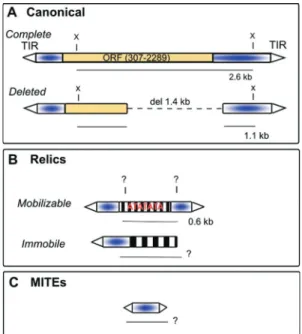
In the hypermutable strain, the occurrence of a high rate of somatic mutations is suggested, as it has been ob-Figure 1- Hobo, relics and MITEs. A) Two forms of canonicalhobo; the
complete and deleted elements. Open triangle = TIR (terminal inverted re-peats);completeelements have a transposase gene (ORF);deleted ele-ments normally lack the central part of the sequence (del 1.4 kbp); X=
XhoI restriction site, which produces a 2.6 kbp fragment in complete ele-ments and, generally, a fragment of 1.1 kbp in deleted eleele-ments. These fragments are used to identify complete and deleted elements in Southern Blots studies; B) Relicshoboelements are present in two forms: mo-bilizable, those that have TIRs and conserved subterminal sequences; and
immobileelements are defective in one TIR. The inner parts of elements are degenerated (striped) and can be AT rich. TheXhoI site may or may not be present (indicated by “?”). InD. simulans,when theXhoI site is present, the more abundant relic element generates a 0.6 kbp fragment. The lengths of fragments generated by immobile copies are variable (?) C)
hoboelements can be found asMITEs(80-700 bp).
served in many flies with severe phenotypic alterations that are not inherited (Figure 3C) (Loretoet al., 1998).
The putative causal agent of this
hypermutability: an old, hectic, energetic and
degenerated hobo element
The molecular characterization of a “de novo” white
mutation isolated in the hypermutable strain showed that it was caused by an insertion of a “relic” non-autonomous
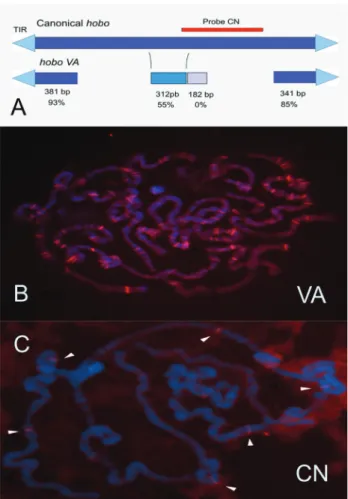
hoboelement. This is a 1.2 kbp element, with conserved re-gions of 12 bp TIRs, 8 bp TSD, and subterminal sequences (Figure 4A). The 5’ region was 381 bp in length and showed 93% similarity with canonicalhobo.The 3’ region was 341 bp in length and 85% similar to canonicalhobo.
The inner region is AT rich and has low similarity with ca-nonicalhobo(Torreset al., 2006). This non-autonomous element is mobilizable in the hypermutable strain, and it is involved in “de novo” mutations and contains sufficient se-quences for transposition (a minimum of 141 bp on the 5’ end and 65 bp on the 3’ end) (Kimet al., 2011). The source of transposase to induce mobilization is postulated as the canonicalhobo, which is present in this strain (Torreset al., 2006; Depráet al., 2009).
Although the only mutation for which the causal agent was fully characterized as being thehoboVA element was thewhitemutant, two other facts lead us to suggest that the causal agent of the hypermutability in this strain is the
hoboVA. First, an insertion of the same size of that element, 1.2 kbp, was also observed in thelozengemutant generated in this hypermutable strain (Loretoet al., 1998). Second, it has long been known that thecis-regulatory heldout region of thedecapentaplegic(dpp) gene is a preferential site for
hoboinsertions (Newfeld and Takaesu, 1999). One of the mutants we have isolated is with the heldout phenotype of
dpp.
Aiming to verify the abundance of sequence similar tohoboVA in theD. simulansgenome, we performed anin silicoanalysis on the genome available after the publication of the 12Drosophilagenomes by Clarket al.(2007). In that study, the genome ofD. simulanswas assembled using a mix of seven strains. The analysis showed that these 1.2 kbp sequences, similar tohoboVA, are abundant, with 147 copies scattered across all chromosomes. These com-prise 92 putatively mobilizable sequences and 72 with TSDs, indicative of recent mobilization. However, the se-quenced strains only had two copies of the putative autono-mous hobo element (Ortiz and Loreto, 2008). Also, we have performed a quantification ofhoboVA sequences in our hypermutableD. simulansstrain, showing that this ele-ment is also abundant in the strain. Figure 4B shows the flu-orescentin situhybridization (FISH) of polytene chromo-somes with the hoboVA element, where at least 90 hybridization sites can be identified. In contrast, when the Figure 3- Mutant phenotypes A) Phenotypic appearance ofblistered
mu-tant (bl); B)dppmutant; C) somatic mutation in which half the thorax and one wing was not formed; D) mosaic fly in which one eye has a wild type phenotype and the other has alozengeappearance.
Figure 4- CanonicalhoboandhoboVA. A) Schematic representation of canonicalhoboandhoboVA. TIR are represented as a triangle. The red line shows the probe region used inin situhybridization (C). ThehoboVA element has the best conserved extremities and a more divergent inner se-quence. The similarity for each region is indicated in %, and the sizes of the regions are indicated in base pairs (bp); B)in situhybridization of polytene chromosomes using the completehoboVA as probe; C)in situ
polytene chromosomes were hybridized with the inner por-tion of thehoboelement, found exclusively in the complete elements, only six hybridization sites were observed (Fig-ure 4C).
Another characteristic of these hobo-related ele-ments,hoboVA, is that they have apparently been main-tained for an evolutionary time that is prior to the D. sechelliaandD. simulansspeciation event, estimated at 0.4 MYA. Sequences similar tohoboVA are found in both spe-cies, suggesting that this element has been maintained as a non-autonomous element in the genomes of these species for all this time (Torres et al., 2006; Ortiz and Loreto, 2008). The presence of short, non-autonomous but mobi-lizable elements in a higher number, contrasting with low copy numbers of autonomous elements, appears to be a pat-tern forhATelements (Ortizet al., 2010).
The data described above suggest that the hyper-mutable strain could have an autonomous hoboelement, free of silencing mechanisms, and in this way, able to mobi-lizehoboVA elements. Because these “relics” elements are maintained for a long time, and are very active, we call it
hobo “Velho Assanhado” (VA), which in Portuguese means “a very animated elder”.
hoboVA and his
cis-regulatory developmental
sites
The transcription factor binding sites in thehoboVA element were predicted using the “motility” toolkit, which allowed us to search for sequence motifs using position weight matrices. For this analysis, we searched high scor-ing bindscor-ing sites for six homeotic genes (bicoid, even-skipped,fushi-tarazu, hunchback, knirpsandkrüppel) us-ing matrices described in Hoet al. (2009). Max-scoring matches were found foreven-skippedandhunchback (Fig-ure 5A).
Experimental evidence that the cis-regulatory sites forhunchbackandeven-skippedare functional inhoboVA were shown by Depráet al.(2009).In situhybridization in embryos of flies belonging to hypermutable and other strains, usinghoboVA as a probe showed expression com-parable to that observed forhunchbackandeven-skipped
(Figure 5B).
The presence ofcis-regulatory sequences of develop-mental genes, mainly those expressed in the initial phase of embryonic development, have been described for many TEs. For example, several retrotransposons ofDrosophila
have these sequences (Ding and Lipshitz, 1994; Borieet al., 2002), as do LINEs in mammals (Lohet al., 2006; Gerdes
Figure 5-hobotranscriptional regulation. A) Transcription factor binding sites (TFBSs) in thehoboVA element predicted by “motility” toolkit. For this analysis, we searched for high scoring binding sites of six homeotic genes (bicoid, even-skipped, fushi-tarazu, hunchback, knirps and kruppel) using ma-trices described in Hoet al.(2009). Possible CAAT and TATA boxes were found using the description ofhoboelements by Strecket al.(1986), for refer-ence in the alignments. TFBSs are represented by colored boxes. A red star indicates a perfect match of TFBS and thehoboVA sequence; B)in situ hy-bridization whole-mount embryos of theDrosophila simulanshypermutable strain, usinghoboVA as probe (RNA).hoboVA can be seen expressing as
et al., 2016). Transcription factor binding sites related to genes involved in the initial phases of development can be selectively advantageous for TEs, which could maximize their chance of increasing their presence in the next genera-tion. For organisms whose germlines and somatic cells are separated, it is important for TEs to be active in phases when transposons can increase their copy number in the germ line, but not in somatic cells. Transposition in germ cells can be selectively advantageous from TE perspec-tives, yet transposition is normally detrimental in somatic cells (Haig, 2016).
Creating new regulatory networks
From Figure 5B, it can be seen thathoboVA are scat-tered across all chromosomes, carrying its regulatory se-quences. When some of these transposons are mobilized, they can be inserted in nearby genes, leading to a new posi-tion for their transcripposi-tion factor binding sites, and this can modify the expression of genes in these new locations. Al-though we do not have a molecular characterization of the
Zoinho-na-pata (Zp)mutation, we can hypothesize that the ectopic expression ofZoinho-na-patamutants, as well as other mutants observed in the hypermutable strain, could be a product ofhoboVA insertion. Master control genes, such aseyegone,which is involved in antennal and eye develop-ment and morphogenesis (Dominguezet al., 2004; Yao and Sun, 2005; Wanget al., 2008), can activate a new spatio-temporal pattern of gene expression when they receive in-sertions of newcis-regulatory sequences in their regulatory region. Therefore, transcription factor binding sites (TFBSs) for hunchback and even-skipped, present in
hoboVA, can produce new phenotypes if inserted in such genes. These TFBSs are known as promoters of spatio-temporal gene control compatible with those observed in
Zpmutant phenotype.
From an evolutionary point of view, the spread of
cis-regulatory sequences can rewire gene regulatory net-works. This can occur with the gradual addition of these se-quences in the promotor regions of new genes, such as products of new TE insertions. As consequence of these in-sertions, genes can show new regulatory patterns by an-swering to transcription factors in which they were not respondent before. This rewiring can later undergo fine-tuning, resulting by natural selection of other mutations in the involved genes and the regulatory sequences that were added to the system by TEs. The involvement of TEs in re-wiring gene networks is well supported in the literature (Feschotte, 2008; Feschotte and Gilbert, 2012; Rebolloet al., 2012; Chuong et al., 2017). The classical Darwinian view of evolution as a gradual process, in which no leaps are taken, fits well in this scenario of the rewiring of gene networks. Also, it has been shown in the literature that plex structures can evolve gradually as, for example, com-plex organs such as eyes found in vertebrates, insects or cephalopods have evolved from photoreceptor cells, in
which many intermediary steps can be found throughout the animals phylogeny (reviewed in Gehring, 2002).
The idea of large mutations producing great leaps of adaptation, as originally proposed by Richard Gold-schmidt, in hishopeful monstertheory, was refuted for a long time. Now, some examples indicate these “monsters” could have a place in evolutionary theory, though not ex-actly as frequently credited to Goldschmidt’s original prop-osition, as mutations with dramatic alterations in pheno-type, producing an organism perfectly adapted to the environment. However, Chouard (2010) has revised some examples where single-gene changes promoting large phe-notype effect can confer large adaptive value. These exam-ples are not in disagreement with the Darwinian theory, they only open space for mutations with large phenotypic consequences, which, when viable in natural situations, could be initial steps for evolutionary novelties.
Master control genes are at the top of networks to build structures, body parts, and metabolic routes. Many master control genes are themselves transcription factors. When transposons carrying transcription factor binding sites (TFBSs) insert into the regulatory region of a master control gene, they can, theoretically, imbricate phenotypic building cascades, leading to evolutionary novelties.
The appearance of antennae with eyes could consti-tute a large evolutionary leap. Unfortunately, after some year of maintenance in the laboratory, we lost the Zp
strains, making it impossible to show ifhoboVA was in-volved in this particular mutation. The difficulty in main-taining this strain in the laboratory is `per se’ indicative that such mutations normally are inviable in nature. However, we can imagine that insertions of TEs, such ashoboVA, carrying TFBSs for master control genes, can bring new regulatory patterns for other master control genes, produc-ing new phenotype patterns. If so, maybe some “hopeful monsters” could be the products of TE insertions, as is sug-gested by this hypothetical example. Maybe,hopeful mon-sters need a “lucky spot”. Large phenotypic alteration, when occurring in particular environments, could be the initial point for evolutionary novelties, and TEs can be part of this process.
Acknowledgments
The study was supported by research grants and fel-lowships from Conselho Nacional de Desenvolvimento Científico e Tecnológico (CNPq), FAPERGS and PROBIC/FAPERGS, and CAPES.
References
Blackman RK, Grimalia R, Koehler MM and Gelbart WM (1987) Mobilization ofhoboelements residing within the decapen-taplegic gene complex: suggestion of a new hybrid dysge-nesis system inDrosophila melanogaster.Cell 49:497-505. Blackman RK, Koehler MM, Grimalia R and Gelbart WM (1989)
ele-ment and its use for germ-line transformation ofDrosophila.
EMBO J 8:211-217.
Biémont C and Vieira C (2006) Junk DNA as an evolutionary force. Nature 443:521-524.
Borie N, Maisonhaute C, Sarrazin S, Loevenbruck C and Biémont C (2002) Tissue-specificity of412retrotransposon expres-sion inDrosophila simulansandD. melanogaster. Heredity 89:247-252.
Boussy IA and Daniels SB (1991)hobotransposable elements in
Drosophila melanogaster and D. simulans. Genet Res 58:27-34.
Britten RJ and Davidson EH (1971) Repetitive and non-repetitive DNA sequences and a speculation on the origins of evolu-tionary novelty. Q Rev Biol 46:111-138.
Calvi BR, Hong TJ, Findley SD and Gelbart WM (1991) Evidence for a common evolutionary origin of inverted repeat trans-posons in Drosophila and plants: hobo, Activator, and
Tam3. Cell 66:465-471.
Cao C, Xu J, Zheng G and Zhu X (2016) Evidence for the role of transposons in the recruitment ofcis-regulatory motifs dur-ing the evolution of C4 photosynthesis. BMC Genomics 17:201.
Carareto CM, Hernandez EH and Vieira C (2014) Genomic re-gions harboring insecticide resistance-associated Cyp genes are enriched by transposable element fragments carrying pu-tative transcription factor binding sites in two sibling Dro-sophilaspecies. Gene 537:93-99.
Chouard T (2010) Evolution: Revenge of the hopeful monster. Nature 463:864-867.
Chung H, Bogwitz MR, McCart C, Andrianopoulos A, French-Constant RH, Batterham P and Daborn PJ (2007)Cis -regu-latory elements in theAccordretrotransposon result in tis-sue-specific expression of theDrosophila melanogaster in-secticide resistance gene Cyp6g. Genetics 175:1071-1077. Chuong EB, Elde NC and Feschotte C (2017) Regulatory
activi-ties of transposable elements: From conflicts to benefits. Nat Rev Genet 18:71-86.
Clark AG, Eisen MB, Smith DR, Bergman CM, Oliver B, Markow TA, Kaufman T, Kellis M, Gelbart W, Iyer VN,et al. (2007) Evolution of genes and genomes on the Dro-sophilaphylogeny. Nature 450:203-218.
Daniels SB, Chovnick A and Boussy IA (1990) Distribution of
hobotransposable elements in the genusDrosophila. Mol Biol Evol 7:589-606.
Deprá M, Ludwig A, Valente VLS and Loreto ELS (2012)Mar, a MITE family ofhATtransposons inDrosophila. Mob DNA 3:13.
Deprá M, Valente VLS, Margis R and Loreto ELS (2009) The
hobotransposon andhobo-related elements are expressed as developmental genes inDrosophila.Gene 448:57-63. Ding D and Lipshitz HD (1994) Spatially regulated expression of
retrovirus-like transposons duringDrosophila melanogaster
embryogenesis. Genet Res 64:167-181.
Dominguez M, Ferres-Marco D, Gutierrez-Avino FJ, Speicher SA and Beneyto M (2004) Growth and specification of the eye are controlled independently by Eyegone and Eyeless in
Drosophila melanogaster. Nat Genet 36:31-39.
Feschotte C (2008) Transposable elements and the evolution of regulatory networks. Nat Rev Genet 9: 397-405.
Feschotte C and Gilbert C (2012) Endogenous viruses: Insights into viral evolution and impact on host biology. Nat Rev Genet 13:283-296.
Feschotte C and Pritham EJ (2007) DNA transposons and the evo-lution of eukaryotic genomes. Annu Rev Genet. 41:331-368. Gerdes P, Richardson SR, Mager DL and Faulkner GJ (2016) Transposable elements in the mammalian embryo: Pioneers surviving through stealth and service. Genome Biol 17:100. Gehring WJ (2002) The genetic control of eye development and
its implications for the evolution of the various eye-types. Int J Dev Biol 46:65-73.
Haig D (2016) Transposable elements: Self-seekers of the germ-line, team-players of the soma. Bioessays 38:1158-1166. Ho MC, Johnsen H, Goetz SE, Schiller BJ, Bae E, Tran DA, Shur
AS, Allen JM, Rau C, Bender W,et al.(2009) Functional evolution ofcis-regulatory modules at a homeotic gene in
Drosophila. PLoS Genet 5:e1000709.
Hua-Van A, Le Rouzic A, Boutin TS, File EJ and Capy P (2011) The struggle for life of the genome’s selfish architects. Biol Direct 6:19.
Kim YJ, Hice RH, O’Brochta DA and Atkinson PW (2011) DNA sequence requirements forhobotransposable element
trans-position in Drosophila melanogaster. Genetica
139:985-997.
Ladevèze V, Chaminade N, Lemeunier F, Periquet G and Aulard S (2012) General survey of hATtransposon superfamily with highlight on hoboelement in Drosophila. Genetica 140:375-392.
Loh YH, Wu Q, Chew JL, Vega VB, Zhang W, Chen X, Bourque G, George J, Leong B, Liu J, et al.(2006) The Oct4 and Nanog transcription network regulates pluripotency in mouse embryonic stem cells. Nat Genet 24:431-440. Loreto ELS, Zaha A, Nichols C, Pollock V and Valente VLS
(1998) Characterization of a hypermutable strain of Dro-sophila simulans.Cell Mol Life Sci 54:1283-1290. McGinnis W, Shermoen AW and Beckendorf SK (1983) A
trans-posable element inserted just 5’ to aDrosophilaglue protein gene alters gene expression and chromatin structure. Cell 34:75-84.
Newfeld SJ and Takaesu NT (1999) Local transposition of ahobo
element within the decapentaplegic locus of Drosophila.
Genetics 151:177-187.
Ohno S (1979) Major Sex-Determining Genes. Springer-Verlag, Berlin, 140 p.
Ortiz MF and Loreto ELS (2008) Thehobo-related elements in the
melanogasterspecies group. Genet Res 90:243-252. Ortiz MF and Loreto EL (2009) Characterization of newhAT
transposable element in 12Drosophilagenomes. Genetica 135:67-75.
Ortiz MF, Lorenzatto KR, Corrêa BR and Loreto EL (2010)hAT
transposable elements and their derivatives: an analysis in the 12Drosophilagenomes. Genetica 138:649-655. Periquet G, Hamelin MH, Kalmes R and Eeken J (1990)Hobo
ele-ments and their deletion-derivative sequences inDrosophila melanogasterand its sibling speciesD. simulans, D. mauri-tianaandD. sechellia.Genet Sel Evol 22:393-402. Periquet G, Lemeunier F, Bigot Y, Hamelin MH, Bazin C,
Lade-vèze V, Eeken J, Galindo MI, Pascual L and Boussy I (1994) The evolutionary genetics of thehobotransposable element
in the Drosophila melanogaster complex. Genetica
Polavarapu N, Mariño-Ramirez L, Landsman D, McDonald JF and Jordan IK (2008) Evolutionary rates and patterns for hu-man transcription factor binding sites derived from repeti-tive DNA. BMC Genomics 9:226.
Rebollo R, Romanish MT and Mager DL (2012) Transposable el-ements: an abundant and natural source of regulatory se-quences for host genes. Annu Rev Genet 46:21-42. Rossato DO, Ludwig A, Deprá M, Loreto ELS, Ruiz A and
Valente VLS (2014)BuT2is a member of the third major group of hAT transposons and is involved in horizontal transfer events in the genusDrosophilagenome. Biol Evol 6:352-365.
Schmidt JM, Good RT, Appleton B, Sherrard J, Raymant GC, Bogwitz MR, Martin J, Daborn PJ, Goddard ME, Batterham P,et al.(2010) Copy number variation and transposable ele-ments feature in recent, ongoing adaptation at the Cyp6g1 locus. PLoS Genet 6:e1000998.
Simmons GM (1992) Horizontal transfer ofhobotransposable el-ements within the Drosophila melanogasterspecies com-plex: Evidence from DNA sequencing. Mol Biol Evol 9:1050-1060.
Streck RD, MacGaffey JE and Beckendorf SK (1986) The struc-ture ofhobotransposable elements and their insertion sites. EMBO J 5:3615-3623.
Sun W, Shen YH, Han MJ, Cao YF and Zhang Z (2014) An adap-tive transposable element insertion in the regulatory region of the EO gene in the domesticated silkworm, Bombyx mori.
Mol Biol Evol 12:3302-3313.
Sundaram V, Cheng Y, Ma Z, Li D, Xing X, Edge P, Snyder MP and Wang T (2014) Widespread contribution of
trans-posable elements to the innovation of gene regulatory net-works. Genome Res 24:1963-1976.
Torres FP, Fonte LFM, Valente VLS and Loreto ELS (2006) Mo-bilization of ahobo-related sequence in the genome of Dro-sophila simulans. Genetica 126:101-110.
Wang L, Peng Q, Zhao J, Ren F, Zhou H, Wang W, Liao L, Owiti A, Jiang Q and Han Y (2016) Evolutionary origin of Rosa-ceae-specific active non-autonomous hAT elements and their contribution to gene regulation and genomic structural variation. Plant Mol Biol 91:179-191.
Wang LH, Chiu SJ and Sun YH (2008) Temporal switching of regulation and function ofeyegone(eyg) inDrosophilaeye development. Dev Biol 321:515-527.
Wang T, Zeng J, Lowe CB, Sellers RG, Salama SR, Yang M, Bur-gess SM, Brachmann RK and Haussler DK (2007) Spe-cies-specific endogenous retroviruses shape the transcrip-tional network of the human tumor suppressor protein p53. Proc Natl Acad Sci U S A 104:18613-18618.
Wicker T, Sabot F, Hua-Van A, Bennetzen JL, Capy P, Chalhoub B, Flavel A, Leroy P, Morgante M, Panaud O,et al.(2007) A unified classification system for eukaryotic transposable el-ements. Nat Rev Genet 8:973-982.
Yao JG and Sun YH (2005)Eygand Ey Pax proteins act by dis-tinct transcriptional mechanisms in Drosophila develop-ment. EMBO J 24:2602-2612.
Associate Editor: Loreta B. Freitas