Rev Bras
Cineantropom
Hum
DOI: http://dx.doi.org/10.5007/1980-0037.2018v20n5p468
review article
Daily step count and cardiometabolic risk in
young people: a systematic review
Número de passos por dia e risco cardiometabólico em
jovens: revisão sistemática
Alex Pinheiro Gordia1,2
Teresa Maria Bianchini de Quadros1,2
Luciana Rodrigues Silva2
Abstract – The aim of this systematic review was to analyze the association between the number of daily steps and cardiometabolic risk factors in children and adolescents. Studies published from 1 January 2000 to 31 May 2016 in the PubMed, SciELO and LILACS databases were analyzed. Manual searches of the reference lists of the selected articles were also performed. Of the 4,454 articles retrieved, eight studies met the eligibility criteria and were included in the analysis. Seven of these studies reported some significant associa-tion between step count and cardiometabolic risk factors. However, the data suggested the lack of an association with hyperglycemia, were inconclusive regarding lipid profile alterations, divergent for high blood pressure, and indicated an association with insulin resistance and metabolic syndrome only in males. The findings of this systematic review do not permit to determine the association between step count and cardiometabolic risk factors in young people. The small number of articles that met the eligibility criteria and the different methodological problems of the studies reviewed were the main factors limiting inferences. Observational studies with a longitudinal design (cohort and case-control) and accurate methodological control are necessary.
Key words: Adolescent; Cardiovascular diseases; Child; Motor activity; Review; Risk factors.
Resumo – O objetivo desta revisão sistemática foi analisar a associação entre o número de passos por dia e fatores de risco cardiometabólico em crianças e adolescentes. Foram analisados estudos publicados de 01 de janeiro de 2000 até 31 de maio de 2016 nas bases de dados PubMed, SciELO e LILACS. Buscas manuais nas listas de referências dos artigos incluídos também foram realizadas. Dos 4.454 registros encontrados, oito estudos atenderam aos critérios de elegibilidade e foram incluídos para análise. Desses, sete observaram alguma associação significativa entre número de passos e fatores de risco cardiometabólico. No entanto, as evidências sugerem ausência de associação com a hiperglicemia, foram inconclusivas para alterações no perfil lipídico, divergentes para pressão arterial elevada e indicaram associação com a resistência a insulina e síndrome metabólica somente para o sexo masculino. Os achados da presente revisão sistemática não per-mitem determinar a associação entre o número de passos e fatores de risco cardiometabólico em jovens. O reduzido número de artigos que atenderam aos critérios de elegibilidade e os diversos problemas metodológicos dos estudos revisados foram os principais fatores que limitaram maiores inferências. Investigações observacionais com delineamento longitudinal (coorte e caso-controle) e com acurado controle metodológico são necessárias.
1 Federal University of Reconcavo of Bahia. Physical Education Course. Amargosa, BA. Brazil.
2 Federal University of Bahia. Faculty of Medicine. Postgraduate Program in Medicine and Health. Salvador, BA. Brazil.
Received: June 12, 2018
INTRODUCTION
Cardiovascular and metabolic diseases are the main causes of morbidity and mortality worldwide1. Classical cardiometabolic risk factors such as
high blood pressure, glucose and total cholesterol account for more than 15% of disability-adjusted life years lost1. These risk factors have also been
observed in pediatric age groups, with worrisome stability from childhood to adulthood2,3.
Evidence suggests that the lack of physical activity, which is considered the fourth leading risk factor for global mortality according to the World Health Organization4, is associated with an unfavorable cardiometabolic
profile in young people5-8. However, it should be remembered that physical
activity is a complex behavior that comprises the type, duration, frequency and intensity of activities performed over a given period of time9. Thus,
different associations with cardiometabolic risk factors may be obtained depending on the method used to measure this behavior5. In general, more
consistent associations with cardiometabolic risk factors are observed in young people when physical activity is estimated objectively rather than self-reported5.
In recent years, objective monitoring of physical activity has become more common, especially the use of accelerometers and pedometers9-11.
Accelerometers provide data for a more detailed analysis of the complex patterns of physical activity and of sedentary behavior because of the ca-pacity of these devices to estimate the intensity, frequency and duration of the activity12. However, the use of accelerometers in public health services
is generally limited because of their high cost, because visualization of the results depends on a computer interface, and because users need to be trained to manipulate the device and to interpret the data13.
On the other hand, the pedometer provides an estimate of the number of daily steps, an indicator of physical activity that can be easily under-stood by any individual10. Pedometers have additional advantages such
as a relative low cost, practicality, and the results are easily obtained and interpreted10,14. Additionally, the pedometer has been shown to be a useful
tool to encourage the practice and self-monitoring of physical activity in the pediatric population15. However, the association between step count
and cardiometabolic risk factors in young people still requires further in-vestigation. Most studies, including systematic reviews, that investigated this association used self-report or accelerometers for the measurement of physical activity5,6,8.
METHODOLOGICAL PROCEDURES
Design, protocol and registration
This systematic review was conducted in accordance with the Preferred Reporting Items for Systematic Reviews and Meta Analyses (PRISMA) Statement16. In addition, the Cochrane Handbook for Systematic Reviews17
was consulted during the study. The study protocol was not registered in the International Prospective Register of Systematic Reviews (PROSPERO) database.
Search strategy
Studies published from 1 January 2000 to 31 May 2016 in the Pub-Med, SciELO and LILACS databases were evaluated. The following search strategy was used in PubMed and the same search terms were used in the other databases: (“physical activity”[All Fields] OR “motor activity”[All Fields] OR “pedometer”[All Fields] OR “pedometry”[All Fields] OR “number of steps”[All Fields] OR “steps/day”[All Fields] OR “step-count”[All Fields]) AND (“blood pressure”[All Fields] OR “hypertension”[All Fields] OR “high blood pressure”[All Fields] OR “glucose”[All Fields] OR “glycemia”[All Fields] OR “hyperglycemia”[All Fields] OR “cholesterol”[All Fields] OR “LDL cholesterol”[All Fields] OR “HDL cholesterol”[All Fields] OR “VLDL cholesterol”[All Fields] OR “dyslipidemia”[All Fields] OR “hypertriglyceridemia”[All Fields] OR “insulin”[All Fields] OR “insulin resistance”[All Fields] OR “insulin sensitivity”[All Fields] OR “cardiovascular risk factors”[All Fields] OR “cardiovascular disorders”[All Fields] OR “cardiovascular risk”[All Fields] OR “metabolic syndrome”[All Fields] OR “metabolic risk”[All Fields] OR “metabolic risk factors”[All Fields] OR “metabolic disorders”[All Fields] OR “cardiometabolic risk”[All Fields] OR “cardiometabolic risk factors”[All Fields] OR “cardiometabolic disorders”[All Fields]) NOT (“Clinical Trial”[All Fields] OR “Controlled Clinical Trial”[All Fields] OR “Randomized Controlled Trial”[All Fields] OR “Review”[All Fields]) AND ((“2000/01/01”[PDAT]: “2016/05/31”[PDAT]) AND (“child”[MeSH Terms:noexp] OR “adolescent”[MeSH Terms])). The reference lists of key articles were also checked.
The literature search was conducted by two independent researchers who first screened the titles and abstracts of the articles. Relevant articles were then selected for reading of the full text. Duplicated articles were removed.
Eligibility criteria
The following criteria were adopted for inclusion of the study in the sys-tematic review:
• Reporting data for children and adolescents (age between 6 and 18 years, or part of this age range, or mean age within this age range). • Observational studies (cross-sectional, cohort, and case-control). • Reporting the results of association analysis.
• Articles published in Portuguese, English, or Spanish.
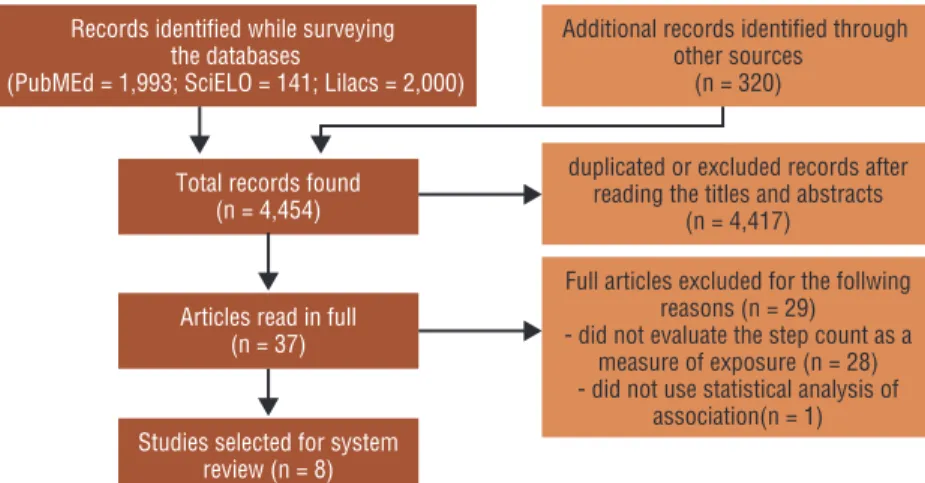
Studies whose samples consisted of young people of the general popu-lation were selected. Studies involving specific groups of patients with previously diagnosed diseases were not included in the review. The stages of study selection are illustrated in Figure 1.
Extraction of data
The information extracted from the articles selected for this review focused on the following items:
1) Descriptive: study, year of publication, study location, study design, sample size, age group, and sex.
2) Methodological: characteristics of exposure and outcome measure-ments and statistical analysis used.
3) Description of the main findings.
RESULTS
A total of 4,454 articles were retrieved, including 1,933 from PubMed, 141 from SciELO, 2,000 from LILACS, and 320 from other sources. After exclusion of duplicates and reading of the titles and abstracts, 37 articles remained for full-text reading. After this step, 29 articles were excluded for the following reasons: the study did not evaluate the number of steps as an exposure variable (n=28) or did not use statistical association analysis (n=1). Finally, eight articles were selected for the systematic review (Figure 1).
Figure 1. Flow chart of the selection process of articles for the systematic review.
Study location, design and population
31 May 2016). The oldest study was published in 200918 and the latest in
201619. Four of the eight studies analyzed were conducted in Australia18,20-22,
three in Brazil19,23,24, and one in Portugal25. Five different samples and/
or databases were investigated in the eight selected articles, considering that different studies used the same database (Canberra, Australia20-22 and
Viçosa, Minas Gerais, Brazil23,24). Five studies had a cross-sectional
de-sign18,19,23-25 and three were cohort studies20-22. Regarding the population
studied, seven articles investigated both sexes19-25 and one only females18.
Age ranged from 6 to 18 years in the samples studied. The sample size of the studies ranged from 18723,24 to 1,139 participants19 (Table 1).
Exposure, outcome and statistical analysis
Five different pedometer brands and/or models were used. In seven stud-ies, the pedometer was used by young people for seven days19-25 and in
one study for four days18. The following cardiometabolic outcomes were
investigated: high blood pressure (three studies), insulin resistance (two studies), metabolic syndrome (two studies), hyperglycemia (one study), lipid profile (one study), dyslipidemia (one study), hypertriglyceridemia (one study), low HDL-cholesterol (one study), and presence of one or more clustered cardiometabolic risk factors (one study). Regarding statistical treatment, a generalized linear mixed model was used in three studies, logistic regression and ROC curves in two studies, and Poisson regression in one study (Table 1).
Main findings
Seven studies observed some significant association between step count and cardiometabolic risk factors19-25. However, in most studies the associations
were not significant for either sex or different outcomes (Table 2). Three cross-sectional studies investigated high blood pressure as out-come18,19,24. Two of these studies found no association between step count
and the outcome18,24. On the other hand, in the study of Quadros et al.19,
young people with a larger number of daily steps were less likely to develop high blood pressure.
The two studies in which insulin resistance was the outcome were longitudinal studies that used the same database for analysis20,21. In one
study, the participants were followed up from 8 to 10 years of age20 and in
the other from 8 to 12 years21. In both studies, variations in the number
of steps explained changes in insulin resistance only in boys.
Metabolic syndrome was investigated as outcome in two cross-sectional studies that used the same database for analysis23,24. As observed for insulin
resistance, step count was only associated with metabolic syndrome in boys. The only study investigating hyperglycemia as outcome was a cross-sectional study that reported no association with step count19. On the other
Regarding lipid profile, the cross-sectional findings indicated that total cholesterol22 and HDL-cholesterol22,24 were associated with step count only
in boys. Dyslipidemia was investigated in one study that did not report an association with step count19. Two studies investigated hypertriglyceridemia
as outcome22,24 and an association with step count was found in one, but only
in boys22. According to the only longitudinal study, changes in the number of
steps from 8 to 12 years of age did not explain alterations in the lipid profile22.
DISCUSSION
To our knowledge, this is the first systematic review that investigated the association between step count and cardiometabolic risk factors in young
Table 1. Description of the selected studies on the association of step count with cardiometabolic risk factor in children and adolescents.
Study Year of
publication Location
Study
design Population
Evaluation of the number of steps
Cardiometabolic risk factor (outcome)
Statistical analysis
Schofield
et al.18 2009
Queensland, Australia
Cross-sectional
415 adolescent girls, mean age of 16 years
Monitoring for 4 days with a Yamax Digi-walker SW-700 pedometer
High blood pressure Logistic
regression
Telford et
al.20 2009
Canberra,
Australia Cohort
498 children (257 girls), follow-up from 8 to 10 years
Monitoring for 7 days with a Walk4Life pedometer
Insulin resistancea
Generalized linear mixed model
Moreira
et al.25 2011
Açores, Portugal
Cross-sectional
417 adolescents (243 girls), age from 15 to 18 years
Monitoring for 7 days with a Kenz Lifecorder Plus pedometer
Presence of one or more of the following cardiometabolic risk factors: abdominal obesity, hyperglyce-mia, low HDL-choles-terol, hypertriglyceri-demia, and high blood pressure
Logistic regression
Telford et
al.21 2012
Canberra,
Australia Cohort
534 children (278 girls), follow-up from 8 to 12 years
Monitoring for 7 days with a Walk4Life pedometer
Insulin resistancea
Generalized linear mixed model
Andaki et
al.24 2014
Viçosa, Mi-nas Gerais, Brazil Cross-sectional 187 children (106 girls), mean age of 9.90 years
Monitoring for 7 days with a DX-8897 pedometer
Hypertriglyceridemia, low HDL-cholesterol, high blood pres-sure, and metabolic syndromeb
ROC curve
Andaki et
al.23 2014
Viçosa, Mi-nas Gerais, Brasil Cross-sectional 187 children (106 girls), mean age of 9.90 years
Monitoring for 7 days with a DX-8897 pedometer
Metabolic syndromeb ROC curve
Telford et
al.22 2015
Canberra,
Australia Cohort
469 children (240 girls), follow-up from 8 to 12 years
Monitoring for 7 days with a Walk4Life pedometer
Altered lipid profile
Generalized linear mixed model
Quadros
et al.19 2016
Amargosa, Bahia, Brazil Cross-sectional 1,139 children and adolescents (633 girls), age from 6 to 18 years
Monitoring for 7 days with a Yamax Digi-walker SW-200 pedometer
Dyslipidemia, hyper-glycemia, and high blood pressure
Poisson regression
people. Only eight articles met the eligibility criteria of the review. An as-sociation between the exposure variable and some cardiometabolic outcome was observed in seven articles. However, the data suggest the absence of an association with hyperglycemia, were inconclusive for altered lipid profile and divergent for high blood pressure, and indicated an association with insulin resistance and metabolic syndrome only in boys.
The number of daily steps is a simple measure of the total volume of physical activity, which can be obtained objectively with a pedometer, a small, noninvasive inexpensive and easy-to-use device10. Furthermore,
stud-ies comparing pedometer and accelerometer estimates of physical activity have suggested a good correlation with total physical activity volume10,14,27.
Despite these advantages, the association of step count with cardiometa-bolic outcomes in childhood and adolescence is poorly understood. Most studies investigated overall physical activity or its domains and sedentary behavior as exposure variables rather than step count, a fact impairing the comparison of our findings with other studies.
Andersen et al.5 conducted a review on the relationship between physical
activity (evaluated by self-report or accelerometry) and cardiometabolic risk factors in children. Studies with different designs (observational, experi-mental, and reviews) were included and the findings indicated an association of physical activity practice with lower blood pressure levels and a healthy lipid profile. The association with metabolic syndrome was inconclusive in the studies that used self-report to measure physical activity, while a more consistent association was observed when accelerometry was used to estimate physical activity5. With respect to systematic reviews and meta-analysis
of intervention studies, the collected body of evidence indicates that an increase in physical activity is consistently associated with improvement in the cardiometabolic profile and with a reduction in the risk of developing metabolic syndrome and insulin resistance in young people6-8. Regarding
Table 2. Main findings of the selected studies on the association of step count with cardiometabolic risk factor in children and adolescents.
Study Main findings
Schofield et al.18 There was no association between step count and high blood pressure.
Telford et al.20 In cross-sectional analysis, no significant association was found between
step count and insulin resistance in boys or girls, while longitudinal analysis revealed an association only in boys.
Moreira et al.25 Adolescents in the 4th quartile of step count were less likely to have one or
more metabolic risk factors compared to those in the 1st quartile (OR = 0.56).
Telford et al.21 Variations in step count explained changes in insulin resistance only in boys
(boys: β = -0.007, p = 0.039; girls: β = 0.0005, p = 0.85).
Andaki et al.24 Step count was a predictor of low HDL-cholesterol and metabolic syndrome
only in boys (AUC = 0.891 and AUC = 0.817, respectively).
Andaki et al.23 Step count was a predictor of metabolic syndrome only in boys (AUC = 0.891).
Telford et al.22 There was no evidence of a longitudinal relationship between step count and
lipid profile in either sex. In cross-sectional analysis, boys (but not girls) with a larger number of steps had higher HDL-cholesterol and lower triglyc-erides (p = 0.04 and p = 0.03, respectively).
Quadros et al.19 There was an association of step count with high blood pressure (PR = 1.32; p
sedentary behavior, Tremblay et al.28 suggested in a systematic review that
a decrease in any type of sedentary time (e.g., TV, computer, video game) is associated with a lower cardiometabolic risk in young people. In particular, evidence suggests that an additional two hours of watching TV per day is associated with a reduction in physical and psychosocial health, while a de-crease in the time spent in this activity results in a lower body mass index28.
Some methodological aspects of the studies included in the review should be addressed. The sample was smaller than 500 subjects in more than 70% of the studies and only one evaluated more than 1,000 partici-pants. This aspect is relevant because small sample sizes reduce the power of statistical association analysis between the exposure and outcome. The three longitudinal studies selected used the same database20-22, as did the
two cross-sectional studies23,24. This fact may have overestimated the results
of association analysis in these studies, especially for insulin resistance and metabolic syndrome. The way the outcomes were analyzed is another factor that can affect the associations with step count. In the longitudinal studies, the outcomes were analyzed continuously, while the outcomes were categorized in the cross-sectional studies. Although categorization is interesting because it discriminates risk groups, there is no consensus in the literature on the criteria used to classify different cardiometabolic outcomes. For example, different cut-offs can be used to classify lipid profile components (triglycerides, total cholesterol and fractions)29,30 or to diagnose
metabolic syndrome26,31. In other words, in addition to reducing the power
of association analysis, outcome categorization can impair comparison even between studies that investigate the same outcome. According to Andersen et al.5, more consistent associations with physical activity are observed
when the cardiometabolic outcomes are analyzed as continuous variables. With respect to the devices and procedures used for the measurement of step count, three studies did not report information about the validity of pedometers for the pediatric population23-25.The lack of this information is
a matter of concern given that validity corresponds to the degree to which the device is able to determine the true value of what is being measured. Regarding the time of pedometer use, seven studies monitored the number of steps for one week19-25 and one study for four days18. Tudor-Locke et
al.32 suggested the measurement for only three days to correspond to the
average daily steps of a person (r=0.80). On the other hand, Clemes et al.10
reported that the ideal number of days for monitoring step count in the pediatric population is still undetermined, although the usual number is seven consecutive days. Although the results of the reactivity of children to sealed or unsealed pedometer monitoring are conflicting10, it should
be noted that three of the selected studies used unsealed pedometers to monitor the number of steps of young people19,23,24. In all cross-sectional
studies, step count was categorized for association analysis and different classification criteria were used. Two studies23,24 classified the number of
steps according to the cut-off values proposed by Vincenti and Pangrazi33,
clas-sified the sample based on quartiles and on the recommendation proposed for adults (10,000 steps per day). The lack of consensus on the classification of step count in young people impairs the comparison among studies and represents an important challenge for future research in this field.
In addition to the methodological limitations of the selected studies, another factor that may explain the lack of more consistent associations between pedometer-measured physical activity and cardiometabolic out-comes in young people is the limitation of pedometers, which evaluate only “walking” activity, i.e., the number of steps. Thus, this device does not take into consideration the intensity or duration of activities. This issue is more relevant among children who perform many short-duration intermittent activities in daily life. Recording only the number of steps may therefore not express the level of physical activity of this population group.
The inclusion of studies with repeat samples or those using the same database to compose the sample might be a limitation of this review be-cause of the possible overestimation of associations. However, these studies were maintained for two reasons: 1) the descriptive design of the present review, with no intention to perform a meta-analysis, and 2) the small number of articles that met the eligibility criteria. Another limitation was the fact that studies published before 2000 were not included. However, research of physical activity by motion sensors and of its association with cardiometabolic risk factors intensified after this year. Nevertheless, the articles included in this review were only published starting in 2009. The absence of quality analysis of the articles is another potential limitation.
CONCLUSION
The results of this systematic review of the association between step count and cardiometabolic risk factors in young people were inconclusive, despite the observation of associations with some cardiometabolic outcome in seven of the eight studies analyzed. The small number of articles that met the eligibility criteria and the different methodological problems of the selected studies were the main factors limiting inferences. Observational studies with a longitudinal design (cohort and case-control), larger sample size and accurate methodological control for the assessment of exposures and outcomes are necessary to determine the association between step count and cardiometabolic risk factors in children and adolescents.
COMPLIANCE WITH ETHICAL STANDARDS
Funding
This research receive grant from Coordination for the Improvement of Higher Education Personnel.
Conflict of interest statement
Author Contributions
Conceived and designed the experiments: APG, TMBQ , LRS. Performed the experiments: APG, TMBQ. Analyzed the data: APG, TMBQ. Con-tributed reagents/materials/analysis tools: APG, TMBQ , LRS. Wrote the paper: APG, TMBQ , LRS.
REFERENCES
1. Collaborators GBDRF, Forouzanfar MH, Alexander L, Anderson HR, Bachman VF, Biryukov S, et al. Global, regional, and national comparative risk assessment of 79 behavioural, environmental and occupational, and metabolic risks or clusters of risks in 188 countries, 1990-2013: a systematic analysis for the Global Burden of Disease Study 2013. Lancet 2015;386(10010):2287-323.
2. Chen W, Srinivasan SR, Li S, Xu J, Berenson GS. Clustering of long-term trends in metabolic syndrome variables from childhood to adulthood in Blacks and Whites: the Bogalusa Heart Study. Am J Epidemiol 2007;166(5):527-33.
3. Juhola J, Magnussen CG, Viikari JS, Kahonen M, Hutri-Kahonen N, Jula A, et al. Tracking of serum lipid levels, blood pressure, and body mass index from childhood to adulthood: the Cardiovascular Risk in Young Finns Study. J Pediatr 2011;159(4):584-90.
4. World Health Organization. Global health risks: mortality and burden of disease attributable to selected major risks. 2009; Available from: http://www.who.int/ healthinfo/global_burden_disease/GlobalHealthRisks_report_full.pdf [2015 jul 20].
5. Andersen LB, Riddoch C, Kriemler S, Hills AP. Physical activity and cardiovas-cular risk factors in children. Br J Sports Med 2011;45(11):871-6.
6. Guinhouya BC, Samouda H, Zitouni D, Vilhelm C, Hubert H. Evidence of the influence of physical activity on the metabolic syndrome and/or on insulin resistance in pediatric populations: a systematic review. Int J Pediatr Obes 2011;6(5-6):361-88.
7. Cesa CC, Sbruzzi G, Ribeiro RA, Barbiero SM, de Oliveira Petkowicz R, Eibel B, et al. Physical activity and cardiovascular risk factors in children: meta-analysis of randomized clinical trials. Prev Med 2014;69:54-62.
8. Miranda VPN, Amorim PRS, Oliveira NCB, Peluzio MCG, Priore SE. Effect of physical activity on cardiometabolic markers in adolescents: systematic review. Rev Bras Med Esporte 2016;22(3):235-42.
9. Ainsworth B, Cahalin L, Buman M, Ross R. The current state of physical activity assessment tools. Prog Cardiovasc Dis 2015;57(4):387-95.
10. Clemes SA, Biddle SJ. The use of pedometers for monitoring physical activity in children and adolescents: measurement considerations. J Phys Act Health 2013;10(2):249-62.
11. Brooke HL, Corder K, Atkin AJ, van Sluijs EM. A systematic literature review with meta-analyses of within- and between-day differences in objectively meas-ured physical activity in school-aged children. Sports Med 2014;44(10):1427-38.
12. Vanhelst J, Beghin L, Duhamel A, Bergman P, Sjostrom M, Gottrand F. Com-parison of uniaxial and triaxial accelerometry in the assessment of physical activity among adolescents under free-living conditions: the HELENA study. BMC Med Res Methodol 2012;12:26.
13. Knuth AG, Assuncao MC, Goncalves H, Menezes AM, Santos IS, Barros AJ, et al. Methodological description of accelerometry for measuring physical activity in the 1993 and 2004 Pelotas (Brazil) birth cohorts. Cad Saude Publica 2013;29(3):557-65.
14. McNamara E, Hudson Z, Taylor SJ. Measuring activity levels of young people: the validity of pedometers. Br Med Bull 2010;95:121-37.
16. Moher D, Liberati A, Tetzlaff J, Altman DG, PRISMA Group. Preferred report-ing items for systematic reviews and meta-analyses: the PRISMA statement. Ann Intern Med 2009;151(4):264-9.
17. Higgins JPT, Green S. Cochrane Handbook for Systematic Reviews of Interven-tions Version 5.1.0. 2011; Available from: http://www.cochranelibrary.com/about/ about-cochrane-systematic-reviews.html [2016 nov 11].
18. Schofield G, Schofield L, Hinckson EA, Mummery WK. Daily step counts and selected coronary heart disease risk factors in adolescent girls. J Sci Med Sport 2009;12(1):148-55.
19. Quadros TM, Gordia AP, Silva LR, Silva DA, Mota J. Epidemiological survey in schoolchildren: determinants and prevalence of cardiovascular risk factors. Cad Saude Publica 2016;32(2):e00181514.
20. Telford RD, Cunningham RB, Shaw JE, Dunstan DW, Lafferty AR, Reynolds GJ, et al. Contrasting longitudinal and cross-sectional relationships between insulin resistance and percentage of body fat, fitness, and physical activity in children-the LOOK study. Pediatr Diabetes 2009;10(8):500-7.
21. Telford RD, Cunningham RB, Telford RM, Kerrigan J, Hickman PE, Potter JM, et al. Effects of changes in adiposity and physical activity on preadolescent insulin resistance: the Australian LOOK longitudinal study. PLoS One 2012;7(10):e47438.
22. Telford RD, Cunningham RB, Waring P, Telford RM, Potter JM, Hickman PE, et al. Sensitivity of blood lipids to changes in adiposity, exercise, and diet in children. Med Sci Sports Exerc 2015;47(5):974-82.
23. Andaki AC, Tinoco AL, Mendes EL, Andaki Junior R, Hills AP, Amorim PR. Anthropometry and physical activity level in the prediction of metabolic syndrome in children. Public Health Nutr 2014;17(10):2287-94.
24. Andaki ACR TA, Andaki Júnior R, Santos A, Brito CJ, Mendes EL. Physical activity level as a predictor of cardiovascular risk factors in children. Motriz: Rev Educ Fis 2013;19(3):S8-15.
25. Moreira C, Santos R, de Farias Junior JC, Vale S, Santos PC, Soares-Miranda L, et al. Metabolic risk factors, physical activity and physical fitness in Azorean adolescents: a cross-sectional study. BMC Public Health 2011;11:214.
26. de Ferranti SD, Gauvreau K, Ludwig DS, Neufeld EJ, Newburger JW, Rifai N. Prevalence of the metabolic syndrome in American adolescents: findings from the Third National Health and Nutrition Examination Survey. Circulation 2004;110(16):2494-7.
27. Rush E, Coppinger T, Obolonkin V, Hinckson E, McGrath L, McLennan S, et al. Use of pedometers to identify less active children and time spent in moderate to vigorous physical activity in the school setting. J Sci Med Sport 2012;15(3):226-30.
28. Tremblay MS, LeBlanc AG, Kho ME, Saunders TJ, Larouche R, Colley RC, et al. Systematic review of sedentary behaviour and health indicators in school-aged children and youth. Int J Behav Nutr Phys Act 2011;8:98.
29. Back Giuliano Ide C, Caramelli B, Pellanda L, Duncan B, Mattos S, Fonseca FH, et al. I Diretriz de Prevenção da Aterosclerose na Infância e na Adolescência. Arq Bras Cardiol 2005;85:S4-36.
30. Expert Panel on Integrated Guidelines for Cardiovascular H, Risk Reduction in C, Adolescents, National Heart L, Blood I. Expert panel on integrated guidelines for cardiovascular health and risk reduction in children and adolescents: summary report. Pediatrics 2011;128:S213-56.
CORRESPONDING AUTHOR
Alex Pinheiro Gordia
Federal University of Reconcavo of Bahia
Av. Nestor de Melo Pita, 535-Centro, CEP: 45300-000, Amargosa, Bahia, Brazil
E-mail: [email protected]
32. Tudor-Locke C, Burkett L, Reis JP, Ainsworth BE, Macera CA, Wilson DK. How many days of pedometer monitoring predict weekly physical activity in adults? Prev Med 2005;40(3):293-8.
33. Vincent SD, Pangrazi, RP. An examination of the activity patterns of elementary school children. Pediatr Exerc Sci 2002;14(4):434-41.