ISSN 0001-3765 www.scielo.br/aabc
The seed coat of
Phaseolus vulgaris
interferes with
the development of the cowpea weevil
[
Callosobruchus maculatus
(F.) (Coleoptera: Bruchidae)
]
LUCIANA B. SILVA1, MAURÍCIO P. SALES2, ANTÔNIA E.A. OLIVEIRA1, OLGA L.T. MACHADO1, KÁTIA V.S. FERNANDES1 and JOSÉ XAVIER-FILHO1 1Laboratório de Química e Função de Proteínas e Peptídeos, Centro de Biociências e Biotecnologia,
Universidade Estadual do Norte Fluminense, 28015-620 Campos dos Goytacazes, RJ, Brasil 2Departamento de Bioquímica, Universidade Federal do Rio Grande do Norte, 59072-970 Natal, RN, Brasil
Manuscript received on August 21, 2003; accepted for publication on October 1, 2003; contributed byJosé Xavier-Filho*
ABSTRACT
We have confirmed here that the seeds of the common bean (Phaseolus vulgaris, L.) do not support develop-ment of the bruchidCallosobruchus maculatus(F.), a pest of cowpea [Vigna unguiculata(L.) Walp] seeds. Analysis of the testa (seed coat) of the bean suggested that neither thickness nor the levels of compounds such as tannic acid, tannins, or HCN are important for the resistance. On the other hand, we have found that phaseolin (vicilin-like 7S storage globulin), detected in the testa by Western blotting and N-terminal amino acid sequencing, is detrimental to the development ofC. maculatus. As for the case of other previously stud-ied legume seeds (Canavalia ensiformisandPhaseolus lunatus) we suggest that the presence of vicilin-like proteins in the testa ofP. vulgarismay have had a significant role in the evolutionary adaptation of bruchids to the seeds of leguminous plants.
Key words:common bean, phaseolin (vicilin), testa, resistance, cowpea weevil.
INTRODUCTION
The common bean (P. vulgaris L.) is a widely cultivated, high-protein containing, legume origi-nated in the New World which has been domes-ticated both in Meso America and South America (Smartt 1990). The common bean seeds are en-dowed with an array of low and high molecular weight substances that protect them against attack by many herbivores (Smartt 1990). Many proteins like lectins,α-amylase inhibitors, arcelins, trypsin inhibitors and others, while protecting the seeds against insects and herbivores in general do not
pro-*Member of Academia Brasileira de Ciências Correspondence to: José Xavier-Filho E-mail: [email protected]
tect them against attack by pests, which presum-ably have co-evolved with the species (Sales et al. 2000). Some of these pests like the weevils Acan-thoscelides obtectusSay andZabrotes subfasciatus
This discrimination may be explained by dif-ferent mechanisms one of them being possibly the presence of proteins in the testa, which may cause a delay in the development or entail death of young larvae. We have recently suggested that the seeds of the legumesP., andC. ensiformiswhich are of New World origin and related toP. vulgarisare resistant to attack byC. maculatusdue to the presence of vi-cilins (7S storage globulins), in the testa (Oliveira et al. 1999, Moraes et al. 2000).
MATERIALS AND METHODS
Seeds. Common bean [P. vulgaris, WAF-9 (white testa) and ‘‘preto’’ (black testa) genotypes] seeds were provided by Empresa de Pesquisa Agropecuá-ria do Rio de Janeiro (Campos dos Goytacazes, RJ, Brazil). Seeds of theC. maculatus-susceptible cow-pea (V. unguiculata) cultivars EPACE-10 (brown testa) and ‘‘fradinho’’ (white testa) were obtained from Centro de Ciências Agrárias, Universidade Fe-deral do Ceará (Fortaleza, Brazil) and in local mar-kets.C. maculatus-resistant cowpea seeds (IT81D-1045, brown testa) were obtained from IITA (In-ternational Institute of Tropical Agriculture, Ibadan, Nigeria), Ibadan, Nigeria trough Centro Nacional de Pesquisa do Arroz e Feijão-Embrapa, Goiânia, Brazil. C. maculatus (cowpea weevil) were pro-vided by J.H. Ribeiro dos Santos from Centro de Ciências Agrárias, Universidade Federal do Ceará (Fortaleza, Brazil) and were maintained in culture (28-30˚C and 65-75% relative humidity). We em-ployed an antibody against cowpea vicilins raised in white rabbits previously prepared by us and an antibody againstP. vulgarisphaseolin kindly pro-vided by Dr. Maarten Chrispeels (Dept. of Biology, University of California, San Diego, USA).
C. maculatusbehavior. Development ofC.
macu-latusonP. vulgarisseeds was observed by placing 2-day old females in glass vials containing ten seeds at 28˚C, 60% relative humidity. After 2 days insects were discarded and the numbers of laid and hatched eggs were counted. Seeds were observed daily for any emergence of adults until the experiment was
discarded (40 days). Three replicates were run. For each replicate one seed was chosen for counting the holes made in the testa by larvae.
The effects of the various seed and testa meals and fractions thereof onC. maculatusdevelopment were assessed through an artificial seed assay (Macedo et al. 1993). Briefly, artificial seeds (400 mg) were made of finely ground cowpea seed meal (EPACE-10) mixed with the materials of interest. For testa meals we used concentrations of 1.0, 2.0, 4.0, 8.0 and 16% and for globulin fractions these were 1.0, 2.0, 4.0 and 8.0%.
Infestation of artificial seeds was accomplished by placing 2-day old female insects in glass vials containing two seeds for 24 hours at 28˚C, 60% relative humidity. Excess laid eggs were removed from the seeds leaving 2-3 eggs per seed. After 20 days (at 28˚C, 60% relative humidity) infested seeds were opened and the weight and number of larvae were counted. Dose-response curves were drawn and the effective doses for 50% response (ED50, %)
and lethal-doses (LD50, %) were calculated.
Con-trol seeds were made with the meal of cowpea seeds without additions. All the experiments were run in triplicate and the data shown are the average of these.
Seed protein isolation. Seeds were carefully dis-sected in order to separate embryonic tissues from the testa. The finely ground meals of testa-free seeds and testa of P. vulgaris (WAF-9) were ex-tracted (1:10, meal to buffer ratio) for 3 h at 5˚C, with 50 mM sodium tetra borate buffer, pH 8.0; the resulting slurry was centrifuged at 10000×g for 30 min at 4˚C. The crude extracts obtained were fractionated by ammonium sulfate and the proteins precipitating between 70 and 90% saturation were collected, dialyzed against water and freeze dried for further analysis.
water and the samples containing testa proteins were recovered by freeze-drying.
Embryo vicilins (or phaseolin) were purified by chromatography in a Sephacryl S-400 column (60×
2.5 cm) employing 0.1 M Tris-HCl, 0.25 M NaCl, pH 8.0 as equilibration and elution buffer (Macedo et al. 1995).
Chemical analysis.Protein was determined by the dye binding method of Bradford (1976) or alterna-tively by the absorbance at 280 nm. An ELISA assay employing an antibody produced againstP. vulgaris
phaseolin was used to quantify phaseolin in testa and embryo tissues.
The presence of phenols in testa and embryo tissues and their quantitation were determined by a procedure described by Chiang and Jackay (1988) that is based on the formation of color complexes between ferric ion and phenol. Tannins were deter-mined by a procedure based on the complex forma-tion between these compounds and proteins, which employs rabbit blood as the source of proteins (Chi-ang and Jackay 1988).
The presence of cyanide resulting from the hy-drolysis of cyanogenic glycosides was measured by the method described by Esashi et al. (1991), which is based in the reaction of HCN with chloramine-T.
Polyacrylamide gel electrophoresis and West-ern blotting. SDS-PAGE was performed accord-ing to Laemmli (1970). Samples (20mug)were dissolved in 0.05 M Tris, 12% glycerol, 4% SDS, 0.01% bromophenol blue, 2% β-mercaptoethanol and heated for 3 min at 100˚C. Electrophoresis was run at 15 mA and gels were stained by 0.05% Coomassie Blue and de-stained in acetic acid. Fol-lowing SDS-PAGE Western blotting was done using nitro-cellulose membranes according to Towbin et al. (1979).
N-amino acid sequencing. N-terminal amino acid sequences were performed on a Shimadzu PPSQ-10Automated Protein Sequencer performing Edman degradation. Sequences were determined from pro-teins blotted on PVDF membranes after SDS-PAGE. PTH-amino acids were detected at 269 nm after
sep-aration on a reverse-phase C18 column(4.6 mm×
2.5 mm)under isocratic conditions, according to the manufacturer’s instructions. The sequences were compared to amino acid data banks. The se-quences selected were submitted to automatic align-ment, which was performed by using the NCBI-BLAST search system.
RESULTS
The thickness of the testa of the seeds of P. vul-garisemployed in this study (WAF-9 and ‘‘preto’’ genotypes) was 0.13±0.03 mm and of seeds of
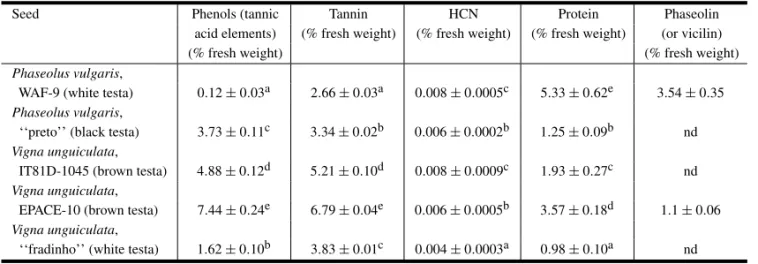
V. unguiculata(EPACE-10 and IT81D-1045 geno-types) was 0.11±0.03 mm and 0.12±0.02 mm, respectively. Several components of the testa were measured in these and other seeds. Some of these compounds are thought to be detrimental to the de-velopment of insects and ofC. maculatusin partic-ular (Janzen 1977, Boughdad et al. 1986). Data in Table II show a high variability in the levels of all the components examined. The level of phenols (as tannic acid) in the testa ofV. unguiculata (EPACE-10) is more than 60 times that inP. vulgaris(WAF-9) while tannin varies only 2.6 times between the testa of these same seeds. The concentration of cyanide (as HCN) varies 2 times between the lowest level (that inV. unguiculata, ‘‘fradinho’’) and the highest (inP. vulgaris, WAF-9). As for protein, the testa of
P. vulgaris(WAF-9) shows the highest level while the level of vicilin (phaseolin) is higher than in the testa ofV. unguiculata(EPACE-10).
We observed that a high proportion (98.7±
1.9 and 86.6±2.9%, respectively) ofC. maculatus
eggs laid onP. vulgarisseeds (‘‘preto’’ and WAF-9 genotypes) hatch but do not give rise to adults. Furthermore, 62.1±5.0 and 46.2 ±3.9% of the larvae die on the testa, respectively. All remaining larvae die during penetration of embryonic tissues.
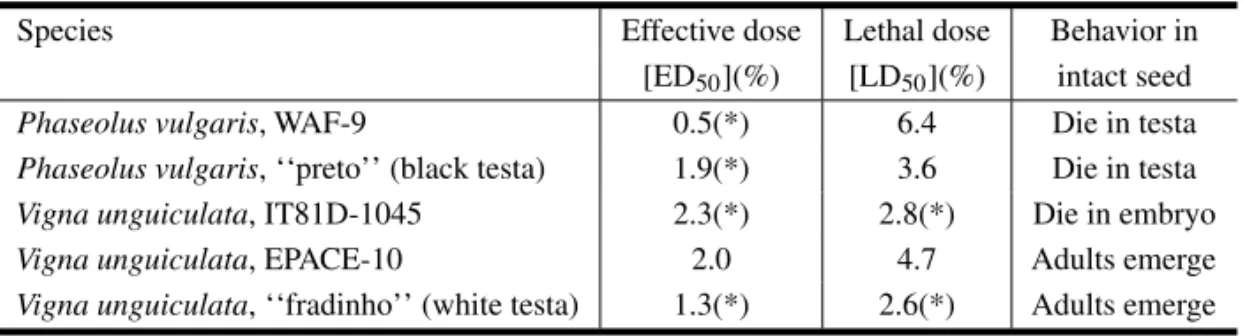
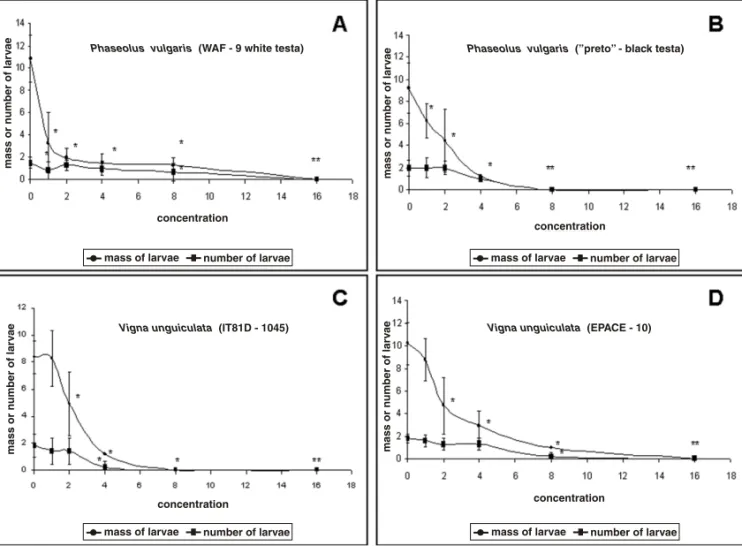
The powdered testa tissues ofP. vulgarisand
V. unguiculatawhen incorporated in artificial seeds are highly detrimental to the larval development of
TABLE I
Seed color and mass and testa thickness for some legume seeds.
Seed color Mass of one Testa thickness
seed (g) (mm)
P. vulgaris(WAF-9) White 0.13±0.03
P. vulgaris‘‘preto’’ Black 0.13±0.03
V. unguiculata(EPACE-10) Brown 0.21±0.007 0.11±0.03
V. unguiculata(IT81D-1045) Dark brown 0.12±0.02
The values given are the average(±sd)of twenty determinations.
TABLE II
Phenols, tannin, HCN, protein and phaseolin (or vicilin) contents (as percentage of the fresh weight) of testa tissue of
Phaseolus vulgarisandVigna unguiculata.
Seed Phenols (tannic Tannin HCN Protein Phaseolin
acid elements) (% fresh weight) (% fresh weight) (% fresh weight) (or vicilin)
(% fresh weight) (% fresh weight)
Phaseolus vulgaris,
WAF-9 (white testa) 0.12±0.03a 2.66±0.03a 0.008±0.0005c 5.33±0.62e 3.54±0.35
Phaseolus vulgaris,
‘‘preto’’ (black testa) 3.73±0.11c 3.34±0.02b 0.006±0.0002b 1.25±0.09b nd
Vigna unguiculata,
IT81D-1045 (brown testa) 4.88±0.12d 5.21±0.10d 0.008±0.0009c 1.93±0.27c nd
Vigna unguiculata,
EPACE-10 (brown testa) 7.44±0.24e 6.79±0.04e 0.006±0.0005b 3.57±0.18d 1.1±0.06
Vigna unguiculata,
‘‘fradinho’’ (white testa) 1.62±0.10b 3.83±0.01c 0.004±0.0003a 0.98±0.10a nd
Values are means±sd of three independent experiments. Values followed by the same letter in a column are not significantly different (Duncan’s multiple range test, P≤0.05). nd, not determined.
equally affect the development of this bruchid. Vicilins (7S globulins or phaseolins) isolated from both embryo and testa tissues of P. vulgaris
seeds were shown to be as detrimental toC. macula-tusdevelopment as vicilin isolated from the embryo of resistantV. unguiculataseeds (Table IV).
Protein bands fromP. vulgarisembryo and testa separated by PAGE-SDS and that react with anti-body againstP. vulgarisphaseolin are seen in Fig. 2. The protein bands of interest (I, II, III, IV, Fig. 2) were transferred to PVDF membranes and excised thereof and submitted to N-terminal amino acid se-quencing. Sequences are shown in Fig. 3 with the accompanying sequence of the N-terminal portion
of a known phaseolin molecule [gi: 230247].
DISCUSSION
We have here confirmed previous observations that the seeds ofP. vulgaris do not support the devel-opment of the bruchidC. maculatus(Applebaum et al. 1970). This has been explained by the action of toxic constituents present in these seed such as
TABLE III
Effect of the addition of testa flours ofPhaseolus vulgarisandVigna unguiculataseeds on the development ofCallosobruchus maculatus.
Species Effective dose Lethal dose Behavior in
[ED50](%) [LD50](%) intact seed
Phaseolus vulgaris, WAF-9 0.5(*) 6.4 Die in testa
Phaseolus vulgaris, ‘‘preto’’ (black testa) 1.9(*) 3.6 Die in testa
Vigna unguiculata, IT81D-1045 2.3(*) 2.8(*) Die in embryo
Vigna unguiculata, EPACE-10 2.0 4.7 Adults emerge
Vigna unguiculata, ‘‘fradinho’’ (white testa) 1.3(*) 2.6(*) Adults emerge
Effective doses for 50% response (ED50, %) are the concentrations of protein fractions that decrease the mass of the larvae to 50% of the mass of the control. Lethal doses (LD50, %) are the concentrations of protein fractions that decrease the number of larvae to 50% of the number found in control seeds. The values were calculated from dose-response curves [values marked (*) were computed from regression curves that showed r values with P < 0.1; all others P > 0.01].
TABLE IV
Effective doses for 50% response (ED50±sd) for 20-day larvae of Callosobruchus maculatusfed on artificial seeds containing vicilins isolated from legume seeds.
Vicilin origin [ED50] %±sd %±sd %
Embryo ofPhaseolus vulgaris, WAF-9 2.22±0.64
Testa ofPhaseolus vulgaris, WAF-9 0.84±0.10
Embryo ofVigna unguiculata(EPACE-10) 6.3*
Embryo ofVigna unguiculata(IT81D-1045) 1.07±0.32**
Effective doses for 50% response (ED50, %) are the concentrations of protein frac-tions that decrease the mass of the larvae to 50% of the mass of the control. The values were calculated from dose-response curves. Values taken from Moraes et al. (2000) and values taken from Yunes et al. (1998).
the viable larvae (62.1% to 46.2%, depending on the bean genotype studied) die on the testa. All re-maining larvae die during penetration of embryonic tissues, possibly as a result of ingesting the mix of its toxic components. These findings strongly suggest that the testa is an important barrier to the infestation ofP. vulgarisseeds byC. maculatusand is in line with our previous reports on its role in the discrim-ination of the seeds of the legumesP. lunatusand
C. ensiformisby this bruchid (Oliveira et al. 1999,
Moraes et al. 2000).
Phaseolus vulgaris(WAF - 9 white testa) Phaseolus vulgaris (”preto” - black testa)
Vigna unguiculata(IT81D - 1045) Vigna unguiculata(EPACE - 10)
mass
or
n
u
mber
of
lar
v
a
e
mass
or
n
umber
of
lar
v
ae
mass
or
n
umber
of
lar
v
ae
mass
or
n
umber
of
lar
v
ae
concentration
concentration
concentration concentration
mass of larvae number of larvae
mass of larvae number of larvae mass of larvae number of larvae mass of larvae number of larvae
Fig. 1 – Effect of ground testa tissues ofPhaseolus vulgarisandVigna unguiculataseeds onCallosobruchus maculatuslarval development weight and survival after 20 days. Powdered testa of the several seeds [(A)P. vulgaris(WAF-9); (B)P. vulgaris
‘‘preto’’ black testa; (C)V. unguiculata(EPACE-10); (D)V. unguiculata(IT81D-1045)] were incorporated into artificial seeds in different concentrations (1.0, 2.0, 4.0, 8.0 and 16.0%). Error bars represent independent SEM (*indicates values significantly different, p≤0,05).
To examine the presence of factors possibly detrimental toC. maculatusdevelopment in the testa of P. vulgaris we first incorporated finely ground testa tissues in artificial seeds (Macedo et al. 1993) and supplied these to ovipositing females. The re-sults suggest that the testa tissues of the examined seeds do not support development of the bruchid even in those seeds (V. unguiculata) that are host to the insect (Table II and Fig. 1). We suggest that the testa of both P. vulgaris andV. unguicu-lataseeds contain detrimental factors toC. macu-latus but in the case of cowpea, intact tissues al-low crossing of this barrier without the insect be-ing affected. We have previously noticed that
aque-ous buffer-insoluble materials from the testa of both
Fig. 2 – SDS polycarylamide gel electrophoresis and Western blotting of proteins fromPhaseolus vulgarisseeds. (A) Coomassie blue staining (pro-tein) and (B) Western blotting employing an antiserum against phaseolin. (1) purified phaseolin from embryo; (2) total extracted proteins from embryo; (3) total extracted protein from testa; (M) molecular markers, kDa×103.
P. vulgaristesta band I S L S G S E X S Q D N P F Y N S
P. vulgaristesta band II X X L E E E X X S Q D N P F Y N S
P. vulgaristesta band III S L E E E X X S Q D N P F Y N S
P. vulgaristesta band IV X Q L R E E E X S Q D N P F
P. vulgarisphaseolin 1 T S L R E E E E S Q D N P F Y N S
[gi:230247]
Fig. 3 – N-terminal amino acid sequences of peptides isolated (by SDS-PAGE) from the testa ofPhaseolus vulgaris. The sequences of protein bands I-IV were compared with the sequence of phaseolin [gi:230247].
andP. lunatusand development or survival of this bruchid (Oliveira et al. 1999, Moraes et al. 2000).
Vicilins (or phaseolin) isolated fromC. macu-latus-resistant cowpea and P. vulgarisseeds were shown to be detrimental to the development of this insect (Yunes et al. 1998). Their presence in the testa of legume seeds (e.g. C. ensiformis andP. lunatus) may explain their resistance to the bruchid (Oliveira et al. 1999, Moraes et al. 2000). When we examined (by an ELISA assay) the levels of phase-olin in the testa ofP. vulgaris(WAF 9) we found a value more than 3×(3.54÷1.1)that for vicilin
from the C. maculatus-susceptible V. unguiculata
exam-ined show N-terminal sequences with a high degree of homology to a phaseolin isolated from the embryo.
We are then led to conclude that, as is the case with the legumesC. ensiformisandP. lunatus, the testa ofP. vulgarismay have been one of the factors which were important in the evolutionary discrim-ination of these seeds by bruchids (Janzen 1977, Jermy 1984, Oliveira et al. 1999, Moraes et al. 2000).
ACKNOWLEDGMENTS
This work was supported by grants from the Brazil-ian agencies Coordenação de Aperfeiçoamento de Pessoal de Nível Superior, Conselho Nacional de Desenvolvimento Científico e Tecnológico, Finan-ciadora de Estudos e Projetos, Programa de Apoio a Núcleos de Excelência, and from the Universidade Estadual do Norte Fluminense supporting body Fun-dação Estadual do Norte Fluminense.
RESUMO
Neste trabalho confirmamos a resistência do feijão comum
(Phaseolus vulgaris) ao bruquídeoCallosobruchus
mac-ulatus(F.), inseto que preda sementes de feijão-de-corda (Vigna unguiculata) (L.). A resistência desta semente não
está relacionada com a espessura do tegumento nem com
os níveis de diversos compostos como ácido taníco, fenóis
e ácido cianídrico conforme demonstram nossos
resulta-dos. No entanto, faseolina, detectada no tegumento por
‘‘Western blotting’’ e seqüenciamento N-terminal, é
tóx-ica aC. maculatus. Esses dados estão de acordo com
estu-dos anteriores feitos com duas outras sementes de
legumi-nosas (Canavalia ensiformisePhaseolus lunatus) e nos
levam a sugerir que a presença de proteínas do tipo vicilina
no tegumento de sementes de leguminosas tiveram papel
importante nos mecanismo de adaptação de bruquídeos a
sementes de leguminosas.
Palavras-chave: feijão comum, phaseolina (vicilina), tegumento, resistência, carundho do feijão-de-corda.
REFERENCES
Applebaum SW, Tadmore U and Podoler M.1970. The effect of starch and of a heteropolysaccharide fraction fromPhaseolus vulgarison development and fecundity ofCallosobruchus maculatus(F.). Ento-mol Exp Appl 13: 61-70.
Bewley JD and Black M.1994. Seeds: Physiology of Development and Germination, 2nd ed. Plenum Press, New York, p 44-50.
Boughdad AA, Gillon Y and Gagnepain C.1986. In-fluence du tégument des graines mûres deVicia faba
sur le développement larvaire de Callosobruchus maculatus. Entomol Exp Appl 42: 219-223.
Bradford MM.1976. A rapid and sensitive method for the quantitation of microgram quantities of protein utilizing the principle of protein-dye binding. Anal Biochem 72: 248-254.
Chiang HS and Jackay LEN.1988. Tough pod wall: A factor involved in cowpea resistance to pod sucking bugs. Insect Sci 9: 389-393.
Esashi Y, Isuzugawa K, Matsuyama S, Ashino H and Hasegawa R.1991. Endogenous evolution of hen during pre-germination periods in many seed species.Physiol Plant 83: 27-33.
Janzen D.1977. How Southern cowpea weevil larvae (Bruchidae:Callosobruchus maculatus) die on non-host seeds. Ecology 58: 921-927.
Jermy T.1984. Evolution of insect/host plant relation-ships. Amer Natural 124: 609-630.
Laemmli KA.1970. Cleavage of structural protein during assembly of head of bacteriophage T4. Nature 227: 680-685.
Macedo MRL, Andrade LBS, Moraes RA and Xavier-Filho J.1993. Vicilin variants and the re-sistance of cowpea (Vigna unguiculata) seeds to the cowpea weevil (Callosobruchus maculatus). Comp Biochem Physiol 105C: 89-94.
Macedo MRL, Fernandes KVS, Sales MP and Xavier-Filho J.1995. Purification and properties of storage proteins (vicilins) from cowpea (Vigna un-guiculata) seeds which are susceptible or resistant to the bruchid beetle. Braz J Med Biol Res 28: 183-190.
is detrimental toCallosobruchus maculatus(cowpea weevil). Braz J Med Biol Res 33: 191-198.
Oliveira AEA, Sales MP, Machado OLT, Fernandes KVS and Xavier-Filho J.1999. The toxicity of the jack bean [Canavalia ensiformis(L.) DC] cotyle-donary and testa proteins to the cowpea weevil [ Cal-losobruchus maculatus(F)]. Entomol Exp Appl 92: 249-255.
Sales MP, Gerhardt IR, Grossi-de-Sá MF and Xavier-Filho J.2000. Do Legume Storage Proteins Play a Role in Defending Seeds Against Bruchids? Plant Physiol. 124: 515-522.
Schoonhoven AV, Cardona C and Valor J. 1983. Resistance to the bean weevil and the Mexican bean weevil (Coleoptera: Bruchidae) in nonculti-vated common bean accessions. J Econ Entomol 76: 1255-1259.
Seifelnasr YE.1991. The role of asparagine and seed coat thickness in resistance ofPhaseolus vulgaris(L.) toCallosobruchus maculatus(F.) (Col., Bruchidae). J Appl Entomol 111: 412-417.
Smartt J. 1990. Grain Legumes – Evolution and Genetic Resources, Cambridge University Press, Cambridge, MA.
Towbin H, Stachelin NT and Gordon J. 1979. Electrophoretic transfer of proteins from polyacry-lamide gels to nitrocellulose sheets; procedures and some applications. Proc Nat Acad Sci USA 176: 4350-4354.