E-mail: [email protected]
Air pollutants and hospital admissions due to stroke
doi: 10.4136/ambi-agua.1318
Received: 14 Feb. 2014; Accepted: 07 Jul 2014
Samara Gavinier;Luiz Fernando Costa Nascimento*
Universidade de Taubaté (UNITAU), Taubaté, SP, Brasil *Corresponding author: e-mail: [email protected],
ABSTRACT
International studies have demonstrated associations between exposure to air pollutants and deaths and hospitalizations due to stroke. However, the profile of these associations is not known in Brazil. This study aims to estimate the association between exposure to air pollutants and hospital admissions due to stroke in individuals who live in a medium-sized city, Sorocaba, Sao Paulo, Brazil. This was ecological time-series study using hospitalization data relating to the diagnosis of stroke (ICD-10 I.60-I.64) in persons 50 years of age or older who resided in the city of Sorocaba between January 1, 2007 to December 31, 2011. The pollutants studied were particulate matter, ozone, nitrogen dioxide and nitrogen oxide, controlled by apparent temperature. The generalized additive model using Poisson regression for the day of hospitalization and for up to five days of lag was used for the analysis. It was not possible to estimate the association between exposure to daily levels of particulate matter, ozone and nitrogen oxide and hospitalizations for strokes, but it was possible to identify an association between exposure to nitrogen dioxide and hospitalization for stroke (RR = 1.004, 95% CI 1.000-1.008) for the third one-day lag. An increase of 10 g m-³ in concentrations of this pollutant represented an increase of 4 percentage points in the risk of hospitalization. Thus, it was established that the nitrogen dioxide is associated with hospitalization for stroke in a medium-sized city, i.e., Sorocaba.
Keywords: air pollution, stroke, time series studies, nitrogen dioxide.
Poluentes atmosféricos e internações por acidente vascular encefálico
RESUMO
Rev. Ambient. Águavol. 9 n. 3 Taubaté - Jul / Sep. 2014 aditivo generalizado pela regressão de Poisson para o dia da internação e para até cinco dias de defasagens. Não foi possível estimar associação entre a exposição aos níveis diários do material particulado, do ozônio e do óxido de nitrogênio e internações por AVE. Mas, foi possível identificar associação entre exposição ao dióxido de nitrogênio e a internação por acidente vascular encefálico (RR= 1,004; IC95% 1,000- 1,008), para o terceiro dia de defasagem. O incremento de 10 µg m-³ nas concentrações desse poluente representou um aumento de 4 pontos percentuais no risco de internação. Assim, foi possível identificar o dióxido de nitrogênio está associado à hospitalização por acidente vascular encefálico em uma cidade de médio porte, Sorocaba.
Palavras-chave: poluição do ar, acidente vascular cerebral, série temporal, dióxido de nitrogênio.
1. INTRODUCTION
Several studies have shown the harmful effects of air pollutants on human health. These studies have found that concentrations of air pollutants below the limit established by national and international governmental standards may significantly impact health (Brazil, 1990; Gouveia et al., 2006; Olmo et al., 2011).
Gaseous pollutants and inhalable particulate matter have acute and chronic effects on respiratory diseases (Cançado et al., 2006; Braga et al., 2007; Ignotti et al., 2010; Amancio and Nascimento, 2012), particularly in children and elderly people; they also significantly impact persons with cardiovascular disease (Cançado et al., 2006; Cendon et al., 2006; Braga et al., 2007; Nascimento, 2011; Gavinier and Nascimento, 2013). Data from hospital admissions, emergency care and mortality have been used to assess such effects.
The main emission sources of air pollutants are the burning of biomass, industries and motor vehicles (Harrison, 2006). The importance of studying the concentration of air pollutants in large cities is apparent, since these areas are heavily industrialized and have heavy vehicular traffic on both highways and in urban areas. However, few studies explore the effects of these pollutants in medium-sized cities.
Recently, three studies conducted in medium-sized Brazilian cities showed significant associations between air pollutant exposure and asthma hospitalization (Amancio and Nascimento, 2012), hospital admissions for ischemic heart disease (Nascimento, 2011) and hospitalization due to stroke (Nascimento et al., 2012).
Stroke is responsible for more morbidity and mortality than any other cardiovascular disease, and is considered the second leading cause of death worldwide (Donnan et al., 2008). Among Latin American countries, Brazil has considerable rates of mortality due to stroke (Lotufo, 2005).
In the year 2009, around 150,000 hospital admissions due to stroke occurred throughout Brazil. These resulted in about 30,000 deaths, with a cost to the national coffers of around R$ 240 million (1 US$ ≈ R$ 2.00). In the state of São Paulo alone, about 40,000 hospital
admissions were due to stroke. Mortality rates for that year were 18.98 per 100,000 inhabitants for Brazil and 20.64 for the state of São Paulo (Brazil, 2013).
Two international studies suggest plausible physiopathological relations. The exposure of individuals to high levels of air pollutants can aggravate or even trigger two possible mechanisms in the pathogenesis of cardiovascular disease (Brook et al., 2004; Pope et al., 2004).
air pollution present a plausible explanation for the occurrence of a sudden cardiovascular response, such as a stroke (Brook et al., 2004; Pope et al., 2004).
International studies have shown associations between air pollutants and deaths due to stroke (Hong et al., 2002.), as well as hospitalizations due to strokes (Hong et al., 2002; Tsai et al., 2003; Wellenius et al., 2005; Johnson et al., 2010); however, only one national study has been conducted (Nascimento et al., 2012).
This study therefore aims to estimate the association between daily exposure to air pollutants and hospital admissions for ischemic or hemorrhagic strokes in the residents of Sorocaba, São Paulo, Brazil, a medium-sized city.
2. MATERIAL AND METHODS
This was an ecological time-series study that used data from daily admissions of both sexes due to stroke in Sorocaba, Sao Paulo, Brazil. Stroke diagnosis (I60 - I64) was determined according to the 10th revision of the International Classification of Diseases. Sorocaba is considered a medium-size city, located in the southwestern region of the state of São Paulo, 90 km from São Paulo at latitude 23º 30' South and longitude 47° 27' West; it is intersected by the major highways of Castello Branco and Raposo Tavares that are heavily used by buses and trucks. Sorocaba has approximately 600 thousand inhabitants (IBGE, 2013), an industrial complex of just over 1,700 industries (Sorocaba, 2013), and a fleet of vehicles of about 200,000 cars and 60,000 motorcycles (IBGE, 2013).
This study included both sexes, aged over 50 years, residents of the city of Sorocaba. The study included the period from January 1, 2007 to December 31, 2011. Hospital admission data were obtained through the DATASUS site of the Hospital Information System (SIH) of the Unified Health System (SUS).
Data regarding daily levels of air pollutants concentrations, the average temperature and average relative humidity of air were supplied by the Environmental Agency of São Paulo (CETESB) in Sorocaba, which has a monitoring station located downtown. This station estimates the daily averages of particulate matter (PM10), and the maximum values of ozone (O3), nitrogen dioxide (NO2) and nitrogen oxide (NO) over 24 hours. The apparent temperature was used in this article because this variable considers average temperature and average relative humidity, (Barnett et al., 2010).
The number of daily admissions was the dependent variable and the levels of PM10, O3, NO2 and NO, quantified in g m-³, were the independent variables and were adjusted for the daily apparent temperature.
An initial descriptive analysis of each variable was conducted in terms of average values, minimum, maximum and standard deviation, and Pearson correlation coefficients were calculated to identify the correlation between exposure to air pollutants, apparent temperature, and hospitalizations.
The study used the generalized additive model (GAM) of Poisson regression. This model is an alternative to modeling nonlinear relationships that require a smaller number of explanatory variables. Furthermore, the GAM is used to calculate the relative risk, given that the outcome is a discrete variable, a rare event (Conceição et al., 2001).
Rev. Ambient. Águavol. 9 n. 3 Taubaté - Jul / Sep. 2014 The coefficients provided by GAM were transformed into relative risks (RR) to hospitalization. The risks of hospitalizations and percentage increase in these risks were estimated according to the increment of 10 g m-³ for each air pollutant.
We applied the following expression to estimate the percentage increase (PI): PI = (RR-1) x 100, where RR is defined as [exp (coef * 10)], where coef is the coefficient given by Poisson regression, in which 10 g m-³ were added to concentrations of air pollutants. Analyses were performed by SPSS v 17 and Statistica v. 7 software.
3. RESULTS AND DISCUSSION
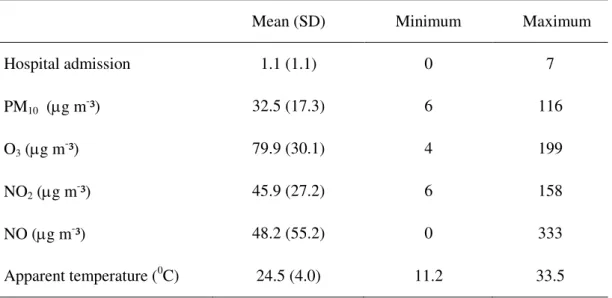
Data from 2047 hospitalizations due to stroke during the study period were obtained; 1083 hospitalizations were of men and 966 were of women. The minimum and maximum values, averages and standard deviations are presented in Table 1.
Table 1. Descriptive analysis of hospital admissions due to stroke, concentrations of air pollutants and climate variable. Sorocaba, SP, Brazil, 2007 to 2011.
Mean (SD) Minimum Maximum
Hospital admission 1.1 (1.1) 0 7
PM10 (g m-³) 32.5 (17.3) 6 116
O3 (g m-³) 79.9 (30.1) 4 199
NO2 (g m-³) 45.9 (27.2) 6 158
NO (g m-³) 48.2 (55.2) 0 333
Apparent temperature (0C) 24.5 (4.0) 11.2 33.5
SD= standard deviation.
There was a lack of data from independent variables ranging from 5.53 to 9.04%, but the missing data were randomly distributed over the entire period. On the other hand, the details of admissions due to stroke were available on all of the days of the study.
The means of PM10 and NO2 did not exceed the annual air quality standards, 50 g m-³ and 100 g m-³, respectively, established in 1990 by the Brazilian National Environmental Council (CONAMA) (Brazil, 1990). Nevertheless, the mean of O3 had 15 values exceeding the established limit throughout the study.
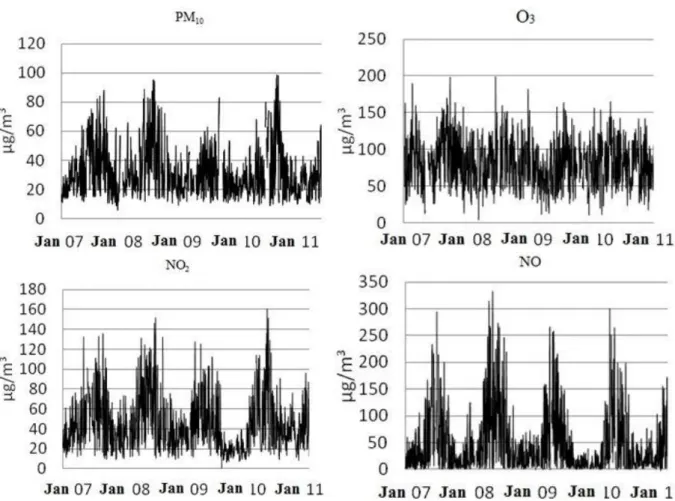
The distribution of the daily levels of air pollutants is shown in Figure 1. A seasonal pattern was observed, with the highest values in daily concentrations for PM10, NO2 and NO during the winter months. Nevertheless, the daily O3 concentrations showed an erratic pattern. Several studies used the average temperature and relative humidity (Tsai et al., 2003; Cendon et al., 2006; Gouveia et al., 2006; Braga et al., 2007; Andersen et al., 2010; Ignotti et al., 2010; Nascimento, 2011; Amancio and Nascimento 2012; Nascimento et al., 2012), but Barnett et al. (2010) argue that the apparent temperature is the best fit for such modeling. This study also used the apparent temperature, as did Wellenius et al. (2005).
Figure 1. Distribution of daily concentrations of particulate matter, ozone, nitrogen dioxide and nitrogen oxide in Sorocaba, SP, Brazil, 2007-2011.
Table 2. Pearson correlation matrix of concentrations of air pollutants, meteorological variable and
hospitalizations. Sorocaba, SP, Brazil, 2007 to 2011.
HA PM10 O3 NO2 NO AT
HA 1.00
PM10 0.02 1.00
O3 -0.01 0.47** 1.00
NO2 0.05* 0.83** 0.37** 1.00
NO 0.05* 0.71** 0.17** 0.75** 1.00
AT -0.02 0.27** 0.65** 0.14** -0.03 1.00
AT= apparent temperature; HA= hospital admission; ** p-value <0.01; * p-value <0.05.
This work used the generalized additive model instead of the generalized linear model, similar to the study by Amancio and Nascimento (2012). The use of GAM is justified by incorporating information about seasonal changes and trends between hospitalizations and climatic variables for this time series study (Conceição et al., 2001).
Rev. Ambient. Águavol. 9 n. 3 Taubaté - Jul / Sep. 2014
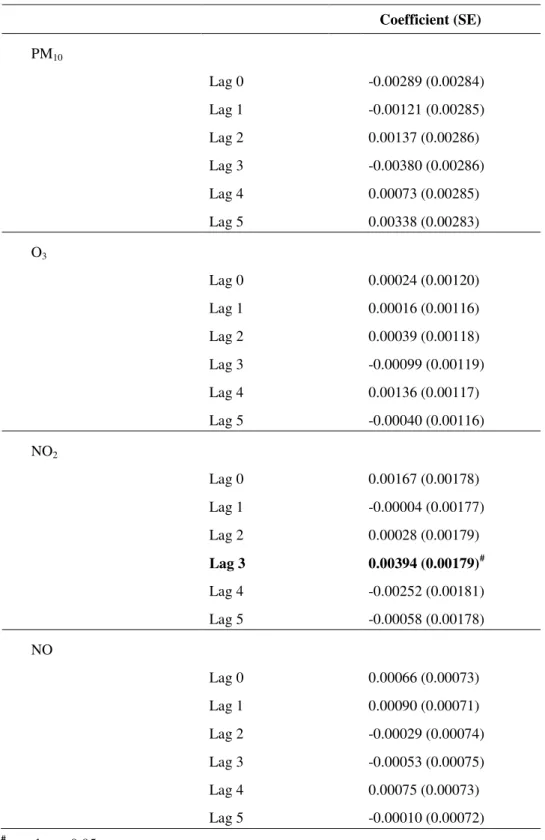
Table 3. Regression coefficients provided by the model for pollutants adjusted for apparent temperature, with the respective standard errors according lags 0-5 days for hospitalizations due to strokes. Sorocaba, SP, Brazil, 2007 to 2011.
# p-value < 0.05
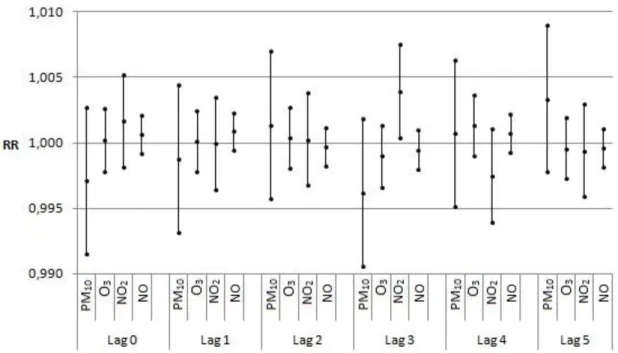
Figure 2 shows the relative risk (RR) for hospitalization in accordance with increment of 10 g m-³ in daily average concentrations of each air pollutant and 95% confidence intervals.
Coefficient (SE)
PM10
Lag 0 -0.00289 (0.00284)
Lag 1 -0.00121 (0.00285)
Lag 2 0.00137 (0.00286)
Lag 3 -0.00380 (0.00286)
Lag 4 0.00073 (0.00285)
Lag 5 0.00338 (0.00283)
O3
Lag 0 0.00024 (0.00120)
Lag 1 0.00016 (0.00116)
Lag 2 0.00039 (0.00118)
Lag 3 -0.00099 (0.00119)
Lag 4 0.00136 (0.00117)
Lag 5 -0.00040 (0.00116)
NO2
Lag 0 0.00167 (0.00178)
Lag 1 -0.00004 (0.00177)
Lag 2 0.00028 (0.00179)
Lag 3 0.00394 (0.00179)#
Lag 4 -0.00252 (0.00181)
Lag 5 -0.00058 (0.00178)
NO
Lag 0 0.00066 (0.00073)
Lag 1 0.00090 (0.00071)
Lag 2 -0.00029 (0.00074)
Lag 3 -0.00053 (0.00075)
Lag 4 0.00075 (0.00073)
Figure 2. Relative risks (RR) for the increment of 10g m-³ and 95% confidence interval for hospitalizations due to stroke at the exposure of pollutants study adjusted by apparent temperature in each lag structure. Sorocaba, SP, Brazil, 2007 to 2011.
We notice that the RR for hospitalizations due to strokes was small. Furthermore, exposure to inhalable particulate matter, ozone and nitrogen oxide showed no significant association with the values of hospital admissions for stroke. On the other hand, nitrogen dioxide showed a significant result.
In our study model, the relative risk to hospitalizations due to strokes after exposure to NO2 reached 1.004 (95% CI 1.000 - 1.008) in the third day lag. This RR estimated an increase of 4 percentage points for the total admissions due to stroke, when considering 10 gm-³ increase in the concentration of this pollutant.
Despite the small magnitude of the RR obtained in this study, the impact of air pollutants on human health must be considered due to the large number of individuals exposed.
A 10-year cohort study with control variables conducted in London (Maheswaran et al., 2010) showed that patients who suffered the first stroke had reduced survival under high concentrations of the pollutants studied. Increased mortality after stroke was observed after exposure to PM10 and NO2, but it was more significant for NO2, which is related to vehicular traffic. An increase of 10 gm-³ in NO2 concentrations was associated with an increase of 28% (95% CI 11% - 48%) in mortality risk, according to these authors.
Another study carried out in nine U.S. cities (Wellenius et al., 2005) identified an association between exposure to air pollutants and increased admissions on the same day. A 2.94% (1.78 to 4.12) percentage increase in the rate of hospitalization due to ischemic stroke after exposure to NO2 was observed, but no association was observed between exposure to any air pollutant and hospitalizations due to hemorrhagic in lags of 0 up to lags of 2. However, our study did not observe the acute effect in the associations between air pollutants and hospital admissions due to stroke.
Rev. Ambient. Águavol. 9 n. 3 Taubaté - Jul / Sep. 2014 during a follow-up of about 10 years. The associations were stronger for the ischemic and unspecified stroke, whereas no association was detected with hemorrhagic stroke.
However, a study in London (Maheswaran et al., 2012) identified no association between NO2 exposure and incidence of hemorrhagic, ischemic and total stroke. Only borderline values of rate ratio of 1.23 (95% CI 0.99 - 1.53) for 10 µg m-³ increase in concentration of the pollutant NO2 were noted, considering people 65 to 79 years old.
A similar study carried out in Copenhagen, Denmark, used a case-crossover model, a variant of case-control, with temporal stratification to study the effects of temporary exposures in acute events (Andersen et al., 2010), and found that ultrafine particles - PM 0,1- (particles <0.1 mm in diameter) acted as a risk factor for hospital admissions due to ischemic stroke. In the present study, it was impossible to analyze ultrafine particles, since they were not monitored by our source, the CETESB.
A similar study carried out in São José dos Campos, São Paulo, Brazil, a medium-size city (Nascimento et al., 2012), identified the association of particulate matter exposure on the same day with hospitalization due to stroke. A multi-pollutant model estimated a significant relative risk of 1.013. This study showed the average daily value of PM10 in 24 gm-³, while the present study showed 32.5 gm-³ while excluding the pollutant NO2 from its investigation. In this study, the inclusion of NO2 concentrations in Sorocaba in the analysis may have better suited the model; the particulate material does not appear as a risk factor for stroke hospitalization. The findings in Sorocaba coincide with the data of Maheswaran et al. (2010) who also did not identify an association between PM10 and the incidence of stroke.
A study carried out in Taiwan (Tsai et al., 2003) detected the association between NO2 and admissions due to stroke. An average NO2 concentration of 28.2 gm-³ was used, almost half of the concentration compared with our study, which used 45.9 gm-³. Positive associations for the pollutants under study for both ischemic and hemorrhagic stroke were identified for single-pollutant models, on hot days (T> 20 ° C). A model considering exposure to two pollutants, PM10 and NO2, and hospital admissions for both types of stroke on hot days showed a statistically positive association. On the other hand, the effects of CO, sulfur dioxide (SO2) and O3 were not significant when NO2 was included in the analysis (Tsai et al., 2003).
In this paper it was impossible to assess the role of SO2 exposure, although studies (Tsai et al., 2003; Nascimento et al., 2012) present relative risks of exposure to this air pollutant in uni-pollutant models, because the source monitoring, CETESB, was missing SO2 data for most days.
Although there has been high Pearson correlation between pollutants and apparent temperature, the same was not observed for hospitalizations; this may have contributed to the result that there was no association between hospital admissions due to stroke in all lags.
The present study used data from DATASUS, as did other studies (Cendon et al., 2006; Gouveia et al., 2006; Nascimento, 2011; Amancio and Nascimento, 2012; Nascimento et al., 2012). Despite the incomplete coverage of hospitalizations and the uncertainties regarding the reliability of information contained in Hospital Information System (SIH / SUS), a variety of studies were found showing internal consistence and coherence with current knowledge (Veras and Martins, 1994; Bittencourt et al., 2006).
Hopitalization was the analyzed outcome of the present study; but hospitalization is just one of the many negative effects of air pollution.
Still, the data provided by DATASUS did not include associated diseases such as hypertension, hypercholesterolemia, physical inactivity, smoking and other co-morbidities that may interfere the stroke occurrence. On the other hand, Johnson et al. (2010) did not observe significant differences when the admissions were controlled for smoking, high blood pressure and body mass index.
This study has limitations, such as the limitations of time series ecological studies which lack individual information on exposure and disease; information is presented in the aggregateas whole populations are studied. It therefore cannot be said that hospitalized individuals were really exposed to levels of air pollution. Also, the study assumes homogeneous exposure throughout the city and that all individuals were similarly exposed. Moreover, daily basis ecological studies show factors whose distributions do not vary daily, and so could not act as potential confounders.
Another limitation of this study is that it uses records related to hospitalizations in the public health system. Thus, the results reflected the effects of air pollutants on the population that uses the network of the Unified Health System, i.e., the majority of the Brazilian population.
There may be some degree of underestimation regarding the frequency of certain complaints, considering the technological profile of the healthcare network and also the possibility of errors in coding of diagnoses. However, the diagnostic confirmation of hospitalizations is performed later in order to reduce diagnostic errors. Another problem may be the double counting of the same patient, since the system does not identify hospitalizations. It should be noted that even at concentrations below those recommended by CONAMA, an increase in hospital admissions due to stroke is associated with exposure to high concentrations of NO2.
4. CONCLUSION
It is expected that the results of this study will serve as a reference for further exploration of exposure to other pollutants and hospital admissions due to stroke. Furthermore, it was possible to identify the long-term effect of exposure to NO2 on hospitalizations due to stroke even in concentrations considered acceptable. If public policy encouraged a reduction in concentrations, the number of hospitalizations due to stroke could likewise be reduced.
5. REFERENCES
AMANCIO, C. T.; NASCIMENTO, L. F. C. Asthma and air pollutants: a time series study. Revista da Associação Médica Brasileira, v. 58, n. 3, p. 302-307, 2012. http://dx.doi.org/10.1590/S0104-42302012000300009
ANDERSEN, Z. J.; KRISTIANSEN, L. C.; ANDERSEN, K. K.; OLSEN, T. S.; HVIDBERG, M.; JENSEN, S. S. et al. Stroke and Long-Term Exposure to Outdoor Air Pollution From Nitrogen Dioxide : A Cohort Study. Stroke, v. 43, n. 2, p. 320-325, 2012. http://dx.doi.org/10.1161/STROKEAHA.111.629246
Rev. Ambient. Águavol. 9 n. 3 Taubaté - Jul / Sep. 2014 BARNETT, A. G.; TONG, S.; CLEMENTS, A. C. A. What measure of temperature is the
best predictor of mortality? Environmental Research, v. 110, n. 6, p. 604–611, 2010. http://dx.doi.org/10.1016/j.envres.2010.05.006
BITTENCOURT, A. S.; CAMACHO, L. A. B.; LEAL, M. C. O Sistema de Informação Hospitalar e a sua aplicação na saúde coletiva. Cadernos de Saúde Pública, v. 22, n. 1, p. 19-30, 2006. http://dx.doi.org/10.1590/S0102-311X2006000100003
BRAGA, A. L. F.; PEREIRA, L. A. A.; PROCÓPIO, M.; ANDRÉ, P. A.; SALDIVA, P. H. N. Association between air pollution and respiratory and cardiovascular diseases in Itabira, Minas Gerais State, Brazil. Cadernos de Saúde Pública, v. 23, supl. 4, p. 570-578, 2007. http://dx.doi.org/10.1590/S0102-311X2007001600017
BRASIL. Ministério do Meio Ambiente. Resolução CONAMA Nº 003/1990. Disponível em: http://www.mma.gov.br/port/conama/legiabre.cfm?codlegi=100. Access in: 20 May 2014.
BRASIL. Ministério da Saúde. Banco de dados do Sistema Único de Saúde. DATASUS. Informações de Saúde. Epidemiológicas e morbidade. Disponível em: <http://tabnet.datasus.gov.br/cgi/deftohtm.exe?sih/cnv/niuf.def>. Access in: 20 Apr. 2013.
BROOK, R. D.; FRANKLIN, B.; CASCIO, W.; HONG, Y.; HOWARD, G.; LIPSETT, M. et al. Air pollution and cardiovascular disease: a statement for healthcare professionals from the Expert Panel on Population and Prevention Science of the American Heart Association. Circulation, v. 109, n. 21, p. 2655-2671, 2004. http://dx.doi.org/10. 1161/01.CIR.0000128587.30041.C8
CANÇADO, J. E. D.; BRAGA, A.; PEREIRA, L. A. A.; ARBEX, M.A.; SALDIVA, P. H. N.; SANTOS, U. D. P. Clinical repercussions of exposure to atmospheric pollution. Jornal Brasileiro de Pneumologia, v. 32, supl. 2, p. 5-11, 2006. http://dx.doi.org/10.1590/S1806-37132006000800003
CENDON, S.; PEREIRA, L. A. A.; BRAGA, A. L. F.; CONCEIÇÃO, G. M. S.; CURY Jr, A.; ROMALDINI, H. et al. Air pollution effects on myocardial infarction. Revista de Saúde Pública, v. 40, n. 3, p. 41-419, 2006. http://dx.doi.org/10.1590/S0034-89102006000300008
CONCEIÇÃO, G. M. S.; SALDIVA, P. H. N.; SINGER, J. M. Modelos MLG e MAG para análise da associação entre poluição atmosférica e marcadores de morbi-mortalidade: uma introdução baseada em dados da cidade de São Paulo. Revista Brasileira de Epidemiologia, v. 4, n. 3, p. 206-219, 2001. http://dx.doi.org/10.1590/S1415-790X2001000300007
DONNAN, G. A.; FISHER, M.; MACLEOD, M.; DAVIS, S. M. Stroke. TheLancet, v. 371, p. 1612-1623, 2008. http://dx.doi.org/10.1016/S0140-6736(08)60694-7
GAVINIER, S.; NASCIMENTO, L. F. C. Material particulado e internações por doenças isquêmicas do coração em Sorocaba, SP. Rev. Ambient. Água vol. 8 (suplemento), p.228-236, 2013. http://dx.doi.org/10.4136/ambi-agua.1418
HARRISON, R. M. Air quality guidelines: global update 2005. Sources of air pollution, 2006. 9p.
HONG, Y. C.; LEE, J. T.; KIM, H.; KWON, H. J. Air pollution: a new risk factor in ischemic stroke mortality. Stroke, v. 33, n. 9, p. 2165-2169, 2002. http://dx.doi.org/10.1161/01.STR.0000026865.52610.5B
IGNOTTI, E.; VALENTE, J. G.; LONGO, K. M.; FREITAS, S. P.; HACON, S. S.; NETTO, P. A. Impact on human health of particulate matter emitted from burnings in the Brazilian Amazon region. Revista de Saúde Pública, v. 44, n. 1, p. 121-130, 2010. http://dx.doi.org/10.1590/S0034-89102010000100013
INSTITUTO BRASILEIRO DE GEOGRAFIA E ESTATÍSTICA - IBGE. Cidades. Available in: <http://cidades.ibge.gov.br/xtras/perfil.php?lang=&codmun=355220& search=sao-paulo|sorocaba>. Access in: 26 Nov. 2013.
JOHNSON, J. Y. M.; ROWE, B. H.; VILLENEUVE, P. J. Ecological analysis of long-term exposure to ambient air pollution and incidence of stroke in Edmonton, Alberta, Canada. Stroke, v. 41, n. 7, p. 1319-1325, 2010. http://dx.doi.org/10. 1161/STROKEAHA.110.580571
LOTUFO, P. A. Stroke in Brazil: a neglected disease. Sao Paulo Medical Jounal, v. 123, n. 1, p. 3-4, 2005. http://dx.doi.org/10.1590/S1516-31802005000100001
MAHESWARAN, R.; PEARSON, T.; SMEETON, N. C.; BEEVERS, S. D.; CAMPBELL, M. J.; WOLFE, C. D. Outdoor air pollution and incidence of ischemic and hemorrhagic stroke: a small-area level ecological study. Stroke, v. 43, n. 1, p. 22-27, 2012. http://dx.doi.org/10.1161/STROKEAHA.110.610238
MAHESWARAN, R.; PEARSON, T.; SMEETON, N. C.; BEEVERS, S. D.; CAMPBELL, M. J.; WOLFE, C. D. Impact of outdoor air pollution on survival after stroke: population-based cohort study. Stroke, v. 41, n. 5, p. 869-877, 2010. http://dx.doi.org/10.1161/STROKEAHA.109.567743
NASCIMENTO, L. F. C. Air pollution and cardiovascular hospital admissions in a medium-sized city in São Paulo State, Brazil. Brazilian Journal of Medical and Biological Research, v. 44, n. 7, p. 720-724, 2011. http://dx.doi.org/10.1590/S0100-879X2011007500079
NASCIMENTO, L. F. C.; FRANCISCO, J. B.; PATTO, M. B. R.; ANTUNES, A. M. Environmental pollutants and stroke-related hospital admissions. Cadernos de Saúde Pública, v. 28, n. 7, p. 1319-1324, 2012. http://dx.doi.org/10.1590/S0102-311X2012000700010
OLMO, N. R. S.; SALDIVA P. H. N.; BRAGA, A. L. F.; LIN, C. A.; SANTOS, U. P.; PEREIRA, L. A. A. A review of low-level air pollution and adverse effects on human health: implications for epidemiological studies and public policy. Clinics, v. 66, n. 4, p. 681-690, 2011. http://dx.doi.org/10.1590/S1807-59322011000400025
Rev. Ambient. Águavol. 9 n. 3 Taubaté - Jul / Sep. 2014 SOROCABA. A cidade de Sorocaba. Disponível em:
<http://www.sorocaba.com.br/sobre-sorocaba>. Access in: 26 Nov. 2013.
TSAI, S. S.; GOGGINS, W. B.; CHIU, H. F.; YANG, C. Y. Evidence for an association between air pollution and daily stroke admissions in Kaohsiung, Taiwan. Stroke, v. 34, n. 11, p. 2612-2616, 2003. http://dx.doi.org/10.1161/01.STR.0000095564.33543.64 VERAS, C.; MARTINS, M. A confiabilidade dos dados nos formulários de Autorização de
Internação Hospitalar, Rio de Janeiro, Brasil. Cadernos de Saúde Pública, v. 10, n. 3, p. 339-355, 1994.