Atmospheric pollutants and hospital admissions due to pneumonia
in children
Poluentes atmosféricos e internações por pneumonia em crianças
Contaminantes atmosféricos e internaciones por neumonía en niños
Juliana Negrisoli1, Luiz Fernando C. Nascimento1
Instituição: Universidade de Taubaté (Unitau), Taubaté, SP, Brasil
1Unitau, Taubaté, SP, Brasil ABSTRACT
Objective: To analyze the relationship between exposure
to air pollutants and hospitalizations due to pneumonia in children of Sorocaba, São Paulo, Brazil.
Methods: Time series ecological study, from 2007
to 2008. Daily data were obtained from the State Envi-ronmental Agency for Pollution Control for particulate matter, nitric oxide, nitrogen dioxide, ozone, besides air temperature and relative humidity. The data concerning pneumonia admissions were collected in the public health system of Sorocaba. Correlations between the variables of interest using Pearson cofficient were calculated. Models with lags from zero to five days after exposure to pollut-ants were performed to analyze the association between the exposure to environmental pollutants and hospital admissions. The analysis used the generalized linear model of Poisson regression, being significant p<0.05.
Results: There were 1,825 admissions for pneumonia,
with a daily mean of 2.5±2.1. There was a strong correla-tion between pollutants and hospital admissions, except for ozone. Regarding the Poisson regression analysis with the multi-pollutant model, only nitrogen dioxide was statistically significant in the same day (relative risk – RR=1.016), as well as particulate matter with a lag of four days (RR=1.009) after exposure to pollutants.
Conclusions: There was an acute effect of exposure to
nitrogen dioxide and a later effect of exposure to particulate matter on children hospitalizations for pneumonia in Sorocaba.
Key-words: pneumonia; air pollutants; particulate
matter; nitrogen dioxide; child health.
RESUMO
Objetivo: Analisar a relação entre exposição aos poluentes atmosféricos e internações por pneumonia na infância, em Sorocaba, São Paulo.
Métodos: Estudo ecológico de séries temporais, no período
de 2007 a 2008. Os dados diários das internações por pneumonia foram coletados na rede pública do município. Obtiveram-se também os dados dos seguintes poluentes, segundo a Compa-nhia de Tecnologia de Saneamento Ambiental: material parti-culado, óxido nítrico, dióxido de nitrogênio e ozônio, além da temperatura e da umidade relativa do ar. As correlações entre as variáveis de interesse foram avaliadas pelo coeficiente de Pearson. Para analisar a associação entre a exposição aos poluentes am-bientais e as internações hospitalares, aplicaram-se modelos com defasagens de zero a cinco dias após a exposição aos poluentes. A análise utilizou o modelo linear generalizado da regressão de Poisson e o nível de significância adotado foi p<0,05.
Resultados: Ocorreram 1.825 internações por pneumonia,
com a média diária de 2,5±2,1. Observaram-se correlações for-tes entre os poluenfor-tes e as internações, com exceção do ozônio. Quanto à regressão de Poisson, na análise com o modelo mul-tipoluente, apenas o dióxido de nitrogênio apresentou signifi-cância estatística no mesmo dia (risco relativo – RR=1,016), assim como o material particulado na defasagem de quatro dias (RR=1,009) após a exposição aos poluentes.
Conclusões: Verificou-se efeito agudo da exposição ao
dió-xido de nitrogênio e efeito mais tardio da exposição ao material particulado sobre as internações por pneumonia em Sorocaba.
Palavras-chave: pneumonia; poluentes do ar; material
particulado; dióxido de nitrogênio; saúde da criança.
Endereço para correspondência: Luiz Fernando C. Nascimento Rua Durval Rocha, 500 – Vila Paraíba CEP 12515-710 – Guaratinguetá/SP E-mail: [email protected]
Conflito de interesse: nada a declarar
RESUMEN
Objetivo: Analizar la relación entre la exposición a los
contaminantes atmosféricos e internaciones por neumonía en la infancia, en Sorocaba, São Paulo (Brasil).
Métodos: Estudio ecológico en series temporales, en el
pe-riodo de 2007 a 2008. Los datos diarios de las internaciones por neumonía fueron recogidos en la red pública del municipio. Se obtuvieron además los datos de los siguientes contaminantes, según la Compañía de Tecnología de Saneamiento Ambiental: material particulado, óxido nítrico, dióxido de nitrógeno y ozono, además de la temperatura y humedad relativa del aire. Las correlaciones entre las variables de interés fueron evaluadas por el coeficiente de Pearson. Para analizar la asociación entre la exposición a los contaminantes ambientales y las interna-ciones hospitalarias, se aplicaron modelos con desfases de cero a cinco días después de la exposición a los contaminantes. El análisis utilizó el modelo lineal generalizado de la regresión de Poisson y el nivel de significancia adoptado fue p<0,05.
Resultados: Hubo 1.825 internaciones por neumonía,
con un promedio diario de 2,5±2,1. Se observaron fuertes correlaciones entre los contaminantes y las internaciones, excepto por el ozono. Respecto a la regresión de Poisson, en el análisis con el modelo multicontaminante, solamente el dióxido de nitrógeno presentó significancia estadística en el mismo día (riesgo relativo – RR=1,016), así como el ma-terial particulado en el desfase de cuatro días (RR=1,009) después de la exposición a los contaminantes.
Conclusiones: Se verificó efecto agudo de la exposición
al dióxido de nitrógeno y efecto más tardío a la exposición al material particulado sobre las internaciones por neumonía en Sorocaba.
Palabras clave: neumonía; contaminantes del aire;
material particulado; dióxido de nitrógeno; salud del niño.
Introduction
Exposure to atmospheric pollutants represents an impor-tant risk factor for the exacerbation of respiratory diseases, generating high costs for the public health care network and signiicant respiratory morbidity(1).In 2006, the inancial costs of hospitalizations for pneumonia in children from zero to nine years old reached nearly R$ 10 million in the state of São Paulo and R$ 690 thousand in the city of Sorocaba(2). Pneumonia, which occurs more frequently at extreme ages, represents the second leading cause of hospitalizations in these age groups(3). Data from the city of São Paulo have been
recently published, which show that, from 2000 to 2004, the age group from zero to ive years old accounted for 80% of pediatric hospitalizations for respiratory diseases, and more than 85% of these hospitalizations were due to pneumonia(4-6). Pneumonia is a multifactorial disease. Air pollutants that reach the respiratory tract(6-8) are currently responsible for its genesis, especially: particulate matter having an aerodynamic diameter equal to or less than 10μm (PM10), sulphur dioxide (SO2), ozone (O3), nitrogen dioxide (NO2), and carbon monoxide (CO)(7,8).
The particulate matter produced by biomass burning, street dust and agricultural activity is formed by a carbon core where there are usually adsorbed ions, such as sulfates and nitrates, heavy metals, and biological materials, such as pollen, spores and bacteria(8). SO
2 irritates airways, leading to a decrease in pulmonary function(8). O
3 is a powerful oxidant that causes irritation of eyes and airways, with a decrease in pulmonary capacity(8).The exposure to NO
2 alters the mucociliary clearance mechanism, particle transport, and local immunity, favoring the onset of respiratory infections(8).
Studies demonstrate that the effect of pollutant gases on the development of acute respiratory crises, represented by hospital admissions, has a gap (lag), which means that an individual exposed to pollution on a given day may be hospitalized on the same day or some days later(7,9).Thus, this study estimated the association between exposure to atmospheric pollutants and hospitalizations for pneumonia in children below ten years old in Sorocaba.
Method
This is a time series ecological study conducted in Sorocaba, a city in the countryside of São Paulo state lo-cated 87km far from the capital, with a population of ap-proximately 600 thousand inhabitants, being considered a medium-sized city(10). Sorocaba has nearly 1,700 established factories, 15,300 trade points and 9,900 service providers(11). Its geographical location is latitude 23°S and longitude 47°W(11). It is crossed by two important roads with a heavy trafic of trucks and buses, which connect cities of São Paulo state with the state of Mato Grosso do Sul.
System (Departamento de Informações e Informática do Sistema Único de Saúde, Datasus) of the city, considering the period from January 1, 2007 to December 31, 2008. Daily means for the pollutants PM10, NO, NO2 and the highest O3 value, measured in µg/m³, were analyzed, as well as mean minimal air temperature and relative humidity. On Datasus database, we selected hospitalizations for pneumo-nia (CID10:J12-J18) of children from zero to ten years old. Pollutants were continuously assessed.
Models with lags from zero to ive days after exposure to pollutants were performed to analyze the association between exposure to environmental pollutants and hospital admissions, using the generalized linear model of Poisson regression, because admissions are counting events.
The percentage increase in the risk of hospitaliza-tion (IRH) was estimated according to the expression: IRH=[exp(β*Δpol)-1]*100, where β is the coeficient obtained from Poisson regression and Δpol is the variation, in μg/m3, to be added in the concentration of the pollutant under analysis.
The risk of hospitalization was assessed using the Stata software, according to the lags from zero to ive days, and adjusted for minimum temperature and mean air humid-ity by means of dependent variables (hospitalizations) and independent variables (pollutants and climatic variables). Descriptive analyses of all variables were performed, and correlations between the variables of interest were calculated using Pearson correlation.
The project was approved by the Research Ethics Committee (REC) of Universidade de Taubaté, under num-ber 314/04.
Results
During the study period, there were 1,825 admissions of children from zero to ten years old due to pneumonia. Most hospitalizations occurred in dry periods and in the winter. The daily mean of admissions was 2.51±2.12, ranging from zero to 14 admissions a day. Children’s mean age was 3.8±2.6 years, and median age was 3 years; in addition, 54% of the patients were male.
Table 2 - Pearson correlation between study variables. Sorocaba, SP, 2007–2008
Hospitalization PM10 NO NO2 O3 Temperature Humidity
Hospitalization 1.00 – – – – – –
PM10 0.19* 1.00 – – – – –
NO 0.22* 0.73* 1.00 – – – –
NO2 0.23* 0.88* 0.77* 1.00 – – –
O3 -0.08** 0.03 -0.35* -0.16* 1.00 – –
Temperature -0.15* -0.26* -0.44* -0.32* 0.22* 1.00 –
Humidity -0.13* -0.55* -0.21* -0.36* -0.50* 0.19* 1.00
*Signiicant correlation for p<0.01; **signiicant correlation for p<0.05 Table 1 - Descriptive analysis of the study variables. Sorocaba,
SP, 2007–2008
Mean (SD) Minimum Maximum Days*
Hospitalizations
PM10 (μg/m3) NO (μg/m3) NO2 (μg/m3)
O3 (μg/m3) Temperature (0C) Humidity (%)
2.5 (2.1)
34.4 (17.8) 12.4 (16.3) 48.1 (27.3)
37.1 (14.8) 16.7 (3.2) 73.3 (12.9)
Zero
6.3 0.1 9.0
1.0 5.1 34.1
14
95.0 115.3 151.0
85.3 23.2 98.6
716
692 675 675
678 696 696 *Days with recorded data; daily means; SD: standard deviation
Table 3 - Relative risks (RR) for hospitalizations for pneumonia with their respective 95% conidence intervals (95%CI) at lags from zero to ive days after exposure to pollutants. Sorocaba, SP, 2007–2008
NO (μg/m3) NO
2 (μg/m
3) PM
10 (μg/m
3) O
3 (μg/m 3)
RR (95%CI) RR (95%CI) RR (95%CI) RR (95%CI)
Lag 0 1.002 (0.996–1.007) 1.016 (1.007–1.025)* 0.991 (0.984–0.998) 0.995 (0.990–1.000)
Lag 1 0.997 (0.992–1.003) 1.004 (0.995–1.013) 1.000 (0.993–1.008) 0.993 (0.988–0.998) Lag 2 1.002 (0.997–1.008) 0.994 (0.985–1.004) 1.005 (0.998–1.012) 0.993 (0.998–0.998) Lag 3 1.005 (0.999–1.010) 1.000 (0.991–1.009) 1.002 (0.995–1.009) 1.001 (0.996–1.006) Lag 4 0.998 (0.993–1.004) 0.999 (0.990–1.008) 1.009 (1.002–1.016)* 0.998 (0.993–1.003)
The most frequent diagnosis was bacterial pneumonia (J15.8). There were 34 missing data for daily mean PM10 concentrations (4.6% of the days analyzed), 51 (6.9%) for NO concentrations, 51 (6.9%) for NO2 concentrations, and 48 (6.6%) for O3 concentrations. As for minimum tempera-ture and mean humidity, there were 30 missing data (4.1% of daily data). Table 1 shows the descriptive analysis of the study variables.
Table 2 presents the Pearson correlation coeficients of the study variables. There was a strong correlation between pollutants and hospital admissions.
Regarding the Poisson regression in the analysis with the multi-pollutant model adjusted for minimum temperature
and mean humidity, only NO2 was statistically signiicant at lag zero, i.e., hospitalization occurred on the same day of exposure, and particulate matter at the lag of four days, i.e., hospitalization occurred four days after exposure. O3 was not found to be a risk factor. Table 3 displays the relative risks (RR) of hospitalizations for pneumonia regarding all pollut-ants under study with a 95% conidence interval.
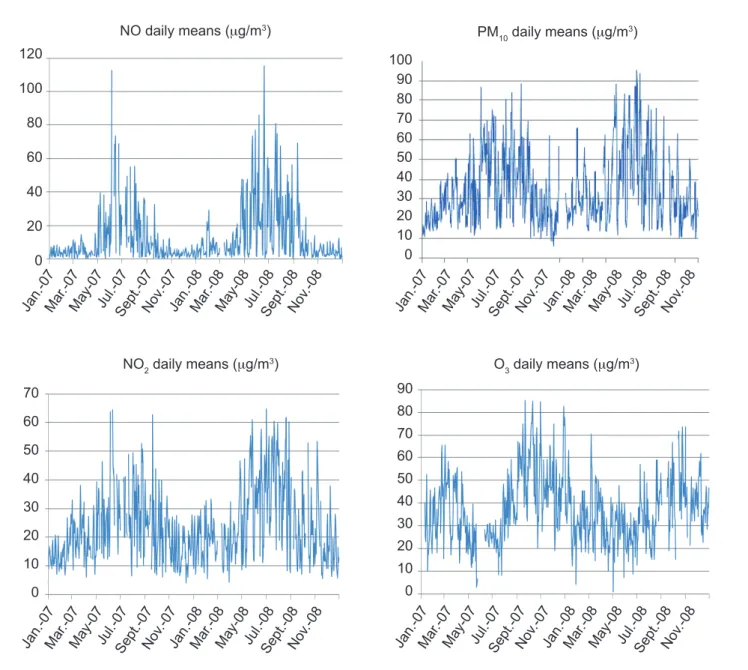
Graphs were developed for the daily pollutant concentra-tions and daily hospitalizaconcentra-tions for pneumonia, as shown in Figures 1 and 2, respectively.
With a 10μg/m3 increase in NO
2 concentration, the risk of hospitalizations increased 16 percentage points and, as for PM10, the increase reached nine percentage points.
Figure 1 - Daily values of pollutant concentrations. Sorocaba, SP, 2007–2008
NO daily means (μg/m3) PM
10 daily means (μg/m 3)
NO2 daily means (μg/m3) O
Figure 2 - Daily values of hospitalizations of children from
zero to ten years old due to pneumonia. Sorocaba, SP, 2007–2008
Daily hospitalizations for pneumonia 14
12 10 8 6 4 2 0
Ja n.-0
7
Ma r.-0
7
Ma y-0
7
Jul.-0 7
Se pt.-0
7
Nov .-07
Jan. -08
Ma r.-0
8
Ma y-0
8
Jul.-0 8
Se pt.-0
8
Nov .-08
Discussion
To date, this is the irst study, conducted in Sorocaba, to analyze the effects of pollution on pediatric admissions due to pneumonia. Its results allowed us to reveal the acute effect of exposure to NO2 on hospitalizations, while the effect of exposure to particulate matter was a little late, four days after exposure, showing the important role of these pollutants on hospital admissions.
The concentrations of particulate matter found in Sorocaba were lower than those identiied in the city of São Paulo(9), 54.5μg/m3, and higher than those observed in São José dos Campos, Southeastern Brazil(12), which reached 25.2μg/m3, but they did not exceed the limit of 100μg/m3, as recommended by the National Environmental Council (Conselho Nacional do Meio Ambiente, Conama).
In the case of the city of São Paulo, these values were asso-ciated with a higher relative risk of pediatric hospitalizations for pneumonia. In the study by Gouveia et al(9), pneumonia in children was most frequent diagnosis among the causes of hospitalization for respiratory diseases reported in the study (more than 60%) and there was an increase in the daily levels of pollutants and hospitalizations in the winter months. Exposure to particulate matter was also associ-ated to pediatric admissions for pneumonia in São José dos Campos(7), where exposure to concentrations of 40μg/m3 was associated with a relative risk of 1.004 – a value close to that found in Sorocaba (RR=1.009). In Cubatão(13), a 56μg/m3 increase in the concentration of this pollutant implied an increase of nearly 10% in the risk of pediatric hospitalization due to respiratory diseases, showing the consistency of the results obtained in Sorocaba.
With regard to NO2, the mean values found in this study (48.06μg/m3), although exceeding the acceptable limit in 41 days (100μg/m3), were below the values found in the city of São Paulo (103μg/m3)(9), but exposure to this pollutant was associated with admission for pneumonia in Sorocaba with similar risks. On the other hand, a study conducted in Cubatão, where there is a NO2 measuring station, found a mean concentration of nearly 27μg/m3 and did not identify any association between exposure to NO2 and pneumo-nia in children(13). A study conducted in Rio de Janeiro, Southeastern Brazil(14), on emergency pediatric consultations in public health care units was not able to ind an association between these consultations and exposure to NO2.
It was not possible to make further comparisons due to the lack of studies conducted in Brazil on exposure to NO2 and pediatric admissions for pneumonia.
The values found for PM10 and NO2 concentrations, which were lower than those observed in São Paulo and Rio de Janeiro, may be explained by the larger vehicle leet and by the industrial park of these two capital cities, in comparison to the city of Sorocaba.
Several epidemiologic studies have shown the harmful effects of atmospheric pollutants on human health(1,7,9,12-14), as well as their seasonal behavior, with higher concentrations in winter months, when air quality is compromised by the impaired pollutant dispersion due to the lack of rain and wind. In addition, there are also days with low air humid-ity and thermal inversions(7,8). Investigations on asthma(12) and pneumonia(7) in Vale do Paraíba, Southeastern, and on respiratory diseases in São Paulo(9,15) also found that pollut-ants show a seasonal behavior, like in this study.
It should be emphasized that PM10 and NO2 concen-trations did not exceed the critical values acceptable by CONAMA; these values refer to pollutant concentrations that, when exceeded, may affect population’s health(16).
Like in the study by Gouveia et al(9), we observed a pre-dominance of admissions of male children, due to the lower diameter and higher tone of airways, with lower pulmonary lows during the irst year of life, which are more evident in boys than in girls(15).
A limitation of this study was the lack of measurements by Cetesb regarding SO2 and CO levels, both of them being powerful irritants of the respiratory tract. As for SO2, two studies conducted in São José de Campos(7,12), a medium-sized city like Sorocaba, also with children from zero to ten years old, conirmed the harmful effect of this pollutant.
paying sources other than SUS. Additionally, there were cases of pneumonia in children treated in the outpatient clinic, i.e., that did not lead to hospitalization and were also not included in the study. Moreover, errors in disease coding may have contributed to an inaccurate accounting of cases. These limitations may collaborate to the under-reporting of the occurrence of the disease. However, it should be emphasized that Datasus is an oficial source of the Ministry of Health and the data available on Datasus portal are used as material for epidemiologic studies. The reported hospitalizations refer to the portion of the population that relies on the public health service, i.e., the majority of the country’s population.
Failures in the monitoring of pollutants during the study led to missing data, both in isolated days and in consecu-tive days. However, in time series ecological studies with daily data, the lack of some data did not interfere with inal results, representing a possible confounding variable(9). Individual exposures to gases were not considered and their concentrations were treated as homogenous throughout the city. Diagnostic errors or the double accounting of the same patient may have occurred. In addition, the greater demand to hospitals may be related to other risk factors, such as infec-tions and allergies(9). It is important to highlight that both ecologic studies and time series studies do not allow us to
identify whether the child was admitted due to exposure to pollutants or whether the child exposed to pollutants was admitted. The design of this study is different from that of the study by Vieira et al(17), which individually measured 64 children and found that exposure to NO2 increased the risk of asthma and pneumonia.
The mechanisms through which environmental pollution interferes with human health are not fully understood yet. Particulate material seems to act via inlammatory media-tors and oxidative stress, and responses seem to depend on the material adsorbed in particles, such as metals, organic carbon, ions (sulfates and nitrates) and other biogenic com-ponents(18). The action of NO
2, which is a free radical, has the potential to deplete tissue antioxidant defenses and thus cause local damage and inlammatory process(19). In this context, epidemiologic studies focusing on this issue are essential, considering the proven respiratory morbidity and the negative impact of pollutants on people’s quality of life, with hospitalization being only one of the many effects caused by air pollution(7,9).
Thus, it was possible to ind an association between exposure to the atmospheric pollutants PM10 and NO2 and hospital admissions for pneumonia in Sorocaba, which pro-vides information for the development of policies to reduce risks to Public Health and especially to children’s health.
References
1. Schwartz J. Air pollution and children’s health. Pediatrics 2004;113 (Suppl 4):1037-43.
2. Brasil - Ministério da Saúde – DATASUS [homepage on the Internet]. Morbidade hospitalar do SUS – por local de residência – São Paulo [cited 2012 Aug 11]. Available from: http://tabnet.datasus.gov.br/cgi/tabcgi.exe?sih/cnv/mrsp.def 3. Marcilio I, Gouveia N. Quantifying the impact of air pollution on the urban
population of Brasil. Cad Saude Publica 2007;23 (Suppl 4):S529-36. 4. Natali RM, Santos DS, Fonseca AM, Filomeno GC, Figueiredo AH, Terrivel
PM et al. Hospital admissions due to respiratory diseases in children and
adolescents of São Paulo city, 2000-2004. Rev Paul Pediatr 2011;29:584-90. 5. Macedo SE, Menezes AM, Albernaz E, Post P, Knorst M. Risk factors for acute respiratory disease hospitalization in children under one year of age. Rev Saude Publica 2007;41:351-8.
6. Nascimento LF, Marcitelli R, Agostinho FS, Gimenes CS. Hierarchical approach to determining risk factors for pneumonia in children. J Bras Pneumol 2004;30:445-51.
7. Nascimento LF, Pereira LA, Braga AL, Módolo MC, Carvalho JA Jr. Effects of air pollution on children’s health in a city in Southeastern Brazil. Rev Saude Publica 2006;40:77-82.
8. Arbex MA, Santos UP, Martins LC, Saldiva PH, Pereira LA, Braga AL. Air pollution and the respiratory system. J Bras Pneumol 2012;38:643-55. 9. Gouveia N, de Freitas CU, Martins LC, Marcilio IO. Respiratory and
cardiovascular hospitalizations associated with air pollution in the city of São Paulo, Brazil. Cad Saude Publica 2006;22:2669-77.
10. Brasil - Instituto Brasileiro de Geograia e Estatística [homepage on the Internet]. IBGE cidades@ [cited 2012 Aug 23]. Avaliable from: http://www.ibge.gov.br/
11. São Paulo - Prefeitura Municipal de Sorocaba [homepage on the Internet]. Sobre Sorocaba. Conheça melhor nossa cidade [cited 2012 Aug 23]. Avaliable from: http://www.sorocaba.com.br/sobre-sorocaba.html
12. Amâncio CT, Nascimento LF. Asthma and ambient pollutants: a time series study. Rev Assoc Med Bras 2012;58:302-7.
13. Jasinski R, Pereira LA, Braga AL. Air pollution and pediatric hospital admissions due to respiratory diseases in Cubatão, São Paulo state, Brazil, from 1997 to 2004. Cad Saude Publica 2011;27:2242-52.
14. Moura M, Junger WL, Mendonça GA, Leon AP. Air quality and acute respiratory disorders in children. Rev Saude Publica 2008;42:503-11.
15. Toyoshima MT, Ito GM, Gouveia N. Morbidade por doenças respiratórias em pacientes hospitalizados em São Paulo/SP. Rev Assoc Med Bras 2005;51:209-13.
16. Brasil - Ministério do Meio Ambiente [homepage on the Internet]. Resolução CONAMA nº 003/1990 [cited 2012 Oct 13]. Avaliable from: http://www.mma. gov.br/port/conama/legipesq.cfm?tipo=3&numero=03&ano=1990&texto= 17. Vieira SE, Stein RT, Ferraro AA, Pastro LD, Pedro SS, Lemos M et al.
Urban air pollutants are signiicant risk factors for asthma and pneumonia in children: the inluence of location on the measurement of pollutants. Arch Bronconeumol 2012;48:389-95.
18. Samet JM, Brauer M, Schlesinger R. Particulate matter. In: Word Health Organization, editor. Air quality guidelines: global update 2005. Copenhagen: WHO; 2006. p. 217-305.