Article
–––––––––––––––––––––––––––––––––––––––––––
* Mailing address: Avenida Francisco Alves Monteiro, nº 700, Apartamento 14B, Independência, Taubaté, SP, Brasil 12.042-335. E-mail: [email protected] and [email protected]
Funding: Coordenação de Aperfeiçoamento de Pessoal de Nível Superior (CAPES).
Testing the Validity of a Psychopathy Index Calculated
from the Big Five Inventory
Natália Costa Simões
*,1Orcid.org/0000-0002-2697-7851
Nelson Hauck Filho
1Orcid.org/0000-0003-0121-7079
–––––––––––––––––––––––––––––––––––––––
1Universidade São Francisco, Itatiba, SP, Brasil
Abstract
One alternative approach to the traditional self-report assessment of socially undesirable traits is pro-totypal matching, which consists of computing indices of a given trait from inventories designed for capturing broad personality dimensions. In the present study, the validity of a psychopathy index de-rived from a clinical portrayal constructed using the items from the Big Five Inventory (BFI) was tested. Participants were 449 students of three Brazilian states, who responded to the BFI, as well as the Dark Triad traits, the Short Dark Triad and the Dirty Dozen inventories. Positive and moderate correlations emerged between the proposed index and the scores in the Dark Triad, with the strongest relationships occurring with the psychopathy factors of each instrument, as expected. These associations were greater when controlling for acquiescent responding. The fi ndings suggest that the index developed could pro-vide an uncovered assessment of psychopathic traits.
Keywords: Psychological assessment, personality, Psychometrics, psychopathy.
Evidências de Validade de um Índice de Psicopatia
a partir do Big Five Inventory
Resumo
Uma alternativa à avaliação direta via autorrelato de traços indesejáveis socialmente é o prototypal matching, que consiste em calcular um índice de um dado traço a partir de inventários de domínios amplos da personalidade. No presente estudo, testou-se a validade de um índice de psicopatia derivado de um perfi l prototípico elaborado a partir dos itens do Big Five Inventory. Participaram do estudo 449 universitários, de três estados brasileiros, que responderam ao Big Five Inventory e a dois instrumentos avaliativos da tríade sombria da personalidade, Short Dark Triad e Dirty Dozen. Foram observadas cor-relações positivas e moderadas entre o índice e os escores na tríade sombria da personalidade, ocorrendo as correlações mais altas para os fatores de psicopatia de cada instrumento, como hipotetizado. Essas correlações se mostraram ainda mais expressivas quando controlado o efeito do viés da aquiescência. Os achados sugerem que o índice possibilita uma avaliação encoberta de traços de psicopatia.
Evidencias de Validez de un Índice de Psicopatía
a partir del Big Five Inventory
Resumen
Una alternativa para la evaluación directa de rasgos socialmente indeseables por medio del autoin-forme es el prototypal matching, que consiste en calcular el índice de un determinado rasgo a partir de inventarios de dominios amplios de la personalidad. En este estudio se examinó la validez de índice de psicopatía derivado de un perfi l prototípico elaborado con base en los ítems del Big Five Inventory. Par-ticiparon del estudio 449 estudiantes, de tres estados brasilenõs, universitarios que respondieron al Big Five Inventory y a dos instrumentos evaluativos de la tríada sombría de la personalidad, el Short Dark Triad y el Dirty Dozen. Fueron observadas correlaciones positivas y moderadas entre el índice y las puntuaciones en la tríada sombría, siendo que las correlaciones más altas fueron para los factores de psi-copatía de cada instrumento, como se previa en las hipótesis. Además, esas correlaciones se mostraron más expresivas cuando se controló el efecto del sesgo de aquiescencia. Los hallazgos sugieren que el índice permite una evaluación encubierta del rasgo de psicopatía.
Palabras clave: Evaluación psicológica, personalidade, Psicometría, psicopatía.
Psychopathy refers to a constellation of personality traits that includes arrogance, callous-ness, egocentricity, interpersonal exploitation, impulsivity and a propensity toward deviant behavior (Cooke & Michie, 2001; Fowles & Dindo, 2006; Miller & Lynam, 2015; Patrick, Fowles, & Krueger, 2009; Skeem, Polaschek, Patrick, & Lilienfeld, 2011). Unsurprisingly, all these features tend to be socially undesirable, therefore assessing them using the self-report method poses a challenge to researchers and practitioners (Miller & Lynam, 2003; Ray et al., 2013). In some testing situations particularly (e.g., a job interview), items with a content that is explicitly negatively evaluated or pejorative might elicit socially desirable responding, that is, responses that are consistent with social or contextual expectations (Paulhus, 1991). The present study describes a tentative solution to this problem, an uncovered method for assessing psychopathy that consists of an index constructed from a broader personality inventory, the Big Five Inventory (Benet-Martínez & John, 1998).
Recent investigations have highlighted psychopathy as a continuous, non-categorical latent entity (Walters, Brinkley, Magaletta, & Diamond, 2008; Walters, Duncan, & Mitchell-Perez, 2007; Walters, Ermer, Knight, & Kiehl, 2015; Walters, Gray, et al., 2007;
Walters, Marcus, Edens, Knight, & Sanford, 201). Accordingly, rather than occurring in a discrete class of individuals, psychopathy more likely results from the extreme phenotypic manifestation of traits that are common to the entire population of individuals (Hauck-Filho, Teixeira, & Dias, 2012; Lynam & Miller, 2015). For instance, from the Big Five perspective (Costa & McCrae, 1992), psychopathy might be described as a particular profi le of low scores in both agreeableness (i.e., manipulation, egocentricity, antagonism, arrogance, and lack of empathy) and conscientiousness (i.e., recklessness, disorganization, lack of purpose, and distraction; Lynam & Miller, 2015; Miller & Lynam, 2015; O’Boyle, Forsyth, Banks, Story, & White, 2014). It should be noted that low agreeableness represents a core element shared with other closely related pathological traits, such as narcissism (i.e., a tendency toward grandiosity) and Machiavellianism (i.e., a propensity toward manipulation; O’Boyle et al., 2014). Because of this similarity, psychopathy, narcissism and Machiavellianism have been often called the “Dark Triad of personality” (Paulhus & Williams, 2002).
in the general population (cf. Lilienfeld & Fowl-er, 2006). The self-report assessment of psy-chopathy has made many advances in the fi eld possible and, paralleling other methods that rely on clinical judgments, has allowed even subtle features of the neuropsychological functioning of psychopathic individuals to be captured (e.g., Zeier & Newman, 2013). Also supporting the use of self-reports in the assessment of the con-struct, a recent meta-analysis found a quasi-null relationship between self-reported psychopathy and social desirability (Ray et al., 2013). How-ever, a correlation between self-reported psy-chopathy and social desirability might still exit when considering only data collected under high stakes testing situations, where test takers are motivated to consistently perform as expected. For instance, a job interview tends to elicit so-cially desirable responding more than the stan-dard anonymous assessments conducted in stud-ies in the fi eld of psychology (Tracey, 2016). In these high stakes contexts, uncovered or indirect methods are recommended, as they can provide psychometric information about the test takers while potentially hiding (or at least making it diffi cult to know) the real purpose of the assess-ment.
Following this rationale, Miller and Lynam (2003) and Miller, Lynam, Widiger, and Leu-kefeld (2001) developed a psychopathy index calculated from the scores of the Revised NEO Personality Inventory (NEO-PI-R; Costa & Mc-Crae, 1992). This index was developed through an approach known as “prototypal matching” (Miller, 2012). The idea of prototypal match-ing is to calculate how close (i.e., correlated) an individual’s pattern of scores in the items of a given instrument are to a theoretically derived profi le of expected scores for a condition or trait level. In the study by Miller et al. (2001), the authors fi rst had clinical psychologists and other experts construct a psychopathy profi le using the items of the NEO-PI-R. For this, they asked the experts to indicate, for each NEO-PI-R item, the score that would best represent the response of a typical psychopath. The mean of the experts’ ratings defi ned the psychopathy profi le against
which the scores of a given individual can be compared in order to estimate the person’s level of psychopathy. Next, the authors applied the NEO-PI-R with a community sample of adults, along with other self-report measures of psy-chopathy with many associated variables. Thus, the psychopathy index consisted of the correla-tion (the “match”) of each individual’s pattern of responses to the theoretical profi le of scores constructed by the experts. As hypothesized, this index correlated positively with the other psy-chopathy scores, as well as with measures of aggressive and antisocial behaviors, Antisocial Personality Disorder symptoms, risky sexual behaviors, substance use, and delay discounting (Miller & Lynam, 2003; Miller et al., 2001).
The prototypal matching approach of Miller et al. (2001) for assessing psychopathic traits has many advantages. As the NEO-PI-R items are relatively less socially undesirable than those of the traditional self-report inventories of psychop-athy, indexes computed using the NEO-PI-R items are expected to be less affected by socially desirable responding. Another advantage is that psychopathy scores can be calculated from any database containing the NEO-PI-R items. This means that the testing of new hypotheses regard-ing psychopathy become possible usregard-ing person-ality data originally collected with no interest in psychopathy. Another benefi t that should be mentioned is the possibility of collecting infor-mation on psychopathy with no need to include a questionnaire other than the NEO-PI-R in per-sonality studies (Miller & Lynam, 2003).
develop-ment of a similar psychopathy index that could be computed from the scores in a briefer Five-Factor model inventory.
The Big Five Inventory (BFI; Benet-Martínez & John, 1998) is one the most widely used self-report questionnaires for the broad assessment of personality traits. Investigating its psychometric properties, one study found support for the BFI fi ve-factor structure across 56 nations (Schmitt, Allik, McCrae, & Benet-Martinez, 2007). Although not exactly brief, the BFI contains 44 items (versus 240 in the NEO-PI) that consist of brief statements, which can therefore be added to research protocols with other scales and questionnaires. Accordingly, in the present study, an index of psychopathy was developed to be calculated from the scores in the 44 BFI items, paralleling the previous work of Miller and colleagues using the NEO-PI-R (Miller & Lynam, 2003; Miller et al., 2001). For testing the validity of this new psychopathy index, it was correlated to scores in the Short Dark Triad (SDT; Jones & Paulhus, 2014) and the Dirty Dozen (DD; Jonason & Webster, 2010) scales, which assess psychopathy and two other related variables, narcissism and Machiavellianism.
The index was expected to correlate with the other scales (SDT and DD), with a hypoth-esis also established concerning the discrimi-nant validity of the index. More specifi cally, it was expected that greater correlations would be found with the scores in the psychopathy fac-tors of both the SDT and the DD compared to correlations with the narcissism and Machia-vellianism factors. In addition, mean differ-ences in the index were also tested according to sex, as the psychopathic phenotype tends to be more prevalent in men when compared to women (Dolan & Völlm, 2009).
Another issue that should be mentioned is that the self-report of personality traits might suffer from acquiescent/disacquiescent responding, i.e., the tendency to agree/disagree with items irrespective of their descriptive content (Soto, John, Gosling, & Potter, 2008). Considering this, the external correlations of the BFI psychopathy index were explored after
controlling for acquiescence in the SDT and DD items. The reason these additional analyses were performed was that acquiescence/ disacquiescence might act as a suppressor variable, attenuating the validity coeffi cients.
Method
Participants
A total of 449 individuals participated, 64% female, with a mean age of 23.47 years (SD = 6.76). The sample was comprised of students from universities of three Brazilian states, São Paulo (41%), Minas Gerais (36%), and Santa Catarina (22%). The overall sample was diverse in terms of the undergraduate courses that the students were attending (11 courses), including mainly Psychology (52.4%), Social Communi-cation (17.8%), and Physical EduCommuni-cation (17.5%). Regarding monthly income, 50.2% reported re-ceiving from one to fi ve minimum salaries. The majority of the participants declared themselves to be white (66.2%) and single (51.3%).
Instruments
Big Five Inventory (Benet-Martínez & John, 1998). The BFI contains 44 self-report items that assess the domains of the Big Five model: extra-version, agreeableness, conscientiousness, neu-roticism, and openness (McCrae & John, 1992). The factor structure of the instrument has been replicated across several cultures and languages (Schmitt et al., 2007). Benet-Martínez and John (1998) found internal consistency estimates for the fi ve scales ranging from .66 to .89. Each item is rated on a fi ve-point, Likert-type scale, 1 = strongly disagree, 5 = strongly agree.
Dirty Dozen (DD; Jonason & Webster, 2010). The DD is a brief, 12-item inventory that assesses the Dark Triad traits, namely, psychop-athy, narcissism, and Machiavellianism. Jonason and Webster (2010) found internal consistency estimates for the scales ranging from .62 to .87. Each item is rated on a fi ve-point, Likert-type scale, 1 = strongly disagree, 5 = strongly agree.
traits, containing 27 self-report items. This in-ventory has been developed to provide a more comprehensive assessment of the Dark Triad traits than the DD, which only contains four items per dimension. Internal consistency es-timates reported by Jones and Paulhus (2014) range from .71 to .77. Items are rated using a fi ve-point Likert-type scale, 1 = strongly dis-agree, 5 = strongly agree.
Procedures
The fi rst step in this study was to develop a profi le of expected scores for a typical psy-chopath in the items of the BFI. The fi nal psy-chopathy index consists solely of the correlation between an individual’s item responses to the BFI items and this theoretical profi le of expected scores in the same items. In other words, the in-dex represents the similarity or proximity of an individual’s scores to the developed profi le. For this, fi ve researchers with experience in the as-sessment of psychopathy and personality disor-ders were asked to indicate what score, in each BFI item, would best represent the response of a typical psychopath. The specialists were explic-itly instructed to give item scores considering a classical psychopath, instead of providing infor-mation about their own personality. Data collec-tion was carried out online via Survey Monkey. Table 1 presents the information for each item considering the mean scores of the experts. This vector of item means consists of the scores in each item that a typical psychopath would be expected to achieve. Overall, the experts suc-ceeded in creating a portrait consistent with studies that addressed the relationship between psychopathy and the Big Five (Miller & Lynam, 2015; Miller et al., 2001; O’Boyle et al., 2014), as the mean scores were particularly low for items with content related to the agreeableness and conscientiousness factors. These results re-veal a prototypical profi le of psychopathy in the BFI items. The index of psychopathy would be simply the correlation between an individual’s scores in the BFI items and the expected scores available in Table 1.
The second step was testing the validity of the new psychopathy index with an independent
sample of students. The data collection took place in classrooms of the three universities and was conducted collectively using standard paper-and-pencil procedures. The research project was previously evaluated by an Institutional Review Board, and all participants were required to sign a consent form prior to enrollment in the study. The BFI was presented fi rst, followed by the DD, the SDT and then some demographic questions. Participants took approximately 40 minutes on average to complete the study questionnaires.
Data Analysis
Pearson’s correlation coeffi cient was used to estimate, for each participant in the sample, the correspondence of their scores with the profi le of expected BFI scores presented in Table 1. The closer (i.e., the more positively correlated) an individual’s item scores were to the values displayed in Table 1, the more psychopathic that he or she was. High scores in psychopathy will occur in the form of high positive correlations to the profi le developed, whereas low scores correspond to high negative correlations, which creates a distribution ranging from −1 to +1.
After some initial exploratory analyses of the data collected, the decision was taken to compute the psychopathy index using only the BFI items from the factors that are more theo-retically relevant for the defi nition of psychopa-thy. More specifi cally, the items that relate to the characteristics of agreeableness and conscien-tiousness (O’Boyle et al., 2014) were selected, although some items of low neuroticism and low openness were also included. The fi nal selection consisted of the following BFI items: 1, 2, 3 4, 6, 7, 8, 12, 13, 17, 18, 21, 22, 23, 24, 27, 28, 29, 31, 34, 35, 36, 37, 38, 39, 42 and 43. These items are boldfaced in Table 1, and only these should be used for calculating the index described in the present study.
Struc-Table 1
The Resulting BFI Psychopathy Profi le
BFI items Mean
1. É conversador, comunicativo. 4.33
2. Às vezes, é frio e distante. 5.00
3. Tende a ser crítico com os outros. 4.89
4. É minucioso, detalhista no trabalho. 2.89
5. É assertivo, não teme expressar o que sente. 2.89
6. Insiste até concluir a tarefa ou o trabalho. 2.33
7. É depressivo, triste. 1.33
8. Gosta de cooperar com os outros. 1.56
9. É original, tem sempre novas ideias. 3.11
10. É temperamental, muda de humor facilmente. 3.56
11. É inventivo, criativo. 2.56
12. É reservado. 2.22
13. Valoriza o artístico, o estético. 1.67
14. É emocionalmente estável, não se altera facilmente. 1.78
15. É prestativo e ajuda os outros. 1.44
16. Às vezes, é tímido e inibido. 1.33
17. Pode ser um tanto descuidado. 3.67
18. É amável, tem consideração com os outros. 2.56
19. Tende a ser preguiçoso. 2.89
20. Faz as coisas com efi ciência. 2.67
21. É relaxado, controla bem o estresse. 3.89
22. É facilmente distraído. 3.33
23. Mantém-se calmo nas situações tensas. 3.89
24. Prefere trabalho rotineiro. 1.89
25. É curioso sobre muitas coisas rotineiras. 2.89
26. É sociável, extrovertido. 3.11
27. Em geral, confi a nas pessoas. 1.00
28. Às vezes, é rude (grosseiro) com os outros. 4.56
29. É cheio de energia. 3.78
30. Começa discussões com os outros. 4.56
31. É um trabalhador de confi ança. 1.67
32. Faz planos e os segue à risca. 2.33
33. Tem uma imaginação fértil. 2.78
34. Fica tenso com frequência. 2.56
35. É engenhoso, alguém que gosta de analisar profundamente as coisas. 2.44
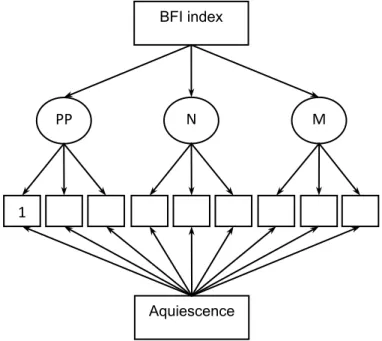
tural Equation Modeling (SEM) was used to more accurately inspect the correlation between the BFI index of psychopathy and each of the factors from the DD and SDT instruments. The type of modeling used was Multiple Indicators Multiple Causes (MIMIC; Muthén, 1989), using the Mean and Variance-adjusted Weighted Least Squares estimation of the model parameters. In the MIMIC model, in addition to receiving the infl uence of a latent variable (e.g., psychopathy, narcissism or Machiavellianism), each item was also specifi ed to be explained by a variable that captures the tendency for acquiescent/disacqui-escent responding, as shown in Figure 1. The inclusion of this acquiescence variable in the model helped to remove spurious systematic
variance, allowing a better estimation of the cor-relation between the BFI psychopathy index and the variables selected for external validation. Two MIMIC models were tested, one for each Dark Triad instrument, as a source of the exter-nal validation of the index.
The strategy for composing the variable to capture acquiescence/disacquiescence followed the procedure described in the study by Soto et al. (2008). First, the researcher needs to fi nd item pairs that are opposed in descriptive con-tent. If the items are perfectly opposed, their mean should be “3” if they are rated on a fi ve-point Likert scale. Individuals with a mean that deviates from this expected value might have responded under the infl uence of acquiescence/
Aquiescence
PP
1
N M
BFI index
37. Gera muito entusiasmo 3.11
38. Tende a ser desorganizado 2.89
39. Gosta de refl etir, brincar com as ideias. 2.00
40. Tem capacidade de perdoar, perdoa fácil. 1.33
41. Preocupa-se muito com tudo. 1.89
42. Tende a ser quieto, calado. 2.11
43. Tem poucos interesses artísticos. 3.56
44. É sofi sticado em arte, música ou literatura. 2.33
Note. Items selected for calculating the BFI psychopathy index are boldfaced. The Brazilian Portuguese items are presented in the same order as the original English version.
disacquiescence. For instance, if someone gives a “2” (i.e., “disagree”) to the item “I am an ex-traverted person,” he or she should give a “4” (i.e., “agree”) to the item “I am an introverted person,” and vice-versa. In this case and all oth-ers, consistent responses to opposed items will always converge to 3. However, if the observed mean is lower than 3, then the individual tend-ed to disagree irrespective of the item content, whereas, if the observed mean is higher than 3, then the participant tended to agree with items irrespective of their content. In the present study, the acquiescence/disacquiescence variable was calculated through the mean of the following SDT items: 11, 13, 14, 17, 20, 22, 25, and 26. As expected, the empirical mean of these items was exactly 3 (SD = .43), with this being specifi ed as
a covariate item in the MIMIC model, as shown in Figure 1.
Results
Initially, the linear relationships between the BFI psychopathy index and the factors from the DD and SDT instruments were investigated. With the exception of one coeffi cient, as hypoth-esized, positive correlations were found, which supports the convergent validity of the index, as shown in Table 2. Also, in agreement with the discriminant validity hypothesis, correlations were more expressive for the psychopathy factor of the DD, and even stronger for a sum variable consisting of all psychopathy items of both the DD and the SDT (r = .59).
Table 2
Bivariate Correlations between the Index and the Dark Triad Factors
r
DD
Machiavellianism .40*
Psychopathy .47*
Narcissism .16
DD Total .41*
SDT
Machiavellianism .39*
Psychopathy .38*
Narcissism −.04
SDT Total .35*
DD total + SDT total .43*
Psychopathy DD + Psychopathy SDT .59*
*p < .01.
In the next step, the MIMIC models (one us-ing the SDT and the other usus-ing the DD) were tested, aiming to better estimate the conver-gent validity of the BIF psychopathy index by controlling for acquiescence/disacquiescence. A very modest approximate fi t to the data was found for the model using the SDT, χ2(298) =
775.95, RMSEA = .060, CFI = .911, TLI = .878, and a very reasonable fi t to the data when using
the DD, χ2(34) = 225.26, RMSEA = .096, CFI =
stronger support for the discriminant validity of the index. As expected, the index was more strongly associated with the psychopathy factors from the DD and the SDT when compared to the narcissism and Machiavellianism factors. When controlling for measurement error and acqui-escence/disacquiescence in the MIMIC model,
the linear relationship with the DD psychopathy factor was .57 (compared to .47 in the bivariate analysis) and.49 for the SDT (compared to .38 in the bivariate analysis). These results suggest a potential suppressor effect of acquiescent/disac-quiescent responding on the validity coeffi cients.
Table 3
Linear Relationships between the BFI Psycho-pathy Index and the Dark Triad Factors after Controlling for Acquiescence/Disacquiescence (MIMIC)
β
DD-12
BFI psychopathy index→Machiavellianism .40*
BFI psychopathy index →Narcissism .23*
BFI psychopathy index →Psychopathy .57*
SDT
BFI psychopathy index → Machiavellianism .32*
BFI psychopathy index → Narcissism −.14
BFI psychopathy index → Psychopathy .49*
*p < .05.
As an additional analysis, sex differences were tested for in the BFI psychopathy index, as men tend to score higher than women in psy-chopathy inventories (Dolan & Völlm, 2009)an-tisocial personality disorder (ASPD. In this case, it was hypothesized that on average men would have a pattern of item responses closer to the BFI psychopathy profi le when compared to women. Supporting this prediction, moderate mean dif-ferences were found between the sexes, t(449) = 3.90, p < .001, d = .39. Specifi cally, the mean correlation of scores to the BFI psychopathy profi le was −0.25 for the women and −0.14 for the men. Thus, the participants tended to score low in the BFI psychopathy index (which is rea-sonable, considering they were undergraduate students), however, the women tended to score even lower than the men.
Discussion
The present study describes the develop-ment of a psychopathy index to be calculated
phenotype more than women (Dolan & Völlm, 2009)antisocial personality disorder (ASPD. These results support the validity of the BFI psy-chopathy index as an uncovered measure of the psychopathic personality in studies using Brazil-ian samples – and possibly samples from other cultures as well.
In addition to investigating the validity of the new psychopathy index, this study also produced another finding that should be mentioned. When contrasting the results from tables 2 and 3, it can be seen that the simple bivariate analyses underestimated the convergent validity coeffi cients of the BFI psychopathy index. The linear relationships based on Pearson’s coeffi cients, compared to the MIMIC analysis, were not only weaker but the differential correlations with the factors of narcissism and Machiavellianism were also less clear. Furthermore, the absence of a control for measurement error and acquiescent/ disacquiescent responding underestimated the validity of the BFI psychopathy index. This finding highlights the need for controlling spurious (unsystematic and systematic) variance when assessing factors from the Dark Triad traits through self-report. Despite concerns having been raised regarding the detrimental impact of response styles on the quality of data collected using self-reports (Bäckström & Björklund, 2013, 2016; Mõttus et al., 2012; Ziegler & Buehner, 2009), this matter has rarely motivated changes in the way psychopathy is measured and how the resulting data are analyzed in typical investigations in the fi eld. The present study illustrates how idiosyncratic usages of the response scale by participants might bias the statistical analysis and obscure the testing of the psychological hypotheses. By including a variable that captures acquiescence/ disacquiescence in the analyses it was possible to fi nd stronger and clearer relationships between the BFI psychopathy index and the external variables collected.
Computing the BFI psychopathy index in other databases is quite simple. The whole pro-cedure only requires the 27 items boldfaced in Table 1, and can be applied with any dataset
con-taining the responses of a sample of individuals (or even only one individual) that provided re-sponses to these BFI items. First, the researcher must have two pieces of information: (1) the vector of 27 item means reported in Table 1, and (2) the dataset that contains the responses of the participants to the BFI items. If using the R software, each object will exist as a distinct data frame. Next, the researcher must calculate, for each individual in data frame (2), the correlation between responses to the 27 target BFI items and the vector of item means from data frame (1). This correlation should be saved as individual scores that will refl ect the similarity between each participant’s responses and the BFI psy-chopathy profi le. The BFI psychopathy index will be distributed raging from −1, a score that indicates an extremely agreeable, kind, altruis-tic and responsible individual, to +1, a score that indicates an extremely egocentric, manipulative, callous and impulsive person —that is, highly psychopathic. Given the continuous nature of the variable, no cutoff is recommended for sepa-rating a “psychopathic” group, even though this possibility might be further investigated in future studies. The entire procedure only requires three lines of command to be executed in R, which can be obtained upon request from the second author of this study.
most widely used inventories for the assessment of the Big Five factors, many researchers could benefi t from the development of other indices computed from the items of this instrument.
The present study has one main limitation. Although the BFI does not contain items with extremely evaluative wording (i.e., items with content that is “too good” or “too bad”), its items are not free of social desirability. Evidence ex-ists that traditional self-report inventories of personality domains also suffer from evalua-tive variance, as item responses might well be infl uenced by how desirably an item is worded (Bäckström & Björklund, 2013, 2016; Bäck-ström, Björklund, & Larsson, 2009). Thus, even though the BFI psychopathy index described here is probably less affected by socially desir-able responding when compared to other psy-chopathy trait inventories, this does not imply that the evaluative variance is null. The BFI psychopathy index is recommended for research purposes, and specifi cally for the assessment of adults in the community, as other applications (e.g., in clinical, health and forensic contexts) still require further investigation.
Conclusion
The BFI psychopathy index provides an un-covered assessment of psychopathy, which can be calculated in all datasets containing responses to the BFI items. The index was developed using prototypal matching, a technique that has other still unexplored applications in the fi eld of as-sessment in Brazil. The index reported here cor-related positively with the external assessment of psychopathy and differentiated the men from the women. Hopefully, the BFI psychopathy in-dex will help Brazilian researchers interested in the study of psychopathic traits among individu-als in community contexts.
References
Bäckström, M., & Björklund, F. (2013). Social desir-ability in personality inventories: Symptoms, di-agnosis and prescribed cure. Scandinavian
Jour-nal of Psychology, 54(2), 152-159. doi: https://
doi.org/10.1111/sjop.12015
Bäckström, M., & Björklund, F. (2016). Is the gen-eral factor of personality based on evaluative responding? Experimental manipulation of item-popularity in personality inventories.
Per-sonality and Individual Differences, 96, 31-35.
doi: https://doi.org/10.1016/j.paid.2016.02.058
Bäckström, M., Björklund, F., & Larsson, M. R. (2009). Five-factor inventories have a major general factor related to social desirability which can be reduced by framing items neutrally.
Jour-nal of Research in PersoJour-nality, 43(3), 335-344.
doi: https://doi.org/10.1016/j.jrp.2008.12.013
Benet-Martínez, V., & John, O. P. (1998). Los Cinco Grandes across cultures and ethnic groups: Mul-titrait multimethod analyses of the Big Five in Spanish and English. Journal of Personality and
Social Psychology, 75(3), 729-750.
Cooke, D. J., & Michie, C. (2001). Refi ning the con-struct of psychopathy: Towards a hierarchical model. Psychological Assessment, 13(2), 171-188.
Costa, P. T., & McCrae, R. R. (1992). Revised NEO Personality Inventory (NEO PI-R) and NEO Five-Factor Inventory (NEO-FFI) professional
manual. Odessa, FL: Psychological Assessment
Resources.
Dolan, M., & Völlm, B. (2009). Antisocial personal-ity disorder and psychopathy in women: A lit-erature review on the reliability and validity of assessment instruments. International Journal
of Law and Psychiatry, 32(1), 2-9. doi: https://
doi.org/10.1016/j.ijlp.2008.11.002
Fowles, D. C., & Dindo, L. (2006). A dual-defi cit model of psychopathy. In C. J. Patrick (Ed.),
Handbook of Psychopathy (pp. 14-34). New
York: The Guilford Press.
Hauck-Filho, N., Teixeira, M. A. P., & Dias, A. C. G. (2012). Psicopatia: Uma perspectiva dimen-sional e não-criminosa do construto. Avances En
Psicología Latinoamericana, 30(2), 317-327.
Jonason, P. K., & Webster, G. D. (2010). The dirty dozen: A concise measure of the dark triad.
Psychological Assessment, 22(2), 420-432. doi:
https://doi.org/10.1037/a0019265
Jones, D. N., & Paulhus, D. L. (2014). Introducing the short Dark Triad (SD3): A brief measure of dark personality traits. Assessment, 21(1), 28-41. doi: https://doi.org/10.1177/1073191113514105
and promises. In C. J. Patrick (Ed.), Handbook
of Psychopathy (pp. 107-132). New York: The
Guilford Press.
Lynam, D. R., & Miller, J. D. (2015). Psychopa-thy from a Basic Trait Perspective: The Util-ity of a Five-Factor Model Approach. Journal
of Personality, 83(6), 611-626. doi: https://doi.
org/10.1111/jopy.12132
McCrae, R. R., & John, O. P. (1992). An Introduc-tion to the Five-Factor Model and Its Applica-tions. Journal of Personality, 60(2), 175-215. doi: https://doi.org/10.1111/j.1467-6494.1992. tb00970.x
Miller, J. D. (2012). Five-Factor Model Personality Disorder Prototypes: A Review of Their Devel-opment, Validity, and Comparison to Alterna-tive Approaches. Journal of Personality, 80(6), 1565-1591. doi: https://doi.org/10.1111/j.1467-6494.2012.00773.x
Miller, J. D., & Lynam, D. R. (2003). Psychopathy and the Five-factor model of personality: A replication and extension. Journal of
Personal-ity Assessment, 81(2), 168-178. doi: https://doi.
org/10.1207/S15327752JPA8102_08
Miller, J. D., & Lynam, D. R. (2015). Understand-ing Psychopathy UsUnderstand-ing the Basic Elements of Personality. Social and Personality
Psychol-ogy Compass, 9(5), 223-237. doi: https://doi.
org/10.1111/spc3.12170
Miller, J. D., Lynam, D. R., Widiger, T. A., & Leuke-feld, C. (2001). Personality disorders as extreme variants of common personality dimensions: Can the Five-Factor Model adequately represent psychopathy? Journal of Personality, 69(2), 253-276.
Mõttus, R., Allik, J., Realo, A., Rossier, J., Zecca, G., Ah-Kion, J., …Johnson, W. (2012). The Effect of Response Style on Self-Reported Conscien-tiousness Across 20 Countries. Personality and
Social Psychology Bulletin, 38(11), 1423-1436.
doi: https://doi.org/10.1177/0146167212451275
Muthén, B. O. (1989). Latent variable modeling in heterogeneous populations. Psychometrika,
54(4), 557-585. doi: https://doi.org/10.1007/ BF02296397
O’Boyle, E. H., Forsyth, D. R., Banks, G. C., Story, P. A., & White, C. D. (2014). A Meta-Analytic Test of Redundancy and Relative Importance of the Dark Triad and Five-Factor Model of Per-sonality [Special issue]. Journal of Personality,
83(6), 644-664. doi: https://doi.org/10.1111/ jopy.12126
Patrick, C. J., Fowles, D. C., & Krueger, R. F. (2009). Triarchic conceptualization of psychopathy: Developmental origins of disinhibition, bold-ness, and meanness. Development and
Psy-chopathology, 21(3), 913-938. doi: https://doi.
org/10.1017/S0954579409000492
Paulhus, D. L. (1991). Measurement and control of response styles. In J. P. Robinson, P. R. Shaver, & L. S. Wrightsman (Eds.), Measures of
person-ality and social psychological attitudes (pp.
17-59). San Diego, CA: Academic Press.
Paulhus, D. L., & Williams, K. M. (2002). The Dark Triad of personality: Narcissism, Machiavel-lianism, and psychopathy. Journal of Research
in Personality, 36(6), 556-563. doi: https://doi.
org/10.1016/S0092-6566(02)00505-6
Ray, J. V, Hall, J., Rivera-Hudson, N., Poythress, N. G., Lilienfeld, S. O., & Morano, M. (2013). The relation between self-reported psychopathic traits and distorted response styles: A meta-ana-lytic review. Personality Disorders, 4(1), 1-14. doi: https://doi.org/10.1037/a0026482
Rolstad, S., Adler, J., & Rydén, A. (2011). Response burden and questionnaire length: Is shorter better? A review and meta-analysis. Value in Health : The Journal of the International So-ciety for Pharmacoeconomics and Outcomes
Research, 14(8), 1101-1108. doi: https://doi.
org/10.1016/j.jval.2011.06.003
Schmitt, D. P., Allik, J., McCrae, R. R., & Benet-Martinez, V. (2007). The Geographic Distribution of Big Five Personality Traits: Patterns and Profi les of Human Self-Description Across 56 Nations. Journal of Cross-Cultural
Psychology, 38(2), 173-212. doi: https://doi.
org/10.1177/0022022106297299
Skeem, J. L., Polaschek, D. L. L., Patrick, C. J., & Lilienfeld, S. O. (2011). Psychopathic Person-ality Bridging the Gap Between Scientifi c Evi-dence and Public Policy. Psychological Science
in the Public Interest, 12(3), 95-162. doi: https://
doi.org/10.1177/1529100611426706
Soto, C. J., John, O. P., Gosling, S. D., & Potter, J. (2008). The developmental psychometrics of big fi ve self-reports: Acquiescence, factor structure, coherence, and differentiation from ages 10 to 20. Journal of Personality and
So-cial Psychology, 94(4), 718-737. doi: https://doi.
Tracey, T. J. G. (2016). A note on socially desirable responding. Journal of Counseling Psychology,
63(2), 224-232. doi: https://doi.org/10.1037/ cou0000135
Walters, G. D., Brinkley, C. A., Magaletta, P. R., & Diamond, P. M. (2008). Taxomet-ric analysis of the Levenson Self-Report Psychopathy scale. Journal of
Personal-ity Assessment, 90(5), 491-498. doi: https://doi.
org/10.1080/00223890802248828
Walters, G. D., Duncan, S. A., & Mitchell-Perez, K. (2007). The latent structure of psychopathy: A taxometric investigation of the Psychopathy Checklist Revised in a heterogeneous sample of male prison inmates. Assessment, 14(3), 270-278. doi: https://doi.org/10.1177/1073191107299594
Walters, G. D., Ermer, E., Knight, R. A., & Kiehl, K. A. (2015). Paralimbic biomarkers in taxometric analyses of psychopathy: Does changing the in-dicators change the conclusion? Personality
Dis-orders: Theory, Research, and Treatment, 6(1),
41-52. doi: https://doi.org/10.1037/per0000097
Walters, G. D., Gray, N. S., Jackson, R. L., Sewell, K. W., Rogers, R., Taylor, J., & Snowden, R. J. (2007). A taxometric analysis of the Psychopa-thy Checklist: Screening Version {(PCL:SV):} further evidence of dimensionality.
Psychologi-cal Assessment, 19(3), 330-339. doi: https://doi.
org/10.1037/1040-3590.19.3.330
Walters, G. D., Marcus, D. K., Edens, J. F., Knight, R. A., & Sanford, G. M. (2011). In search of the psychopathic sexuality taxon: Indicator size does matter. Behavioral Sciences & the Law, 29(1), 23-39. doi: https://doi.org/10.1002/bsl.964
Zeier, J. D., & Newman, J. P. (2013). Both self-report and interview-based measures of psychopathy predict attention abnormalities in criminal of-fenders. Assessment, 20(5), 610-619. doi: https:// doi.org/10.1177/1073191111415364
Ziegler, M. (2015). “F*** You, I Won’t Do What You Told Me!” – Response Biases as Threats to Psychological Assessment. European Journal of
Psychological Assessment, 31(3), 153-158. doi:
https://doi.org/10.1027/1015-5759/a000292
Ziegler, M., & Buehner, M. (2009). Modeling Socially Desirable Responding and Its Ef-fects. Educational and Psychological
Mea-surement, 69(4), 548-565. doi: https://doi.
org/10.1177/0013164408324469
Recceived: 14/06/2017
1st revision: 14/08/2017
Accepted: 16/08/2017
__________________________________________________________________________________________