BIOSECURITY PREACAUTIONS ADOPTED BY
PROFESSIONALS WORKING IN AUDIOLOGY
Medidas de biossegurança adotadas
por proissionais atuantes em Audiologia
Ana Paula Ferreira Rocha(1), Bárbara Antunes Rezende(1), Flávia Aparecida Felipe de Lima(1),
Marina Garcia de Souza Borges(1), Rafaella Cristina Oliveira(1), Juliana Nunes Santos(2)
(1) Faculdade de Estudos Administrativos FEAD – MG, Belo Horizonte, MG, Brasil.
(2) Departamento de Fonoaudiologia da Universidade Federal de Minas Gerais – UFMG, Belo Horizonte, MG, Brasil. Research realized in Departamento de Fonoaudiologia of UFMG and Postgraduate of Faculdade FEAD
Conlict of interest: non-existent
biosecurity practices are essentials to infections control and reduction of the intrinsic risks associated to health assistance2,3. The health care
profes-sionals are responsible for preventions and control of diseases and health promotion. However, they are not always aware of the importance of adopting biosecurity measures and ready to following the required steps in order to eliminate and/or reduce the risks for patients, themselves and for your staff4,
which increases the chance of accidents and infec-tions risks.
All sectors of health assistance institutions present potential for biological contamination3,5,
and generally, the major cause of accident in these environments are related to: inappropriate
INTRODUCTION
Biosafety is a set of actions that aims to prevent and remove (or minimize) the inherent risks of the activities of research, production, education, techno-logical development and provision of services, thereby seeking to preserve human, animals and environment health1. Particularly in health sphere,
ABSTRACT
Purpose: to know the Biosecurity practices adopted by Speech Therapists working in the ield of Audiology and relate these practices with continuing education and professionals’ time of graduation. Methods: this study subjects were 70 speech therapists working in the ield of Audiology in the cities of Belo Horizonte and Contagem. We administered a questionnaire on Biosafety in Audiology, based on Regulatory Norm 32, comprising 27 closed questions, covering aspects of hand hygiene, personal protective equipment, organization and cleanliness of working items and the environment. Results: most of the speech therapists interviewed reported adopting the following Biosafety actions: hand hygiene before patients care (71%), use of lab coats with long sleeves (74%) and buttoned (91%), hair tied (79%), nails cleaned and cut (91%), separation and disinfection of used items (83%), organization of the environment (97%). However only 40% of them reported washing their hands between patients’ appointments and 9% reported glove use when carrying out meatoscopy. It was observed that the
allocation of items for disinfection is a routine practice for most professionals with expertise (p <0.05).
Professionals with longer time of graduation adhered better to the hand hygiene practice. Conclusion: washing the hands before the appointments, dressing properly, allocating the items intended for disinfection and organizing the work environment are Biosecurity practices adopted by most of speech
therapists. Some factors such as time of graduation and continuous education positively inluence the
adoption of correct measures on Biosafety.
previously tested in a pilot version with ten speech therapists and the questions considered hard to understand were redrafted.
The participants answered the questionnaire in the workplace and/or in previously scheduled place
and were free to express any doubts and make questions, which were clariied.
The questionnaire was composed by 27 closed questions about “Biosafety in Audiology”, which were divided in accordance with the items: 1) hand hygiene; 2) personal protective equipment and health professionals; 3) organization and cleanliness of working items; 4) organization and cleanliness of the environment. The speech therapist should mark “yes” to the presence of the behavior or biosecurity practice; “no” to the absence of that; “sometimes” to the biosafety practices that were realized in one time or situation and not realized in another time or situation; or “not apply” to the biosecurity practices that are not part of the work routine of Audiology.
This study was previously approved by the Ethics Committee of UFMG under the number ETIC 0380.0.203.000-10.
After the data analysis, a database was structured
speciically for this research in the statistical software
EPI INFO version 6.04. For the descriptive analysis, it were realized the frequency distribution of the categorical variables of the study and the analysis of the measures of central tendency and dispersion of continuous variables. The data were previously imparted and the ones that were considered incon-sistent and the deleted information were properly treated. For the answer marked as “sometimes”, the data were considered as “no”, since the biosafety practices, according to Regulatory Norm 32 (NR32) should always stand by in the routine of the health professional. The Chi-Square was used for the
statistical analysis. The signiicance level adopted was 5% (p < 0.05).
instruction, ineficient supervision, misuse of the
personal protective equipment, do not follow the rules and inappropriate practices, among others factors6.
The Decree 485 of the Ministry of Labour and
Employment, of 11 November 2005, approving the Regulatory Norm 32 (NR32), is responsible for implementing the basic protections measures to the worker’s safety and health7. As the speech
therapist works autonomously and independently
and exercises its activities in different environments
of health care, they should know about biosafety and its importance, in order to apply them in the daily practice6,8. In this professional clinical activity,
the direct contact with possibly infected patients is a potential risk for health, which demands the adoption of procedures of infection’s control in the
various ields of work and workplace, especially
hand hygiene.
The aim of this research was to identify the biosecurity practices adopted by speech therapists working in Audiology and related these practices with continuing education and time of graduation.
METHODS
This is a transversal study with a random sample.
The participants were the professionals that fulill
the following inclusion criteria: a) speech therapists working in audiology, b) speech therapists working in the cities of Belo Horizonte and Contagem, c) speech therapists that agree to participate of the research through the signature of Informed Consent Form.
The data collection was realized between October of 2010 and January of 2011 by means of the application of the questionnaire of Biosafety in Audiology (Figure 1), structures by the authors, based on the Regulatory Norm 32 (NR32) of the
Ministry of Labour, that deals with “safety and health
QUESTIONNAIRE OF BIOSAFETY IN AUDIOLOGY
Name: (it is not necessary to ill): _________________________________________________________________________
Gender:___________________ Age: ____________
Time of graduation: ______________________________
Do you have specialization: ( ) Yes ( ) Conclude ( ) Undergoing Area of expertise_____________________________
( ) No
Hand Hygiene
1. Sinks for hand hygiene are provided with paper towels, liquid soap and trash with drive for foot or elbows? ( ) Yes ( ) no
2. Do you remove rings, bracelets and watches for hand hygiene? ( ) yes ( ) no
3. Do you wash your hands before starting attendance? ( ) yes ( ) no ( ) sometimes
4. Do you wash your hands between the attendances? ( ) yes ( ) no ( ) sometimes
5. Do you realize antiseptic cleaning with alcohol? ( ) yes ( ) no ( ) sometimes
Personal Protective Equipment and Health Professionals 6. Do you wear gloves for performing meatoscopy? ( ) yes ( ) no ( ) sometimes
7. Do you wear gloves for performing auditory tests (immitanciometry, tonal audio)? ( ) yes ( ) no ( ) sometimes
8. Do you use lab coat during the service? ( ) yes ( ) no ( ) sometimes
9. Does your lab coat have protective barrier for individual clothing (long sleeves and high collar)? ( ) Yes ( ) no
10. Is your lab coat always kept buttoned? ( ) yes ( ) no
11. Do you keep your hair tied during the sessions? ( ) yes ( ) no ( ) not apply
12. Do you maintain your nails clean and cut? ( ) yes ( ) no
13. Have you received instructions on how to use the personal protective equipment? ( ) yes ( ) no
14. Do you usually leave the workplace wearing personal protective equipment used in the workplace (eg: lab coat)? ( ) yes ( ) no ( ) sometimes
Organization and cleanliness of working items
15. The headphones and vibrators used during audiometric test are cleaned or disinfected between attendances? ( ) yes ( ) no
16. Are the items (olives, headphones) used in the patient care intended for disinfection? ( ) yes ( ) no
17. Are the items (olives, speculums) used in patients care put in a suitable place, separated from the others articles? ( ) yes ( ) no
18. Are the cleaned items (olives, speculums) packaged in jars with lids and labeled with name and date of disinfection? ( ) yes ( ) no
19. Is the audiometric booth lined with washable material, allowing for easy cleaning? ( ) yes ( ) no
Organization and Cleanliness of Environment 20. Do you smoke in the workplace?
( ) yes ( ) no
21. Do you use adornments like earrings, bracelets or necklaces in the workplace? ( ) yes ( ) no
22. Do you handle contact lenses in the workplace? ( ) yes ( ) no
23. Do you consume food and beverages in the workplace? ( ) yes ( ) no
24. Is the environment (attendance room, waiting room) kept organized by the professionals? ( ) yes ( ) no
25. Is there an appropriate place to store food and personal items? ( ) yes ( ) no
26. Are there instructions on how to use the equipment of the clinic? ( ) yes ( ) no
27. Is the covering of the wall, loors and ceiling resistant to washing and use of disinfectant?
( ) yes ( ) no
Audiology; 13 (18,6%) are graduated and have an
expertise in Audiology; 11 (15,7%) are graduated and have an expertise in other area; 2 (2,9%) are graduated and have more the one expertise and 21 (30%) are graduated and do not have a expertise.
All of them work in Audiology in the cities of Belo Horizonte and Contagem (MG).
The biosecurity practices realized by the speech therapists in the work routine of Audiology can be visualized in Figure 2.
RESULTS
This research was realized with 70 adults subjects aged from 23 to 44 year, mean age of 26,2 years (±4,6), being that 66 (94,3%) female and 4 (5,75) male. The speech therapists presented an average time of graduation of 2 years and 8 months,
with minimum of 6 months and maximum of 14
years (± 9,5).
Regarding the academic education, 23 (32,8%)
are graduated and are taking a expertise in
Legend: N=Professional numbers; %: percentage of professionals
Source: Survey Data
Figure 2- Practices of biosafety adopted by 70 speech therapists from Belo Horizonte and Contagem in work routine in Audiology, 2011
PRACTICES OF BIOSAFETY Yes No Not apply
N % N % N %
Hand hygiene
Sinks are appropriate (Standards of ANVISA) ? 50 71 20 29 -
Remove adornments (ex: rings) to hand hygiene? 46 66 24 34 -
Hand hygiene before attendance? 50 71 20 29 -
Hand hygiene between attendances? 28 40 42 60 -
Makes antisepsis with alcohol? 40 57 30 43 -
-Personal Protective Equipment and Health Professionals
Wear gloves during meatoscopy? 6 9 64 91 -
-Wear gloves during audiological tests (eg:imitanciometry)? 1 1 69 99 -
-Wear lab coat during attendance? 62 89 8 11 -
-Does lab coat has a protective barrier (eg :long sleeve)? 52 74 18 26 -
-Is lab coat always kept buttoned? 64 91 6 9 -
-Is hair always tied? 55 79 10 14 5 7
Cleaned and cut nails? 64 91 6 9 -
-Received instructions on how to use the PPE? 70 100 0 0 -
-Leave the workplace wearing PPE? 6 8 64 92 -
-Organization and Cleanliness of working items (phones, olives e speculum)
Are the items cleaned between attendances? 5 7 62 89 3 4
Are the used items intended for disinfection? 58 83 11 16 1 1
Are the used items separated from the others? 62 89 8 11 -
-Are the clean items packed properly? 27 39 43 61 -
-Is the audiometric booth easy to clean? 30 43 37 53 3 4
Organization and Cleanliness of Environment
Smoke in the workplace? 3 4 67 96 -
-Wear adornments (eg:earrings) in the workplace? 48 69 22 31 -
-Handling contact lenses in the workplace? 3 4 67 96 -
-Consume food in the workplace? 28 40 42 60 -
-Maintains the enviroment organized? 68 97 2 3 -
-Is there an appropriate place to store food and personal items? 55 79 15 21 -
-Are there instructions on how to use the equipment? 37 53 33 47 -
-The Table 2 presents the relation between the biosecurity practices adopted by the speech thera-pists and the time of graduation.
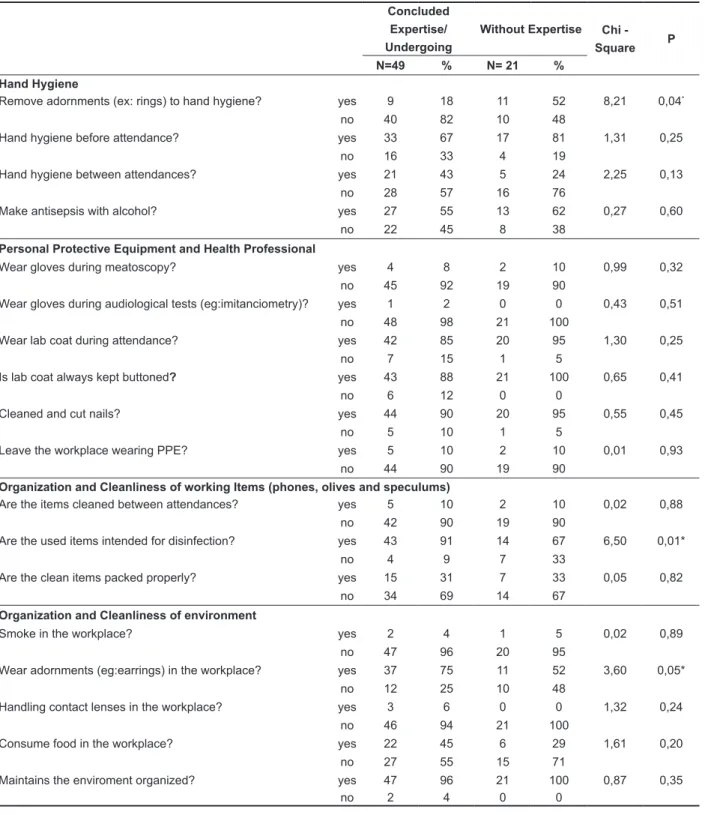
The relation between the biosecurity practices adopted by the speech therapists and continuing education can be visualized in Table 1.
Table 1 – Biosafety practices adopted by speech therapists and continuing education
Concluded Expertise/ Undergoing
Without Expertise Chi -
Square P
N=49 % N= 21 %
Hand Hygiene
Remove adornments (ex: rings) to hand hygiene? yes 9 18 11 52 8,21 0,04*
no 40 82 10 48
Hand hygiene before attendance? yes 33 67 17 81 1,31 0,25
no 16 33 4 19
Hand hygiene between attendances? yes 21 43 5 24 2,25 0,13
no 28 57 16 76
Make antisepsis with alcohol? yes 27 55 13 62 0,27 0,60
no 22 45 8 38
Personal Protective Equipment and Health Professional
Wear gloves during meatoscopy? yes 4 8 2 10 0,99 0,32
no 45 92 19 90
Wear gloves during audiological tests (eg:imitanciometry)? yes 1 2 0 0 0,43 0,51
no 48 98 21 100
Wear lab coat during attendance? yes 42 85 20 95 1,30 0,25
no 7 15 1 5
Is lab coat always kept buttoned? yes 43 88 21 100 0,65 0,41
no 6 12 0 0
Cleaned and cut nails? yes 44 90 20 95 0,55 0,45
no 5 10 1 5
Leave the workplace wearing PPE? yes 5 10 2 10 0,01 0,93
no 44 90 19 90
Organization and Cleanliness of working Items (phones, olives and speculums)
Are the items cleaned between attendances? yes 5 10 2 10 0,02 0,88
no 42 90 19 90
Are the used items intended for disinfection? yes 43 91 14 67 6,50 0,01*
no 4 9 7 33
Are the clean items packed properly? yes 15 31 7 33 0,05 0,82
no 34 69 14 67
Organization and Cleanliness of environment
Smoke in the workplace? yes 2 4 1 5 0,02 0,89
no 47 96 20 95
Wear adornments (eg:earrings) in the workplace? yes 37 75 11 52 3,60 0,05*
no 12 25 10 48
Handling contact lenses in the workplace? yes 3 6 0 0 1,32 0,24
no 46 94 21 100
Consume food in the workplace? yes 22 45 6 29 1,61 0,20
no 27 55 15 71
Maintains the enviroment organized? yes 47 96 21 100 0,87 0,35
no 2 4 0 0
Legend: N= number of professionals; %: percentage of professionals; P= p-value *p<0,05; Chi-square test
Table 2 – Relation between the biosafety practices adopted by the speech therapists and the time of graduation
Up to 18 months of graduation
n=36
More than 18 months
(n=34)
Chi -
square P
N % N %
Hand Hygiene
Remove adornments (eg: rings) to hand hygiene? yes 23 64 22 65 0,01 0,94
no 13 36 12 35
Hand hygiene before attendance? yes 26 72 24 71 0,02 0,88
no 10 28 10 29
Hand hygiene between attendances? yes 12 33 16 47 6,32 0,011*
no 24 67 18 53
Personal Protective Equipment and Health Professionals
Wear gloves during meatoscopy? yes 4 11 2 6 0,60 0,43
no 32 89 32 94
Wear gloves during audiological tests (eg:imitanciometry)? yes 1 3 0 0 0,94 0,33
no 35 97 34 100
Wear lab coat during attendance? yes 36 100 31 91 3,27 0,07
no 0 0 3 9
Is lab coat always kept buttoned? yes 34 94 30 88 0,85 0,35
no 2 6 4 12
Cleaned and cut nails? yes 31 86 33 97 2,64 0,10
no 5 14 1 3
Leave the workplace wearing PPE? yes 4 11 3 9 0,10 0,75
no 32 89 31 91
Organization and Cleanliness of working items (phones, olives e speculums)
Are the items cleaned between attendances? yes 4 11 3 9 0,08 0,78
no 32 89 30 91
Are the used items intended for disinfection? yes 31 89 26 79 1,18 0,27
no 4 11 7 21
Are the clean items packed properly? yes 8 22 14 41 2,87 0,09
no 28 78 20 59
Organization and Cleanliness of Environment
Smoke in the workplace? yes 1 3 2 6 0,40 0,52
no 35 97 32 94
Wear adornments (eg:earrings) in the workplace? yes 25 69 23 68 0,03 0,87
no 11 31 11 32
Handling contact lenses in the workplace? yes 0 0 3 9 2,27 0,07
no 36 100 31 91
Consume food in the workplace? yes 15 42 14 41 0,00 0,96
no 21 58 20 59
Mantains the environment organized? yes 36 100 32 94 2,15 0,14
no 0 0 2 6
Legend: N=number of professionals; %: percentage of professionals; P= p-value *p<0,05; Chi-square Test
Source: Survey Data
DISCUSSION
This research aimed to study and analyze the biosecurity practices adopted by speech therapist
working in Audiology. As there is no speciic Federal
legislation about biosecurity in health, this research is based on Regulatory Norm 32 (NR32)7, which
deals with safety and health at work in health service,
presenting the basic guidelines for the implemen-tation of protection measures to the worker’s safety and health in health care services, as well in that one that promotes activities of promotions and health assistance.
material for the correct procedure of hand hygiene 7-9,11. The non-compliance of these orientations, as
the lack of equipment or not accessible localization items for hand hygiene and no provision of supplies like soaps and paper tower is appointed in the literature as a factor for no adherence to the correct practices of hand hygiene2,3.
In this study, 40 speech therapists (57%) related to be used to do the antiseptic cleaning with alcohol. It is recommended the use of antiseptic products for hand hygiene, due to their antimicrobial activity and the residual and persistent effect. The alcohol-based solution that contains ethanol (ethyl alcohol) is recommended for hand hygiene by having an antimicrobial effect. In Brazil, they are the antiseptic products most widely used2. Others products that
also have the antiseptic function and can be used for
hand hygiene are: chlorhexidine, iodophores (PVPI
– povidone-iodine) and triclosan2. It is important to
highlight that such procedure does not exclude the
need for hand hygiene with water and soap, but can be a feasible solution in audiological clinics that does not have adequate sink (28%).
Another biosecurity measure is the use of personal protective equipment (PPE), which is a device destined to protect worker’s physical integrity and health. This practice is one of the basic precautions that help the professionals in the correct technical procedures14. The use of barriers
of protections by the health professionals should be prioritized, since in the large part of situations is impossible or infeasible to control the source of biological agents or the environment as a whole15.
In addition, it is important to consider that it is not always possible to know if the patient has an infectious disease13. In relation to this issue, it was
observed that 62 (89%) of the professionals working in Audiology use lab coat as protective equipment.
The use of safety practices like this signiicantly
reduces the risk of occupational injury4, and should
be done independently of the use of write clothes or uniform, since it is a physical protection barrier for personal clothes16. In this research, only six
professionals (8%) leave the PPE in the workplace, including lab coat. A previous study showed that uniform and write lab coats became progressively contaminated during clinical treatments and contam-ination reaches a level of saturation, suggesting the possibility that they are a potential vehicle for trans-mission of microorganisms17. Thus, lab coat must be
changed from time to time or daily and/or whenever dirty6 and taken off every time the professional get
out of the workplace7,9. Furthermore, in this research
52 (74%) of the professionals informed the use of lab coat with long sleeve and 64 (91%) of buttoned lab coat, which corroborates with the literature health service2,8-11, since the hands are considered
the main tools of the health professionals, which can be colonized by pathogenic microorganisms2.
It was observed in this study that 50 professionals (71%) stated that they wash their hands before start service. However, only 28 (40%) reported hand hygiene between attendance. Such percentage is considered as low, due to the importance of this procedure for the reduction of dissemination of microorganisms between patients and
profes-sionals. Those indings corroborate with the
literature, which mentions that the health profes-sionals adherence to the recommended practices varies between 5% and 81%, on average stand at around 40%2,3. However, one study that approached
biosecurity measures in nursing professionals in an Intensive Care Unit has found that hand hygiene is a procedure incorporated in the work routine and occurs with a high frequency12. Such variance can
be explained by the type of work environment, as
well as the kind of patient of the intensive care in relation to audiological clinic.
According to the literature, the performance of washing with water and soap is indicate when hands are clearly dirty or contaminated with blood,
secretions and/or others body luids, in initiating and inishing work shift, before and after contact
with patient13, between different procedures with the
same patient, after any contact with contaminated item or equipment, before putting on gloves and immediately after withdrawal2,6-8,10 or as often as
required during patient service11.
When the speech therapists were questioned about removing rings, bracelets and watches for hand hygiene, 46 (66%) reported that they do it against 24 (24%) that say they do not do it. According to the National Health Surveillance Agency (ANVISA, in Portuguese)2, any and all
adornment of hands and forearm, as watches, rings and bracelets should be removed before hand hygiene, once they can gather microorganism2,6,10.
The indings of this research can be related to the
lack of knowledge of the speech therapist about the importance of removing these adornments and the fact that the use of them is habitual and was not properly approached during graduation.
Also according to ANVISA2, the sink for hand
hygiene should be used only for this purpose, provided with: disposable paper towel, liquid soap and trash with drive for foot or elbows. 50 (71%) of the 70 professionals, who have participated in this research, reported to work in audiological clinics in which the sink follow the standardization described above. Others manuals and literatures articles also
state the importance of an exclusive sink, with a
microorganism present, especially, on hearing mucosa8.
30 (43%) professionals reported that the material that covered the audiometric booth does not favor
the hygiene of it. Generally, the internal and external material for cover the wall, ceiling and loor of the
audiometric booth are selected in order to increase sound absorption. However, it is essential to pay attention if these materials make the hygiene a routine20.
In relation to the practices of the professionals in workplace, it was observed that the most of them (96%) do not smoke or handle contact lenses, in
accordance with NR 32. However, 40% (n=28) of
the investigated population stated that consume food and beverages in labor, which is prohibited, as well as storage food in places not intended for that purporse7.
The maintenance of the organization in the workplace is important not only for biosafety, but also to make the environment enjoyable for the profes-sional and the patient. In this research, 68 (97%) of the interviewee reported that the environment is kept organized.
The companies must be careful to follow the norms of biosafety, offering the employee a place to store food and personal items and instructing them in the use of equipment, among others recommen-dations. The most professionals – 55 (79%) and 37 (53%) respectively – related that the company in which they work addresses these two recom-mendations. The company must also pay attention
to the criterion of lining the walls, loor and ceiling,
which must be resistant to washing and to the use of disinfectant16. The research showed that 58 (83%)
professionals work in places that meet this criterion.
When analyzing the inluence of continuing education on execution of correct biosecurity
practices (Table 1), it was observed that the speech
therapists with completed or undergoing expertise
had better biosecurity practices when compared to
those without expertise. In the question related to
the allocation of the items (olives and speculums) for disinfections, it was observed a statistically
signiicant difference (p=0,01) when comparing the responses of interviewees who have expertise with
those who do not have. This result corroborates with the literature that says that continuing education is a type of intervention that can lead to the adoption and implementation of biosecurity measures on the daily routine of the health worker12,21. Studies
reported that biosafety is a educational activity and should be represented by a system of teaching and learning22,23, in a continuous process.
However, in questions 2 and 21 – Do you remove rings, bracelets and watches to hand hygiene? and researched, that appoints that the lab coat must has
long sleeves and should be kept buttoned16,18.
In relation to the use of gloves, 69 speech thera-pists (99%) do not use this kind of PPE in Audiology. The literature describes gloves as protective barriers
that avoid the contact with body luids, secretions and
contaminated items9. The use of gloves is indicated
during audiological test8,19 and in the handling of
specula and olives, in order to minimize the risk of cross infection9. Furthermore, the literature suggests
the use of gloves during meatoscopy8, which is a
practice that is not realized for the most profes-sionals of this research (91%). This can happen
due to lack of information regarding these speciic
recommendations or negligence due to a poor perception of risks, which leads to non-compliance of such measures15. This fact was not observed in
others areas, as Nursing and Dentistry, in which the use of gloves for handling patient is more frequent12.
Regarding to the practice of use hair tied and keep clean and cut nails, it was observed that 55 (795) and 64(%) of the respondents, respectively, keep such habits, which is advocated in the literature, that suggests the use of hold hair and kept short nails regularly6,19.
The hygiene of the items is relates to the care with the supplies used in health and their cleaning. The process of cleaning is composed by the removal of dirty or organic matter, preceding actions of sterilization or disinfection6,16. Failures in this
case facilitate microbial growth and thus promote the transmission of infections16. Approximately 80%
of the professionals send the items for disinfection and separate them from the others. However, 61% stated that, despite carrying the recommended cleaning, they do not store the olives, speculums and other articles adequately, increasing the risk of items contamination even before direct contact with the patient. It is important to highlight that, according to literature, speculums and olives should be, preferably, disposable19. If this is impossible, these
articles should be disinfected8.
During audiological tests realized by speech therapists noncritical items are used, those intended for contact with intact skin of the patient and require cleaning and disinfecting6,13, for example electrodes,
vats, phones and cannula for irrigation8. It is also
used semi-critical items, those intended for contact with no-intact skin or intact mucous and require high level of disinfection or sterilization6,13, for example
speculum and olives8. In this research, 62 (93%)
institutions should promote the empowerment of
their students. So that, they are suitably qualiied
to promote procedures that minimizes and/or eliminate the real risks to the health employees and customers27-29. The professional who is omitted
in the implementation and execution of the NR 32
would be breaching the professional Code of Ethics,
which speciically recommends obedience to the laws of the country in which its the norm.
The change of behavior (development of skills and change attitudes) and the implementation of best practices are required for prevention of cross-transmission between patients and professionals of occupational diseases. A program of professional training in biosafety as performed at the Instituto Oswaldo Cruz is essential besides an instruction in the graduation and campaigns that maintains the professional oriented30.
New researches in phonoaudiology that approaches the biosafety practices, not only in Audiology, but also in the others areas, must be developed. There is also the need to include questions about immunization of the speech therapist, according to what is determined for the health care professional, issue not addressed in this study.
CONCLUSION
It concludes that the most biosecurity practices are follow by the speech therapists working in Audiology.
Factors as time of graduation and continuing
education positively inluence the adoption of correct
biosafety precautions.
The data indicate the need to improve the adherence of the speech therapist working in Audiology to biosecurity measures, in order to prevent and reduce infections, as well the promotion of the safety of patients, professionals and others users of health services.
Do you use adornments like earrings, bracelets or necklaces in workplace?, respectively – it was observed that a higher number of professionals
without expertise stated to have a practice of
withdrawal adornments during work routine for hand hygiene when compared to the number of profes-sionals who reported the same practice and have
expertise. This result was not expected, since it is
believed that specialization is a period of learning
best practices. This fact can be explained by a deicit that exists between academic training and
the routine of work, regarding to biosafety24,25.
When analyzing the inluence of time of gradu -ation in the adoption of biosafety practices (Table 2),
it was veriied a better compliance in the practice of
hand hygiene in the professionals with longer time
of graduation (p=0,011). It is believed that this result
is due to the improvement in the practices that occur over time, in which the health professional acquires training and passes to observe the necessity of such measures in their daily lives. This corroborates with the literature, which reports improvement of practices with the increase of graduation time26.
It is observed that hand hygiene, use of PPE and organization and cleanliness of working items and the environment are biosafety measures known by almost all health professionals and speech thera-pists interviewee in this study. However, it can be notice that there are professionals that do not incor-porate such practices in the work routine or realize them in a wrong way.
The NR 32 is nationally recognized as one of the most important achievements of health profes-sionals in relation to safety and health at work. The effectiveness of this norm is directly related to the
extensive knowledge of all aspects by the profes -sionals. However, a considerable part of these professionals, be they speech therapist, doctors or
nurses presents deicits knowledge related to the
2006. Disponível em: http://www.fonoaudiologia. org.br/ Acesso: 13 de fevereiro de 2011 às 21:35h. 7. Brasil. Ministério do Trabalho e Emprego. Portaria n. 485. 11 de novembro de 2005. Aprova a Norma Regulamentadora nº 32 – NR-32 que dispõe sobre segurança e saúde no trabalho nos
serviços de saúde. Diário Oicial da República
Federativa do Brasil, Brasília (DF); 2005 Nov 16; Seção 1. Disponível em: http://portal.mte.gov.br/ data/files/FF8080812BE914E6012BF8B4FDFC0
C65/p_20051111_485.pdf. Acesso em: 10 de julho
de 2011 às 14:50h.
8. Mancini PC, Teixeira LC, Rezende LM, Gomes AM, Vicente LCC, Oliveira PM. Medidas de
biossegurança em Audiologia. Rev. CEFAC. 2008;10(4):603-10.
9. Panhotra BR, Saxena AK, Al-Mulhim AS. Contamination of patients’ iles in intensive
care units: an indication of strict handwashing after entering case notes. Am J Infect Control. 2005;33(7):398-401.
10. Souza CP, Tanigute CC, Tipple AFV. Biossegurança: medidas de precauções-padrão em fonoaudiologia. Fonoaudiol Bras. 2000;3(4):18-24. 11. Brasil. Ministério da Saúde. Portaria n. 2.616, de
13 de maio de 1998. Expede na forma de anexos as
diretrizes e normas para a prevenção e controle das
infecções hospitalares. Diário Oicial da República
REFERENCES
1. Teixeira P, Valle S. Biossegurança: uma
abordagem multidisciplinar. Rio de Janeiro: Fiocruz; 1996.
2. Brasil. Agência Nacional de Vigilância Sanitária – ANVISA. Segurança do paciente – Higienização das mãos. Brasília (DF), 2009. Disponível em: www.
anvisa.gov.br/ servicosaude/manuais/paciente_ hig_maos.pdf. Acesso: 21 de dezembro de 2010 às
20:30h.
3. Ardila AM, Muñoz AI. Bioseguridad con énfasis en contaminantes biológicos en trabajadores de la salud. Ciênc. saúde coletiva. 2009;14(6):2132-41. 4. Carvalho CMRS, Madeira MZA, Tapety FI, Alves
ELM, Martins MCC, Brito JNPO. Aspectos de
biossegurança relacionados ao uso do jaleco pelos
proissionais de saúde: uma revisão da literatura. Texto Contexto Enferm. 2009;18(2):355-60.
5.Taegtmeyer M, Suckling RM, Nguku PM, Meredith
C, Kibaru J, Chakaya JM, Muchela H, Gilks CF.
Working with risk: occupational safety issues
among healthcare workers in Kenya. AIDS Care.
2008;20(3):304-10.
6. Conselho Federal de Fonoaudiologia. Medidas de Controle de infecção para fonoaudiólogo: Manual de Biossegurança. 8º Colegiado. Brasília,
RESUMO
Objetivo: explicitar as práticas de biossegurança adotadas por fonoaudiólogos atuantes na área
de Audiologia e relacioná-las com a educação continuada e o tempo de formação dos proissio -nais. Métodos: participaram deste estudo 70 fonoaudiólogos atuantes na área de Audiologia, nos municípios de Belo Horizonte e Contagem. Foi aplicado um questionário sobre biossegurança em Audiologia, com base na Norma Regulamentadora 32, composto por 27 perguntas fechadas, abor-dando os aspectos de higienização das mãos, equipamentos de proteção individual e organização e higienização dos artigos e do ambiente. Resultados: a maioria dos fonoaudiólogos relatou que adota as seguintes medidas de biossegurança: higienização das mãos antes dos atendimentos (71%), uso de jaleco com mangas longas (74%) e abotoado (91%), cabelos presos (79%), unhas limpas e cor-tadas (91%), separação e desinfecção dos artigos usados (83%) e organização do ambiente (97%).
No entanto somente 40% dos proissionais referiram higienizar as mãos entre os atendimentos e 9%
referiram o uso de luvas na realização da meatoscopia. Observou-se que a destinação dos artigos
para desinfecção é uma prática mais rotineira para proissionais com especialização (p< 0,05). Os proissionais com maior tempo de formação aderiram melhor à prática de higienização das mãos.
Conclusão: higienizar as mãos antes dos atendimentos, vestir-se corretamente, destinar os artigos para desinfecção e organizar o ambiente de trabalho são práticas de biossegurança adotadas pela
maioria dos fonoaudiólogos. Fatores como tempo de formação e educação continuada inluenciam de
maneira positiva na adoção de corretas medidas de biossegurança.
21. Guirado AO, Heredia OR, Delgado EP, García MG. Bioseguridad: su comportamiento. Revista Archivo Médico de Camagüey. 2008;12(5):1-11. 22. Andrade AC, Sanna MC. Ensino de Biosseguraça na Graduação em Enfermagem: uma revisão da literatura. Rev Bras Enferm. 2007;60(5):569-72.
23. Reis RK, Gir E, Canini SRMS. Accidents with
biological material among undergraduate nursing students in a public Brazilian university. Braz J Infect Dis 2004;8(1):18-24.
24. Pereira MEC, Costa MAF, Borba CM, Jurberg C. Construção do conhecimento em biossegurança: uma revisão da produção acadêmica nacional na área de saúde (1989-2009). Saúde Soc. 2010;19(2):395-404.
25. Mastroeni MF. A difícil tarefa de praticar a biossegurança. Cienc. Cult. 2008;60(2):4-5.
26. Cortijo J, Gómez M, Samalvides F. Cambios en conocimientos, actitudes y aptitudes sobre bioseguridad en estudiantes de los últimos años de Medicina. Rev Med Hered. 2010;21(1):27-31.
27. Antunes, HM, Cardoso, LO, Antunes RPG,
Gonçalves, SP, Oliveira, H. Biossegurança e ensino de medicina na Universidade Federal de Juiz de Fora, (MG). Rev. bras. educ. med. 2010;34(3):335-45 .
28. De Bonis M, Costa MAF. Educação em biossegurança e bioética: articulação necessária em biotecnologia. Ciênc. saúde coletiva. 2009;14(6):2107-14.
29. Costa MAF, Costa MFB. Biosafety education: educational contributions to the health professional education. Ciênc. saúde coletiva. 2010:15(1):1741-50.
30. Pereira, MEC, Jurberg, C, Soeiro, MNC, Borba, CM. A estruturação do Programa de Capacitação
Proissional de Biossegurança no contexto do Projeto de Modernização da Gestão Cientíica
do Instituto Oswaldo Cruz. Saude Soc. 2010; 19(2):440-8.
Federativa do Brasil, Brasília (DF); 1998 Mai 13; Seção 1:133.
12. Correa CF, Donato M. Biossegurança em uma unidade de terapia intensiva. A percepção da equipe de enfermagem. Esc Anna Nery R Enferm. 2007;11(2):197 – 204.
13. Velásquez BLA. Atención al paciente VIH/ SIDA: Legislación y bioseguridad odontológica en
Colombia. Acta Bioethica. 2006;12(1):23-8.
14. Skraba I, Nickel R, Wotkoski SR. Barreiras de contenção: EPI e EPCs. In: Mastroeni MF. Biosseguranca aplicada a laboratório e serviços de saúde. São Paulo (SP): Atheneu; 2006.
15. Caixeta RB, Barbosa-Branco A. Acidente de trabalho, com material biológico, em proissionais
de saúde de hospitais públicos do Distrito Federal, Brasil, 2002/2003. Cad. Saúde Pública. 2005;21(3):737-46.
16. Brasil. Ministério da Saúde. Secretaria de Políticas de Saúde. Coordenação Nacional de DST e AIDS. Controle de infecções na prática odontológica em tempos de AIDS: manual e condutas. Brasília; 2000.
17. Loveday HP, Wilson JA, Hoffman PN, Pratt
RJ. Public perception social and microbiological
signiicance of uniforms in the prevention and control
of healthcare-associated infections: an evidence review. Br J Infec. 2007;8(4):10-21.
18. Guandalini, S.L. Biossegurança. J Bra Odont
Clin. 1997;1(1):9-11.
19. Kemp RJ, Roeser RJ, Pearson DW, Ballachandra
BB. Infection control for the professions of audiology and speech language pathology. Olathe: Iles Publications; 1996.
20. Conselho Federal e Regional de Fonoaudiologia. Ambiente acústico em cabina / sala de teste. Março, 2010. Disponível em: http://www.fonoaudiologia.org.
br/ paginas_internas/guiasManuais.asp. Acesso: 14
de fevereiro de 2011 às 00:15h.
Received on: November 17, 2011 Accepted on: January 31, 2012
Mailing address:
Ana Paula Ferreira Rocha Av. do Contorno, 9.939 sala 404 Prado – Belo Horizonte – MG CEP 30110-067