HYGROTHERMAL BEHAVIOUR OF EARTHEN PLASTERS FOR
SUSTAINABLE HOUSING CONSTRUCTION
Paulina Faria1*, Tânia Santos2
1: UNIC, Department of Civil Engineering Faculty of Sciences and Technology
NOVA University of Lisbon 2829-516 Caparica, Portugal
e-mail: [email protected] web: http://www.unic.fct.unl.pt/unic 2: Department of Civil Engineering
Faculty of Sciences and Technology NOVA University of Lisbon 2829-516 Caparica, Portugal
e-mail: [email protected] web: http://www.fct.unl.pt/
Keywords: Earth, mortar, plaster, hygrothermal behaviour
Abstract A ready-mixed and several laboratory formulated mortars were produced and tested in fresh state and after hardening, simulating a masonry plaster for indoor application. All the mortars used a clayish earth from the same region and different compositions of aggregates, eventually including fibres and a phase change material. All the formulated mortars were composed by 1:3 volumetric proportions of earth and aggregate. Tests were developed for consistency, fresh bulk density, thermal conductivity, capillary absorption and drying, water vapour permeability and sorption-desorption. The use of PCM changed drastically the workability of the mortars and increased their capillary absorption. The use of fibres and variations on particle size distribution of the mixtures of sand that were used had no significant influence on tested pro perties. But particularly the good workability of these mortars and the high capacity of sorption and desorption was highlighted. With this capacity plasters made with these mortars are able to adsorb water vapour from indoor atmosphere when high levels of relative humidity exist and release water vapour when the indoor atmosphere became too dry. This fact makes them able to contribute passively for a healthier indoor environment. The technical, ecological and environmental advantages of the application of plasters with this type of mortars are emphasized, with the aim of contributing for an increased use for new or existent housing.
1. INTRODUCTION
For some decades the use of earth as a building material stopped in many countries and the craftsmanship knowledge was almost lost. This was due to the generalized used of cement and cement-based materials. Mainly since the 80´s energetic problems and environmental concerns have led to a regain of conscience and earth re-began to be considered, again, as a building material, namely for the production of mortars for plastering indoor masonry.
Nowadays many ready-mixed earthen mortars are produced and commercialized worldwide and there is a German standard on the subject (DIN 18947 [1]), defining terms, definitions, requirements and some test methods to assess and classify earth mortar plasters for the German market.
Earthen plasters have low embodied energy, because the energy required for extracting, transform and produce building materials based on earth are extremely low when compared with other materials. Therefore the life cycle is characterized by a reduced environmental impact and consume of energy [2]. These mortars present interesting characteristics for the quality and comfort of indoor environment, namely in terms of hygroscopicity [3]. Depending on the exterior climatic conditions and the habits of the users, this property can contribute for indoor hygrometric equilibrium and for the limitation of health problems of the inhabitants associated with extreme hygrometric conditions. Simultaneously and because earth is naturally pigmented, earth plasters can offer interesting aesthetic colour finishing without need of painting systems. For all those reasons earthen mortars may be an eco-efficient choice for plastering the surface of masonries, existent or new ones, contributing for the indoor air quality, aesthetic and comfort, and for the sustainability of housing construction. Furthermore they may be applied on different types of masonries, not only earthen based [4].
In this paper the hygrothermal characterization of earth mortars will be analysed: thermal conductivity, water vapour sorption and desorption, water vapour permeability, capillary absorption and drying. Analysed mortars are a ready-mixed mortar and mortars formulated in laboratory. All the mortars used the same type of clayish earth but the grain size distribution, type and proportion of the aggregates varied. Some of the mortars had a vegetal fibre or a phase change material.
2. MATERIALS, MORTARS AND SAMPLES
The ready-mixed earth plastering mortar was produced by Embarro company and included clayish earth, siliceous sand and 1-2 cm oat fibres. The mortars formulated in laboratory had different proportions of some of the following materials:
- a fine and a coarse siliceous sand, FS and CS; they were used separately or together; - a phase change material Micronal DS 5040 X from BASF, PCM; it was used as sand
replacement;
- oat straw fibres cut 1-2 cm, F; they were used as an addition.
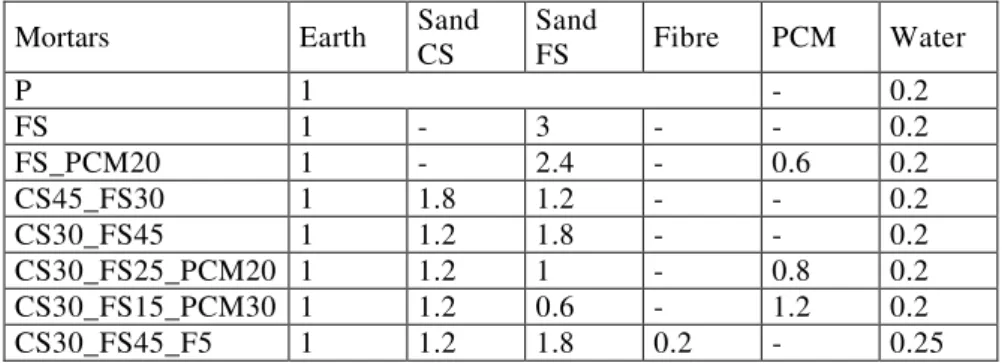
expressed as a function of the amount of dry constituents. Volumetric compositions are presented in Table 1.
Mortars Earth Sand CS
Sand
FS Fibre PCM Water
P 1 - 0.2
FS 1 - 3 - - 0.2
FS_PCM20 1 - 2.4 - 0.6 0.2
CS45_FS30 1 1.8 1.2 - - 0.2
CS30_FS45 1 1.2 1.8 - - 0.2
CS30_FS25_PCM20 1 1.2 1 - 0.8 0.2 CS30_FS15_PCM30 1 1.2 0.6 - 1.2 0.2 CS30_FS45_F5 1 1.2 1.8 0.2 - 0.25
Table 1. Mortars volumetric proportions
Mortars were produced based on DIN standard [1], with manual homogenization, water addition and mixing for about 30 seconds, other 30 seconds of mechanical laboratory mixing, rest for 5 minutes and final 30 seconds mechanical mixing. After fresh state characterization, mortar samples with 90 mm diameter and 20 mm high were produced in PVC moulds and samples with 40 mm x 40 mm x 160 mm were produced in metallic moulds. All samples were let to dry in stable laboratory conditions at 65% relative humidity and 20ºC temperature.
3. METHODS, RESULTS AND DISCUSSION
3.1.Fresh state characterization
The characterization of mortars in the fresh state included consistency by flow table test, based on EN 1015-3 [6], and bulk density based on EN 1015-6 [7]. Results are presented in Table 2.
Mortar Flow table [mm]
Bulk density [kg/dm3]
P 161.5 2.00
FS 168.0 2.04
FS_PCM20 171.5 1.44 CS45_FS30 168.0 2.06 CS30_FS45 167.5 2.06 CS30_FS25_PCM20 167.0 1.46 CS30_FS15_PCM30 151.5 1.43 CS30_FS45_F5 192.5 2.00
Table 2. Fresh state characterization of the mortars
1.2 kg/dm3, the lower limit defined by the DIN [1].
3.2.Thermal conductivity
The thermal conductivity was determined using three circular samples with 20 mm high and 90 mm diameter. A Heat Transfer Analyser Isomet 2104 equipment was used, with a 60 mm diameter contact probe API 210412. Results (in terms of average and standard deviation for each mortar) are presented in Figure 1.
Figure 1. Thermal conductivity of mortars
The thermal conductivity of mortars with more coarse sand, with fibres and particularly with PCM decreases when compared to other mortars (Figure 1). For the other mortars thermal conductivity is similar to common air lime based mortars, between 0.8-1.0 W/(m.K).
3.3.Capillary absorption and drying
The capillary absorption of the mortars was assessed, based on EN 15801 [8] and EN 1015-18 [9]. Specimens with 40 mm x 40 mm x 40 mm were cut from the prismatic samples. The lateral faces were waterproofed with an epoxy resin. A thin cotton tissue was applied on the top down of the samples, to contain eventual mass loss of fines, and was maintained by a thin elastic band.
The capillary curve of the mortars is presented in Figure 2 and the capillary coefficient was calculated by the slope of the more representative initial segment of the curve of each mortar. In the case of these mortars the initial segment represents the capillary absorption velocity. Capillary coefficients (in terms of average and standard deviation) are presented in Table 3. The capillary coefficient is higher for mortars with PCM. These mortars achieve capillary saturation very fast. All the other mortars present a similar CC, always high and corresponding to the first segment (from 0 to 2 minutes).
0,0 0,2 0,4 0,6 0,8 1,0 1,2
λ
[
W
/(
m
.K)
Mortar CC
[kg/(m2.min0.5)] DR [kg/(m2.h)]
DI [-]
P 2.52±0.12 0.18±0.02 0.23±0.02
FS 2.62±0.17 0.19±0.01 0.23±0.01 FS_PCM20 7.33±1.90 0.27±0.01 0.21±0.00 CS45_FS30 2.59±0.05 0.18±0.00 0.20±0.01 CS30_FS45 2.27±0.11 0.23±0.04 0.15±0.03 CS30_FS25_PCM20 5.00±0.27 0.33±0.01 0.23±0.14 CS30_FS15_PCM30 4.28±1.55 0.25±0.07 0.22±0.01 CS30_FS45_F5 2.56±0.14 0.23±0.01 0.17±0.01
Table 3. Capillary coefficient CC, drying rate DR and drying index DI of mortars
Figure 2. Capillary curve of mortars
The drying capacity of the mortars was assessed just after the capillary absorption test with the same specimen, based on RILEM Test No. II.5 [10]. But because of the degradation of these type of mortars with water, some of the mortar samples were not capillary saturated at the beginning of the drying test.
The drying curve of the mortars is presented in Figure 3. The drying rate represents the initial drying velocity of mortars and was determined by the slope of the initial segment of the drying curve but with water decrease by square meter of drying area in ordinate [11]. The drying index represents the difficulty to achieve a complete drying, in equilibrium with the environment, and is calculated based on Normal 29/88 [12], following the simplified procedure presented by Grilo et al. [11]. The drying rate and drying index, in terms of average and standard deviation, are presented in Table 3.
0 2 4 6 8 10 12 14
0 5 10 15 20 25
C
a
p
il
a
rr
y
W
a
ter
A
b
so
rpt
io
n
[
k
g
/m
2]
Time [min0,5]
P FS
FS_PCM20 CS45_FS30
CS30_FS45 CS30_FS25_PCM20
Figure 3. Drying curve of mortars
The drying rate is particularly high for mortars with 20% PCM, what shows that fast drying may compensate their fast capillary absorption. The drying rate of mortars with 30% of coarse sand is also higher than the other mortars.
The drying index is very similar for all the tested mortars. Only mortars with 30% coarse sand and 45% fine sand, without other constituents or with fibres, present a slightly higher drying capacity.
3.4.Water vapour permeability and sorption-desorption capacity
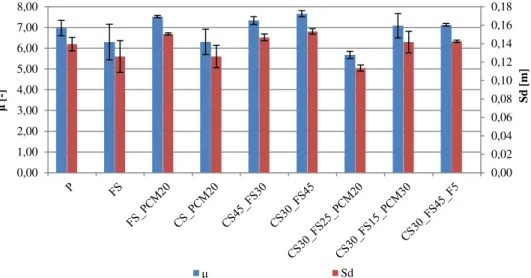
Water vapour permeability of the mortars were determined based on DIN 18947 [ 1], EN 1015-19 [13], EN ISO 12572 [14] and EN 15803 [15], using the same samples with 90 mm diameter and 20 mm thick. The wet method was used and the mortar specimen systems were placed in a climatic chamber at 23ºC and 40% RH. Results, in terms of average and standard deviation of water vapour resistance factor and water vapour diffusion equivalent air layer thickness, are shown in Figure 4.
The differences of composition of mortars are not significant once all present water vapour resistance factor not to high and within the range of 5/10 defined by DIN [1] for earthen mortars (Figure 4).
The sorption and desorption capacity of the mortars are determined with the circular samples with 20 mm high and 90 mm diameter, with much smaller area than the samples defined by DIN 18947 [1] - these ones with 1000 cm3. The samples were coated with a film of polyethylene in all the surfaces except the top one. The test procedure was based on DIN 18947 [1] test: samples were placed in equilibrium at 50% HR in a climatic chamber; this chamber was programmed for 80% RH and the water vapour gain of the mortar samples after determined periods of time inside the climatic chamber were assessed (0,5h, 1h, 3h, 6h and 12h), using a 0,001 g precision scale.
0 5 10 15 20 25 30
0 20 40 60 80 100 120 140 160 180 200
W
a
te
r
v
a
p
o
u
r
[%
]
Time [h]
P FS
FS_PCM20 CS45_FS30
CS30_FS45 CS30_FS25_PCM20
Figure 4. Water vapour resistance factor and water vapour diffusion equivalent air layer thickness of mortars
The desorption of the mortars, initially at equilibrium at 80% RH, was determined, programming the climatic chamber for 50% RH and determining the water vapour decrease of the same samples after the same defined periods of time (weighting after 0,5h, 1h, 3h, 6h and 12h). The sorption and desorption curves of the mortars are presented in Figure 5.
Figure 5. Sorption (continuous line) and desorption (dashed line) of mortars
It can be noticed that the sorption capacity of all the tested mortars and particularly the ready-mixed mortar is very high, ranging from around 80 to 125 g/m2 after 12 h at 80%
0,00 0,02 0,04 0,06 0,08 0,10 0,12 0,14 0,16 0,18 0,00 1,00 2,00 3,00 4,00 5,00 6,00 7,00 8,00 S d [ m ] μ [ -] μ Sd -200 -150 -100 -50 0 50 100 150
0 2 4 6 8 10 12 14
RH. Even using samples with much smaller superficial area than the ones of the standard [1], results indicate that all the mortars could be classified in the upper class WS III. Simultaneously a good desorption capacity can be noticed (Figure 5). The differences between distinct mortar compositions are not significant; only mortar CS45_FS30 presents a bizarre behaviour from 3 to 6 h, most probably due to some error on data register. It is then expected that plasters with all these mortars can adsorb water vapour from the indoor atmosphere whenever high levels of humidity exist and release that vapour when the indoor air dries.
4. CONCLUSIONS
The characterization of diverse mortars based on a clayish earth from the same region with different compositions in terms of aggregates, including a ready-mixed mortar and mortars formulated in laboratory with only fine or a mixture of coarse and fine sands, allowed to conclude that:
- All the mortars presented a very good workability but it changed drastically when a PCM partially substituted the fine sand; the flow table consistency could not express that change of workability but it could be noticed by the decrease on fresh bulk density.
- The use of fibres slightly decreased the fresh bulk density, as expected; the high consistency of the fibre-formulated mortar is due to a slightly higher water composition, that most probably was not needed.
- The thermal conductivity of mortars with PCM decreases when compared to other mortars; this is certainly due to the fact of being lighter mortars; but this positive difference is not very important because of the relatively thin thickness of common masonry plasters.
- PCM mortars present very high initial capillary absorption and that can be a problem if there is some capillary size from the floor, for instance during daily housing cleaning; nevertheless the initial drying is very fast.
- All the mortars present a relatively low water vapour resistance, allowing the water vapour to evaporate.
- All the mortars presented very high sorption (and de-sorption) capacity; this means that plasters with all these mortars can adsorb water vapour from the indoor atmosphere whenever high levels of humidity exist and release that vapour when the indoor air dries, contributing for maintaining indoor levels of RH in a healthier range.
- The differences obtained by varying grain size distribution of the sand and the addition of oat fibres were not significative concerning the hygrothermal aspects under study, showing that different kinds of sands can be used on plastering mortars with this type of clayish earth.
the scientific knowledge on these particular building products, which can be used worldwide with local clayish earths. For the time being the use of PCM, with similar percentages, cannot be recommended because of workability reasons.
But the good hygrothermal characteristics obtained with the ready-mixed and the other formulated earth mortars should be highlighted. Together with ecological reasons, it may be emphasized that eco-efficient plasters made of earthen mortars can be a strong possibility for sustainable new housing construction and sustainable housing rehabilitation.
ACKNOWLEDGEMENTS
The authors wish to acknowledge Vitor Silva for helping on all the testing campaign and EMBARRO Company for making available the materials for the production of mortars.
REFERENCES
[1] NABau, DIN 18947:2013 - Earth plasters, Terms and definitions, requirements, test methods (in German). Berlin.
[2] P. Melià, G. Ruggieri, S. Sabbadini, G. Dotelli, “Environmental impacts of natural and conventional building materials: a case study on earth plasters”, Journal of Cleaner Production, vol. 80, pp. 179-186, 2014.
[3] Minke, G. Building with earth. Berlin, 2006.
[4] P. Faria, T. Santos, V. Silva, “Earth-based mortars for masonry plastering”, in Proceedings of 9th International Masonry Conference, Guimarães, Portugal, 7-9 July, 2014 (cd).
[5] C. Ziegert, Test report 11045a, “Análise de argila para construção em Portugal, Rebocos de argila EMBARRO PORTUGAL”. Ziegert Seiler Ingenieure GmbH, Berlin, 2011.
[6] CEN, EN 1015-3:1999 – Methods of test for mortar for masonry. Determination of consistence of fresh mortar (by flow table). Brussels.
[7] CEN, EN 1015-6:1998 – Methods of test for mortar for masonry - Part 6: Determination of bulk density of fresh mortar. Brussels.
[8] CEN, EN 15801: 2009 – Conservation of cultural property. Test methods. Determination of water absorption by capillarity. Brussels.
[9] CEN, EN 1015-18:2002 – Methods of test for mortars for masonry. Part 18: Determination of water absorption coefficient due to capillary action of hardened mortar. Brussels.
[10] RILEM, “Recommended tests to measure the deterioration of stone and to assess the effectiveness of treatment methods. Test nº II.5 – Evaporation curve”, Materials & Structures, vol. 13, pp. 204-207, 1980.
conditions”, Construction and Building Materials, vol. 54, pp. 378-384, 2014.
[12] CNR-ICR, Normal 29/88:1991 – Misura della perdita per evaporazione dell’acqua assorbita dal material. Rome.
[13] CEN, EN 1015-19:1998 – Methods of test for mortar for masonry; Part 19: Determination of water vapour permeability of hardened rendering and plastering mortars. Brussels.
[14] ISO, ISO 12572:2001 – Hygrothermal performance of building materials and products
– Determination of water vapour transmission properties. Switzerland.