J. res.: fundam. care. online 2015. out./dez. 7(4): 3375-3387
3375
A influência dos fatores estressores sobre os níveis de atenção de profissionais de enfermagemThe influence of stress factors on the attention levels of nursing professionals La influencia de los factores estresantes en los niveles de atención de los profesionales de
enfermería
Andrea Zavalis ¹, Lucia Alves Marques Vianna ², Luciane de Souza Velasque ³, Vivian Schutz 4, Daniel
Aragão Machado 5
Objective: To identify, according to the reference of nursing professionals, which stress factors have the greatest influence in the attention process; and analyze, which ones generate greater impact in the development of care activities. Method: This is a quantitative, descriptive correlational study where connections among stress, attention and nursing care have been described. Results: 50 nursing professions were evaluated. 54% (n = 27) stated that stress factors interfere on the levels of attention given by nursing professionals in carrying out their care tasks. 55% (n = 15) point that stress factors related to the working environment are the ones that interfere the most on the levels of attention, followed by stressors classified as biological (n = 10) and psychological (n = 02). Conclusion: Stress factors related to the work environment had the greatest influence on attention and are possibly the ones that affect the most the quality of care provided to clients. Descriptors: Attention, Stress, Nursing.
Objetivo: Identificar, segundo a referência dos profissionais de enfermagem, quais fatores estressores têm a maior influência no processo de atenção; e analisar, quais geram maior impacto no desenvolvimento das atividades de cuidado. Método: Trata-se de um estudo quantitativo, correlacional descritivo onde foram descritas as relações entre o estresse, atenção e assistência de enfermagem. Resultados: Avaliados 50 profissionais de enfermagem, dentre eles 54% (n=27) afirmaram que os fatores estressores interferem nos níveis de atenção destinados pelos profissionais de enfermagem na execução de suas tarefas assistenciais. Destes, 55% (n=15) evidenciam que os fatores estressores relativos ao ambiente de trabalho são os que mais interferem nos níveis de atenção, seguidos de fatores estressores classificados como biológicos (n=10) e psicológicos (n=02). Conclusão: Fatores estressores relacionados ao ambiente tiveram a maior influencia na atenção e possivelmente são os que mais interferem na qualidade da assistência prestada aos clientes. Descritores: Atenção, Estresse, Cuidados de enfermagem.
Objetivos: Identificar, según la referencia de los profesionales de enfermería, los factores estresantes que ejercen una mayor influencia en el proceso de atención; y analizar cuáles generan un mayor impacto en el desarrollo de las actividades asistenciales. Método: Se trata de un estudio cuantitativo, descriptivo y correlacional en el cual fueron descritas las relaciones entre estrés, atención y cuidados de enfermería. Resultados: Fueron evaluados 50 profesionales de enfermería, de los cuales el 54% (n = 27) indicó que los factores estresantes interferían en los niveles de atención de los profesionales de enfermería en la realización de sus tareas asistenciales. De estos, el 55% (n = 15) afirmó que los factores estresantes relativos al entorno laboral eran los que más afectaban los niveles de atención, seguidos por factores estresantes clasificados como biológicos (n = 10) y psicológicos (n = 2). Conclusión: Los factores estresantes relacionados con el entorno laboral tuvieron una mayor influencia en la atención y posiblemente fueron los que más interferían en la calidad de la asistencia prestada a los clientes. Descriptores: Atención, Estrés, Cuidados de enfermería.
1 Nursing academic. Graduattion in progress in Nursing of the Federal University of the State of Rio de Janeiro (UNIRIO), Rio de Janeiro, Rio de Janeiro (RJ), Brazil. E-mail: [email protected] 2 Nutritionist. PhD in Biochemistry at Federal University of the São Paulo (UNIFESP), São Paulo, São Paulo (SP), Brazil. Professor at the Federal University of the State of Rio de Janeiro (UNIRIO), Rio de Janeiro, Rio de Janeiro (RJ), Brazil. Guiding the Master and Doctorate in Neurology (Neuroscience) and the Doctorate in Nursing and Biosciences both the Federal University of the State of Rio de Janeiro (UNIRIO), Rio de Janeiro, Rio de Janeiro (RJ), Brazil. E-mail: [email protected] 3 Estatistica. PhD at Public Health from National School of Public Health (ENSP), Rio de Janeiro, Rio de Janeiro (RJ), Brazil. Professor at the Federal University of the State of Rio de Janeiro (UNIRIO), Rio de Janeiro, Rio de Janeiro (RJ), Brazil. E-mail: [email protected] 4 Nurse. PhD in Nursing from School of Nursing Anna Nery at the Federal University of Rio de Janeiro (UFRJ), Rio de Janeiro, Rio de Janeiro (RJ), Brazil. Professor of the Fundamental Nursing Department at the Alfredo Pinto Nursing School of the Federal University of the State of Rio de Janeiro (EEAP/UNIRIO), Rio de Janeiro, Rio de Janeiro (RJ), Brazil. Professor of the graduate Nursing Program (PPGENF – Master) of the Federal University of the State of Rio de Janeiro (UNIRIO), Rio de Janeiro, Rio de Janeiro (RJ), Brazil. E-mail: [email protected] 5 Nurse. PhD in Biosciences at Federal University of the State of Rio de Janeiro (UNIRIO), Rio de Janeiro, Rio de Janeiro (RJ), Brazil. Professor of the Fundamental Nursing Department at the Alfredo Pinto Nursing School of the Federal University of the State of Rio de Janeiro (EEAP/UNIRIO), Rio de Janeiro, Rio de Janeiro (RJ), Brazil. E-mail: [email protected]
J. res.: fundam. care. online 2015. out./dez. 7(4): 3375-3387
3376
owadays, the demands on cognitive processes have influenced the lives of individuals as a whole. The levels of demands required from workers, especially those who deal with constant technological and scientific advances, increase the physical and psychological loads, which may have negative effects on the individual. 1-2When it comes to the understanding of cognition we may take as basis the definition given by Neves, as the act or process of getting to know, which includes mental states and processes such as thinking, attention, reasoning, memory, judgment, imagination, reasoning , speech, visual and audible perception, learning, consciousness and emotions. 3 Cognition is a complex process and every human being, since the development of cognitive structures and their improvement, is able to develop skills and use them in their daily activities.
Among the existing cognitive processes and their integration towards the development of individuals, the attention arouses great interest once it’s responsible for generating impact on the nursing assistance. For nursing care field, being constantly aware is a primary condition.
In this study, it is assumed that stress interferes in the levels of attention of health professionals. Therefore, it seeks to learn how much, according to the stress factors described in the literature, these professionals realize that their levels of attention are being affected. This issue when related to the assessment of cognitive processes altered by stress, whether physical or psychological, aims at sustaining that over the years the health implications generate consequences to the work done in nursing and for clients in care.
The chronicity of the state of stress can significantly reduce cognitive functions and bring harm. 4
It is known that stress is associated with several psychological variables such as lack of motivation, problems with information processing, lack of concentration, problems with memory and attention. Stress, combined with constant everyday events, can cause irritation besides influencing negatively executive processes, such as memory and attention. 5
With specific regard to the cognitive process of attention, studies show that stressful environments harm the attention process, as the number of distractors and irrelevant information are constant. 5
Attention is the means by which a limited amount of information isactively processed from the huge amount of information available through the senses, the memory stored and other cognitive processes. It has been conceived as a complex phenomenon sharing boundaries
J. res.: fundam. care. online 2015. out./dez. 7(4): 3375-3387
3377
with perceptual skills (visual, tactile, etc.), memory, affection and levels of consciousness. 6-7Attention is divided into four sub-items: selectivity, support, division and alternation. Selective attention is the selection of the available stimuli for processing information meanwhile maintaining other stimuli “suspended". It is responsible for limiting the processing, or non-processing, of all that is presented to us in visual or auditory fields and thus directing the focus to the relevant stimulation. Therefore, selective attention refers to the ability to focus on a specific stimulus rather than distractors. 8
The alternating attention corresponds to the ability to switch between a stimulus or set of stimuli and another, or even between one type of task and another, successively. Divided attention is the ability to focus on two separate stimuli simultaneously. Sustained attention is the ability to maintain attentive focus on a particular activity for a prolonged time with the same standard of consistency. 7
After placing Attention as the background for a macro analysis, we are brought to an implication in this process which is when different stress levels affect nursing professionals. Stress is characterized by an adaptive response of the organism to new situations, especially those understood as threatening. It is considered an individual process, with several variables on the perception of tension and psychological manifestations. In the workplace it can produce a variety of physical, psychological and cognitive symptoms, once it requires prolonged adaptive responses, to tolerate, overcome or adapt to stress factors, which can compromise the individual and organizations. 9
It is already proven that stress is part of daily practice in the nursing field. And it is known that among the effects of stress, its interference on the development of cognitive processes is important. 10 The hospital still constitutes a major source of stress for professionals, especially by the suffering that is experienced there. Different work conditions associated with conflicts and feelings of workers, undertake not only the productive performance, but also the physical and emotional balance of those workers. So it is consensus for many researchers that nursing is a stressful profession. 11 So far we are concerned about the impact that a stressful work environment can have on the attention of nursing professionals.
We are not concerned about the formation of the attention process, as in children, but with degeneration of that process due to possible stress factors present in the work environment of those professionals, regardless of the professional field.
It is necessary to investigate whether nurses have any idea of the importance of the attention process in the development of their work and in which moments while developing their activities the attention process is highly requirement.
Stress has three perspectives: environmental, psychological and biological. The environmental focuses on stress as a characteristic of stimulation, as a load. The Psychological focuses on the dynamic interaction between the individual and the environment and on the subjective evaluation of the stress made by the individual. The organic focuses on a non-specific physiological response, but as on a syndrome consisting of physiological changes that occur in the biological system when it is affected by a stimulus, or by an excessive or harmful load. 12
J. res.: fundam. care. online 2015. out./dez. 7(4): 3375-3387
3378
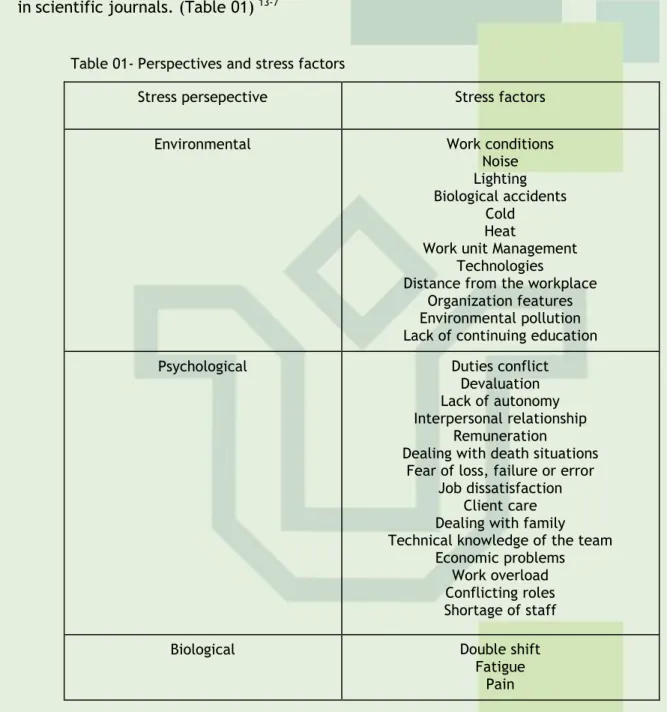
All of these perspectives are involved while at the development of the nursing work and, from them, we are able to establish some stress factors to be allocated in each, according to their descriptions in the scientific literature.Among those stress factors a selection was made of those who emerged from the hospital space, regardless of the specific unit of care. Those were allocated to under the perspectives of stress - environmental, biological and psychological - which are more evident in scientific journals. (Table 01) 13-7
Table 01-Perspectives and stress factors
Stress persepective Stress factors
Environmental Work conditions
Noise Lighting Biological accidents
Cold Heat
Work unit Management Technologies
Distance from the workplace Organization features Environmental pollution Lack of continuing education
Psychological Duties conflict
Devaluation Lack of autonomy Interpersonal relationship
Remuneration
Dealing with death situations Fear of loss, failure or error
Job dissatisfaction Client care Dealing with family Technical knowledge of the team
Economic problems Work overload Conflicting roles Shortage of staff
Biological Double shift
Fatigue Pain
Therefore, this study, which has as its object the impact of stress on the nursing work due to the cognitive process of attention and its consequences for the development of nursing activities. We seek to highlight among the stress factors those which bring greater harm to the development of activities of nurses reported by those who work directly with clients. Goals
1) Identify, according to the reference of nursing professionals, which stress factors have the greatest influence in the attention process;
2) Analyze, among the factors that influence the attention process, those that generate greater impact in the development of care activities.
J. res.: fundam. care. online 2015. out./dez. 7(4): 3375-3387
3379
This is a quantitative, descriptive correlational study where researchers sought to describe the connections among stress, attention and nursing care. It has been investigated how stress factors can influence the process of attention at the work practice of nursing professionals.The study was conducted with nursing professionals who worked in a University Hospital of the Rio de Janeiro City and developed their activities in various fields of practice, such as clinical and surgery hospital wards. Only professionals in direct contact with clients at nursing care were addressed in this research.
All subjects only had to respond to a questionnaire upon accepting to participate in the study. The risks to the subjects were minimal and understood only as the time for answering the instrument. The Resolution No 466/12 from the National Council of Ethics in Research was respected and the protocol was approved by the CEP UNIRIO under the Protocol 526,388. It is noteworthy that all subjects signed a term of informed consent (IC).
Nursing professionals in direct contact with clients at care were included in the research. Nursing professional who performed administrative services, and those who did not perform the direct care to clients were not included in this research. As well as professionals who referred to having any type of psychological changes in the last six months due to the risk of this change of impacting in a more effective way the investigation process.
A demographic questionnaire and a data collection instrument were applied, not validated, built by the authors and based on the stress factors described in the literature (Table 01). Then, several questions were prepared and their answers stratified as in a Likert scale, where respondents answered questions in order of agreement.
Data were stored in a database (PSPP) and measured on a scale (raw scale) ranging from 0 to 100 for each perspective, where 0 = worst and 100 = best, in order to enable the understanding of how much the stress factors interfere with attention the process. The selection of the raw scale occurred due to lack of any unit of measurement. The calculation formula for each perspective was constructed as follows:
𝑃𝑒𝑟𝑠𝑝𝑒𝑐𝑡𝑖𝑣𝑒 𝑋 =𝑆𝑢𝑚 𝑜𝑓 𝑡ℎ𝑒 𝑣𝑎𝑙𝑢𝑒𝑠 𝑜𝑏𝑡𝑎𝑖𝑛𝑒𝑑 𝑜𝑛 𝑖𝑠𝑠𝑢𝑒𝑠 𝑜𝑓 𝑝𝑒𝑟𝑠𝑝𝑒𝑐𝑡𝑖𝑣𝑒 𝑋 − 𝑈𝑝𝑝𝑒𝑟 𝑙𝑖𝑚𝑖𝑡 𝑥 100 𝑉𝑎𝑟𝑖𝑎𝑡𝑖𝑜𝑛
Figure 01 - Calculation formula for each perspective
Where X means the analyzed perspective and both the Upper Limit (UL), and the variation (V) are fixed. The UL of environmental perspective was 60 and the variation equals to 48; the psychological perspective, UL = 100 and V = 80; and the biological perspective, UL = 30 and V = 24.
J. res.: fundam. care. online 2015. out./dez. 7(4): 3375-3387
3380
Through the objectives and the proposed methodology, the following data that emerged from the study are presented.On the demographic Questionnaire
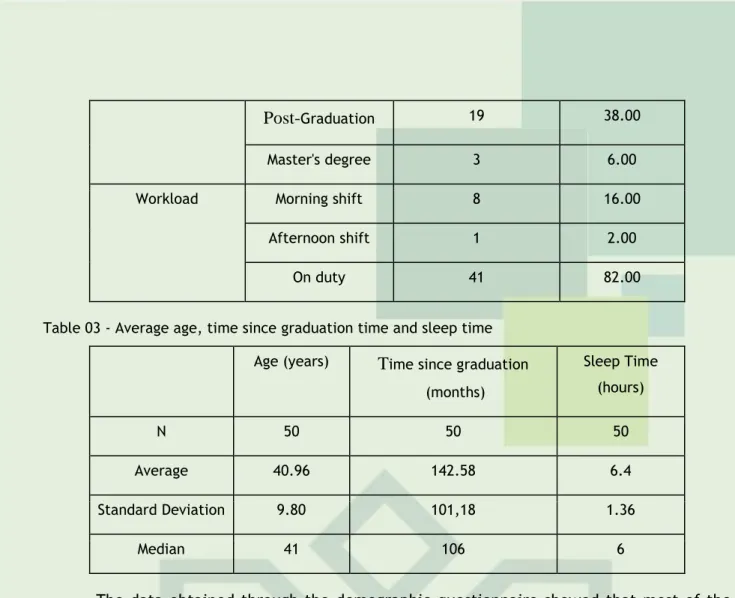
Data from 50 nursing professionals were collected. To the demographic questionnaire the following were evaluated: average, median, standard deviation, minimum and maximum. In the table below are described the frequency and percentage characterizing the study sample:
Table 02 - Description of demographic data
Value label Frequency Percentage (%)
Gender Male 9 18.00 Female 41 82.00 Number of children 0 24 48.00 1 10 20.00 2 13 26.00 3 2 4.00 4 1 2.00
Marital status Single 25 50.00
Married 19 38.00
Divorced 6 12.00
Formal contract jobs 0 28 56.00
1 13 26.00 2 8 16.00 3 1 2.00 Profession Nurse 18 36.00 Nursing Technician 24 48.00 Nursing Assistant 8 16.00
Education Technician course 22 44.00
J. res.: fundam. care. online 2015. out./dez. 7(4): 3375-3387
3381
Post-
Graduation 19 38.00Master's degree 3 6.00
Workload Morning shift 8 16.00
Afternoon shift 1 2.00
On duty 41 82.00
Table 03 - Average age, time since graduation time and sleep time Age (years)
T
ime since graduation(months) Sleep Time (hours) N 50 50 50 Average 40.96 142.58 6.4 Standard Deviation 9.80 101,18 1.36 Median 41 106 6
The data obtained through the demographic questionnaire showed that most of the staff is composed of nursing technicians (48.00%), with the predominance of females (82.00%), most of them being around 40 years old, single ( 50.00%) and not having any children (48.00%). Some professionals reported having technical course in nursing, as well as graduation (4 subjects) or post-graduation degrees (6 subjects) in areas other than nursing.
In regard to the number of employment under a formal contract, the majority (56.00%) did not have any, since it was a public institution. As for the work schedule, most of them reported working on duty (82.00%).The staff pointed average sleep hours of 6.4 hours per day.
About the Survey
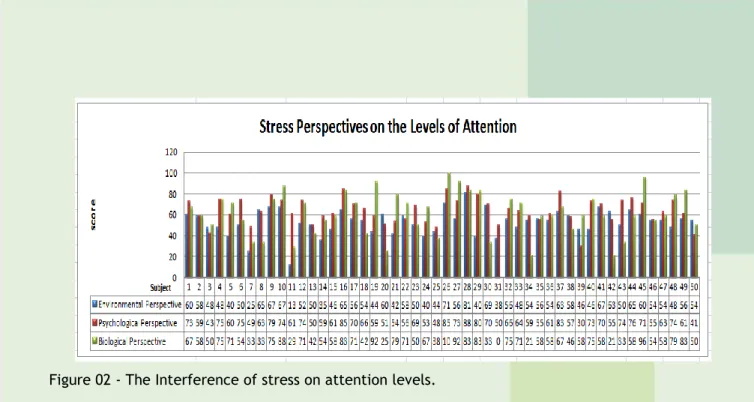
After analyzing the data and by observation the figure 02 shown below, we can see that the environmental perspective is the one that interferes with the levels of attention of nursing professionals during the work period (15 subjects - score <50 points). By the biological perspective (10 subjects - score <50 points) and the psychological one (02 subjects - score <50 points) there was less interference of those factors on the attention process.
23 subjects didn’t show any link between the level of attention and the perspectives of stress. Meanwhile 21 subjects showed to be affected by one of the perspectives. 04 subjects presented a combination of two perspectives affecting their process of attention and only 02 subjects presented the three perspectives affecting their levels of attention.
J. res.: fundam. care. online 2015. out./dez. 7(4): 3375-3387
3382
Figure 02 - The Interference of stress on attention levels.On demographic data
Regarding the age of the subjects studied the average was 40.96 years old which is shown to be slightly higher than the figures given for nursing professionals by the Federal Board of Nursing in 2011. In that one COFEN shows that the majority of nursing professionals are aged around 26-35 years, which is equivalent to 35.98% of nurses in Brazil. 18
Regarding gender, the predominance of women (80%) is historical. Women have been dealing with all that is related to caring since the mid-nineteenth century with Florence Nightingale. 19 The COFEN data in 2011 showed that 87.24% of the nursing professionals were women. 18
Regarding the marital status, the study sample showed similar values to those from COFEN (2011) where most of the professionals are single (49.29%). In this study sample 50% were single. 18
In the sample there was a significant number for professionals who did not have a formal contract (56%) of employment, since it was a public institution. Which differs from a study carried out by Dedecca (2005), where it is reported that the nursing staff has a high quantitative of professionals working under formal contracts, and also where more than 80% of these professionals have a formal job. 20
Regarding the sleeping hours data found in the sample, there was an average value of 6.4 hours per day. This shows that nursing professionals have bad quality of sleep, which may lead to changes in their brain function due to modifications in the activity of neural circuits needed for the attention and memory processes. 21
It is known that every individual has different quantitative hours of sleep that is considered ideal for each one, though, on average, to have a satisfactory amount of sleep one needs to respect the period of daily 8 sleeping hours. 22
It was found that more than half of the sample (82%) worked 12 hours per day (on duty). Overwork can create difficulty for nurses in dealing with situations of everyday care for because it requires increased capacity to direct attention to the decision-making and problem solving in the context of their work, and trigger changes in concentration, sleep disorders, physical discomfort, increased responses to the excess room brightness and noise.23
J. res.: fundam. care. online 2015. out./dez. 7(4): 3375-3387
3383
Regardless of the perspectives of stress, physical and psychological conditions are affected. Both have direct impact on the levels of attention of professionals which consequently affects on the quality of care provided. The psychological stress caused by the work influences the nurses' performance in different scenarios, being the source of conflicts, including the Burnout Syndrome. 24The results of this study point to the environmental conditions where the care is provided as a first source for cognitive changes, particularly the levels of the attention given by the nursing professional while at providing care. Since 1980, authors emphasize that specific elements such as noise, heat, cold and many other potentially intolerable conditions are stress factors in the workplace. It’s accepted that the existence of these leads to the development of stress, dissatisfaction and effects on productivity and performance. 25
Our study corroborates the Baptist and Bianchi (2006) study which shows that the organizational structure of the hospital has its share in the occurrence of stress, interfering in the personal and professional life of individuals. Working in unhealthy and unsafe conditions influences directly on the physical and mental well-being of individuals. Besides, the deficiency in the number of employees is a considerable source of stress, reflecting on the quality of care, with frequent confrontation between nurses, patients and families. 26
Noise appears as an important influencer between stress and the level of attention. Santos and Guirardello (2007) point out that the level of noises interfere on the level of attention of people, especially in critical care units, where they happen to be constant and often unpredictable and uncontrollable. 23
The hospital as a whole, regardless of its units, has a constant and diverse stimuli to which professionals are exposed - excessive noise, intense lamp brightness 24 hours a day, work overload and conflicts. To each one these the attention of individuals may be drawn to or affected. Braunstein-Bercovitz (2010) in an experimental study found that stress harms the process of attention due to the increasing number of irrelevant information. 27 In addition, Santos and Guirardello (2007) show that the fatigue generated by work reduces the ability to target attention and reflects directly in the planning and execution of care. 23
It demands our attention the fact that psychological perspectives, even with the greatest amount of stress factors tied to them have had less interference in the levels of attention in the study sample, according to the literature and as shown in Table 01. Related to this there is the autonomy factor, which was expected to present different results as we have worked in agreement with what Rzezak, Tufik and Mello (2013) state: the lower the worker's autonomy in organizing their activity, the greater the possibilities for mental health disorders. The obtained data in this study did not confirm that. 21
The average hours of sleep found in the sample can be one of the sources impacting the quality of care provided, as well as the reductions in attention levels, as already referenced. Lack of sleep leads to changes in brain function and possibly modifies the activity of neuronal circuitry necessary to attention and memory processes. 21
According to Rzezak, Tufik and Mello (2013) the rotation of the work shifts helps reduce health problems related to psychological aspects in terms of need for recovery, sleep quality and general health. 21
J. res.: fundam. care. online 2015. out./dez. 7(4): 3375-3387
3384
Pejovic et al (2013) showed the importance of sleep for the restoration of variables related to stress when they investigated people in a sleep lab and came to the conclusion that psychomotor performance deteriorates significantly after restriction and no improvement is found after a period of sleep recovery. This has direct relation with sleep deprivation to which nursing professionals are submitted and certainly in the care they provide. 28Stress and fatigue cause cognitive damages that intensify the risks of accidents and mistakes made by professionals. In this regard Rzezak, Tufik and Mello (2013) show that human errors result from both physiological and psychological limitations and would be consequences of excessive fatigue, cognitive overload, interpersonal communication failures, losses in the skills for processing information and decision making. Such issues are perfectly linked to the nursing care. 21
At the end of the study we were able to conclude that we have achieved the proposed objectives. Among the 50 evaluated professionals, 54% (n = 27) state that the stress factors interfere in the levels of attention given by the nursing staff while carrying out their care task. Of these, 55% (n = 15) show that the stress factors related to the working environment are the ones that interfere the most in the levels of attention, followed by those contained in the biological perspective (n = 10) and psychological (n = 02).
The fact that environmental factors have greater influence in the cognitive process of attention, according to the reference of nurses, differs from the literature, which shows that the psychological perspective is the one that most influences the attention levels.
We have also noted that some subjects had a very close result to the cut-off point in the survey (50 pts), which separates those who refer to attention as affected by the stress perspectives and those that do not mention them. It is possible that in the ramifications of this study, a "safety margin" between 45-55 points may be established. The goal would be to separate the most susceptible professionals to changes in attention under a given perspective, i.e. professionals whose results are within the range, which as a rule, the stress factors mentioned by them do not interfere or slightly interfere in their levels of attention so that they would present greater probability of developing greater damages in their cognitive processes, in case those stress factores were not prevented.
Also, it is necessary to investigate the stress level of nursing professionals to widen the understanding of the connections the level of attention and the stress perspectives, since we have stemmed from with the principle that stress influences the attention.
J. res.: fundam. care. online 2015. out./dez. 7(4): 3375-3387
3385
It is essential to expand research into the subject and to establish parameters in order to increase the certainty of the data. Valuing the care environment is essential for the mitigation of errors in face of the care provided.1. Machado DA. Registros de enfermagem: a mensagem sobre o cuidado contida na linguagem
escrita. [Dissertação]. Rio de Janeiro: Universidade Federal do Estado do Rio de Janeiro; 2010
[citado 2013 Mai 20]. Disponível em:
http://www2.unirio.br/unirio/ccbs/ppgenf/arquivos/dissertacoes-arquivo/dissertacoes-2010/daniel-aragao-machado.
2. Greco PBT, Magnago TSBS, Prochnow A, Beck CLC, Tavares JP. Utilização do modelo
demanda-controle de karasek na américa latina: uma pesquisa bibliográfica. R Enferm UFSM [periódico na Internet]. 2011 [citado 2013 Jun 13]; 1(2):272-81. Disponível em: http://cascavel.ufsm.br/revistas/ojs-2.2.2/index.php/reufsm/article/view/2566/1656.
3. Neves, DA. Ciência da informação e cognição humana: uma abordagem do processamento
da informação. Ci Inf [periódico na Internet]. 2006; 35(1):39-44 [citado 2013 Mar 06]. Disponível em: http://www.scielo.br/pdf/ci/v35n1/v35n1a05.pdf.
4. Paschoalini B, Oliveira MM, Frigério MC, Dias ALRP, Santos FH. Efeitos cognitivos e
emocionais do estresse ocupacional em profissionais de enfermagem. Acta Paul Enferm [periódico
na Internet]. 2008 [citado 2013 Mar 06]; 21(3):487-92. Disponível em:
http://www.scielo.br/pdf/ape/v21n3/pt_17.pdf.
5. Baptista MN, Rueda FJM, Sisto FF. Relação entre estresse laboral e atenção concentrada.
Revista de Psicologia. 2007; vol. XI, nº. 16.
6. Sternberg RJ. Psicologia cognitiva. São Paulo: Cengage Learning; 2010.
7. Malloy-Diniz LF, Fuentes D, Mattos P, Abreu N et al. Avaliação neuropsicológica. Porto
Alegre: Artmed; 2010.
8. Duchesne M, Mattos P, Fontenelle LF, Veiga H, Rizo L, Appolinario JC. Neuropsicologia dos
transtornos alimentares: revisão sistemática da literatura. Rev Bras Psiquiatr [periódico na
Internet]. 2004 [citado 2013 Mai 30]; 26(2):107-17. Disponível em:
http://www.scielo.br/scielo.php?script=sci_arttext&pid=S1516-44462004000200008.
9. Paschoalini B, Oliveira MM, Frigério MC, Dias ALRP, Santos FH. Efeitos cognitivos e
emocionais do estresse ocupacional em profissionais de enfermagem. Acta Paul Enferm [periódico
na Internet]. 2008 [citado 2013 Jun 10]; 21(3):487-92. Disponível em:
http://www.scielo.br/pdf/ape/v21n3/pt_17.pdf.
10. Baptista MN, Rueda FJM, Sisto FF. Relação entre estresse laboral e atenção concentrada.
Encontro Revista de Psicologia. 2007; Vol. XI, Nº. 16.
11. Fernandes SMBA, Medeiros SM, Ribeiro LM. Estresse ocupacional e o mundo do trabalho
atual: repercussões na vida cotidiana das enfermeiras. Rev Eletr Enf [periódico na Internet]. 2008
[citado 2013 Out 06]; 10(2):414-27. Disponível em:
J. res.: fundam. care. online 2015. out./dez. 7(4): 3375-3387
3386
12. Ribeiro JP, Marques T. A avaliação do stresse: a propósito de um estudo de adaptação da
escala de percepção de stresse. Psic., Saúde & Doenças [periódico na Internet]. 2009 [citado
2013 Out 28]; 10(2):237-248. Disponível em:
http://www.scielo.gpeari.mctes.pt/scielo.php?script=sci_arttext&pid=S1645-00862009000200008&lng=pt.
13. Rodrigues TDF. Fatores estressores para a equipe de enfermagem da unidade de terapia
intensiva. Rev Min Enferm [periódico na Internet]. 2012 [citado 2013 Out 28];16(3): 454-62. Disponível em: http://www.reme.org.br/content/imagebank/pdf/v16n3a18.pdf.
14. Santos FD, Cunha MHF, Robazzi MLCC, Pedrão LJ, SILVA LA, Terra FS. O estresse do
enfermeiro nas unidades de terapia intensiva adulto: uma revisão da literatura. Revista eletrônica saúde mental álcool e drogas [periódico na Internet]. 2010 [citado 2013 Out 20]; 06(1) art. 13. Disponível em: http://pepsic.bvsalud.org/pdf/smad/v6n1/14.pdf.
15. Martins LMM, Bronzatti JAG, Vieira CSCA, Parra SHB, Silva YB. Agentes estressores no
trabalho e sugestões para amenizá-los: opiniões de enfermeiros de pós-graduação. Ver Esc Enf USP [periódico na Internet]. 2000 [citado 2013 Out 20]; 34(1):52-8. Disponível em: http://www.scielo.br/pdf/reeusp/v34n1/v34n1a07.pdf.
16. Souza C. Estresse ocupacional do enfermeiro: fatores estressante do trabalho em hospital.
[Trabalho de Conclusão de Curso] Universidade Federal do Rio Grande do Sul. Porto Alegre; 2008
[citado 2013 Out 20]; Disponível em:
http://www.lume.ufrgs.br/bitstream/handle/10183/49690/000669031.pdf?sequence=1.
17. Bezerra MMM, Cruz RSBLC, SILVA EA. Fatores associados ao estresse do enfermeiro
intensivista: uma revisão da literatura. Universidade Estadual do Ceará-UECE [periódico na
Internet]. [data desconhecida] [ciatdo em 20 Out 2013]; Disponível em:
http://www.estudosdotrabalho.org/texto/gt6/fatores.pdf.
18. COFEN. Análise de dados dos profissionais de enfermagem existentes nos conselhos
regionais. [Internet]. Mar; 2011. [citado em 04 Dez 2014]. Disponível em: http://www.cofen.gov.br/wp-content/uploads/2012/03/pesquisaprofissionais.pdf.
19. Sánchez MS. Enfermería Avanza: Un projecto para difundir El conocimiento generado em
La enfermería/ Historia de La enfermería (2007/2012). I Simpósio internacional de história de enfermagem associação nacional de história de enfermagem [periódico na Internet]. 2013 [citado
em 9 Dez 2014]; ISBN: 978-989-97181-4-2. Disponível em:
http://repositorio.ipl.pt/bitstream/10400.21/2695/1/Hist%C3%B3ria%20das%20tecnologias%20da %20sa%C3%BAde_um%20olhar%20sobre%20a%20hist%C3%B3ria.pdf.
20. Dedecca CS, Rosandiski EM, Carvalho MS, Barbieri CV. A dimensão ocupacional do setor de
atendimento à saúde no Brasil. Trab Edu Saúde [periódico na Internet]. 2005 [citado 2014 Dez
15]; 3(1). Disponível em:
http://www.scielo.br/scielo.php?pid=S1981-77462005000100007&script=sci_arttext.
21. Rzezak P, Tufik S, Mello MT. Trabalhador por turno e aspectos psicológicos. Trabalhador
em turno: fadiga. São Paulo: Editora Atheneu; 2013.
22. Fernandes JC, Portela LF, Rotenberg L, Griep RH. Jornada de trabalho e comportamentos
de saúde entre enfermeiros de hospitais públicos. Revista Latino-Americana de Enfermagem [periódico na Internet]. 2013 [citado 2014 Dez 15]; 21(5):1-8. Disponível em: http://www.redalyc.org/pdf/2814/281428540013.pdf.
J. res.: fundam. care. online 2015. out./dez. 7(4): 3375-3387
3387
23. Santos LSC, Guirardello EB. Demandas de atenção do enfermeiro no ambiente de trabalho.
Rev Latino-am de Enfermagem [periódico na Internet]. 2007 [citado 2014 Out 20]; 15(1). Disponível em: http://www.scielo.br/pdf/rlae/v15n1/pt_v15n1a05.pdf.
24. Machado DA, Louro TQ, Figueiredo NMA, Vianna LMA. O esgotamento dos profissionais de
enfermagem: uma revisão integrativa sobre a síndrome de burnout em UTI. R pesq: cuid fundam online [periódico na Internet]. 2012 [citado 2014 Out28]; 4(4):2765-75. Disponível em: http://www.seer.unirio.br/index.php/cuidadofundamental/article/view/1605/pdf_615.
25. Fraser TM. Human stress, work and job satisfaction: a critical approach. International
labour office geneva, Switzerland [periódico na Internet]. 1983 [citado 2014 Out 27]. ISBN 92-2-103042-3; Disponível em: http://www.ilo.org/wcmsp5/groups/public/---ed_protect/---protrav/---safework/documents/publication/wcms_250134.pdf.
26. Batista KM, Bianchi ERF. Estresse do enfermeiro em unidade de emergência. Rev
Latino-am Enfermagem [periódico na Internet]. 2006 [citado 2014 Out 28]; 14(4):534-9. Disponível em: http://www.scielo.br/pdf/rlae/v14n4/v14n4a10.pdf.
27. Braunstein-bercovitz H. Does Stress Enhance or Impair Selective Attention? The Effects of
Stress and Perceptual Load on Negative Priming. Anxiety, Stress & Coping. 2003;16(4):345-357.
28. Pejovic S, Basta M, Vgontzas AN, Kritikou I, Shaffer ML, Tsaoussouglou M et al. Effects of
recovery sleep after one work week of mild sleep restriction on interleukin-6 and cortisol secretion and daytime sleepiness and performance. American Journal of Physiology-Endocrinology and Metabolism. 2013;305(7):E890-E6.
Received on: 27/02/2015 Required for review: No Approved on: 14/05/2015 Published on: 01/10/2015
Contact of the corresponding author: Andrea Zavalis Universidade Federal do Estado do Rio de Janeiro – UNIRIO Sala 502 – Prédio de Enfermagem – Av. Pasteur, 296 Rio de Janeiro, RJ E-mail: [email protected]. .