BJRS
03-01 (2015) 01-09Dose distribution assessment (comparison) in the target
volume treated with VMAT given by the planning system
and evaluated by TL dosimeters
A. Bravim
a; R.K.Sakuraba
a,b; L.L.Campos
aaGerência de Metrologia das Radiações, Instituto de Pesquisas Energéticas e Nucleares (IPEN/CNEN-SP),
05508-000, São Paulo-SP, Brasil
aDepartamento de Radioterapia, Hospital Israelita Albert Einstein, 05652-900, São Paulo-SP, Brasil
ABSTRACT
Volumetric-modulated arc therapy (VMAT) is a relatively new therapy technique in which treatment is delivered using a cone beam that rotates around the patient. The radiation is delivered in a continuous gantry rotation while the cone beam is modulated by the intertwining of dynamic multileaf collimators (MLCs). Studies of VMAT plans have shown reduction in the treatment delivery time and monitor units (MU) comparable to IMRT plans improving major comfort to the patient and reducing uncertainties associated with patient movement during treatment. The treatment using VMAT minimizes the biological effects of radiation to critical structures near to the target volumes and pro-duces excellent dose distributions. The dosimetry of ionizing radiation is essential for the radiological protection programs for quality assurance and licensing of equipment. For radiation oncology a quality assurance program is essentially to maintain the quality of patient care. As the VMAT is a new technique of radiation therapy it is im-portant to optimize quality assurance mechanisms to ensure that tests are performed in order to preserve the patient and the equipment. This paper aims to determinate the dose distribution in the target volume (tumor to be treated) and the scattered dose distribution in the risk organs for VMAT technique comparing data given by the planning system and thermoluminescent (TL) response.
Keywords:VMAT, thermoluminescence, planning system.
1. INTRODUCTION
In the scenery of radiation therapy, a new method of treatment, volumetric modulated arc thera-py (VMAT) has been responsible to bring benefits and to allow a lower toxicity in the treatment of patients. This treatment minimizes the radiation dose to the healthy tissues and escalates the dose to the target volume (tumor) (Hall, 1998; Mundt, 2005; Bortfeld, 2006).
VMAT works simultaneously with radiation delivery in a continuous gantry rotation and modu-lation of the multileaf collimators (MLCs). Studies comparing VMAT and IMRT plans have presented that VMAT minimizes treatment delivery time, so reducing uncertainties associated with patient movement during treatment. VMAT uses lower MUs than IMRT being faster, safer, and more accurate technique (Otto, 2008;Verbakel et al, 2009; Shaffer et al, 2010; Nguyen et al., 2013).
The dosimetry of ionizing radiation is essential for the radiological protection programs for qual-ity assurance and licensing of equipment. All components that are involved in the process of treatment planning and dose delivery have to be verified to guarantee the quality assurance. This process is essential to maintain the integrity of treatment and therapy equipment. Several organi-zations recommended maximum values range of ±5% for the uncertainty in the absorbed dose. This verification of patient dose certificates the quality improvement in radiation therapy (ICRU, 1976; AAPM, 1983).
There is few methods of quality assurance deep-seated for IMRT and as the deployment of VMAT is still at the beginning is important to optimize and facilitate quality control mecha-nisms. It is important to ensure that tests are performed in order to preserve above all the patient but also the equipment itself. To guarantee that the services accord the highest clinical standards, each institution should invest in a quality assurance program for treatment planning and dose absorbed (Palta et al, 2008; Hancock, 2008) .This paper aims to determinate the dose distribution in the target volume (tumor to be treated) and the scattered dose distribution in the risk organs for VMAT technique comparing data given by the planning system and thermoluminescent (TL) response.
The pre irradiation heat treatment used to the LiF:Mg,Ti dosimeters produced by Hashaw Chem-ical Company was 400ºC for one hour using a furnace VULCAN model 3-550 PD plus 100ºC for two hours using a furnace FANEN model 315-IEA 11200. The dosimeters were separated into groups of five dosimeters and selected with repeatability better than ± 5%.
The dose response curves were obtained using a linear accelerator Truebeam STx of Varian Medical Systems of the Hospital Israelita Albert Einstein (HIAE). The irradiation was done us-ing 6 MV photons clinical beams with doses rangus-ing from 30 up to 1400 cGy. The irradiations were carried out using a polymethacrylate (PMMA) phantom with absorbed doses corrected to the maximum dose depth by planning system of the equipment.
For the dose assessment a specific PMMA phantom containing five different geometric cavities was designed. One cavity was defined as a target volume and the other cavities as possible or-gans at risk. The PMMA phantom with cavities is showed in the Figure 1a. A PMMA block 10 cm thick was placed on the PMMA phantom (Figure 1b) and was used to ensure the backscat-tered radiation. A group of eight dosimeters were positioned inside each cavity and all cavities were irradiated with homogeneous doses in the linear accelerator Truebeam STx of Varian Med-ical Systems of HIAE, Figure 2. This irradiation was done three times in three different days. The thermoluminescent responses were obtained using TL reader Harshaw model 4500.
Figure 1. PMMA phantom containing five cavities and PMMA block used upon phantom with
Figure 2. Set up of dosimeters irradiation using PMMA phantom with five cavities and linear
accelerator Truebeam STx of Varian Medical Systems of HIAE.
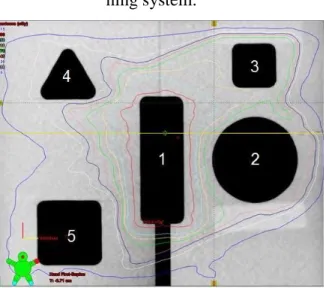
The absorbed doses given by the VMAT planning system of the HIAE were 300 cGy, 150 cGy, 200 cGy, 100 cGy and 50 cGy in the cavities 1 to 5 respectively and they were compared with resultsobtained using the LiF:Mg,Ti dosimeters. The cavity 1 was defined as target volume. The planning has been done so that no isodose line pass through cavities providing a homogeneous dose of radiation inside each cavity. The isodose lines provided by planning system of VMAT
Cavity Block
the LiF:Mg,Ti dosimeters agree with the VMAT planning system enabling measurements simu-lating some tumor treatment.
Each presented value of the dose response curves and the phantom irradiation is the average of five and eight measurements of dosimeters of the same sensitivity respectively. The error bars represent the standard deviation of the mean (1σ) with a confidence interval of 95%.
Figure 3. Dose distribution in the phantom with five cavities - isodose lines provided by
plan-ning system.
3. RESULTADOS E DISCUSSÕES
The TL dose-response curves of LiF:Mg,Ti dosimeters to linear accelerator Truebeam STx of Varian Medical Systems to the absorbed dose range studied (30 – 1400 cGy) are presented in Figure 4.
It can be observed a linear behavior from 30 up to 1000 cGy and above 1000 cGy a saturation of the TL response.
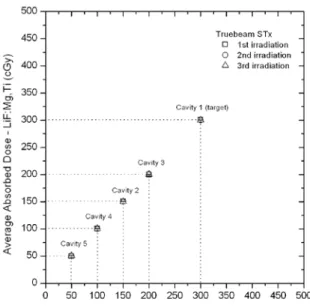
The average dose given by the planning system of linear accelerator TruebeamSTx of Varian Medical Systems of HIAE and the minimum, maximum and average absorbed doses evaluated by the LiF:Mg,Ti dosimeters are showed in the table 2.
Table 2. Average dose given by the VMAT planning system of HIAE and minimum, maximum
and average absorbed doses obtained by LiF:Mg,Ti dosimeters inside each cavity.
Absorbed doses (cGy) Cavities at phantom 1 (target) 2 3 4 5 Planning system D 300.0 150.0 200.0 100.0 50.00 1st irradiation Dmin 299.4 148.7 198.2 98.7 48.90 Dmax 301.4 151.8 201.7 101.4 51.40 D 300.4 150.5 199.5 100.4 50.00 2nd irradiation Dmin 298.6 149.7 199.2 99.0 49.37 Dmax 301.0 151.0 201.9 101.4 51.10 D 300.1 150.3 200.7 100.4 50.34 3rd irradiation Dmin 298.3 149,0 198.9 99.1 49.07 Dmax 301.0 151.7 201.3 101.8 51.32
The absorbed doses measured with LiF:Mg,Ti dosimeters ranged from 298.3cGyup to 301.4cGy for cavity 1 (target volume), from 148.7cGyup to 151.8cGyfor cavity 2, from 198.2cGyup to 201.9cGyfor cavity 3, from 98.7cGyup to 101.8cGyfor cavity 4, from 48.90cGyup to 51.40cGyfor cavity 5. The measurements obtained using TL dosimeters showed maximum varia-tion of punctual absorbed dose of ±2.8% referring cavity 5 (50cGy) compared to VMAT plan-ning system.
The variation of the average absorbed dose measured with LiF:Mg,Ti dosimeters inside each cavity compared with the absorbed dose given by the VMAT planning system was 0.13%, 0.25%, 0.13%, 0.44% and 0.30% in the cavities 1 to 5 respectively.
The agreement between absorbed dose given by the planning system of linear accelerator True-beamSTx of Varian Medical Systems of HIAE and obtained with the LiF:Mg,Tidosimetersis showed in the Figure 4.
Figure 4. Average absorbed doses provided by the VMAT planning system of HIAE and
4. CONCLUSIONS
All measurements were better than ± 3%, so the repeatability of TL response was within ac-ceptable limits for radiotherapy purposes [ICRU, 1973; AAPM, 1983].The variation of the
aver-age absorbed dose measured with LiF:Mg,Ti dosimeters inside each cavity ranged from ± 0.13% to the cavity that simulated the tumor to be treated up to ± 0.44% to the cavity that
sim-ulated the risk organs (scattered radiation). It shows the great agreement between the doses measured with LiF:Mg,Ti dosimeters and the dose given by the VMAT planning sys-tem.LiF:Mg,Ti dosimeters showed great performance to evaluate the dose distribution in VMAT planning. Therefore further studies will be done to add more reliability to analyze the isodoses lines of the treatments that use the VMAT system and to establish dosimetric methods to assur-ing the quality control for absorbed doses of this kind of therapy.
5. ACKNOWLEDGMENTS
The authors are thankful to grant #2010/16437-0, São Paulo Research Foundation (FAPESP); CNPq, CAPES and INCT - Metrology of Radiation in Medicine for the partial financial support and to the Radiation Therapy staff of the Hospital Israelita Albert Einstein for the photons irradi-ations.
REFERÊNCIAS
1. HALL, E.J. Radiobiology for the radiologist. Lippincott, 1988.
2. MUNDT, A.J. Intensity Modulated Radiation Therapy – A clinical perspective. BC Decker Inc., 2005.
3. BORTFELD, T. Image-Guided IMRT. Springer-Verlag, 2006.
4. OTTO, K. Volumetric modulated arc therapy: IMRT in a single gantry arc. Med. Phys. v. 35, n. 1, p. 310–317, 2008.
5. VERBAKEL, W.F.; CUIJPERS, J.P.; HOFFMANS, D. Volumetric intensity- modulated arc therapy vs conventional IMRT head-and-neck cancer: A comparative planning and dosimet-ric study. Int. J. Radiat. Oncol. Biol. Phys. v. 74, n. 1, p. 252–259, 2008.
arc therapy for conventional intensity-modulated radiotherapy for frontal and temporal high-grade gliomas. Int. J. Radiat. Oncol. Biol. Phys. v. 76, n. 4, p. 1177–1184, 2009.
7. NGUYEN, K.; CUMMINGS, D.; LANZA, V.C.; MORRIS, K.; WANG, C.; SUTTON, J.; GARCIA, J. A dosimetric comparative study: Volumetric modulated arc therapy vs intensity-modulated radiation therapy in the treatment of nasal cavity carcinomas. Medical Dosimetry, v. 38, n. 3, p. 225-232, 2013.
8. ICRU - International Commission on Radiation Units and Measurements. Determination
of Absorbed Dose in a Patient Irradiated by Beams of X or Gamma Rays in Radiotherapy Procedures. Report 24, Maryland, 1976.
9. AAPM - American Association of Physicists in Medicine. A protocol for the determina-tion of absorbed dose from high-energy photon and electron beams (TG-21). Medical Physics, v. 10, n. 6, p. 741-771, 1983.
10. HANCOCK, S.S. End-to-End Radiosurgery tests with Lucy® Phantom. Radiation Therapy Department, Southeast Missouri, Hospital Missouri, 2008.
11. PALTA, J.R; LIU, C.; LI, J.G. Quality Assurance of Intensity-Modulated Radiation Therapy. Int. J. Radiat. Oncol. Biol. Phys. v. 71, p. 108-112, 2008.