UNIVERSIDADE DA BEIRA INTERIOR
Engenharia
Dynamic OSINT System Sourcing from Social
Networks
Ivan Sousa Fernandes
Dissertação para obtenção do Grau de Mestre em
Engenharia Informática
(2º ciclo de estudos)
Orientador: Prof. Doutor Pedro Ricardo Morais Inácio
Co-orientador: Prof. Doutor João Paulo da Costa Cordeiro
Acknowledgements
During the year in which I have been involved in the development of this masters project, I had the fortunate opportunity to rely on the help and support of many people, who directly or indirectly contributed to its successful conclusion.
First of all, I am thankful to my parents for all the support and motivation they gave me through-out my life, and for providing me the opportunity to pursue an academic path.
I would also like to express my gratitude to my supervisor, Professor Pedro Ricardo Morais Inácio, and my co-supervisor, Professor João Paulo da Costa Cordeiro, first for accepting to be my supervisors, and secondly for the availability, attention and motivation that they gave me during the course of this project.
Last, but not least, I would like to thank all friends that contributed to the development of this project and made this experience richer. I am especially grateful to my colleagues from the laboratory — Bernardo Sequeiros, Acácio Correia, and Manuel Meruje — for their support and willingness to help me.
Resumo
Atualmente, a World Wide Web (WWW) fornece aos utilizadores enormes quantidades de in-formação sob os mais diversos formatos: notícias, blogs, nas redes sociais, entre outros. O crescimento exponencial desta informação representa um grande desafio para a comunidade em geral, uma vez que a procura e correlação frequente de notícias acaba por se tornar numa tarefa repetitiva, potencialmente aborrecida e sujeita a erros. Apesar da maioria das pes-soas ainda fazer o escrutínio da informação de forma manual e regularmente, têm surgido, nos últimos anos, sistemas Open-Source Intelligence (OSINT) que efetuam a vigilância, seleção e extração de informação textual, a partir de redes sociais e da web em geral. Estes sistemas são hoje ferramentas muito populares e úteis aos profissionais de diversas áreas, como a da ciber-segurança, onde estar atualizado com as notícias e as tendências mais recentes pode levar a um impacto direto na reação a ameaças.
O objetivo deste trabalho passa pela tentativa de solucionar o problema motivado anterior-mente, através da implementação de um sistema dinâmico OSINT. Para este sistema foram de-senvolvidos dois algoritmos: um para adicionar, remover e classificar, dinamicamente, contas de utilizadores com tweets relevantes na área da segurança informática e outro para classi-ficar as publicações desses utilizadores. A relevância de um utilizador depende não só da sua frequência de publicação mas também da sua importância (status) na rede social, bem como a relevância da informação publicada. Neste último ponto, são propostas funções de prospeção de texto que permitem medir a relevância de segmentos de texto.
A abordagem proposta é inovadora, envolvendo gestão dinâmica da relevância dos utilizadores e das suas publicações, garantindo assim um quadro de fonte de informação mais fidedigna e importante. Para além dos algoritmos e das funções que os compõem (também propostas no contexto deste trabalho), esta dissertação descreve várias experiências e testes usados na sua avaliação. Os resultados qualitativos constatados são pertinentes, denotando uma elevada utilidade prática. Em termos de interface homem-máquina, é disponibilizado um mural de in-formação contínua que vai sendo gerado dinâmica e automaticamente, a partir da rede social
Twitter, e apresentado sob a forma de uma página web, destacando as notícias apresentadas
pelo grau de relevância que possuem (vermelho para relevância elevada, amarelo para relevân-cia moderada e verde para relevânrelevân-cia reduzida).
As contribuições principais deste trabalho compreendem os dois algoritmos propostos e a sua avaliação. Um protótipo totalmente funcional de um sistema que os implementa, acompan-hado pelo mural que mostra as notícias selecionadas, constituem outro resultado importante do trabalho.
Palavras-chave
Ciber-Segurança, Classificação de Tweeters, Classificação de Posts, Inteligência Open-Source, Mineração de Texto, OSINT, Twitter, Web Crawler
Resumo alargado
Este capítulo sintetiza, mas de forma alargada e em língua portuguesa, o trabalho descrito nesta dissertação. Começa-se pela descrição do problema abordado e quais os objetivos a alcançar. De seguida, são apresentadas as tecnologias envolvidas na elaboração do sistema pretendido e são referidos alguns trabalhos relacionados com este. Posteriormente são discutidas as com-ponentes do sistema e os dois algoritmos responsáveis pelas funcionalidades para as quais o mesmo foi desenvolvido. Depois são apresentados os passos necessários para a implementação das componentes. A penúltima secção é dedicada à avaliação dos algoritmos implementados e à discussão dos resultados obtidos. O capítulo termina com a breve discussão das principais conclusões obtidas e com a apresentação de algumas direções para trabalho futuro.
Neste resumo alargado, os acrónimos estão definidos em Português nas suas formas longas. Contudo a forma curta dos acrónimos utilizados está de acordo com o respetivo acrónimo na língua Inglesa, de maneira a manter a consistência. Adicionalmente, para alguns acrónimos não faria sentido traduzi-los para Português, pelo que é mantida a sua designação inglesa e tratados como estrangeirismos.
Enquadramento, Descrição do Problema e Objetivos
Na atualidade, o fluxo de informação textual prolifera abundantemente na Web. A cada dia, uma enorme quantidade de informação é publicada sob os mais variados formatos: notícias,
blogs, nas redes sociais, entre outros. O acumular da informação cresce realmente a ritmo
exponencial constituindo um desafio nas áreas da segurança e inteligência, pois humanamente torna-se incomportável observar e muito menos “digerir” tanta informação. Neste quadro, têm emergido, no últimos anos, sistemas de vigilância, seleção e extração de informação textual, a partir das plataformas da Web.
Os sistemas Open-Source Intelligence (OSINT) são já ferramentas muito populares e úteis a profissionais de ciber-segurança, permitindo detetar mais precocemente novas ameaças e assim agir mais atempadamente. Estes sistemas destinam-se a encontrar, recolher e correlacionar conteúdo informativo disponível para o público em geral através das redes sociais, blogs, jornais, televisão, etc. Em comunidades como a da Segurança da Informação, ter acesso às notícias e tópicos mais recentes tem um impacto direto na preparação e reação a ameaças, como por exemplo os ataques de dia zero.
Redes sociais como o Twitter são, neste momento, fontes facilitadoras dos sistemas OSINT, através da partilha de recursos com a comunidade por parte de utilizadores que são especialistas “creditados” em determinado domínio, e que pesquisam e filtram informação com maior rigor que a comunidade em geral. Por outro lado, a limitação de 140 caracteres por mensagem (post), no Twitter, leva a um género de publicação já bastante sumariada, fazendo com que
a totalidade da informação de um post relevante seja realmente importante e sem rodeios. Contudo, o número de utilizadores aumenta de dia para dia e a comunidade é afetada por utilizadores que publicam sobre os mais diversos temas, sem que por vezes haja uma verificação das fontes de informação, nem uma análise e síntese da mesma. Deste modo, constata-se que o lidar manualmente com a dinamicidade da comunidade e com a quantidade e redundância da informação é ainda hoje uma tarefa desafiadora, repetitiva e potencialmente aborrecida, mas acima de tudo sujeita a erros de incompletude e inconsistência.
O objetivo deste trabalho passa pela tentativa de ultrapassagem dos problemas descritos an-teriormente através do desenvolvimento de métodos para lidar com recursos de redes sociais, nomeadamente o Twitter, e métodos para classificar publicações recolhidas no âmbito da área de Segurança da Informação. Para tal, foi implementada uma estratégia baseada em dois algo-ritmos interdependentes: um para lidar com a adição e remoção de utilizadores em tempo real e outro para lidar com a classificação de publicações. Na prática, o primeiro algoritmo deve considerar e avaliar os utilizadores, com base nas suas publicações, de forma a saber qual o seu grau de relevância e se este deve ou não ser adicionado ao nosso sistema. Devem também ser identificados os utilizadores que ao longo do tempo deixam de ser relevantes, devendo portanto ser excluídos. O segundo algoritmo efetua a classificação de um dado post, a partir do próprio texto que o compõe, permitindo determinar o grau de relevância de cada post e permitindo assim também caracterizar o grau de relevância do utilizador, que não é mais que o agregado da relevância dos seus posts. Assim, foi implementado um sistema que integra os algoritmos mencionados numa plataforma web OSINT, alojada numa máquina virtual de um serviço cloud, com a finalidade de disponibilizar à comunidade as notícias mais recentes e relevantes na área da Segurança da Informação.
Principais Contribuições
Esta secção apresenta sinteticamente as principais contribuições resultantes do trabalho apre-sentado nesta dissertação:
• Uma das principais contribuições deste trabalho é o desenvolvimento de um algoritmo que permite a classificação de utilizadores da rede social Twitter, através de uma fórmula que contempla o seu estatuto na rede, a sua frequência de publicação e a relevância das notícias publicadas;
• Outra importante contribuição consiste no desenvolvimento de um algoritmo que permite a classificação de publicações dos utilizadores, através de uma fórmula que contempla a relevância do texto presente nas publicações e os likes e retweets das mesmas;
• A última grande contribuição deste trabalho consiste na implementação de um sistema que integra os algoritmos mencionados numa plataforma web OSINT, alojada numa máquina
virtual de um serviço cloud, com a finalidade de disponibilizar à comunidade as notícias mais recentes e relevantes na área da Segurança da Informação.
Tecnologias Utilizadas
O cumprimento dos objectivos propostos para esta dissertação implicam a utilização de tec-nologias que permitem a prospecção de dados, a partir de fontes de informação como redes sociais e a web em geral. Neste âmbito foram apresentadas duas tecnologias distintas, mas com procedimentos semelhantes, nomeadamente web crawlers e APIs. Os web crawlers são programas que navegam pela web, recolhendo informação das páginas visitadas e seguindo as ligações presentes nas mesmas, que redirecionam o crawler para outras páginas. Os crawlers requerem a definição dos procedimentos necessários para a prospecção de informação, pro-cedimentos esses que têm de respeitar um conjunto de políticas gerais referentes às páginas a serem visitadas, à frequência com que páginas já visitadas voltam a ser analisadas, para ver se houve alteração da informação aí presente, à atribuição de maior prioridade a páginas mais relevantes e à distribuição das tarefas de crawling por vários crawlers, de forma a potencializar a eficiência deste processo. As API representam um conjunto de normas e procedimentos que permitem o desenvolvimento de aplicações que comunicam com os serviços para os quais as APIs foram desenvolvidas. Em contraste com os web crawlers, as APIs fornecem previamente todos os procedimentos necessários para a prospecção de dados, bem como as políticas que têm de ser respeitadas na utilização das mesmas.
O capítulo evolui para a apresentação das características principais da rede social Twitter, uti-lizada como fonte de informação no desenvolvimento deste sistema, e da sua API. Para poder aceder aos conteúdos do Twitter, através da sua API, é inicialmente necessário possuir uma conta registada nesta rede social, para se obterem conjuntos de credenciais que permitem en-tão aceder aos conteúdos pretendidos. A obtenção destas credenciais pode ser efectuada de diversas formas, de acordo com o caso de uso a que elas se destinam, como pode ser visualizado na Tabela 2.2.
De seguida são apresentados alguns trabalhos relacionados com o sistema desenvolvido, que implementam técnicas semelhantes, como utilização de conjuntos de palavras para filtrar as publicações recolhidas, a utilização de mecanismos de processamento de linguagem natural para calcular a relevância de textos e a utilização de procedimentos associados a APIs.
Na fase final deste capítulo foram ainda referidas e descritas brevemente as ferramentas uti-lizadas na implementação do sistema desenvolvido.
Arquitetura do Sistema e Algoritmos Implementados
Este capítulo começa por abordar as componentes do sistema implementado. Este sistema é composto por quatro componentes essenciais: uma aplicação desenvolvida em Java, uma base
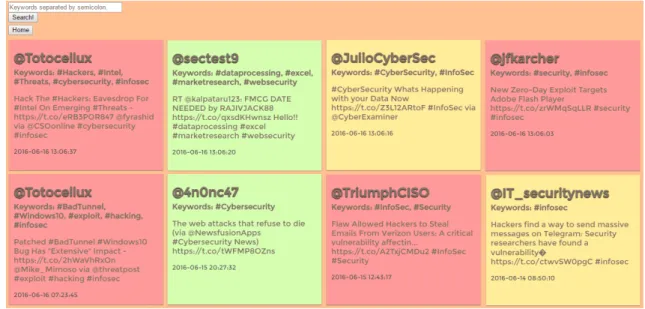
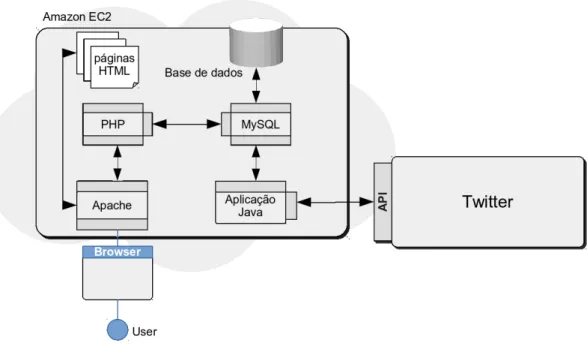
de dados, uma plataforma web e uma máquina virtual. A aplicação desenvolvida em Java é responsável pela selecção e classificação de utilizadores do Twitter e pela classificação das publicações associadas aos mesmos. Esta aplicação é composta por cinco classes, de forma a organizar os métodos utilizados de acordo com o tipo de dados com que cada um interage. É também utilizada uma classe externa que permite calcular a relevância de segmentos de texto. A base de dados é responsável pelo armazenamento dos utilizadores recolhidos e das suas pub-licações. Esta é composta por três tabelas onde são armazenados os utilizadores recolhidos, que são colocados num estado de quarentena ou de produção de notícias, e onde são também armazenadas as notícias publicadas pelos utilizadores que se encontram no estado de produção de notícias. Estas tabelas possuem um número limite de entradas para prevenir que o tamanho da base de dados aumente indefinidamente e para melhor a qualidade dos utilizadores e das notícias armazenadas, com o passar do tempo. A plataforma web consiste na interface homem-máquina do sistema e apresenta aos utilizadores as notícias recolhidas pelo mesmo, ordenadas pela sua data de publicação e destacadas pela relevância que possuem (vermelho para relevân-cia elevada, amarelo para relevânrelevân-cia moderada e verde para relevânrelevân-cia baixa), como se pode observar na Figura 3.1. A plataforma web possui ainda um campo de pesquisa, onde podem ser introduzidas palavras para filtrar as notícias apresentadas no mural. A máquina virtual actua como servidor do sistema desenvolvido e é responsável pela integração das componentes men-cionadas anteriormente. A vantagem da sua utilização prende-se com o facto de esta possuir um IP público que permite que a plataforma web seja acedida por qualquer utilizador que possua uma ligação à Internet. A forma como todas as componentes interagem umas com as outras pode ser visualizada na Figura 3.2.
Subsequentemente, este capítulo evolui para a descrição dos algoritmos que representam as funcionalidades essenciais do sistema desenvolvido, nomeadamente o algoritmo de classificação de tweeters e o algoritmo de classificação de tweets. O algoritmo de classificação de tweeters efectua uma gestão dinâmica do estatuto dos tweeters, baseada no cálculo contínuo da sua importância para o sistema. Esta importância é calculada utilizando uma fórmula que contempla a relevância média das publicações de um utilizador, o número de publicações, relacionadas com a área da segurança da informação, nos últimos trinta dias e o número de seguidores desse utilizador, registados na base de dados e que possuem o estatuto de produção de notícias. O valor obtido para a importância de um utilizador determina então qual o estatuto que o utilizador terá no sistema. Os resultados desta importância encontram-se compreendidos numa escala de 0.0 a 1.0, de forma a facilitar a atribuição de um estatuto. O algoritmo de classificação de
tweets atribui uma relevância às publicações recolhidas, utilizando uma fórmula que contempla
a relevância do texto dessa publicação e o seu número de likes e retweets. Os resultados da relevância das publicações encontram-se também compreendidos numa escala de 0.0 a 1.0, de forma a facilitar a atribuição de um nível de relevância a cada publicação.
Implementação das Componentes do Sistema
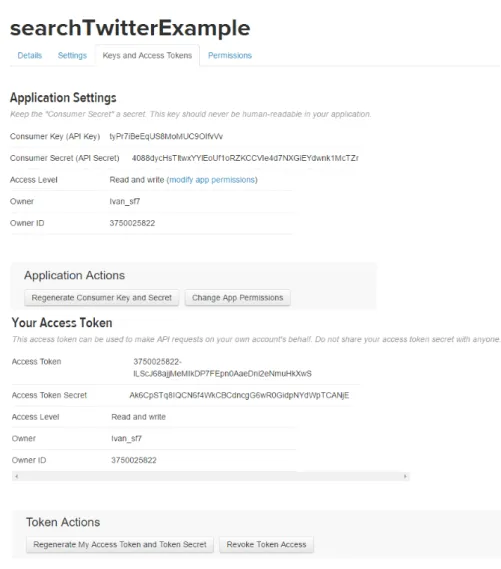
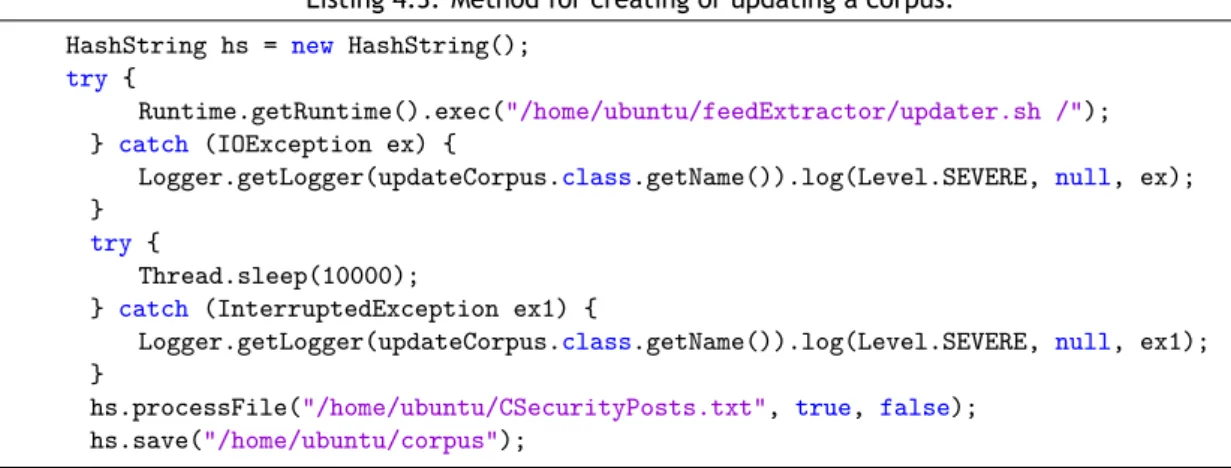
Este capitulo aborda os passos necessários para a implementação de todas as componentes do sistema. Começando pela aplicação Java, esta necessita, numa primeira fase, da adição de algumas bibliotecas que permitem a aplicação comunicar com a API do Twitter e com a base de dados e fornecem os métodos necessários para a classificação de segmentos de texto. De seguida são geradas as credenciais que permitem que a aplicação Java aceda aos recursos da API do Twitter. Estas credenciais são compostas por quatro atributos, como se pode observar na Figura 4.1. Obtidas as credenciais, é possível criar objectos que irão servir de elo de comuni-cação com a APi do Twitter. De seguida é necessário definir um conjunto de palavras que serão utilizadas para filtrar as publicações selecionadas. As palavras utilizadas para este efeito podem ser visualizadas na Listagem 4.2. É também necessário dispor-se de um corpus especifico, do domínio, para que se possa atribuir uma relevância a determinada publicação. Este corpus é criado recorrendo a um script desenvolvido em Python que recolhe as notícias publicadas no site https://threatpost.com. Seguidamente é criada a base de dados associada ao sistema, de acordo com os atributos ilustrados na Figura 4.2. Finalmente, a aplicação Java pode então ser executada. A sua execução consiste fundamentalmente nos passos apresentados no algo-ritmo de classificação de tweeters, juntamente com a classificação de tweets. Na execução da aplicação são também utilizados dois métodos para a actualização regular da relevância das notícias e do corpus utilizado na classificação das mesmas.
Na implementação da plataforma web foram criados três ficheiros. O primeiro ficheiro é re-sponsável pela recolha e apresentação das notícias da base de dados. Estas são organizadas pela data da sua publicação e destacadas pela relevância que possuem. O segundo ficheiro é responsável pela recolha e apresentação de notícias que contenham um conjunto de palavras definido pelo utilizador. O terceiro ficheiro contém as formatações e os estilos utilizados na apresentação do conteúdo da página web.
Para a implementação da máquina virtual foi escolhido o serviço cloud fornecido pela
Ama-zon denominado AmaAma-zon Web Services. É necessário possuir previamente uma conta registada
neste serviço para se proceder então à criação de uma máquina virtual. Esta criação envolve a definição de algumas configurações bastante triviais. Nestas, salienta-se as regras que foram criadas para a firewall da máquina virtual. Esses regras destinam-se a permitir o acesso dos utilizadores à plataforma web e o acesso do administrador do sistema à máquina virtual, como se pode observar na Figura 4.3. Após a criação da máquina virtual é ainda necessária a criação de uma chave privada que permite que as comunicações entre o administrador e a máquina virtual sejam feitas de forma segura. Em seguida é necessária a instalação de diversos pacotes de software que possam ser integrados e executadas as restantes componentes do sistema. Esta instalação só é possível através de uma ligação SSH à máquina virtual, que é feita recorrendo ao programaputty.exe. Finalmente resta apenas migrar os ficheiros correspondentes à plataforma
web para a directoria /var/www/html/ e o ficheiro .jar para a directoria /home/ubuntu/. De seguida é possível executar o ficheiro.jar que inicia a execução do sistema.
Testes e Discussão dos Resultados
Neste capítulo foram realizados alguns testes para estimar os valores que condicionam a atribuição de uma classificação aos tweeters e aos tweets. O primeiro teste consistiu na selecção aleatória de 1000 tweeters e a sua importância, para se tentar procurar um padrão que permitisse es-timar os valores para a sua classificação. Dos resultados obtidos neste teste, apresentados no Gráfico 5.1, estimaram-se então estes valores. De seguida procedeu-se a realização de outros testes para avaliar a eficácia dos resultados obtidos no primeiro teste. Selecionaram-se então aleatoriamente 10 tweeters com o estatuto “em produção” para serem analisados subjectiva-mente. Também se estabeleceram alguns parâmetros a que foram atribuídas classificações, pe-los analisadores, para se poderem obter resultados quantitativos, para efeitos de demonstração da eficácia da classificação feita pelo sistema.
Para a classificação de tweets foram realizados inicialmente dois testes, que consistiram na selecção aleatória de 1000 tweets e a respectiva relevância, que ainda não tivessem sido actu-alizados, e na selecção aleatória de 1000 tweets e a respectiva relevância, que possuíssem pelo menos um like ou um retweet. Estes testes foram executados com a finalidade de se tentar procurar também um padrão que permitisse estimar os valores para a sua classificação. Os re-sultados obtidos nestes testes podem ser visualizados nos Gráficos 5.4 e 5.5, respectivamente. Dos resultados obtidos estimaram-se então os valores mencionados. De seguida procedeu-se à realização de outros testes para avaliar a eficácia dos resultados obtidos nos testes anteri-ores. Estes últimos consistiram na selecção aleatória de 50 tweets com relevância elevada e 50
tweets com relevância moderada, a fim de serem analisados subjectivamente para aferir uma
relevância do ponto de vista humano. Foram também definidos alguns parâmetros aos quais foram atribuídas classificações, pelos analisadores, para efeitos de demonstração da eficácia da classificação feita pelo sistema.
No que diz respeito aos resultados, da avaliação quantitativa pode observar-se que a maioria dos
tweeters e dos tweets avaliados possuíam valores, resultantes da análise humana, próximos dos
valores atribuídos pelo sistema. Contudo a eficácia das classificações só ficou mais clara através da análise qualitativa desses tweeters e tweets. Nesta análise foi possível constatar que, de facto, a maioria dos tweeters e dos tweets avaliados possuem uma relevância significativa para o sistema, o que comprova a eficácia dos métodos de classificação implementados e dos valores que condicionam essas classificações.
Foram ainda realizados outros testes, menos relevantes, na tentativa de estimar o número de
tweeters e tweets que são adicionados às tabelas da base de dados durante um mês.
Conclusões e Trabalho Futuro
Este trabalho foi desenvolvido com o objectivo de ultrapassar o desafio que representa a recolha e classificação de informação proveniente de fontes da web. O sistema OSINT desenvolvido focou-se na prospecção e classificação de dados provenientes da rede social Twitter. Para este sistema foram implementados métodos que permitissem efectuar uma recolha e gestão de tweeters e que permitissem recolher e classificar tweets. Para estes métodos foram escol-hidos parâmetros que se consideraram pertinentes na obtenção de uma classificação rigorosa para as entidades mencionadas. Dos testes realizados e da análise dos resultados obtidos pode concluir-se que os métodos utilizados no cálculo da importância de um tweeter e no cálculo da relevância de um tweet, bem como as métricas definidas para a atribuição de uma clas-sificação aos mesmos, denotam uma eficácia significativa, reforçando a utilidade do sistema desenvolvido.
Contudo, o sistema ainda está longe da perfeição, pelo que seria interessante, no futuro, mel-horar alguns aspectos em relação ao seu funcionamento. Um dos aspectos que poderia ser melhorado seria a adição de mais parâmetros aos métodos de classificação implementados, como por exemplo a adição da importância das hashtags, utilizadas na identificação de tópi-cos, ao método de classificação de tweeters. Algumas hashtags são utilizadas frequentemente para a procura de tópicos relevantes, pelo que a sua adição ao método mencionado poderia representar uma mais valia para essa classificação. Também poderiam ter sido implementados métodos que prevenissem a recolha de tweets que possuem os URLs, referentes às notícias com-pletas, corrompidos ou inexistentes. Os parâmetros seleccionados para a análise subjectiva e os testes realizados também poderiam ser mais diversificados. Na página web também poderiam ser feitas algumas alterações, nomeadamente o destacamento dos URLs de cada publicação e a inclusão de uma pesquisa mais diversificada para a selecção de notícias a serem apresentadas na página web. Finalmente, o sistema ficaria mais completo se tivessem sido implementados métodos que permitissem a recolha de notícias de diferentes fontes de informação, para além do Twitter.
Abstract
Nowadays, the World Wide Web (WWW) is simultaneously an accumulator and a provider of huge amounts of information, which is delivered to users through news, blogs, social networks, etc. The exponential growth of information is a major challenge for the community in general, since the frequent demand and correlation of news becomes a repetitive task, potentially tedious and prone to errors. Although information scrutiny is still performed manually and on a regular basis by most people, the emergence of Open-Source Intelligence (OSINT) systems in recent years for monitoring, selection and extraction of textual information from social networks and the Web promise to change the life of some of them. These systems are now very popular and useful tools for professionals from different areas, such as the cyber-security community, where being updated with the latest news and trends can lead to a direct impact on threat response.
This work aims to address the previously motivated problem through the implementation of a dynamic OSINT system. For this system, two algorithms were developed: one to dynamically add, remove and rate user accounts with relevant tweets in the computer security area; and another one to classify the publications of those users. The relevance of a user depends not only on how frequently he publishes, but also on his importance (status) in the social network, as well as on the relevance of the information published by him. Text mining functions are proposed herein to achieve the objective of measuring the relevance of text segments.
The proposed approach is innovative, involving dynamic management of the relevance of users and their publications, thus ensuring a more reliable and important source of information frame-work. Apart from the algorithms and functions on which they were build (which were also pro-posed in the scope of this work), this dissertation describes several experiments and tests used in their evaluation. The qualitative results are very interesting and demonstrate the practi-cal usefulness of the approach. In terms of human-machine interface, a mural of information, generated dynamically and automatically from the social network Twitter, is provided to the end-user. In the current version of the system, the mural is presented in the form of a web page, highlighting the news by its relevancy (red for high relevance, yellow for moderate rele-vance, and green for low relevance).
The main contributions of this work are the two proposed algorithms and their evaluation. A fully working prototype of a system with their implementation, along with a mural for showing selected news, is another important output of this work.
Keywords
Cybersecurity, Open-Source Intelligence (OSINT), Post Classification, Text Mining, Twitter, Tweet-ers Classification, Web Crawler
Contents
1 Introduction 1
1.1 Motivation and Scope . . . 1
1.2 Problem Statement and Objectives . . . 2
1.3 Adopted Approach for Solving the Problem . . . 3
1.4 Main Contributions . . . 3
1.5 Structure of the Dissertation . . . 4
2 State of the Art and Technologies 7 2.1 Introduction . . . 7
2.2 Web Crawlers . . . 7
2.2.1 Overview . . . 7
2.2.2 Behavior of a Web Crawler . . . 9
2.3 APIs . . . 12 2.4 Twitter . . . 13 2.4.1 Overview . . . 13 2.4.2 Twitter API . . . 13 2.5 Related Works . . . 15 2.6 Used Tools . . . 16 2.6.1 NetBeans IDE . . . 16
2.6.2 XAMPP and LAMP . . . 16
2.6.4 PuTTYgen . . . 17
2.6.5 WinSCP . . . 17
2.7 Conclusions . . . 17
3 System Architecture and Components 19 3.1 Introduction . . . 19
3.2 System Architecture . . . 19
3.2.1 The Java Application . . . 19
3.2.2 Database . . . 20
3.2.3 Web Platform . . . 20
3.2.4 Virtual Machine (VM) . . . 21
3.3 Algorithm for Classifying Tweeters . . . 21
3.4 Algorithm for Classifying Tweets . . . 24
3.5 Conclusions . . . 26
4 Implementation 29 4.1 Introduction . . . 29
4.2 Java Application and Database Implementation . . . 29
4.3 Mural Implementation . . . 34
4.4 Virtual Machine Configuration . . . 34
4.5 Conclusions . . . 40
5 Application Evaluation 41 5.1 Introduction . . . 41
5.2 Thresholds Definition for Tweeters Classification . . . 42
5.3 Evaluation of the Classification of Tweeters . . . 44
5.4 Thresholds Definition for Post Classification . . . 45
5.5 Evaluation of the Post Classification . . . 46
5.6 Limit for the Number of Entries in the Database Tables . . . 48
5.7 Conclusions . . . 49
6 Conclusions and Future Work 51 6.1 Main Conclusions . . . 51
6.2 Future Work . . . 53
Bibliography 55
List of Figures
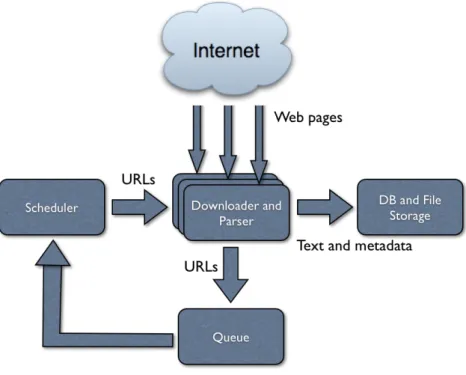
2.1 Architecture of a standard Web crawler. . . 8
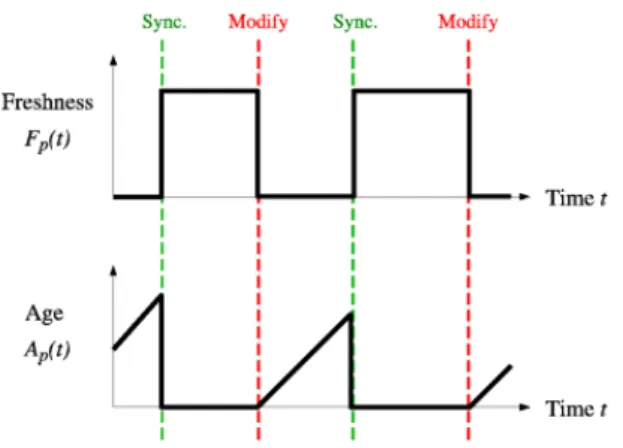
2.2 Evolution of freshness and age with time. The two events presented in the figure correspond to a change of a web page in a server(event modify) and the down-loading of that page modified by a crawler(event sync). . . . 11
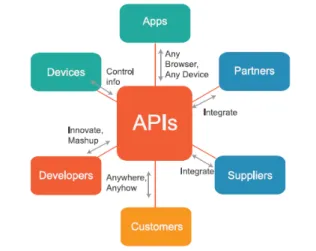
2.3 Example of an Application Programming Interface (API) and its possible associated entities. . . 12
3.1 The interface for the end user of the system developed in the scope of this mas-ter’s project. . . 21
3.2 Developed system architecture. . . 22
4.1 Twitter application settings. . . 30
4.2 Database tables with their attributes. . . 32
4.3 Inbound rules for the Virtual Machine (VM) firewall. . . 36
4.4 AWS VM settings. . . 37
4.5 Conversion of the private key.pem format to the .ppk format. . . 37
4.6 Establishing an Secure Shell (SSH) connection with the VM. . . 38
4.7 Establishing an SSH connection with the VM. . . 39
5.1 Importance value for 1000 randomly selected tweeters. . . 42
5.2 Average importance for tweeters in thequarantine table over time (15 minutes interval). . . 43
5.3 Average importance for tweeters in theinproduction table over time (15 minutes interval). . . 44
5.5 Relevance of posts that have had, at least, one like or one retweet since its pub-lication. . . 47
List of Tables
2.1 Comparison of the execution time for a basic crawler and parallel crawler, ac-cording to [SS11]. . . 11
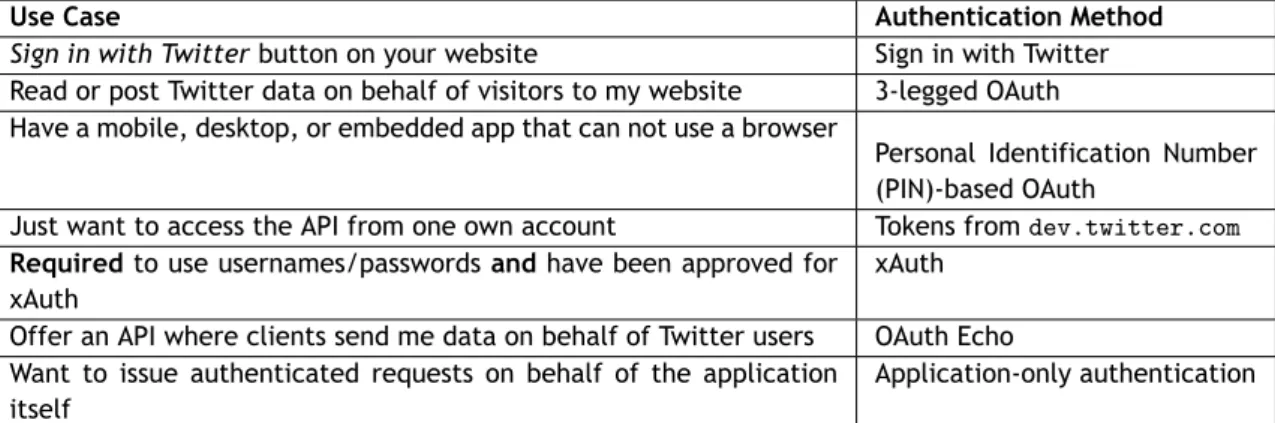
2.2 Use cases and authentication methods to obtain access tokens. . . 14
5.1 Results for the classification of tweeters obtained by the system and by the human evaluators (subjective analysis). . . 45
5.2 Number of tweeters inserted in thequarantine table per day, for 5 different days. 48
5.3 Number of tweeters inserted in the inproduction table per day, for 5 different days. . . 48
5.4 Number of posts inserted in thenews table per day, for 5 different days. . . 49
A.1 Results for the classification of posts with metrics obtained by the system and scores from the human evaluators (subjective analysis). The system considered these posts to be of moderate relevance. . . 60
A.2 Results for the classification of posts with metrics obtained by the system and scores from the human evaluators (subjective analysis). The system considered these posts to be of high relevance. . . 61
Listings
4.1 Method for creating a Twitter object. . . 31 4.2 List of keywords used to filter news . . . 31 4.3 Method for creating or updating a corpus. . . 32 4.4 Method for selecting news containing a list of provided keywords. . . 34
Acronyms
ACM Association for Computing Machinery
AMI Amazon Machine Image
API Application Programming Interface
AWS Amazon Web Services
CCS Computing Classification System
CPU Central Processing Unit
CSS Cascade Style Sheets
DBMS Database Management System
DNS Domain Name System
DoD Department of Defense
DSA Digital Signature Algorithm
EC2 Elastic Cloud Computing
FTP File Transfer Protocol
HTML HyperText Markup Language
HTTP HyperText Transfer Protocol
HVM Hardware Virtual Machine
JDK Java Development Kit
JSON JavaScript Object Notation
IDE Integrated Development Environment
IoT Internet of Things
IP Internet Protocol
IT Information Technology
LTS Long Term Support
NLP Natural Language Processing
OSINT Open-Source Intelligence
PIN Personal Identification Number
REST Representational State Transfer
RSA Rivest Shamir and Adleman
SCP Secure Copy
SFTP Secure File Transfer Protocol
SSH Secure Shell
UBI Universidade da Beira Interior
URL Uniform Resource Locator
VM Virtual Machine
WebDAV Web Distributed Authoring and Versioning WinSCP Windows Secure Copy
WWW World Wide Web
XAMPP Cross-platform (package with) Apache, MySQL, PHP, Perl and Python
Chapter 1
Introduction
1.1
Motivation and Scope
Every day, large amounts of information is published in the World Wide Web (WWW) in different formats such as news, blogs, social networks, etc. It is therefore relatively easy for a user to get lost in this sea of data and sometimes difficult to find precise and useful information on a given subject. This problem is aggravated by the dynamic nature of the web and the natural presence of unstructured data and lack of semantic. Nonetheless, it is obvious that the web comprises a source that cannot be neglected for many reasons, with ubiquity and responsiveness among them.
Many communities, teams and institutions benefit greatly of receiving accurate information in a timely manner, as for example cyber-security teams or secret intelligence agencies. When this information is coming from publicly available sources, such as posts from blogs, webpages or social networks, the process of collecting, exploiting and disseminating that information in a timely manner for a specific audience with the intention of addressing a given intelligence requirement is called Open-Source Intelligence (OSINT). This definition is given by the United Stated Department of Defense (DoD) in [OSI06]. In the case of the cyber-security community, getting timely access to the latest news and topics may comprise a decisive difference in the response to threats such as zero-day attacks [Ste07]. It also allows users and administrators to be aware of the existent risks and issues in the most diverse technologies, and thus to increase the overall security status of their applications and software.
Since the web is one of the most fruitful sources of information nowadays, and given the in-creasing demand for OSINT, it is easy to understand the interest in developing systems that perform the aforementioned tasks in an automatic or semi-automatic manner. Many of them [Kar12c, Kar12b, Kar12a], are backed up by a supporting community that curate news, or focused in well defines sources, such as network, operating system and service scanning. Nonetheless, there are no general public OSINT frameworks based on Twitter, which partly motivated this work. The fact that Twitter already forces authors to summarize their ideas into 140 characters may result in added value when trying to deliver concise information to end-users. Nonetheless, it should be a challenge to make sense out of these small pieces of information for the sake of selecting what is good from what is not.
This master’s project was focused on developing a fully automated OSINT system, which inte-grates means to deal with data sourcing form social networks, namely Twitter. These means involve the collection of data associated with tweeters and their posts, and the classification of the collected data, with emphasis on text analysis. Its scope falls in the intersection of the areas of information security, social networks and Natural Language Processing (NLP). Since it will deal with a social network, Application Programming Interfaces (APIs) and web crawlers will play important roles in this work. Under the 2012 version of the Association for Computing Ma-chinery (ACM) Computing Classification System (CCS), a de facto standard for computer science, the scope of the master’s project, reflected in this dissertation, is defined by the categories named:
• Human-centered computing Visualization;
• Information systems Information retrieval;
• Security and privacy Security services;
• Security and privacy Social aspects of security and privacy.
1.2
Problem Statement and Objectives
Social networks like Twitter ease the process of sharing resources with the community by users who are credited experts in a given field, which search and filter information more accurately than the general community. On the other hand and on Twitter, the 140 characters per message (post) limitation leads to a genre of publication that is already well summarized, making sure that the entire information of a relevant post is indeed relevant and flatly. However, the number of users increases daily and the community is affected by users who publish on various topics without checking the sources of information, or those ones who do not analyze or synthesize it. Thus, it appears that manually handling this dynamic community and the amount of information it generates is nowadays a challenging, repetitive and potentially boring task, but, above all, subject to incompleteness errors and inconsistency.
Given the problem mentioned above, the objectives of this research work can be further detailed as follows:
1. Research, develop and evaluate an algorithm that automatically adds and analyzes and removes sources of information related with information security on social networks ac-cording to their activity and significance of their contents;
2. Research, develop and evaluate an algorithm that automatically categorizes, merges and manages Information Security news, sourcing from the Twitter social network;
3. Integrate both algorithms in a web platform that automatically tracks sources of informa-tion, categorizes, merges and manages news, and shows them in a visually concise and meaningful manner.
1.3
Adopted Approach for Solving the Problem
To achieve the previously identified objective, a strategy based on two interdependent algo-rithms was adopted: the first algorithm was focused on handling the addition and removal of users in real time; and the second algorithm was focused on handling ratings for publications. In practice, the first algorithm should select and evaluate users, based on their publications, in order to know the relevance degree and whether it should or should not be added to our system. Also, over the time, users who are no longer relevant should be removed. The second algorithm performs the classification of a post, based on the text itself, allowing the determination of the relevance degree for each post and the characterization of the user relevance degree, which might be more than the aggregate of the relevance of their posts. Thus, it was implemented a system integrating the algorithms mentioned above in a fully automated OSINT web platform, hosted on a virtual machine of a cloud service, in order to provide to the community the most recent and relevant news in the information security area.
The steps to the adopted approach can be further detailed as follows:
1. Contextualize with the problem at hands and with the objectives of this project, as well as with the technologies involved. Revision of the specialized literature and related works;
2. Design and development of an algorithm that automatically adds, analyses and removes sources of information on social networks;
3. Design and development of an algorithm that automatically classifies news coming from the several sources of information, but focused on Twitter;
4. Prototyping of the web platform integrating the aforementioned algorithms;
5. Definition of the metrics and method for evaluation of the algorithms;
6. Testing, fine-tuning and evaluation of the developed algorithms.
1.4
Main Contributions
To the best of the knowledge of the author, the proposed solution to the aforementioned problem is innovative. No other OSINT systems with the characteristics described herein were found in the literature or online. The proposed solution involves the dynamic management of Twitter users through their the assessment of their importance and relevance of their posts on the social
network. There are OSINT systems that deal with information from social networks [Nou13] but not in this way. The main contributions of this work can be described as follows:
1. The design, implementation and evaluation of an algorithm to classify users from Twitter, based on what they publish and on their importance on the surrounding community. The classification can be understood as a measure of the importance of these users to the system (and thus to the cyber-security community);
2. The design, implementation and evaluation of an algorithm to classify Twitter posts, based on their relevance to the topic of cyber-security and feedback from the community. The design of both algorithms included the proposal of formulas to estimate user importance and Twitter relevance, also discussed herein. These formulas combine several variables such as the number of likes, retweets and followers, as well as the integration of NLP techniques to assess the relevance of the text
3. The delivery of a fully functional prototype of a system integrating both algorithms for a proof-of-concept. The system is available online and ready to use. The evaluation of the algorithms was performed after having the system working. It provides a mural, publicly reachable, where the most relevant news are shown organized by colors.
1.5
Structure of the Dissertation
The body of the dissertation is composed of 6 chapters and an annex. The contents of each one of them can be summarized as follows:
• Chapter 1 — Introduction — presents the scope and the motivation behind the work de-scribed in this dissertation, as well as the addressed problem and objectives. It also in-cludes a subsection describing the approach taken to fulfill the objectives and its main contributions for the advance of knowledge. The dissertation structure is presented at the end of this chapter.
• Chapter 2 — State of the Art and Technologies — presents and describes the necessary concepts for the preparation of the desired system. It also presents various approaches and methodologies used to solve similar problems to the one addressed in this dissertation.
• Chapter 3 — System Architecture and Components — describes the components used in the preparation of the system as well as the two algorithms implemented for the two main features of this system: the Twitter Users Management and the Users Post Classification. It also presents the tools used in the development of the system along with a brief description of each one of them.
• Chapter 4 — System Implementation — discusses the requirements and configurations necessary for the implementation of the system components and so that they can interact with each other.
• Chapter 5 — Application Evaluation — presents the procedure used for the evaluation of the two implemented algorithms and the reasons for choosing the value of key variables in the application execution. The results are discussed and some conclusions are drawn from them.
• Chapter 6 — Conclusions and Future Work — presents the main conclusions of this re-search work, with focus on the results and the application utility. It also presents some considerations about the future work.
• Annex 1 — Human Classification of Posts — contains the tables that summarize the ex-periments concerning the subjective analysis to the algorithm for classification of posts. These tables are mentioned in chapter 5.
Chapter 2
State of the Art and Technologies
2.1
Introduction
This chapter discusses the theoretical concepts required to fully understand the problem ad-dressed in the scope of this project. Several approaches and technologies related with the work at hands will be discussed in this chapter, as well as the techniques and tools used to implement the proposed solution. This chapter is divided into six main sections. Section 2.2 presents the concept of a web crawler and provides details regarding its way of functioning. Section 2.3 presents the concept of an API and its utility in the development of software applications that communicate with back-end services. Section 2.4 briefly describes the Twitter social network and present its API structure, which played an important role in the system developed within the scope of this work. Section 2.5 presents several approaches to solve similar problems to the one addressed in this project, with emphasis on the similarities and differences between those approaches and the one followed herein. Finally, section 2.6 presents the tools used in the implementation of the developed system.
2.2
Web Crawlers
This section provides a brief introduction to web crawlers, whose concepts were instrumental in some parts of the development of the system proposed in this project.
2.2.1
Overview
The WWW is nowadays providing a huge volume of information to users in the form of hypertext. However, due to the dynamic nature of this information and the presence of unstructured se-mantics, it may be difficult for a user to find relevant and valid information matching a desired topic. Web crawlers comprise a partial solution to that problem, in the sense that it crawls the web with the intention of categorizing it in some meaningful manner, which can later be used to perform searches and find information. In its most basic implementation, a web crawler is a program that browses the web automatically, downloading content from the visited pages and following the links therein to other pages.
Initially, a list of Uniform Resource Locators (URLs), called seeds, must be provided to the crawler so that it can begin the search. As the crawler visits the provided URLs, it will store information in such a way that the corresponding page can be seen as if one was accessing it on
the web, though it is preserved as a snapshot, which represents the state of the page at a given point in time. After storing the information of the current page, the crawler will then identify all the links of the page and add them to a list of URLs to visit in the future, called the crawl frontier. Then it will apply the aforementioned procedures to the new set of URLs in accordance with a set of policies that will be mentioned later. In addition to these features, that show the basic operation of a crawler, others can be included to enable the crawler to perform more complex tasks such as page validation, structural analysis and visualization, update notification, web mirroring and personal assistants/agents [SD11]. The architecture of a standard web crawler is illustrated in Figure 2.1, adapted from [SD11].
Figure 2.1: Architecture of a standard Web crawler.
Despite the basic procedures of a crawler are relatively easy to understand and implement, there are relevant web features that hinder the crawling process like the huge volume of data on the Web, the speed at which this information changes and the dynamic page generation. The huge volume of information implies the existence of a method to prioritize the most relevant pages, since in a given time frame, the crawler will be just able to download a fraction of all the Web pages it intends to visit. On the other hand, the rate at which information changes and the dynamic nature of the web pages means that it is quite likely that, by the time the crawler completes the download of a website, new pages have been added, changed or re-moved, causing inconsistency in the information. That said, it is noticeable that the definition of policies by which the crawler is governed will have considerable influence on its operation and performance.
2.2.2
Behavior of a Web Crawler
The behavior of a Web crawler results from a combination of several policies [Car04] such as:
• Selection policy, which states which web pages should be visited;
• Re-visit policy, which determines when the crawler should check for changes on pages;
• Politeness policy, which defines how to avoid overloading the servers responsible for the pages;
• Parallelization policy, that defines how to coordinate the operation of distributed Web crawlers.
As stated earlier, a crawler will only be able to download a fraction of the possible web pages with a given time frame. Therefore, it must be able to distinguish the visited pages, according to their importance in relation to the searched topic. The importance associated with each page can be determined through a function admitting the intrinsic quality of that page, and its popularity in terms of links or visits and/or its URL as parameters. There are several approaches on how to select the pages to be visited. The following list only three of them:
• Topic-focused Web Crawling — is the most common approach and is motivated by the fact that most people are only interested in a small fraction of the Web content. This method focuses on crawling a small web portion in order to discover a set of related pages with a desired topic. This procedure proves to be essential in the performance of the crawler, due to the finite resources inherent to crawling, such as storage capacity, bandwidth and execution time;
• URL Normalization — is a useful approach that allows the crawler to avoid crawling the same page more than once, since in the page hierarchy of links it is likely to find links that refer to pages previously visited. This process is known as URL Normalization or URL Canonicalization and consists of modifying and standardizing a consistent URL. This standardization can be achieved through various procedures, such as the conversion of URLs to lowercase, the removal of segments. and .., and adding trailing slashes to the non-empty path component;
• Path-ascending Crawling — is an approach used by crawlers that intend to download all the possible features of a particular web page. In this method, the crawler follows each ascending path, starting from the initial target URL. For example, given the URL http://www.di.ubi.pt/Cursos/mei/, the crawler will attempt to download the contents fromhttp://www.di.ubi.pt/, http://www.di.ubi.pt/Cursos/ and http://www.di.ubi. pt/Cursos/mei/, instead of focusing only in pages located in http://www.di.ubi.com/
Courses/mei/. Researcher Viv Cothey found that path-ascending crawlers are quite ef-fective in finding isolated resources or resources with no previously indicated or found links [Cot04].
Due to the web dynamic nature and the fact that crawling only one of its fractions can last for weeks or months, it is quite likely that several events such as the creation, update and removal of resources has occurred during the execution of the crawling cycle. From a search engine point of view, there is a cost associated with not detecting these events, meaning that the crawler has an outdated copy of some features. This value can be determined by different functions, and two of the most frequently used are freshness and age [CJ00], shown in equations 2.1 and 2.2:
• Freshness — a binary measure that indicates whether the local copy is accurate or not. The freshness of a page p in the repository at time t is defined as:
Fp(t) =
1 if p is equal to the local copy at time t 0 otherwise.
(2.1)
• Age — a measure that indicates how outdated the local copy is. The age of a page p in the repository, at time t is defined as:
Ap(t) =
0 if p is not modified at time t
t- modification time of p otherwise
(2.2)
The objective of the crawler is to keep the average freshness of the pages in its collection as high as possible and the average page age as low as possible, by monitoring the number of outdated pages. The evolution of the values of the freshness and age functions for a page along the time is illustrated in Figure 2.2, adapted from [CJ00]. When the age of a page reaches a given threshold, the crawler synchronizes its contents, but the page may have been changed in the meanwhile.
Despite the fact that crawlers can extract information faster and on a larger scale compared to humans, their use can be a heavy burden to the performance of a website. A good example of this occurs when a crawler is running multiple requests per second or downloading large files. The server may have a hard time dealing with the aforementioned or similar events from the crawlers. Web crawlers are thus very useful to perform various tasks related with cataloging of information on the web, but they generally incur in costly activities, specially to web servers, as for example:
• network resources, since the execution of web crawlers requires considerable bandwidth and they perform various procedures in parallel for a long period of time;
Figure 2.2: Evolution of freshness and age with time. The two events presented in the figure correspond to a change of a web page in a server(event modify) and the downloading of that page modified by a
crawler(event sync).
• server overload, particularly if the number of accesses is very high;
• poor crawler implementation, which can compromise the operation of servers or routers, among other resources they usually can candle;
• use of personal crawlers operated by too many users can also compromise the operation of the network and the servers.
A partial solution to these problems is the use of the robots exclusion protocol, also known as therobots.txt protocol, which is a standard that allows administrators of web servers to define the restricted content for crawlers, considerably reducing their execution time. Outside parameters for defining a time interval between crawlers requests to the same server, which is the most effective way to prevent server overload, can also be added to this standard.
The parallelization policy is a strategy for having crawlers running multiple tasks in parallel, in order to optimize the download speed and the computational cost of tasks parallelization. Within this context, Shruti Sharma [SS11] developed a basic crawler and a parallel crawler, and compared their efficiency in the collection and analysis of the web pages in the URLs http://www.modusporta.com and http://www.e-paranoids.com. Table 2.1 shows the results, highlighting the number of pages visited and the time taken to download and analyze them, for each crawler. The parallel crawlers must have a method to record every new found URL during
URL Number of visited pages Basic Crawler time (s) Parallel Crawler time (s)
http://www.modusporta.com 7 25 21
http://www.e-paranoids.com 74 482 387
Table 2.1: Comparison of the execution time for a basic crawler and parallel crawler, according to [SS11].
2.3
APIs
In computer programming, an API is a set of routines and standards that allow the development of software applications that communicate with back-end services [CR14]. APIs provide meth-ods for programmers to access or modify the content provided by the intended software and enables the integration of applications , partners, and customers on those services in an easily consumable way. Figure 2.3 illustrates the entities that benefit from the usage of APIs (figure adapted from [Vyb16]).
Figure 2.3: Example of an API and its possible associated entities.
The APIs are used in various systems such as databases, web sites and operating systems, and facilitate the development of applications which communicate with these systems by providing libraries for different programming languages. Usually, an API provide methods, inputs, outputs, and underlying types, defining implementation independent functionalities [Vyb16]. By using them, a large amount of software and applications can be developed without compromising the service interface.
The development of APIs provide several benefits for businesses enterprises and the community in general [CR14]:
• Reduction of costs — developing APIss reduces software production costs through the reuse of services instead of developing new ones;
• Increasing business agility — the use of APIs allows developers to have an higher degree of productivity since they allow the integration of different types of technology;
• Increasing innovation and new business models — as APIs allow users to access and handle the resources of a service, it is possible to develop new applications to different contexts, using the available API resources and resources from third-party entities.
The system developed along this project makes extensive use of the Twitter API. The main rea-sons for including a discussion on these topics herein are that some of the concepts, advantages and limitations of crawlers and APIs inspired some of the implementation choices and system features discussed later on.
2.4
This section provides an overview of the Twitter API, one of the other basilar stones of this work.
2.4.1
Overview
Founded in 2006, Twitter is a social network and micro-blogging service allowing users to com-municate with each other and with the community through the publication of texts called tweets and the exchange of messages between users. Twitter users are also referred to as Twitters. Twitters may follow other users in order to stay apprised of their updates and to find specific threads. Each user creates its own profile with a brief user biography, the tweets he made and those made by his or her followers. The information content generated by the general commu-nity can be accessed directly from the Twitter website or through external applications, using the Twitter API.
2.4.2
Twitter API
The Twitter API provides methods that allows developers to access and manipulate almost all available in Twitter, in an open but limited way, which can be integrated into applications that communicate directly with the Twitter site via HyperText Transfer Protocol (HTTP) requests. Crawlers scrapping this social network contents should thus be aware of the limitations that Twitter imposes. These limitations were also taken into consideration when developing the system described in the remaining part of the dissertation.
The Twitter API is composed of fourobjects that represent the main entities related to all the content on can find on this social network, as follows:
• Users - responsible for managing all content published on Twitter;
• Tweets - text messages up to 140 characters long, forming the basic building blocks for all Twitter content and generally representing an user status update;
• Entities - provide metadata and additional contextual information about content posted on Twitter;
• Places - specific named locations with corresponding geo coordinates.
To access and manipulate Twitter content it is necessary to use the methods provided by the API, requiring an authentication made by the client application. This authentication is performed
Use Case Authentication Method
Sign in with Twitter button on your website Sign in with Twitter Read or post Twitter data on behalf of visitors to my website 3-legged OAuth Have a mobile, desktop, or embedded app that can not use a browser
Personal Identification Number (PIN)-based OAuth
Just want to access the API from one own account Tokens fromdev.twitter.com
Required to use usernames/passwords and have been approved for
xAuth
xAuth Offer an API where clients send me data on behalf of Twitter users OAuth Echo Want to issue authenticated requests on behalf of the application
itself
Application-only authentication
Table 2.2: Use cases and authentication methods to obtain access tokens.
using the OAuth authentication service that allows a third party application to get limited access to an HTTP service in a safe manner, since it is not necessary to share passwords between users and third party applications [OAu16]. The OAuth authentication service will generate four credentials that are listed and described below:
• The Consumer key — is essentially the API key associated with the Twitter application. This key identifies the client, which may be a website or service that is trying to access resources from an end-user;
• The Consumer secret — is the client password that is used to authenticate with the authen-tication server, in this case comprised by a Twitter server that authenticates the client;
• The Access token — is the token issued to the client after successful authentication (using the consumer key and consumer secret). This access token defines the privileges of the client, and the kind of data the client can and cannot access;
• The Access token secret — is sent along with the access token as a password (similar to the consumer secret), in order to access resources of the end-user;
Twitter offers two types of authentication to be used according to the needs of a user:
Application-user authentication and Application-only authentication. When using the Application-Application-user au-thentication, the outgoing call to the API will identify both the identity of the application itself
and the identity of the user who makes the call. On the other hand, the Application-only
au-thentication is used, only the identify of the application that makes the calls is sent. In this
case, it is not possible to use methods which require users context such as, for example, the publication of a message. In both cases, it is necessary to get an OAuth access token to the application in order to communicate with the API. This access token can be obtained in several ways, as presented in table 2.2, in where some use cases and the appropriate authentication method are described.
According to the desired content and user requirements, several API variants can be selected
from the existing possibilities: Representational State Transfer (REST) API, Stream API, and Ads API. The REST API variant is responsible for the provision of methods which extract and publish the Twitter content in a static way, where replies to outgoing calls are available in JavaScript Object Notation (JSON) format. The Stream API variant is responsible for monitoring the Twitter content in real time. the REST API methods can be used in this variant in order to obtain information content in a dynamic way, for example, to get the tweets related to a specific user, published during the application execution. The Ads API variant allows integration in the Twitter Ad platform, enabling Twitters to develop tools to manage their own advertising campaigns.
The access to the API methods is conditioned by a request time frame of fifteen minutes, in order to prevent users from overloading Twitter servers with too many requests per time unit. As this social network is worldwide used, without these limits, Twitter server performance would be quickly hindered. The limits are set in [Twi16b] for all existing methods in the API according to the authentication type. The values shown indicate the maximum number of API calls that can be made without getting access denied.
2.5
Related Works
There are a number of approaches and applications for collecting and processing resources and information available on Twitter, but none of them follows a goal and strategy similar to the system that was implemented in the scope of this project.
Jeff Boleng [JB14] has developed a system to monitor relevant information about an attack on a diplomatic mission of the United States of America in Benghazi, Libya, which occurred on 11 September 2012, to inform users about the latest events related with the attack. The developed system consists in a collection of tweets posted in real time, filtered through a set of words associated with the attack and the geolocalization of the author of a tweet. The information is combined to provide a map to the user with the locations and descriptions of the events reported.
Martijn Spitters [MS14] developed an application for detecting eminent threats in messages posted on Twitter. Threat detection is achieved through the identification of the presence of certain keywords in a tweet and the relationship context of these words in various related tweets. For the purpose demonstrating the application, two datasets of tweets were build and used for testing: one containing tweets considered as threatening and another one containing the same number of tweets, but chosen randomly and that did not represent a threat.
Alex Wang Hai [Wan10] developed an application for spam detection on Twitter. Users are randomly chosen in real time along with their publications, their friends and their followers.
These users are then classified as spammers or not, according to a set of policies and metrics such as the misuse of mentions and replies, the existence of too many duplicate tweets, the relationship between friends and followers, among others.
Clive Best [CB11] developed a crawling system quite complex that allows users to collect content from various sources of online information. This system enables the addition of any web site or social network such as Twitter, Facebook, etc., implementing methods based on existing algorithms and APIs for the purpose of collecting and processing information. The results are presented to the users on a web platform.
2.6
Used Tools
The approach pursued in the scope of this work to have a dynamic OSINT system, based on Web data and Social Networks, led to the implementation of a system that combines the use of a number of existing tools and techniques. These are briefly presented in this section.
2.6.1
NetBeans IDE
NetBeans Integrated Development Environment (IDE) is a free and open source environment that enables users to develop desktop, mobile and web applications. The IDE supports appli-cation development in various languages, including Java, HyperText Markup Language (HTML)5, Hypertext PreProcessor (PHP) and C++. The IDE provides integrated support for the complete development cycle, from project creation through debugging, profiling and deployment [Ora13]. Since the developed system was built in Java with an HTML frontend, this IDE proved to be the most suitable IDE for the work at hands.
2.6.2
XAMPP and LAMP
Cross-platform (package with) Apache, MySQL, PHP, Perl and Python (XAMPP) is a free and open source cross-platform web server solution stack package, developed by Apache Friends, com-posed by the Apache HTTP Server, MariaDB database (former MySQL), and interpreters for scripts written in the PHP and Perl programming languages, used primarily in the development of web applications and deployment of web servers [Apa16]. The difference between the XAMPP and the LAMP platforms is that XAMPP can be installed in any operating system, while LAMP was implemented only for the Linux operating systems. In addition, the XAMPP platform comes usu-ally with a compiler for the Perl programming language, which might not occur in the LAMP platform.
In this project, the XAMPP platform was used to develop the proposed system in a Windows environment, while the LAMP platform was used in the system deployment in the remote Amazon Virtual Machine (VM).