- 452 - Original Article
FRAILTY OF ELDERLY PATIENTS ADMITTED TO THE MEDICAL CLINIC
OF AN EMERGENCY UNIT AT A GENERAL TERTIARY HOSPITAL
1Luana Baldin Storti2, Suzele Cristina Coelho Fabrício-Whebe3, Luciana Kusumota4, Rosalina Aparecida Partezani Rodrigues5, Sueli Marques6
1 Extracted from a Scientiic Initiation study funded by the Institutional Scholarship Program for Scientiic Initiation/National Council of Scientiic and Technological Development (PIBIC/CNPq), in the period between 2010 and 2011.
2 M.Sc., Graduate Program in Fundamental Nursing, University of São Paulo at Ribeirão Preto College of Nursing (EERP-USP). São Paulo, Brazil. Email: [email protected]
3 Ph.D. in Nursing. Professor, School of Nursing, Unersity Center Barão de Mauá. São Paulo, Brazil. Email: [email protected] 4 Ph.D. in Nursing. Professor, General and Specialized Nursing Department, EERP/USP. São Paulo, Brazil. Email: kusumota@
eerp.usp.br
5 Ph.D. in Nursing. Full Professor, General and Specialized Nursing Department, EERP/USP. São Paulo, Brazil. Email: rosalina@ eerp.usp.br
6 Ph.D. in Nursing. Professor, General and Specialized Nursing Department, EERP/USP. São Paulo, Brazil. Email: smarques@ eerp.usp.br
ABSTRACT: This descriptive and cross-sectional study was aimed at classifying elderly patients admitted to the medical clinic of a
tertiary hospital, according to socio-demographic variables, and identifying their frailty. Data collection was carried out in the period between October 2010 and March 2011, through a questionnaire with socio-demographic data and the Edmonton Frail Scale. Eighty-four elderly patients with an average age of 73.8 participated in the study; 60.7% were male, 44.0% married and 32.1% widowers/ widows; 75.0% were retired; 54.8% possessed between one and four years of formal education. Regarding the identiication of frailty, 42.9% presented severe, 33.3% mild and 19.0% moderate frailty. Among the elderly who presented severe frailty, 63.6% were women, 63.0% were over 80 years of age, 53.1% lived without a partner and 75.8% considered their health poor. It is believed that identifying the frailty of elderly patients helps healthcare professionals in planning and implementing care actions for the elderly.
DESCRIPTORS: Aging. Hospitalization. Frail elderly.
FRAGILIDADE DE IDOSOS INTERNADOS NA CLÍNICA MÉDICA DA
UNIDADE DE EMERGÊNCIA DE UM HOSPITAL GERAL TERCIÁRIO
RESUMO: Este estudo objetivou caracterizar os idosos internados na clínica médica de um hospital terciário, segundo variáveis
sociodemográicas, e identiicar a fragilidade nos mesmos. Estudo descritivo e transversal. A coleta de dados foi realizada no período de outubro de 2010 a março de 2011, utilizando-se um instrumento contendo questionário sociodemográico e a Edmonton Frail Scale. Participaram 84 idosos, média de idade 73,8 anos; 60,7% eram homens, 44,0%, casados e 32,1%, viúvos; 75,0%, aposentados; 54,8% estudaram entre um e quatro anos. Quanto à identiicação da fragilidade, 42,9% apresentaram fragilidade severa, 33,3%, leve e 19,0%, moderada. Dentre os idosos que apresentaram fragilidade severa, houve predomínio de mulheres (63,6%), de idosos com 80 anos ou mais (63,0%), dos que viviam sem companheiro(a) (53,1%) e dos que descreveram sua saúde como ruim (75,8%). Acredita-se que identiicar a fragilidade em idosos hospitalizados auxilia os proissionais da saúde no planejamento e na implementação da assistência ao idoso.
DESCRITORES: Envelhecimento. Hospitalização. Idoso fragilizado.
FRAGILIDAD EN EL ADULTO MAYOR INTERNADOS EN LA CLÍNICA
MÉDICA DE LA UNIDAD DE EMERGENCIA DE UN HOSPITAL GENERAL
TERCIARIO
RESUMEN: Este estudio objetivó caracterizar a adultos mayores en la clínica médica de un hospital terciario, según variables
socio-demográicas e identiicar la fragilidad de ellos. Estudio descriptivo y transversal. La colecta de datos fue realizada en el periodo de octubre 2010 a marzo 2011; se utilizó un instrumento conteniendo cuestionario socio-demográico y Edmonton Frail Scale. Participaron 84 adultos mayores, con edad media de 73,8 años; 60,7% eran hombres, 44.0% casados y 32,1% viudos; 75,0% jubilados; 54,8% estudiaron entre 1 a 4 años. En relación a identiicación de la fragilidad, 42.9% presentaron fragilidad severa habiendo predominio de mujeres (63,6%), de adultos mayores con 80 años a más (63,0%), de los que viven sin compañero(a) (53,1%) y de los que describieron su salud como mala (75,8%). Se cree que identiicar la fragilidad en adultos mayores hospitalizados ayuda a profesionales de salud en el planeamiento e implementación de la asistencia a esos adultos mayores.
INTRODUCTION
A signiicant portion of the elderly popula
-tion has illnesses that make these people suscep
-tible to a large number of adverse events. The elderly are classiied in the geriatric literature as those who have a syndrome called frailty.1 Early
deinitions of frailty equally related disability and frailty, describing this syndrome through the following terms: disability resulting from chronic diseases, multiple disorders, institu
-tionalized people, advanced age and pre-death
condition.2
Comorbidity is a risk factor for frailty, and disability is a consequence. Frailty is a clinical syndrome in which three or more of the following criteria are present: non-intentional weight loss, self-reported exhaustion, slowness, low physical activity level and weakness. Intermediate frailty condition is characterized by the presence of one or two of these factors.3
Frailty is a syndrome with multi-factorial aspects: biological, psychological, cognitive and
social.4 Following this line of thought, this syn
-drome “could be identiied early so that early interventions and actions could be performed”. 5:183
Frailty increases with age and means a greater health risk to the elderly, including mortal
-ity, institutionalization, falls and hospitalization.3
Therefore, early detection of frailty in the elderly enables the development of prevention strategies and/or treatment, improving their prog
-nosis. For this purpose, objective instruments/ scales are needed that are easy and quick to use.
In Canada, researchers developed and evaluated the validity and reliability of Edmonton Frail Scale (EFS). This scale serves to evaluate the elderly’s frailty and is composed of nine aspects
(cognition, functional performance, mood, func-tional independence, use of medications, social
support, nutrition, general health conditions and
continence).6 In Brazil, the EFS was culturally
adapted and validated (analysis of psychometric properties) and is considered reliable, easy to ap
-ply and feasible for use by a multi professional
team.7
Considering this a current and relevant topic, this study was aimed at identifying the frailty of the hospitalized elderly, in order to support the development of strategies to assist healthcare ser
-vices and professional teams, in particular nurses, in the planning and implementation of care to
the frail and hospitalized elderly. Based on this, we proposed the following objectives: classifying elderly patients admitted to the medical clinic of the emergency unit at a university hospital in Ri
-beirão Preto-SP, according to socio-demographic variables, and identifying their frailty.
METHOD
This is a descriptive and cross-sectional study. The study was undertaken in the medical clinic of the abovementioned hospital. This clinic is composed of a semi-intensive care unit (six beds); two isolation rooms (two beds) and six nursing wards (19 beds). It can be highlighted that this study was developed with the participation of the elderly who were admitted to the six nursing wards. Most hospitalized patients are elderly with chronic diseases, generally multiple and with dif
-ferent levels of functional dependence.
The population was constituted by the el
-derly (≥60 years old) admitted to the mentioned unit, in the period between October 2010 and March 2011 and who met the following inclusion criteria: age 60 years or older, male or female and have, at the time of data collection, conditions to understand and respond to the interview and/or the presence of a family member or caregiver who could assist with the answers.
The convenience sampling method was used to select the sample. Thus, it was composed of the elderly approached during hospitalization in the medical clinic, within the period referred above, who met the inclusion criteria and accepted to participate in the study. As a result, eighty-four elderly patients composed the sample. It is im
-portant to note that, during data collection, 175 elderly patients were hospitalized. Thirteen pa
-tients refused to participate, 24 did not meet the
inclusion criteria (conditions to understand and
participate in the interview and/or the presence of a family member or caregiver who could assist with the answers); eight were readmissions to hos
-pital and 46 losses (deaths, admissions/releases at weekends and releases).
Data collection was performed in the pe
-riod previously mentioned, through interviews conducted by the researcher, using an instrument composed of three parts: a) a questionnaire with
data related to personal information (gender, date
and place of birth, age, marital status, number of children and religion) and social proile (level of
occupa-tion, age of retirement and housing); b) medical diagnoses identiied in the elderly’s medical re
-cords and c) frailty identiication through EFS, cul
-turally adapted and validated.7 The EFS comprises
nine aspects, which are represented by 11 items: cognition (clock drawing test – TDR – which con
-sists of presenting the people being interviewed with the drawing of a circle and requesting them to imagine a clock, put the number in the correct positions and then include the pointers to indicate “eleven hours and ten minutes”), general health condition (hospitalization in the last year and self-rated health), functional independence (the need for help to perform daily activities), social support (help to fulill the needs), use of medi -cations (use of medi-cations and forgetfulness),
nutrition (weight loss), mood (perception of sad
-ness/depression), continence (urinary control), functional performance (timed stand up and walk for balance and mobility).
The maximum score on this scale is 17, which represents the highest level of frailty. The scores to classify frailty are: 0-4 points represents no frailty; 5-6 apparently vulnerable, 7-8 mild frailty, 9-10 moderate frailty and 11 or over severe frailty.7
The interviews were conducted between Monday and Friday, from 2pm to 6pm. The re
-searcher went to the Unit where the study was carried out, consulted the daily records of the Unit, which included the name, registration, gender and age of hospitalized patients, as well as the medical specialty, with the purpose of identifying the daily hospitalizations and selecting potential elderly people to participate in the study. After this consultation, the hospitalized elderly and/or their caregivers were approached, when the researcher identiied herself, provided relevant clariications about the study and presented and discussed the Informed Consent Form. After each participant had agreed to take part, the interviews took place in the nursing ward where the elderly was stay
-ing. The average duration of the interviews was
30 minutes.
For data processing, a spreadsheet was cre
-ated in the program Microsoft Excel, containing a dictionary (codebook) and two spreadsheets, where the data were entered in the form of double entry to verify their internal consistency (double-entry validation). After the data had been entered and validated, they were exported to the software Statistical Package for the Social Sciences (SPSS), version 16.0, to determine absolute and relative frequencies of all variables, as well as central
trend and dispersion measures for the numerical variables. Therefore, the data will be presented descriptively and by means of contingency tables.
The project was submitted to the Research Ethics Committee of HCFMRP/USP, registration number 8056/2010 and approved in July 2010.
RESULTS
In relation to the socio-demographic charac
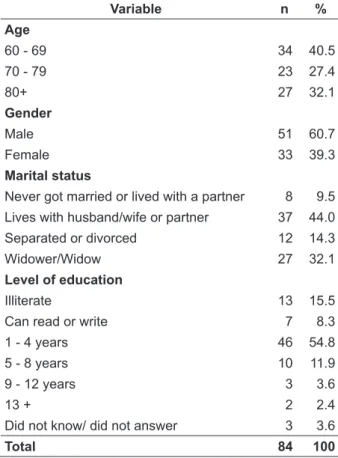
-teristics, the distribution of the elderly according to age, gender, marital status and level of education is described in table 1 below.
Table 1 - Distribution of the elderly admitted to the medical clinic, according to age, gender, marital status and level of education. Ribeirão Preto-SP, 2011
Variable n %
Age
60 - 69 34 40.5
70 - 79 23 27.4
80+ 27 32.1
Gender
Male 51 60.7
Female 33 39.3
Marital status
Never got married or lived with a partner 8 9.5
Lives with husband/wife or partner 37 44.0
Separated or divorced 12 14.3
Widower/Widow 27 32.1
Level of education
Illiterate 13 15.5
Can read or write 7 8.3
1 - 4 years 46 54.8
5 - 8 years 10 11.9
9 - 12 years 3 3.6
13 + 2 2.4
Did not know/ did not answer 3 3.6
Total 84 100
The ages ranged between 60 and 99, with an average of 73.8 and standard deviation 8.8. The largest group, with 34 (40.5%) was found in the age range from 60 to 69 years. Most participants, 51 (60.7%) were male, 37 (44.0%) lived with their husband/wife or partner and 27 (32.1%) were widowers/widows. In relation to the level of edu
of formal education, followed by 20 (23.8%) who were illiterate or could read and write.
Concerning the source of income, most of the elderly, that is, 63 (75.0%) stated to receive retire
-ment pay-ments and 18 (21.4%) received pension. The monthly income of the elderly varied from R$0 to R$5,000.00 (median R$540.00).
The medical diagnoses of the studied sample were obtained through consultation of medical records, which revealed between 1 and 7 diagnoses per individual, with an average of 3 and standard deviation of 1.3, being that 23 (27.4%) had two diagnoses, 22 (26.2%) four and 20 (23.8%) three.
The overall frequency of medical diagnoses for the elderly participating in this study cor
-responded to 252 (100%). The chapters of the In
-ternational Classiication of Diseases and Related Health Problems (ICD-10)8 with the largest num
-ber of diagnoses were: cardiovascular diseases with 84 diagnoses (33.3%) and respiratory diseases with 42 (16.7%).
In this study, as mentioned, in order to identify the frailty level of the sample, the EFS was used. It is important to highlight that, in relation to the cognitive performance with TDR, 76 (90.5%) failed with signiicant mistakes. In this case, the presence of a caregiver during the EFS was required.
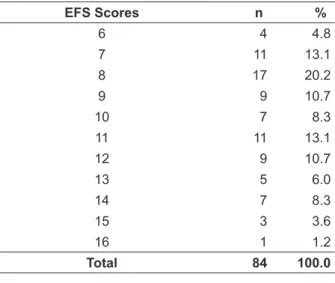
The maximum score on this scale is 17, which represents the highest level of frailty. Table 2 shows the distribution of the elderly according to the EFS scores.
Table 2 - Distribution of elderly patients admitted to the medical clinic, according to EFS scores. Ribeirão Preto-SP, 2011
EFS Scores n %
6 4 4.8
7 11 13.1
8 17 20.2
9 9 10.7
10 7 8.3
11 11 13.1
12 9 10.7
13 5 6.0
14 7 8.3
15 3 3.6
16 1 1.2
Total 84 100.0
The EFS scores varied between six and 16 points, with an average of 10 and standard de
-viation of 2.6. It was noted that 17 (20.2%) of the elderly scored eight points, 11 (13.1%) scored 11 points and the other 11 (13.1%) scored 7 points.
Table 3 shows the distribution of the elderly according to the frailty scores.
Table 3 - Distribution of elderly patients admitted to the medical clinic, according to the frailty scores. Ribeirão Preto-SP, 2011
Scores to identify frailty n %
(0-4) – Did not present frailty -
-(5-6) – Apparently vulnerable 4 4.8
(7-8) – Mild frailty 28 33.3
(9-10) – Moderate frailty 16 19.0
(11 or more) – Severe frailty 36 42.9
Total 84 100.0
Of the 84 (100%) elderly patients, 36 (42.9%) presented severe, 28 (33.3%) mild and 16 (19.0%) moderate frailty scores, that is, 80 (95.2%) were shown to be frail.
The relationship between the frailty scores and the variables gender, age, marital status and self-rated health showed that, concerning severe frailty, there was a predominance of women (63.6%), those aged 80 or older (63.0%), single, divorced, separated or widows (53.1%) and those who described their health as poor (75.8%).
In relation to mild frailty, there was a pre
-dominance of men (37.3%), those aged between 70 and 79, those married or in a de facto relationship (43.2%) and those who described their health as excellent, very good or good (63.2%).
DISCUSSION
The average age of the elderly was 73.8 years and the standard deviation 8.8 years, with 40.5% of the elderly in the age group between 60 and 69 years. This average age was similar to those result
-ing from studies involv-ing the elderly liv-ing in the community and which used the frailty phenotype for their identiication,9-10 as well as in a study that
used the EFS.7
The high average age may be related to the age structure of society, with the increas
diseases and more frequent exacerbations, as well as hospitalizations. Although frailty is as
-sociated with age, not all elderly are frail,11 and
frailty is more related to the reduction in the ability to perform daily activities than chrono -logical age.12
In this study, there was a predominance of men (60.7%). Concerning studies aimed at identi
-fying the frailty of elderly in the community using the frailty phenotype3,9 or the EFS,6-7 there was a
predominance of women.
In fact, there are more women in society and they have a longer life expectancy than men. The predominance of elderly females in the demo
-graphic composition of the country is due to fac
-tors like: greater survival among women, different exposures to occupational risks, higher rates of mortality from external causes among men, differ
-ent lifestyle in relation to alcohol consumption and cigarettes, and increased demand for healthcare among them.13
Based on this, the predominance of men in this study may be explained by the fact that it involves the elderly admitted to hospital and, considering that men are less careful with their health, they are probably more prone to hospi
-talization.
As for marital status, 44.0% lived with their husband/wife or partner and 32.1% were widowers/widows, a fact that conirms the ind
-ings of another study.9 In Brazil, more than one
quarter of men live with their wives, while two thirds of women are widows, single or sepa -rated.14 This inequality can be explained by two
factors: greater life expectancy of women and the cultural trend of men’s union with younger women.15
Of the elderly participants, 54.8% had be
-tween one and four years of formal education. The predominance of elderly people with low levels of education in the country is still high. Other
studies7,16 showed that 54.8% and 49.0% of the
elderly participants had up to four years of formal education, respectively. The low level of formal education predisposes the elderly to greater risks of having health problems and, consequently, to decreased functionality.17
Concerning the source of income, 75.0% received retirement payments, and their monthly income ranged from R$0 to R$5,000.00 (median R$540.00). Currently, retirement and pension pay
-ments are viewed as the main sources of income
of the Brazilian elderly population. Elderly people with lower income generally have worse health conditions, worse physical functioning and less access to healthcare services.18
As regards the occurrence of diseases, the
number of medical diagnoses ranged from 1 to
7 per elderly person, with an average of 3 and standard deviation of 1.3, being that 27.4% had two diagnoses, 26.2% four and 23.8% three. Thirty three per cent of medical diagnoses were related to cardiovascular diseases and 16.7% to respira
-tory diseases. In a study undertaken to develop and implement a frailty phenotype in relation to the elderly,3 it was noted that frailty was strongly
associated with the number of chronic diseases, including cardiovascular, pulmonary and Diabetes
Mellitus, that is, there was greater likelihood of
elderly people being frail when they had two or
more diseases.
The literature3 points out that there is evi
-dence that common conditions related to the el
-derly, such as dependence to perform daily activi
-ties and the occurrence of comorbidi-ties, may lead to frailty. Frailty, comorbidity and disability are, however, different medical conditions, although they can happen simultaneously.19
To identify frailty among the participants in this study, the EFS was used. After performing the TDR, 90.5% failed with signiicant mistakes; however, it is important to emphasize that, in order to execute the test, the elderly reported the following: impaired eye sight, lack of knowledge/ skills, inability to move the dominant limb, trem
-bling hands, illiteracy, confusion, among others. Therefore, it was possible to note the existence of factors that contributed to failing with signiicant mistakes, but this did not mean that the cognition of the elderly was compromised. In this regard, a study7 stated that the low performance in the clock
test may be related to dificulties regardless of the cognitive deicit.
In this study, 95.2% of the hospitalized elderly were frail. However, studies involving the elderly living in the community, the frailty phenotype or the EFS having been used, it was possible to note lower frailty rates, 20%,9 13.3%,20
and 29.9%,7 respectively.
Given that frailty increases with age, deter
-mining greater risk of death, institutionalization, falls and hospitalization3 for the elderly and that,
457
-conditions and by changes in the quality of life and lifestyle,21 it is believed that the high rate of
frailty found in this research can be explained by hospitalization itself.
The relationship between frailty scores and the variables gender, age, marital status and self-rated health showed that, in relation to severe frail
-ty, there was a predominance of women (63.6%), elderly people over 80 years of age (63.0%), those living without a partner (53.1%) and those who de
-scribed their health as poor (75.8%). Other authors also showed that the frail elderly were women, older people, those with low level of formal educa
-tion, lower income, high rates of chronic diseases and worse health conditions,3 widowers/widows,
those with greater dependence to perform basic and instrumental daily activities and with worse self-rated health.20
In a study involving hospitalized elderly in a town located in the state of Rio de Janeiro, with the purpose of describing the proile and identifying the dependence on nursing care, the authors mentioned that frailty is more usu
-ally seen in women than men.22 In fact, being a
female can present an intrinsic risk to frailty, as women start losing lean mass and strength before men of the same age. Women can, also, be more vulnerable to frailty due to the effects
of sarcopenia.23
Sarcopenia causes reduction of mobility, which leads to high risk of falls. Also, due to the decrease in bone density, fractures occur. The decreased reserve capacity and instability, often seen in frail elderly people, cause them to be more vulnerable to diseases, hospitalization and greater chances of dying.24
Elderly people tend to develop several chronic conditions, which interact with the changes related to aging and contribute to frailty,11
since this syndrome is currently related to a critical decrease in functional reserves and homeostatic
unbalance.
Therefore, frailty is an expression of risk aggregation caused by age or disease, associated with physiological changes. Although the initial stages of this process may be clinically silent, when reserve losses reach a threshold that leads to se
-vere vulnerability, frailty can become detectable through markers: medical, functional, behavioral and biological. It can be also added that frailty is marked by large luctuations in health status and high risk of acute complications that can affect
the elderly’s recovery, negatively impacting the functionality of this person and increasing the cost of healthcare.19
CONCLUSION
Most of the elderly people showed severe frailty, which entails greater health risk, includ
-ing hospitalization and mortality, among others, which can result in overload for the family and the healthcare system. The identiication of frailty in relation to hospitalized elderly people, however, can assist healthcare professionals in the planning and implementation of care to the elderly, so as to eliminate or delay this process. The fact that these professionals consider frailty a condition caused by aging may, however, result in delayed decisions being taken concerning the implementa
-tion of appropriate interven-tions, which reduces the potential to revert their effects, including the reduction of a healthy life expectancy and absence
of disabilities.
Thus, it is important that a multidisciplinary team carry out a periodic medical evaluation of the elderly for the early detection of frailty, which may reduce the rates of morbimortality, institutionalization and hospitalization of the elderly. In this sense, the use of simple applica
-tion tools that enable risk identiica-tion and/ or frailty becomes relevant, which can assist in the development of preventive practices and/or appropriate and individualized interventions, from an interdisciplinary perspective, that meet this speciic need.
It is important to highlight the importance of including the family in the context of frailty, either by offering support to the frail elderly and/or to the healthcare team providing the as
-sistance, or by receiving the necessary support to provide effective care without damaging their own health during the process. For this, there is a need to focus on inding and implementing care models that prioritize the prevention of frailty, aiming at a better quality of life for the frail elderly, as well as at the reduction of costs for healthcare services.
Given that the frail elderly need extensive health care and social support, they should be the subject of public health policies.
In this study, the EFS was applied to hos
458
-and living in the community. Furthermore, the lack of studies approaching the identiication of frailty in hospitalized elderly patients made any comparisons based on the existing literature dif
-icult.
ACKNOWLEDGEMENTS
We thank Dr. Miyeko Hayashida, RN, from the University of São Paulo at Ribeirão Preto College of Nursing, University of São Paulo, for the technical support provided in structuring the database and validating the data.
REFERENCES
1. Lourenço RA. A síndrome de fragilidade no idoso:
marcadores clínicos e biológicos. Rev HUPE. 2008 Jan-Jun; 7(1):21-9.
2. Teixeira INDO, Neri AL. A fragilidade no
envelhecimento: fenômeno multidimensional, multideterminado e evolutivo. In: Freitas EV, Py L, Néri AL, Cançado FAX, Gorzoni ML, Rocha SM. Tratado de geriatria e gerontologia. Rio de Janeiro (RJ): Guanabara Koogan; 2006. p.1102-9.
3. Fried LP, Tangen CM, Walston J, Newman AB,
Hirsch C, Gottdiener J, et al. Frailty in older adults: evidence for a phenotype. J Gerontolog Med Sci.
2001 Mar; 56(3):146-56.
4. Bergman H, Béland F, Karunananthan S, Hummel
S, Hogan D, Wolfson C. Développement d’un cadre de travail pour comprendre et étudier la fragilité. Gérontol Soc. 2004 Jun; 109:15-29.
5. Macedo C, Gazzola JM, Najas M. Síndrome da
fragilidade no idoso: importância da isioterapia. Arq Bras Ciênc Saúde. 2008 Set-Dez; 33(3):177-84.
6. Rolfson DB, Majumdar SR, Tsuyuki RT, Tahir
A, Rockwood K. Validity and reliability of the
Edmonton Frail Scale. Age Aging. 2006 Sep; 35(5):526-9.
7. Fabrício-Wehbe SCC. Adaptação cultural e validação
da “Edmonton Frail Escale” (EFS) - escala de
avaliação de fragilidade em idosos [tese]. Ribeirão Preto (SP): Universidade de São Paulo, Escola de Enfermagem de Ribeirão Preto; 2008.
8. Classiicação estatística internacional de doenças e problemas relacionados à saúde CID10. Décima revisão, Volume I, 2008. [acesso 2011 Julho 13]. Disponível em: http://www.datasus.gov.br/cid10/ v2008/cid10.htm
9. Silva SLA, Vieira RA, Arantes P, Dias RC. Avaliação de fragilidade, funcionalidade e medo de cair em
idosos atendidos em um serviço ambulatorial de
geriatria e gerontologia. Fisioter Pesq. 2009 Abr-Jun; 16(2):120-5.
10. Breda JC. Prevalência de quatro critérios para
avaliação de fragilidade em uma amostra de idosos
residentes na comunidade: um estudo exploratório
[tese na internet]. Campinas (SP): Universidade Estadual de Campinas, Programa de Pós-Graduação em Educação; 2007 [acesso 2010 Abr 12]. Disponível em: http://www.bibliotecadigital.unicamp.br/ document/?code=vtls000410730
11. Hamerman D. Toward an understanding of frailty.
Ann Intern Med. 1999 Jun; 130(11):945-50.
12. Schuurmans H, Steverink N, Linderberg S, Frieswijk
N, Slates JP. Old or frail: what tells us more?. J Gerontol A Biol Sci Med Sci 2004 Sep; 59(9):962-5.
13. Feliciano A, Moraes S, Freitas I. O peril do idoso
de baixa renda no Município de São Carlos, São Paulo, Brasil: um estudo epidemiológico. Cad Saúde Pública. 2004 Nov-Dez; 20(6):1575-85.
14. Paschoal SMP, Franco RP, Salles RFN. Epidemiologia
do envelhecimento. In: Papaléo Netto M. Tratado de gerontologia. São Paulo (SP): Atheneu; 2007. p.
39-56.
15. Camarano AA. Mulher idosa: suporte familiar
ou agente de mudança? Estud Av. 2003 Set-Dez; 17(49):35-64.
16. Silva VA, Souza KL, D’elboux MJ. Incontinência
urinária e os critérios de fragilidade em idosos em
atendimento ambulatorial. Rev Esc Enferm USP.
2011 Jun; 45(3):672-8.
17. Rosa TEC, Benicio MHD, Latorre MRDO, Ramos LR. Fatores determinantes da capacidade funcional entre idosos. Rev Saúde Pública. 2003 Fev; 37(1):40-8. 18. Neri M, Soares WL. Políticas sociais, renda e saúde
na terceira idade. In: 15° Encontro Nacional de Estudos Populacionais, 2006 Set 8-22; Caxambu, Brasil. Caxambu (MG): Associação Brasileira de Estudos Populacionais; 2006.
19. Fried LP, Ferrucci L, Darer J, Williamson JD,
Anderson G. Untangling the concepts of disability, frailty and comorbidity: implications for improved
targeting and a care. J Gerontol Med Sci. 2004 Mar; 59(3):255-63.
20. Santos EGS. Perfil de fragilidade em idosos
comunitários de Belo Horizonte: um estudo transversal. [tese na internet] Belo Horizonte (MG): Universidade Federal de Minas Gerais; 2008 [acesso 2010 Abr 12]. Disponível em: http://www. bibliotecadigital.ufmg.br/dspace/handle/1843/ MSMR-7W4PX3.
21. Morton C. Creditor, MD. Hazards of hospitalization
of the elderly. Ann Intern Med. 1993 Feb;
118(3):219-23.
22. Santos I, Sales FM. Peril de idosos hospitalizados e
nível de dependência de cuidados de enfermagem: identificação de necessidades. Texto Contexto Enferm. 2007 Jul-Set; 16(3):495-502.
23. Evans WJ. Exercise, nutrition and aging. Clin Geriatr
Med. 1995 Nov; 11(4):725-34. 24. Pel-Little RE, Schuurmans MJ, Emmelot-Vonk MH, Verhaar HJJ. Frailty: deining and measuring of a concept. J Nutr Health Aging. 2009; 13(4):390-4.
Correspondence: Sueli Marques
General and Specialized Nursing Department
Nursing College of Ribeirao Preto, Universidade de Sao Paulo Av. Bandeirantes, 3900.
14040-902 – Campus Universitario, Ribeirao Preto, SP, Brazil Email: [email protected]