Rev Odontol UNESP. 2017 Mar-Apr; 46(2): 109-115 © 2017 - ISSN 1807-2577
ORIGINAL ARTICLE
Doi: http://dx.doi.org/10.1590/1807-2577.12416
Clinical efectiveness of luorescence, digital images and ICDAS for
detecting occlusal caries
Efetividade clínica da luorescência, imagens digitais e ICDAS na detecção de cárie oclusal
Cristina Dupim PRESOTO
a*, Tamara Carolina TREVISAN
a, Maria Costa de ANDRADE
a,
Andrea Abi-Rached DANTAS
a, Juliana Alvares Duarte Bonini CAMPOS
a,
Osmir Batista de OLIVEIRA-JUNIOR
aaFaculdade de Odontologia, UNESP – Universidade Estadual Paulista, Araraquara, SP, Brasil
Resumo
Introdução: A detecção de pequenas lesões de cárie ainda é um desafio para profissionais da Odontologia, que em sua prática clínica dispõem de uma grande variedade de métodos para detectar cáries nas superfícies oclusais.
Objetivo: Avaliar clinicamente a efetividade da câmera de fluorescência Vista Proof, da microcâmera intraoral digital Vista Cam e do critério visual ICDAS (International Caries Detection and Assessment System) para detecção de lesões de cárie nas superfícies oclusais. Material e método: Cento e sete dentes posteriores de pacientes adultos foram examinados visualmente e por meio de radiografias digitais por um examinador que os classificou de acordo com a presença ou ausência de cárie. Os dentes foram então avaliados por outro examinador que utilizou o ICDAS, fluorescência e imagens digitais ampliadas. A efetividade dos métodos foi mensurada por meio da sensibilidade, especificidade, razão de verossimilhança positiva e negativa. Para cada método, a curva ROC (Receiver Operating Characteristic) e a área sob a mesma - AUROC (Area Under the ROC curve) foram estimadas. Resultado: Houve excepcional capacidade discriminante para as imagens intraorais (AUROC=0,93) e para o ICDAS (AUROC=0,91), com diferença estatística não significativa entre eles (z=0,35, p=0,73). A fluorescência apresentou capacidade discriminante aceitável (AUROC=0,78), embora tenha sido menor que os outros. A razão de verossimilhança positiva para a fluorescência foi 2,32, comparado a 20,58 para a imagem intraoral e 58,11 para o ICDAS. Conclusão: Ambos os métodos e o ICDAS exibiram um adequado desempenho clínico, sendo que o ICDAS e a imagem intraoral foram mais efetivos que a fluorescência.
Descritores: Cárie dentária; efetividade; diagnóstico; fluorescência.
Abstract
Introduction: The detection of small caries lesions is still a challenge for dental professionals who in their clinical practice have a wide variety of methods to detect caries on occlusal surfaces. Objective: To clinically assess the effectiveness of the Vista Proof fluorescence camera, the Vista Cam digital intraoral micro camera and the International Caries Detection and Assessment System (ICDAS) visual criterion for detecting caries lesions on occlusal surfaces of permanent teeth. Material and method: One hundred and seven posterior teeth from adult patients were examined visually and by means of digital radiographs by an examiner who rated them according to the presence or absence of occlusal caries. The teeth were then assessed by the other examiner using ICDAS, fluorescence and magnified digital images. The effectiveness of the methods was measured based on sensitivity, specificity, positive and negative likelihood ratio. For each method, the Receiver Operating Characteristic (ROC) curve and the Area Under the ROC curve (AUROC) were estimated. Result: There was exceptional discrimination capacity for the intraoral images (AUROC=.93) and the ICDAS (AUROC=.91), with no significant statistical difference between them (z=.35, p=.73). The fluorescence exhibited an acceptable discrimination capacity (AUROC=0.78), although it was lower than the others. The positive likelihood ratio for the fluorescence was only 2.32, compared to 20.58 for the intraoral image and 58.11 for the ICDAS. Conclusion: Both methods and the ICDAS exhibited an adequate clinical performance, although the ICDAS and intraoral image were more effective than the fluorescence.
INTRODUCTION
Nowadays, three main aspects are taken into consideration when discussing dental caries: prevention, control and a proper diagnosis, which oten includes the detection of lesions at the earliest possible stage1. However, the detection of small lesions, especially on occlusal surfaces, is still a challenge for dental professionals2-5, mainly due to the complex anatomy of dental grooves and issures6-8, overlapping structures during radiography and the increased number of hidden caries lesions caused by the continuous use of luorides9,10.
In their clinical practice, dentists use a wide variety of methods to detect caries on occlusal surfaces11,12. hese methods include visual inspection, visual-tactile inspection, radiographs, digital radiographs, laser or light luorescence based-methods, electrical impedance measurements12, intraoral images13, dyes and iber-optic transillumination11.
An ideal method to detect caries lesions should be fast and easy to use, with high sensitivity and speciicity14,15, as well as reliability and an accessible cost. his will enable the documentation and detection of caries at an early stage, without causing discomfort for the patient, as well as the possibility of diferentiating reversible and irreversible damage, with similar efectiveness when applied to all dental surfaces16. Nevertheless, satisfying all of these requirements is not an easy task.
he International Caries Detection & Assessment System (ICDAS)17 is an accessible set of criteria for dentists, researchers and professors and presents acceptable sensitivity and speciicity to the detection of occlusal caries4,5,10,18,19. According to this system, caries detection on coronal teeth surfaces is a process that comprises two stages. he irst stage involves classifying each tooth surface according to its condition (sound, sealed, restored, with or without a dental crown, or missing). he second stage involves the classiication of the extent of the lesion on an ordinal scale17.
Methods that use luorescence are based on the phenomenon that caries lesions luoresce diferently from healthy tissues when excited by light in speciic wavelengths2. he Vista Proof luorescence camera [Dürr Dental, Bietigheim-Bissingen, Germany] uses gallium nitride light-emitting diodes (GaN LEDs) that emit blue light at 405 nanometers (nm) on the teeth surface4,5. he light emitted from this wavelength stimulates porphyrins present in the cariogenic bacteria to emit red light, which contains less energy, as opposed to sound enamel, which emits green light4. his luorescence is recorded by the camera, transferred to a computer and processed by DBSWIN sotware [Dürr Dental, Bietigheim-Bissingen, Germany]. A digital image is then generated, showing lesions in diferent colors, and numerical information about the depth of caries is also provided. Since the images can be stored in the patient’s database, Vista Proof can facilitate the control of the lesion’s progress over time7,13,20.
Digital intraoral cameras, such as the Vista Cam device [Dürr Dental, Bietigheim-Bissingen, Germany], are ergonomic and provide enlarged images, which have signiicantly improved communication with patients, favoring a correct diagnosis and allowing professionals to save the data. However, there are no
reports in the literature of studies that used Vista Cam as an auxiliary method of caries diagnosis.
herefore, the aim of the present study was to clinically assess the efectiveness of the ICDAS visual criterion, the Vista Proof luorescence camera and the Vista Cam digital intraoral camera in detecting caries lesions on occlusal surfaces of permanent teeth. he null hypothesis was that the efectiveness of these diferent methods would not difer among them.
MATERIAL AND METHOD
Ethical Aspects
his study was approved by the Research Ethics Committee of the Araraquara Dental School – UNESP (Brazil) under protocol number 47/11 and was conducted in full accordance with the World Medical Association Declaration of Helsinki. All participants signed an Informed Consent Form.
Sample Design
his was an observational cross-sectional study with a convenience non-probabilistic sampling design. Prior to the deinitive study, the MedCalc statistical sotware was used to calculate the sample size using the data obtained in the pilot study. It was considered α=0.05, β=0.20, minimum AUROC of 0.70 and null hypothesis=0.5. his way, a minimum sample size of 63 teeth was calculated.
It were considered eligible to participate in this study young adult patients (male and female, 18 to 28 years old) with sounded or decayed teeth who regularly attended the Clinic of Restorative Dentistry at Araraquara Dental School (UNESP), from August to December 2012. Patients were selected for the study from a previously screening. he exclusion criteria were teeth with sealants/restorations of any kind or malformations, such as luorosis, enamel hypoplasia, amelogenesis imperfect and/or hypomineralization. hird molars were also not assessed, nor patients who were using ixed orthodontic appliances at the time of the assessment, as the orthodontic band overlaps dental structures during the performance of radiography.
One hundred and seven posterior teeth (42 molars and 65 premolars) from 14 young adult patients comprised the eligibility criteria and were included in this study. All individuals who participated in this research and needed treatment were attended at the Clinic of Restorative Dentistry or referred to other clinics of the Araraquara Dental School (UNESP), depending on their requirements.
Study Variables and Procedures
In the present study, the effectiveness of the ICDAS criterion, the Vista Proof fluorescence camera and the magnified digital image (Vista Cam) were assessed in relation to detecting caries lesions on occlusal surfaces based on visual inspections plus digital radiographs, which were considered as the comparison standard.
Restorative Dentistry Clinic, with a one week interval between the assessments. For the examiners’ calibration the same criteria that will be described below for deinitive study were used.
Ater the calibration process, an experienced examiner (A) examined the 107 teeth visually and radiographically. he participants received professional prophylaxis with pumice and water and then had their teeth visually examined and classiied, based on the presence or absence of caries. In addition, the teeth were also radiographed using an RX device (Dabi Atlante). Phosphor plates [Dürr Dental, Bietigheim-Bissingen, Germany] were coupled to interproximal positioners [Indusbello] and subsequently scanned by the VistaScan Mini [Dürr Dental, Bietigheim-Bissingen, Germany] device and processed using DBSWIN sotware (Figure 1).
One week later, the examiner A analyzed the radiographs on a microcomputer. he presence or absence of a radiolucent image on the enamel or dentin characterized the presence or absence of caries lesions, respectively21.
Seven days ater the visual exam, the volunteers received new prophylaxis with pumice and water and had their teeth assessed (wet and dry) by another examiner (B) by means of ICDAS visual criterion11. his examiner was also trained in a pilot study and used the artiicial light of a dental lamp, an air jet and a dental mirror. ICDAS scores were classiied as follows: from 0 to 2 - absence of caries; from 3 to 6 - presence of caries.
Aterwards, the same participants were submitted to a new assessment using the Vista Proof luorescence camera. he same examiner, who had been previously trained according to the manufacturer’s recommendations, captured images of the occlusal surfaces of teeth using the Vista Proof luorescence camera. Ater drying with an air jet for 5 seconds, the camera was positioned perpendicularly to the occlusal surface of the teeth. he results were automatically interpreted by DBSWIN sotware, which created images of 720×576 pixels that ranged from green (around 510 nm wavelength)7 to red (around 685 nm wavelength) and provided a numerical value for the severity of the lesion (Figure 2).
Subsequently, examiner B classiied the images based on their scores (Table 1).
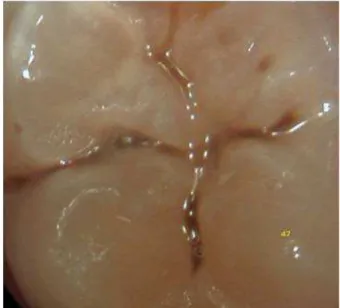
Finally, digital images of the occlusal surfaces of the teeth were captured by examiner B using the Vista Cam digital intraoral camera (Figure 3).
he images obtained were coded and recorded in a microcomputer for posterior analysis by the same examiner, who classiied them according to the ICDAS criterion.
Figure 1. Radiographic image of posterior teeth.
Figure 2. Fluorescence image of a posterior teeth.
Table 1. Classiication of luorescence images, obtained by Vista Proof, according to the depth of caries lesions
Color Classiication according to the manufacturer Lesion depth (mm) Score Final classiication
Green Healthy enamel <1 0 Absence of caries
Purple Initial enamel caries 1≤x<1.5 1 Presence of caries
Red Caries in dentinoenamel junction 1.5≤x<2 2 Presence of caries
Orange Caries in dentin 2≤x<2.5 3 Presence of caries
Yellow Deep caries in dentin x≥2.5 4 Presence of caries
Statistical Analysis
A – Pilot study
he intra-examiner reproducibility of the visual and radiographic examinations was estimated using the Kappa statistic (κ). he intra-examiner reproducibility of the luorescence, magniied digital images and ICDAS were estimated using the Kappa statistic with linear weighting (κpl)22 by point and a 95% conidence interval (CI95%). he agreement obtained was classiied based on the proposal of Landis, Koch23. An agreement level with a minimum classiication of “great” for visual and radiographic exams and a minimum classiication of “good” for the other methods was considered adequate.
B – Deinitive study
Concerning the efectiveness of the ICDAS, luorescence and magniied digital images in relation to the visual inspection and digital radiographs, the sensibility, speciicity, positive likelihood and negative likelihood ratio of the tests were estimated. he Receiver Operating Characteristic (ROC) curve was constructed and its area (AUROC) was estimated. he discriminant capacity of each test was classiied, as described by Hosmer, Lemeshow24.
he areas of the diferent methods were compared using the z statistic. he signiicance level chosen was 5%. he analysis was conducted using MedCalc 12.4.0 sotware (Mariakerke, Belgium).
RESULT
Table 2 displays the intra-examiner reproducibility obtained for the occlusal caries detection methods, by point and 95% conidence interval.
With the exception of the luorescence, which exhibited good reproducibility, all other methods produced a great agreement.
Table 3 displays the quantity of occlusal lesions detected by each method, in comparison to the visual and radiographic examinations.
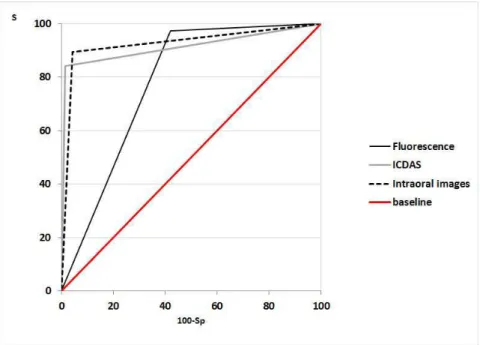
Figure 4 displays the ROC curves constructed using the occlusal caries detection methods, according to the visual and radiographic examinations.
he efectiveness of the three methods is described in Table 4.
An exceptional discriminating capacity for the ICDAS and intraoral images was recorded, with no statistically signiicant diferences between them (z=0.348; p=0.727). he luorescence exhibited acceptable discriminating capacity, although it was lower than the other two methods. his way, the null hypothesis was rejected.
Table 3. Number of occlusal lesions detected by each method, according to visual inspection and BW digital radiography
Method Visual inspection and BW digital radiography Total
Absence of caries Presence of caries
ICDAS
Absence of caries 68 0 68
Presence of caries 1 38 39
Total 69 38 107
Intraoral image
Absence of caries 66 4 70
Presence of caries 3 34 37
Total 69 38 107
Fluorescence
Absence of caries 40 1 41
Presence of caries 29 37 66
Total 69 38 107
Table 2. Intra-examiner reproducibility for methods to detection
occlusal caries
Intra-examiner Agreement - κ
(CI95%)
A x A B x B
Visual inspection 0.878
(0.782-0.974)
-BW digital radiography 0.960
(0.882-1.000)
-ICDAS - 0.959
(0.928-0.990)
Intraoral Image - 0.943
(0.907-0.979)
Fluorescence - 0.656
DISCUSSION
he complex anatomy of dental grooves and issures on the occlusal surfaces of teeth make it diicult to accurately detect caries lesions6-8. Although several detection methods have been described in the literature7-9,17, choosing the ideal method it is not an easy task.
In order to make a suitable decision, it is important to consider the calibration of the device and the examiners, since good reproducibility is the irst step in obtaining consistent results from diferent examiners at diferent assessment periods20. Moreover, a lack of reproducibility may result in an inaccurate treatment plan and intervention25. hus, calibration is a crucial element in both laboratory and clinical research, as well as among educators, who assist dental students in their training.
A histological examination is the gold standard for determining the extent to which tissue is afected by dental caries in in vitro
studies21. hus, a limitation of this study was the impossibility of performing histological examination and opening the teeth classiied as non-carious. herefore, visual inspection and digital BW radiography were selected as the comparison standard.
In order to avoid potential bias, examiner A analyzed the radiographs one week ater the clinical examination. Furthermore,
one examiner performed the clinical and radiographic examination and a second examiner used the other evaluation methods. Examiner B also followed the manufacturer’s recommendations for using Vista Proof, such as drying the teeth for 5 seconds and positioning the camera perpendicular to the occlusal surface of the teeth.
he images from the Vista Proof luorescence camera were classiied using scores provided by the manufacturer, based on the depth of the lesion, and the intra-examiner reproducibility was considered “good”7,20,26. For other methods of caries detection, reproducibility was “great”, which is essential in investigation studies and also in clinical practice. he reliability for the visual examination with ICDAS, when used by six diferent examiners, ranged from “regular” (κ=.59) to “great” (κ=.82) in a previous study17, which described this criterion as a practical system with content validity. Similar reproducibility was found by Shoaib et al.15 when assessing the occlusal surfaces of deciduous teeth.
In the present study, the sensitivity of the Vista Proof camera for occlusal lesions was 0.97, indicating a strong ability to detect caries lesions when they are actually present. Similar indings were described by Schwendicke et al.27. Nonetheless, this method exhibited worse speciicity (0.58) than the intraoral image (0.96) and the ICDAS (0.98), indicating that the luorescence camera
Figure 4. Receiver Operating Characteristic (ROC) curves for ICDAS, luorescence and intraoral images, according to visual inspection and
BW digital radiography.
Table 4. Efectiveness of auxiliary methods for detecting occlusal caries in premolars and molars
AUROC (IC95%) Sensitivity Speciicity *LR+ *LR–
Fluorescence 0.777
b
(0.686-0.842) 97.37 57.97 2.32 0.045
ICDAS 0.914
a
(0.844-0.959) 84.21 98.55 58.11 0.16
Intraoral image 0.926
a
(0.858-0.967) 89.47 95.65 20.58 0.11
detects more false-positive results than the others. In this case, it would be an overtreatment (a clinical intervention on healthy teeth). High sensitivity (0.86) for the Vista Proof camera was described by Rodrigues et al.7 in an in vitro study of occlusal lesions on dentin. he authors stressed that, despite the high sensitivity observed for this device (0.86), it did not adequately detect caries lesions on enamel.
An exceptional discriminatory capacity (AUROC=0.91 to 0.96) for the Vista Proof luorescence camera was found by Jablonski-Momeni et al.26. Although the present study only found an acceptable discriminatory capacity (AUROC=.78 (.69 to .84)), these indings indicate that the Vista Proof luorescence camera can be considered appropriate for the detection of caries, but should be used in association with other methods.
Similar to the Vista Proof luorescence camera, the Vista Cam is ergonomic and enables the storage of magniied images on the patient’s database. Consequently, communication, the archiving of images and the control of lesion progression become easier over time. Nevertheless, until now, this is the irst study that assessed the performance of the Vista Cam digital intraoral camera as an auxiliary method of detecting caries. In the literature, we only found studies that assessed (in vitro) the performance of the Vista Cam iX12,26, a version of the camera with a more simple optical set. Although the Vista Cam iX has multiple functions on the same camera (intraoral and luorescence camera), only the luorescence was used in the previously published studies and the data obtained were compared with those found for the Vista Proof camera. hus, it is diicult to compare the intraoral image data from the present study with similar data in the literature.
he present study recorded an excellent equilibrium between sensitivity and speciicity for the Vista Cam digital intraoral camera (0.89/0.96) and for the visual inspection with the ICDAS criterion (0.84/0.99). he larger areas under ROC curves (0.93 (0.86-0.97)
for the Vista Cam and 0.91 (0.84-0.96) and for ICDAS indicates that the ICDAS criterion and magniied images can add important information to a visual exam, facilitating the detection of caries lesions. he magniied images also improve the vision ield of dentists and allow them to plan the treatment with more precision.
he positive likelihood ratio expresses the number of times that it is more probable to ind a positive result among people who exhibit caries lesions, when compared with people without caries. he ICDAS exhibited the highest value, indicating that the chance for a positive test to be true is 58.11 times greater than the chance of it being false. Hereater, the highest result was for the intraoral image (20.58), followed by luorescence (2.32). Similar results for Vista Proof (2.28) was found by Rodrigues et al.7.
he negative likelihood ratio observed for the ICDAS (0.16) indicates that the chance of a negative result being true in relation to a false-positive result is 100:16, or 6.25 times. For the intraoral image, the chance was 9.1 times and for luorescence, the chance was 22.2.
CONCLUSION
Both methods and the ICDAS exhibited an adequate clinical performance, although the ICDAS and intraoral image were more efective. hese data could assist dentists and researchers when choosing the best method of detecting caries lesions on occlusal surfaces, while also highlighting the importance of the association of methods to obtaining a correct diagnosis.
ACKNOWLEDGEMENTS
he authors would like to thank the São Paulo Research Foundation (FAPESP) for inancial support (FAPESP – process numbers 2011/11397-3 and 2011/07828-9).
REFERENCES
1. Tranaeus S, Shi XQ, Angmar-Månsson B. Caries risk assessment: methods available to clinicians for caries detection. Community Dent Oral Epidemiol. 2005 Aug;33(4):265-73. PMid:16008633. http://dx.doi.org/10.1111/j.1600-0528.2005.00234.x.
2. Bader JD, Shugars DA. A systematic review of the performance of a laser fluorescence device for detecting caries. J Am Dent Assoc. 2004 Oct;135(10):1413-26. PMid:15551982. http://dx.doi.org/10.14219/jada.archive.2004.0051.
3. Aktan AM, Cebe MA, Ciftçi ME, Sirin Karaarslan E. A novel LED-based device for occlusal caries detection. Lasers Med Sci. 2012 Nov;27(6):1157-63. PMid:22080431. http://dx.doi.org/10.1007/s10103-011-1020-0.
4. Jablonski-Momeni A, Heinzel-Gutenbrunner M, Klein SM. In vivo performance of the VistaProof fluorescence-based camera for detection of occlusal lesions. Clin Oral Investig. 2014 Sep;18(7):1757-62. PMid:24287891. http://dx.doi.org/10.1007/s00784-013-1150-9.
5. Jablonski-Momeni A, Heinzel-Gutenbrunner M, Vill G. Use of a fluorescence-based camera for monitoring occlusal surfaces of primary and permanent teeth. Int J Paediatr Dent. 2016 Nov;26(6):448-56. PMid:26590509. http://dx.doi.org/10.1111/ipd.12216.
6. Ricketts D, Kidd E, Weerheijm K, Soet H. Hidden caries: what is it? Does it exist? Does it matter? Int Dent J. 1997 Oct;47(5):259-65. PMid:9448806. http://dx.doi.org/10.1002/j.1875-595X.1997.tb00786.x.
7. Rodrigues JA, Hug I, Diniz MB, Lussi A. Performance of fluorescence methods, radiographic examination and ICDAS II on occlusal surfaces in vitro. Caries Res. 2008;42(4):297-304. PMid: 18663299. http://dx.doi.org/10.1159/000148162.
8. De Paula AB, Campos JA, Diniz MB, Hebling J, Rodrigues JA. In situ and in vitro comparison of laser fluorescence with visual inspection in detecting occlusal caries lesions. Lasers Med Sci. 2011 Jan;26(1):1-5. PMid:19784712. http://dx.doi.org/10.1007/s10103-009-0731-y. 9. Weerheijm KL, Kidd EA, Groen HJ. The effect of fluoridation on the occurrence of hidden caries in clinically sound occlusal surfaces. Caries
10. Qudeimat MA, Alomari QD, Altarakemah Y, Alshawaf N, Honkala EJ. Variables affecting the inter- and intra-examiner reliability of ICDAS for occlusal caries diagnosis in permanent molars. J Public Health Dent. 2016;76(1):9-16. PMid:26095924. http://dx.doi.org/10.1111/ jphd.12105.
11. Hintze H, Wenzel A, Danielsen B, Nyvad B. Reliability of visual examination, fibre-optic transillumination, and bite-wing radiography, and reproducibility of direct visual examination following tooth separation for the identification of cavitated carious lesions in contacting approximal surfaces. Caries Res. 1998;32(3):204-9. PMid:9577986. http://dx.doi.org/10.1159/000016454.
12. Jablonski-Momeni A, Stucke J, Steinberg T, Heinzel-Gutenbrunner M. Use of ICDAS-II, fluorescence-based methods, and radiography in detection and treatment decision of occlusal caries lesions: an in vitro study. Int J Dent. 2012;2012:371595. http://dx.doi.org/10.1155/2012/371595. 13. Murdoch-Kinch CA, McLean ME. Minimally invasive dentistry. J Am Dent Assoc. 2003;134(1):87-95. PMid:12555961. http://dx.doi.
org/10.14219/jada.archive.2003.0021.
14. Lussi A, Francescut P. Performance of conventional and new methods for the detection of occlusal caries in deciduous teeth. Caries Res. 2003 Jan-Feb;37(1):2-7. PMid:12566632. http://dx.doi.org/10.1159/000068226.
15. Shoaib L, Deery C, Ricketts DN, Nugent ZJ. Validity and reproducibility of ICDAS II in primary teeth. Caries Res. 2009;43(6):442-8. PMid:19907175. http://dx.doi.org/10.1159/000258551.
16. Firestone AR, Sema D, Heaven TJ, Weems RA. The effect of a knowledge-based, image analysis and clinical decision support system on observer performance in the diagnosis of approximal caries from radiographic images. Caries Res. 1998;32(2):127-34. PMid:9544861. http:// dx.doi.org/10.1159/000016442.
17. Ismail AI, Sohn W, Tellez M, Amaya A, Sen A, Hasson H, et al. The International Caries Detection and Assessment System (ICDAS): an integrated system for measuring dental caries. Community Dent Oral Epidemiol. 2007 Jun;35(3):170-8. PMid:17518963. http://dx.doi. org/10.1111/j.1600-0528.2007.00347.x.
18. Jablonski-Momeni A, Stachniss V, Ricketts DN, Heinzel-Gutenbrunner M, Pieper K. Reproducibility and accuracy of the ICDAS-II for detection of occlusal caries in vitro. Caries Res. 2008;42(2):79-87. PMid:18204251. http://dx.doi.org/10.1159/000113160.
19. Diniz MB, Boldieri T, Rodrigues JA, Santos-Pinto L, Lussi A, Cordeiro RC. The performance of conventional and fluorescence-based methods for occlusal caries detection: an in vivo study with histologic validation. J Am Dent Assoc. 2012 Apr;143(4):339-50. PMid:22467694. http:// dx.doi.org/10.14219/jada.archive.2012.0176.
20. De Benedetto MS, Morais CC, Novaes TF, Almeida Rodrigues J, Braga MM, Mendes FM. Comparing the reliability of a new fluorescence camera with conventional laser fluorescence devices in detecting caries lesions in occlusal and smooth surfaces of primary teeth. Lasers Med Sci. 2011 Mar;26(2):157-62. PMid:20157753. http://dx.doi.org/10.1007/s10103-010-0757-1.
21. Lino JR, Ramos-Jorge J, Coelho VS, Ramos-Jorge ML, Moysés MR, Ribeiro JC. Association and comparison between visual inspection and bitewing radiography for the detection of recurrent dental caries under restorations. Int Dent J. 2015 Aug;65(4):178-81. PMid:26032493. http://dx.doi.org/10.1111/idj.12172.
22. Light RJ. Measures of response agreement for qualitative data: some generalizations and alternatives. Psychol Bull. 1971 Nov;76(5):365-77. http://dx.doi.org/10.1037/h0031643.
23. Landis JR, Koch GG. The measurement of observer agreement for categorial data. Biometrics. 1977 Mar;33(1):159-74. PMid:843571. http:// dx.doi.org/10.2307/2529310.
24. Hosmer DW, Lemeshow S. Applied logistic regression. New York: John Wiley & Sons; 2000.
25. Merrett MC, Elderton RJ. An in vitro study of restorative dental treatment decisions and dental caries. Br Dent J. 1984 Aug;157(4):128-33. PMid:6591943. http://dx.doi.org/10.1038/sj.bdj.4805448.
26. Jablonski-Momeni A, Liebegall F, Stoll R, Heinzel-Gutenbrunner M, Pieper K. Performance of a new fluorescence camera for detection of occlusal caries in vitro. Lasers Med Sci. 2013 Jan;28(1):101-9. PMid:22434499. http://dx.doi.org/10.1007/s10103-012-1080-9.
27. Schwendicke F, Tzschoppe M, Paris S. Radiographic caries detection: a systematic review and meta-analysis. J Dent. 2015 Aug;43(8):924-33. PMid:25724114. http://dx.doi.org/10.1016/j.jdent.2015.02.009.
CONFLICTS OF INTERESTS
he authors declare no conlicts of interest.
*CORRESPONDING AUTHOR
Cristina Dupim Presoto, Faculdade de Odontologia, UNESP – Universidade Estadual Paulista, Rua Humaitá, 1680, Centro, 14801-903 Araraquara - SP, Brasil, e-mail: [email protected]