Rev Odontol UNESP. 2013 July-Aug; 42(4): 259-265 © 2013 - ISSN 1807-2577
ORIGINAL ARTICLE
Perception of oral health by patients who use dental clinics
Percepção de saúde bucal em pacientes usuários de clínica odontológica
Lorena Marques da NÓBREGA
a, Lorenna Mendes TEMÓTEO
a, Joselúcia da Nóbrega DIAS
a,
Monalyza Myllenna Silva Monteiro LIMA
a, Luciana de Barros Correia FONTES
a,
Sérgio d’Avila Lins Bezerra CAVALCANTI
aaUEPB – Universidade Estadual da Paraíba, Campina Grande, PB, Brasil
Resumo
Introdução: O uso de indicadores clínicos para avaliar o estado de saúde bucal e a necessidade de tratamento é reconhecido como tendo limitações, atualmente têm sido utilizados outros fatores entre eles os sociais e a qualidade de vida. Objetivo: Este trabalho teve como objetivo a avaliação da autopercepção da saúde bucal, em adultos usuários das clínicas de Odontologia de uma universidade pública. Metodologia: O estudo do tipo transversal teve uma amostra de 86 participantes. Foram utilizados um questionário, constando dos dados sócio demográficos, e a aplicação do índice GOHAI. A análise estatística foi descritiva, com dados absolutos e percentuais, através do programa Epi Info. versão 6. Resultado: A maioria dos usuários era composta por mulheres (89,7 %), com estado civil de casadas (69,8 %), na faixa etária de 35 a 38 anos (39,6 %), tinham ensino médio completo (32,6 %), com renda mensal de 1 a 3 salários mínimos (79,1 %). O resultado do índice GOHAI foi classificado como baixo, apresentando valor do escore de 27,06. Conclusão: Foi verificado um baixo índice e impacto negativo das condições de saúde bucal na vida diária dos usuários avaliados.
Descritores: Saúde bucal; qualidade de vida; saúde do adulto; condições de saúde.
Abstract
Introduction: The use of clinical indicators to evaluate oral health status and the need for treatment is recognized as having limitations, and nowadays other factors, among them social and quality of life, have been used.
Objective: The aim of this study was to evaluate the self-perception of oral health in adults using the Dental clinics at a public university. Methodology: This cross-sectional study had a sample of 86 participants. A questionnaire consisting of sociodemographic data and application of the GOHAI index were used. Descriptive statistical analysis was performed with absolute and percentage data, using the Epi Info. version 6 software program. Result: The majority of users were women (89.7 %); marital status: married (69.8 %); age-range from 35 to 38 years (39.6 %), they had completed high school (32.6 %), and had a monthly income from 1 to 3 minimum wages (79.1 %). Results of the GOHAI index were classified as low, presenting a score value of 27.06. Conclusion: A low index and negative impact of oral health conditions on the daily lives of the evaluated users was verified.
Descriptors: Oral health; quality of life; adult health; health status.
INTRODUCTION
Self-evaluation of oral health is a multidimensional variable, and may be related to both clinical and subjective factors. Clinical characteristics alone are not adequate measurements for evaluating dental treatment needs, and self-perception stimulates dental self-care and motivates the population to seek dental care1-3.
he subjective factors of oral diseases may be: age, income, gender in addition to personal values, and cannot be summed up as discomfort and pain only, but also relect psychological and social aspects, such as personal appearance, communication and interaction with other persons4,5.
he “Geriatric Oral Health Assessment Index (GOHAI) – Atchison, Dolan6 (1990), validated for Brazil7 was
developed to evaluate the oral health conditions of elderly persons, in a format that would allow its use in both epidemiological studies and in clinical practice. However, it has been proved that the results obtained with the application of GOHAI were satisfactory in other types of populations, including low-income groups, youngsters and adults of all ages8.
In view of the foregoing, it is important to study the adult patient who seeks the health services, to evaluate the degree of oral health perception, and the socio-demographic proile of this population.
METHODOLOGY
he study was conducted in a municipality in the Brazilian Northeast, which is considered one of the main complexes of economic development in the interior of the country, with a population of 379,871 inhabitants and human development index of 0.7210.
he study design was of the cross-sectional type. Data was collected by using a form containing two parts. he irst part, prepared by the authors of the research, considered the following variables: gender, age, marital status, occupation, educational level, family income, and inclusion in government social programs. he second part was composed of the Geriatric Oral Health Assessment Index (GOHAI) for the measurement of oral health self-perception.
he sample was composed of patients of both genders in the age-range from 35-44 years, who sought the dental service of the school clinic of the dentistry course at a public state university, for the irst dental consultation.
For the efect of calculating the sample size, an expected percentage equal to 50% in each response was estimated, with a margin of error of 5.0% and a conidence interval of 95.0%, thus resulting in a universe 385 participants. However, as this concerned a inite population with a mean of 100 patients per month attended at the clinic, in which the characteristic of homogeneity of the sampling data was outstanding, it was necessary to verify the need for the use of a factor of correction,
given by the following formula: n0≤0,05
N . herefore the factor of correction =
+ 0 0 n n n 1 N
was used, by which a total of 85 users was
obtained. An addition of 10% for losses was made, arriving at 93 participants as the sample size.
For this study, the following inclusion criteria were determined: he subject must be undergoing treatment during the research, be an adult in the age-range selected for the study, and be a resident of the municipality. For sample selection the simple random sampling technique was used. During the course of three months, when the daily clinical attendances began in the triage center, it was observed whether the patients itted into this age range, and a patient was randomly selected from the list provided.
he formula was applied to those in the waiting room, who were available for holding the interview. he study was preceded by a pilot study with two data collectors who interviewed patients of another age range, which occurred with 10% of the total sample. he purpose of this was to adjust the collection of data and analyze the methods of evaluating the variables used, planning of the study, time spent on holding the interview, and the clarity of the instrument. he intention of this pre-test was to verify the use
of the data collection instrument, and apply the Kappa Test of Agreement, in which the value of 0.89 was obtained, considered “excellent” agreement. he dependent variable of the study was perception of oral health.
During the pilot study, it was found that the study participants had extreme diiculty with self-reporting their race, an item present in the socio-demographic questionnaire; therefore the option was taken to remove this information, since its removal would not interfere in the results of the research.
he GOHAI index contains twelve questions, which allow oral health to be analyzed with regard to three basic functions: (a) physical, including dietary information, speech and swallowing; (b) psychological, comprising concern about or care of one’s own oral health, dissatisfaction with appearance, self-consciousness relative to oral health and the fact of avoiding social contacts due to dental problems; (c) pain or discomfort, considering the use of medication to relieve these feelings, provided that they arise in the mouth.
he questions provide the following response conditions: always, sometimes and never, with reference to the last three months. For the responses to these questions (always, sometimes and never), there are weights/scores (1, 2 and 3, respectively), which added together result in the value of the index. In questions 3, 5 and 7 the weights/scores for the responses are inverted (3, 2 and 1). he higher the score, the more signiicant the perception of the individual’s oral health. hese values range from 12 to 36, classiied as high (34 to 36), moderate (31 to 33) and low (below 30)11.
he study was evaluated and approved by the Research Ethics Committee of the State University of Paraíba (Protocol No. 0295.0.133.000-08), in compliance with all the requirements and rules of Resolution No. 196 of the National Health Council (CNS).
he data collected were grouped and coded using the sotware program Epi Info version 6, and the results were presented in the form of graphs and tables. In order to obtain the absolute and percentage frequencies, descriptive statistical techniques were used. he study followed the criteria adopted in STROBE (Strengthening the Reporting of Observational Studies in Epidemiology).
RESULT
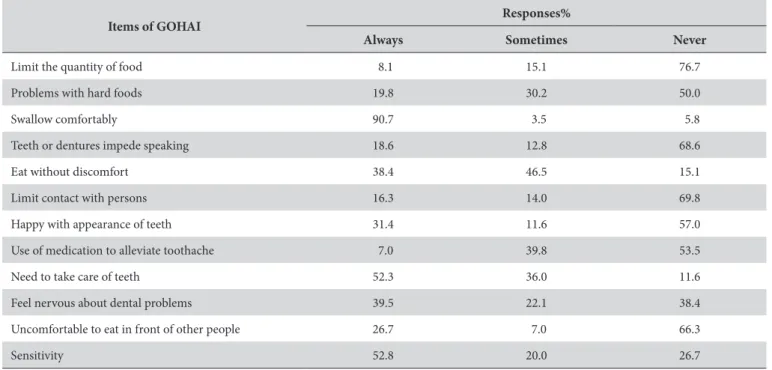
According to Table 2, one observes that 76.7% of the adults had never limited the type or quantity of foods due to problems with their teeth or dentures, and that half of the sample had never presented any problem when chewing hard foods. he major portion of the adults (90.7%) always swallowed foods comfortably, and 68.6% had never had any diiculties with speech due to problems with their teeth or dentures. Almost half of the researched subjects (46.5%) responded that they were sometimes able to eat anything at all without feeling discomfort.
As regards interpersonal contacts, due to problems with their teeth or dentures (69.8%) of the population had never limited them. When asked about having used medications to alleviate pain or discomfort, 53.5% airmed they had never used this type of medication. Over half of the sample (57.0%) had never been satisied with the appearance of their teeth or dentures, and 52.3% of the researched subjects airmed that they were concerned about or cared for their teeth, gums or dentures. Nevertheless, it was veriied that 38.4% of the adults never became nervous due to problems with their teeth, gums or dentures (Table 2).
herefore, as shown in Table 3, low perception of oral health (77.9%) was veriied, obtaining a mean GOHAI index of 27.06.
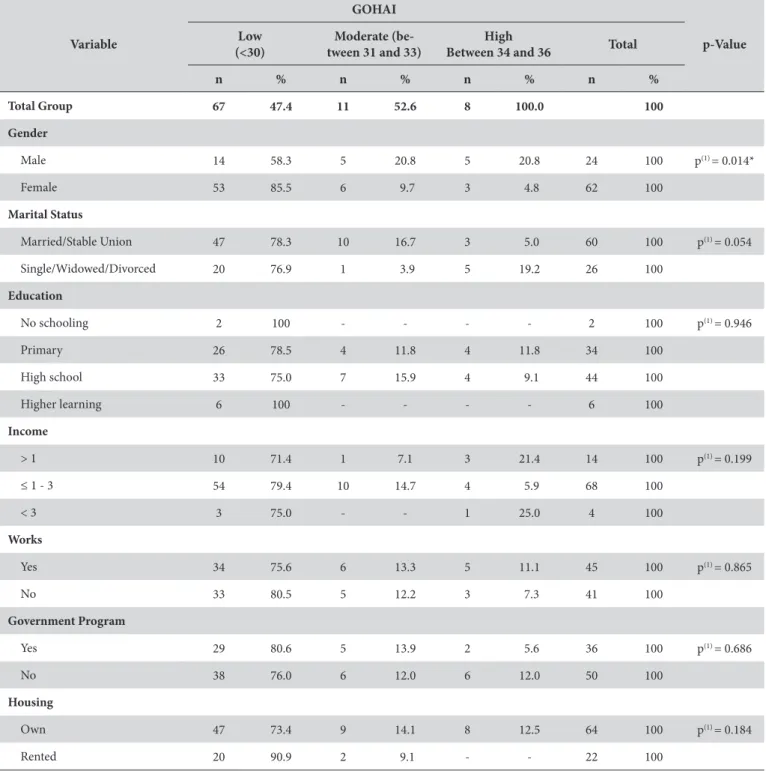
When the bivariate analysis of the GOHAI index was performed with the independent variables, the only variable that was signiicant was the low GOHAI index with the female sex, which presented a higher percentage than that of the male sex (Table 4).
Figure 1 showed the mean GOHAI value and the absolute number according to educational level, showing that the majority of those with self-perception classiied as low had up to complete high school education. Figure 2 presented the mean GOHAI value with regard to family income, demonstrating that the low GOHAI index was found in higher number among those with an income that ranged from 1 to 3 minimum wages.
DISCUSSION
It is extremely important to know the socio-economic pattern of users of public services, in the planning of activities to be performed in the clinics of higher learning institutions, and it is also a determinant of the construction of the treatment plan to be proposed to each patient12.
he majority of the patients who sought the service were women, corroborating indings in the literature that have also shown predominance of the female gender13-18. One of the
limitations of this study was to achieve a sample that would present a parity of gender between the participants, since the majority were of the female gender. d’Avila et al.13 (2010) justiied
this predominance of the female gender by the disposition of women in jobs with less strict working hours, and the fact that public services, in the majority of instances have day time hours of attendance, making it diicult for men to seeks the services.
Outpatient attendances in the clinics of dental schools are performed with ixed protocols, and frequently, the treatments are prolonged, so that patients who work full time desist from seeking this service due to the delay in concluding treatment.
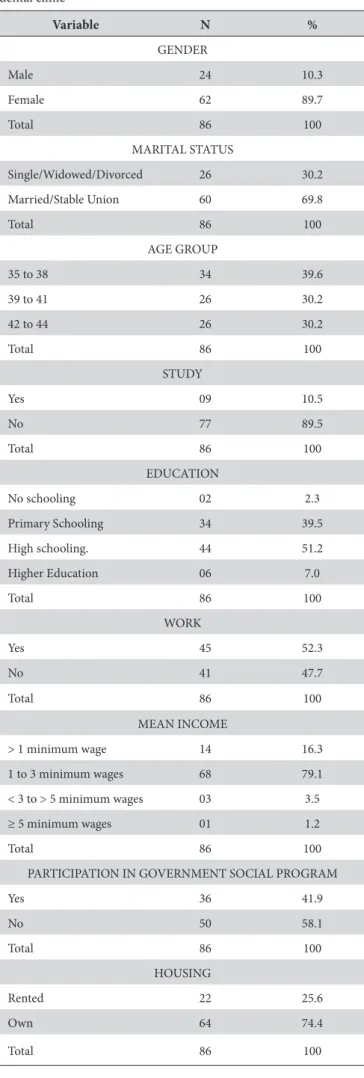
Table 1. Socio-demographic Characteristics of patients who used the dental clinic
Variable N %
GENDER
Male 24 10.3
Female 62 89.7
Total 86 100
MARITAL STATUS
Single/Widowed/Divorced 26 30.2
Married/Stable Union 60 69.8
Total 86 100
AGE GROUP
35 to 38 34 39.6
39 to 41 26 30.2
42 to 44 26 30.2
Total 86 100
STUDY
Yes 09 10.5
No 77 89.5
Total 86 100
EDUCATION
No schooling 02 2.3
Primary Schooling 34 39.5
High schooling. 44 51.2
Higher Education 06 7.0
Total 86 100
WORK
Yes 45 52.3
No 41 47.7
Total 86 100
MEAN INCOME
> 1 minimum wage 14 16.3
1 to 3 minimum wages 68 79.1
< 3 to > 5 minimum wages 03 3.5
≥ 5 minimum wages 01 1.2
Total 86 100
PARTICIPATION IN GOVERNMENT SOCIAL PROGRAM
Yes 36 41.9
No 50 58.1
Total 86 100
HOUSING
Rented 22 25.6
Own 64 74.4
he literature conirms that the major portion of the demand for the services of the university dental clinics is by young patients13-15. Other studies analyzed16-18 presented age-ranges
with wide variation, which made comparison and classiication diicult.
he number of marriages in 2003 returned to the level of 1993 – almost 750 thousand – ater it had fallen to around 730 thousand in 2000. Moreover, in relation to 1993, the number of judicial separations and divorces rose by 17.8% and 44%, respectively19. In this study the majority of subjects declared
they were married or lived within a stable partnership (69.8%), corroborating the data of some studies14,17, however, diverging
from the study13, a fact that appears to be related to the sample size.
Low educational levels are associated with the worst oral health conditions in general, because it appears to afect preventive care and judgment about the signiicance of diseases; and persons with a higher educational level show a more careful behavior with regard to their teeth20.
Of the total number of subjects researched 40.8% had primary schooling, similar to the data presented in the literature14,16,18. Studies have also shown that the majority of users
were unemployed13,14,18, difering from the study of Reis, Marcelo2
(2006), indicating that the majority were working.
here is a close relationship between oral health conditions and social standards, even in countries showing a decline in the prevalence of dental caries. Oral health has an inverse relationship between the socio-economic level and populations of less favored social classes, which present worse oral health conditions and have less access to dental services21.
his situation shows that the collective methods of dental caries prevention, such as luoridation of public water supplies, in spite of being efective, are incapable of overcoming the inequalities
Table 2. RelativeFrequency of GOHAI Index responses
Items of GOHAI Responses%
Always Sometimes Never
Limit the quantity of food 8.1 15.1 76.7
Problems with hard foods 19.8 30.2 50.0
Swallow comfortably 90.7 3.5 5.8
Teeth or dentures impede speaking 18.6 12.8 68.6
Eat without discomfort 38.4 46.5 15.1
Limit contact with persons 16.3 14.0 69.8
Happy with appearance of teeth 31.4 11.6 57.0
Use of medication to alleviate toothache 7.0 39.8 53.5
Need to take care of teeth 52.3 36.0 11.6
Feel nervous about dental problems 39.5 22.1 38.4
Uncomfortable to eat in front of other people 26.7 7.0 66.3
Sensitivity 52.8 20.0 26.7
Table 3. Classiication of oral health perception and frequencies relative to GOHAI index
Classiication of Perception N %
> 30 (Low) 67 77.9
From 31 to 33 (Moderate) 11 12.8
From 34 to 35 (High) 08 9.3
Total 86 100
Figure 1. Educational level related to GOHAI index values.
Table 4. Bivariate analysis of GOHAI index and independent variables
Variable
GOHAI
p-Value Low
(<30)
Moderate (be-tween 31 and 33)
High
Between 34 and 36 Total n % n % n % n %
Total Group 67 47.4 11 52.6 8 100.0 100
Gender
Male 14 58.3 5 20.8 5 20.8 24 100 p(1) = 0.014*
Female 53 85.5 6 9.7 3 4.8 62 100
Marital Status
Married/Stable Union 47 78.3 10 16.7 3 5.0 60 100 p(1) = 0.054
Single/Widowed/Divorced 20 76.9 1 3.9 5 19.2 26 100
Education
No schooling 2 100 - - - - 2 100 p(1) = 0.946
Primary 26 78.5 4 11.8 4 11.8 34 100
High school 33 75.0 7 15.9 4 9.1 44 100
Higher learning 6 100 - - - - 6 100
Income
> 1 10 71.4 1 7.1 3 21.4 14 100 p(1) = 0.199
≤ 1 - 3 54 79.4 10 14.7 4 5.9 68 100
< 3 3 75.0 - - 1 25.0 4 100
Works
Yes 34 75.6 6 13.3 5 11.1 45 100 p(1) = 0.865
No 33 80.5 5 12.2 3 7.3 41 100
Government Program
Yes 29 80.6 5 13.9 2 5.6 36 100 p(1) = 0.686
No 38 76.0 6 12.0 6 12.0 50 100
Housing
Own 47 73.4 9 14.1 8 12.5 64 100 p(1) = 0.184
Rented 20 90.9 2 9.1 - - 22 100
(*): Signiicant Association at 5.0%. (1): By means of Exact Fisher test.
of access to care and other preventive means, such as hygiene materials, suitable diet and other forms of prevention, since caries is a multifactorial disease. hese inequalities afect access to health services, which in Brazil, are unsatisfactory in the public network, and for many, inaccessible in the private network. It is fair to conclude that there is a need for improvement in the quality of life of individuals, in order to change the condition of health12.
A larger number of patients belonged to social classes with an income lower than 3 minimum wages, similar to studies present in the literature, in which the users received fewer than 5 minimum wages13,14.
Of the interviewees, 41.9% depended on social programs, of which 69.4% were beneited by the “Programa Bolsa Família” (family assistance program), 22.2% on “Bolsa Escola” (school assistance) and 8.3% on “Fome Zero” (zero hunger). Nevertheless, 74.4% owned their homes. he North and Northeast regions have the highest percentages of home ownership20. A
situation found in the study of d’Avila et al.13 (2010), over half the
users own their homes, in spite of the low educational level and low monthly income.
factor that shows the level of information of the patient with regard to knowledge of preventive measures, and in this sense it is emphasized that self-perception may be directly associated with education and the socio-economic situation of individuals, and must be observed as an object of subjective evaluating, needing to be complemented with a clinical evaluation23.
he last survey of the oral health conditions of the Brazilian population – “Projeto SB Brasil”24, portrays results with reference
to self-perception of oral health, in which 37.1% of the patients from 34 to 44 years of age classiied themselves as being satisied. he same situation has been found in studies conducted in other countries25,26.
he present study veriied a low perception of oral health, by means of using the GOHAI Index, with a mean of 27.06, being in agreement with studies27,28 that presented means close to this and
classiied as poor, being 26.8 and 29 respectively, thus perceiving the negative impact of oral health conditions on the daily lives of the users. One is reminded that these results must be compared with caution, considering that the study population of the irst mentioned research consisted of elderly persons, and the second, of patients from the clinic of a school of dentistry.
he responses to the GOHAI Index revealed that 76.7% of the subjects had never limited the quantity of foods ingested; 90% swallow comfortably, and 50% had never had any problems with hard foods. On the other hand, 57% were not happy with the appearance of their teeth and 52.8% always feel the sensitivity of their teeth.
One emphasizes the importance of the teeth in the daily lives of persons, in which the problems caused by tooth losses are functional (eating, chewing and speaking) and social (behavioral changes, dissatisfaction with appearance, and compromised social acceptance)29.
When relating the GOHAI mean to educational level and family income, one perceives that the majority of users had an educational level which could go up to the category of incomplete high school education and income of up to three minimum wages.
he relations between economic, social, cultural and educational factors determine behavioral patterns that does or does not generate health. his fact requires change in behavior of both users and health professionals, mainly as far as educational actions are concerned12. Not only is the ofer of quality dental
services an important factor for amplifying access by the population to services that resolve their problems, but also the perception of oral health needs by individuals, so that they do indeed seek these services30.
CONCLUSION
he study sample was composed of women who had a low monthly income. he result of the GOHAI index was classiied as low, and a negative impact of oral health conditions was veriied on the daily lives of the users evaluated.
REFERENCES
1. Alcarde ACB, Bittar TO, Fornazari DH, Meneghim MC, Ambrosano GMB, Pereira AC. A cross-sectional study of oral health-related quality of life of Piracicaba`s elderly population. Rev Odonto Ciência. 2010; 25: 126-31. http://dx.doi.org/10.1590/S1980-65232010000200004 2. Reis SCGB, Marcelo VC. Saúde bucal na velhice: percepção dos idosos, Goiânia, 2005. Ciênc Saúde Coletiva. 2006; 11(1): 191-9. http://
dx.doi.org/10.1590/S1413-81232006000100028
3. Nitschke I, Muller F. he impacto f oral health on the quality of life in elderly. Oral Health Prev Dent. 2004; 2(Suppl 1): 271-5. PMid:15646585.
4. Slade GD, Spencer JA. Social impact of oral conditions among older adults. Aust Dent J. 1994; 39: 358-64. http://dx.doi. org/10.1111/j.1834-7819.1994.tb03106.x
5. Martins AMEBL, Barreto SM, Pordeus IA. Auto-avaliação de saúde bucal em idosos: análise com base em modelo multidimensional. Cad Saúde Pública. 2009; 25: 421-35. http://dx.doi.org/10.1590/S0102-311X2009000200021
6. Atchison KA, Dolan TA. Developement the geriatric oral health assessment index. J Dent Educ. 1990; 54: 680-7. PMid:2229624. 7. Silva SRC, Fernandes RAC. Autopercepção das condições de saúde bucal por idosos. Rev Saúde Pública. 2001; 35: 349-55. PMid:11600923.
http://dx.doi.org/10.1590/S0034-89102001000400003
8. Atchison KA, Der-Martirosian C, Git HC. Components of self-reported oral health and general health in racial ethnic groups. J Public Health Dent. 1998; 54: 301-8. http://dx.doi.org/10.1111/j.1752-7325.1998.tb03013.x
9. Martins CC, Bonanato KT, Valério DS, Moura Leite FR, Paiva SP, Vale MPP. Efetividade de uma técnica educativa na aquisição de conhecimentos por pais sobre uso reacional do lúor. Rev Odonto Ciência. 2006; 21: 105-11.
10. Instituto Brasileiro de Geograia e Estatística (IBGE). Disponível em: http://www.ibge.gov.br
11. Pinto VG, Lima MOP. Estudo epidemiológico de saúde bucal em trabalhadores da indústria: Brasil 2002-2003. Brasília: SESI/DN; 2006. 12. Brandini DA, Poi WR, Mello MLM, Macedo APA, Panzarini SR, Pedrini D, et al. Caracterização social dos pacientes atendidos na
disciplina de Clínica Integrada da Faculdade de Odontologia de Araçatuba, UNESP. Pesq Bras Odontoped Clín Integr. 2008; 8: 245-50. http://dx.doi.org/10.4034/1519.0501.2008.0082.0020
14. Nassri MRG, Silva AS, Yoshida ET. Levantamento do peril sócio-econômico de pacientes atendidos na clínica odontológica da universidade de Mogi das Cruzes e do tratamento ao qual foram submetidos: clínica endodôntica. RSBO: Revista Sul-Brasileira de Odontologia. 2009; 6: 272-8.
15. Nakamura CC, Gonçalves DR, Castro RFM, Closs OS. Peril dos pacientes atendidos na clínica odontológica da Faculdade São Lucas, Porto Velho – RO. Saber Cientíico Odontológico. 2010; 1(1): 42-52.
16. Abdo EM, Lima RPE, Rodrigues AS, Alves LCF, Gomes CO, Passos JB, et al. Peril do atendimento e dos pacientes das clínicas de exodontias da Faculdade de Odontologia da Universidade Federal de Minas Gerais (UFMG). Arq Odontol. 2004; 40: 183-96.
17. Reis SCGB, Santos LB, Leles CR. Clínica integrada de ensino odontológico: peril dos usuários e necessidades odontológicas. ROBRAC: Revista Odontológica do Brasil Central. 2011; 20(52): 46-51.
18. Fernandes SKS, Coutinho ACM, Pereira EL. Avaliação do peril socioeconômico e nível de satisfação dos pacientes atendidos em Clínica Integrada Odontológica Universitária. Rev Bras Promoç Saúde. 2008; 21: 137-43. http://dx.doi.org/10.5020/18061230.2008.p137 19. Instituto Brasileiro d Geograia e Estatística (IBGE), 2004. Disponível em: http://www.ibge.gov.br/home/presidencia/noticias/noticia_
impressao.php?id_noticia=283
20. Silveira RG, Brum SC, Silva DC. Inluência dos fatores sociais, educacionais e econômicos na saúde bucal das crianças. Rev Méd Aeronaut Bras. 2002; 52(1): 34-9.
21. Melgaço CA, Miqueletti CCC, Cantoni HCL, Martins LHPM, Auad SM. Classiicação econômica dos pacientes atendidos na clínica de ortodontia do departamento de Odontopediatria e Ortodontia da Faculdade de Odontologia da UFMG. Arq Odontol. 2001; 37: 115-20. 22. Kallestal C, Dahlgren L, Stenlund H. Oral Health behaviour and self-esteem in swedish children. Soc Sci Med. 2000; 51: 1841-9. http://
dx.doi.org/10.1016/S0277-9536(00)00115-5
23. Lima LHMA, Soares MSM, Passos IA, Rocha APV, Feitosa SC, Lima MG. Auto percepção oral e seleção de alimentos por idosos usuários de próteses totais. Rev Odontol UNESP. 2007; 36:131-6.
24. Brasil. Ministério da Saúde. Projeto SBBRASIL 2010 pesquisa nacional sobre saúde bucal. Brasília; 2011.
25. Koposova N, Eriksen HM, Widstrãm E, Eisemann M, Opravin A, koposov R. Oral health-related quality of life among 12-year-olds in northern norway and north-west Russia. Oral Health Dent Manag. 2012; 11: 206-14. PMid:23208598.
26. Halvari AEM, Halvari H, Bjørnebekk G. Deci EL. Oral health and dental well-being: testing a self-determination theory model. J Appl Soc Psychol. 2013; 43: 275–92. http://dx.doi.org/10.1111/j.1559-1816.2012.00996.x
27. Moura C, Cavalcante FT, Catão MHCV, Gusmão ES, Soares RSC, Santillo PMH. Fatores relacionados ao impacto das condições de saúde bucal na vida diária de idosos, Campina Grande, Paraíba, Brasil. Pesq Bras Odontoped Clín Integr. 2011; 11: 553-9. http://dx.doi. org/10.4034/PBOCI.2011.114.16
28. Araújo PF, Silva EFA, Silva DD, Sousa MLR. Qualidade de vida em adultos e idosos que procuraram a Faculdade de Odontologia de Piracicaba para confeccionar próteses totais. Rev Odontol UNESP. 2008; 37: 109-16.
29. Vargas AMD, Paixão HH. Perda dentária e seu signiicado na qualidade de vida de adultos usuários de serviço público de saúde bucal do Centro de Saúde Boa Vista, em Belo Horizonte. Cienc Saúde Coletiva. 2005; 10: 1015-24. http://dx.doi.org/10.1590/S1413-81232005000400024
30. Silva SRC, Castellanos RAF. Autopercepção das condições de saúde bucal por idosos. Rev Saúde Pública. 2001; 35:349-55. PMid:11600923. http://dx.doi.org/10.1590/S0034-89102001000400003
CONFLICTS OF INTERESTS
he authors declare no conlicts of interest.
CORRESPONDING AUTHOR
Prof. Dr. Sérgio d’Ávila Lins Bezerra Cavalcanti
Departamento de Odontologia, UEPB – Universidade Estadual da Paraíba, Av. das Baraúnas, 351, Bairro Universitário, 58429-600, Campina Grande - PB, Brasil
e-mail: [email protected]