C u n h a C u n h a C u n h a C u n h a C u n h a
Evaluation of pulmonary function in patients submitted to reduction mammaplasty 11
Rev. Col. Bras. Cir. 2011; 38(1): 011-014
Original Article
Original Article
Original Article
Original Article
Original Article
Evaluation of pulmonary function in patients submitted to
Evaluation of pulmonary function in patients submitted to
Evaluation of pulmonary function in patients submitted to
Evaluation of pulmonary function in patients submitted to
Evaluation of pulmonary function in patients submitted to
reduction mammaplasty
reduction mammaplasty
reduction mammaplasty
reduction mammaplasty
reduction mammaplasty
Avaliação da função pulmonar em pacientes submetidas à mastoplastia
Avaliação da função pulmonar em pacientes submetidas à mastoplastia
Avaliação da função pulmonar em pacientes submetidas à mastoplastia
Avaliação da função pulmonar em pacientes submetidas à mastoplastia
Avaliação da função pulmonar em pacientes submetidas à mastoplastia
redutora
redutora
redutora
redutora
redutora
M
ARCELOS
ACRAMENTOC
UNHA. TCBC-BA
1; L
ÍVIOL
IMAS
ANTOS2; A
MANDAA
NDRADAV
IANA3; N
ILMARG
ALDINOB
ANDEIRA4; J
OSÉA
DMIRÇOL
IMAF
ILHO5; J
OSÉV
ÁLBERL
IMAM
ENESES6A B S T R A C T
A B S T R A C T
A B S T R A C T
A B S T R A C T
A B S T R A C T
Objective: Objective: Objective: Objective:
Objective: To prospectively evaluate the pulmonary function in patients undergoing reduction mammaplasty. Methods:Methods:Methods:Methods:Methods: Twelve female patients with Gigantomastia and without medical antecedents were submitted to reduction mammaplasty at our University Hospital. The patients underwent lung function testing and arterial blood gas measurements in the preoperative and postoperative period (three to six months). The data were analyzed using the Wilcoxon test and the level of statistical significance was p <0.05. Results:
Results: Results: Results:
Results: As for lung function tests, total lung capacity and residual volume were higher postoperatively (p <0.05). As for the arterial gases, there was no statistically significant difference. Conclusion:Conclusion:Conclusion:Conclusion:Conclusion: The increase in total lung capacity and residual volume may suggest a better lung function after reduction mammaplasty for Gigantomastia treatment, although not altering blood gases in healthy patients.
Key words: Key words: Key words: Key words:
Key words: Mammaplasty. Spirometry. Respiratory function test.
Work done at Hospital das Clínicas, Faculty of Medicine of Bahia Federal University – UFBA, Bahia, Brazil. Bahia League of Plastic Surgery. 1. Tenured Professor, Plastic Surgery, Faculty of Medicine of Bahia Federal University, Bahia, Brazil; 2. Medical Staff, Faculty of Medicine of Bahia Federal University, Bahia, Brazil; 3. Plastic Surgeon; Member, Brazilian Society of Plastic Surgery, Bahia, Brazil; 4. Anesthesiologist, Faculty of Medicine of Bahia Federal University, Bahia, Brazil; 5. Head, Department of Plastic Surgery, Faculty of Medicine of Bahia Federal University, Bahia, Brazil.
INTRODUCTION
INTRODUCTION
INTRODUCTION
INTRODUCTION
INTRODUCTION
R
eduction mammaplasty is one of the most common
procedures in plastic surgery. The main indications of
reduction mammaplasty for patients with Gigantomastia
range from improving the shape of the breasts to somatic
symptoms. There are several associated symptoms in the
breast and musculoskeletal system (back, shoulder and
cervical spine)
1,2. Several retrospective and prospective
studies have documented statistically significant
improvement in symptoms and quality of life of patients
who underwent reduction mammaplasty
3-6. Despite this
documentation, it has been considered a more aesthetic
than strictly medical procedure.
The lung function has been studied in patients
undergoing reduction mammaplasty, however, few studies
have evaluated objective data
3,7,8. This can be done through
lung function tests and measurement of arterial blood
ga-ses. Bulky and heavy breasts can cause restriction and
reduction of chest wall compliance, which interferes with
pulmonary ventilation.
The aim of this study was to prospectively
evaluate, by means of pulmonary function tests and
measurement of arterial blood gases, the pulmonary function
in patients undergoing reduction mammaplasty.
METHODS
METHODS
METHODS
METHODS
METHODS
The project and consent form were approved by
the Ethics Committee on Research of the Hospital of UFBA.
We studied 12 patients with Gigantomastia
seeking plastic surgery care at Hospital of UFBA from July
2007 to March 2008 with indication of reduction
mammaplasty, aged 18-42 years (mean 29 25), body mass
index (BMI) of 23.24 kg/m2 to 30.48 kg/m2 (mean 26.83
kg/m2), non-smokers and without medical backgrounds.
We requested preoperative tests, mammography
and breast ultrasonography (for patients over 40 years).
The patients who showed abnormalities in mammograms
or ultrasound examinations were evaluated by a mastologist.
The individuals were intravenously anesthetized
with sufentanil (0.02 mcg/kg/min) and propofol (200 mcg/
kg/min) by the same team of anesthesiologists. They were
ventilated with the Inter 5* microprocessor ventilator with
positive end-expiratory pressure (PEEP) of 5 mmHg and a
tidal volume of 10ml/Kg.
12
Rev. Col. Bras. Cir. 2011; 38(1): 011-014
C u n h a C u n h a C u n h a C u n h a C u n h a Evaluation of pulmonary function in patients submitted to reduction mammaplasty
The patients underwent lung function testing and
arterial blood gas measurements in the preoperative period,
as well as in the early postoperative period, three and six
months after surgical procedure. The tests were carried out
by the same team, with the same technique and equipment.
The data were analyzed using SPSS 15.0
(Wilcoxon). Values with p<0.05 indicated statistical
significance.
RESULTS
RESULTS
RESULTS
RESULTS
RESULTS
The total amount of breast tissue resected ranged
from 730g to 2,720g, with mean of 1,525g.
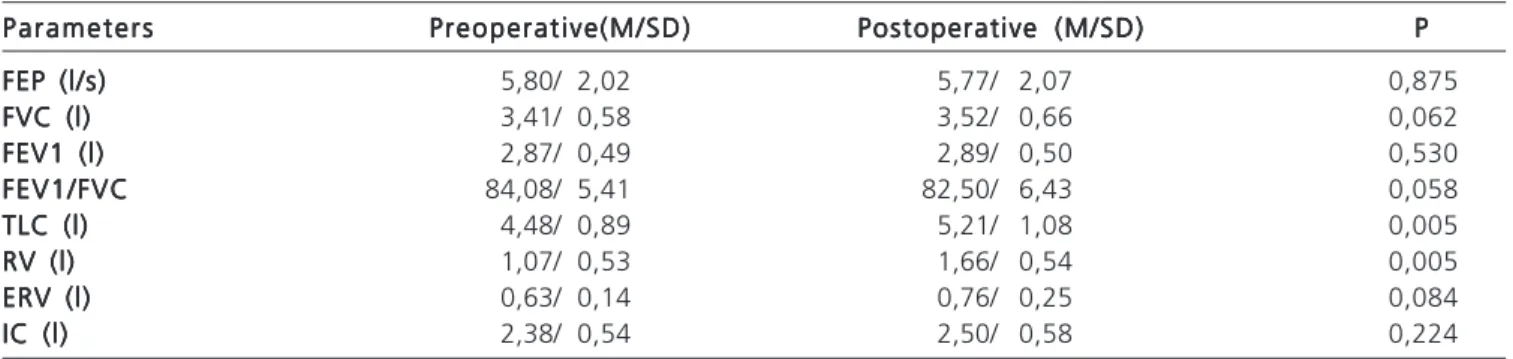
The results of pulmonary function tests are shown
in table 1. Variables that were statistically significant at
different times were: total lung capacity (TLC) and residual
volume (RV).
The results in the measurement of arterial blood
gases were not statistically significant (Table 2).
DISCUSSION
DISCUSSION
DISCUSSION
DISCUSSION
DISCUSSION
There are few studies addressing the changes in
lung function and respiratory mechanics in patients
undergoing breast reduction.
The first published work, an observational one,
is attributed to Conway and Smith
10. The authors found
better respiratory dynamics reported by patients undergoing
reduction mammaplasty, deeming this benefit as possibly
resultant of an increase in chest wall compliance.
Goldwyn
11published a study with ten patients
in 1974 assessing the lung function before and after
resection of the breast (mean resection 1,980g), finding
no change in the variables addressed. Starley et al.
7used
the same methodology of Goldwyn’s study in 1998, with
19 healthy women with a mean age of 34.9 years and
mean body mass index of 27.62, the average weight of
resected breast of 1,546g. All preoperative pulmonary
function tests were within normal limits. Seventeen
patients experienced improvement in pulmonary function
tests postoperatively. A statistically significant
improvement was found in peak expiratory and peak
inspiratory flows.
In 2003, Sood et al.
3found statistically significant
improvement in spirometry in the parameters inspiratory
capacity, peak expiratory flow and maximal voluntary
Figure 3 -Figure 3 -Figure 3
-Figure 3 -Figure 3 - Patient in the postoperative period (six months) of reduction mammaplasty.
Figure 1 -Figure 1 -Figure 1 Figure 1
-Figure 1 - Patient with Gigantomastia (preoperatory).
Figure 2 -Figure 2 -Figure 2 Figure 2
C u n h a C u n h a C u n h a C u n h a C u n h a
Evaluation of pulmonary function in patients submitted to reduction mammaplasty 13
Rev. Col. Bras. Cir. 2011; 38(1): 011-014
ventilation (2,220g of mean weight of resected breast).
These parameters were also positively correlated with body
mass index: the more obese the patients, the better the
parameters of lung function.
In 2006, Iwuagwu et al.
8found no statistical
significance in the same parameters in a randomized
controlled study with 73 patients (mean of resected breast
1,381g), but when those data were analyzed with the
weight of resected breast, they showed a positive correlation:
forced expiratory volume over vital capacity, forced
expiratory volume over forced vital capacity, peak expiratory
flow and forced vital capacity.
In the present study (average of resected breast
1,525g) we observed a statistically significant increase in
total lung capacity and residual volume.
Table 1 – Table 1 – Table 1 – Table 1 –
Table 1 – Results of pulmonary function tests. Parameters
Parameters Parameters Parameters
Parameters Preoperative(M/SD)Preoperative(M/SD)Preoperative(M/SD)Preoperative(M/SD)Preoperative(M/SD) Postoperative (M/SD)Postoperative (M/SD)Postoperative (M/SD)Postoperative (M/SD)Postoperative (M/SD) PPPPP FEP (l/s)
FEP (l/s) FEP (l/s) FEP (l/s)
FEP (l/s) 5,80/ 2,02 5,77/ 2,07 0,875
FVC (l) FVC (l) FVC (l) FVC (l)
FVC (l) 3,41/ 0,58 3,52/ 0,66 0,062
FEV1 (l) FEV1 (l) FEV1 (l) FEV1 (l)
FEV1 (l) 2,87/ 0,49 2,89/ 0,50 0,530
FEV1/FVC FEV1/FVC FEV1/FVC FEV1/FVC
FEV1/FVC 84,08/ 5,41 82,50/ 6,43 0,058
TLC (l) TLC (l) TLC (l) TLC (l)
TLC (l) 4,48/ 0,89 5,21/ 1,08 0,005
RV (l) RV (l) RV (l) RV (l)
RV (l) 1,07/ 0,53 1,66/ 0,54 0,005
ERV (l) ERV (l) ERV (l) ERV (l)
ERV (l) 0,63/ 0,14 0,76/ 0,25 0,084
IC (l) IC (l) IC (l) IC (l)
IC (l) 2,38/ 0,54 2,50/ 0,58 0,224
FEP - Forced expiratory peak; FVC - Forced vital capacity, FEV1 - Forced expiratory volume in one second; TLC - total lung capacity, RV - residual volume; ERV - expiratory reserve volume; IC - inspiratory capacity, (l/s) - liters per second (l) - liters; M - Mean, SD – Standard Deviation, FEV1/FVC - Ratio between forced expiratory volume in one second and forced vital capacity.
Table 2 – Table 2 – Table 2 – Table 2 –
Table 2 – Analysis of arterial blood gases. Parameters
Parameters Parameters Parameters
Parameters Preoperative(M/SD)Preoperative(M/SD)Preoperative(M/SD)Preoperative(M/SD)Preoperative(M/SD) Postoperative (M/SD)Postoperative (M/SD)Postoperative (M/SD)Postoperative (M/SD)Postoperative (M/SD) PPPPP p H
p H p H p H
p H 7,42/ 0,02 7,40/ 0,01 0,121
P a O P a O P a O P a O
P a O22222 100,30/ 11,26 110,83/ 16,80 0,263
P a C O P a C O P a C O P a C O
P a C O22222 35,72/ 3,62 34,90/ 2,02 0,623
H C O H C O H C O H C O
H C O33333 23,33/ 1,83 22,16/ 1,49 0,183
Sat O Sat O Sat O Sat O
Sat O22222 97,63/ 0,85 98,05/ 0,84 0,206
PaO2 – partial pressure of oxygen; PaCO2 – partial pressure of carbon dioxide; HCO3 – bicarbonate; SpO2 – oxygen saturation; M – mean; SD – standard deviation.
Big and bulky breasts could exert a restraining
effect on the chest, decreasing chest wall compliance and
negatively affecting respiratory dynamics, reducing TLC and
RV. We observed an increase in TLC and RV after reducing
the size of the breasts of the studied patients.
There were no statistically significant results in
the analysis of arterial blood gases. This fact can be
explained by the large existing pulmonary functional
reser-ve, since the patients in the study were healthy and young.
However, it is possible that in situations of physiological
stress or lung diseases, these can be altered.
The increase in total lung capacity and residual
volume may suggest a better lung function after reduction
mammaplasty in Gigantomastia, although not affecting
blood gases in healthy patients.
R E S U M O
R E S U M O
R E S U M O
R E S U M O
R E S U M O
Objetivo: Objetivo: Objetivo: Objetivo:
Objetivo: Avaliar prospectivamente a função pulmonar de pacientes submetidas à mastoplastia redutora. Métodos:Métodos:Métodos:Métodos:Métodos: Doze pacientes femininas portadoras de gigantomastia e sem antecedentes médicos, realizaram mastoplastia redutora no Hospital das Clínicas da UFBA. As pacientes foram submetidas ao teste de função pulmonar e medidas de gases sanguíneos arteriais nos períodos pré-operatório e pós-operatório (três a seis meses). Os dados obtidos foram analisados por meio do teste de Wilcoxon e o nível de significância estatística foi p< 0,05. Resultados:Resultados:Resultados:Resultados:Resultados: Nos dados obtidos por intermédio dos testes de função pulmonar, a capacidade pulmonar total e o volume residual foram maiores no pós-operatório (p < 0,05). Quanto aos dados de gases arteriais, não houve variações estatisticamente significantes. Conclusão
Conclusão Conclusão Conclusão
Conclusão: O aumento da capacidade pulmonar total e volume residual podem sugerir uma melhor função pulmonar após mastoplastia redutora em gigantomastia, apesar de não alterarem os gases arteriais das pacientes saudáveis.
Descritores: Descritores: Descritores: Descritores:
14
Rev. Col. Bras. Cir. 2011; 38(1): 011-014
C u n h a C u n h a C u n h a C u n h a C u n h a Evaluation of pulmonary function in patients submitted to reduction mammaplasty
REFERENCES
REFERENCES
REFERENCES
REFERENCES
REFERENCES
1. Ferreira MC, Costa MP, Cunha MS, Sakae E, Fels KW. Sensibility of the breast after reduction mammaplasty. Ann Plast Surg 2003;51(1):1-5.
2. Foreman KB, Dibble LE, Droge J, Carson R, Rockwell WB. The impact of breast reduction surgery on low-back compressive for-ces and function in individuals with macromastia. Plast Reconstr Surg 2009;124(5):1393-9.
3. Sood R, Mount DL, Coleman JJ, Ranieri J, Sauter S, Mathur P, Thurston B. Effects of reduction mammoplasty on pulmonary function and symptoms of macromastia. Plast Reconstr Surg 2003;111(2):688-94.
4. Rogliani M, Gentile P, Labardi L, Donfrancesco A, Cervelli V. Improvement of physical and psychological symptoms after breast reduction. J Plast Reconstr Aesthet Surg 2009;62(12):1647-9. 5. Gonzalez F, Walton RL, Shafer B, Matory WE Jr, Borah GL.
Reduction mammaplasty improves symptoms of macromastia. Plast Reconstr Surg 1993;91(7):1270-6.
6. Davis GM, Ringler SL, Short K, Sherrick D, Bengtson BP. Reduction mammaplasty: long-term efficacy, morbidity, and patient satisfaction. Plast Reconstr Surg 1995;96(5):1106-10.
7. Starley IF, Bryden DC, Tagari S, Mohammed P, Jones BP. An investigation into changes in lung function and the subjective medical benefits from breast reduction surgery. Br J Plast Surg 1998;51(7):531-4.
8. Iwuagwu OC, Platt AJ, Stanley PW, Hart NB, Drew PJ. Does reduction mammaplasty improve lung function test in women with macromastia? Results of a randomized controlled trial. Plast Reconstr Surg 2006;118(1):1-6; discussion 7.
9. Costa MP, Ching AW, Ferreira MC. Thin superior medial pedicle reduction mammaplasty for severe mammary hypertrophy. Aesthetic Plast Surg 2008;32(4):645-52.
10. Conway H, Smith J. Breast plastic surgery: reduction mammaplasty, mastopoxy, augmentation mammaplasty, and mammary construction: analysis of two hundred and fortyfive cases. Plast Reconstr Surg 1958;21(1):8-19.
11. Goldwyn RM. Pulmonary function and bilateral reduction mammoplasty. Plast Reconstr Surg 1974;53(1):84.
Received 15/12/2009
Accepted for publication 16/02/2010 Conflict of interest: none
Source of funding: none
How to cite this article: How to cite this article:How to cite this article: How to cite this article:How to cite this article:
Cunha MS, Santos LL, Viana AA, Bandeira NG, Lima Filho JA, Meneses JVL. Evaluation Of Pulmonary Function In Patients Submitted To Reduction Mammaplasty. Rev Col Bras Cir. [periódico na Internet] 2011; 38(1). Disponível em URL: http://www.scielo.br/rcbc