Samara Ramalho MattaI Vera Lucia LuizaII Thiago Botelho AzeredoI
I Programa de Pós-Graduação em Saúde Pública. Escola Nacional de Saúde Pública. Fundação Oswaldo Cruz. Rio de Janeiro, RJ, Brasil
II Núcleo de Assistência Farmacêutica. Departamento de Ciências biológicas. Escola Nacional de Saúde Pública. Fundação Oswaldo Cruz. Rio de Janeiro, RJ, Brasil
Correspondence: Samara Ramalho Matta R. Leopoldo Bulhões, 1480 210421-210 Rio de Janeiro, RJ, Brasil E-mail: [email protected] Received: 6/13/2011
Approved: 10/2/2012
Article available from: www.scielo.br/rsp
Brazilian adaptation of
the questionnaire to assess
adherence to treatment for
arterial hypertension
ABSTRACT
OBJECTIVE: To describe the cross-cultural adaptation of the questionnaire evaluating adhesion to treatment for arterial hypertension from its original Spanish version to a Portuguese version, to be applied in Brazil.
METHODS: In order to establish conceptual, semantic and operational equivalents of the items, two independent translations to Portuguese, and two back-translations into Spanish were performed. The translations and back-translations were assessed for changes in referential and general meanings. The synthesis of the translations was applied in pre-tests with patients with arterial hypertension and/or diabetes, which were important to identify different problems and confi rm earlier decisions.
RESULTS: In general, the second translation and back translation were evaluated more positively because the translation process did not affect the meanings in fi ve of the twelve items of the questionnaire. Operational changes were made and a vignette with response options and an example included in the instrument facilitated application in interviews.
CONCLUSIONS: The results obtained in the process of evaluating the items’ conceptual, semantic and operational equivalence allowed the construction of a Portuguese version of the MBG questionnaire to assess adherence to treatment which can be applied in the Brazilian context.
Arterial hypertension and diabetes mellitus are among the most serious preventable health problems in Brazil. According to the Ministry of Health, 11% of the Brazilian population suffer from diabetes and 35% of the population aged over 40 have arterial hypertension.a,b These health problems are risk factors
for cerebrovascular disease and ischemic heart disease and, if not properly treated, may lead to vascular, renal and cardiac complications, signifi cantly reducing the subject’s quality of life.8
Proper treatment for diabetes and hypertension may reduce or delay the appearance of these complication. However, once started, these are lifelong treatments which the patient needs to follow in order not to nega-tively affect their quality of life.
Failure to adhere to treatment for chronic illness is a worldwide public health problem. It is estimates that in developed countries the rate of adhering to treat-ment for chronic illnesses is as low as 50%.12 Failure
to follow treatment, as well as affecting the health of the individual, has an economic impact on the health system. In many cases, low adherence to treatment results in higher costs due to hospital admissions, including treating long term complications.12 Failure
to control a disease cannot be attributed solely to the failure to follow medical treatment. It can be assumed that this has a signifi cant contibution,7 and
that it leads to an increase in direct costs for treating complications. However, in a country such as Brazil, with a public health system which needs to provide care for a population of almost 200 million people, it is essential that strategies are adopted to help improve adherence to medical treatment.
There are various methods of measuring adherence to treatment, but the lack of a gold standard makes it diffi cult to compare results found in the literature.12
Structured interviews, usually in the form of questio-nnaires,6 are one of the most common methods, due
to the lower cost.
There is also a lack of consensus on the concept of adherence to treatment, whether this means simply complying with doctor’s orders or whether the defi -nition should be broader and include the individual’s behavior during treatment.2,6,11
In 2003, the World Health Organization (WHO) proposed that adherence to long-term therapy be viewed as the “degree to which a person’s behavior – taking medicine, following a diet and/or making lifestyle INTRODUCTION
changes – corresponds to the doctor’s recommenda-tions”12 which would indicate the patient’s participation.
The aim of this article is to describe the stages of the transcultural adaptation of the adherence to arterial hypertension treatment questionnaire, developed in Spanish, for application in the context of Brazil.
METHODS
In order to evaluate adherence to treatment for arte-rial hypertension, the Martín-Bayarre-Grau (MBG) questionnaire, developed and validated by Alfonso et al,5 was used.
The MBG questionnaire underwent an adaptation process in order for it to be applicable to the Brazilian context in the evaluation study of the the “Remédio em Casa Project” of the Prefeitura of Rio de Janeiro, in 2010, which aimed to study hypertension and diabetes patients’ adherence to treatment, considered from the WHO perspective.
An operational system based on the model developed by Herdman et al,3 described in Reichenheim & Moraes,10
for the transcultural adaptation of instruments. The steps require the verifi cation of six types of equivalence, inclu-ding: conceptual, item, semantic, operational, measure-ment and functional. This last dispenses with specifi c tests or procedures, as their equivalents are found in the other stages of the assessment.
With regards to conceptual and item equivalence, the fi rst step consists of exploring the construct in question in the place of origin and in the population with which the instrument will be used. This process includes a bibliographical revision of the processes involved in constructing the source instrument, as well as assessing the relevance of the items to capture each of these domains.10
The bibliographical references used by the authors of the original questionnaire, in the Cuban culture, were compared with those which underpin the concept of adherence used in the study applied in the Brazilian culture. This process also aimed to observe the rele-vance of the items in the MBG questionnaire to be applied in the context of hypertension and diabetes patients’ adherence to treatment.
In addition to the researchers responsible for the transcultural adaptation of the instrument, specialists in the study of adherence also participated and thus
a Ministério da Saúde, Secretaria de Atenção à Saúde, Departamento de Atenção Básica. Diabetes Mellitus. Brasília (DF); 2006. (Cadernos de Atenção Básica, 16).
broadened the discussion during the investigation of the instrument’s conceptual and item equivalence. In another stage, representatives of the target population were consulted on their experiences of caring for arterial hypertension and diabetes and their general understanding of the instrument, these consultations, carried out by the principal researcher, served as the fi rst contact with the target population, whose contributions would be more systematically collected and analyzed later in the pre-test stage.
The process of evaluating semantic equivalence involved translation, back-translation, evaluation of the back-translations and a pre-test of the synthesized version. It is recommended that the translation is carried out by someone bilingual whose mother tongue and culture are that into which the instrument is being translated.10
Two, independent translations of the MBG question-naire from Spanish into Portuguese were carried out by Brazilians with a good mastery of Spanish, resulting in two versions translated into Portuguese (T1 and T2).
Next, T1 and T2 were back-translated into the original language, also independently. Respecting the recom-mendations with regards to the profi le of the translators, this was done by translators whose mother tongue was Spanish and who had a good mastery of Portuguese, thus obtaining two back-translations into Spanish, R1 and R2, respectively.
The back-translated versions went through a formal evaluation in which a new, bilingual translator, a public health care professional, whose mother tongue was Spanish and with mastery of Portuguese, judged the equivalence of each with the original instrument. The evaluator was provided with two forms, in which they had to evaluate the semantic equivalence of the original instrument and each of the back-translations. Each form consisted of pairs of statements (one from the back-translation and one from the original instrument), for which the evaluator had to assess the semantic equivalence between the pair. In order to maintain the autonomy of the evaluation with regards to the trans-lators and back-transtrans-lators, the form did not indicate which statement was from the original version and which from the back-translation. Moreover, the pairs of statements appeared in random order.
This assessment covered referential and general meanings. The former refers to the denotative meaning of the words/expressions. If the referential meaning in the original instrument is the same as in the respective translation, it is presumed that there is a literal corres-pondence between them. The latter refers to the conno-tative meaning of each item in the original instrument, which was contrasted with that of the translation into the target language.9,10
The correspondence of the general or connotative meaning transcends the literal meaning of those terms and takes into account more subtle aspects, such as the impact the expression has in the cultural context of the target population, in contrast to the aim of analyzing the referential of denotative signifi cance of the items. This analysis of general meaning is necessary as the literal correspondence of a term does not necessarily mean that the same emotional impact will be evoked in different cultures.10 At the beginning of the evaluation form, there
was an explanation for the translator on the difference between denotative and connotative meaning.
In order to evaluate the agreement between the items with regards to referential (denotative) meaning, the evaluator gave each pair of items a mark between zero and ten, which was directly proportional to their opinion as to the agreement between the pairs of statements. To evaluate the level of change in the general (connota-tive) meaning, the evaluator had to choose between the following options: unaltered, little altered, signifi cantly altered or completely altered. Next, they had to justify in writing the score given for agreement, with regards to referential meaning and the classifi cation of alteration of general meaning for each pair of statements.
The synthesized version of the instrument, obtained after evaluating the translations, was tested in order to fi ne tune it, as in this process of cultural adaptation, it is essential that a correspondence between the perception and the impact on the respondent is reached.10
Operational equivalence refers to the comparison between the aspects of using the instrument with the target and the source population, so that the effi cacy is similar even if the modus operandi is not the same.10
The pre-tests were carried out through face to face interviews with 12 diabetic and/or hypertensive patients who were approached while waiting to be seen in the pharmacy of a health center in Rio de Janeiro, Southeastern Brazil, in 2010. The intention, therefore, was for the socio-demographic characteristics to be as similar as possible to those of the population to be interviewed in the study.
Table 1. Assessment of semantic equivalence between the Martín-Bayarre-Grau instrument in the Spanish original and two translations into Portuguese. Rio de Janeiro, Southeastern Brazil, 2010.
Original instrument
Semantic evaluationa (exponent)
T1 R1 Ref Ger T2 R2 Ref Ger
a) Toma los medicamentos en el horario establecido - take medication at the correct time
Toma as medicações no horário estabelecido Tomar los medicamentos
en el horário establecido
10 LA No horário marcado toma os
remédios
En el horario marcado toma
los remedios
7 LA
b) Se toma todas las dosis indicadas - take all prescribed doses
Devem-se tomar todas as dosagens indicadas
Se deben de tomar todas las dosis indicadas
10 SA Se tomam todas as
doses indicadas Se toma toda las dosis indicadas
5 SA
c) Cumple las indicaciones relacionadas con la dieta - follow recommendation on diet
Cumpre as indicações relacionadas
com a dieta
Cumplir las indicaciones relacionadas con
la dieta
10 LA Segue as regras da
dieta Sigue las reglas de la dieta 10 UN
d) Asiste a las consultas de seguimiento programadas - attend all follow up appointments Acompanha as consultas ambulatoriais programadas Acompañar las citas programadas
3 CA Vai a consultas
periódicas consultas Asiste a periódicas
10 UN
e) Realiza los ejercicios físicos indicados - Do recommended exercise Realiza os exercícios físicos indicados Realice los ejercicios físicos indicados
10 LA Faz os exercícios físicos indicados Hace los ejercicios médicos indicados 0 CA f) Acomoda sus horarios de medicación, a las actividades de su vida diaria - Fit schedule for taking medicine in with day-to-day life
Adequa seus horários de tomada dos medicamentos às atividades de sua
vida diária
Adaptar sus horários de la
toma de sus medicamentos con los de sus actividades
diárias
8 LA Encaixa os horários do remédio no seu
dia a dia
Los horarios de sus remédios encajan en su
dia a dia
8 LA
g) Usted y su médico, deciden de manera conjunta, el tratamiento a seguir - You and your doctor made a joint decision as to what treatment to follow
O senhor e seu médico decidem
de maneira conjunta o tratamento a ser
seguido
Usted con su médico deciden
como llevar a cabo su tratamiento
10 UN Senhor/Senhora e seu médico decidem juntos o tratamento que vai
fazer
Señor/Señora y su médico deciden juntos
el tratamiento que va hacerce
8 UN
h) Cumple el tratamiento sin supervisión de su familia o amigos - Follow treatment without supervision by family or friends
Cumpre o tratamento sem
supervisão de sua família ou
amigos
Cumpla con el tratamiento
sin la ayuda de familiares o
amigos
10 SA Cumpre o
tratamento sem supervisão de sua família ou amigos
Cumple el tratamiento sin supervicion de sus familiares o
amigos
10 UN
i) Lleva a cabo el tratamiento sin realizar grandes esfuerzos - Follow the treatment without major effort
Leva até o fi m o tratamento sem realizar grandes esforços Termine su tratamiento sin hacer mayores esfuerzos
This study was approved by the Committee for Ethical Research of the Escola Nacional de Saúde Pública Sérgio Arouca (Process n° CAAE 0157.0.031.000-09 5/8/2009) and the Committee for Ethical Research of the Secretaria Municipal de Saúde e Defesa Civil do Rio de Janeiro (Process nº CAAE 0257.0.314.000-09 14/12/2009).
RESULTS
When assessing the conceptual equivalence, equi-valence is deemed to exist between the construct of adherence to therapy in the original culture and the construct of adherence to therapy in the target culture as the Brazilian study, in which the translation of this instrument would be used, also considers adherence to treatment to be understood as a process in which the individual actively participates.
It was possible to identify the equivalence of items in the instrument, as the cultural context of the original population is similar to that of the target population. The results referring to semantic equivalence are shown in Table 1.
It is noteworthy that translation 2 scored better that translation 1, as it received a score of 10 for referential
meaning and unaltered (UN) for general meaning for a greater number of items, indicating they were perfectly translated.
Two items (h, k) were translated in the same way into Portuguese (T1=T2). However, T1 and T2 received different evaluations, due to problems with the back-translation R1 of these items into Spanish.
The translation of item (b) in both T1 and T2 were not well done. The assessment of the referential meaning for T2 received a score of 5 due to an error in agreement which occurred upon back-translating this sentence into Spanish, which impacted directly on the general meaning. In the case of T1, in spite of the referential meaning remaining unaltered, the use of the term ‘se deben’ in back-translation 2 modified the general meaning of this item.
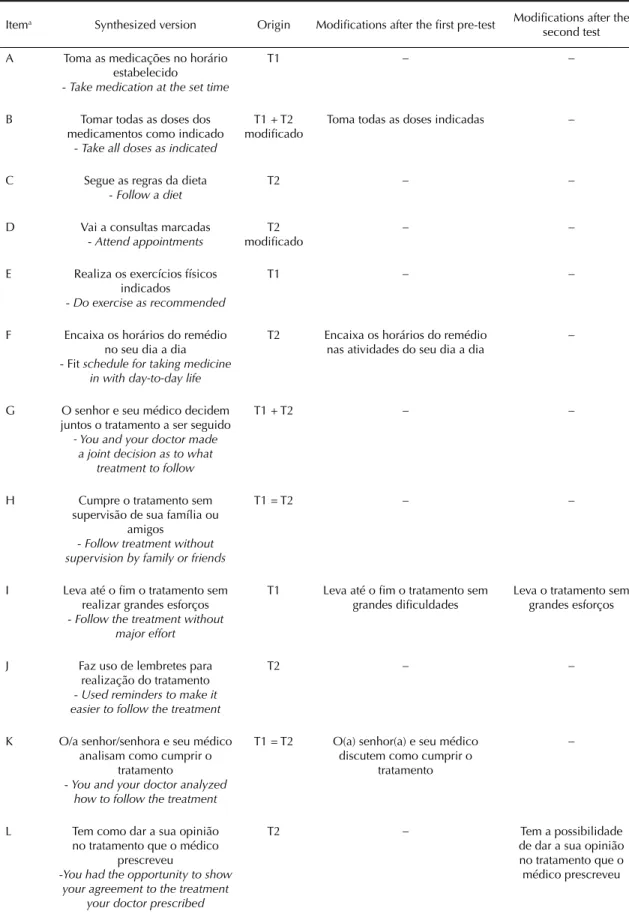
Doubts and problems of understanding of the questions identifi ed in both pre-tests are shown in Table 2. The alterations resulting from analyzing the respondents’ problems in understanding and doubts are shown in Table 3. Modifi cations made to items (b) and (f) make these sentences clearer for the interviewees, who showed no more doubts when responding to them.
Continuation
Original instrument Semantic evaluation
a (exponent)
T1 R1 Ref Ger T2 R2 Ref Ger
j) Utiliza recordatorios que faciliten la realización del tratamiento - Used reminders to make it easier to follow the treatment
Utiliza lembretes que facilitem a
realização do tratamento
Utilice papelitos recordatorios para facilitar la
realización de su tratamiento
8 SA Faz uso de
lembretes para realização do
tratamento
Hace uso de recordatorios
para la realizacion del
tratamiento
10 UN
k) Usted y su médico analizan, cómo cumplir el tratamiento - You and your doctor analyzed how to follow the treatment
O senhor e seu médico analisam
como cumprir o tratamento
Usted con su médico deciden como realizar su
tratamiento
6 SA Senhor/Senhora e seu médico analisam como
cumprir o tratamento
Señor/Señora y su médico analizan como
cumplir el tratamiento
8 LA
l) Tiene la posibilidad de manifestar su aceptación del tratamiento que ha prescripto su medico - You had the opportunity to show your agreement to the treatment your doctor prescribed
Tem a possibilidade de
manifestar sua concordância
com o tratamento prescrito pelo
seu medico
Tiene la posibilidad de manifestar
que está de acuerdo con el tratamiento que le dejó su
médico
10 UN Tem como dar a sua opinião no tratamento que o médico prescreveu
Tiene como dar su opinion en el tratamiento que le médico
prescribio
10 UN
It was noted that there was a problem in understanding items (g), (k) and (l). In the original instrument, these items composed the category ‘Interrelationship’, in other words, they investigated the patient’s active and passive role in relation to the doctor. However, the majority of responses to items (g) and (k) were positive (always and almost always), whereas as those to item (l) were negative (never or almost never). Moreover, respondents only commented on item (l) saying “accept everything the doctor says as s/he’s the doctor”, showing a passive attitude to treatment and indicating that only this item led to the interpretation sought by all three items on the interrelationship between patient and doctor.
Substituting the term ‘analyze’ for ‘discuss’ in item (k) emphasized the patient’s active position in relation to the doctor, as respondents then understood that this sentence referred to their participation in their consul-tations with the doctor.
Despite the fact that no ambiguity was noted in item (l) during the pre-test, it was suggested that the expression “be able to” could be understood to be the respondents’ technical capacity to give an opinion on the treatment. Therefore, in the fi nal version of the instrument, this item was reformulated to include the expression “have the possibility of” arising from T1 of this item.
Substituting “effort” for “diffi culties” in item (i) made the sentence clearer for some, but was understood by
others to mean fi nancial diffi culties. In order to avoid ambiguities, this change was not included.
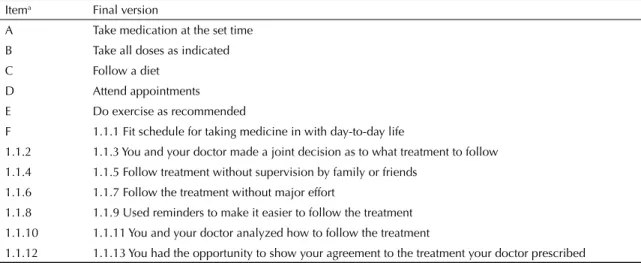
After the alterations resulting from the second pre-test the fi nal version, shown in Table 4, was arrived at.
As regards operational equivalency, during both of the pre-tests it was observed that there were diffi culties in applying the Likert scale in the interviews, due to both the lack of objectivity in choosing one of the fi ve frequency options as well as a natural tendency to agree or disagree with the statement, responding ‘yes’ or ‘no’ to each item.
When faced with the diffi culty of responding objec-tively using one of the fi ve frequency options on the scale, it was proposed that an explanation be given in order to familiarize the interviewee with the way in which the questions should be answered before they encountered the items themselves. Moreover, it was also proposed that a written explanation with the fi ve options from the response scale be given to the interviewee in order to help them respond objectively.
These modifi cations to the way the instrument was carried out were tested in the second pre-test.
Two interviewees were given the instrument without having been shown the written explanation, as had been done in the fi rst pre-test. In spite of the example making the instrument easier to apply, the
Table 2. Problems identifi ed in the pre-tests and their respective suggested solutions. Rio de Janeiro, Southeastern Brazil, 2010.
Itema Problem Suggested solution
b Some people did not understand the meaning of
“dose of medicine.” Introduced an explanation of the concept of doses in the fi eldworker manual. Other proposed changes to this item were to conjugate the verb “take” instead of leaving it in the infi nitive and replace “as stated” for “indicated.”
F Understood by respondents as: “take medications
on schedule.” Added the term “activities” to the sentence.
i The term “great efforts” was not clearly understood. Replaced the term “great efforts” by “great diffi culty.”
K The term “analyze” in item k was understood by the respondent as clinical analysis of your health and not as establishing a partnership relationship with the doctor.
The term “analyze” was replaced by “discuss” the sentence of item (k).
g, k Were understood the same way by the
respondents, who even asked if it was a repeated question.
Although “discuss” is not a synonym for “analyze” in Portuguese, it emphasizes the active role of the patient in relation to the doctor more than the term “analyze”.
g, k, l Nuanced understanding of items that comprise the
same category. The term “be able to give your opinion” replaced by “have the opportunity to give your opinion” in the sentence in item (l).
c, e Did not apply to some patients because they received no recommendation on diet or physical exercise.
Table 3. Modifi cations to the synthesized version of the Martín-Bayarre-Grau instrument after the pre-tests. Rio de Janeiro, Southeastern Brazil, 2010.
Itema Synthesized version Origin Modifi cations after the fi rst pre-test Modifi cations after the second test
A Toma as medicações no horário estabelecido
- Take medication at the set time
T1 – –
B Tomar todas as doses dos medicamentos como indicado
- Take all doses as indicated
T1 + T2
modifi cado Toma todas as doses indicadas
–
C Segue as regras da dieta - Follow a diet
T2 – –
D Vai a consultas marcadas - Attend appointments
T2 modifi cado
– –
E Realiza os exercícios físicos indicados
- Do exercise as recommended
T1 – –
F Encaixa os horários do remédio no seu dia a dia - Fit schedule for taking medicine
in with day-to-day life
T2 Encaixa os horários do remédio nas atividades do seu dia a dia
–
G O senhor e seu médico decidem juntos o tratamento a ser seguido
- You and your doctor made a joint decision as to what
treatment to follow
T1 + T2 – –
H Cumpre o tratamento sem supervisão de sua família ou
amigos
- Follow treatment without supervision by family or friends
T1 = T2 – –
I Leva até o fi m o tratamento sem realizar grandes esforços - Follow the treatment without
major effort
T1 Leva até o fi m o tratamento sem
grandes difi culdades Leva o tratamento sem grandes esforços
J Faz uso de lembretes para realização do tratamento - Used reminders to make it easier to follow the treatment
T2 – –
K O/a senhor/senhora e seu médico analisam como cumprir o
tratamento
- You and your doctor analyzed how to follow the treatment
T1 = T2 O(a) senhor(a) e seu médico discutem como cumprir o
tratamento
–
L Tem como dar a sua opinião no tratamento que o médico
prescreveu
-You had the opportunity to show your agreement to the treatment
your doctor prescribed
T2 – Tem a possibilidade
de dar a sua opinião no tratamento que o médico prescreveu
interviewees still did not respond one of the fi ve options on the Likert scale.
Two other interviewees were given the written expla-nation in the following order: always, almost always, sometimes, almost never, never. The understanding of the scale was better as, as well as the example, the written explanation also enabled them to choose one of the fi ve options objectively.
Two other individuals were given the written explana-tion, but in the following order: never, almost never, sometimes, almost always and always. The aim in starting the explanation with the lowest frequencies was to minimize possible bias in positive. When the expla-nations were given in the order never to always, it was observed that there was greater diversity in the responses.
However, it was established that before completing the questionnaire, an example would be given and that there would also be a written explanation of the options written in the order never, almost never, sometimes, almost always and always.
DISCUSSION
The drawing up of the MBG instrument by Martin Alfonso et al5 was preceded by an analysis of the
different defi nitions which appeared in the literature referring to the behaviour of complying with medical treatment. These authors agreed with the criticism of the term ‘compliance’, as it was limited in its coverage of the complexity of the phenomenon in question.
It was also observed that the term ‘compliance’ is one which is frequently used in medical and pharmaceutical practice, and is frequently encountered as a synonym of adherence.4
Finally, Martin Alfonso4 consider adherence to
treat-ment to be a behavioral matter and to depend as much on the behavior of the patient as of the doctor. In this sense, adherence to treatment was considered to be the most appropriate term for its psychological meaning. It was proposed that for adhesion to treatment to occur the following must be observed in the process: accep-tance of the treatment agreed between patient and their doctor; following the treatment; active participation in the treatment and the voluntary character of the actions of following the treatment.4 Based on this proposal, the
operational defi nition of adherence to treatment adopted by Alfonso et al5 in drawing up the MBG questionnaire
was: “patient’s voluntary and active involvement in behavior related to following the treatment mutually agreed upon with their doctor”.
In addition to the wide bibliographical revision on this topic in order to formulate an operational defi nition for adherence to treatment, the WHO suggestions on adherence to long term treatment were also considered. This was based on following medical recommenda-tions established in agreement with patients and on good communication between patients and health care professionals.12 Thus the defi nition of adherence
to therapy in the Cuban MBG questionnaire5 and the
construct of adherence proposed by the WHO12 are
shown to be convergent.
In spite of it being considered that for the majority of items on the instrument the cultural context of the original and target populations were similar, the only criticism raised was about the relevance of items referring to following recommended diets and exer-cise.1 Although they are mentioned in the Brazilian
Hypertension and Diabetes Societies, it is possible that there are patients with hypertension and diabetes who were not recommended to go on a diet and do exercise by their doctor.a,b
Table 4. Final version of the Martín-Bayarre-Grau instrument, adapted for use in Brazil. Rio de Janeiro, Southeastern Brazil, 2010.
Itema Final version
A Take medication at the set time B Take all doses as indicated
C Follow a diet
D Attend appointments
E Do exercise as recommended
F 1.1.1 Fit schedule for taking medicine in with day-to-day life
1.1.2 1.1.3 You and your doctor made a joint decision as to what treatment to follow 1.1.4 1.1.5 Follow treatment without supervision by family or friends
1.1.6 1.1.7 Follow the treatment without major effort
1.1.8 1.1.9 Used reminders to make it easier to follow the treatment 1.1.10 1.1.11 You and your doctor analyzed how to follow the treatment
It is also possible that such recommendations were given by other health care professionals such as nutri-tionists or nurses1 which would make it necessary to
have an instrument which included these patients’ adherence to the recommendations of other health care professionals. In these cases, it is not possible to consider adherence to recommendations which did not exist. To get around this problem, questions on recommendations were added to the questionnaire in the assessment study.
Still, overall, it was considered that specifi c items in the questionnaire are relevant and acceptable to be applied to the target population.
With respect to semantic equivalence, overall, T2 and R2 scored better, as they were marked as not signifi -cantly altered for both referential and general meanings for fi ve of the 12 items (items c, d, h, j, l). In the case of T1 and R1, a perfect translation was only obtained for two of the 12 items. In order to create the synthe-sized version, the T2 translation of items (c), (h), (j) and (l) was incorporated in full and the T2 translation of item (d) was changed, as the expression “regular consultations” is not commonly used, and replaced with “appointments”.
It should be pointed out that items (h) and (k) were translated in the same way in both T1 and T2, but T2 scored better due to problems in the back-translation into Spanish. In the case of item (f), the T1 translation was different to that of T2, but both received the same score for general and referential meaning. The sentence from T2 was eventually chosen for the synthesized version.
Both T1 and T2 translations of item (g) were positively evaluated for both referential and general meaning, but in order to create the synthesized version terms from both translations were included. The opposite was the case for item (b), as neither T1 nor T2 received positive evaluations and, therefore, in the synthesized version, this item originated from both translations and was further modifi ed with the introduction of the expression “as stated”.
These results show the problems which often occur when back-translating sentences into the original language and not during the translation into the target language.
Thus, it is important that two independent translations are carried out, as this increases the options for creating the synthesized version of the translated questionnaire.
The two pre-tests proved to be important as each of them identified different problems and confirmed decisions made in the previous pre-test.
Among the operational modifi cations was the introduc-tion of an example in the explanaintroduc-tion of the instrument – to train the interviewee to respond – and the provision of a written explanation with the response options – in the order never, almost never, sometimes, almost always, always. These elements, in addition to making the questionnaire easier to administer, also enabled it to become an instrument which could be used as part of an interview as well as self-administered, whilst maintaining the same output as the original scale – a numerical score of fi ve points for each item. This meant the results of the application of the instrument received the same analytical treatment as that suggested in the original instrument and facilitated comparisons of psychometric properties between versions.
In order to conclude the transcultural adaptation, it was also necessary to verify the equivalence of measure-ment, although this was not an objective of this study and will be presented in specialist publications.
Also, to avoid the effects of fatigue (paying less attention to the responses to the fi nal questions) or learning (responding worse to the fi rst questions as the questionnaire has still not been properly understood), the starting point of the questionnaire was changed regularly. The research group’s assessment was that the formulation of the items in the MBG questionnaire was suffi ciently independent to allow for alterations in the order in which they are presented without negatively affecting understanding.
1. Felipe GF, Moreira TMM, Silva LF, Oliveira ASS. Consulta de enfermagem ao usuário hipertenso acompanhado na atenção básica. Rev Rene.
2011;12(2):287-94.
2. Gusmão JL, Mion Jr D. Adesão ao tratamento: conceitos. Rev Bras Hipertens. 2006;13(1):23-5. 3. Herdman M, Fox-Rushby J, Badia X. A model of equivalence in the cultural adaptation of HRQoL instruments: the universalist approach. Qual Life Res.
1998;7(4):323-335.
4. Martín Alfonso L. Acerca del concepto de adherencia terapéutica. Rev Cubana Salud Publica. 2004;30(4). 5. Martín Alfonso L, Bayarre Vea HD, Grau Ábalo JA.
Validación del cuestionario MBG (Martín-Bayarre-Grau) para evaluar la adherencia terapéutica en hipertensión arterial. Rev Cubana Salud Publica.
2008;34(1).
6. Milstein-Moscati I, Persano S, Castro LLC. Aspectos metodológicos e comportamentais da adesão à terapêutica. In: Castro LCC, organizador. Fundamentos de farmacoepidemiologia. Campo Grande: AG Editora; 2001. p.171-9.
7. Mori ALPM, Heimann JC, Dórea EL, Bernik MMS, Storpirtis S. Pharmaceutic guidance to hypertensive patients at USP University Hospital:
effect on adherence to treatment. Braz J Pharm Sci. 2010;46(2):353-62. DOI:10.1590/S1984-82502010000200023
8. Ramos ACMF, Seixas TC, Rocha CRM, Ávila RT. O programa de controle da hipertensão arterial no sistema público de saúde do Município do Rio de Janeiro. Rev SOCERJ. 2003;16(2):141-5.
9. Reichenheim ME, Moraes CL, Hasselmann MH. Equivalência semântica da versão em português do instrumento Abuse Assessment Screen para rastrear a violência contra a mulher grávida. Rev Saude Publica. 2000;34(6):610-6. DOI:10.1590/S0034-89102000000600008
10. Reichenheim ME, Moraes CL. Operacionalização de adaptação transcultural de instrumentos de aferição usados em epidemiologia. Rev Saude Publica. 2007;41(4):665-73. DOI:10.1590/S0034-89102006005000035.
11. Rocha CH, Oliveira APS, Ferreira C, Faggiani FT, Schroeter G, Souza ACA, et al. Adesão à prescrição médica em idosos de Porto Alegre, RS. Cienc Saude Coletiva. 2008;13(Supl):703-10. DOI:10.1590/S1413-81232008000700020
12. World Health Organization. Adherence to long-term therapies: evidence for action. Geneva; 2003.
REFERENCES