CLINICAL SCIENCE
A randomized controlled trial evaluating early versus
traditional oral feeding after colorectal surgery
Ahmet Dag, Tahsin Colak, Ozgur Turkmenoglu, Ramazan Gundogdu, Suha Aydin
Departments of General Surgery Medical Faculty of Mersin University, Mersin/TURKEY.
OBJECTIVE:This prospective randomized clinical study was conducted to evaluate the safety and tolerability of early oral feeding after colorectal operations.
METHODS: A total of 199 patients underwent colorectal surgery and were randomly assigned to early feeding (n = 99) or a regular diet (n = 100). Patients’ characteristics, diagnoses, surgical procedures, comorbidity, bowel movements, defecation, nasogastric tube reinsertion, time of tolerance of solid diet, complications, and length of hospitalization were assessed.
RESULTS:The two groups were similar in terms of gender, age, diagnosis, surgical procedures, and comorbidity. In the early feeding group, 85.9% of patients tolerated the early feeding schedule. Bowel movements (1.7¡0.89 vs. 3.27¡1.3), defecation (3.4¡0.77 vs. 4.38¡1.18) and time of tolerance of solid diet (2.48¡0.85 vs. 4.77¡1.81) were significantly earlier in the early feeding group. There was no change between the groups in terms of nasogastric tube reinsertion, overall complication or anastomotic leakage. Hospitalization (5.55¡2.35 vs. 9.0¡6.5) was shorter in the early feeding group.
CONCLUSIONS:The present study indicated that early oral feeding after elective colorectal surgery was not only well tolerated by patients but also affected the postoperative outcomes positively. Early postoperative feeding is safe and leads to the early recovery of gastrointestinal functions.
KEYWORDS: Early Feeding; Colorectal Surgery; Postoperative Complication; Fasting.
Dag A, Colak T, Turkmenoglu O, Gundogdu R, Aydin S. A randomized controlled trial evaluating early versus traditional oral feeding after colorectal surgery. Clinics. 2011;66(12):2001-2005.
Received for publication onApril 14, 2011;First review completed onMay 23, 2011;Accepted for publication onJune 30, 2011 E-mail: [email protected]
Tel.: 90 324 3374300
INTRODUCTION
After colorectal operations, traditional care regimens have usually included restricted oral intake to prevent signs of postoperative ileus and to protect the surgical anastomoses. This practice has been challenged by evidence from several gastrointestinal physiologic studies that examined the con-tractile activity of the intestine. Whereas postoperative dysmotility predominantly affects the stomach, the small bowel recovers normal function 4–8 hours after laparot-omy.1-3These data suggest that the concept of postoperative ileus as a paralysis of the entire bowel with the complete absence of any functional contractile activity is misleading. When postoperative ileus develops, it is usually transient and clinically not significant. Therefore, feeding within 24 hours after laparotomy is tolerated, and the feed is absorbed.4-5
The other rationale for withholding food or feeding animals orally is to allow anastomoses time to heal before being stressed by food. However, it is known that the
stomach and pancreas secrete one to two liters of fluid daily, which is readily absorbed in the small intestine.5Therefore, patients without a nasogastric tube postoperatively are in fact tolerating high volumes of fluid.6-9 In addition, starvation changes the body’s metabolism within 24 hours by increasing insulin resistance and reducing muscle function. Several studies suggested that after surgery, optimal nutritional status and maintenance of bowel function contribute significantly to wound healing.10,11 Early oral intake has also been suggested to reduce sepsis risk because of decreased bacterial colonization and decreased translocation through defects on the bowel mucosa into the blood circulation.11Based on these findings, the concept of withholding oral intake postoperatively does not seem to be reasonable.
Standardized care pathways have been used over the last decade to reduce the length of stay after abdominal surgery. Another potential advantage of an early feeding scheme is that the patients tend to have shorter hospital stays. Because a clear rationale for delaying oral intake after colorectal surgery is lacking and there are potential benefits from early postoperative feeding, we planned a prospective rando-mized study.
The aim of the present prospective randomized clinical study was to evaluate the safety and tolerability of early oral
Copyrightß2011CLINICS– This is an Open Access article distributed under the terms of the Creative Commons Attribution Non-Commercial License (http:// creativecommons.org/licenses/by-nc/3.0/) which permits unrestricted non-commercial use, distribution, and reproduction in any medium, provided the original work is properly cited.
feeding after elective open abdominal colorectal surgery in terms of gastrointestinal recovery, complications, and the length of hospitalization.
CLINICAL RELEVANCY
Traditional postoperative care regimens after colorectal surgery in which postoperative oral feeding is gradually introduced following the resumption of bowel sounds and the passage of flatus or stools is based mainly on the fear that early oral feeding can increase anastomotic leakage and prolong paralytic ileus. The current practice is to reduce the withholding of oral intake as soon as possible. The current findings support this. The early feeding protocol that was administered in this study did not increase anostomotic leakage or prolong paralytic ileus or hospital stay.
MATERIALS AND METHODS
Between August 2007 and September 2009, a total of 215 consecutive patients who were undergoing elective open colorectal cancer surgery were enrolled in this study. The study was approved by the local Ethical Committee at the University Hospital, Mersin, Turkey. Informed consent was obtained from all patients. All consecutive patients were included in this study, regardless of American Society of Anesthesiologists (ASA) score, comorbidity, localization and stage of the tumor, preoperative chemoradiotherapy, and diabetes. However, the patients that were scheduled to have an ileostomy or colostomy and patients who under-went an operation that was finished by creating a colostomy or ileostomy were excluded from the study. A total of 16 patients were excluded from the study: colostomy was necessary for four patients and ileostomy was necessary for three patients; three patients were excluded because of advanced metastatic disease, for which colonic resection was not performed; and six patients refused to participate. Finally, 199 patients were assigned randomly to the early oral feeding group (Group 1, n = 99) or regular feeding group (Group 2, n = 100). The perioperative care protocol in the early oral feeding group included early postoperative oral feeding commencing approximately 12 hours after the operation with a fluid diet; this was gradually increased to a solid diet as tolerated by the patient. The perioperative care protocol in the regular diet feeding group consisted of fasting until the patient passed first flatus or stools.
Randomization was performed according to a computer-generated list immediately after surgery by an independent computer consultant. All patients underwent standard bowel preparation based on FleetH phospho-soda (Kozmed Ltd., Istanbul, Turkey) and received i.v. prophy-lactic antibiotics before surgery. A standard anesthetic protocol was followed and routine monitoring applied. A nasogastric tube was inserted before surgery and removed immediately after surgery. Postoperative pain management was similar in all patients and obtained with a patient-controlled analgesic intravenous pump with meperidine hydrochloride 1 mg/mL solution 300 mg to 400 mg/ 24 hours for 48 to 72 hours, followed by intramuscular dipyrone (Sanofi Aventis Co., Istanbul, Turkey) or acetami-nophen (650 mg) 4 to 6 times daily.
Patient characteristics and comorbidity (e.g., with dia-betes mellitus), diagnoses, and surgical procedures were recorded. Primary hospital stay was accepted as a primary clinical endpoint, whereas bowel movements, defecation,
time of tolerance of solid diet, and complications were secondary clinical endpoints. Primary hospital stay was expressed as days in hospital after surgery. All of the patients were monitored for bowel movements, nasogastric tube reinsertion, and time of tolerance of solid diet, complications, and the length of hospitalization. The presence of bowel movements was assessed daily by two independent investigators. Patients’ examinations were conducted and recorded by the colorectal unit doctors.
The nasogastric tube was reinserted if two or more episodes of vomiting of more than 100 ml occurred in the absence of bowel movement. Patients in both groups were discharged once they fulfilled all the following discharge criteria, including the passage of flatus or stools, toleration of oral liquid and solid food, comfortable on oral analgesia and no complications that required hospital treatment.
STATISTICAL ANALYSIS
In order to detect a mean difference of one day in the postoperative length of hospital stay, a minimum sample size of 81 patients for each group was calculated, with an alpha of 0.05, an expected standard deviation of less than two days, and a power of 0.90. The sample size was established before the study, and 100 patients were established in each arm to provide appropriate statistical power analyses.
The results were expressed as mean¡standard deviation
(SD). Differences between the treatment groups were ana-lyzed with the x2 test and the Mann-Whitney U-test. The
Mann Whitney U-test was performed for nonparametric data such as gender, comorbidity, diabetes mellitus, diagnosis, surgical procedures, nasogastric tube insertion, and complica-tion rate. The Pearsonx2test was performed for dependent
variables (age, bowel moment, time taken to tolerate a solid diet, time to first defecation, and hospital stay). Probability values of less than 0.05 were considered significant.
RESULTS
The early feeding group included 52 males and 47 females, with a mean age of 62¡12.33 years, whereas the
regular feeding group consisted of 61 males and 39 females, with a mean age of 61¡15.82 years. There was no significant
difference between the two groups in terms of gender or age of the patients (p =0.254 and p =0.981, respectively). In
addition, there were no statistically significant differences between the two groups regarding patients’ comorbid diseases and diabetes mellitus (p= 0.563 and p= 0.500,
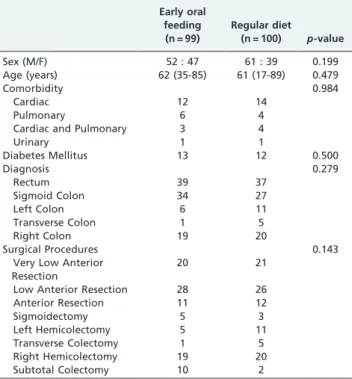
respectively). The two groups were also similar on the basis of patients’ diagnosis and the type of operation performed (p =0.279 and p= 0.143, respectively). The patients’
demo-graphics are shown in Table 1.
The majority of the patients in the early feeding group (85.9%) tolerated the early feeding schedule. When con-sidering the gastrointestinal recovery, earlier intestinal movements (1.70¡0.89 vs. 3.27¡1.3,p,0.001) and defeca-tion (3.40¡0.77 vs. 4.38¡1.18, p,0.001) were observed in the early feeding group’s patients as opposed to the regular feeding group’s patients. Moreover, the regular diet was tolerated by patients in the early feeding group significantly earlier than those in the regular feeding group (2.48¡0.85
reinsertion. However, this difference was not statistically significant (p =0.363). Table 2 shows the gastrointestinal
recovery parameters.
No statistical difference was found between the two groups when considering all the postoperative complica-tions (p= 0.541). Fewer anastomotic leakages were shown in
the early feeding group when compared with the regular feeding group. While six anastomotic leakages in the regular diet group developed, only two anastomotic leakages developed in the early feeding group. However, the difference was not statistically significant (p= 0.279). The
postoperative complications are summarized in Table 2. The mean hospital stay was significantly shorter in the early feeding group when compared with the regular diet group (5.55¡2.35 vs. 9.00¡6.50,p,0.001).
DISCUSSION
Traditionally, the postoperative management of patients undergoing colorectal surgery has involved the use of nasogastric tubes and avoidance of the oral intake of fluids
or nutrients until resolution of the postoperative ileus. Recently, this approach has been increasingly questioned, and intensive efforts have been made to obtain relevant clinical evidence. Today, a few studies have shown that nasogastric tube insertion has a limited role in postoperative care for abdominal surgery.9,12-14In addition, trials compar-ing postoperative fastcompar-ing and early enteral feedcompar-ing after gastrointestinal resections have not shown a clear advan-tage. The authors suggested that early feeding might be of benefit in terms of morbidity and mortality.15-20
The reasons surgeons use nasogastric intubation is to prevent gastric dilatation, to treat postoperative paralytic ileus, and to decrease tension on intestinal anastomosis. However, studies investigating gastric emptying after transabdominal vascular surgery concluded that a normal diet may be started on the second day after surgery.21
Moreover, Han Geurts et al. removed nasogastric tubes directly after elective abdominal surgery in all cases. Their findings justified the conclusion that patients were able to judge their own food tolerance adequately.22 Similarly, in
the present study, nasogastric tubes were inserted before surgery and removed immediately after surgery in all patients as a standard practice. This approach was tolerated by most of the patients, and the reinsertion of a nasogastric tube was rarely needed in either group. Furthermore, this condition was free from the concept of feeding.
Postoperative ileus is an important factor determining and contributing negatively to postoperative convalescence. The mechanisms of this involve the stimulation of pain fibers, excessive sympathetic tone, and the release of inhibitory neurotransmitters from the gut wall.23 Gastrointestinal phy-siologic studies that examined the contractile activity of the intestine showed that the small bowel recovered normal function 4–8 hours after laparotomy and that gastric emptying resumed on the first postoperative day.1,2,7It was suggested that the early resumption of an oral diet diminishes the duration of ileus. In the present study, the early enteral feeding group patients had an oral diet on the day after the operation without evidence of bowel motility, and most of these patients tolerated the early feeding schedule. This result showed that oral feeding can be started on the first postoperative day without waiting for the resolution of postoperative ileus. Thus, the patients can be protected from starvation and the related side effects, such as metabolic imbalance. This situation might diminish the complications and accelerate recovery. In the present study, early feeding resulted in early intestinal movements and defecation. These findings show that an early oral diet improved the gastrointestinal recovery parameters
Table 1 -The patients’ demographics and baseline data.
Early oral feeding
(n = 99)
Regular diet
(n = 100) p-value
Sex (M/F) 52 : 47 61 : 39 0.199
Age (years) 62 (35-85) 61 (17-89) 0.479
Comorbidity 0.984
Cardiac 12 14
Pulmonary 6 4
Cardiac and Pulmonary 3 4
Urinary 1 1
Diabetes Mellitus 13 12 0.500
Diagnosis 0.279
Rectum 39 37
Sigmoid Colon 34 27
Left Colon 6 11
Transverse Colon 1 5
Right Colon 19 20
Surgical Procedures 0.143
Very Low Anterior Resection
20 21
Low Anterior Resection 28 26
Anterior Resection 11 12
Sigmoidectomy 5 3
Left Hemicolectomy 5 11
Transverse Colectomy 1 5
Right Hemicolectomy 19 20
Subtotal Colectomy 10 2
Table 2 -Gastrointestinal recovery parameters and postoperative complications.
Early enteral Regular diet p-value
Time of intestinal movements (days) 1.76 (1–6) 3.27 (1–10) 0.0001
Time to defecation (days) 3.41 (2–6) 4.38 (2–10) 0.0001
Time to toleration of a regular diet (days) 2.48 (2–7) 4.77 (2–16) 0.0001
No reinsertion of the nasogastric tube 8 6 0.363
Hospital stay (days) 5.55 (4–22) 9.0 (4–49) 0.0001
Complications 12 14 0.541
Wound infection 5 7
Pneumonia 3 3
Toxic Hepatitis 1 0
Sepsis 1 2
Evisceration 0 1
Cerebral Infarct 0 1
and shortened the duration of postoperative ileus. However, although the two groups were similar in terms of gender, age, diagnosis, surgical procedures, and comorbidity, there is a difference in the number of subtotal colectomies. In the early feeding group, subtotal colectomy was more common than in the other group. We accepted this condition as a bias of the study.
Another common belief (which lacks evidence) is that patients should not eat for several days after colorectal surgery in order to avoid anastomotic leakage. However, there is evidence that adequate oral intake has a strengthen-ing effect on intestinal anastomoses and does not lead to anastomotic complications. In addition, carcinomas nega-tively affect wound healing. Furthermore, it was shown that feeding reverses the mucosal atrophy induced by starva-tion and increases anastomotic collagen deposistarva-tion and strength.24-26Experimental data in both animals and humans suggest that enteral nutrition is associated with an improve-ment in wound healing.27-28In agreement with the literature,
in the present study, early oral feeding did not alter the incidence of anastomotic leakage and overall complications. The psychological impact of oral fluids and food following surgery was considered and an improved sense of well-being was observed in the patients who ate sooner.29 The psychological aspect also has a significant role throughout the postoperative recovery process. However, there are no trials comparing early feeding and conventional feeding after colorectal operations in terms of analgesic requirements. Lower pain perceptions and improved general health perceptions are advantageous. Earlier oral feeding has been shown to shorten the postoperative hospital stay in some trials following gastrointestinal surgery.30In addition, early
feeding leads to earlier discharge from the hospital after nongastrointestinal procedures.31 However, in studies fol-lowing colorectal operations, the elimination of nasogastric tubes and earlier oral feeding have failed to show any association with a shorter length of hospital stay.15,22,32 A shorter hospital stay is a potential advantage of early postoperative feeding, and this feature was demonstrated in the present study. Because early feeding significantly shortens the length of ileus, it also significantly shortens the length of hospitalization. The overall reduction corresponded to approximately 3.5 days, which is clinically important.
In our study, patients undergoing colectomy were started on early oral intake regardless of objective signs of the return of bowel functions; this protocol was demonstrated to be safe and effective, with a shortened hospital stay as the primary benefit.
ACKNOWLEDGMENT
No financial support played a role in the trial. Our special thanks to Arzu Kanik, Professor of the Department of Biostatistics. We confirm that Tables 1–3 presented in this manuscript were created specifically for this manuscript and have not been borrowed or adapted from any other source.
AUTHOR CONTRIBUTIONS
Dag A conceived and designed the study. Colak T was responsible for the data analysis and interpretation. Turkmenoglu O and Gundogdu R were responsible for the acquisition of data. Aydin S was responsible for the critical revision of the manuscript.
REFERENCES
1. Silk DBA, Gow NM. Postoperative starvation after gastrointestinal surgery. British Medical Journal. 2001;323:761–2, doi: 10.1136/bmj.323. 7316.761.
2. Casto CJ, Krammer J, Drake J. Postoperative feeding: a clinical review. Obstetrical and Gynecological Survey. 2000;55:571–3, doi: 10.1097/ 00006254-200009000-00022.
3. Ortiz H, Armendariz P, Yarnoz C. Is early postoperative feeding feasible in elective colon and rectal surgery? International Journal of Colorectal Disease. 1996;11:119–21, doi: 10.1007/s003840050032.
4. Pearl ML, Valea FA, Fischer M, Mahler L, Chalas E. A randomized controlled trial of early postoperative feeding in gynecologic oncology patients undergoing intra-abdominal surgery. Obstet Gynecol. 1998;92:94–7, doi: 10.1016/S0029-7844(98)00114-8.
5. Bufo AJ, Feldman S, Daniels GA, Lieberman RC. Early postoperative feeding. Dis Colon Rectum. 1994;37:1260–5, doi: 10.1007/BF02257793. 6. Lassen K, Hannemann P, Ljungqvist O, Fearon K, Dejong CHC, von
Meyenfeldt MF, et al. Patterns in current perioperative practice: survey of colorectal surgeons in five northern European countries. British Journal of Medicine. 2005;330:1420–1, doi: 10.1136/bmj.38478.568067. AE.
7. Bauer JJ, Gelernt JM, Salky BA, Keel J. Is routine postoperative nasogatric decompression really necessary? Ann Surg. 1985;201:233–6, doi: 10.1097/ 00000658-198502000-00017.
8. Nelson R, Edwards S, Tse B. Prophylactic nasogastric decompression after abdominal surgery. Cochrane Database Syst Rev. 2007;18 3:CD 004929.
9. Nathan BN, Pain JA. Nasogastric suction after elective abdominal surgery: a randomized study. Ann R Coll Surg Engl. 1991;73:291-4 10. Windsor JA, Knight GS, Hill GL. Wound healing response in surgical
patients: recent food intake is more important than nutritional status. British Journal Surgery. 1988;75:135–7, doi: 10.1002/bjs.1800750215. 11. Deitch EA, Andrassy RJ, Booth FVM, Moore FA. Current concepts in
postoperative feeding. Contemporary Surgery. 1991;39:37–55.
12. Rao W, Zhang X, Zhang J, Yan R, Hu Z, Wang Q. The role of nasogastric tube in decompression after elective colon and rectum surgery: a meta-analysis. Int J Colorectal Dis. 2011;26:423-9, doi: 10.1007/s00384-010-1093-4.
13. Davila-Perez R, Bracho-Blanchet E, Tovilla-Mercado JM, Hernandez-Plata JA, Reyes-Lopez A, Nieto-Zermen˜o J. Unnecessary gastric decom-pression in distal elective bowel anastomoses in children: a randomized study. World J Surg. 2010;34:947-53, doi: 10.1007/s00268-010-0442-3. 14. Petrelli NJ, Stulc JP, Rodriquez-Bigas M, Blumenson L. Nasogastric
decompression following elective colorectal surgery. Am Surg. 1993;59: 632-5.
15. Schoetz DJ Jr, Bockler M, Rosenblatt MS, Malhotra S, Roberts PL, Murray JJ, et al. ‘Ideal’ length of stay after colectomy: whose ideal? Dis. Colon Rectum. 1997;40:806–10, doi: 10.1007/BF02055437.
16. Lewis SJ, Egger M, Sylvester PA, Thomas S. Early enteral feding versus ‘nil by mouth’ after gastrointestinal surgery: systematic review and meta-analysis of controlled trials. BMJ. 2001;323:1–5, doi: 10.1136/bmj.323.7303.1.
17. Carr CS, Ling KD, Boulos P, Singer M. Randomised trial of safety and efficacy of immediate postoperative enteral feeding in patients under-going gastrointestinal resection. BMJ. 1996;312:869-71.
18. Heslin MJ, Latkany L, Leung D, Brooks AD, Hochwald SN, Pisters PW, et al. A prospective, randomized trial of early enteral feeding after resection of upper gastrointestinal malignancy. Ann Surg. 1997;226:567-77, doi: 10.1097/00000658-199710000-00016.
19. Arsalani-Zadeh R, Ullah S, Khan S, Macfie J. Current pattern of perioperative practice in elective colorectal surgery; a questionnaire survey of ACPGBI members. Int J Surg. 2010;8:294-8, doi: 10.1016/j.ijsu. 2010.01.014.
20. Hasenberg T, La¨ngle F, Reibenwein B, Schindler K, Post S, Spies C, et al. Current perioperative practice in rectal surgery in Austria and Germany. Int J Colorectal Dis. 2010;25:855-63, doi: 10.1007/s00384-010-0900-2. 21. Avrahami R, Cohen JD, Haddad M, Singer P, Zelikovski A. Gastric
emptying after elective abdominal aortic aneurysm surgery: the case for early postoperative enteral feeding. Eur J Vasc Endovasc Surg. 1999;17:241-4, doi: 10.1053/ejvs.1998.0744.
22. Han-Geurts IJ, Jeekel J, Tilanus HW, Brouwer KJ. Randomized clinical trial of patient-controlled versus fixed regimen feeding after elective abdominal surgery. Br J Surg. 2001;88:1578-82, doi: 10.1046/j.0007-1323. 2001.01934.x.
23. Holte K, Kehlet H. Postoperative ileus: a preventable event. Br J Surg. 2000;87:1480, doi: 10.1046/j.1365-2168.2000.01595.x
24. Ozerhan IH, Ersoz N, Onguru O, Ozturk M, Kurt B, Cetiner S. Fascin expression in colorectal carcinomas. Clinics. 2010;65:157-64, doi: 10.1590/ S1807-59322010000200007.
25. Gonc¸alves CG, Groth AK, Ferreira M, Matias JE, Coelho JC, Campos AC. Influence of preoperative feeding on the healing of colonic anastomoses in malnourished rats. J Parenter Enteral Nutr. 2009;33:83-9, doi: 10.1177/ 0148607108327047.
27. Demetriades H, Botsios D, Kazantzidou D, Sakkas L, Tsalis K, Manos K, et al. Effect of early postoperative enteral feeding on the healing of colonic anastomosis in rats. Eur Surg Res. 1999;31:57–63, doi: 10.1159/000008621. 28. Inan A, Sen M, Surgit O, Ergin M, Bozer M. Effects of the histamine H2 receptor antagonist famotidine on the healing of colonic anastomosis in rats. Clinics. 2009;64:567-70, doi: 10.1590/S1807-59322009000600012. 29. Schilder JM, Hurteau JA, Look KY, Moore DH, Raff G, Stehman FB, et al.
A prospective controlled trial of early postoperative oral intake following major abdominal gynecologic surgery. Gynecol Oncol. 1997;67:235–40, doi: 10.1006/gyno.1997.4860.
30. Cheatham ML, Chapman WC, Key SP, Sawyers JL. A metaanalysis of selective versus routine nasogastric decompression after elective lapar-otomy. Ann. Surg. 1995;221:469–76, doi: 10.1097/00000658-199505000-00004. 31. Steed HL, Capstick V, Flood C, Schepansky A, Schulz J, Mayes DC. A randomized controlled trial of early versus ‘traditional’ postoperative oral intake after major abdominal gynecologic surgery. Am J Obstet Gynecol. 2002;186:861–5, doi: 10.1067/mob.2002.123057.