FLAMMA, 4 (2), 81-84, 2013 ISSN 2171 - 665X
CC Attribution-NonCommercial-ShareAlike 3.0 License
81
Effects of terrace construction on runoff and
erosion in a recently burnt forest area in
north-central Portugal
M.A.S. Martins (*), D. Serpa, A.I. Machado, R.F.H.de Lenne, A.G.v.d. Linden, S.R. Faria, R.S.V. Ferreira, I. Skulska, S.A. Prats, M.E.T. Varela, J.J. Keizer
Centre for Environmental and Marine Studies (CESAM), Dept.of Environment and Planning, University of Aveiro, 3810-193 Aveiro, Portugal
* Corresponding author: [email protected]
Keywords Abstract
Forestry Terraces Runoff Erosion Wildfires
In present-day Portugal, wildfires are a common phenomenon that, on average, affects some 100.000 ha of forest lands each year. Fires can markedly increase runoff generation and the associated sediment transport, nevertheless the magnitude of these impacts strongly depends on post-fire forestry management practices. This study evaluates the effect of terrace construction on runoff and erosion at micro-plot and catchment scale, six months after a wildfire in a forest area in north central Portugal. At the micro-plot scale, there was a clear trend for greater runoff volumes and sediment losses after the construction of terraces. In addition, pre-terracing sediment losses showed a visible relationship with rainfall amounts unlike post-terracing losses. At the catchment scale, an increase in sediment losses was observed after terracing consistently with micro-plot data.
1
I
NTRODUCTIONIn Portugal, wildfires occur frequently and affect large areas, on average some 100.000 ha per year but in extreme years such as 2003 and 2005 over 300.000 ha (Pereira et al., 2005). As thoroughly reviewed by Shakesby and Doerr (2006) and Shakesby (2011), wildfires can lead to considerable changes in geomorphologic and hydrological processes. Previous studies in various parts of the world, including Portugal (Ferreira et al., 2005; Prats et al., 2012; Shakesby et al., 1996), have revealed strong and sometimes extreme responses in runoff generation and associated soil losses following wildfire, especially during the earlier stages of the so- alled i do
FLAMMA | Vol. 4 | 2 | 81-84
82
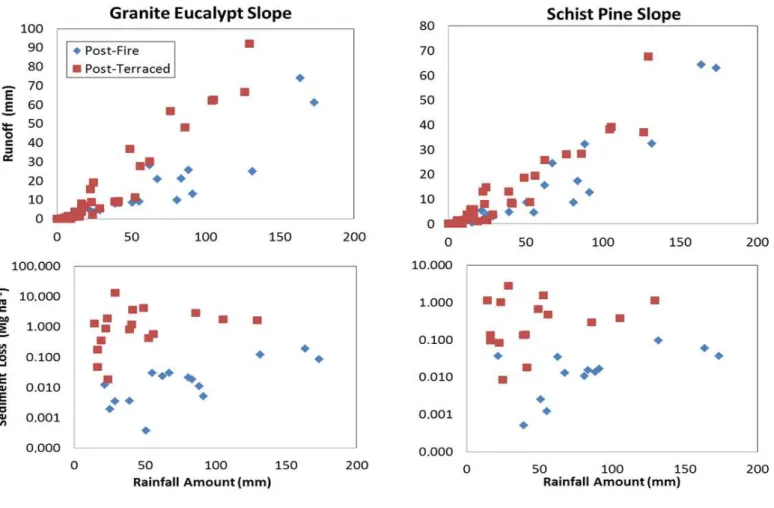
Figure 1. Relationships of runoff (upper graphs) and sediment losses (lower graphs) with rainfall amounts before and after the construction of terraces for a recently burnt eucalypt plantation (left graphs) and a recently burnt Maritime Pine stand (right graphs).
one occasion, gully formation over the full hill slope length. Runoff and associated sediment losses, however, have hardly ever been quantified for recently terraced forest plantations.
2
O
BJECTIVESThe main aim of this study was to assess the impact of the construction of terraces on overland flow generation and inter-rill erosion rates. This was done by comparing the results for micro-plots that were installed in a eucalypt a Maritime Pine plantation following a wildfire in July 2010, and then re-installed after the construction of terraces during February 2011. A second objective was to assess the terracing impact at catchment scale, by comparing bed loads before and after terracing.
3
M
ETHODOLOGY3.1 STUDY AREA AND EXPERIMENTAL SITES
This study was carried out in a forest area in the Sever do Vouga municipality, north-central Portugal, that was burnt by a wildfire during the summer of 2010. Within this
Er ida ur t area of roughl 250 ha, si hill slopes ere
FLAMMA | Vol. 4 | 2 | 81-84
83 February 2011, the plots were re-installed on basically the same locations. This was not done on the terraces themselves but on newly-constructed dirt roads, first and foremost to maintain a similar slope angle to before the terracing.
Within the Ermida area, an entirely burnt catchment of roughly 25 ha was instrumented with two subsequent flumes with maximum discharge capacities of 120 and 1700 L s-1. The bed load that deposited in the smallest flume was removed and weighted in the field at regular intervals. Also, one or more samples were collected for laboratory analysis.
Rainfall was measured since the middle of August 2010, using several automatic and collecting gauges in the burnt area.
3.2 FIELD DATA AND SAMPLE COLLECTION
From August 2010 to August 2011, the runoff amounts
a u ulated i the ta ks o e ted to the plots outlets
were measured at 1- to 2-weekly intervals, depending on rainfall, and samples of 1.5 L taken for laboratory analyses. Rainfall accumulated in the collecting gauges was measured on the same occasions.
3.3 LABORATORY ANALYSIS
The runoff samples were filtered in the laboratory using filters with a 12-14 µm pore size. The filters were then dried in an oven for 24 hours at 105 oC to determine sediment concentrations. The bed load samples were also dried in an oven for 24 h at 105 oC to determine moisture content.
4
R
ESULTS AND CONCLUSIONSAt both study sites but especially at the eucalypt plantation on granite, there was a tendency for greater runoff volumes after the construction of the terraces then before it (Figure 1). Also, the differences in runoff volumes between the two study sites were clearer after than before terracing, with the eucalypt sites producing more overland flow than the pine site. The relationship of overland flow with rainfall, however, was similarly well-defined for both sites and both study periods.
Sediment losses revealed a more pronounced role of terracing than runoff volumes before with (almost) consistently higher values after than before terracing
(Figure 1). Also, the differences in sediment losses between the two sites were more marked after than before terracing. Pre-terracing sediment losses revealed a detectable relationship with rainfall amounts but post-terracing losses did not.
Thus, the present results showed that overland flow generation and especially mobilization of sediments on sloping terrain in terraced areas (such as dirt roads) can be substantial and can exceed immediate post-fire runoff and erosion rates.
The bed load data suggested that terracing also increased sediment losses at the catchment scale. Namely, 875 mm of rainfall that fell before terracing produced about 340 kg of bed load, whilst 800 mm that fell after terracing produced 620 kg. Bed load deposition rates per mm of rain were thus about twice as high after than before terracing, 0.39 and 0.74 kg mm-1 rain, respectively.
R
EFERENCESFernández C, Vega JA, Fontúrbel T, Pérez-Gorostiaga P, Jiménez E, Madrigal J. 2007. Effects of wildfire, salvage logging and slash treatments on soil degradation. Land Degradation and Development 18: 591-607.
Fernandéz-Raga M, Fraile R, Keizer JJ, Varela MET, Castro A, Palencia C, Calvo AI, Koenders J, Marques RLC. 2010. The kinetic energy of rain measured with an optical disdrometer: An application to splash erosion. Atmospheric Research 96: 210-240 Ferreira AJD, Coelho COA, Boulet AK, Lopes FP. 2005.
Temporal patterns of solute loss following wildfires in Central Portugal. International Journal of Wildland Fire 14: 401-412.
Novara A, Gristina L, Bodí MB, Cerdà A. 2011. The impact of fire in redistribition of soil organic matter on a mediterranean hillslope under maquia vegetation type. Land degradation & development 22: 530-536.
Pereira J, Carreira J, Silva J, Vasconcelos M. 2005. Alguns conceitos basicos sobre os fogos rurais em Portugal. In: Pereira JS, Pereira JMC (Eds.), Incêndios lorestais em Portugal - caracterização, impactes e prevenção, ISAPress, Lisbon, pp. 133. Prats SA, Macdonald LH, Monteiro MSV, Ferreira AJD,
Coelho COA, Keizer JJ. 2012. Effectiveness of
forest residue ul hi g i redu i g post-fire runoff and erosion in a pine and a eucalypt plantation in north-central Portugal. Geoderma, in press, DOI:10.1016/j.geoderma.2012.02.009. Shakesby RA, Boakes D, Coelho COA, Gonçalves AJB, Walsh
FLAMMA | Vol. 4 | 2 | 81-84
84 of wildfire in pine and Eucalyptus forests in Portugal. Applied Geography 16: 337-355.
Shakesby RA, Coelho COA, Ferreira AJD, Terry JP, Walsh RPD. 1994. Fire, post-burn land management practice and soil erosion response curves in eucalypt and pine forests, north-central Portugal. In: Sala M, Rubio JL (Eds.), Soil erosion and degradation as a consequence of forest fires. Geoforma Ediciones, Logroño, pp. 111-132. Shakesby RA, Doerr SH. 2006. Wildfire as a hydrological
and geomorphological agent. Earth-Science Reviews 74: 269-307.
Shakesby RA. 2011. Post-Wildfire soil erosion in the Mediterranean: Review and future research directions. Earth-Science Reviews 105: 71-100. Walsh RPD, Boakes DJ, Coelho COA, Ferreira AJD, Shakesby