DOI: 10.2298/AVB1201111D UDK 636.32/.38:617.3:615.216.2:615.032:616.832.9
EFFICACY OF EPIDURAL ADMINISTRATION OF MORPHINE WITH BUPIVACAINE FOR ORTHOPAEDIC SURGERY IN SHEEP
DUREJ M, LEDECKÝ V, MICHALÁK D, HLUCHÝ M and KÒAZOVICKÝ D
University of Veterinary Medicine and Pharmacology in Ko{ice, Slovakia (Received 28thAugust 2011)
The aim of the study was to test the hypothesis that epidural administration of morphine with bupivacaine provides more intense and sufficient perioperative analgesia compared with parenterally administrated butorphanol during orthopaedic surgery. Sheep were assigned to group C (control group, 6 sheep) and group E (epidural, 5 sheep). Sheep from group C were pre-medicated with midazolam (0.3 mg/kg, i.m.) and butorphanol (0.2 mg/kg, i.m.). Propofol was used for induction of general anesthesia in both groups. Sheep from group E were pre-medicated with midazolam, but without butorphanol. Sacrococcegeal epidural analgesia with morphine (0.1 mg/kg) and bupivacaine (1 mg/kg) was performed. We detected a significant increase in heart rate (19%, p=0.021) during surgery in group C. Two hours after surgery, the heart rate was 14.9% lower than prior to surgery in group E (p=0.017). In group E, throughout the surgery, we measured an insignificant increase in respiratory rate of 1.99%. In the same group, 120 minutes post surgery, we measured an increase in respiratory rate of 14.7%, while in group C there was a smaller increase of only 10.9%. The result from both groups was insignificant (p>0.05). The consumption of isoflurane in group C was higher than in group E by 27.3% (p=0.0043). The mean MAC was in group C higher by 27.6% as it was in group E (0.75% ± 0.25, 0.95 ± 0.3 in Group E and C, respectively). This distinction, according to the Mann-Whitney test, was not significant (p=0.329).
Key words: bupivacaine, butorphanol, epidural, morphine, sheep, stifle surgery
INTRODUCTION
economical and do not require sophisticated equipment. Besides this, general anesthesia in this species often leads to tympanitis or regurgitation (Hashim and Hossain, 1989). Caudal epidural anesthesia also has many applications in sheep and goats, but the main practical use for an epidural in these animals would be correction of dystocia and reposition/retention of a vaginal and/or rectal prolapse. However, since caesarean section in these animals is usually performed in lateral recumbency, a higher epidural dose could also be used for this procedure, as well as for surgery on the hind limbs. The epidural technique used is much the same as in cattle, but it is sometimes harder to find the first intercoccygeal space, the most common place used is the sacrococcegeal space (S5-Co1) (Beltmanet al., 2010). The most frequently used epidural anesthetic is lidocaine, but mepivacaine, bupivacaine, and procaine are also used. With the exception of bupivacaine, these agents provide analgesia of a relatively short duration and may necessitate re-administration of the agent to allow completion of the procedure (Day and Skarda, 1991). Epidural adminitration of agents with greater duration of action may be more appropriate for procedures requiring long acting analgesia. These agents include opioids and alpha-2 agonists (Luttingeret al., 1985; Eisenachet al., 1996). The half-time of elimination of butorphanol in the cow ranges between 1 and 2 hours (Dodman et al., 1992) and will provide 2-3 hours of postoperative analgesia and epidural morphine may provide 12-24 hours of postoperative analgesia (Riebold, 2002).
MATERIAL AND METHODS
Animals
After approval by the Ethical Committee for the handling of animals at the University of Veterinary Medicine and Pharmacy in Ko{ice, 11 healthy adult female Merino sheep weighing from 33.5 kg to 52.0 kg were included in an orthopaedic research study involving surgical approach to the stifle joint and osteotomy of the proximal tibia. During the experimental period, all sheep were housed in a stall, fed with grass and hay and with free access to water. Sheep were assigned to group C (positive control group, six sheeps) or group E (epidural, five sheeps).
Study protocol
butorphanol (0.1 mg/kg) prepared for the painful reactions during surgery. We used flunixin (Finadyne inj., SCHERING PLOUGH Sante Animale; 2.2 mg/kg) after observation in a post-operative period of 3 days. All animals were cannulated with a 20 gauge catheter and at a constant infusion rate of 0.9% saline solution (10 mL/kg/hour). For maintenance of general anesthesia during surgery, isoflurane (Isofluran® Torrex) in oxygen was used after endotracheal intubation. We used Komesaroff Mini-Kom anaesthetic machine with the vaporizer placed within the circuit. Heart rate (HR), respiratory rate (RR), and rectal body temperature (RT) were recorded before anesthesia, during the surgery at 10., 30. (osteotomy) and 60. minutes and 120 minutes after surgery. In Group E, duration of analgesia was assessed by the response to superficial muscular pinpricks over the whole hind legs. We evaluated muscle and tail relaxation on the basis of movement (flexion and extension of the hind legs and tail movement). We also measured onset of analgesia (min.), duration of analgesia (min.) and time needed to stand upright (min). During the surgery we recorded the following data: heart rate, respiratory rate, rectal temperature, and minimal alveolar concentration (MAC; %) of isoflurane. Data was recorded by a monitor (Mindray PM 9000 Vet). After surgery we measured the consumption of isoflurane by use of a graduated vessel and calculated it in mL/kg/60 min. The average length of surgery time was 74 minutes.
Statistical analysis
Heart rate, respiratory rate and rectal temperature were analyzed between groups by use of a 2-tail Student t test. Minimal alveolar concentration and consumption of isoflurane were analyzed by Mann-Whitney test. Significance was set atp£0.05.
RESULTS
Physiologic variables
consider this as clinically relevant. Hypothermia (less than 37oC) was not detected in any of the sheep. Heart rate, respiratory rate and rectal temperature are sumarized in Table 1.
The volume of consumed isoflurane was being measured from the beginning to the end of the surgery in units mL/kg/60 min. The consumption of isoflurane in Group C was higher than in group E by 27.3%. This difference, according to the Mann-Whitney test, was very relevant (p=0.0043).
Table 1. Mean±SD heart rate (HR, beats/min.), respiratory rate (RR, breaths/min.) and rectal temperature (RT,oC) of the control group (C) and epidural group (E)
Variable
Time
pre-operative
intra-operative
post-operative 10´ (osteotomy)30 60´
HR C 78.7 ± 14.7 83.1 ± 9.5 93.6 ± 20.6 80.7 ± 12.9 88.2 ± 14.3 E 81.8 ± 13.4 79.4 ± 14.8 72.8 ± 16.5 76.8 ± 11.3 69.6 ± 13.4
RR C 27.3 ± 7.3 29.1 ± 6.9 30.5 ± 14.5 33.4 ± 9.2 30.3 ± 2.7 E 31.2 ± 6.7 31.5 ± 8.4 31.8± 6.9 34.9 ± 11.1 35.8 ± 10.5
RT C 38.9 ± 0.4 37.9 ± 0.9 37.2 ± 0.6 37.1 ± 0.5 37.3 ± 0.5 E 39.1 ± 0.5 38.8 ± 0.6 37.8 ± 0.7 37.6 ± 0.7 37.2 ± 0.9
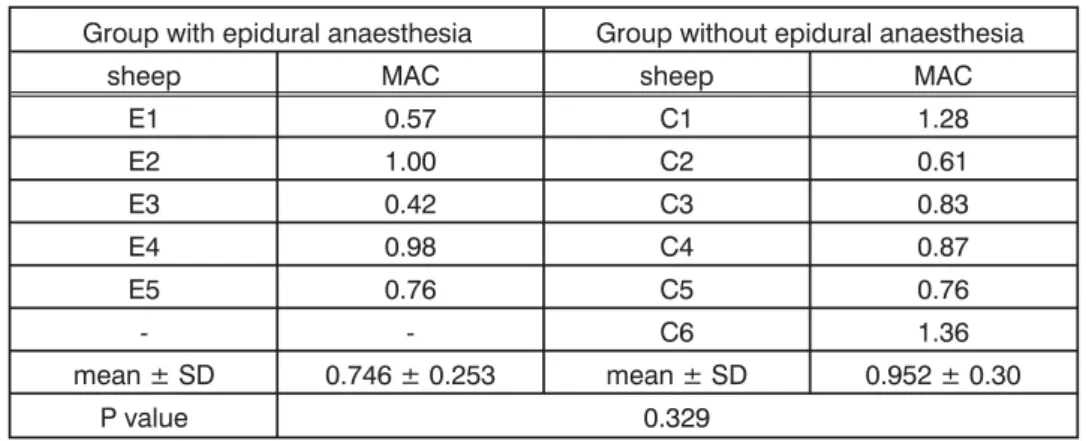
The mean MAC in Group C was higher by 27.6% compared to Group E. The MAC mean values for Group E and C were 0.75 % ± 0.25 and 0.95 ± 0.3, respectively. This distinction, according to the Mann-Whitney test, was not significant (p=0.329). The results of the volume of consumed isoflurane and minimal alveolar concentration of isoflurane in both groups are summarized in Table 2 and 3, respectively.
Table 2. The volume of consumed isoflurane in groups E and C during surgery
Group with epidural anaesthesia Group without epidural anaesthesia
sheep the consumed isofluranein mL/kg/60 min sheep the consumed isofluranein mL/kg/60 min
E1 0.334 C1 0.527
E2 0.378 C2 0.428
E3 0.347 C3 0.455
E4 0.335 C4 0.426
E5 0.382 C5 0.398
- - C6 0.475
mean ± SD 0.355 ± 0.023 mean ± SD 0.452 ± 0.045
Table 3. Minimal alveolar concentration of isoflurane in groups E and C during surgery
Group with epidural anaesthesia Group without epidural anaesthesia
sheep MAC sheep MAC
E1 0.57 C1 1.28
E2 1.00 C2 0.61
E3 0.42 C3 0.83
E4 0.98 C4 0.87
E5 0.76 C5 0.76
- - C6 1.36
mean ± SD 0.746 ± 0.253 mean ± SD 0.952 ± 0.30
P value 0.329
We administrated a combination of morphine and bupivacaine by epidural route after general anaesthesia in Group E. The onset of the effect was at an average of 13.2 minutes. In two sheep from this group, we did not observe any general attributes of epidural anaesthesia. The renewal of hind leg muscles reflexes was on average after 195 minutes. The sheep were able to stand after at an average of 372 minutes. All attributes of epidural analgesia in group E are summarized in Table 4.
Table 4. Effect of morphine and bupivacain on epidural analgesia in five sheep
Sheep analgesiaOnset of (min.)
Duration of analgesia
(min.)
Ability to stand
(min.) Observations
E1 15 195 315 adequate muscle relaxationpoor tail relaxation
E2 12 180 360 good muscle relaxationgood tail relaxation
E3 10 195 405 good muscle relaxationgood tail relaxation
E4 15 165 330 good muscle relaxationgood tail relaxation
E5 14 240 450 adequate muscle relaxationpoor tail relaxation
DISCUSSION
group compared to the epidural group. Two sheep had hyperventilation after surgery in group E. Troncy et al. (2002) described respiratory depression, assessed by a decrease in rate which was higher in dogs receiving epidural injections of morphine alone as opposed to dogs receiving morphine and bupivacaine, although the former group was maintained at a higher inhalational anesthetic concentration, which could have contributed to this adverse effect. We did not observe any complications associated with epidural anaesthesia. The complications of general anaesthesia included regurgitation and tympany. All sheep ingested food after 24 hours without problems.
In conclusion, the combination of midazolam, epidural analgesia and inhalant anaesthesia provided better muscle relaxation and analgesia during orthopaedic surgery. Isoflurane MAC and consumption were less in the epidural group and these results are in agreement with earlier findings. Sheep are relatively stoical creatures and it is possible that they do not display obvious signs of pain and distress. Postoperative comfort appeared better for the epidural group, although the respiration rate was less in the butorphanol group.
ACKNOWLEDGEMENTS:
This study was made with the support of the Scientific Sponsorship Agency of the Ministry of education of the Slovak Republic (project VEGA M[ SR ~. 1/0631/09).
Address for correspondence: MVDr. Durej Marek
Small animal clinic
University of Veterinary Medicine and Pharmacology Komenskeho 73
04081 Ko{ice, Slovak Republic E-mail: durejªuvm.sk
REFERENCES
1.Beltman ME,Self I,Duane M, 2010, The use of epidurals in cattle,Irish Vet J, 63, 51-4.
2.Day TK,Skarda RT, 1991, The pharmacology of local anesthetics, In:Vet Clin North Am Eq Pract, 7, 489-500.
3.Dodman NH,Levine H,Court M, 1992, Clinical assessment of analgesic effects of butorphanol in cattle, In: Short CE, Poznak A, editors, Animal pain, Churchill Livingstone, New York, 396-401. 4.Egger Ch,Love L, 2009, Local and regional anesthesia techniques, Part 4: Epidural anesthesia and
analgesia,Vet Med, 10, 460-6.
5.Eisenach JC, Decock M, Klim S, 1996, Alpha-2 adrenergic agonists for regional anesthesia: A clinical review of clonidine,Anesthesiology, 85, 655-74.
6.Feldman HS,Covino B, 1988, Comparative motor blocking effects of bupivacaine and ropivacaine, a new amino amide local anaesthetic in the rat and dog,Anesth Analg, 67, 1047-52.
7.Hashim MA,Hossain MA, 1989, Effect of starvation and positioning on gastro-esophageal reflux in anaesthetized goat during chloral hydrate-magnesium suphate anaesthesia,Bangl J Sci Ind Res, 24, 62-9.
8.Hendrix PK, Raffe MR, Robinson EP, Felice LJ, Randall DA,1996, Epidural administration of bupivacaine, morphine or their combination for post-operative analgesia in dogs,J Am Vet Med Assoc, 209, 598-607.
10.Kumar A,Chouhan DS, 1996, Local anaesthesia, In: Tyagi RPS, Singh J, editors, Ruminant surgery 1stedition, CBS, Shanhdara, Delhi, 110.
11.Ley S,Waterman A,Livingston A, Variation in the analgesic effects of xylazine in different breeds of sheep,Vet Rec, 126, 508.
12.Lucky NS,Hashim MA,Ahmed JU,Sarker K,Gazi NM,Ahmed S, 2007, Caudal epidural analgesia in sheep by using lignocaine hydrochloride and bupivacaine hydrochloride,Bangl J Vet Med, 5, 77-80.
13. Luttinger D, Ferarri R, Perrone MH, Haubrich D, 1985, Pharmacological analysis of alpha-2 adrenergic mechanisms in nociception and ataxia,J Pharm Experim Ther, 232, 883-9. 14.Muir HA,Shukla R,Liston R,Writer D, 1996, Randomized trial of labor analgesia: a pilot study to
compare patient-controlled intravenous analgesia with patient-controled epidural analgesia to determine if analgesic method affects delivery outcome (abstract),Can J Anaesth, 43, A60. 15. Novello L, 2010, Pros and cons of epidurals with local for orthopaedic surgery, Proceedings
WVOC, Bologna, september 15 – 18, Italy.
16.Pablo LS, 1993, Epidural morphine in goats after hindlimb orthopedic surgery,Vet Surg, 22, 307-10. 17. Riebold TW, 2002, Anesthesia in South American camelids, In: Greene SA, editor, Veterinary
Anesthesia and Pain Management Secrets. Philadelphia, PA:Hanley & Belfus, 263-72. 18.Sharma SK,Sidawi JE,Ramin SM,Lucas MJ,Leveno KJ,Cunningham FG, 1997, Cesarean delivery:
a randomized trial of epidural versus patient-controlled meperidine analgesia during labor, Anesthesiology, 87, 487-94.
19.Sherajee SJ,Rafiq K,Juyena NS,Ahmed S,Hashim MA, 2003, Combined sedation and regional analgesia in Black Bengal goats of Bangladesh,J Biol Science, 3, 1140-7.
20.Sibanda S,Hughes JML,Pawson PE,Kelly G,Bellenger, CR, 2006, The effects of preoperative extradural bupivacaine and morphine on the stress response in dogs undergoing femoro-tibial joint surgery,Vet Anaesth Analg, 33, 246-57.
21.Troncy E,Junot S,Keroack S, 2002, Results of preemptive epidural administration of morphine with or without bupivacaine in dogs and cats undergoing surgery: 265 cases (1997-1999),J Am Vet Med Assoc, 221, 666-71.
EFIKASNOST PRIMENE EPIDURALNE ANESTEZIJE KORI[]ENJEM MORFINA SA BUPIVAKAINOM U ORTOPEDSKOJ HIRURGIJI OVACA
DUREJ M, LEDECKÝ V, MICHALÁK D, HLUCHÝ M i KÒAZOVICKÝ D
SADR@AJ