A New Methodology for Neutrosophic Multi-attribute
Decision-making with Unknown Weight Information
Pranab Biswas1, Surapati Pramanik2*, and Bibhas C. Giri3
1
Department of Mathematics, Jadavpur University, Kolkata,700032, India. E-mail: [email protected]
2 *Department of Mathematics, Nandalal Ghosh B.T. College, Panpur, P.O.-Narayanpur, 743126, India. Email: [email protected] 3
Department of Mathematics, Jadavpur University, Kolkata,700032, India. Email:[email protected]
*Corresponding author’s email: [email protected]
Abstract. In this paper, we present multi-attribute decision-making problem with neutrosophic assessment. We assume that the information about attribute weights is incompletely known or completely unknown. The ratings of alternatives with respect to each attributes are considered as single-valued neutrosophic set to catch up imprecise or vague information. Neutrosophic set is characterized by three independent degrees namely truth-membership degree (T), indeterminacy-truth-membership degree (I), and falsity-membership degree (F). The modified grey relational analysis method is proposed to find out the best alternative for multi-attribute decision-making problem under neutrosophic
environment. We establish a deviation based optimization model based on the ideal alternative to determine attribute weight in which the information about attribute weights is incompletely known. Again, we solve an optimization model with the help of Lagrange functions to find out the completely unknown attributes weight. By using these attributes weight we calculate the grey relational coefficient of each alternative from ideal alternative for ranking the alternatives. Finally, an illustrative example is provided in order to demonstrate its applicability and effectiveness of the proposed approach.
Keywords: Neutrosophic set; Single-valued neutrosophic set; Grey relational analysis; Multi-attribute decision making; Unknown weight information.
1 Introduction
In the real world problem, we often encounter different type of uncertainties that cannot be handled with classical mathematics. In order to deal differen types of uncertainty, Fuzzy set due to Zadeh [1] is very useful and effective. It deals with a kind of uncertainty known as “fuzziness”. Each real value of [0, 1] represents the membership degree of an element of a fuzzy set i.e partial belongingness is considered. If μA(x)∈[0,1]is the membership degree of an element x of a fuzzy set A, then (1-μA(x)) is assumed as the non-membership degree of that element. This is not generally hold for an element with incomplete information. In 1986, Atanassov [2] developed the idea of intuitionistic fuzzy set (IFS). An element of intuitionistic fuzzy set A characterized by the membership degree μA(x)∈[0,1] as well as non-membership degreeνA(x)∈[0,1] with some restriction 0ืȝA(x)+ȞA(x)ื1.Therefoe certain amount of indeterminacy or incomplete information
(
(x) (x))
1−μA +νA remains by default. However, one may also consider the possibility μA(x)+νA(x)>1, so that inconsistent beliefs are also allowed. In this case, an element may be regarded as both member and non-member at the same time. A set connected with this features is called Para-consistent Set [3].
Smarandache [3-5] introduced the concept of neutrosophic set (NS) which is actually generalization of different type of FSs and IFSs. Consider an example, if μA(x)∈[0,1]is a membership degree, νA(x)∈[0,1] is a non-membership
degree of an element x of a set A, then fuzzy set can be expressed as A= x/(μA(x),0,1−μA(x)) and IFS can be represented as A = x/(ȝA(x),1-ȝA(x)-ȞA(x),ȞA(x)) with 0≤μA(x)+νA(x)≤1 . The main feature of neutrosophic set is that every element of the universe has not only a certain degree of truth (T) but also a falsity degree (F) and indeterminacy degree (I). These three degrees have to consider independently from each other. Another interesting feature of neutrosophic set is that we do not even assume that the incompleteness or indeterminacy degree is always given by
(
(x) (x))
1−μA +νA .
Multiple attribute decision-making (MADM) problem in the area of operation research, management science, economics, systemic optimization, urban planning and many other fields has gained very much attention to the researchers during the last several decades. These problems generally consist of choosing the most desirable alternative that has the highest degree of satisfaction from a set of alternatives with respect to their attributes. In this approach the decision makers have to provide qualitative and/ or quantitative assessments for determining the performance of each alternative with respect to each attribute, and the relative importance of evaluation attribute.
Pranab Biswas, Surapati Pramanik, Bibhas C. Giri, A New Methodology forNeutrosophic Multiple Attribute Decision-making with Unknown Weight Information.
possible to evaluate the importance of attributes weights and the ratings of alternatives by using crisp numbers due to un-availability of complete information about attribute values. Chen [11] extended the classical TOPSIS by developing a methodology for solving multi-criteria decision-making problems in fuzzy environment. Zeng [12] solved fuzzy MADM problem with known attribute weight by using expected value operator of fuzzy variables. However, fuzzy set can only focus on the membership grade of vague parameters or events. It fails to handle non-membership degree and indeterminacy degree of imprecise parameters. Boran et al. [13] extended the TOPSIS method for multi-criteria intuitionistic decision-making problem. Xu and Hu [14] developed two projection models for MADM problems with intuitionistic fuzzy information. Xu [15] studied MADM problem with interval-valued intuitionistic fuzzy decision-making by using distance measure.
In IFS the sum of membership degree and non-membership degree of a vague parameter is less than unity. Therefore, a certain amount of incomplete information or indeterminacy arises in an intuitionistic fuzzy set. It cannot handle all types of uncertainties successfully in different real physical problems. Hence further generalizations of fuzzy set as well as intuitionistic fuzzy sets are required.
Neutrosophic set information is helpful to handling MADM for the most general ambiguity cases, including paradox. The assessment of attribute values by the decision maker takes the form of single-valued neutrosophic set (SVNS) which is defined by Wang et al. [16]. Ye [17] studied multi-criteria decision-making problem under SVNS environment. He proposed a method for ranking of alternatives by using weighted correlation coefficient. Ye [18] also discussed single-valued neutrosophic cross entropy for multi-criteria decision-making problems. He used similarity measure for interval valued neutrosophic set for solving multi-criteria decision-making problems. Grey relational analysis (GRA) is widely used for MADM problems. Deng [19-20] developed the GRA method that is applied in various areas, such as economics, marketing, personal selection and agriculture. Zhang et al. [21] discussed GRA method for multi attribute decision-making with interval numbers. An improved GRA method proposed by Rao & Singh [22] is applied for making a decision in manufacturing situations. Wei [23] studied the GRA method for intuitionistic fuzzy multi-criteria decision-making. Biswas et al. [24] developed an entropy based grey relational analysis method for multi-attribute decision-making problem under single valued neutrosophic assessments.
The objective of this paper is to study neutrosophic MADM with unknown weight information using GRA. The rest of the paper is organized as follows. Section 2
briefly presents some preliminaries relating to neutrosophic set and single-valued neutrosophic set. In Section 3, Hamming distance between two single-valued neutrosophic sets is defined. Section 4 is devoted to represent the new model of MADM with SVNSs based on modified GRA. In section 5, an illustrative example is provided to show the effectiveness of the proposed model. Finally, section 6 presents the concluding remarks.
2 Preliminaries of Neutrosophic sets and Single valued neutrosophic set
In this section, we provide some basic definition about neutrosophic set due to Smrandache [3], which will be used to develop the paper.
Definition 1 Let X be a space of points (objects) with
generic element in X denoted by x. Then a neutrosophic set A in X is characterized by a truth membership function TA, an indeterminacy membership function IA and a falsity membership function FA. The functions TA, IA and FA are real standard or non-standard subsets of] 0-, 1+[ that is TA : X→]0
-, 1+[ ; IA : X→]0
-, 1+[; FA : X→]0
-, 1+[
It should be noted that there is no restriction on the sum of TA(x), IA(x), FA(x) i.e. 0
- ≤
TA(x) + IA(x) +FA(x) ≤ 3 +
.
Definition 2 The complement of a neutrosophic set A is
denoted by Acand is defined by =
) x (
TAc {1}−TA(x) +
; I c(x) {1} IA(x)
A = −
+
;
) x ( F } 1 { ) x (
Fc A
A = −
+
Definition 3 A neutrosophic set A is contained in the other neutrosophic set B, A⊆B if and only if the following result holds.
) x ( T inf ) x ( T
inf A ≤ B , supTA(x)≤supTB(x) (1) )
x ( I inf ) x ( I
inf A ≥ B , supIA(x)≥supIB(x) (2) )
x ( F inf ) x ( F
inf A ≥ B , supFA(x)≥supFB(x) (3) for all x in X.
3Some basics of single valued neutrosophic sets (SVNSs)
In this section we provide some definitions, operations and properties about single valued neutrosophic sets due to Wang et al. [17]. It will be required to develop the rest of the paper.
Definition 4 (Single-valued neutrosophic set). Let X be a universal space of points (objects), with a generic element of X denoted by x. A single-valued neutrosophic set
X
⊂
~
N is characterized by a true membership function )
x ( T~
indeterminacy function I~(x)
N withT~N(x), IN~(x), F~N(x)∈
[0, 1] for all x in X.
When X is continuous a SVNSs, N~can be written as ∫
= x
~ ~
~(x),I (x),F (x) x, T
~
N N N
N ∀x∈X.
and when X is discrete a SVNSs N~can be written as
∑T (x),I (x),F (x) /x
~ m 1 i ~ ~ ~ =
= N N N
N , ∀x∈X.
Actually, SVNS is an instance of neutrosophic set that can be used in real life situations like decision making, scientific and engineering applications. In case of SVNS, the degree of the truth membership T~(x),
N the
indeterminacy membership I~(x)
N and the falsity
membership F~(x)
N values belong to [0, 1] instead of non
standard unit interval] 0-, 1+ [as in the case of ordinary neutrosophic sets.
It should be noted that for a SVNSN~,
3 ื ) x ( F sup ) x ( I sup ) x ( T sup ื
0 ~ ~ ~
N N
N + + ,∀x∈X. (4)
and for a neutrosophic set, the following relation holds , 3 ื ) x ( F sup + ) x ( I sup + ) x ( T sup ื 0 + ~ ~ ~ -N N
N ∀x∈X. (5)
Definition 5 The complement of a neutrosophic set N~ is denoted by N~cand is defined by
= ) x (
T~Nc FN~(x);IN~c(x)= 1−IN~(x); F~Nc(x)= TN~(x)
Definition 6 A SVNS N~A is contained in the other SVNS
B ~
N , denoted as N~A ⊆N~B, if and only if ) x ( T ื ) x ( T B ~ A ~ N
N ;IN~A(x)≥IN~B(x);FN~A(x)ุ FN~B(x)
. X x∈ ∀
Definition 7 Two SVNSs N~A and N~B are equal, i.e. N~A
= N~B, if and only if N~A⊆N~B and N~A ⊇ N~B.
Definition 8 (Union)The union of two SVNSsN~A and
B ~
N is a SVNSN~C, written as N~C= N~A∪N~B. Its truth membership, indeterminacy-membership and falsity membership functions are related to those of N~A and N~B
by )) x ( T ), x ( T ( max = ) x ( T B ~ A ~ C ~ N N N ; )) x ( I ), x ( I ( max = ) x ( I B ~ A ~ C ~ N N N ; )) x ( F ), x ( F ( min = ) x ( F B ~ A ~ C ~ N N
N for all x in X.
Definition 9 (Intersection)The intersection of two SVNSs
A ~
N and N~B is a SVNS N~C, written as N~C= N~A ∩N~B, whose truth membership, indeterminacy-membership and falsity membership functions are related to those of N~A
and N~B byT (x)=min(T (x),T (x)) B ~ A ~ C ~ N N N ; )) x ( I ), x ( I ( min = ) x ( I B ~ A ~ C ~ N N N ; )) x ( F ), x ( F ( max = ) x ( F B ~ A ~ C ~ N N
N for all x in X.
4 Distance between two neutrosophic sets.
Similar to fuzzy or intuitionistic fuzzy set, the general SVNS having the following pattern
}. ∈ x : )) x ( F ), x ( I ), x ( T /( x {( ~ ~ ~ ~ X N N N
N= For finite SVNSs
can be represented by the ordered tetrads:
))} x ( F ), x ( I ), x ( T /( x ..., )), x ( F ), x ( I ), x ( T /( x {( ~ m ~ m ~ m ~ m 1 ~ 1 ~ 1 ~ 1 N N N N N N N=
, ∀x∈X
Definition 10 Let
))} x ( F ), x ( I ), x ( T /( x ..., )), x ( F ), x ( I ), x ( T /( x {( ~ n A ~ n A ~ n A ~ n 1 A ~ 1 A ~ 1 A ~ 1 A N N N N N N N = and ))} x ( F ), x ( I ), x ( T /( x ..., )), x ( F ), x ( I ), x ( T /( x {( ~ n B ~ n B ~ n B ~ n 1 B ~ 1 B ~ 1 B ~ 1 B N N N N N N N = (6)
be two SVNSs in X = {x1, x2,…, xn).
Then the Hamming distance between two SVNSs N~Aand
B ~
N is defined as follows:
∑ ) x ( F ) x ( F ) x ( I ) x ( I ) x ( T ) x ( T d n 1 i 1 B ~ 1 A ~ 1 B ~ 1 A ~ 1 B ~ 1 A ~ B , A ~ ~ ~ = ⎪ ⎪ ⎭ ⎪⎪ ⎬ ⎫ ⎪ ⎪ ⎩ ⎪⎪ ⎨ ⎧ − + − + − = ⎟ ⎠ ⎞ ⎜ ⎝ ⎛ N N N N N N
N N N (7)
and normalized Hamming distance between two SVNSs
A ~
N and B
~
N is defined as follows:
{
}
∑ T (x) T (x) I (x) I (x) F (x) F (x) n 3 1 d n 1 i 1 B ~ 1 A ~ 1 B ~ 1 A ~ 1 B ~ 1 A ~ B , A ~
N ~ ~
= − + − + − = ⎟ ⎠ ⎞ ⎜ ⎝ ⎛ N N N N N N N N N
(8) with the following two properties
1. 0ืdN~
(
N~A,N~B)
ื3n (9) 2. 0ื d~(
~A,~B)
ื1N N N
N (10)
5 GRA based single valued neutrosophic multiple attribute decision-making problems with incomplete weight information.
Pranab Biswas, Surapati Pramanik, Bibhas C. Giri, A New Methodology forNeutrosophic Multiple Attribute Decision-making with Unknown Weight Information.
Table 1. Decision matrix of attribute values
C1 C2 ... Cn
n m ij d D
×
= =
m 2 1
A . . A A
⎥ ⎥ ⎥ ⎥ ⎥ ⎥ ⎥
⎦ ⎤
⎢ ⎢ ⎢ ⎢ ⎢ ⎢ ⎢
⎣ ⎡
mn 2
m 1 m
n 2 22
21
n 1 12
11
d ... d
d
... ... ... ...
... ... ... ...
d ... d d
d ... d
d
(11)
The weight wj∈[0,1]( j = 1, 2, ..., n) reflects the relative
importance of attribute Cj ( j = 1, 2, ..., m) to the
decision-making process such that ∑ = = n
1 j j
. 1
w S is a set of known
weight information that can be represented by the following forms due to Park et al. [25], Park and Kim [26], Kim et al. [27], Kim and Ahn [28], and Park [29].
Form 1. A weak ranking: wi≥wj, for i ≠j;
Form 2. A strict ranking: wi−wj≥ϕi,ϕi>0, for i ≠j;
Form 3. A ranking of differences:wi−wj≥wk−wl, for
l k j≠ ≠ ;
Form 4. A ranking with multiples:wi≥βjwj,βj∈[0,1],
for i ≠j;
Form 5. An interval form: αi≤wi≤αi+εi,
. 1 0≤αi<αi+εi ≤
GRA is one of the derived evaluation methods for MADM based on the concept of grey relational space. The first step of GRA method is to create a comparable sequence of the performance of all alternatives. This step is known as data pre-processing. A reference sequence (ideal target sequence) is defined from these sequences. Then, the grey relational coefficient between all comparability sequences and the reference sequence for different values of distinguishing coefficient are calculated. Finally, based on these grey relational coefficients, the grey relational degree between the reference sequence and every comparability sequences is calculated. If an alternative gets the highest grey relational grade with the reference sequence, it means that the comparability sequence is most similar to the reference sequence and that alternative would be the best choice (Fung [30]). The steps of improved GRA method under SVNS are described below.
Step 1. Determine the most important criteria.
Generally, there are many criteria or attributes in decision-making problems, where some of them are important and others may not be so important. So it is crucial to select the proper criteria or attributes for decision-making situation. The most important attributes may be chosen with the help of experts’ opinions or by some others method that are technically sound.
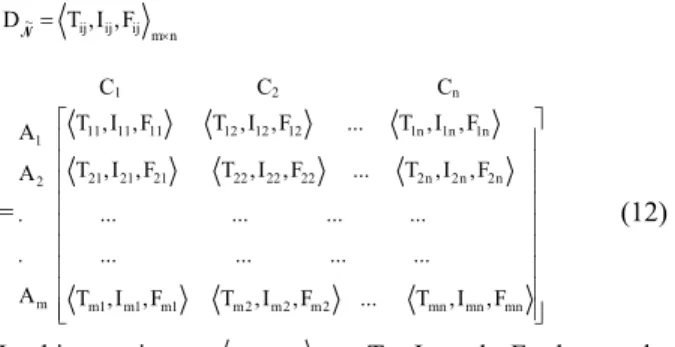
Step 2. Construct the decision matrix with SVNSs
Assume that a multiple attribute decision making problem have m alternatives and n attributes. The general form of decision matrix as shown in Table1 can be presented after data pre-processing. The original GRA method can effectively deal with quantitative attributes. However, there exist some difficulties in the case of qualitative attributes. In the case of a qualitative attribute, an assessment value may be taken as SVNSs. In this paper we assume that the ratings of alternatives Ai (i = 1, 2,…m ) with respect to attributes Cj (j = 1, 2,…n) are SVNSs. Thus the neutrosophic values associated with the alternatives for MADM problems can be represented in the following decision matrix:
Table 2. Decision matrix with SVNS
n m ij ij ij ~ T,I,F
D
×
=
N
C1 C2 Cn
=
m 2 1
A . . A A
⎥ ⎥ ⎥ ⎥ ⎥ ⎥ ⎥ ⎥ ⎥
⎦ ⎤
⎢ ⎢ ⎢ ⎢ ⎢ ⎢ ⎢ ⎢ ⎢
⎣ ⎡
mn mn mn 2
m 2 m 2 m 1 m 1 m 1 m
n 2 n 2 n 2 22
22 22 21 21 21
n 1 n 1 n 1 12
12 12 11 11 11
F , I , T ... F , I , T F , I , T
... ... ... ...
... ... ... ...
F , I , T ... F , I , T F , I , T
F , I , T ... F , I , T F , I , T
(12)
In this matrix
n m ij ij ij ~ T,I,F
D
×
=
N , Tij, Iij and Fij denote the degrees of truth membership, degree of indeterminacy and degree of falsity membership of the alternative Ai with respect to attribute Cj. These three degrees for SVNS satisfying the following properties:
1. 0≤Tij≤1, 0≤Iij≤1, 0≤Fij≤1
2. 0≤Tij+Iij+Fij≤3.
Step 3. Determine the ideal neutrosophic estimates
reliability solution (INERS) and the ideal neutrosophic estimates un-reliability solution (INEURS) for neutrosophic decision matrix.
The ideal reliability estimation can be easily determined due to Biswas et al. [24].
Definition 11 The ideal neutrosophic estimates reliability
solution (INERS) Q [q ,q ,...,q ] n ~ 2 ~ 1 ~
~ + + +
+ =
N N N
N is a solution in
which every component +
j + j + j +
j
~ = T ,I ,F
qN , where
}, T { max =
T ij
i +
j I min{Iij} i j = +
and F min{Fij} i j = +
in the
neutrosophic decision matrix
n m ij ij ij ~ T,I ,F D
×
=
N .
Definition 12 The ideal neutrosophic estimates
un-reliability solution (INEURS) Q [q ,q ,...,q ] n ~ 2 ~ 1 ~
~ − − −
− =
N N N
be taken as a solution in the form − = j− −j j− j
~ T ,I ,F
qN , where
}, T { min
T ij
i j = −
} I { max
I ij
i j =
− and F max{F}
ij i j =
− in the
neutrosophic decision matrix
n m ij ij ij ~ T,I ,F D
×
=
N .
Step 4. Calculate the neutrosophic grey relational
coefficient of each alternative from INERS and INEURS.
Grey relational coefficient of each alternative from INERS is defined as:
ij j i ij
ij j i ij j i ij
max max
max max min
min
+ +
+ +
+
Δ ρ
+ Δ
Δ ρ
+ Δ =
χ , where
ij +
Δ =
(
~ij)
j ~,q q d
N N
+
, i= 1, 2,…,m. and j=1, 2,…,n. (13)
Grey relational coefficient of each alternative from INEURS is defined as:
ij j i ij
ij j i ij j i ij
max max
max max min
min
− −
− −
−
Δ ρ
+ Δ
Δ ρ
+ Δ =
χ , where
ij −
Δ =
(
−~j)
ij ~,q qd N N , i = 1, 2,…,m. and j = 1, 2,…,n. (14) ρis the distinguishing coefficient or the identification coefficient, ρ
∈
[0,1]. Smaller value of distinguishing coefficient will yield in large range of grey relational coefficient. Generally, ρ = 0.5 is considered for decision- making situation.Step 5. Determine the weights of criteria.
In the decision-making process, decision maker may often feel that the importance of the attributes is not same. Due to the complexity and uncertainty of real world decision-making problems, the information about attribute weights is usually incomplete. The estimation of the attribute weights plays an important role in MADM. Therefore, we need to determine reasonable attribute weight for making a reasonable decision. Many methods are available to determine the unknown attribute weight in the literature such as maximizing deviation method (Wu and Chen [31]), entropy method (Wei and Tang [32]; Xu and Hui [33]), optimization method (Wang and Zhang [34-35]) etc. In this paper, we use optimization method to determine unknown attribute weights for neutrosophic MADM.
The basic principle of the GRA method is that the chosen alternative should have the largest degree of grey relation from the INERS. Thus, the larger grey relational coefficient determines the best alternative for the given weight vector. To obtain the grey relational coefficient, we have to calculate weight vector of attributes if the information about attribute weights is incompletely known. The grey relational coefficient between INERS and itself is
(1, 1, …, 1), similarly, coefficient between INEURS and itself is also (1, 1, …, 1). So the corresponding comprehensive deviations are
(
)
jn
1 j ij i(W) 1 w d =∑ −χ
= +
+ (15)
(
)
jn
1 j ij i(W) 1 w d =∑ −χ
= −
− (16)
Smaller value of (15) as well as (16) indicates the better alternative Ai. A satisfactory weight vector W= (w1, w2,…, wn) is determined by making smaller all the distances
(
)
jn
1 j ij i(W) 1 w
d =∑ −χ
= +
+ and
(
)
j n
1 j ij i(W) 1 w
d =∑ −χ
= −
− .
We utilize the max-min operator developed by Zimmermann and Zysco [36] to integrate all the distances
(
)
jn
1 j ij i(W) 1 w d =∑ −χ
= + +
for i = 1, 2, …, m and
(
)
jn
1 j ij i(W) 1 w d =∑ −χ
= − −
for i = 1, 2, …, m separately.
Therefore, we can formulate the following programming model:
(M-1a)
(
)
⎪ ⎪ ⎩ ⎪ ⎪ ⎨ ⎧
∈
= ξ ≤
∑ −χ
ξ
+ =
+ +
S W
m ... , 2 , 1 i for w 1 : to subject Min
j n
1 j ij
(17)
(M-1b)
(
)
⎪ ⎪ ⎩ ⎪ ⎪ ⎨ ⎧
∈
= ξ ≤
∑ −χ
ξ
− =
− −
S W
m ... , 2 , 1 i for w 1 : to subject Min
j n
1 j ij
(18)
Here ξ+=
(
)
⎭ ⎬ ⎫ ⎩⎨
⎧∑ −χ
= +
j n
1 j ij
i 1 w
max (19)
and ξ−=
(
)
⎭ ⎬ ⎫ ⎩⎨
⎧∑ −χ
= −
j n
1 j ij
i 1 w
max for 1, 2, …, m. (20)
Solving these two model (M-1a) and (M-1b), we obtain the optimal solutions W (w1,w2,...wn)
+ + + +=
and
) w ... , w , w (
W 1 2 n
− − − −=
respectively. Combinations of these two optimal solutions will give us the weight vector of the attributes i.e. W=γW++(1−γ)W− for γ∈[0,1]. (21)
If the information about attribute weights is completely unknown, we can establish another multiple objective programming:
(M-2)
(
)
[
]
⎪ ⎪ ⎩ ⎪⎪ ⎨ ⎧
=
= χ
− =
= =
+ +
∑w 1
: to subject
. m ..., , 1 i ,
∑1 w
) W ( d min
n
1 j j
n
1 j
2 j ij i
Pranab Biswas, Surapati Pramanik, Bibhas C. Giri, A New Methodology forNeutrosophic Multiple Attribute Decision-making with Unknown Weight Information.
Since each alternative is non-inferior, so there exists no preference relation between the alternatives. Then, we can aggregate the above multiple objective optimization models with equal weights in to the following single objective optimization model:
(M-3)
(
)
[
]
⎪ ⎪ ⎩ ⎪⎪ ⎨ ⎧ = = χ − = = = = = + = + +∑w 1
: to subject . m ..., , 1 i ,
∑∑1 w
∑d (W)
) W ( d min n 1 j j m 1 i n 1 j 2 j ij m 1 i i (23)
To solve this model, we construct the Lagrange function:
)
Ȝ
, W (
L =
[
(
)
]
⎟⎠ ⎞ ⎜ ⎝ ⎛ − λ + χ − = = = + ∑ 1 w 2
∑∑1 w n
1 j j m 1 i n 1 j 2 j
ij (24)
Where λ is the Lagrange multiplier. Differentiating equation (24) with respect to wj (j = 1, 2,…, n) and λ, and putting these partial derivatives equal to zero, we have the following set of equations:
0 2 ) 1 ( w 2 w ) , w ( L m 1 i 2 ij j j
j = ∑ −χ + λ= ∂ λ ∂ = + (25) ∑ − = = λ ∂ λ ∂ = n 1 j j j 0 1 w ) , w ( L (26)
Solving equations (25) and (26), we obtain the following relation
(
)
⎥ ∑(
−χ)
⎦ ⎤ ⎢
⎣ ⎡
∑⎜⎝⎛∑ χ− ⎟⎠⎞ = = + − = − = + + m 1 i 2 ij 1 n 1 j 1 m 1 i 2 ij
j 1 1
w (27)
Then we get χ+ifor i = 1, 2,…, m.
Similarly, we can find out the attribute weight w taking −j into consideration of INERUS as:
(
)
⎥ ∑(
−χ)
⎦ ⎤ ⎢
⎣ ⎡
∑⎜⎝⎛∑ χ− ⎟⎠⎞ = = − − = − = − − m 1 i 2 ij 1 n 1 j 1 m 1 i 2 ij
j 1 1
w (28)
Combining (27) and (28), we can determine the j-th
attribute weight with the help of (21).
Step 6. Calculate of neutrosophic grey relational coefficient (NGRC).
The degree of neutrosophic grey relational coefficient of each alternative from ITFPIS and ITFNIS are calculated by using the following equations:
∑nw
1 j j ij i
= +
+= χ
χ (29)
and χ =∑ χ =
− − n
1 j j ij
i w for i= 1, 2,…,m. (30)
Step 7. Calculate the neutrosophic relative relational degree (NRD).
We calculate the neutrosophic relative relational degree of each alternative from ITFPIS by employing the following equation: − + + χ + χ χ = i i i i
R , for i = 1, 2,…, m. (31)
Step 8. Rank the alternatives.
Based on the neutrosophic relative relational degree, the ranking order of all alternatives can be determined. The highest value of Ri presents the most desired alternatives.
5 . Illustrative Examples
In this section, neutrosophic MADM is considered to demonstrate the application and the effectiveness of the proposed approach. Let us consider the decision-making problem adapted from Ye [37]. Suppose there is an investment company, which wants to invest a sum of money in the best option. There is a panel with four possible alternatives to invest the money: (1) A1 is a car company; (2) A2 is a food company; (3) A3 is a computer company; and (4) A4 is an arms company. The investment company must take a decision based on the following three criteria: (1) C1 is the risk analysis; (2) C2 is the growth analysis; and (3) C3 is the environmental impact analysis. We obtain the following single-valued neutrosophic decision matrix based on the experts’ assessment:
Table3. Decision matrix with SVNS
3 4 ij ij ij ~ T,I,F
D
×
=
N =
C1 C2 C3
4 3 2 1 A A A A ⎥ ⎥ ⎥ ⎥ ⎥ ⎥ ⎥ ⎦ ⎤ ⎢ ⎢ ⎢ ⎢ ⎢ ⎢ ⎢ ⎣ ⎡ 2 . 0 , 3 . 0 , 4 . 0 2 . 0 , 1 . 0 , 6 . 0 1 . 0 , 0 . 0 , 7 . 0 2 . 0 , 3 . 0 , 5 . 0 3 . 0 , 2 . 0 , 5 . 0 3 . 0 , 2 . 0 , 3 . 0 2 . 0 , 2 . 0 , 5 . 0 2 . 0 , 1 . 0 , 6 . 0 2 . 0 , 1 . 0 , 6 . 0 5 . 0 , 2 . 0 , 2 . 0 3 . 0 , 2 . 0 , 4 . 0 3 . 0 , 2 . 0 , 4 . 0 (32)
Information about the attribute weights is partially known. The known weight information is given as follows: S = {.30≤ w1 ≤ .35, .36≤ w2 ≤ .48, .26≤ w3 ≤ .30}
such that wj≥0 for j = 1, 2, 3and w 1. 3 1 j j = ∑ =
Step 1. Determine the ideal neutrosophic estimates
⎥ ⎥ ⎥ ⎥
⎦ ⎤
⎢ ⎢ ⎢ ⎢
⎣ ⎡
=
= + + +
+
} F { min }, I { min }, T { max
, } F { min }, I { min }, T { max , } F { min }, I { min }, T { max
] q , q , q [ Q
3 i i 3 i i 3 i i
2 i i 2 i i 2 i i 1 i i 1 i i 1 i i
3 ~ 2 ~ 1 ~ ~
N N N N
=
[
0.7,0.0,0.1, 0.6,0.1,0.2, 0.5,0.2,0.2]
Step 2. Similarly, determine the ideal neutrosophic
estimates un-reliability solution (INEURS) as:
⎥ ⎥ ⎥ ⎥
⎦ ⎤
⎢ ⎢ ⎢ ⎢
⎣ ⎡
=
= − − −
+
} F { max }, I { max }, T { min
, } F { max }, I { max }, T { min , } F { max }, I { max }, T { min
] q , q , q [ Q
3 i i 3 i i 3 i i
2 i i 2 i i 2 i i 1 i i 1 i i 1 i i
3 ~ 2 ~ 1 ~ ~
N N N N
=
[
0.4,0.2,0.3, 0.4,0.2,0.3, 0.2,0.3,0.5]
Step 3. Calculation of the neutrosophic grey relational
coefficient of each alternative from INERS and INEURS By using equation (13) the neutrosophic grey relational coefficient of each alternative from INERS can be obtained
as:
[ ]
⎥ ⎥ ⎥ ⎥ ⎥
⎦ ⎤
⎢ ⎢ ⎢ ⎢ ⎢
⎣ ⎡
= χ+ ×
6666 . 0 0000 . 1 0000 . 1
8000 . 0 5714 . 0 3333 . 0
0000 . 1 0000 . 1 5714 . 0
4000 . 0 5000 . 0 3636 . 0
3 4
ij (33)
and from equation (14), the neutrosophic grey relational coefficient of each alternative from INEUS is
[ ]
⎥ ⎥ ⎥ ⎥ ⎥
⎦ ⎤
⎢ ⎢ ⎢ ⎢ ⎢
⎣ ⎡
= χ− ×
4111 . 0 4667 . 0 3333 . 0
3684 . 0 7778 . 0 7778 . 0
3333 . 0 4667 . 0 4667 . 0
7778 . 0 0000 . 1 0000 . 1
3 4
ij (34)
Step 4. Determine the weights of attribute.
Case 1. Utilizing the model (M-1a) and (M-2b), we
establish the single objective programming model: Case 1a. Minξ+
subject to: 0.6364 w1+ 0.5000 w2+ 0.6000w3≤ξ+; 0.4286 w1≤ξ+;
0.6667w1+ 0.4286 w2+ 0.2000w3≤ξ+;
0.3334w3≤ +
ξ ; 30≤ w1≤ 35; 36≤ w2≤ 48; 26≤ w3 ≤ 30;
w1+ w2+ w3=1; wj ≥0, j = 1, 2, 3. Case 1b.
Similarly, Minξ−
subject to: 0.2222w3≤ −
ξ ; 0.5353w1+ 0.5353 w2+ 0.6667 w3≤
−
ξ ; 0.2222w1+ 0.2222 w2+ 0.6316w3≤
−
ξ ; 0.6667 w1+ 0.5353w2+ 0.5889w3≤
−
ξ ; 30≤ w1≤ 35; 36≤ w2≤ 48; 26≤ w3 ≤ 30;
w1+ w2+ w3=1; wj ≥0, j = 1, 2, 3.
We obtain the same solution set W+= W-= (0.30, 0.44, 0.26) after solving Case 1a and Case 1b separately. Therefore, the obtained weight vector of attributes is W = (0.30, 0.44, 0.26).
Case 2. If the information about the attribute weights is
completely unknown, we can use another proposed formula given in (27) and (28) to determine the weight vector of attributes. The weight vector W+= (0.1851, 0.4408, 0.3740) is determined from equation (27) and W-= (0.3464, 0.4361, 0.2174) from equation (28). Therefore, the resulting weight vector of attribute with the help of equation (21) (takingγ=0.5) is W′= (0.2657, 0.4384, 0.2957). After normalizing, we obtain the final weight vector of the attribute as W= (0.2657, 0.4385, 0.2958).
Step 5. Determine the degree of neutrosophic grey
relational co-efficient (NGRC) of each alternative from INERS and INEUS.
The required neutrosophic grey relational co-efficient of each alternative from INERS is determined by using equations (29) with the corresponding obtained weight vector W for Case-1 and Case-2 are presented in Table 4.
Similarly, the neutrosophic grey relational co-efficient of each alternative from INEURS is obtained with the help of equation (30) for all two cases are listed in Table 4.
Step 6. Neutrosophic relative degree (NRD) of each
Pranab Biswas, Surapati Pramanik, Bibhas C. Giri, A New Methodology forNeutrosophic Multiple Attribute Decision-making with Unknown Weight Information.
4. Calculation of NGRC and NRD of each alternative from neutrosophic estimates reliability solution
Proposed method Weight Vector NGRC from INERS NGRC from INEURS NRD from INERS Ranking Result Selection
0.4331 0.9422 0.3149
0.8714 0.4320 0.6686 R4>R2> R3>R1 A4
Case-1 (0.30, 0.44, 0.26) 0.5594 0.6714 0.4545 0.9133 0.4122 0.6890
0.4342 0.9343 0.3173
0.8861 0.4272 0.6747 R4>R2> R3>R1 A4
Case-2 (0.2657, 0.4385, 0.2958) 0.5758 0.6567 0.4672 0.9014 0.4149 0.6847
Step 7. From Table 4, we can easily determine the ranking
order of all alternatives according to the values of neutrosophic relational degrees. For case-1, we see that A4 i.e. Arms company is the best alternative for investment purpose. Similarly, for case-2 A4 i.e. Arms company also is the best alternative for investment purpose.
6 Conclusion
In this paper, we introduce single-valued neutrosophic multiple attribute decision-making problem with incompletely known or completely unknown attribute weight information based on modified GRA. In order to determine the incompletely known attribute weight minimizing deviation based optimization method is used. On the other hand, we solve an optimization model to find out the completely unknown attributes weight by using Lagrange functions. Finally, an illustrative example is provided to show the feasibility of the proposed approach and to demonstrate its practicality and effectiveness. However, we hope that the concept presented here will create new avenue of research in current neutrosophic decision-making arena. The main thrust of the paper will be in the field of practical decision-making, pattern recognition, medical diagnosis and clustering analysis.
References
[1] L. A. Zadeh. Fuzzy Sets, Information and Control, 8(1965), 338-353.
[2] K. T. Atanassov. Intuitionistic fuzzy sets, Fuzzy Sets and Systems, 20 (1986), 87–96.
[3] F. Smarandache. A unifying field in logics. Neutrosophy: Neutrosophic probability, set and logic. Rehoboth: American Research Press (1999).
[4] F. Smarandache. Neutrosophic set-a generalization of intuitionistic fuzzy set. Journal of Defense Resources Management, 1(1) (2010), 107-116.
[5] F. Smarandache. Neutrosophic set- a generalization of intuitionistic fuzzy sets. International Journal of Pure and Applied Mathematics, 24 (3) (2005), 287-297.
[6] C. L. Hwang, and K. Yoon. Multiple attribute decision making: methods and applications: a state-of-the-art survey, Springer, London (1981).
[7] J.P. Brans, P. Vinvke, and B. Mareschal. How to select and how to rank projects: The PROMETHEE method, European Journal of Operation Research, 24(1986), 228–238. [8] S. Opricovic. Multicriteria optimization of civil engineering
systems, Faculty of Civil Engineering, Belgrade (1998). [9] S. Opricovic, and G. H. Tzeng. Compromise solution by
MCDM methods: a comparative analysis of VIKOR and TOPSIS. European Journal of Operation Research, 156 (2004), 445–455.
[10]B. Roy. The outranking approach and the foundations of ELECTRE methods. Theory Decision, 31(1991), 49–73. [11]C. T. Chen. Extensions of the TOPSIS for group decision
making under fuzzy environment, Fuzzy Sets and Systems, 114(2000), 1-9.
[12]L. Zeng. Expected value method for fuzzy multiple attribute decision making, Tsinghua Science and Technology, 11 (2006) 102–106.
[13]F. E. Boran, S. Genc, M. Kurt, and D. Akay. A multi-criteria intuitionistic fuzzy group decision making for supplier selection with TOPSIS method, Expert Systems with Applications, 36(8) (2009), 11363–11368.
[14]Z. S. Xu. And H. Hu. Projection models for intuitionistic fuzzy multiple attribute decision making. International Journal of Information Technology & Decision Making. 9 (2) (2010), 285-297.
[15]Z. Xu. A method based on distance measure for interval-valued intuitionistic fuzzy group decision making, Information Sciences, 180(2010), 181-190.
[16]H. Wang, F. Smarandache, Y. Q. Zhang, and R. Sunderraman. Single valued neutrosophic sets. Multispace and Multistructure, 4(2010), 410–413.
[17]J. Ye. Multicriteria decision-making method using the correlation coefficient under single-valued neutrosophic environment, International Journal of General Systems, 42(4) (2013), 386-394.
[19]J. L. Deng. Introduction to grey system theory, The Journal of Grey System (UK), 1(1) (1989), 1–24.
[20]J. L. Deng. The primary methods of grey system theory, Huazhong University of Science and Technology Press, Wuhan (2005).
[21]J. J. Zhang, D. S. Wu, and D. L. Olson. The method of grey related analysis to multiple attribute decision making problems with interval numbers. Mathematical and Computer Modelling, 42(2005), 991–998.
[22]R. V. Rao, and D. Singh. An improved grey relational analysis as a decision making method for manufacturing situations, International Journal of Decision Science, Risk and Management, 2(2010), 1–23.
[23]G. W. Wei. Grey relational analysis method for intuitionistic fuzzy multiple attribute decision making. Expert systems with Applications, 38(2011), 11671-11677.
[24]P. Biswas, S. Pramanik, and B. C. Giri. Entropy based grey relational analysis method for multi-attribute decision-making under single valued neutrosophic assessments. Neutrosophic Sets and Systems, 2 (2014), 102-110.
[25]K.S. Park, S.H. Kim, and W.C. Yoon. Establishing strict dominance between alternatives with special type of incomplete information, European Journal of Operational Research, 96 (1996), 398-406.
[26]K.S. Park, S.H. Kim. Tools for interactive multi-attribute decision-making with incompletely identified information, European Journal of Operational Research, 98 (1997), 111-123.
[27]S.H. Kim, S.H. Choi, and J.K. Kim. An interactive procedure for multiple attribute group decision-making with incomplete information: range based approach, European Journal of Operational Research, 118 (1999), 139-152. [28]S.H. Kim, B.S. Ahn. Interactive group decision-making
procedure under incomplete information, European Journal of Operational Research, 116 (1999), 498-507.
[29]K.S. Park. Mathematical programming models for charactering dominance and potential optimality when multicriteria alternative values and weights are simultaneously incomplete, IEEE transactions on systems, man, and cybernetics-part A, Systems and Humans, 34 (2004) 601-614.
[30]C.P. Fung. Manufacturing process optimization for wear property of fibre-reinforced polybutylene terephthalate composites with gray relational analysis, Wear, 254(2003), 298–306.
[31]Z.B. Wu, and Y.H. Chen. The maximizing deviation method for group multiple attribute decision making under linguistic environment, Fuzzy Sets and Systems, 158(2007), 1608– 1617.
[32]C. Wei, and X. Tang. An intuitionistic fuzzy group decision making approach based on entropy and similarity measures, International Journal of Information Technology and Decision Making, 10(6) (2011), 1111-1130.
[33]Z. Xu, and H. Hui. Entropy based procedures for intuitionistic fuzzy multiple attribute decision making. Journal of Systems Engineering and Electronics. 20(5) (2009), 1001-1011.
[34]J. Q. Wang, and Z. H. Zhang. Multi-criteria decision-making method with incomplete certain information based on intuitionistic fuzzy number. Control and decision. 24 (2009), 226-230.
[35]J. Q. Wang, and Z. H. Zhang. Multi-criteria decision-making method with incomplete certain information based on intuitionistic fuzzy number. Control and decision. 24 (2009), 226-230.
[36]H.J. Zimmermann, P. Zysco. Latent connectives in human decision-making, Fuzzy Sets and Systems, 4 (1980), 37-51. [37]J. Ye. Fuzzy decision-making method based on the weighted
correlation coefficient under intuitionistic fuzzy environment. European Journal of Operational Research, 205(2010), 202–204.