University of New Mexico
Value and ambiguity index based ranking method of single-valued
trapezoidal neutrosophic numbers and its application to multi-attribute
decision making
Pranab Biswas
1, Surapati Pramanik
2, Bibhas C. Giri
3 1Department of Mathematics, Jadavpur University, Kolkata, 700032, India, [email protected] 2Department of Mathematics, Nandalal Ghosh B.T. College,Panpur,Narayanpur, 743126, India, sura [email protected]3Department of Mathematics, Jadavpur University, Kolkata, 700032, India, [email protected]
Abstract:The objective of the paper ARE to introduce single-valued trapezoidal neutrosophic numbers(SVTrNNs), which is a special case of single-valued neutrosophic numbers and to develop a ranking method for ranking SVTrNNs. Some operational rules as well as cut sets of SVTrNNs have been introduced. The value and ambiguity indices of truth, indeterminacy, and falsity membership functions of
SVTrNNs have been defined. A new ranking method has been pro-posed by using these two indices and applied the ranking method to multi attribute decision making problem in which the ratings of the alternatives over the attributes are expressed in terms of TrNFNs. Fi-nally, an illustrative example has been provided to demonstrate the validity and applicability of the proposed approach.
Keywords:Single-valued neutrosophic number(SVNN), Single-valued trapezoidal neutrosophic number, Value index, Ambiguity index, Ranking of SVTrNNs, Multi attribute decision making.
1
Introduction
Fuzzy set [1] is capable of dealing with imprecise or vague information in decision making process, whose basic compo-nent is a membership function lying in the unit interval [0, 1]. Fuzzy number [2, 3] is a fuzzy subset of real numbers rep-resenting the expansion of assurance. Fuzzy numbers can be used to represent vagueness in multi-attribute decision making (MADM) [4, 5, 6, 7], data mining, pattern recognition, medical diagnosis, etc. However, in fuzzy numbers independence of non-membership function is not considered although it is equally im-portant to represent imprecise numerical values in a flexible way. Intuitionistic fuzzy number [8], a generalization of fuzzy num-bers, can present ill-known information with membership and non-membership function in the case where the available infor-mation is not sufficient to be expressed with fuzzy numbers. Shu et al.[9] defined a triangular intuitionistic fuzzy number(TIFN) and applied to fault tree analysis on printed board circuit as-sembly. Wang [10] extended TIFN to the trapezoidal intuition-istic fuzzy number(TrIFN) in a similar way as that of the fuzzy number. The concept of ranking of intuitionistic fuzzy numbers [11, 12, 13, 14, 15] has been employed in MADM under intu-itionistic fuzzy environment. Li [16] proposed a ranking method for TIFNs by defining a ratio of value index to ambiguity index of TIFNSs and applied it to MADM problem. Zeng et al.[17] ex-tended this ranking method by incorporating TrIFN and utilized it in MADM problems. For intuitionistic fuzzy number, indeter-minate information is partially lost although hesitant information is taken into account by default. Therefore, indeterminate
zoidal fuzzy neutrosophic sets. Biswas et al. [22] defined trape-zoidal fuzzy neutrosophic number and their membership func-tions. Biswas et al. [22] also proposed relative expected value and cosine similarity measure for solving multiple attribute deci-sion making problem.
Ranking method of SVTrNNs can play an important role in decision making problems involving indeterminate informa-tion which is beyond the scope of fuzzy numbers, intuiinforma-tionis- intuitionis-tic fuzzy numbers. Literature review reflects that little attention has been received to the researchers regarding ranking method of SVTrNNs. Recently, Deli and S¸ubas¸ [23] proposed a rank-ing method for generalized SVTrNNs and presented a numeri-cal example to solve multi-attribute decision making problem in neutrosophic environment. In the present study, We define nor-malized SVTrNNs and develop a ranking method of SVTrNNs to solve multi attribute decision making problem in neutrosophic environment.
Rest of the paper has been organized as follows: Section 2 pro-vides some basic definitions of fuzzy sets, fuzzy numbers, single-valued neutrosophic sets. In Section 3, we propose SVNNs, SVTrNNs and study some of their properties. In Section 4, we present some arithmetic operations of SVTrNNs. Section 5 is de-voted to present the concept of value index and ambiguity index of SVTrNNs and a ranking method of SVTrNNs. In Section 6, we formulate MADM model with the proposed ranking method of TrNNs. Section 7 presents an illustrative example. In Section 8, we present concluding remarks and future scope of research.
2
Preliminaries
In this Section, we recall some basic concepts of fuzzy sets, fuzzy number, single valued neutrosophic set.
Definition 1. [1, 3] A fuzzy setA˜in a universe of discourseXis defined byA=˜ {hx, µA˜(x)i |x∈X}, where,µA˜(x): X →[0,1]
is called the membership function ofA˜and the value ofµA˜(x)is
called the degree of membership forx∈X.
Theα−cut of the fuzzy setAis the crisp setAαgiven byAα=
{x∈X:µA(x)≥α},α∈[0,1].
Definition 2. [3] A fuzzy setA˜of the real lineRwith membership
functionµA˜(x) :R→[0,1]is called a fuzzy number if
1. A˜ is normal, i.e. there exists an element x0 such that
µ˜
A(x0) = 1,
2. A˜ is convex, i.e. µA˜(λx1 + (1 − λ)x2) ≥
min µA˜(x1), µA˜(x2)
for allx1, x2∈Randλ∈[0,1],
3. µA˜is upper semi continuous, and
4. the support ofA, i.e.˜ S( ˜A)={x ∈ X : µ˜
A(x) > 0} is
bounded.
Definition 3. [2] A fuzzy numberA˜is called a trapezoidal fuzzy number(TrFN), if its membership function is defined by
µ˜
A(x) =
x−a1
a2−a1
, a1≤x≤a2
1, a2≤x≤a3
a4−x
a4−a3
, a3≤x≤a4
0, otherwise.
Figure 1: Trapezoidal fuzzy numberA˜
The TrFNA˜is denoted by the quadrupletA=˜ (a1, a2, a3, a4)
wherea1,a2,a3,a4are the real numbers anda1 ≤ a2 ≤ a3 ≤
a4. The value ofxat[a2, a3]gives the maximum ofµA˜(x), i.e.,
µA˜(x)=1; it is the most probable value of the evaluation data.
The value of xoutside the interval[a1, a4]gives the minimum
ofµA˜(x), i.e., µA˜(x)=0; it is the least probable value of the
evaluation data. Constantsa1and a4are the lower and upper
bounds of the available area for the evaluation data. Theα−cut
of TrFNA=˜ (a1, a2, a3, a4)is the closed interval
Aα= [Lα( ˜A), Rα( ˜A)]
= [(a2−a1)α+a1,−(a4−a3)α+a4], α∈[0,1].
Definition 4. [20] A single valued neutrosophic setA˜in a
uni-verse of discourseXis given by
˜
A=n x, T˜
A(x), IA˜(x), FA˜(x)
|x∈Xo,
where,TA˜ :X →[0,1],IA˜:X →[0,1]andFA˜:X →[0,1],
with the condition
0≤TA˜(x) +IA˜(x) +FA˜(x)≤3, for allx∈X.
The numbersT˜
A(x),IA˜(x)andFA˜(x)respectively represent the
truth membership, indeterminacy membership and falsity
mem-bership degree of the elementxto the setA.˜
Definition 5. An(α, β, γ)-cut set of SVNSA, a crisp subset of˜ R is defined by
˜
Aα,β,γ =
x|TA˜(x)≥α, IA˜(x)≤β, FA˜(x)≤γ (1)
where,0≤α≤1,0≤β≤1,0≤γ≤1, and0≤α+β+γ≤
3.
Definition 6. A single-valued neutrosophic set
˜
A=n
x, TA˜(x), IA˜(x), FA˜(x)
|x ∈ Xo is called
neut-normal, if there exist at least three pointsx0, x1, x2 ∈ X such
thatTA˜(x0) = 1,IA˜(x1) = 1,FA˜(x2) = 1.
Definition 7. A single-valued neutrosophic set
˜
A=n
x, TA˜(x), IA˜(x), FA˜(x)|x ∈ X
o
real line, called neut-convex if for allx1, x2 ∈Randλ∈[0,1]
the following conditions are satisfied
1. TA˜(λx1+ (1−λ)x2)≥min TA˜(x1), TA˜(x2)
;
2. IA˜(λx1+ (1−λ)x2)≤max IA˜(x1), IA˜(x2);
3. FA˜(λx1+ (1−λ)x2)≤max FA˜(x1), FA˜(x2)
.
That isA˜is neut-convex if its truth membership function is fuzzy
convex, indeterminacy membership function is fuzzy concave and falsity membership function is fuzzy concave.
3
Single-valued neutrosophic number
and some arithmetic operations
Single valued neutrosophic set is a flexible and practical tool to handle incomplete, indeterminate or uncertain type information. However, it is often hard to express this information with the truth membership degree, the indeterminacy degree, and the fal-sity degree represented by the exact real values. Thus extension of SVNSs is required to deal the issues.
Definition 8. A single-valued neutrosophic set
˜
A=n x, T˜
A(x), IA˜(x), FA˜(x)
|x ∈ Xo, subset of the real
line, is called single-valued neutrosophic number if
1. A˜is neut-normal,
2. A˜is neut-convex,
3. TA(x)is upper semi continuous,IA(x)is lower semi
con-tinuous, andFA(x)is lower semi continuous, and
4. the support ofA, i.e.˜ S( ˜A)={x∈X :TA˜(x)>0, IA˜(x)<
1, FA˜(x)<1}is bounded.
Thus for any SVNNsA˜, there exist twelve numbersa11,a21,
a31, a41, b11, b21, b31, b41, c11, c21, c31, c41 ∈ Rsuch that
c11 ≤ b11 ≤ a11 ≤c21 ≤ b21 ≤ a21 ≤a31 ≤ b31 ≤ c31 ≤
a41 ≤ b41 ≤ c41 and the six functions TAL˜(x),TAR˜(x),IAL˜(x),
IR
˜
A(x),F L
˜
A(x),F R
˜
A(x) :R → [0,1]to represent the truth
mem-bership, indeterminacy memmem-bership,and falsity membership de-gree ofA˜. The three non decreasing functions TL˜
A(x), I L
˜
A(x),
andFL
˜
A(x) represent the left side of truth, indeterminacy, and
falsity membership functions of a SVNNA˜respectively. Simi-larly, the three non increasing functionsTR
˜
A(x),I R
˜
A(x),F R
˜
A(x)
represent the right side of truth membership, indeterminacy, and falsity membership functions of a SVNNA˜, respectively.
Then the truth membership, indeterminacy membership and falsity membership functions ofA˜can be defined in the following form:
TA˜(x) =
TAL˜(x), a11≤x≤a21,
1, a21≤x≤a31,
TU
˜
A(x), a31≤x≤a41,
0, otherwise.
(2)
IA˜(x) =
IL
˜
A(x), b11≤x≤b21,
1, b21≤x≤b31,
IAU˜(x), b31≤x≤b41,
0, otherwise,
(3)
FA˜(x) =
FL
˜
A(x), c11≤x≤c21,
1, c21≤x≤c31,
FU
˜
A(x), c31≤x≤c41,
0, otherwise.
(4)
The sum of three independent membership degrees of a SVNN ˜
Alie between the interval[0,3]i.e,
0≤TAU˜(x) +IAU˜(x) +FAU˜(x)≤3, x∈A.˜
Definition 9. A single-valued trapezoidal neutrosophic number
(SVTrNN) A˜ with the set of parameters c11 ≤ b11 ≤ a11 ≤
c21 ≤ b21 ≤ a21≤a31 ≤ b31 ≤ c31 ≤a41 ≤ b41 ≤ c41 is
denoted as
˜
A= h(a11, a21, a31, a41),(b11, b21, b31, b41),(c11, c21, c31, c41)i
in the set of real numbers R. The truth membership,
indeter-minacy membership and falsity membership degree ofA˜can be
defined as follows:
TA˜(x) =
x−a11
a21−a11
, a11≤x≤a21,
1, a21≤x≤a31,
a41−x
a41−a31
, a31≤x≤a41,
0, otherwise.
(5)
IA˜(x) =
x−b11
b21−b11
, b11≤x≤b21,
1, b21≤x≤b31,
x−b31
b41−b31
, b31≤x≤b41,
0, otherwise.
(6)
F˜
A(x) =
x−c11
c21−c11
, c11≤x≤c21,
1, c21≤x≤c31,
x−c31
c41−c31
, c31≤x≤c41,
0, otherwise.
(7)
For a SVTrNN A˜, a21=a31 for truth membership, b21=b31
for indeterminacy membership, andc21=c31for falsity
3.1
Cuts of single-valued trapezoidal
neutro-sophic numbers
Let A˜ = (a11, a21, a31, a41),(b11, b21, b31, b41),
(c11, c21, c31, c41)
be the SVTrNN in the set of real numbersR, whereTA˜(x),IA˜(x), andFA˜(x)be the truth, indeterminacy and
falsity membership functions.
Definition 10. A α-cut set of SVTrNN
˜
A=h(a11, a21, a31, a41),(b11, b21, b31, b41),(c11, c21, c31, c41)i is a crisp subset ofRdefined byA˜α=
x|TA˜(x)≥α , where0≤α≤1. According to the definition of SVTrNN ofA˜and Definition 1, it can be shown thatA˜α is a closed interval. This interval is denoted by
˜
Aα=Lα( ˜A), Rα( ˜A)and defined by
Lα( ˜A), Rα( ˜A) =
a11+α(a21−a11), a41−α(a41−a31) . (8)
Definition 11. A β-cut set of SVTrNN
˜
A=h(a11, a21, a31, a41),(b11, b21, b31, b41),(c11, c21, c31, c41)i is a crisp subset ofRdefined byA˜β=x|TA˜(x)≤β , where0≤β≤1.
Similarly, the close interval is denoted byA˜β=
Lβ( ˜A), Rβ( ˜A) and defined by
Lβ( ˜A), Rβ( ˜A) =
b21+β(b21−b11), b31+β(b41−b31) . (9)
Definition 12. A γ-cut set of SVTrNN
˜
A=h(a11, a21, a31, a41),(b11, b21, b31, b41),(c11, c21, c31, c41)i is a crisp subset ofRdefined byA˜α=
x|TA˜(x)≤γ , where0≤γ≤1. The close interval obtained fromA˜is denoted byA˜γ=
Lγ( ˜A), Rγ( ˜A) and defined by
Lγ( ˜A), Rγ( ˜A) =
c21+γ(c21−c11), c31+γ(c41−c31) . (10)
The (α, β, γ)-cut set of SVTrNN
˜
A=h(a11, a21, a31, a41),(b11, b21, b31, b41),(c11, c21, c31, c41)i
can be defined by using Eqs.(8),(9), and (10) simultaneously.
Definition 13. An (α, β, γ)-cut set of SVTrNN ˜
A=h(a11, a21, a31, a41),(b11, b21, b31, b41),(c11, c21, c31, c41)i is a crisp subset ofR, which is defined by
˜
Aα,β,γ=x|TA˜(x)≥α, IA˜(x)≤β, FA˜(x)≤γ
= (
Lα( ˜A), Rα( ˜A) ,
Lγ( ˜A), Rγ( ˜A) ,
Lγ( ˜A), Rγ( ˜A) )
(11)
=
a11+α(a21−a11), a41−α(a41−a31) ,
b21+β(b21−b11), b31+β(b41−b31) ,
c21+γ(c21−c11), c31+γ(c41−c31)
(12)
where,0≤α≤1,0≤β≤1,0≤γ≤1, and0≤α+β+γ≤3. We observe for the(α, β, γ)-cut set of SVTrNNA˜that
1. dLdαα( ˜A) > 0, dRdαα( ˜A) < 0for allα ∈ [0,1], thusL1( ˜A) ≥ R1( ˜A),
2. dLdββ( ˜A) < 0, dRdββ( ˜A) > 0for all β ∈ [0,1], thusL0( ˜A) ≤
R0( ˜A),
3. dLdγγ( ˜A) < 0, dRdγγ( ˜A) > 0for all γ ∈ [0,1], thus L0( ˜A) ≤ R0( ˜A).
4
Some arithmetic operations of
single-valued trapezoidal neutrosophic
num-bers
In this section, some arithmetic operations of SVTrNNs have been presented by using neutrosophic extension principle and(α, β, γ)-cuts method.
4.1
Arithmetic Operations of single-valued
neu-trosophic numbers based on extension
princi-ple
The arithmetic operation(∗)of two SVTrNNs is a mapping of an input vectorX= [x1, x2]Tdefined in the Cartesian product space
R×Ron to an outputydefined in the real spaceR. LetA˜andB˜be two SVTrNNs, then their outcome of arithmetic operation is also an SVTrNN defined by the form
˜ A∗B˜
(y) =
y, sup y=x1∗x2
h
min TA˜(x1), TB˜(x1) i
,
inf y=x1∗x2
h
max IA˜(x1), IB˜(x1) i
,
inf y=x1∗x2
h
max FA˜(x1), FB˜(x1) i
,
. (13)
for allx1,x2inR.
To calculate the arithmetic operation of NTrFNs, it is sufficient to determine truth, indeterminacy and falsity membership function of re-sultant NTrFN as
TA˜∗B˜(y) = sup y=x1∗x2
h
min TA˜(x1), TB˜(x1) i
;
IA˜∗B˜(y) =y=infx
1∗x2 h
max IA˜(x1), IB˜(x1) i
andFA˜∗B˜(y) =y=infx
1∗x2 h
max FA˜(x1), FB˜(x1) i
.
4.2
Arithmetic operations of single-valued
trape-zoidal
neutrosophic
numbers
based
on
(
α, β, γ
)
-cuts method
Some properties of SVTrNNs in the set of real numbers are presented here.
Property 1. IfA=˜
(a11, a21, a31, a41),(b11, b21, b31, b41), (c11, c21, c31, c41)
andB=˜
(a12, a22, a32, a42), (b12, b22, b32, b42),(c12, c22, c32, c42)
be two SVTrNNs in the set of real numbersRthen,C˜= ˜A⊕B˜is also a SVTrNN and
˜ A⊕B˜=
*(a11+a12, a21+a22, a31+a32, a41+a42), (b11+b12, b21+b22, b31+b32, b41+b42), (c11+c12, c21+c22, c31+c32, c41+c42)
+ . (14)
summation of(α, β, γ)-cut sets ofA˜andB˜is
Aα,β,γ+Bα,β,γ
=
a11+α(a21−a11), a41−α(a41−a31) ,
b21+β(b21−b11), b31+β(b41−b31) ,
c21+γ(c21−c11), c31+γ(c41−c31)
(15)
+
a12+α(a22−a12), a42−α(a42−a32) ,
b22+β(b22−b12), b32+β(b42−b32) ,
c22+γ(c22−c12), c32+γ(c42−c32)
=
a11+a12+α(a21+a22−a11−a12), a41+a42−α(a41+a42−a31−a32)
,
b21+b22+β(b21+b22−b11−b12), b31+b32+β(b41+b42−b31−b32)
,
c21+c22+γ(c21+c22−c11−c12), c31+c32+γ(c41+c42−c31−c32)
= (A+B)α,β,γ. (16)
This establishes the property.
Property 2. If A=˜
(a11, a21, a31, a41),(b11, b21, b31, b41), (c11, c21, c31, c41)
be a SVTrNN in the set of real numbers R
andkbe a real number then,kA˜is also a SVTrNN and
kA˜=
*
(ka11, ka21, ka31, ka41),(kb11, kb21, kb31, b41), (kc11, kc21, kc31, kc41) +
*
(ka41, ka31, ka21, ka11),(kb41, kb31, kb21, b11), (kc41, kc31, kc21, kc11) +
,
(17) fork >0andk <0respectively.
Proof. To establish this property, it has to be proved that kA˜α,β,γ=(kA˜)α,β,γ.
From Eq.(12), the(α, β, γ)-cut sets ofA˜multiplied with the real num-berk >0can be taken as
kA˜α,β,γ=k
a11+α(a21−a11), a41−α(a41−a31) ,
b21+β(b21−b11), b31+β(b41−b31) ,
c21+γ(c21−c11), c31+γ(c41−c31)
=
[ka11+α(ka21−ka11), ka41−α(ka41−ka31)], [kb21+β(kb21−kb11), kb31+β(kb41−kb31)], [kc21+γ(kc21−kc11), kc31+γ(kc41−kc31)]
= (kA˜)α,β,γ.
Similarly, it can be shown thatkA˜α,β,γ=(kA˜)α,β,γfor real numberk < 0. The two results fork >0andk <0prove this property.
Now we define some arithmetical operation of SVTrNN.
Definition 14. If A=˜
(a11, a21, a31, a41),(b11, b21, b31, b41), (c11, c21, c31, c41)
be a SVTrNN in the set of real numbersRandkbe a real number, then the following operations are valid:
1. A˜⊕B˜=
*(a11+a12, a21+a22, a31+a32, a41+a42), (b11+b12, b21+b22, b31+b32, b41+b42), (c11+c12, c21+c22, c31+c32, c41+c42) +
2. A˜⊗B˜=
* (a11a12, a21a22, a31a32, a41a42), (b11b12, b21b22, b31b32, b41b42),
(c11c12, c21c22, c31c32, c41c42) +
3. λA˜=
* (λa11, λa21, λa31, λa41), (λb11, λb21, λb31, λb41),
(λc11, λc21, λc31, λc41) +
4. A˜λ=
(aλ
11, aλ21, aλ31, aλ41),(bλ11, bλ21, bλ31, bλ41), (cλ
11, cλ21, cλ31, cλ41)
5
Value and ambiguity index based
ranking method for SVTrNNs
Definition 15. LetA˜α,A˜β, andA˜γbe theα-cut,β-cut, andγ-cut sets of a SVTrNNA˜. Then the value of truth(TA˜(x)), indeterminacy(IA˜(x)), and falsity(TA˜(x)) membership degree ofA˜are respectively defined by
VT( ˜A) = Z 1
0
Lα( ˜A) +Rα( ˜A)
f(α)dα; (18)
VI( ˜A) = Z 1
0
Lβ( ˜A) +Rβ( ˜A)
g(β)dβ; (19)
VF( ˜A) = Z 1
0
Lγ( ˜A) +Rγ( ˜A)
h(γ)dγ. (20)
Weighting functionsf(α),g(β)andh(γ)can be set according to na-ture of decision making in real situations. The functionf(α) =α(α∈
[0,1])gives different weights to elements in differentα-cut sets which make less the contribution of the lowerα-cut sets as these cut sets aris-ing from values ofTA˜(x)have a considerable amount of uncertainty. Thus,VT( ˜A)synthetically reflects the information on every membership degree and may be regarded as a central value that represents from the membership function point of view. Similarly, the functiong(β) = 1−β has the effect of weighting on the differentβ-cut sets. g(β)diminishes the contribution of the higherβ-cut sets, which is reasonable since these cut sets arising from values ofIA˜(x)have a considerable amount of uncertainty.VT( ˜A)synthetically reflects the information on every inde-terminacy degree and may be regarded as a central value that represents from the indeterminacy function point of view. Similarly, the function h(γ) = 1−γhas the effect of weighting on the differentγ-cut sets.g(γ) diminishes the contribution of the higherγ-cut sets, which is reasonable since these cut sets arising from values ofFA˜(x)have a considerable amount of uncertainty. VF( ˜A)synthetically reflects the information on every falsity degree and may be regarded as a central value that repre-sents from the falsity membership function point of view.
Takingf(α) =αin Eq.(18), the value of truth membership function can be obtained as:
VT = Z 1
0
LA˜(α) +RA˜(α)
f(α)dα
= Z 1
0 h
a11+α(a21−a11) +a41−α(a21−a11)iαdα
=1
6 a11+ 2a21+ 2a31+a41
. (21)
indetermi-nacy membership function can be defined as:
VI= Z1
0
LA˜(α) +RA˜(α)
g(β)dβ
= Z1
0 h
b21−γ(b21−b11) +b31+γ(b41−b31)i(1−β)dβ
=1
6 b11+ 2b21+ 2b31+b41
. (22)
and by consideringh(γ) = 1−γin Eq.(20), the value of falsity mem-bership function is defined by
VF = Z 1
0
LA˜(γ) +RA˜(γ)
g(γ)dγ
= Z 1
0 h
c21−γ(c21−c11) +c31+γ(c41−c31)i(1−γ)dγ
=1
6 c11+ 2c21+ 2c31+c41
. (23)
Definition 16. Let A˜α, A˜β, and A˜γ be the α-cut, β-cut, and γ-cut sets of a SVTrNN A˜ . Then the ambiguity of truth(TA˜(x)), indeterminacy(IA˜(x)), and falsity(TA˜(x)) membership function of a SVTrNNA˜are respectively defined by
AT( ˜A) = Z 1
0
Rα( ˜A)−Lα( ˜A)
f(α)dα; (24)
AI( ˜A) = Z 1
0
Rβ( ˜A)−Lβ( ˜A)
g(β)dβ; (25)
AF( ˜A) = Z 1
0
Rγ( ˜A)−Lγ( ˜A)
h(γ)dγ. (26)
It is observed thatRα( ˜A)−Lα( ˜A),Rβ( ˜A)−Lβ( ˜A), andRγ( ˜A)−
Lγ( ˜A)represent the length of the intervals ofA˜
α,A˜β, andA˜γ respec-tively. Thus,AT( ˜A),AI( ˜A), andAF( ˜A)can be regarded as the global spreads of the truth, indeterminacy, and falsity membership function re-spectively. The ambiguity of three membership functions determine the measure of vagueness ofA.˜
Now, putting the values ofα-cut ofA˜andf(α) =αin Eq.(24), the ambiguity of membership functionTA˜(x)can be determined as:
AT( ˜A) = Z 1
0
Rα( ˜A)−Lα( ˜A) f(α)dα
= Z 1
0 h
a41−α(a41−a31)−a11−α(a21−a11)iαdα
=1
6 −a11−2a21+ 2a31+a41
. (27)
Similarly, putting the values ofβ-cut ofA˜andf(β) = 1−βin Eq.(25), the ambiguity of membership functionIA˜(x)can be determined as:
AT( ˜A) = Z 1
0
Rβ( ˜A)−Lα( ˜A) f(β)dβ
= Z 1
0 "
b31+β(b41−b31)−b21 +β(b21−b11)
#
(1−β)dβ
=1
6 −b11−2b21+ 2b31+b41
; (28)
and setting the values ofγ-cut ofA˜andf(γ) = 1−γin Eq.(26), the
ambiguity of membership functionIA˜(x)can be determined as:
AT( ˜A) = Z 1
0
Rβ( ˜A)−Lα( ˜A) f(γ)dγ
= Z 1
0 "
b31+γ(b41−b31)−b21 +γ(b21−b11)
#
(1−γ)dγ
=1
6 −c11−2c21+ 2c31+c41
. (29)
Definition 17. Let A˜ =
(a11, a21, a31, a41), (b11, b21, b31, b41), (c11, c21, c31, c41)
be a SVTrNN. A value index and ambiguity index forA˜can be defined by
Vλ,µ,ν=λVT+µVI+νVF (30)
=λ 6
a11+ 2a21+ 2a31+a41
+µ 6
b11+ 2b21+ 2b31+b41
+ν 6
c11+ 2c21+ 2c31+c41
(31)
Aλ,µ,ν=λAT+µAI+νAF (32)
=λ 6
−a11−2a21+ 2a31+a41 +µ
6
−b11−2b21+ 2b31+b41 +ν
6
−c11−2c21+ 2c31+c41
(33)
where, the co-efficientsλ,µ,νofVλ,µ,νandAλ,µ,νrepresent the deci-sion makers’ preference value with the conditionλ+µ+ν = 1. The decision maker may intend to take decision pessimistically in uncertain environment forλ ∈ [0,1
3]andµ+ν ∈ [ 1
3,1]. On the contrary, the decision maker may intend to take decision optimistically in uncertain environment forλ ∈ [23,1]andµ+ν ∈ [0,13]. The impact of truth, indeterminacy, and falsity degree are same to the decision maker for λ=µ =ν = 13. Therefore, the value index and the ambiguity index may reflect the decision makers attitude for SVTrNN.
In the following, some properties regarding value and ambiguity in-dex have been presented.
Theorem 3. Let A1˜ =
(a11, a21, a31, a41), (b11, b21, b31, b41), (c11, c21, c31, c41)
and A2˜ =
(a12, a22, a32, a42), (b12, b22, b32, b42),(c12, c22, c32, c42)
be two SVTrNN in the set of real numbersR. Then forλ, µ, ν ∈[0,1]andψ ∈R, the following results hold good.
Vλ,µ,ν A1˜ + ˜A2
=Vλ,µ,ν A1˜
+Vλ,µ,ν A2˜
(34) Vλ,µ,ν φA1˜=φVλ,µ,ν A1˜ (35)
Proof. From definition-14, the sum of two NTrFNsA1˜ andA2˜ can be written as follows:
˜
A⊕B˜=D(a11+a12−a11a12, a21+a22−a21a22, a31+a32−a31a32, a41+a42−a41a42), (b11b12, b21b22, b31b32, b41b42),
(c11c12, c21c22, c31c32, c41c42)E
˜
A2can be written as follows:
Vλ,µ,ν A1˜ + ˜A2 (36)
=λVT A1˜ + ˜A2+µVI A1˜ + ˜A2+νVF A1˜ + ˜A2 (37)
= λ 6 h
(a11+a21) + 2(a12+a22) + 2(a13+a23) + (a14+a24)
i
+µ 6 h
(b11+b21) + 2(b12+b22) + 2(b13+b23) + (b14+b24)
i
+ν 6 h
(c11+c21) + 2(c12+c22) + 2(c13+c23) + (c14+c24)
i (38) =λ 6
a11+ 2a12+ 2a13+a14
+λ
6
a21+ 2a22+ 2a23+a24
+µ 6
b11+ 2b12+ 2b13+b14
+µ
6
b21+ 2b22+ 2b23+b24
+ν 6
c11+ 2c12+ 2c13+c14
+ν
6
c21+ 2c22+ 2c23+c24
=Vλ,µ,ν A1˜
+Vλ,µ,ν A2˜
(39)
For the second part of the theorem,
Vλ,µ,ν φA1˜
(40) =λVT φA1˜+µVI φA1˜+νVI φA1˜
= λ
6 φa11+ 2φa12+ 2φa13+φa14
+µ
6 φb11+ 2φb12+ 2φb13+φb14
+ν
6 φc11+ 2φc12+ 2φc13+φc14 =φ λ
6 a11+ 2a12+ 2a13+a14
+µ
6 b11+ 2b12+ 2b13+b14
+ν
6 c11+ 2c12+ 2c13+c14
=φVλ,µ,ν A1˜
(41)
Therefore, Vλ,µ,ν A1˜ + A2˜
=Vλ,µ,ν A1˜
+ Vλ,µ,ν A2˜
and Vλ,µ,ν φA1˜=φVλ,µ,ν A1˜.
Theorem 4. Let A1=˜
(a11, a21, a31, a41), (b11, b21, b31, b41), (c11, c21, c31, c41)
and A2˜ =
(a12, a22, a32, a42), (b12, b22, b32, b42),(c12, c22, c32, c42)
be two SVTrNNs in the set of real numbersR. Then forλ, µ, ν ∈[0,1]andψ∈R, the following equations hold good.
Aλ,µ,ν A1˜ + ˜A2=Aλ,µ,ν A1˜+Aλ,µ,ν A2˜ (42) Aλ,µ,ν φA1˜=φAλ,µ,ν A1˜ (43)
Proof. From definition-14, the sum of two SVTrNNsA1˜ andA2˜ , the ambiguity index of the sum of two SVTrNNsA1˜ andA2˜ can be written
as:
Aλ,µ,ν A1˜ + ˜A2 (44)
=λAT A1˜ + ˜A2+µAI A1˜ + ˜A2+νAF A1˜ + ˜A2 (45)
= λ 6 h
−(a11+a21)−2(a12+a22) + 2(a13+a23) + (a14+a24)
i
+µ 6 h
−(b11+b21)−2(b12+b22) + 2(b13+b23) + (b14+b24)
i
+ν 6 h
−(c11+c21)−2(c12+c22) + 2(c13+c23) + (c14+c24)
i (46) =λ 6
−a11−2a12+ 2a13+a14
+λ
6
−a21−2a22+ 2a23+a24
+µ 6
−b11−2b12+ 2b13+b14
+µ
6
−b21−2b22+ 2b23+b24
+ν 6
−c11−2c12+ 2c13+c14
+ν
6
−c21−2c22+ 2c23+c24
=Aλ,µ,ν A1˜+Aλ,µ,ν A2˜
For the second part of the theorem,
Aλ,µ,ν φA1˜
(47) =λAT φA1˜
+µAI φA1˜
+νAI φA1˜ = λ
6 −φa11−2φa12+ 2φa13+φa14
+µ
6 −φb11−2φb12+ 2φb13+φb14
+ν
6 −φc11−2φc12+ 2φc13+φc14 =φ λ
6 −a11−2a12+ 2a13+a14
+µ
6 −b11−2b12+ 2b13+b14
+ν
6 −c11−2c12+ 2c13+c14
=φAλ,µ,ν A1˜
(48)
Therefore, Aλ,µ,ν A1˜ + A2˜=Aλ,µ,ν A1˜ + Vλ,µ,ν A2˜ and Aλ,µ,ν φA1˜
=φAλ,µ,ν A1˜
.
Proposition 1. Let A1=˜
(a11, a21, a31, a41), (b11, b21, b31, b41), (c11, c21, c31, c41)
and A2˜ =
(a12, a22, a32, a42), (b12, b22, b32, b42),(c12, c22, c32, c42)
be two SVTrNNs in the set of real numbersR. Then ranking of two SVTrNNsA1˜ andA2˜ can be done by using the value and ambiguity of SVTrNN. The procedures have been defined as follows:
P1. If Vλ,µ,ν A1 ≤ Vλ,µ,ν A1, thenA1˜ is smaller than A2, i.e,˜ ˜
A1 ≺A2.˜
P2. If Vλ,µ,ν A1 ≥ Vλ,µ,ν A1, thenA1˜ is greater than A2˜, i.e, ˜
A1 ≻A2.˜ P3. If Vλ,µ,ν A1
= Vλ,µ,ν A1
andAλ,µ,ν A1
≥ Vλ,µ,ν A1
, thenA1˜ is smaller thanA2˜, i.e,A1˜ ≺A2˜.
P4. If Vλ,µ,ν A1
= Vλ,µ,ν A1
andAλ,µ,ν A1
≤ Vλ,µ,ν A1
, thenA1˜ is grater thanA2˜, i.e,A1˜ ≻A2˜.
P5. If Vλ,µ,ν A1
= Vλ,µ,ν A1
andAλ,µ,ν A1
= Vλ,µ,ν A1
, thenA1˜ is equalA2, i.e,˜ A1˜ ≈A2.˜
Theorem 5. Let A1˜=
(a11, a21, a31, a41), (b11, b21, b31, b41), (c11, c21, c31, c41)
and A2˜ =
(b12, b22, b32, b42),(c12, c22, c32, c42)
be two NTrFNs in the set of real numbersR.Ifa11 > a42, b11 > b42 and c11 > c42 then
˜ A1>A2.˜
Proof. We can obtain the following results from Eq.(21), (22) and (23):
VT( ˜A1) = λ
6 a11+ 2a21+ 2a31+a41
> a11,
VT( ˜A2) = λ
6 a12+ 2a22+ 2a32+a42
< a42
VI( ˜A1) =λ
6 b11+ 2b21+ 2b31+b41
> b11,
VI( ˜A2) =λ
6 b12+ 2b22+ 2b32+b42
< b42
and VF( ˜A1) =λ
6 c11+ 2c21+ 2c31+c41
> c11,
VF( ˜A2) = λ
6 c12+ 2c22+ 2c32+c42
< c42
With the relationsa11 > a42, b11 > b42 andc11 > c42, it follows thatVT( ˜A1)> VT( ˜A2),VI( ˜A1)> VI( ˜A2), andVF( ˜A1)> VF( ˜A2). Therefore from Eq.(30), we can obtain
Vλ,µ,ν( ˜A1) =λVT( ˜A1) +µVI( ˜A1) +νVF( ˜A1)
> λVT( ˜A2) +µVI( ˜A2) +νVF( ˜A2) =Vλ,µ,ν( ˜A2)
This completes the proof.
Theorem 6. Let A1, A2 and A3 be three SVTrNNs, where ˜
Ai=h(a1i, a2i, a3i, a4i),(b1i, b2i, b3i, b4i),(c1i, c2i, c3i, c4i)i fori = 1,2,3. IfA1˜ >A2, then˜ A1˜ + ˜A3>A2˜ + ˜A3.
Proof. For A1, A2 and A3, we can write the following results from Eq.(30):
Vλ,µ,ν( ˜A1+ ˜A2) =Vλ,µ,ν( ˜A1) +Vλ,µ,ν( ˜A2)
and Vλ,µ,ν( ˜A2+ ˜A3) =Vλ,µ,ν( ˜A2) +Vλ,µ,ν( ˜A3).
SinceA1˜ >A2, then we have˜
Vλ,µ,ν( ˜A1+ ˜A2) =Vλ,µ,ν( ˜A1) +Vλ,µ,ν( ˜A2)
> Vλ,µ,ν( ˜A2) +Vλ,µ,ν( ˜A3)
=Vλ,µ,ν( ˜A2+ ˜A3).
This completes the proof.
6
Formulation of MADM model under
SVTrNNs information
In this section, we present value and ambiguity based ranking method to MADM in which the ratings of alternatives over the at-tributes have been expressed with NTrFNs. Assume that for a MADM problem, A = {A1, A2, . . . , Am} be a set of m alter-natives, C = {C1, C2, . . . , Cn} be a set of n attributes. The weight vector of the attributes provided the decision makers is W =(w1, w2, . . . , wn)T, where wj ∈ [0,1], Pnj=1wj = 1 and wj is the degree of importance for the attribute Cj. The rating of al-ternative Ai with respect to attribute Cj has been expressed with NTrFN dij=
(a1ij, a2ij, a3ij, a4ij),(b1ij, b2ij, b3ij, b4ij),(cij1, c2ij, c3ij, c4ij)
,
wherea1
ij,a2ij,a3ij,a4ij, b1ij, b2ij, bij3, b4ij,c1ij, cij2,c3ij, c4ij ∈ Rand c1ij ≤ b1ij ≤ a1ij ≤ c2ij ≤ bij2 ≤ a2ij ≤ a3ij ≤ b3ij ≤ c3ij ≤ a4ij ≤ b4ij ≤ c4ijfori = 1,2, . . . , m;j = 1,2, . . . , n. The compo-nent(a1ij, a2ij, a3ij, a4ij),(b1ij, b2ij, b3ij, b4ij), and(c1ij, c2ij, c3ij, c4ij) repre-sent the truth membership degree, the indeterminacy membership de-gree and the falsity membership dede-gree, respectively, of the alternative Aiwith respect to the attributeCj.
In a MADM problem, the rating values ˜
dij=
(a1ij, a2ij, a3ij, a4ij),(b1ij, b2ij, b3ij, b4ij),(cij1, c2ij, c3ij, c4ij)
can be arranged in a matrix format, we call it neutrosophic decision matrix D= d˜ijm×nwhere,
˜ dij
m×n=
C1 C2 · · · Cn A1 d11˜ d12˜ · · · d13˜ A2 d21˜ d22˜ · · · d2˜n
..
. ... ... ... ... Am d˜m1 d˜m2 · · · d˜mn
(49)
fori= 1,2, . . . , mandj = 1,2, . . . , n. Here, value index and ambi-guity index of SVTrNN have been applied to solve a MADM problem with SVTrNN by the following steps:
Step 1. Normalization of SVTrNNs based decision matrix
The decision matrix d˜ijm×n needs to be normalized into r˜ijm×n to eliminate the effect of different physi-cal dimensions during final decision making process, where ˜
rij=
(x1ij, x2ij, x3ij, x4ij),(yij1, y2ij, y3ij, y4ij),(zij1, zij2, z3ij, zij4)
. Linear normalization technique has been used to normalize the decision matrix for the benefit type attribute (B) and cost type attribute (C) by the following formulas:
˜ rij=
x1 ij x4+j
, x 2 ij x4+j
, x 3 ij x4+j
, x 4 ij x4+j
,
y1 ij yj4+
, y 2 ij y4+j
, y 3 ij y4+j
, y 4 ij yj4+
,
z1 ij z4+j
, z 2 ij zj4+
, z 3 ij zj4+
, z 4 ij z4+j
forj∈B;
(50)
˜ rij=
x1−
j x1 ij ,x 1− j x2 ij ,x 1− j x3 ij ,x 1− j x4 ij ,
y1−
j y1 ij ,y 1− j y2 ij ,y 1− j y3 ij ,y 1− j y4 ij ,
z1−
j z1 ij ,z 1− j z2 ij ,z 1− j z3 ij ,z 1− j z4 ij
forj∈C
(51)
where, x4+j =maxi (x 4
ij), yj4+=maxi (y 4
ij), zj4+=maxi (z 4 ij), x1−
j =maxi (x 1
ij), y1
−
j =maxi (y 1
ij), and z1
−
j =maxi (z 1 ij) for i= 1,2, . . . , mandj= 1,2, . . . , n.
Step 2. Aggregation of the weighted rating values of alternatives According to definition-14, the aggregated weighted rating values of the alternativesAi(i= 1,2, . . . , m)can be determined as
˜ Si=
n X
j=1
wj˜rij, (52)
respectively. Here, the aggregated weighted rating values S˜i(i = 1,2, . . . , m)are considered as SVTrNNs.
Step 3. Ranking of all alternatives
7
An illustrative Example
Consider a decision making problem in which a customer intends to buy a tablet from the set of primarily chosen five tablets Ai(i = 1,2,3,4,5).The customer takes into account of the four attributes namely:
1. features(C1);
2. hardware specification(C2); 3. affordable price(C3); 4. customer care(C4).
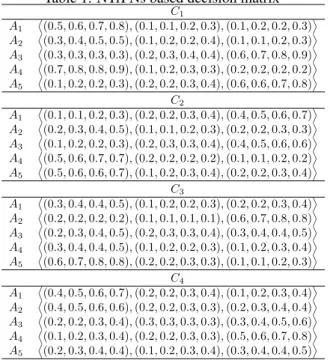
Assume that the weight vector of the four attribute is W={0.25,0.25,0.30,0.20} and the evaluations of the five alter-natives with respect to the four attributes have been considered as SVTrNNs. Then we have a SVTrNNs based decision matrix d˜ij5×4 presented in Table-1.
Table 1: NTrFNs based decision matrix C1
A1
(0.5,0.6,0.7,0.8),(0.1,0.1,0.2,0.3),(0.1,0.2,0.2,0.3)
A2
(0.3,0.4,0.5,0.5),(0.1,0.2,0.2,0.4),(0.1,0.1,0.2,0.3)
A3
(0.3,0.3,0.3,0.3),(0.2,0.3,0.4,0.4),(0.6,0.7,0.8,0.9)
A4
(0.7,0.8,0.8,0.9),(0.1,0.2,0.3,0.3),(0.2,0.2,0.2,0.2)
A5
(0.1,0.2,0.2,0.3),(0.2,0.2,0.3,0.4),(0.6,0.6,0.7,0.8)
C2
A1
(0.1,0.1,0.2,0.3),(0.2,0.2,0.3,0.4),(0.4,0.5,0.6,0.7)
A2
(0.2,0.3,0.4,0.5),(0.1,0.1,0.2,0.3),(0.2,0.2,0.3,0.3)
A3
(0.1,0.2,0.2,0.3),(0.2,0.3,0.3,0.4),(0.4,0.5,0.6,0.6)
A4
(0.5,0.6,0.7,0.7),(0.2,0.2,0.2,0.2),(0.1,0.1,0.2,0.2)
A5
(0.5,0.6,0.6,0.7),(0.1,0.2,0.3,0.4),(0.2,0.2,0.3,0.4)
C3
A1
(0.3,0.4,0.4,0.5),(0.1,0.2,0.2,0.3),(0.2,0.2,0.3,0.4)
A2
(0.2,0.2,0.2,0.2),(0.1,0.1,0.1,0.1),(0.6,0.7,0.8,0.8)
A3
(0.2,0.3,0.4,0.5),(0.2,0.3,0.3,0.4),(0.3,0.4,0.4,0.5)
A4
(0.3,0.4,0.4,0.5),(0.1,0.2,0.2,0.3),(0.1,0.2,0.3,0.4)
A5
(0.6,0.7,0.8,0.8),(0.2,0.2,0.3,0.3),(0.1,0.1,0.2,0.3)
C4
A1
(0.4,0.5,0.6,0.7),(0.2,0.2,0.3,0.4),(0.1,0.2,0.3,0.4)
A2
(0.4,0.5,0.6,0.6),(0.2,0.2,0.3,0.3),(0.2,0.3,0.4,0.4)
A3
(0.2,0.2,0.3,0.4),(0.3,0.3,0.3,0.3),(0.3,0.4,0.5,0.6)
A4
(0.1,0.2,0.3,0.4),(0.2,0.2,0.3,0.3),(0.5,0.6,0.7,0.8)
A5
(0.2,0.3,0.4,0.4),(0.1,0.2,0.3,0.4),(0.3,0.4,0.4,0.5)
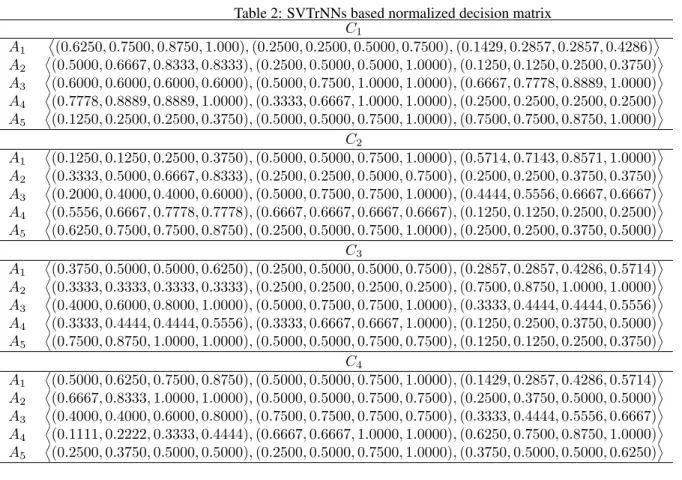
Step 1. Normalization of SVTrNNs based decision matrix
Using Eq.(50), the decision matrixd˜ij
5×4has been normalized to the decision matrixd˜N
ij
5×4by considering the selected four attributes as benefit type attributes. Then the normalized decision matrixd˜N
ij
5×4 can be obtained in Table-2.
Step 2. Aggregation of the weighted normalized rating values of alter-natives
The weighted normalized rating values of the alternative Ai(i = 1,2,3,4,5) can be determined by using Eq.(52). Table-3 shows the aggregated weighted normalized rating values of alternatives.
Step 3. Ranking of all alternatives
The value index and ambiguity index of NTrFNsA˜i(i= 1,2, . . . , m) are determined by using Definition-17 and Proposition-1 as
Vλ,µ,ν(A1) = 0.5428λ+ 0.5542µ+ 0.4536ν; Vλ,µ,ν(A2) = 0.6041λ+ 0.4396µ+ 0.5365ν; Vλ,µ,ν(A3) = 0.5667λ+ 0.7708µ+ 0.5898ν; Vλ,µ,ν(A4) = 0.5871λ+ 0.7278µ+ 0.3656ν; Vλ,µ,ν(A5) = 0.6083λ+ 0.6354µ+ 0.4542ν;
and
Aλ,µ,ν(A1) = 0.0802λ+ 0.1417µ+ 0.0941ν Aλ,µ,ν(A2) = 0.0847λ+ 0.0979µ+ 0.1260ν Aλ,µ,ν(A3) = 0.0933λ+ 0.0875µ+ 0.0713ν Aλ,µ,ν(A4) = 0.0574λ+ 0.1222µ+ 0.0677ν Aλ,µ,ν(A5) = 0.0625λ+ 0.1729µ+ 0.0750ν.
To rank the alternativesAi(i= 1,2,3,4,5), the value index and ambi-guity index of each alternative have been examined for different values forλ, µ, ν ∈ [0,1]. The results have been shown in the Table-4. For different values ofλ, µ, ν ∈[0,1], the ranking order of alternatives has been obtained as follows:
A3 ≻A5 ≻A4≻A2≻A1. ThusA5is the best alternative.
8
Conclusions
In the present study, we have introduced the concept of SVTrNN and de-fined some operational rules. We have also dede-fined value index and am-biguity index of SVTrNN and established some of their properties. Then we have proposed a ranking method SVTrNN by using these two indices of SVTrNN. The proposed method has been applied to MADM problem with SVTrNN information. The method is simple, attractive and effec-tive to determine the ranking order of alternaeffec-tives used in neutrosophic MADM problems. The proposed concept can be easily extended to rank single-valued triangular neutrosophic numbers. The proposed MADM approach can be extended to solve the problem of medical diagnosis, pattern recognition, personal selection, etc.
Table 2: SVTrNNs based normalized decision matrix C1
A1
(0.6250,0.7500,0.8750,1.000),(0.2500,0.2500,0.5000,0.7500),(0.1429,0.2857,0.2857,0.4286) A2
(0.5000,0.6667,0.8333,0.8333),(0.2500,0.5000,0.5000,1.0000),(0.1250,0.1250,0.2500,0.3750) A3
(0.6000,0.6000,0.6000,0.6000),(0.5000,0.7500,1.0000,1.0000),(0.6667,0.7778,0.8889,1.0000) A4
(0.7778,0.8889,0.8889,1.0000),(0.3333,0.6667,1.0000,1.0000),(0.2500,0.2500,0.2500,0.2500) A5
(0.1250,0.2500,0.2500,0.3750),(0.5000,0.5000,0.7500,1.0000),(0.7500,0.7500,0.8750,1.0000) C2
A1
(0.1250,0.1250,0.2500,0.3750),(0.5000,0.5000,0.7500,1.0000),(0.5714,0.7143,0.8571,1.0000) A2
(0.3333,0.5000,0.6667,0.8333),(0.2500,0.2500,0.5000,0.7500),(0.2500,0.2500,0.3750,0.3750) A3
(0.2000,0.4000,0.4000,0.6000),(0.5000,0.7500,0.7500,1.0000),(0.4444,0.5556,0.6667,0.6667) A4
(0.5556,0.6667,0.7778,0.7778),(0.6667,0.6667,0.6667,0.6667),(0.1250,0.1250,0.2500,0.2500) A5
(0.6250,0.7500,0.7500,0.8750),(0.2500,0.5000,0.7500,1.0000),(0.2500,0.2500,0.3750,0.5000) C3
A1
(0.3750,0.5000,0.5000,0.6250),(0.2500,0.5000,0.5000,0.7500),(0.2857,0.2857,0.4286,0.5714) A2
(0.3333,0.3333,0.3333,0.3333),(0.2500,0.2500,0.2500,0.2500),(0.7500,0.8750,1.0000,1.0000) A3
(0.4000,0.6000,0.8000,1.0000),(0.5000,0.7500,0.7500,1.0000),(0.3333,0.4444,0.4444,0.5556) A4
(0.3333,0.4444,0.4444,0.5556),(0.3333,0.6667,0.6667,1.0000),(0.1250,0.2500,0.3750,0.5000) A5
(0.7500,0.8750,1.0000,1.0000),(0.5000,0.5000,0.7500,0.7500),(0.1250,0.1250,0.2500,0.3750) C4
A1
(0.5000,0.6250,0.7500,0.8750),(0.5000,0.5000,0.7500,1.0000),(0.1429,0.2857,0.4286,0.5714) A2
(0.6667,0.8333,1.0000,1.0000),(0.5000,0.5000,0.7500,0.7500),(0.2500,0.3750,0.5000,0.5000) A3
(0.4000,0.4000,0.6000,0.8000),(0.7500,0.7500,0.7500,0.7500),(0.3333,0.4444,0.5556,0.6667) A4
(0.1111,0.2222,0.3333,0.4444),(0.6667,0.6667,1.0000,1.0000),(0.6250,0.7500,0.8750,1.0000) A5
(0.2500,0.3750,0.5000,0.5000),(0.2500,0.5000,0.7500,1.0000),(0.3750,0.5000,0.5000,0.6250)
Table 3: Aggregated rating values of attributes
Alternative Aggregated rating values of Attributes
A1
(0.4000,0.4938,0.5813,0.7063),(0.3625,0.4375,0.6125,0.8625),(0.2929,0.3928,0.5000,0.6429) A2
(0.4417,0.5583,0.6750,0.7166),(0.3000,0.3625,0.4750,0.6625),(0.3688,0.4313,0.5563,0.8750) A3 (0.4000,0.5100,0.6100,0.7600),(0.5500,0.7500,0.8125,0.9500),(0.4444,0.5556,0.6333,0.7167)
A4
(0.4556,0.5667,0.6167,0.7000),(0.4833,0.6667,0.8167,0.9167),(0.2563,0.3188,0.4125,0.4750) A5
Table 4: Ranking results for alternatives Alternative Value ofλ, µ, ν Value index Ambiguity index Ranking order
A1 0.5027 0.1117
A2 0.5045 0.1107
A3 λ=.10;µ=.40; 0.6599 0.0800 A3≻A5≻A4≻A2≻A1
A4 ν =.50 0.5327 0.0885
A5 0.5421 0.1129
A1 0.5125 0.1051
A2 0.5258 0.1046
A3 λ=.30;µ=.32; 0.6408 0.0831 A3≻A5≻A4≻A2≻A1
A4 ν =.38 0.5480 0.0821
A5 0.5584 0.1026
A1 0.5168 0.1053
A2 0.5267 0.1029
A3 λ=
1 3;µ=
1
3; 0.6424 0.0840 A3≻A5≻A4≻A2≻A1
A4 ν=
1
3 0.5602 0.0824
A5 0.5660 0.1035
A1 0.5283 0.1014
A2 0.5412 0.0969
A3 λ=.50;µ=.30; 0.6325 0.0872 A3≻A5≻A4≻A2≻A1
A4 ν =.20 0.5850 0.0789
A5 0.5856 0.0981
A1 0.5361 0.0939
A2 0.5645 0.0915
A3 λ=.70;µ=.20; 0.6098 0.0900 A3≻A5≻A4≻A2≻A1
A4 ν =.10 0.5931 0.0714
References
[1] L. Zadeh. Fuzzy sets,Information and control, 8(3):338–353,1965. [2] D. Dubois and H. Prade. Fuzzy Sets and Systems: Theory and
Applica-tions, Academic Press, New York, 1980.
[3] A. Kaufmann and M. M Gupta. Introduction to Fuzzy Arithmetic: Theory and Applications, Van Nostrand Reinhold, New York, 1991.
[4] Y. He, Q. Wang and D. Zhou. Extension of the expected value method for multiple attribute decision making with fuzzy data, Knowledge-Based Systems, 22(1):63–66, 2009.
[5] C. Kahraman, D. Ruan, and I. Doan. Fuzzy group decision-making for facility location selection,Information Sciences,157:135–153, 2003. [6] D. F. Li and J.B.Yang Fuzzy linear programming technique for
multi-attribute group decision making in fuzzy environments, Information Sci-ences, 158:263–275, 2004.
[7] A. Sanayei, S. F. Mousavi and A. Yazdankhah. Group decision making pro-cess for supplier selection with VIKOR under fuzzy environment, Expert Systems with Applications, 37(1):24–30, 2010.
[8] P. Burillo, H. Bustince and V. Mohedano. Some definitions of intuitionistic fuzzy number. First properties,Proceedings of the 1st Workshop on Fuzzy Based Expert Systems, 53–55, 1994.
[9] M. H. Shu, C. H. Cheng and J. R. Chang Using intuitionistic fuzzy sets for fault-tree analysis on printed circuit board assembly, Microelectronics Reliability, 46(12):2139–2148, 2006.
[10] J. Wang and Z. Zhang. Multi-criteria decision-making method with incom-plete certain information based on intuitionistic fuzzy number,Control and decision, 24(2): 226–230, 2009.
[11] P. Grzegorzewski. Distances and orderings in a family of intuitionistic fuzzy numbers,EUSFLAT Conference, 223–227, 2003.
[12] H. B. Mitchell. Ranking-intuitionistic fuzzy numbers,International Jour-nal of Uncertainty, Fuzziness and Knowledge-Based Systems, 12(3):377– 386, 2004.
[13] G. Nayagam, V. Lakshmana, G. Venkateshwari and G. Sivaraman. Rank-ing of intuitionistic fuzzy numbers, IEEE International Conference on Fuzzy Systems, 2008.(IEEE World Congress on Computational Intelli-gence), 1971–1974:2008.
[14] H. M. Nehi. A new ranking method for intuitionistic fuzzy numbers, Inter-national Journal of Fuzzy Systems, 12(1):80–86, 2010.
[15] S. Rezvani. Ranking method of trapezoidal intuitionistic fuzzy numbers, Annals of Fuzzy Mathematics and Informatics, 5(3):515–523, 2013. [16] D. F. Li. A ratio ranking method of triangular intuitionistic fuzzy numbers
and its application to MADM problems,Computers and Mathematics with Applications, 60(6):1557–1570, 2010.
[17] X. T. Zeng, D. F. Li, and G. F. Yu, A value and ambiguity based ranking method of trapezoidal intuitionistic fuzzy numbers and ap-plication to decision making, The Scientific World Journal, 2014, doi:10.1155/2014/560582.
[18] F. Smarandache, A unifying field in logics. Neutrosophy: neutrosophic probability, set and logic, Rehoboth: American Research Press, 1998. [19] F. Smarandache, Neutrosophic set– a generalization of the intuitionistic
fuzzy set, International Journal of Pure and Applied Mathematics, 24: 287–297, 2005.
[20] H. Wang, F. Smarandache, Y. Q. Zhang, and R. Sunderraman, Single val-ued neutrosophic sets, Multispace and Multistructure, 4:410–413, 2010 .
[21] J. Ye, Trapezoidal neutrosophic set and its application to multiple attribute decision-making, Neural Computing and Applications,2014, doi:10.1007/s00521-014-1787-6.
[22] P. Biswas, S. Pramanik, and B. C. Giri. Cosine similarity measure based multi-attribute decision making with trapezoidal fuzzy neutrosophic num-bers,Neutrosophic Sets and System, 8:47–57, 2015.
[23] I. Deli and Y.S¸ubas¸. A ranking method of single valued neutrosophic numbers and its applications to multi-attribute decision making problems, International Journal of Machine Learning & Cybernatics,2016, doi: 10.1007/s13042-016-0505-3.