Processing and Application of Ceramics 7 [2] (2013) 45–62
Recent progress on synthesis of ceramics core/shell
nanostructures
Vladimir V. Srdić
*, Bojana Mojić, Milan Nikolić, Stevan Ognjanović
Department of Materials Engineering, Faculty of Technology, University of Novi Sad, Novi Sad, Serbia Received 9 June 2013; received in revised form 27 June 2013; accepted 29 June 2013
Abstract
Thin surface layers on ine particles were found to substantially change their functionalities and properties, such as chemical reactivity, thermal stability, catalytic activity, dispersibility, or optical, magnetic and elec-tronic properties. Because of that, the core/shell nanostructures have opened up research opportunities in almost all areas of science and engineering, including medicine, catalysis, biotechnology, chemistry, optics, electronics, energy storage, etc. Immense efforts have been implied to produce and investigate different core/ shell systems, and thereby, various synthesis techniques have been developed. In this review, we report a detailed overview of different synthesis techniques used for preparation of various ceramics core/shell nano -structures with tunable size and tailored structure.
Keywords: ceramics, nanostructures, core/shell particles, synthesis, review
Contents
1. Nanotechnology: Core/shell nanostructures ... 45
2. Type of core/shell nanostructures ... 47
3. Synthesis of core/shell nanostructures ... 47
3.1 Gas phase processes ... 47
3.1.1 Surface oxidation ... 47
3.1.2 Flame synthesis ... 47
3.1.3 Synthesis based on reaction/decomposition of lowing gases ... 47
3.1.4 Spray pyrolysis ... 48
3.2 Liquid phase techniques ... 49
3.2.1 Chemical deposition on core-particles ... 49
3.2.2 Chemical deposition on functionalized core-particles ... 51
3.2.3 Assembly of preformed nanoparticles by electrostatic interactions ... 53
3.2.4 Assembly of preformed nanoparticles onto functionalized core-particles ... 55
3.3 Synthesis of complex core/shell nanostructures ... 57
4. Conclusions and Outlook ... 59
References ... 59
I. Nanotechnology: Core/shell nanostructures With the development of nanotechnology and nano-structured materials, one of the primary research goals became to reach advanced properties and
multifunc-tionality, in order to achieve better performances and novel applications. Naturally, this has led to the discov-eries of novel materials, but also brought the research attention to many other potential methods for combin-ing two or more properties in one material.
Thin surface layers on ine particles were found to substantially change their functionalities and properties, * Corresponding author: tel: tel: +381 21 485 3665
fax: +381 21 450 413, e-mail: [email protected]
Review paper
46
V.V. Srdić et al. / Processing and Application of Ceramics 7 [2] (2013) 45–62
such as chemical reactivity, thermal stability, catalytic activity, dispersibility, or optical, magnetic and elec-tronic properties. These heterostructures were irst real-ized in the late 1980s, with semiconductor nanoparticles [1–3], where they contributed to carrier coninement or separation, depending on the band gap alignment of the two semiconductor materials with different energy gaps. Since that the terminology “core/shell” was well accepted by researchers [4,5] and their use was extend-ed to different areas of science and technology.
Up to now, concept of core/shell nanostructures has received a lot of research attention, bringing variety of solutions and systems with advanced properties. Even-though the motive for the investigation of various core/ shell nanosystems is different, this research ield can be roughly classiied into three perspectives.
Most of the core/shell nanostructures are developed with the idea to combine two materials - and thus two properties within one structure. In this way, the nano-structure itself is characterized with the properties of both core and shell, offering variety of new possibili-ties and uncountable combinations. For example, iron oxide nanoparticles covered with silica layer show magnetic properties arising from the core and lumines-cent optical properties arising from the shell [6]. In ad-dition, magnetic core particles are often covered with a shell that is providing biocompatibility and chemi-cal stability, in order to be used for biomedichemi-cal applica-tions [7,8]. Core/shell nanostructures, which are com-posed of one component that can attach antibodies and enzymes and the other that absorb light, can be used in therapeutic application for targeted drug delivery [9– 11]. Often, shell is used to alter the surface charge and reactivity, or to provide good thermal stability of parti-cles. Ultraine metallic particles coated with shell ma-terials that provide good colloid stability, and in the same time can be chemically inert and optically trans-parent, are often used as paints, magnetic luids, paper coatings, etc. [12]. In the ields of structural materials, core/shell particles have been used as reinforcements and tougheners in composites due to complicated inter-actions between the particle surface and the matrix and the need for good bond between the reinforcement and the matrix [13,14].
In some cases, the beneit of core/shell nanostruc-ture is arising from their speciic design and geometry.
The speciic design of core/shell structure is used for lowering the costs, with the idea to use the inexpensive material as a carrier for a thin shell of active materi-al [15]. A typicmateri-al example are the core/shell pigments containing a core of cheap oxides covered with a layer of phosphates, which are produced as a more econom-ically feasible solution for anticorrosive pigments than the traditional ones [16]. Often, different shell thick-ness is used to tune the selected property of particles. Thus, by changing the thickness of gold shell on
sili-ca particles, one sili-can tune the absorption band from vis-ible to infrared region and move the surface plasmon resonance band position to the desirable wavelength range [17]. Similar idea was utilized for the preparation of core/shell nanoparticles which exhibited the quan-tum coninement effect or novel electronic, magnet-ic and optmagnet-ical properties. For example, multifunctional core/shell nanoparticles consisting of gold cores cov-ered with two shells - dense silica and CdSe quantum dots (QD) - allow for versatile control of CdSe-QD and Au-metal interactions through the control of the size of Au nanoparticles and the thickness of the di-electric silica layer [18]. The factor of geometry is also broadly used in catalysis, where catalysts are covered with mesoporous shells and catalytic reaction rates can be tuned by adjusting the crystallinity and porosity of the outer shell.
In another group of core/shell systems we can clas-sify those in which the particular combination and spe-ciic coupling of core and shell material results in an
entirely new property, that none of the materials indi-vidually possesses. Nanostructures with ferromagnetic core and ferroelectric shell, for example, are extensive-ly investigated over the last few years, since it was dis-covered that they are the ideal building block material for composite ceramics in which a new property:
mag-netoelectric effect, arises from strain mediated interac
-tion between core and shell phases. In some other cas-es, the speciic core/shell system is characterized with a property intermediate between those of both mate-rials individually, like in the case of core/shell semi-conducting nanocrystals, or bimagnetic core/shell sys-tems, where intimate contact between core and shell produces an effective exchange coupling and offers the possibility to tune the magnetic properties for electro-magnetic and permanent electro-magnetic applications [19]. Recently, several types of core/shell structured elec-trode materials for lithium ion batteries are found to increase the diffusion coeficient of lithium ions and improve the reversibility of lithium intercalation and
deintercalation [20].
Until today, core/shell structures have opened up re-search opportunities in almost all areas of science and engineering, including medicine, catalysis, biotechnol-ogy, chemistry, optics, electronics, energy storage, etc. Consequently, a large number of methods for synthesis core/shell particles have been developed and improved. Moreover, with the progress of nanotechnology, very advanced core/shell architectures with multishell lay-ers and a quite complex structure, such are some archi-tectures used in drug delivery and cancer therapy [21], have been developed and investigated.
V.V. Srdić et al. / Processing and Application of Ceramics 7 [2] (2013) 45–62
II. Type of core/shell nanostructures
Core/shell particles are typically spherical in shape, but there are many more possible types of core/shell nanostructures based on the different core shapes, such as: nanotubes, nanowires, nanorods, nanorings and na-nostars (see review articles 22–27). As can be seen in Fig. 1 various spherical core/shell nanostructures can be distinguished. Thus, core/shell particles can have dense, porous or eccentric cores and when the core material is completely removed from the structure either by calci-nation or dissolving with suitable solvent hollow nano-structures can be formed (Fig. 1a). Similarly, there are different types of shells: continuous and dense shells, continuous and porous/particulate shells or discontin-uous/particulate shell (Fig. 1b). In addition, more com-plex nanostructures have been prepared and include: core/bilayered-shell, core/composite-shell or core/mul-tilayered-shell nanoparticles (Fig. 1c).
III. Synthesis of core/shell nanostructures
Various synthesis techniques have been developed for the synthesis of core/shell particles with controlled composition, type, morphology, shell thickness, core size and size distribution. Generally, they can be di-vided into: gas phase processes and liquid phase tech-niques.
3.1 Gas-phase processes
Synthesis of core/shell nanostructures in gas phase processes is mostly based on reaction/decomposition of lowing gases or volatile precursors, but some other methods, such as surface oxidation and lame synthesis, have also been developed. In all these techniques basic knowledge in gas-dynamics and gas-kinetics has been
utilized to obtain core/shell particles with a controlla-ble composition and morphology, good adhesion of the shell, complete coverage of the core surface and desir-able shell thickness.
3.1.1 Surface oxidation
Core/shell nanostructures can be simply synthe-sized by surface oxidation of core particles (Fig. 2). Thus, if silicon nanoparticles (or non-oxides, such as
SiC, Si3N4 etc.) are exposed to oxygen, under the
spe-ciic conditions, the exothermic surface reaction will cause the formation of a thin SiO2 shell with the
thick-ness dependent on the selected processing conditions (size of silicon particles, temperature, oxygen partial pressure, reaction time etc.).
3.1.2 Flame synthesis
Core/shell nanostructures can also be prepared in low-pressure lame reactor. The method was devel-oped by Jana et al. [28] and is based on addition of
pre-cursors/Ar mixture in low-pressure premixed H2/O2/
Ar lames and subsequent formation of corresponding oxide core/shell nanoparticles. The appropriate selec-tion of precursors is the most important for successful fabrication of core/shell particles and the reaction rate coeficient of the shell precursor must be larger com-pared to the precursor of the core. Thus, γ-Fe2O3 parti
-cles, with a diameter of a few nanometers, having a thin SiO2 shell were synthesized from organometallic
pre-cursors iron-pentacarbonyl (Fe(CO)5) and
tetramethyl-silane (Si(CH3)4). An axially movable, cooled sintered
bronze plate burner was located on one end of a low-pressure reaction chamber. The precursors/Ar mixture was introduced in the burner and decomposed in H2/O2/
Ar lames. In the reaction zone at the pressure of ~ 40 mbar precursors react with oxygen and the γ-Fe2O3/SiO2
nanoparticles were formed. The obtained core/shell par-ticles can be separated from the gas stream by different methods, such as thermophoresis, iltration, molecular beam probing, etc.
3.1.3 Synthesis based on reaction/decomposition of lowing gases
Different type of core/shell particles have been pre-pared by reaction/decomposition of lowing gases or volatile metalorganic precursors in a reactor consist-ing of two reaction zones or two sequential reactors. Thus, Powell et al. [29] fabricated TiO2-core/SiO2
-shell particles via gas phase in a tubular, hot-wall, low reactor. Titania particles were produced in the irst part of the reactor, via the vapour phase reaction of TiCl4
Figure 1. Schematic illustration of core/shell particles with different type of: a) cores, b) shells and c) core/shell
particles with complex nanostructures
Figure 2. Schematic illustration of surface oxidation of silicon nanoparticle
ć
a)
b)
γ
γ
a)
b)
c)
ć
γ
48
V.V. Srdić et al. / Processing and Application of Ceramics 7 [2] (2013) 45–62
and oxygen. The gaseous reactant SiCl4 was injected
into the reactor at a point after the region in which ti-tania particles were formed. There the SiCl4 vapour
re-acted with oxygen in the presence of the titania par-ticles to form silica shell. Silica shell can be formed by several mechanisms (Fig. 3) [29,30]. If tempera-ture and supersaturation are high enough, SiCl4 can re
-act with oxygen and form silica nanoparticles by ho-mogenous nucleation. The formed nanoparticles can reach the titania particle surface, attach themselves to it and form a shell. Alternatively, the silica can grow to form separate silica particles (Fig. 3). However, at lower temperature and supersaturation, SiCl4 can react
with oxygen on the titania particle surfaces, nucleate heterogeneously and form a shell by chemical vapour
deposition (Fig. 3).
Vollath and Szabo [31,32] reported on the synthesis of different core/shell nanostructures based on Al2O3
and ZrO2 by two sequential microwave plasma
reac-tors. Chloride precursor of the core phase was decom-posed and oxidized in the irst reactor, and the formed oxide-core particles were transported with gas low in the second reactor. The second chloride reactant was injected into the second reactor and after the surface reaction the corresponding oxide shell was deposit-ed on the core particles. When the alumina cores are small, or alternatively when the alumina shells are thin, amorphous alumina and crystalline zirconia structures were obtained. Otherwise, core/shell particles consist-ing of a crystalline zirconia core and a γ-alumina shell were formed. In addition, maghemite (γ-Fe2O3) parti
-cles coated with cubic zirconia were also successful-ly fabricated using two sequential microwave plasma
reactors [32].
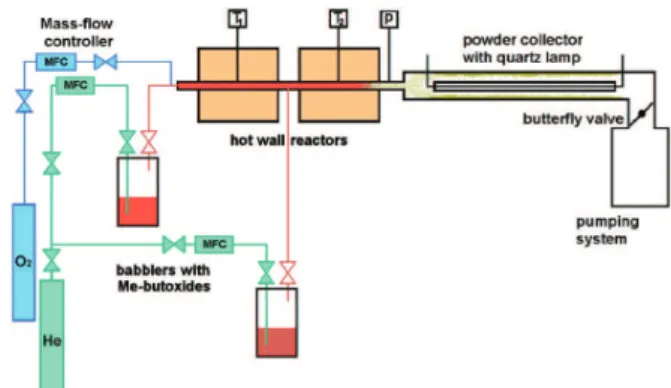
Srdić et al. [33] synthesized nanocrystalline
zirco-nia surface doped with 3 and 30 mol% alumina (with the size of ~5 nm) by chemical vapour synthesis using two sequential hot-wall reactors (i.e. two serial reaction zones consisting of two alumina tubes heated separate-ly by two resistance furnaces, Fig. 4). In the irst reactor, zirconia precursor molecules are decomposed and react with oxygen forming zirconium oxide nanoparticles.
The ZrO2 particles were used as seeds (substrates with
a very large surface-to-volume ratio) for heterogeneous growth of alumina in the chemical vapour deposition mode in the second reactor. The obtained powders had the characteristic core/shell structure with ZrO2 core
and a very thin, amorphous shell consisting of zirconia highly doped with alumina [33]. The same method, but with some modiications, was used for the preparation of polymer-coated alumina nanopowders [34].
3.1.4 Spray pyrolysis
Different core/shell nanostructures can also be fabri-cated by a spray pyrolysis process. The process is simi-lar to those mentioned above, however, instead of low-ing gases there are lowlow-ing aerosols (mixture of very ine precursor droplets with the carrier gas). Synthe-sis of core/shell particles by spray pyrolySynthe-sis process is based on solvent evaporation from droplets, formation of particles by reaction or precipitation and their subse-quent coating usually in a reactor consisting of two re-action zones or two sequential reactors.
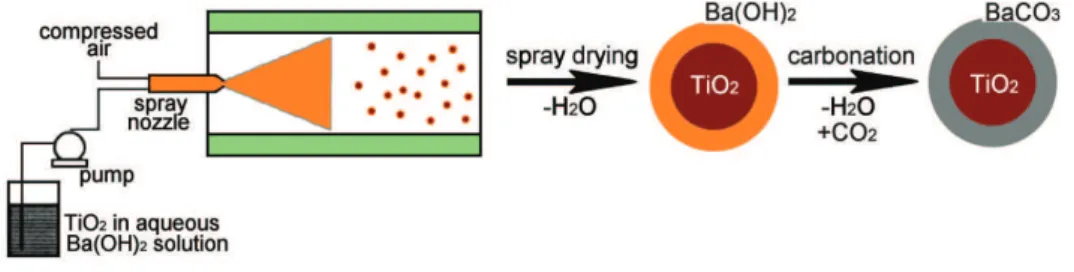
Rӧssel and co-workers [35] used a two-step spray pyrolysis method for the preparation of TiO2-core/
BaCO3-shell structures. During the irst step, an
aque-ous Ba(OH)2 solution containing TiO2 particles was
dispersed in small droplets and by spray drying (us-ing argon as an inert gas) transformed in TiO2-core/
Ba(OH)2-shell structure (Fig. 5). During the second step
the Ba(OH)2 layer was carbonated to BaCO3 by reaction
with a CO2/H2O stream.
Chung et al. [36] used a continuous multi-step spray
pyrolysis process for the preparation of NiFe2O4-core/
TiO2-shell particles. Aqueous solution of iron chloride
and nickel acetate tetrahydrate was atomized by an ul-trasonic nebulizer and moved by air into the irst reac-tor. NiFe2O4 particles, precipitated within the droplet in
the irst reactor, were moved by the carrier gas into the second reactor heated to 700 °C, where titanium isop-ropoxide, Ti(iOC
3H7)4, was injected by a syringe pump.
The injected Ti(iOC
3H7)4 was evaporated by a
pre-heat-ed N2 carrier gas. The thickness of the titania layer was
controlled by the amount of injected Ti(iOC
3H7)4. Due
to the speciic requirement (prevention of the
photo-Figure 3. Different mechanisms of shell formation: a) chemical vapor deposition b) assembly of
preformed nanoparticles and c) formation of separate silica aggregates
Figure 4. Schematic illustration of the CVS system used for the synthesis of core/shell nanoparticles
ć –
γ γ
ć
ӧ
ć –
and
d
γ γ
ć
ӧ
49
V.V. Srdić et al. / Processing and Application of Ceramics 7 [2] (2013) 45–62
dissolution phenomenon) another layer had to be de-posited between the NiFe2O4 core and the titania layer,
as a passivation layer. It was shown that spray pyrol-ysis can be easily adjusted for the production of such bilayered core/shell nanostructures simply by adding a Si(OC2H5)4 (tetraethoxysilane, TEOS) injection port
be-tween the two reactors [36]. Dehumidiied N2 gas was
also used as a carrier gas for TEOS.
Spray pyrolysis was used by Stopic et al. [37] for
the synthesis of spherical TiO2-RuO2 core/shell
parti-cles. Aerosol, obtained by ultrasonical treatment of Ti-based precursor, was entered into the irst reactor zone and after solvent evaporation and precipitation within the droplets TiO2 particles were formed. Titania
parti-cles, formed in the irst reactor zone, were moved by the carrier gas into the second reactor. Then, RuCl3 so
-lution was ultrasonicated and, in second pyrolysis zone, mixed with the aerosol containing the formed TiO2 par
-ticles. Nearly perfect core/shell particles were formed.
3.2 Liquid-phase techniques
In addition to the core/shell nanostructures produced from the gas phase, they have been synthesized by var-ious liquid phase methods as well. Generally, they can be divided in four main groups:
• chemical deposition on core-particles,
• chemical deposition on functionalized
core-parti-cles,
• assembly of preformed nanoparticles by
electro-static interactions,
• assembly of preformed nanoparticles onto func-tionalized core-particles,
3.2.1 Chemical deposition on core-particles
Chemical deposition (also called deposition-precip-itation) method is an attractive route for direct forma-tion of an amorphous or crystalline layer on core-par-ticles from corresponding salt. In this case, surface of the core-particles is used for heterogeneous nucleation
of solid shell phase (Fig. 6). Similar to the gas phase synthesis, whether a precursor will react and form par-ticles in the surrounding liquid phase by homogeneous nucleation (which will then be attracted to the par-ticles, see chapter 3.2.3) or directly react on the core-particle surfaces by chemical deposition depends on the
processing conditions.
Considerable research work has been directed to the synthesis and application of ferrite nanoparticles with silica shell, which will be in this review used as a mod-el system to mod-elucidate the mechanisms of shmod-ell forma-tion by chemical deposiforma-tion method and describe the in-luence of processing parameters on shell thickness and uniformity. However, some other interesting core/shell systems will also be mentioned.
Mechanisms of shell formation
Many researchers used chemical deposition for the synthesis of spherical ferrite-core/silica-shell nanocom-posite particles with very narrow size distribution and tunable shell thickness. The method is based on the well-known Stӧber process [38], in which silica shell is formed around a core-particle via the hydrolysis and condensation of a silica precursor.
The ferrite core-nanoparticles with narrow size dis-tribution and different compositions can be prepared by various methods, such as precipitation from solu-tions, microemulsion, aerosol-vapor methods, spray pyrolysis, laser pyrolysis, hydrothermal methods, high-temperature decomposition of organic precur-sors etc. However, the main problem regarding to the synthesis of core/shell particles is hard agglomeration of the ferrite nanoparticles due to their large surface to volume ratio and high surface energies [39]. This can be solved with stabilization and surface modiica-tion of the as-synthesized ferrite nanoparticles usual-ly by citric acid. Citric acid creates a negative particle charge in the whole pH range, shifts the zeta poten-tial towards more negative values and allows increas-ing organosilane afinity for the particle surface [39– 41]. In the next step, the ferrite nanoparticles surface, coupled with –OH, or –C–OH groups, are used for the chemical deposition of silica layer. The mechanism of the silica shell formation on the surface of the fer-rite nanoparticles is depicted in Fig. 7 [42]. If TEOS is used as a precursor for shell formation, at irst,
sili-Figure 5. Scheme for the preparation of TiO2-core/BaCO3-shell structures by spray pyrolysis
Figure 6. Schematic illustration of the shell formation by chemical deposition method
–
ӧ –
a
s
l ent
50
V.V. Srdić et al. / Processing and Application of Ceramics 7 [2] (2013) 45–62
cate groups will attach to the –OH groups on the sur-face of the ferrite particles. After this irst silica layer is formed, additional layers can be obtained by direct hydrolysis and condensation of TEOS on the surface of the existing silica layer.
Shell thickness and uniformity control
The control of the shell thickness has always been an important task during the synthesis of the core/ shell nanostructures by the chemical deposition meth-od. Thus, inluence of processing parameters on the shell thickness and uniformity is well demonstrated by Maurice and co-workers [40], who prepared ma-ghemite-core/silica-shell nanoparticles from citrate-modiied γ-Fe2O3 nanoparticles and TEOS. The
sil-ica shell was formed by the hetero-condensation of TEOS in a mixture of ethanol and water in presence of a small amount of ammonia as a catalyst [40,43]. It was shown that the shell thickness can be well- con-trolled by changing the concentration of ammonia and/ or TEOS. Thus, for a given TEOS and ferrite-nanopar-ticles concentration, a low concentration of ammonia led to the formation of a non-uniform shell around the particles, but a larger amount of ammonia led to the formation of maghemite free silica particles as a re-sult of rapid hydrolysis of TEOS (Fig. 8a). On the oth-er side, for an optimized ammonia concentration and a given ferrite-nanoparticles concentration, there is a minimal concentration of TEOS necessary to ensure a complete covering of particles, and above it the thick-ness of the shell can be tuned with the TEOS concen-tration (Fig. 8b) [40].
Similarly like in ferrite/silica systems, the controlled deposition of silica on (Ba,Sr)TiO3 particles, having
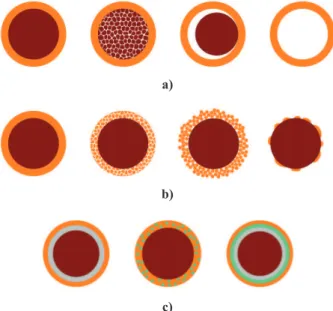
surface modiied by citric acid, was based on a seed-ed growth process and the hydrolysis/condensation of TEOS catalyzed by ammonia in highly diluted ethanol solution [44,45]. Such procedure can lead to the depo-sition of uniform and homogeneous silica shell, avoid-ing the formation of silica nuclei. In addition, the select-ed method allowselect-ed the control of the silica shell from 2 to 80 nm (with an accuracy of 1–2 nm) only by chang-ing the amount of TEOS used in the reaction (Fig. 9).
However, the chemical deposition processes are sometimes related to the formation of thin, even monolayer, shell structures and thicker shell can be obtained only by modiied methods. One of the ele-gant ways is to use the multistep deposition process also called layer-by-layer deposition, which was ap-plied for the fabrication of BaTiO3-core/Al2O3-shell
and ZrO2-core/Al2O3-shell particles [46,47]. The core
(BaTiO3 or ZrO2) nanoparticles, dried to remove any
surface-bound water, were dispersed in dry toluene
Figure 8. Illustration how ammonia (a) and TEOS
(b) concentration have inluence on silica
shell thickness
Figure 7. Mechanism of silica shell formation
ć –
γ
ć –
Figure 7. Mechanism of s
a)
b)
γ
Figure 9. TEM images of (Ba,Sr)TiO3 nanoparticles with different thickness of silica shell: a) 0, b) 2, c) 7, d) 13, e) 25 and f) 80 nm (bar = 200 nm) [45]. Reprinted with permission
from S. Mornet et al., Chem. Mater., 17 (2005) 4530-6. Copyright 2005 American Chemical Society. a)
b)
ć –
V.V. Srdić et al. / Processing and Application of Ceramics 7 [2] (2013) 45–62
and mixed with methylalumoxane (MAO). Methylalu-moxane was anchored to the surface of the nanoparti-cles by covalent Al–O bonds formed in the mutual re-action. After washing off excess MAO and exposure to air, the MAO on the nanoparticles surface rapidly oxidizes/hydrolyzes to form a shell of Al2O3. This step
is applied multiple times to incrementally increase the
Al2O3 shell thickness [47].
Shell formation on hydrophobic core-particles
All methods for the preparation of core/shell par-ticles based on the Stӧber process are easily adjust-ed for hydrophilic core-particles. However, due to the reactions in aqueous/alcohol solutions, problems arise with the use of hydrophobic core particles. One pos-sible solution is the functionalization of the surface of the hydrophobic particles (see chapter 3.2.2). Alterna-tively, reverse microemulsion techniques, in which the micelles are used to conine the seed particles and con-trol the deposition of silica within the micelle [24,48– 50]. The reverse microemulsion technique was used, for example, for the synthesis of silica coating of
CoFe2O4 nanoparticles [49,51,52].
Microemulsion was obtained by mixing ferrolu-id (dispersion of spherical CoFe2O4 nanoparticles,
prepared through thermal decomposition of metal acetylacetonates, in hexane or cyclohexane), TEOS and ammonia in a micellar solution. The core/shell nanoparticles with narrow particle size distribution were formed during the base-catalyzed hydrolysis of TEOS within micelles and destabilized from the mi-croemulsion by using methanol.
3.2.2 Chemical deposition on functionalized
core-particles
The direct chemical deposition of homogeneous shell is usually very dificult or even not possible due to various reasons such as the hydrophobic nature of the core surface, inadequate surface charge of the
core-particles, incompatibility of the core surface groups with attaching shell precursor, etc. Thus, in order to grow homogeneous shells, the core-particles are usu-ally functionalized with an appropriate agent (Fig. 10).
Mechanisms of shell formation
Functional groups at the surface of the unmodi-ied silica nanoparticles are predominantly silanol (Si-OH) or ethoxy (Si-OC2H5) groups [53]. This is the
reason why the corresponding synthesis methods for core/shell particles are easily adjustable to hydrophil-ic core-parthydrophil-icles, but due to the reactions in aqueous/ alcohol solutions hydrophobic particles must under-go a ligand exchange before the deposition. Various types of functional silanes were used, all of which have trimethoxysilyl, triethoxysilyl, or silanol groups at one end and an amino, tiol, phosphonate or oth-er group at the othoth-er end (Table 1) [22,24,54–58]. In addition, some other functionalization agents have been utilized, such as poly(diallyldimethylammonium chloride) (PDDA), cetyltrimethylammonium bromide (CTAB) polyethyleneglycol (PEG), glutaraldehyde etc. [59–61].
Three different strategies for the functionaliza-tion of core-particles in methods based on the Stӧber process could be recognized [57]. Firstly (Fig. 11a), surface hydroxyl groups of the coparticle can re-act with –OMe group (–OCH3 or –OC2H5) of the used
silane coupling agents [R–(CH3)nSi(OMe)3] through
the exchange of –OH with –R groups and, thus, form the desirable surface modiication. The second possi-bility (Fig. 11b) is to chemisorb the appropriate func-tional silane (with the –S– bridge) onto the non-oxide nanoparticle surface, and then create a surface covered with another ligand, –R, by the formation of silioxane bonds via the hydrolysis of –OMe groups and conden-sation with other silica species in solution. The third strategy is based on the attachment of an appropriate
Figure 10. Schematic illustration of chemical deposition on functionalized core-particles
Table 1. Functional silanes
Functional silanes Silane-group R-group
3-aminopropyltrimethoxysilane (APTMS) trimethoxysilyl group amine group
3-aminopropyltriethoxysilane (APTES) triethoxysilyl group amine group
3-mercaptopropyl(trimethoxy)silane (MPTMS) trimethoxysilyl group thiol group
vinyltriethoxysilane (VTEOS) triethoxysilyl group vinil-group
2-(Diphenylphosphino)ethyltriethoxysilane triethoxysilyl group diphenylphosphine group
propyltrimethoxysilane (PTMS) trimethoxysilyl group methyl
ć –
ӧ
52
V.V. Srdić et al. / Processing and Application of Ceramics 7 [2] (2013) 45–62
functional silane on particle surface, which would ini-tiate subsequent silica shell formation (Fig. 11c).
The selection of the appropriate functionalization agent is very important, thus, a few characteristic exam-ples are given bellow.
Functionalization with CTAB
As it was already mentioned, the problem with hard agglomeration of ferrite nanoparticles during the synthe-sis of core/shell nanostructures can be solved by their surface modiication with citric acid. However, some-times it is more convenient to use oleic acid instead of
citric acid, but the ferrite nanoparticles, modiied with oleic acid, can be dispersed in water only with additional functionalization, for example, with cetyltrimethylam-monium bromide, CTAB. The hydrophobic side-chain of CTAB associates with the alkyl tail of the oleic acid through hydrophobic van der Waals interactions, where-as the hydrophilic group of CTAB enables them to be dispersible in water [60,61]. The hydrophilic groups of CTAB are very helpful in subsequent shell forma-tion and also can be used as an organic template for the growth of mesoporous silica shell (Fig. 12) [61,62].
Functionalization with APTMS or APTES
Functionalization with 3-aminopropyltrimethox-ysilane (APTMS) or 3-aminopropyltriethox3-aminopropyltrimethox-ysilane
(APTES) has also been frequently used for prepara-tion of core/shell structures [63–66]. It creates sur-face –NH2 groups, that can directly react with
corre-sponding shell-forming chemicals, or can be further modiied (such as by subsequent conversion into am-monium ions by stirring the silica spheres in a dilute hydrochloric acid solution).
A good example is the fabrication of silica-core/ gold-shell particles from HAuCl4×3H2O. The direct
chemical deposition of metallic gold from anionic complexes is only favored under highly acidic condi-tions (at pH < 2, below the isoelectric point of silica) where the silica surface is positively charged. Howev-er, under these conditions HAuCl4 is not
signiicant-ly dissociated and the hydrosigniicant-lysis of HAuCl4 increas
-es only above pH > 2 (with formation of anionic gold species, e.g., [AuClx(OH)4-x]−). Therefore,
functional-Figure 13. TEM image of the gold shell formed at functionalized silica-core particle [66]. Reprinted with permission from N. Phonthammachai et al., Langmuir, 24 (2008) 5109-12. Copyright 2008 American Chemical Society. Figure 12. Schematic illustration of shell formation on the
CTAB-functionalized core-particle
Figure 11. Different strategies for the functionalization of core-particles
ć –
a)
b)
c)
ӧ
−
a)
b)
c)
ć –
ӧ (Fig. 11a),
t
] through
nd
-−
ć –
V.V. Srdić et al. / Processing and Application of Ceramics 7 [2] (2013) 45–62
ization of core-particles and creation of their positive-ly charged surface is necessary [65–67]. One strate-gy employed functionalization of the silanol groups on the silica cores with APTES which creates the sur-face –NH2 groups. The surface modiied silica
parti-cles were used as seeds for the formation of a particu-late gold shell with the structure strongly dependent on pH, temperature and deposition time [66]. It can also be possible to further modify the APTES-functional-ized silica surface by subsequent conversion of the amine groups into ammonium ions by stirring the sili-ca spheres in a dilute hydrochloric acid solution. These positively charged ammonium groups on silica surfac-es can strongly absorb gold anions ([AuClx(OH)4-x]−)
and form gold shell with controllable characteristics (Fig. 13). Further growth of uniform gold shell with desirable thickness can be obtained in the next step, by chemical deposition from aqueous solution of HAuCl4
and K2CO3 in presence of reducing agent and precise
control of pH and concentration [66].
Functionalization with MPTME
Many researchers [57,68–72] have recognized that the use of 3-mercaptopropyl(trimethoxy)silane (MPTME) is very effective in the preparation of core/ shell nanostructures especially with metallic cores. Furthermore, Liu et al. [18] have shown that MPTME
was better suited for the surface activation of gold nanoparticles than APTMS or APTES because of the stronger binding of the thiol groups to the gold sur-faces. Fu et al. [71,72] used
MPTMS-functionaliza-tion for nickel or cobalt nanoparticles (Fig. 14). They dispersed metallic nanoparticles in anhydrous toluene solution containing MPTMS and obtained complete complexation of the –SH groups of MPTMS with the surface of nanoparticles after aging at room tempera-ture. The modiied core-nanoparticles were then coat-ed with uniform layers of silica by the controllcoat-ed
hy-drolysis and condensation of TEOS [71,72]. Jana et al.
[57] also utilized MPTME for the functionalization of Au, Ag, and ZnS-CdSe nanoparticles. The thiol group of this functional agent was chemisorbed onto the non-oxide nanoparticle surface, and the trimethoxysilane groups initiated the silica layer formation on the par-ticle surface
3.2.3 Assembly of preformed nanoparticles by
electrostatic interactions
Core/shell structures can be prepared by assembling the previously formed nanoparticles on the oppositely charged surface of the core-particles (Fig. 15). Usual-ly the assembUsual-ly process has been performed by homo-geneous nucleation of the nanoparticles from the liq-uid phase in which the core-particles are homogenously dispersed. The assembling process is strongly pH-sen-sitive, as the pH has to be adjusted at the value where, for example, negatively charged core-particles will at-tract positively charged shell-nanoparticles (or vice ver-sa). In addition, uniform core/shell structure can be ob-tained only if agglomeration of the nanoparticles during the deposition process is prevented.
Adjustment of opposite surface charges
A typical example of the assembling of the oppo-sitely charged core and shell particles is the fabrica-tion of perovskite based core/shell structures developed by Buscaglia et al. [73]. They assembled the previously
formed SrTiO3 or BaZrO3 nanoparticles on the oppositely
charged surface of the of BaTiO3 spherical particles.
Sr-TiO3 and BaZrO3 nanoparticles were prepared from
aque-ous chloride solution of TiCl4 + SrCl2×6H2O and ZrCl4
+ BaCl2×2H2O, respectively. The prepared chloride
so-lution was then quickly added to a suspension of Ba-TiO3 particles in an aqueous NaOH solution. Synthesis
was carried out in a closed telon vessel due to the better control of the coating process and avoiding product con-tamination with adsorption of CO2 from air. Under opti
-Figure 15. Schematic illustration of the assembling of the oppositely charged core and shell particles Figure 14. Schematic illustration of shell formation on the MPTMS-functionalized core-particle
ć –
−
Liu et al. [18] have shown that MPTME
ć –
54
V.V. Srdić et al. / Processing and Application of Ceramics 7 [2] (2013) 45–62
mal processing conditions, SrTiO3 or BaZrO3 nanopar
-ticles were homogeneously nucleated in surrounding liquid phase and attached on the surface of BaTiO3
spher-ical particles to form uniform particulate shell (Fig. 16). Even though this assembling method has been wide-ly used for fabrication of different core/shell particles, its drawback is that it is strongly pH-sensitive and the nanoparticles can be easily desorbed from the core-sur-face if pH is even slightly changed. Claesson et al. [74],
for example, demonstrated that the maximum attraction for maghemite to the silica surface is expected to be at pH = 3.0–4.0, and for cobalt-ferrite, the maximum at-traction was found in the range of pH = 4.0–4.3. Thus, even a small change in pH has a considerable inlu-ence on the structure of the synthesized core/shell parti-cles. Similar conclusions, for the SiO2-core/Fe3O4-shell
structures, were brought out by Nikolic et al. [75], who
investigated the assembling process of ferrite nanopar-ticles on monodispersed silica parnanopar-ticles prepared by the Stöber process. Figure 17 conirms that the silica and ferrite particles have oppositely charged surfaces in the pH range between ~3.0 and 6.2. Thus, if the pH is high-er than 6.2 thhigh-ere is no electrostatic inthigh-eraction between silica and ferrite particles and therefore the shell cannot be formed. On the other hand, even at pH < 4 there are appropriate conditions for shell formation between sili-ca and ferrite particles, but at these pH values the ferrite particles cannot be formed.
Buscaglia et al. [76] developed the method based on
the electrostatic interactions to fabricate BaCO3-core/
TiO2-shell nanostructure and showed that it can be done
only by ine-tuning the relevant processing parameters. The main idea was to disperse ine BaCO3 particles in
an aqueous TiCl4 solution from which TiO2 nanoparti
-cles will be formed and assembled on the BaCO3
surfac-es. However, BaCO3 is soluble in water at pH < 7 and
only in highly acidic conditions hydrolysis of TiCl4 can
be suppressed, preventing precipitation of amorphous
or crystalline TiO2 [77]. By further investigation, it was
found that the stability of aqueous solution containing
Ti4+ ions can be extended up to neutrality or even
slight-ly basic conditions by using a mixture of H2O2 and NH3
[78,79]. Because of that Buscaglia et al. [76] dispersed
ine BaCO3 particles in an aqueous TiCl4 solution
sta-bilized using the appropriate H2O2/NH3 ratio at pH
be-tween 7 and 10, where the zeta potential of BaCO3 is
positive, while that of TiO2 is negative. Therefore the
amorphous titania nanoparticles, produced by the hy-drolysis of Ti4+, were formed and spontaneously
self-assembled at the surface of the BaCO3 core-particles. Prevention of nanoparticle agglomeration
As already mentioned, the uniform shell cannot be formed if the nanoparticles tend to agglomerate during the deposition process. Because of that, diluted disper-sions of the nanoparticles, subjected to ultrasonication and intensive mechanical stirring are usually utilized. However, some other solutions have been suggested performed and two characteristic examples are given bellow.
Nikolic et al. [75] observed that, during the
assem-bly of NiFe2O4 nanoparticles on the silica core-particles,
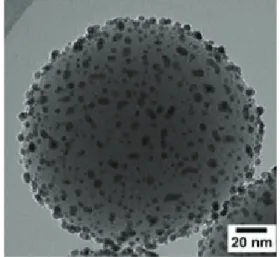
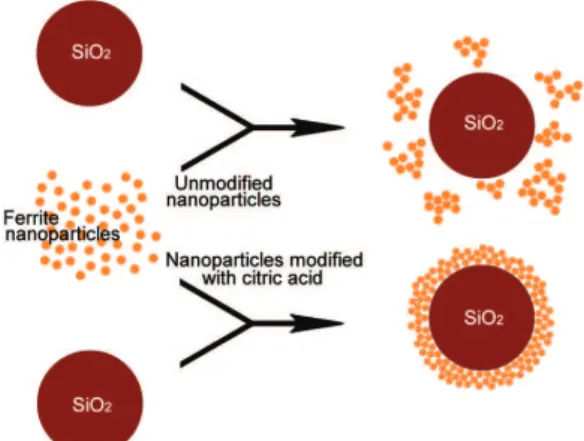
a perfect nickel-ferrite shell cannot be formed on the en-tire surface of the silica particles even if the appropriate pH was used (where the opposite surface charges of sil-ica and nickel particles were obtained). They concluded that the formation rate of nickel-ferrite particles, at the selected relatively high pH, becomes faster than the de-position rate on the silica core. Consequently, self-aggre-gation dominates the competing formation of the ferrite shell. Surface modiication of the nickel-ferrite nanopar-ticles with citric acid prior to their deposition on the sil-ica core prevented the self-aggregation process and re-sulted in the formation of a uniform shell (Fig. 18).
Lee et al. [80] tried to optimize the conditions for
synthesis of SiO2-core/TiO2-shell particles. Silica
core-particles, prepared by the Stöber method, were
dis-Figure 16. TEM image of BaTiO3-core/SrTiO3-shell particles [73]. Reprinted with permission from M.T. Buscaglia et al., Chem. Mater., 18 (2006) 4002-10.
Copyright 2006 American Chemical Society.
Figure 17. Aqueous electrophoresis curves silica and maghemite particles
ć –
V.V. Srdić et al. / Processing and Application of Ceramics 7 [2] (2013) 45–62
persed in ethanol and an appropriate amount of distilled water and hydroxypropyl cellulose was added. Titania shell was obtained by slowly adding Ti(OC4H9)4, pre
-viously dissolved in ethanol, to the prepared silica sol. It was shown [80] that with the low concentration of Ti(OC4H9)4 (0.06 mol/L) a very thin shell (~9 nm) can
be obtained. The shell thickness can be increased by in-creasing the Ti(OC4H9)4 concentration, but there is the
upper concentration limit above which the growth of necks between the particles appears, promoting their agglomeration. Because of that, for preparation of a thicker shell, the agglomeration has to be suppressed or another synthesis method has to be employed. The so-lution was found in a multistep titania deposition pro-cess (i.e. layer-by-layer deposition). Figure 19 clearly shows that agglomeration of the titania nanoparticles was successfully avoided and an increase of the titania shell thickness with the increase of number of deposit-ed layers was obtaindeposit-ed.
3.2.4 Assembly of preformed nanoparticles onto functionalized core-particles
The direct assembly of nanoparticles on the core surface is often not possible due to a variety of reasons, including different nature of the core and shell particles, strong tendency of the nanoparticles to detach from the core surface, inadequate surface charge of the core and/ or shell nanoparticles, incompatibility of the core sur-face groups with the sursur-face of attaching nanoparticles, etc. The problem can be solved with functionalization of the core-particles (Fig. 20). Two different approach-es can be recognized and both are dapproach-escribed in this sec-tion: i) assembly by electrostatic interaction and ii) as-sembly by chemical coordination.
Assembly by electrostatic interactions
The functionalization of the core-particles can im-prove the assembling of the preformed nanoparticles if this changes the surface charge of the core-particle and, thus, increases the electrostatic attraction between the core and the shell.
A typical example is fabrication of silica-core/sil-ica-shell nanostructures by the assembling of the pri-mary silica nanoparticles synthesized by neutralization of highly basic sodium silicate solution, on the surface of monodispersed silica cores prepared from TEOS
Figure 18. Schematic illustration how the surface
modiied of ferrite nanoparticles can have inluence on core/shell structure
Figure 19. SEM and TEM micrographs of SiO2-core/TiO2 -shell particles prepared by layer-by-layer procss using:
a) 1, b) 2, c) 3 and d) 5 step deposition [80]
Figure 20. Schematic illustration of the assembling process onto functionalized core-particles
ć –
ć –
ć –
56
V.V. Srdić et al. / Processing and Application of Ceramics 7 [2] (2013) 45–62
[81,82]. In this case, both the core and shell particles had isoelectric point at pH between 2.5 and 3 and neg-ative surface charge at higher pH values. Thus, there is no electrostatic interaction between them and uniform shell cannot be formed. The assembling was improved by functionalization with 3-aminopropyltriethoxysilane (APTES) or poly(diallyldimethylammonium chloride) (PDDA), as they extended the interval in which SiO2
core particles are positively charged, at pH up to ~7.5 or even above 10, respectively (Fig. 21). The function-alization enabled preparation of mesoporous, relative-ly uniform and continuous silica shell on monodispered
silica core particles (Fig. 22).
Similar problem appeared during synthesis of sil-ica-core/gold-shell nanostructures. It was shown by Oldenburg et al. [17,54] that core/shell structure cannot
be formed if unmodiied silica spheres are used as the core-particles. This was explained by the repulsion of the negatively charged gold nanoparticles from the neg-atively charged silanol groups of the unmodiied silica particles. Because of that functionalization with APT-MS was performed [17,54,83]. The functionalization with APTMS introduces an amine group to the silica surface. With an available lone electron pair, the amine group is able to bind to the gold nanoparticles [54]. Thus, when the functionalized silica particles were add-ed to the previously preparadd-ed aqueous suspension, gold nanoparticles were easily attached to the silica surface.
The inluence of pH on the assembly by electrostatic interactions is well demonstrated by Nikolic et al. [75],
who synthesized core/shell structures by depositing NiFe2O4 nanoparticles onto functionalized spherical
sil-ica particles. They showed that acidic conditions (pH < 6) are not favorable for the formation of NiFe2O4
nanoparticles and their subsequent deposition on the surface of silica core-particles. However, both SiO2 and
NiFe2O4 particles are negatively charged for pH > 6.
Because of that functionalization of silica surfaces was performed with APTES and PDDA [75]. This enabled the assembly of core/shell nanostructures by electrostat-ic interactions as the APTES-functionalization insured an opposite surface charge of ferrite and silica particles in the pH range up to 7.5. Moreover, functionalization with PDDA extended this interval up to pH = 10.5.
The formation of silica-core/gold-shell particles was investigated by Shi et al. [67], who proposed the
as-sembling mechanism of the gold nanoparticles onto the APTES-functionalized silica particles (Fig. 23). Organ-ic functionalization of the silanol groups on the surface of silica particles with APTES resulted in the formation of amine groups on their surfaces. The amine groups (–NH2) were subsequently converted into ammonium
ions (–NH3
+) by dispersing the silica particles in a dilute
hydrochloric acid solution. These positively charged silica spheres were necessary to attract citrate ion-modi-ied gold nanoparticles. Thus, the surface modiion-modi-ied gold nanoparticles were adsorbed to the positively charged ammonium ion-functionalized silica nanospheres via
electrostatic interactions [67].
Assembly by chemical coordination
The second approach to assembling core/shell nano-structures is related to the functionalization of the core-particles and the creation of desirable surface-groups that can chemically bond the shell nanoparticles from the surrounding liquid. Various functional agents, that contain hydrolyzable groups at one side and nonhydro-lyzable groups at their other side, were used. The hy-drolyzable group can react with the surface of the sili-ca particle, whereas the nonhydrolyzable group (amino, tiol, phosphonate or other group) can bind to the surface of the nanoparticles and link them to the silica surface.
It is usually very dificult to determine the dominant mechanism responsible for the assembly of a nanopar-ticle to the surface of a core-parnanopar-ticle. Most of them are
Figure 21. Aqueous electrophoresis curves obtained for non-functionalized, APTES-functionalized and
PDDA- functionalized silica particles
Figure 22. TEM image of mesoporous silica shell deposited on silica
core [82]
–
57
V.V. Srdić et al. / Processing and Application of Ceramics 7 [2] (2013) 45–62
deined as an assembly by electrostatic interactions and only in a few examples chemical coordination was mentioned. Thus, for example, Westcott et al. [54] in
-vestigated the formation of the shell of gold nanoparti-cles on thiol-functionalized silica nanopartinanoparti-cles (treated with MPTMS) and mentioned that the interaction of the gold nanoparticles with the silica nanoparticles cannot be purely electrostatic. Philipse and Vrij [84] described the deposition process of the magnetic particles onto MPTMS-functionalized silica and proposed the interac-tion mechanism. They thought that the methoxy groups of MPTMS are irst hydrolyzed in the presence of am-monia, thereby forming oligomers that bind to the silan-ol groups on the surface of the silica particles through a
condensation reaction.
3.3 Synthesis of complex core/shell nanostructures
Recently, synthesis of complex core/shell nanostruc-tures (multilayered core/shell particles, hollow par-ticles, eccentric core/shell particles etc.) has begun to draw considerable attention. Due to the complex struc-ture, these multifunctional nanoparticles have been usu-ally synthesized by combinations of different gas- and/ or liquid-phase methods mentioned above. Because of that, only some characteristic examples will be present-ed in this section.
Multilayered core/shell structures
Gas phase processes have been used for fabrication of bilayered core/shell nanostructures, usually by reac-tion/decomposition of lowing gases or volatile metal-organic precursors in a reactor consisting of three re-action zones or three sequential reactors. Thus, Fotou and Kodas [85] produced bilayered core/shell particles,
consisting of Al2O3 and SiO2 thin layers on TiO2, via gas
phase in a hot-wall reactor with three reaction zones. The titania particles produced in the irst reaction zone by reaction of TiCl4 vapor with O2 entered the second
reaction zone where AlCl3 was introduced. Alumina
layers were formed by the chemical vapor deposition. Then, titania particles with alumina shell entered the third reaction zone where SiCl4 was introduced. It was
conirmed that coating in this case took place by deposi-tion of silica particles or aggregates on TiO2/Al2O3 core/
shell particles that were formed by the gas phase
reac-tion of SiCl4 with O2[85].
Multifunctional core/shell nanoparticles have also been prepared by combination various liquid phase techniques and four typical examples will be described here. The irst example is a process for synthesis of gold/silica/CdSe nanoparticles developed by Liu et al.
[18]. It included synthesis of gold nanoparticles, gold-particle surface functionalization with MPTMS, chemi-cal deposition of a dense silica shell, modiication of the silica surfaces with APTMS and inal assembly of CdSe quantum dots (CdSe-QD) onto the gold/silica particle surfaces by strong interaction with −NH2 ligands (Fig.
24). This nanostructure allows for versatile control of CdSe-QD and Au-metal interactions through control of the size of Au nanoparticle and the thickness of the di-electric silica layer.
Abramson et al. [86], for instance, reported the
syn-thesis of bilayered γ-Fe2O3/SiO2/TiO2 nanoparticles
us-ing a two-step chemical deposition method. In the irst step, ammonia, ethanol and TEOS were successive-ly added to an aqueous dispersion of citrate-coated γ-Fe2O3 nanoparticles. The obtained Fe2O3-core/SiO2
-shell powder was washed and inally redispersed in ab-solute ethanol. In the second step, TiO2 layer was
de-posited by successively adding Ti(OBu)4 dissolved in
absolute ethanol to the prepared suspension of γ-Fe2O3/
SiO2 nanoparticles under N2 atmosphere.
A process combining the assembly of magnet-ic nanopartmagnet-icles on the sphermagnet-ical silmagnet-ica cores with sub-sequent chemical deposition of the second silica layer was used for the preparation of complex multifunc-tional core/shell nanostructure for biomedical applica-Figure 23. Schematic illustration of the assembling of modiied gold nanoparticles on the APTES-functionalized
silica particle
–
Figure 24. Schematic illustration of the synthesis of gold/silica/CdSe nanoparticles
58
V.V. Srdić et al. / Processing and Application of Ceramics 7 [2] (2013) 45–62
tion [74]. In the irst step the magnetic nanoparticles were deposited onto the surface of MPTMS-functional-ized silica spheres. The thiol-functionalMPTMS-functional-ized silane irre-versibly binds the ferrite particles to the silica surface. The second silica layer was prepared from TEOS by the Stöber method ensuring the biocompatibility of the ob-tained structure.
Shi et al. [67] prepared size tunable and structure
tailored complex core/shell spheres containing silica cores with two shells. The irst shell was made of gold nanoparticles on which the second silica shell with con-trolled structure was deposited. The citrate-modiied, negatively charged gold nanoparticles were assembled by electrostatic interaction on the APTES-functional-ized silica spheres subsequently modiied with a dilute hydrochloric acid solution (to create positively charged silica with surface –NH3
+ groups). In addition, they
demonstrated that the second shell can be dense, cor-rugated or porous (Fig. 25). The dense shell can be ob-tained by controlled hydrolysis of TEOS in presence of ammonia. The formed silicate anions replace the nega-tive citrate ions around the gold nanoparticles and en-able the growth of the silica shell. The dense silica lay-er will not be formed if APTES-functionalization is not adequate, i.e. if the concentration of APTES is low. In this case, some non-functionalized silanol groups, left on the silica surface, will dissociate to form surface SiO– groups and thus repel the silicate anions. A
corru-gated silica shell can be formed simply by etching the dense silica layer with KCN solution, whereas a porous silica shell can be formed if sodium silicate instead of TEOS is used (Fig. 25).
Hollow particles
Hollow structures can be obtained simply in two steps, by irst synthesizing core/shell structures and then removing the core material via calcination or leaching. Various methods have been used to prepare hollow spheres, and polymers such as polystyrene are widely used as they can be easily removed. Thus, sil-ica layers on polystyrene cores were deposited in pro-cesses based on chemical deposition from silica
precur-sors [25,87,88]. It was shown that TEOS is not suitable for coating polystyrene, which is hydrophilic and nega-tively charged. Organo-silica precursors, such as vinyl-trimethoxysilane (VTMS), decrease the number of OH–
groups and increase the number of hydrocarbon groups at the surface. Both phenomena reduce the hydrophilic character of the surface leading to higher interface ten-sion and direct growth of the silica shell [88]. In the i-nal step of core/shell particle synthesis polystyrene was usually removed by heating to 500–600 °C and mono-dispersed hollow spheres with thickness from tens to few hundreds of nanometers were formed.
Eccentric core/shell particles
Recently, eccentric core/shell structures, in which the core is partially or completely separated from the shell, attracted much attention because of their unique catalytic behavior and persistence against aggregation of the encapsulated particles under heating [89–92].
A simple approach, adopted by Demirors et al. [91],
is applicable to core/shell structure which during fur-ther heat-treatment undergoes higher shrinkage of the core than the shell enclosing them. This method was used for preparation of eccentric TiO2-core/SiO2-shell
particles. In the irst step, silica coating of porous tita-nia particles was obtained by Stöber method. After cal-cination of the synthesized particles at 600–625 °C a unique eccentric core/shell structure was prepared, as a result of extensiveshrinkage of the highly porous tita-nia core with respect to the silica shell (Fig. 26).
Eccentric core/shell structures can also be prepared with the so-called template-assisted selective etching method, a multistep process developed recently [89,93– 95]. In the irst step, core/shell particles are prepared and then parts of cores or shells are selectively removed by dissolution with a solvent. A similar multistep ap-proach is based on the synthesis of a core with two shells and subsequent removal of the middle shell by etching or controlled heat-treatment [91–93].
An interesting way for the preparation of eccentric core/shell structures with very ine cores (Fe3O4 or Au
nanoparticles) and tunable functionalized mesoporous
Figure 25. Schematic illustration of the synthesis of bilayered core/shell nanostructures with dense, corrugated or porous silica shell
ć –
γ
γ
59
V.V. Srdić et al. / Processing and Application of Ceramics 7 [2] (2013) 45–62
silica shell, based on the one-step organo-silane-assist-ed etching method, was developorgano-silane-assist-ed by Yang et al. [92].
First, the core/shell particles were formed by deposition of mesoporous silica shell on the functionalized Fe3O4
or Au nanoparticles, by incomplete hydrolysis and con-densation of TEOS. Then, organo-silane precursor 1,2-bis-(trimethoxysilyl)ethane was added, which ac-celerated the hydrolysis of Si–O–Si bonds (i.e. dissolu-tion of the inner mesoporous silica layer). However, at the same time, organo-silane was deposited on the sur-face of the core/shell particles, forming a protective lay-er that prevented the hydrolysis of the Si–O–Si bonds near the outer surface of the core/shell particles [92,96]. Thus, the formation of the outer mesoporous organo-sil-ica shell and the selective dissolution of the inner meso-porous silica shell occur at the same time and the eccen-tric core/shell particles were inally formed (Fig. 27).
IV. Conclusions and outlook
With the development of nanotechnology and nanostructured materials, one of the primary research goals became to reach advanced properties and mul-tifunctionality, in order to achieve better performanc-es and novel applications. Naturally, this has led to the discoveries of novel materials and development of new strategies in synthesis and processing of desirable nanostructures. Thus, thin surface layers on ine par-ticles were found to substantially change their
func-tionalities and properties, such as chemical reactivi-ty, thermal stabilireactivi-ty, catalytic activireactivi-ty, dispersibilireactivi-ty, or optical, magnetic and electronic properties. These core/shell nanostructures were irst realized in the late 1980s, and since then has been well accepted by re-searchers and their use was extended to almost all ar-eas of science and engineering, including medicine, catalysis, biotechnology, chemistry, optics, electron-ics, energy storage, etc. In this paper a detailed over-view of different synthesis techniques used for prep-aration of various ceramics core/shell nanostructures with tunable size and tailored structure is presented. An original and unique systematization of all those fabrication methods is given and many different ap-proaches important for the shell uniformity and thick-ness control are described.
Acknowledgements: The results presented in this
pa-per are realized with the inancial support of Ministry for Education and Science of Republic of Serbia trough the project III45021.
References
1. L. Spanhel, H. Weller, A. Henglein, “Photochemistry
of semiconductor colloids”, J. Am. Chem. Soc., 109 (1987) 6632–6635.
2. H-C. Youn, S. Baral, J.H.J. Fendler, “Dihexadecyl
phosphate, vesicle-stabilized and in situ generated mixed cadmium sulide and zinc sulide semiconduc-tor particles: preparation and utilization for photosen-sitized charge separation and hydrogen generation”,
Phys. Chem., 92 (1988) 6320–6327.
3. A. Henglein, “Small-particle research:
Physicochem-ical properties of extremely small colloidal metal and semiconductor particles”, Chem. Rev., 89 (1989) 1861–1873.
4. C.F. Hoener, K.A. Allan, A.J. Bard, A. Campion,
M.A. Fox, T.E. Malluok, S.E. Webber, J.M. White, “Demonstration of a shell-core structure in layered cadmium selenide-zinc selenide small particles by X-ray photoelectron and Auger spectroscopies”, J. Phys. Chem., 96 (1992) 3812–3817.
5. H.S. Zhou, H. Sasahara, I. Honma, H. Komiyama,
J.W. Haus, “Coated semiconductor nanoparticles: The CdS/ PbS system’s photoluminescence properties”,
Chem. Mater., 6 (1994) 1534–1541.
6. Z. Chen, Z.L. Wang, P. Zhan, J.H. Zhang, W.Y. Zhang,
H.T. Wang, N.B. Ming, “Preparation of mettalodie-lectric composite particles with multishell structure”,
Langmuir, 20 (2004) 3024–3046.
7. J. Wagner, T. Autenrieth, R. Hempelmann, “Core shell
particles consisting of cobalt ferrite and silica as mo-del ferroluids [CoFe2O4–SiO2 core shell particles]”,
J. Magn. Magn. Mater., 252 (2002) 4–6.
8. X. Xie, X. Zhang, H. Zhang, D. Chen, W. Fei, “Prep-aration and application of surface-coated superpar-amagnetic nanobeads in the isolation of genomic DNA”, J. Magn. Magn. Mater., 277 (2004) 16–23.
Figure 26. Schematic illustration of the synthesis of eccentric core/shell particle
Figure 27. TEM image of eccentric Fe3O4/SiO2 core/shell nanoparticles [92]. Reprinted with permission from Y. Yang
et al., Chem. Mater., 23 (2011) 3676-84. Copyright 2011 American Chemical Society.
ć –
Figure 26. Schematic illustration of the synthesis of
60
V.V. Srdić et al. / Processing and Application of Ceramics 7 [2] (2013) 45–62
9. J.L. West, N.J. Halas, Application of nanotechnology to biotechnology. Curr Opin Biotechnol., 11 (2000) 215–217.
10. K. Sparnacci, M. Laus, L. Tondelli, L. Magnani, C.
Bernardi, “Core-shell microspheres by dispersion po-lymerization as drug delivery systems”, Macromol.
Chem. Phys., 203 (2002) 1364–1369.
11. T. Amirhalingam, J. Kalirajan, A. Chockalingam,
“Use of silica-gold core shell structured nanoparticles for targeted drug delivery system”, J Nanomedic. Na-notechnol., 2 (2011) 119–124.
12. L.M. Liz-Marzan, M. Giersig, P. Mulvaney,
“Syn-thesis of nanosized gold-silica core-shell particles”,
Langmuir, 12 (1996) 4329–4335.
13. P.A. Tzika, M.C. Boyce, D.M. Parks,
“Micromechan-ics of deformation in particle-toughened polyamides”,
J. Mech. Phys. Solids, 48 (2000) 1893–1929.
14. H.L. Duan, Y. Jiao, X. Yi, Z.P. Huang, J. Wang,
“So-lutions of inhomogeneity problems with graded shells and application to core-shell nanoparticles and compos-ites”, J. Mechan. Phys. Solids.,54 (2006) 1401–1425. 15. Q. Zhang, I. Lee, J. Bong Joo, F. Zaera, Y. Yin,
“Core-shell nanostructured catalysts”, Accounts Chem. Res.,
xx (2013) xx–xx.
16. N.M. Ahmed, “Modiied zinc oxide-phosphate
core-shell pigments in solvent-based paints”, Anti-Corro -sion Meth. Mater., 55 (2008) 333–340.
17. S.J. Oldenburg, R.D. Averitt, S.L. Westcott, N.J.
Ha-las, “Nanoengineering of optical resonances”, Chem. Phys. Lett., 288 (1998) 243–247.
18. N. Liu, B.S. Prall, V.I. Klimov, “Hybrid gold/silica/ nanocrystal-quantum-dot superstructures: Synthesis and analysis of semiconductor-metal interactions”, J.
Am. Chem. Soc., 128 (2006) 15362–15363.
19. H. Zeng, S. Sun, J. Li, Z.L. Wang, J.P. Liu, “Tailor-ing magnetic properties of core/shell nanoparticles“,
Appl. Phys. Lett., 85 (2004) 792–794.
20. H.P. Zhang, L.C. Yang, L. Fu, Q. Cao, D.L. Sun, Y.P.
Wu, R. Holze, “Core-shell structured electrode mate-rials for lithium ion batteries”, J. Solid State Electro-chem., 13 (2009) 1521–1527.
21. V. Salgueirino-Maceira, M.A. Correa-Duarte, M.
Spa-sova, L.M. Liz-Marzan, M. Farle, “Composite silica spheres with magnetic and luminescent functionali-ties”, Adv. Funct. Mater., 16 (2006) 509–514.
22. F. Caruso, “Nanoengineering of particle surfaces”,
Adv. Mater., 13 (2001) 11–22.
23. S. Karele, S.W. Gosavi, J. Urban, S.K. Kularni,
“Na-noshell particles: Synthesis, properties and applica-tions”, Curr. Sci., 91 (2006) 1038–1052.
24. Y. Piao, A. Burns, J. Kim, U. Wiesner, T. Hyeon,
“De-signed fabrication of silica-based nanostructured par-ticle systems for nanomedicine applications”, Adv.
Funct. Mater., 18 (2008) 3745–3758.
25. A. Guerrero-Martınez, J. Perez-Juste, L.M.
Liz-Mar-zan, “Recent progress on silica coating of nanopar-ticles and related nanomaterials”, Adv. Mater., 21 (2009) 1–14.
26. R. Hao, R. Xing, Z. Xu, Y. Hou, S. Gao, S. Sun,
“Syn-thesis, functionalization, and biomedical applications of multifunctional magnetic nanoparticles”, Adv. Ma -ter., 22 (2010) 2729–2742.
27. R. Ghosh Chaudhuri, S. Paria, “Core/shell
nanopar-ticles: Classes, properties, synthesis mechanisms, characterization, and applications“, Chem. Rev., 112
(2012) 2373–2433.
28. C. Janzen, J. Knipping, B. Rellinghaus, P. Roth, “For-mation of silica-embedded iron-oxide nanoparticles in low-pressure lames”, J. Nanopart. Res., 5 (2003)
589–596.
29. Q.H. Powell, T.T. Kodas, B.M. Anderson, “Coating of TiO2 particles by chemical vapor deposition of SiO2”,
Chem. Vap. Depos., 2 (1996) 179–181.
30. M. Winterer, Nano-crystalline Ceramics. Synthesis
and Structure, Springer, Berlin. 2002.
31. D. Vollath, D.V. Szabo, ”Nanocoated particles: A
spe-cial type of ceramic powder”, Nanostruct. Mater., 4 (1994) 927–938.
32. D. Vollath, D.V. Szabo, J. HauBelt, “Synthesis and properties of ceramic nanoparticles and nanocompos
-ites”, J. Eur. Ceram. Soc., 17 (1997) 1317–1324.
33. V.V. Srdic, M. Winterer, A. Moller, G. Miehe, H. Hahn,
“Nanocrystalline zirconia surface-doped with alumina: Chemical vapor synthesis, characterization, and prop-erties”, J. Am. Ceram. Soc., 84 (2001) 2771–2776. 34. M. Schallehn, M. Winterer, T. Weirich, U.
Keider-ling, H. Hahn, “In-situ preparation of polymer-coated alumina nanopowders by chemical vapor synthesis”,
Chem. Vap. Depos.,9 (2003) 40–44.
35. M. Rӧssel, S. Gablenz, T. Müller, A. Rӧder, H-P.
Abicht, “A core-shell structured BaTiO3 precursor preparation, characterization and potential”, Anal. Bi
-oanal. Chem., 375 (2003) 310–314.
36. Y.S. Chung, S.B. Park, D-W. Kang, “Magnetically
separable titania-coated nickel ferrite photocatalys”,
Mater. Chem. Phys., 86 (2004) 375–381.
37. S. Stopic, B. Friedich, M. Schroeder, T.E.
Weir-ich, “Synthesis of TiO2 core/RuO2 shell particles us-ing multistep ultrasonic spray pyrolysis”, Mater. Res. Bull., 48 (2013) 3633–3635.
38. W. Stӧber, A. Fink, E. Bohn, “Controlled growth of mesoporous silica spheres in the micron size range”,
J. Colloid Interface Sci., 26 (1968) 62–69
39. A-H. Lu, E.L. Salabas, F. Schuth, “Magnetic nanoparti-cles: Synthesis, protection, functionalization, and appli-cation”, Angew. Chem. Int. Ed., 46 (2007) 1222–1244. 40. V. Maurice, T. Georgelin, J-M. Siaugue, V. Cabuil,
„Synthesis and characterization of functionalized co-re-shell γ-Fe2O3-SiO2 nanoparticles”, J. Magn. Magn.
Mater., 321 (2009) 1408–1413.
41. B. Mojic, K.P. Giannakopoulos, Z. Cvejic, V.V. Srdic,
“Silica coated ferrite nanoparticles: Inluence of cit-rate functionalization procedure on inal particle mor-phology”, Ceram. Int., 38 (2012) 6635–6641.
42. B. Arkles, “Tailoring surfaces with silanes”, Chem.
![Figure 9. TEM images of (Ba,Sr)TiO 3 nanoparticles with different thickness of silica shell: a) 0, b) 2, c) 7, d) 13, e) 25 and f) 80 nm (bar = 200 nm) [45]](https://thumb-eu.123doks.com/thumbv2/123dok_br/18304701.348073/6.892.115.404.874.1104/figure-images-tio-nanoparticles-different-thickness-silica-shell.webp)