little can be done, prevention being the only remedy. Worldwide, it is one of the leading causes of chronic morbidity and mortality, and there is a trend toward the worsening of this situation.(1)
Asthma and COPD are both major causes of human suffering and financial loss, for the patients, their families and the community, as well as for the government, representing serious public health problems in most countries.(2) Therefore, various organizations and medical
Introduction
Asthma and COPD are examples of common diseases seen in the offices of pulmonologists. Both impair daily life and can kill. Whereas the former is more prevalent among children, the latter typically affects adults, especially form the fifth decade of life onward. Asthma impairs leisure and work activities. It also motivates the recurrent seeking of treatment in emergency rooms and outpatient clinics, as well as being responsible for hospitalizations and deaths. However, COPD is a disease against which only
Asthma and COPD according to the pulmonologist*
A asma e a DPOC na visão do pneumologista
Hisbello da Silva Campos, Antonio Carlos Moreira Lemos
Abstract
Objective: To evaluate how pulmonologists view the impact that asthma and COPD has on their patients, as well as how they treat these diseases. Methods: Survey including 227 pulmonologists participating in the VI Brazilian Congress on Asthma, II Brazilian Congress on COPD and II Brazilian Congress on Smoking, all of which were held in 2007. Results: According to the answers given by the pulmonologists, COPD is a public health problem of equal or greater importance than asthma, and COPD causes various disruptions in the lives of patients and their family members. When prescribing an inhalation device, pulmonologists feel that simplicity of use is more important than is the cost. There was a slight preference for the Aeroliser® and Diskus® systems. The budesonide-formoterol combination was the therapeutic regimen most often cited for the continued treatment of symptomatic asthma, whereas tiotropium bromide was the most often cited medication for the treatment of COPD. Selection of the therapeutic regimen for asthma and COPD is primarily influenced by the results of therapeutic trials published in the literature. Conclusions: The opinions of pulmonologists on the topics under study are in concordance with data in the specialized literature.
Keywords: Questionnaires; Asthma; Pulmonary disease, chronic obstructive; Physician’s practice patterns; Brazil.
Resumo
Objetivo: Avaliar como o pneumologista vê o impacto da asma e da DPOC na sua clientela, e como ele vem tratando essas doenças. Métodos: Inquérito com 227 pneumologistas participantes do VI Congresso de Asma e II Congressos Brasileiros de DPOC e de Tabagismo, realizados em 2007. Resultados: As respostas dos pneumologistas mostraram que a DPOC é um problema de saúde pública igual ou maior que a asma, e que a DPOC causa inúmeros transtornos para o doente e para seus familiares. Na escolha do dispositivo inalatório, a simplicidade de uso é mais importante que o custo, havendo discreta predileção pelos sistemas Aeroliser® e Diskus®. A associação entre budesonida e formo-terol foi a conduta terapêutica mais citada para o tratamento continuado do asmático sintomático, enquanto o brometo de tiotrópio foi o medicamento preferido pela maior parte para o tratamento continuado do portador de DPOC. A escolha do esquema para o tratamento continuado do asmático e do portador de DPOC é especialmente influenciada pela publicação de resultados de ensaios terapêuticos na literatura. Conclusões: A opinião do pneumo-logista sobre os temas abordados está de acordo com a literatura especializada.
Descritores: Questionários; Asma; DPOC; Condutas na prática dos médicos; Brasil.
* Study carried out at the Professor Hélio Fraga Referral Center, National School of Public Health, National Ministry of Health, Rio de Janeiro (RJ) Brazil and in the Brazilian Thoracic Association, Brasília (DF) Brazil.
Correspondence to: Hisbello da Silva Campos. Rua do Catete, 311/708, CEP 22220-001, Rio de Janeiro, RJ, Brasil. Tel 55 21 2245-5614. E-mail: [email protected]
Financial support: None.
141 (62%) were male and 86 (38%) were female, accepted the invitation and completed the ques-tionnaire. Of those, 21% had graduated less than 10 years prior, 66% had graduated between 10 and 30 years prior, and 13% had graduated more than 30 years prior. Slightly more than half of the interviewees reported treating only adults, 3% were pediatric pulmonologists, and 42% treated patients of all ages.
When the physicians were queried regarding which of the two diseases—asthma or COPD— represents the more serious public health problem, 56% of the interviewees considered them equivalent. This opinion was not dependent on the time since graduation. However, when asked about which represents the greater problem for the patient, 54% indicated COPD, and only 4% indicated asthma. The remainder (42%) expressed the belief that both represented equivalent problems for the patients. Again, the time since graduation had no apparent influ-ence on their opinion.
Since the characteristics of both diseases require the family/guardians to assume respon-sibility for the care of the patient, we inquired as to which disease, in the view of the pulmon-ologist, represents a greater burden. Again, half (49%) of the interviewees found the two to be equivalent: 40% indicated COPD as that repre-senting the greater burden for the family; and only 10% indicated asthma.
We tried to identify which factors were considered in the choice of the pharmacolog-ical approach. When asked about what they considered more important—inhaler or oral medication—in the selection of the pharmaco-logical treatment to be prescribed, two thirds of the interviewees answered that the two were equally important, whereas similar proportions societies have defined diagnostic and
thera-peutic routines (consensuses), aiming at greater effectiveness in the approach to these diseases. However, even with the international medical community attempting to take effective action to reduce the burden that these two diseases represent, recent studies have demonstrated various problems associated with the manage-ment of asthma and COPD: the gap between the expectations of the patients and the medical actions carried out; inappropriate management by health professionals; and the impact of the diseases on the daily life of patients, as well as on personal, institutional and governmental budgets.(3)
In 2007, with the objective of evaluating how pulmonologists view the scenario of these two diseases and the impact they have on their clien-tele, as well as the treatment used, the Sociedade Brasileira de Pneumologia e Tisiologia (SBPT; Brazilian Thoracic Association) conducted a survey of 227 physicians, the results of which are presented and commented upon in this article.
Methods
This was a cross-sectional study carried out using a survey with a standardized questionnaire (Appendix 1), applied during the VI Brazilian Congress on Asthma, II Brazilian Congress on COPD and II Brazilian Congress on Smoking, all of which were held on August 22-25 of 2007 in the city of Belo Horizonte, Brazil. The pulmon-ologists who visited the SBPT booth were invited to complete the questionnaire.
Results
Among the approximately 1,000 participants of the congress, 227 pulmonologists, of which
Table 1 - Distribution of the responses, according to the time since graduation of the pulmonologist, for the question “Which inhaled medication do you prescribe with greatest frequency for the long-term treatment of symptomatic asthma patients?”
Time since graduation, years
CB, n (%)
BF, n (%)
FS, n (%)
Indifferent, n (%)
1-10 9 (20) 26 (57) 8 (17) 3 (7)
11-20a 5 (7) 41 (60) 12 (18) 10 (15)
21-30a 10 (12) 44 (54) 15 (19) 12 (15)
> 30 2 (7) 14 (47) 9 (30) 5 (17)
Total 26 (12) 125 (56) 44 (20) 30 (13)
long-acting β2 agonist and an inhaled corticos-teroid seems to be the therapeutic regimen most frequently used by pulmonologists, regardless of time since graduation. This is followed by the combination of tiotropium bromide and long-acting β2 agonist.
The inhaler is important for the effective-ness of the inhaled medication. A number of studies have demonstrated that the choice of the inhalation system should consider character-istics of the user, of the solution to be inhaled and the appropriate site for the deposition of the drug. In Brazil, there are three models of inhalers designed to deliver the long-acting
β2 agonist + inhaled corticosteroid combina-privileged one or the other. This opinion was
also independent of the time since graduation. The SBPT has long been promoting the production and distribution of consensuses in the management of asthma and COPD. In these consensuses, in an up-to-date manner and similar to the way in which the principal inter-national consensuses have been developed, the therapeutic guidelines are given according to the severity of the disease in question. Although it is likely that most of the pulmonologists in Brazil know the diagnostic and therapeutic practices recommended in these consensuses, at times, other factors are involved in the phar-macological decision. One of the aims of the survey was to know more about the therapeutic approaches employed and the factors involved in the choice of the treatment regimen for the asthma patient, as well as for the patient with COPD. Table 1 shows the answers to the ques-tion regarding which is the pharmacological regimen most often employed in the long-term treatment of the symptomatic asthma patient. We were able to observe that, regardless of the time since graduation, the option “budesonide + formoterol” was chosen by a little more than half of the interviewees.
Table 2 shows the answers to the ques-tion about which is the therapeutic opques-tion most often prescribed for the long-term treat-ment of the patient with COPD. It is of note that the combination of tiotropium bromide, a
Table 3 - Distribution of the responses, according to the time since graduation of the pulmonologist, for the question “Which system of inhalation do you prefer for the administration of the long-acting β2 agonist + corticosteroid combination?”
Time since graduation,
years
Aeroliser®, n (%)
Diskus®, n (%)
Turbuhaler®, n (%)
1-10 14 (42) 9 (27) 6 (18) 11-20 18 (40) 15 (33) 10 (22) 21-30a 15 (31) 14 (29) 16 (33) > 30 7 (30) 11 (48) 3 (13) Total 54 (36) 49 (33) 35 (24)
aEleven participants did not draw a distinction between the
Diskus® and Turbuhaler® systems.
Table 2 - Distribution of the responses, according to the time since graduation of the pulmonologist, for the question “Which option do you prescribe with greatest frequency for the long-term treatment of patients with COPD?”
Treatment option*
Time since graduation, years Total,
n (%) 1-10, n (%) 11-20, n (%) 21-30, n (%) > 30, n (%)
IB - 1 (1) 1 (2) 2 (7) 4 (2)
TB 1 (2) 2 (3) 4 (6) 2 (7) 9 (4)
LAB2 2 (4) - 1 (2) - 3 (1)
IB + SAB2 2 (4) 5 (7) 2 (3) 2 (7) 11 (5)
IB + LAB2 16 (35) 16 (24) 9 (14) 2 (37) 43 (20)
LAB2 + IC 1 (2) 4 (6) 3 (5) 1 (33) 9 (4)
LAB2 + SAB2 - - 1 (2) - 1 (< 1)
TB + SAB2 2 (4) - - - 2 (1)
TB + LAB2 6 (13) 16 (24) 17 (26) 9 (33) 48 (23)
TB + LAB2 + IC 13 (28) 24 (35) 24 (36) 12 (74) 73 (35)
IB: ipratropium bromide; TB: tiotropium bromide; LAB2: long-acting β2 agonist; IB + SAB2: ipratropium bromide +
short-acting β2 agonist; IB + LAB2: ipratropium bromide + long-acting β2 agonist; LAB2 + IC: long-acting β2 agonist + inhaled
corticosteroid; LAB2 + SAB2: long-acting β2 agonist + short-acting β2 agonist; TB + SAB2: tiotropium bromide +
short-acting β2 agonist; TB + LAB2: tiotropium bromide + long-acting β2 agonist; and TB + LAB2 + IC: tiotropium bromide +
aged significantly, and that the over-65 age group will account for 10% of the population in contrast with the current 6.6%.(4)
Apparently, the prevalence of asthma is increasing in developed and underdeveloped countries, affecting people of all ages, races and ethnic groups. Estimates made by the WHO Global Initiative for Asthma indicate that 300 million people worldwide suffer from asthma.(5) The prevalence of asthma ranges from 1% to 18% of the population in different countries.(6) There is evidence that this has been increasing in certain countries, that it has recently increased in some other countries and that it is stable, at present, in still others. With the prediction that the proportion of the global population living in urban settings will change from 45% to 59% by 2025, everything indicates that the number of asthma patients will increase over the next two decades. Therefore, it is estimated that over 100 million people will have asthma by 2025.(5,6) According to WHO estimates, asthma causes the loss of 15 million disability-adjusted life years (DALYs), representing the sum of the years lost to premature death or incapacity. This measure represents the impact of a disease on society, representing 1% of all the losses caused by diseases. According to the estimates of the WHO, asthma causes approximately 250,000 deaths annually worldwide,(5) accounting for 1 of every 250 deaths.
In 1990, COPD occupied the 12th place in the ranking of the causes of DALYs; by 2020, it will probably be in 5th place among the causes of DALYs and in 3rd place among the causes of death.(7) Currently, the WHO estimates that tion: Aeroliser® (capsules for inhalation); Diskus®;
and Turbuhaler®. Two thirds of the interviewees reported a preference for a determined inhaler. Table 3 shows the preferences according to time since graduation. We found a discrete preference for Aeroliser® and Diskus® systems regardless of the time in practice.
When inquired about what was the most important factor to in order to give prefer-ence to a certain inhalation system, “simple to use” (38%) was the most cited. The degree of penetration in the bronchial tree was cited by 15% and the opinion of the patient was cited by 12%. Cost was the least cited factor (7%).
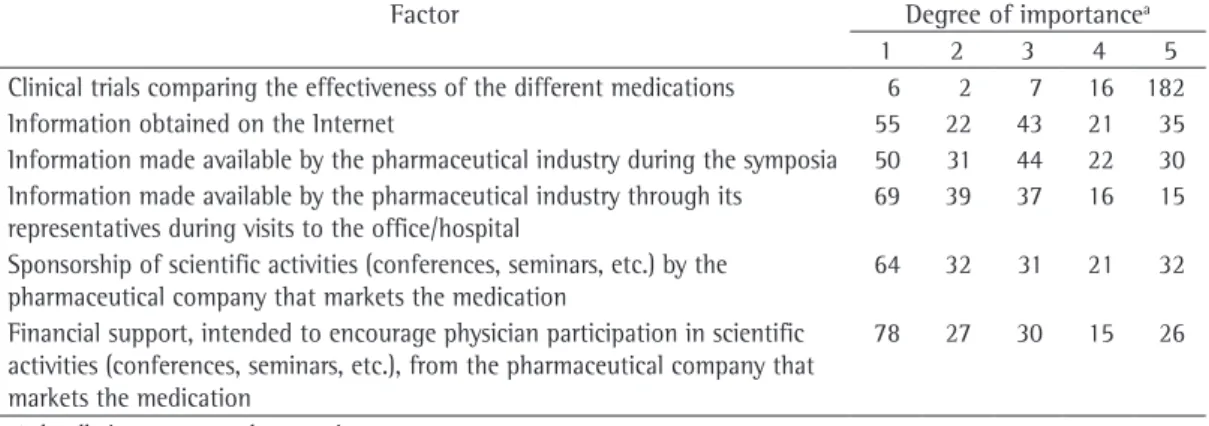
Finally, we tried to identify the most impor-tant factor in the selection of the medication to be prescribed. Several options were given, involving different modalities of scientific infor-mation and support given by pharmaceutical industries to medical activities. We asked the pulmonologist to establish a value for each of the options, ranging from 1 (least important) to 5 (most important). In Table 4, we showed the degrees of importance given to each of the factors listed.
Discussion
The impact that the binomial of asthma and COPD has on the individual, the family and society is enormous and has been increasing, in parallel with the aging of the population, increased environmental pollution and increases in the consumption of tobacco. The estimates of the World Health Organization (WHO) indicate that, by 2025, the world population will have
Table 4 - Distribution of the responses to the question “Which is the most important factor in choosing the medication?”
Factor Degree of importancea
1 2 3 4 5
Clinical trials comparing the effectiveness of the different medications 6 2 7 16 182
Information obtained on the Internet 55 22 43 21 35
Information made available by the pharmaceutical industry during the symposia 50 31 44 22 30 Information made available by the pharmaceutical industry through its
representatives during visits to the office/hospital
69 39 37 16 15
Sponsorship of scientific activities (conferences, seminars, etc.) by the pharmaceutical company that markets the medication
64 32 31 21 32
Financial support, intended to encourage physician participation in scientific activities (conferences, seminars, etc.), from the pharmaceutical company that markets the medication
78 27 30 15 26
disproportionally greater in those with more severe disease.(15) In turn, COPD is also respon-sible for enormous financial costs, whether direct (value of the health care resources allocated for the diagnosis and clinical management) or indirect (monetary value of the disability, lost productivity, home care and premature death). It is estimated that that the direct costs of respi-ratory diseases account for 6% of the overall health care budget in the European Union. Of these costs, COPD is responsible for 56%. In the United States, the direct and indirect costs of COPD have been shown to be on the order of US$18 billion and US$14.4 billion, respectively. (15) Worldwide, summing the prevalence of the disease with its impact, the per capita cost of COPD is nearly three times greater than is that of asthma.(16) In the United States, the 1992 annual per capita Medicare expenditure was 2.4 times greater for patients with COPD than for those without (US$8,482 vs. US$ 3,511).(17)
Between 1992 and 2006, respiratory diseases constituted the eighth leading cause of hospi-talization in Brazil, being responsible for approximately 15% (13-17%) of all hospitali-zations funded by the Sistema de Informações Hospitalares do Sistema Único de Saúde (SIH-SUS, Hospital Information Service of the Unified Health Care System).
In this period, in the SUS-financed hospi-tals alone, asthma was responsible for a mean annual number of hospitalizations of 324,237 (888 hospitalizations/day; 17% of all hospitalizations for respiratory diseases; 3% of all-cause hospitalizations reported by the SIH-SUS).(18) In turn, COPD was responsible for a mean annual number of hospitalizations of 237,779 (651 hospitalizations/day; 12% of all hospitalizations for respiratory diseases; 2% of all-cause hospitalizations reported by the SIH-SUS).(19) It is likely that the number of hospitalizations for COPD has been underre-ported, since the coding system used to indicate the cause of hospitalization generates certain distortions. In the 1979-2006 period, asthma was responsible for a mean number of deaths of 2,155/year (approximately 6 deaths/day) in Brazil,(20) whereas the mean annual number of COPD-related deaths was 22,010 (60 deaths/ day). Over the same period, the annual number of COPD-related deaths demonstrated a trend 210 million people worldwide have COPD, and
that this disease caused the death of more than 3 million people in 2005 (5% of all of deaths occurring in that year).(8) Unless urgent meas-ures are taken in order to minimize the risk factors, especially smoking, the number of deaths from COPD will likely increase by 30% in the next ten years. Since COPD is a classic example of a smoking-related disease, it is diffi-cult to dissociate its epidemiology from that of smoking. Despite the fact that COPD is also associated with poverty,(9) it is less common in developing countries, since the populations of such countries are younger and the preva-lence of smoking is lower, in comparison with those of industrialized countries. However, the projections are that the rates of COPD will also increase in these regions, since the prevalence of smoking is increasing (between 1985 and 1990, it increased by 3.4%; and it is estimated that to have increased by 2.7% between 1995 and 2000).(6) In Brazil, the trend appears to be the inverse. According to one study, COPD is the sixth leading cause of death, and its prevalence is near 16%.(10) It should be borne in mind that, despite the fact that COPD has traditionally been considered a disease characteristic of those older than 50, one recent study revealed that the disease can be present in the 20-45 year age bracket.(11) The historic view that COPD is predominant in males is being reviewed, since smoking is becoming more common among females.(12) The habit of burning biomass for heating and cooking, popular in certain coun-tries, is also a factor responsible for the fact that the incidence of the disease is becoming equiva-lent between the genders.(13)
that COPD causes greater impairment for the caregivers. In summary, from any perspective, be it that of public health, that of the patient or that of the caretaker, approximately half (49%) of the pulmonologists interviewed stated that the two diseases are equivalent, and slightly less than half (41%) indicated COPD as the greater source of suffering. This opinion is in accordance with the scenario of the two diseases worldwide—asthma causes approximately 250,000 deaths annually, compared with slightly more than 3 million for COPD. The financial cost of asthma ranges from US$300 to US$1,300 per asthma patient per year, and that of COPD is three times greater. The impairment of quality of life is also greater in COPD.
It has been demonstrated that the pulmo-nologist is more effective than is the general clinician in the treatment of patients with obstructive lung disease.(22,23) Studies comparing general clinicians and pulmonologists have demonstrated that the specialists employ the available resources with greater effectiveness, resulting in better care and outcomes that are more favorable, making the pulmonologist of indisputable value in the treatment of patients with severe asthma or in the advanced stages of COPD.(24) Principally in the case of COPD, a disease for which there is a significant amount of disinformation in the general population,(9) the lack of specific training among general physicians has a negative impact on the treat-ment of the patients.(25)
Within the arsenal of therapeutic strategies currently available and proven effective in the treatment of symptomatic asthma patients, the combination of a long-acting β2 agonist and an inhaled corticosteroid it is considered the best option.(5) For the treatment of COPD, tiotropium bromide, which has a bronchodilator effect that is prolonged (slightly more that 24 h), is consid-ered the best medication currently available.(26) Various studies have demonstrated that, admin-istered through inhalation in a single daily dose of 18 µg, tiotropium bromide is superior to ipra-tropium bromide used four times a day,(27) as well as to salmeterol used twice a day.(28) Apparently, the combination of the tiotropium bromide and formoterol, with or without an inhaled corticos-teroid, is the ideal treatment strategy for patients in the intermediate stages of COPD.(29)
toward growth: from 9,358 in 1980 to 35,548 in 2004.(21)
In accordance with the data shown above, approximately one third of the interviewees in the Belo Horizonte survey expressed the belief that COPD represents a public health problem greater than that generated by asthma, whereas slightly more than half believed the two to be equivalent. It should be borne in mind that, since we did not interview a representative sample of the pulmonologists working in Brazil, the results presented here cannot be extrapolated to the class as a whole. They represent only the opin-ions of the group interviewed. Nevertheless, this group was composed of approximately 25% of those present at the VI Brazilian Congress on Asthma, II Brazilian Congress on COPD and II Brazilian Congress on Smoking. In addition, there was no selection of who would complete the questionnaire, which was offered to all who visited the SBPT booth. Therefore, we can suppose that the results presented here are a fair representation of the general opinion.
Finally, we attempted to identify the principal factors involved in the choice of the treatment regimen for asthma patients and patients with COPD. In most cases, the principal factor cited was the information obtained from the results of clinical trials. This addresses the issue of the recommended best practices. According to the responses obtained, the information made avail-able by the pharmaceutical companies, whether on the Internet, through symposia (conferences seminars, etc.) or in visits made by the sales force to the office/hospital, has little or no effect on the choice of the medication. The same was true for the financial support that the pharma-ceutical industry provides in order to encourage physicians to participate in conferences.
In conclusion, according to the greater part of the pulmonologists interviewed, COPD is as much a problem of public health as a personal problem, equal to or greater than that caused by asthma. In the choice of the inhaler, simplicity of use is more important than is the cost, a slight predilection for the Aeroliser® and Diskus® systems being observed when the long-acting
β2 agonist + inhaled corticosteroid combina-tion was prescribed. The budesonide+formoterol combination was the treatment regimen most often cited for the long-term treatment of symp-tomatic asthma patients, whereas the tiotropium bromide was the drug of choice for the greater part of patients with COPD under long-term treatment. The choice of the regimen for the long-term treatment of asthma patients and of patients with COPD is especially influenced by the publication of results of clinical trials.
Acknowledgments
We would like to thank Maria Beatriz Campos for the grammatical revision of the text. We are also grateful to Maria do Socorro de Moraes Bezerra, administrative assistant at the SBPT for her inestimable role in gaining the attention of and convincing the pulmonolo-gists participating in the VI Brazilian Congress on Asthma, II Brazilian Congress on COPD and II Brazilian Congress on Smoking to complete the questionnaire. Finally, we offer our grati-tude to Rosangela Maria Allão Sena and Regina Claudia Gayoso de Azeredo Coutinho for their considerable assistance in compiling all of the data obtained for later tabulation and analysis using the Epi Info program.
Part of the questionnaire was aimed at eval-uating the treatment practices preferred by the pulmonologists in the long-term treatment of asthma and COPD. On the question regarding the option prescribed with the greatest frequency for the long-term treatment of symptomatic asthma patients, slightly more than half (56%) of the pulmonologists indicated the budesonide + formoterol combination, whereas approximately 20% stated a preference for the fluticasone + salmeterol combination, and 13% found no significant difference between the two strategies. Slightly more than 10% expressed a preference for the use of an inhaled corticosteroid in isolation, or accompanied by a short-acting β2 agonist when necessary. Therefore, the conduct of the pulmo-nologists in the treatment of asthma patients is apparently in line with the current scientific knowledge. When asked about the preferred treatment option for the long-term treatment of patients with COPD, slightly more than one third of the interviewees (37%) expressed a preference for the long-acting β2 agonist + inhaled corti-costeroid + tiotropium bromide combination. A slightly smaller proportion (21%) stated their pref-erence for the long-acting β2 agonist+tiotropium bromide combination. In general, the greater part (63%) stated that they always prescribe tiotropium bromide, either alone or in combina-tion. Again, the responses obtained demonstrate synchrony between the scientific knowledge and the practice.
Program working group report on the cost effectiveness of asthma care. Am J Respir Crit Care Med. 1996;154(3 Pt 2):S84-95.
15. National Asthma Campaign (Australia). Report on the cost of asthma in Australia. Melbourne: National Asthma Campaign; 1997.
16. Strassels S, Sullivan D, Smith DH. Characterization of the incidence and cost of COPD in the US. Eur Respir J. 1996;9(Suppl 23):421s.
17. Grasso ME, Weller WE, Shaffer TJ, Diette GB, Anderson GF. Capitation, managed care, and chronic obstructive pulmonary disease. Am J Respir Crit Care Med. 1998;158(1):133-8.
18. Campos HS. Asma como causa de hospitalização no Brasil, 1992-2006. No prelo. In press.2009.
19. Campos HS. Doença pulmonar obstrutiva crônica como causa de hospitalização no Brasil, 1992-2006. In press 2009na.
20. Campos HS. Mortalidade por asma no Brasil, 1979-2006. In press 2009.
21. Campos HS. Mortalidade por doença pulmonar obstrutiva crônica (DPOC) no Brasil, 1980-2006. In press 2009. 22. Janson S, Weiss K. A national survey of asthma
knowledge and practices among specialists and primary care physicians. J Asthma. 2004;41(3):343-8.
23. Schermer T, Smeenk F, van Weel C. Referral and consultation in asthma and COPD: an exploration of pulmonologists’ views. Neth J Med. 2003;61(3):71-81. 24. Wu AW, Young Y, Skinner EA, Diette GB, Huber M, Peres
A, et al. Quality of care and outcomes of adults with asthma treated by specialists and generalists in managed care. Arch Intern Med. 2001;161(21):2554-60. 25. Barr RG, Celli BR, Martinez FJ, Ries AL, Rennard SI,
Reilly JJ Jr, et al. Physician and patient perceptions in COPD: the COPD Resource Network Needs Assessment Survey. Am J Med. 2005;118(12):1415.
26. Guyatt GH, Townsend M, Pugsley SO, Keller JL, Short HD, Taylor DW, et al. Bronchodilators in chronic air-flow limitation. Effects on airway function, exercise capacity, and quality of life. Am Rev Respir Dis. 1987;135(5):1069-74.
27. Easton PA, Jadue C, Dhingra S, Anthonisen NR. A comparison of the bronchodilating effects of a beta-2 adrenergic agent (albuterol) and an anticholinergic agent (ipratropium bromide), given by aerosol alone or in sequence. N Engl J Med. 1986;315(12):735-9. 28. Blosser SA, Maxwell SL, Reeves-Hoche MK, Localio
AR, Zwillich CW. Is an anticholinergic agent superior to a beta 2-agonist in improving dyspnea and exercise limitation in COPD? Chest. 1995;108(3):730-5. 29. Haughney J, Gruffydd-Jones K. Patient-centred
outcomes in primary care management of COPD - what do recent clinical trial data tell us? Prim Care Respir J. 2004;13(4):185-97.
References
1. Pauwels RA, Buist AS, Calverley PM, Jenkins CR, Hurd SS; GOLD Scientific Committee. Global strategy for the diagnosis, management, and prevention of chronic obstructive pulmonary disease. NHLBI/WHO Global Initiative for Chronic Obstructive Lung Disease (GOLD) Workshop summary. Am J Respir Crit Care Med. 2001;163(5):1256-76.
2. Lopez AD, Murray CC. The global burden of disease, 1990-2020. Nat Med. 1998;4(11):1241-3.
3. Halpern MT, Stanford RH, Borker R. The burden of COPD in the U.S.A.: results from the Confronting COPD survey. Respir Med. 2003;97 Suppl C:S81-9.
4. World Health Organization [homepage on the Internet]. Geneva: World Health Organization [cited 2008 Mar]. The World Health Report 1998. Life in the 21st century. A vision for all. Available from: www.who.int/entity/ whr/1998/en/
5. Masoli M, Fabian D, Holt S, Beasley R; Global Initiative for Asthma (GINA) Program. The global burden of asthma: executive summary of the GINA Dissemination Committee report. Allergy. 2004;59(5):469-78. 6. World Health Organization [homepage on the Internet].
Geneva: World Health Organization [cited 2008 Mar]. The world health report 1999 - making a difference. Available from: www.who.int/entity/whr/1999/en/ 7. Murray CJ, Lopez AD. Alternative projections of mortality
and disability by cause 1990-2020: Global Burden of Disease Study. Lancet. 1997;349(9064):1498-504. 8. World Health Organization [homepage on the Internet].
Geneva: World Health Organization [cited 2008 Mar]. The World Health Report 2006. Available from: www. who.int/entity/respiratory/copd/GOLD_WR_06.pdf 9. Miravitlles M, de la Roza C, Morera J, Montemayor T,
Gobartt E, Martín A, et al. Chronic respiratory symptoms, spirometry and knowledge of COPD among general population. Respir Med. 2006;100(11):1973-80. 10. Jardim JR, Nascimento O. Respiratory health in Brazil.
Chron Respir Dis. 2007;4(1):45-9.
11. de Marco R, Accordini S, Cerveri I, Corsico A, Sunyer J, Neukirch F, et al. An international survey of chronic obstructive pulmonary disease in young adults according to GOLD stages. Thorax. 2004;59(2):120-5.
12. Soriano JB, Maier WC, Egger P, Visick G, Thakrar B, Sykes J, et al. Recent trends in physician diagnosed COPD in women and men in the UK. Thorax. 2000;55(9):789-94.
13. Di Marco F, Verga M, Reggente M, Maria Casanova F, Santus P, Blasi F, et al. Anxiety and depression in COPD patients: The roles of gender and disease severity. Respir Med. 2006;100(10):1767-74.
14. Sullivan S, Elixhauser A, Buist AS, Luce BR, Eisenberg J, Weiss KB. National Asthma Education and Prevention
About the authors
Hisbello da Silva Campos
Physician. Professor Hélio Fraga Referral Center, National School of Public Health, National Ministry of Health, Rio de Janeiro (RJ) Brazil.
Antonio Carlos Moreira Lemos
Appendix 1 - Standardized questionnaire employed in the study. Dear colleague,
The Sociedade Brasileira de Pneumologia e Tisiologia (SBPT, Brazilian Thoracic Association), together with the Professor Hélio Fraga Referral Center (National Ministry of Health), are studying the factors involved in deciding how to treat asthma and COPD. To that end, we request that you complete the questionnaire below. We assure you that the questionnaire is anonymous and that the responses given to the questions posed will be used only for the objectives of the study, whose results will be published in the official journal of the SBPT, the Brazilian Journal of Pulmonology. We are grateful for your support, SBPT
Professor Hélio Fraga Referral Center, National Ministry of Health. 01) Gender: M F
02) Time since graduation: years
03) Do you treat patients with one of both of the diseases in question (asthma and COPD)? Yes No 04) What age patients do you treat? adults children both
5) In your opinion, which of the two represents the greater public health problem? Asthma COPD They are equivalent Neither represents a public health problem
06) In your opinion, which of the two represents the greater problem for the patient? Asthma COPD They are equivalent
07) In your opinion, which of the two represents the greater problem for the family members/caregivers? Asthma COPD They are equivalent
08) What has more importance in the definition of the medication for the patient (asthma patient or patient with COPD)?
The system of inhalation The pharmacological agents Both are equally important 09) Which of the options below do you prescribe with greatest frequency for the long-term treatment of symptomatic asthma patients?
Inhaled corticosteroid in isolation, with SOS use of a short-acting β2 agonist Budesonide + formoterol
Salmeterol + fluticasone
10) Which of the inhaled medications below do you most often prescribe for the long-term treatment of patients with COPD?
Ipratropium bromide Tiotropium bromide
Ipratropium bromide + short-acting β2 agonist Ipratropium bromide + long-acting β2 agonist Tiotropium bromide + short-acting β2 agonist Tiotropium bromide + long-acting β2 agonist
11) Do you give preference to one of the available systems of inhalation for delivery of the inhaled corticosteroid + long-acting β2 agonist combination?
Yes No
If Yes, for which? Turbuhaler Diskus Capsules for inhalation
12) If you prefer one of the available systems of inhalation to the others, what is the most important factor in its choice?
Simplicity of use Degree of penetration in the bronchial tree Cost Opinion of the patient I have no preference
13) Which are the factors involved in the definition of the medication chosen for the patient? (Please score each from 1 to 5: 1 = hardly important; and 5 = very important):
Clinical trials comparing the effectiveness of the different medications Information obtained on the Internet
Information made available by the pharmaceutical industry in symposia
Information made available by the pharmaceutical industry through sales representatives during visits to the office/hospital
Sponsorship of scientific activities (conferences, seminars, etc.) by the pharmaceutical company that markets the medication