© 2016 IBRACON
Inluence of the addition sequence of PVA-ibers and
water on mixing and rheological behavior of mortars
Inluência da sequência de adição de ibras e da
água no comportamento de mistura e reológico de
argamassas com ibras de PVA
a LME-PCC-POLI/USP – Escola Politécnica da Universidade de São Paulo, São Paulo – SP – Brasil. Received: 01 Sep 2015 • Accepted: 23 Nov 2015 • Available Online 21 Mar 2016
Abstract
Resumo
The mixing process of iber-containing cementitious suspensions is a crucial factor to obtaining a good dispersion of ibers and guarantee ad-equate mechanical performance of the hardened products. The addition of ibers into the suspension causes reduction of the luidity of the sys-tem due to factors inherent to the ibers, the matrix and their interaction. During mixing, these interactions make dispersion and homogenization processes more diicult due to the formation of ibers - particles agglomerates. Conventional techniques to assess workability of mortars are inadequate to evaluate the rheological behavior of iber-reinforced systems, in which parameters like viscosity and yield stress are not completely taken into account. Therefore, this work employs rotational rheometry to evaluate the inluence of iber and water addition sequences on mix-ing and rheological behavior of mortars containmix-ing Polyvinyl Alcohol (PVA) ibers. Constant test parameters were: mixmix-ing time of 317s; impeller velocity 126.5 rpm; water low 128g/s. A constant mix design was used with a water content of 16%wt, and a 0.2%vol of ibers were added to the reference composition. Four mixing sequences were studied: S1 and S2 are based on the addition of ibers at diferent stages of the mixing pro-cess; while in S3 and S4 not only the ibers are added at diferent stages, but also the water addition is performed in two steps (25% irst and 75% latter).Results showed that it is possible to optimize the mixing step of iber-containing systems by changing the moment of iber addition into the mixture. The introduction of ibers after mixing the dry mortar with water, when it already had achieved its luidity point, demanded a lower mixing efort and produced a more lowable material.
Keywords: mixing sequence, rheology, PVA ibers.
O processo de mistura de suspensões cimentícias contendo ibras é uma etapa crucial para que se obtenha uma boa distribuição das ibras, garantindo os benefícios que as mesmas podem trazer ao desempenho mecânico. A introdução das ibras na suspensão tende a provocar redução na luidez. Isso ocorre devido a uma série de fatores inerentes às ibras, à matriz e, à interação entre elas. Durante a mistura, essas interações tornam a dispersão e homogeneização mais difícil devido à formação de aglomerados de partículas e ibras. Técnicas convencionais de avaliação da trabalhabilidade são insuicientes para avaliar o comportamento reológico de sistemas reforçados com ibras porque parâmetros como viscosidade e tensão de escoamento não são considerados em sua totalidade. Assim, este trabalho propõe utilizar técnicas de reometria rotacional, para avaliar a inluência da sequência de adição da ibra e da água na mistura e no comportamento reológico de argamassas. O tempo de mistura é mantido ixo em 317s, a velocidade do equipamento é 126,5rpm e a taxa de adição de água 128g/s para todas as sequências. Uma mesma composição granulométrica foi usada ixando o teor de água em 16% e o de ibra em 0,2%. Quatro sequências de mistura foram estudadas: S1 e S2 são baseadas na adição das ibras em diferentes estágios do processo de mistura, enquanto na S3 e S4, não só as ibras são adicionadas em diferentes estágios, mas também a água é adicionada em duas etapas (primeiro 25% e depois 75%). Os resultados indicaram que é possível otimizar o preparo de sistemas com ibras de PVA modiicando etapas simples do processo como o momento de introduzir as ibras. Entre as sequências avaliadas concluiu-se que introduzir as ibras após a homo-geneização prévia dos materiais, no ponto de luidez, tende a produzir sistemas mais luidos e com menor esforço para mistura.
Palavras-chave: sequência de mistura, reologia, ibras de PVA.
M. S. DE FRANÇA a
F. A. CARDOSO a
R. G. PILEGGI a
1. Introduction
Mixing is the main preparation step of cementitious suspensions, since the adequate dispersion and homogenization of the raw ma-terials in the system is the starting point for fresh and hardened properties to achieve their full potential based on the product’s mix design. In this sense, fresh characteristics of the cementitious sus-pensions like rheological behavior, water retention capacity, and phase separation stability (robustness) are very important because they determine the initial conditions for a suitable microstructural development, which will have substantial efect on the hardened properties of cement-based products.
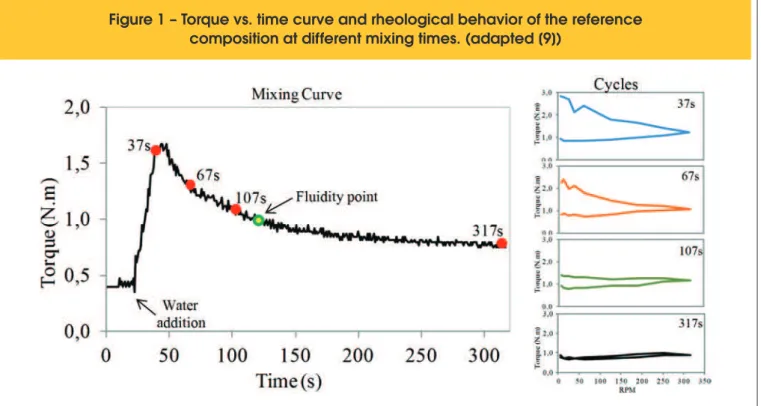
During mixing, the formation of agglomerates occurs when the liq-uid (water) get in contact with the solid particles, increasing the necessary eforts for mixing until a point of maximum cohesion between particles is achieved. At this point, the mixing eforts are high and there is a competition between the forces of agglomer-ate formation and their break. The agglomeragglomer-ates are destroyed by impact and shear energy provided by the mixing equipment, thus, promoting ines and aggregates dispersion, as well as, the homog-enization of the solid particles between them and with water [1–6]. The eforts related to the mixing process can be assessed by spe-cial rheometers capable to withstand and measure the high levels of torque generated during mixing of highly concentrated suspen-sions (like mortars and concretes) [1–4], or by mixers equipped adequately to quantify the energy consumption [5–7] during the process, also allowing for the identiication of the moment that the material starts to behave like a luid [2,8], the luidity point. This point can be determined in the mixing curve as the moment in which the torque levels start to stabilize and the irst derivative of the curve tends to zero asymptotically, Figure 1 [2].
Mixing stages can be assessed by torque vs. time curves, while
shear cycles performed immediately after mixing provide informa-tion regarding the efects of mixing on the rheological behavior of the material, Figure 1 [9]. In Figure 1, each red point marked on the curve indicates a mixing time when the rheological proile of a mortar was evaluated by a shear cycle (accelerating and de-celerating with steps at diferent rotation speeds). It can be noted that the shorter the mixing time, the larger the diference between acceleration and deceleration curves (hysteresis), indicating that the system was still rheologically unstable because the mixing was incomplete, therefore the mortar needed an additional energy – provided by the shear cycle – to proceed with dispersion and ho-mogenization and, then, achieve a stable state. For longer mixing times, the hysteresis area gets progressively smaller until it zero or almost zero, which indicates that the procedure provided enough energy for an adequate mixing that produced a rheologically stable mortar for the experimental conditions applied [9].
Fibers are generally incorporated into cementitious materials as re-inforcements aiming to improve their strength [10], dynamic prop-erties [11,12], resistance to shrinkage cracking and post-failure re-sidual strength [13]. The reinforcement depends on ibers’ features – nature, mechanical properties, geometry – their anchorage with-in the matrix and their dispersion as well. A poor iber distribution with-in the matrix promotes little or no reinforcement at all, and it can even generate critical defects within the composite if its concentration is extremely localized [14]. There are various types of ibers used in cementitious matrix: natural, metallic, ceramic, glassy, polymeric and recycled [15]. They are classiied in function of the raw mate-rial from which they are produced, inorganic or organic types; and they can be also characterized by length, shape and diameter. Ac-cording to their size, they are called macroibers (diameter bigger than 0.3mm and length from 30 to 60mm) or microibers (diam-eter between 10 and 30mm and length between 3 and 18mm) [16].
228 IBRACON Structures and Materials Journal • 2016 • vol. 9 • nº 2
In general, microibers are used to reduce shrinkage cracking and macroibers for structural reinforcement [17]. Microibers present an advantage over the larger ones to prevent cracking because they require a higher pressure to initiate or to propagate cracking due to their smaller diameter [18].
The addition of ibers in cementitious materials causes loss of their workability or reduction of luidity. This phenomenon is mainly as-sociated to the iber content, its features (type, geometry, surface treatment, and stifness), distribution and orientation of the ibers in the matrix, iber-iber and iber-matrix interactions. All these fac-tors make the rheological behavior of iber-containing suspensions quite complex [19,20].
During mixing, these iber-related interactions make dispersion and homogenization processes more diicult due to the formation of ibers-particles and even iber-iber agglomerates. Trying to reduce / avoid the perturbations caused by iber interactions during mix-ing, some authors have suggested diferent mixing methods and sequences of addition of raw materials to improve the processing of cementitious composites. For mortars reinforced with polypro-pylene (PP) ibers, it was observed that sequence of addition of the materials and mixing time had inluence on the homogeneity of the obtained mortar [21]. Others [22] showed that mixing the ibers with the liquid previously to the particulate materials afected iber dispersion and consequently the toughness of the composite. An initial mixing of the ibers with the dry particulate materials also reported a better dispersion of sand and ibers [23]. In refractory castables technology, some authors investigating alumina-based concretes with PP iber addition studied two types of processing: (i) mixing the ibers with the dry materials and (ii) addition of the ibers into the luid concrete already mixed [4]. The study [4] concluded that depending on the addition method diferent shear levels dur-ing mixdur-ing and damage to the ibers were obtained. Damage was lower for shorter ibers and when they were added after the con-crete was already mixed [4]. Another investigation also showed better results when the ibers were mixed in the inal stage of the processing, after all particulate materials had already been mixed with water [18]. The cementitious composites reinforced with PVA ibers obtained by this mixing method presented a more homo-geneous iber distribution, improved mechanical properties, and reduced shrinkage [18].
The investigations of diverse mixing procedures for iber-contain-ing cementitious composites seek optimum dispersion of the ibers within the matrix with reduced damaged (that may be caused
dur-ing processdur-ing), in order that the ibers can perform their reinforce-ment role as expected and, consequently, to produce a composite that can achieve its designed properties. In this context, the goal of the present work is to use rheometry techniques to evaluate the in-luence of diferent addition sequences of PVA-ibers and water on mixing and rheological behavior of mortars. Four mixing sequenc-es are studied: S1 and S2 are based on the addition of ibers at diferent stages of the mixing process; while in S3 and S4 not only the ibers are added at diferent stages, but also the water addition is performed in two steps (25% irst and 75% latter).
2. Experimental
2.1 Materials
The reference composition – R – is composed of Portland cement CPII F, hydrated lime Brazilian type CH III, calcium carbonate iller and crushed sand with maximum particle size of 2mm. Mix design in volume is demonstrated in Table 1 along with the physical char-acteristics (speciic gravity and speciic surface area) of the raw materials. Water content in weight was 16% for all mixtures (water/ solids ratio of 0.16).
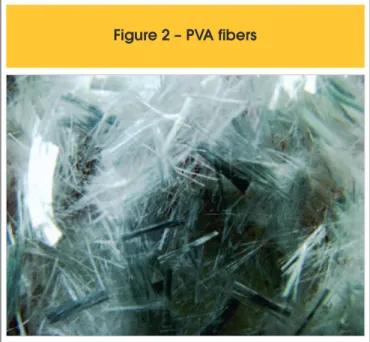
Polyvinyl Alcohol or PVA ibers with 6mm in length, 16mm of diam
-eter and speciic gravity of 1.3 g/cm³ were employed, Figure 2. A iber content of 0.2%vol was added to the reference composition (0% of ibers). Before all the mixing procedures with the mortars, the dry ibers were dispersed manually and, then, with the aid of an air jet low inside a plastic bag.
2.2 Equipment
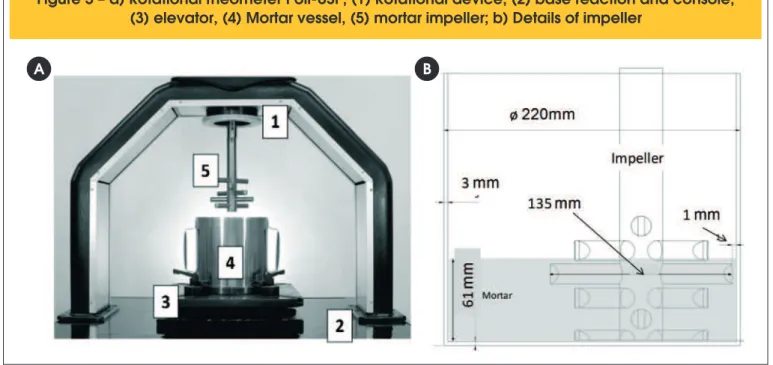
The rotational rheometer for mortars and concretes (Figure 3) de-veloped at Poli-USP (Brazil) was used. The equipment performs speed-controlled tests while the electric power of the engine is measured and, then (using calibration constant), converted into torque values. The impeller used in the planetary setup for mixing
Table 1 – Mix proportions and physical
characteristics (specific gravity, BET specific
surface area) of the raw materials
Raw material
BET surface area
(m2/g)
Stress
(MPa) Zone
Filler 1.23 2.76 12.3
Cement 1.43 3.10 14.5
Hydrated Lime CHIII 6.15 2.49 4.5
Crushed sand 0.27 2.79 68.7
and rheological tests has six blades in spiral coniguration, and the blades pass in a minimum distance of 1mm from the wall and bot-tom of the vessel. The device is capable of mixing mortars from dry powder to luid state and of performing shear cycles for determina-tion of rheological behavior.
2.3 Mixing sequences
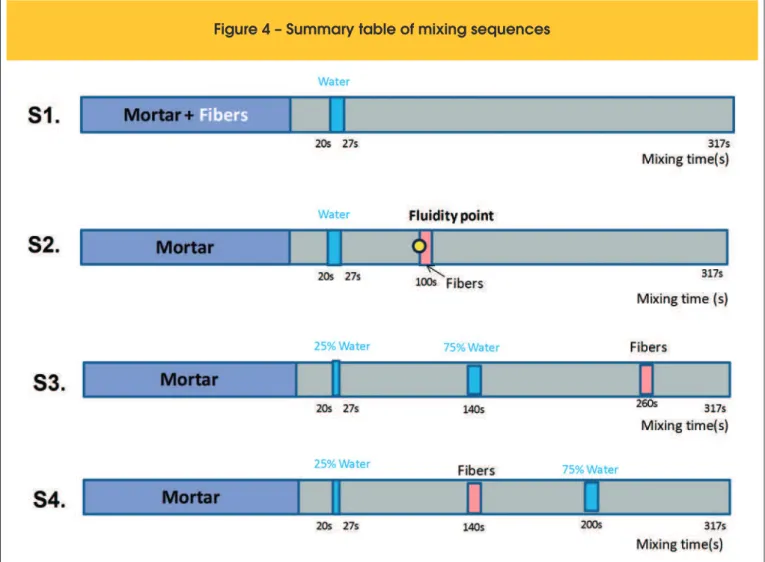
Four mixing sequences are studied. Sequences S1 and S2 are based on the addition of ibers at diferent stages of the mixing process: S1 – ibers are added in the beginning of the process with the particulate materials; S2 – ibers are introduced at the luid-ity point. While in S3 and S4 procedures, not only the ibers are added at diferent stages, but also the water addition is performed in two steps (25% irst and 75% latter). These last sequences were based on previous studies [1,24–26] that showed that the addition of water in two steps increased mixing energy and improved the dispersion of particles. All mixing sequences are described below and in Figure 4.
Mixing sequence 1 – S1 : Dry PVA ibers previously dispersed are incorporated into the 4kg-batch of the dry mixture of raw materials and the whole mixture is homogenized inside a plastic bag. Then, this mixture is transferred to the rheometer vessel. The irst 20s of mixing in the rheometer consist of a dry homogenization step, then all the water is added at a rate of 128g/s. Mixing continues at 126.5rpm until 317s.
Sequence 2 – S2 : This sequence is similar to S1, but the mortar is mixed without the ibers, which are added manually for 10s only at the luidity point (100s). This point was determined analyzing the mixing curve of sequence S1 with the same methodology used in [2].
Sequence 3 – S3 : Dry particulate materials are introduced in the vessel. After 20s of dry mixing, 25% of the water are added at a
rate of 128g/s and mixed for 120s. Then, the remaining 75% of water are added at the same rate and mixing continues. After 120s, the ibers are introduced manually into the system in 10s and mix-ing proceeds until 317s.
Sequence 4 – S4 : Dry particulate materials are introduced in the
vessel. After 20s of dry mixing, 25% of the water are added at a rate of 128g/s and mixed for 120s. Then, the ibers are introduced manually into the system in 10s and mixing continues. At 200s, the remaining 75% of water are added at the same low rate and mix-ing proceeds until 317s.
2.4 Assessment of mixing behavior
Batches of 4kg of dry material were mixed in the rotational rheom-eter with the planetary setup (Figure 3). Mixing speed, total mixing time and low rate of water addition were kept constant and, re-spectively, equal to: 126.5rpm, 317s, and 128g/s. The variation of the torque required to maintain the impeller at a constant rotation speed was monitored by the rheometer during the whole process, from dry material mixing to the end of each procedure (described in 2.3), thus, resulting in the mixing curves as exempliied in Figure 1. The overall work during each mixing sequence is quantiied by the area under the torque vs. time curve (integral).
2.5 Rheological evaluation
Immediately after mixing, the mortars are subjected to a ro-tational shear cycle with the same rheometer setup used for mixing (impeller geometry and planetary coniguration). The shear cycle consists of accelerating and decelerat-ing the mortar with 5-second steps at diferent rotations (6.3; 12.7; 25.3; 38; 63.3; 126.5; 190, 253; and 316 rpm), as illus-trated in Figure 5. The rheological behavior is obtained from
Figure 3 – a) Rotational rheometer Poli-USP, (1) Rotational device, (2) base reaction and console,
(3) elevator, (4) Mortar vessel, (5) mortar impeller; b) Details of impeller
230 IBRACON Structures and Materials Journal • 2016 • vol. 9 • nº 2
Figure 4 – Summary table of mixing sequences
the shear cycle, as well as, the hysteresis area (the difer-ence between acceleration and deceleration curves) that re-gards the stability condition of the material, therefore, also indicating the mixing eiciency provided by the procedure ap-plied [27].
After the rheological test, fresh density and air content of the mor-tars were determined by gravimetric method according to the Bra-zilian standard ABNT NBR 13278 (2005) [28].
3. Results and discussion
3.1 Air content
Table 2 shows the results of air content entrained in the mortars after the shearing cycle. For the reference composition (0% i-ber), there is no observed inluence of the mixing sequence on the entrained air. The iber-containing mortars presented a slightly higher air content than the reference compositions, especially for sequences S3 and S4.
3.2 Mixing curves
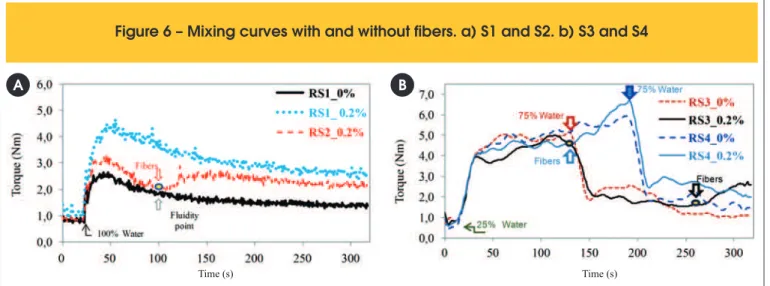
Mixing curves for the mortars prepared by the diverse sequences are demonstrated in Figure 6. For sequences S1 and S2, Figure 6a, after water was added torque levels increased rapidly until peak, which corresponds to the point of maximum cohesion of the
mixture. Then, shear forces due to intense mixing started to over-come capillary and van de Walls forces breaking the agglomerates and distributing entrapped water throughout the system, causing a gradual decrease of torque. When torque levels tend to stabilize, it marks the point from which the material started to behave as a luid, i.e. the luidity point.
The torque levels of the mortars with PVA ibers mixed following S1 are considerably higher than for the reference mortar prepared by the same sequence. Due to the presence of the ibers a strong ag-glomerate structure is formed, because the non-linear shape of the lexible ibers creates a greater interaction between the particles [20], probably creating bigger agglomerates and mechanical bridg-ing between agglomerates and between the ibers themselves as well. Moreover, van der Waals attractive forces added by the ibers collaborate for the formation of the agglomerates, making disper-sion of the ine particles even more diicult and, consequently, in-creasing mixing eforts and reducing lowability [29].
The ibers were previously mixed with the dry mortar in S1 resulting in eforts greater than the ones observed for S2, in which the ibers were added only at the luidity point. In S1, ibers participate in the formation of the agglomerates since the beginning of the process, having an adverse efect on dispersion and homogenization of par-ticles, also on their own dispersion as well. It reasonably expected that mechanical damaged of the ibers could be more intense in the mortar prepared by S1 than in the one prepared by S2 because time and shear, that the ibers were subjected to, are considerably higher in the irst than in the latter sequence. In S2, ibers were introduced when the material was already in a luid condition, at a much lower torque when compared to S1. From this point on, ibers were most homogenized throughout the system and a mod-erate increase in torque occurred immediately after their addition, but it tended to decrease slightly until the end of the procedure. In the preparation sequences S3 and S4, water was added in two steps (25% and 75%); therefore, the mixing curve proile was changed, as illustrated in Figure 6b. After the initial 25% of water addition, torque rose abruptly (as for S1 and S2) and reached a plateau (≈ 5N.m) until the remaining 75% of water were introduced at 140s for S3. The amount of water corresponding to 25% of the total was not enough for this composition to turn into a luid-like material, therefore torque levels remained high until the rest of the
Table 2 – Air content of the mortars prepared
by different mixing sequences
0% fiber Air content
(%) 0,2% fibers
Air content (%)
RS1_0% 5.1 RS1_0.2% 5.6
RS2_0% 5.1 RS2_0.2% 5.8
RS3_0% 4.5 RS3_0.2% 7.8
RS4_0% 5.2 RS4_0.2% 6.5
Figure 6 – Mixing curves with and without fibers. a) S1 and S2. b) S3 and S4
A
B
232 IBRACON Structures and Materials Journal • 2016 • vol. 9 • nº 2
water was added, which caused an instantaneous drop of torque. For the reference mortar, torque levels continued to reduce until the end of the mixing as dispersion and homogenization processes with all the water took place. In S3, ibers were added to the mortar only at 260s and caused the torque to increase.
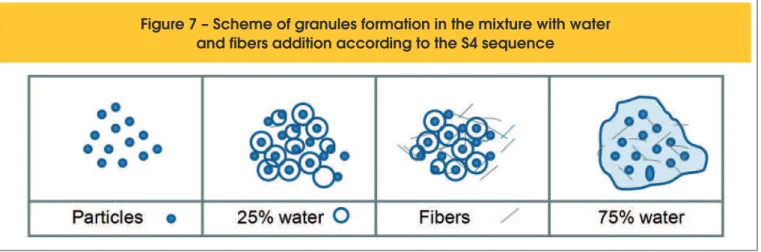
The process of adding only 25% of the water in the beginning of the mixing promoted a pre-homogenization of the raw materials in a low level of liquid saturation. Torque increased until the maximum cohe-sion state (or capillary forces) was reached when water created cap-illary bridges surrounding the particles, thus forming small granules (Figure 7). During sequence S4, the ibers were introduced under this high-torque plateau situation, therefore causing the cohesion to increase even more and pushing torque to higher values. As already mentioned, owing to ibers-particles interaction, ibers are likely to create bridges between diferent granules, thus promoting them to grow and intensifying cohesion forces (both by mechanical bridging and by surface area increase). When the remaining 75% of water were added, the liquid saturation is reached rapidly and most of the granules are destroyed, increasing interparticle separation distance and the distance between ibers as well, making the system much more disperse and, consequently, more luid.
The overall work associated to each mixing sequence was quantiied by the area under the torque vs. time curves (integral) and results are shown in Table 3. For the reference mortar without ibers, S3 and S4 sequences displayed much larger work values than S1 because the time mixing with only 25% of water in S3 and S4 resulted in signiicantly high torque levels, thus increasing shear energy during the process.
In the case of the mortars with 0.2% of PVA ibers, adding the ibers at the luidity point as in S2 reduced the work 25% compared to S1, in which the ibers were mixed with the particulate materials since the start of the process.
Adding the ibers at the luidity point, as in S2, seems to be a more appropriate procedure, because it demands less energy (which also means that it requires an equipment with lower power capac-ity) and the rheological behavior of the matrix composite, which in this case is the mortar, governs directly iber dispersion [30]. Ac-cording to Table 3, S2 resulted in the lowest mixing work compared to the others sequences applied to the compositions with ibers. When comparing S2 and S4, they inal torque are similar, but the work associated to the irst is considerably lower (42%) than the work of the last. S3, on the other hand, did not increase the work, but inal torque was higher and not yet stabilized since iber were added at the end of the mixing procedure and did not had time to disperse properly.
Results showed that the sequence of iber and water addition does have a signiicant inluence on mixing behavior, which may contrib-ute for iber distribution and reducing the required mixing energy. Work of Zhou et al [31] demonstrated that the plastic viscosity of the mortar before iber addition needs to be controlled in order to promote a good iber distribution and that changes in the mixing sequence can improve the process.
3.3 Rheological behavior
Figure 8a shows the results of the shear cycles for sequences S1 and S2. The mortar without ibers (RS1_0%) display a curve with much lower toque levels than the iber-containing mortar mixed following sequence S1 (RS1_0.2%). Hysteresis area for RS1_0% is also lower than for RS1_0.2%. For S2, in which the iber were added at the luidity point, torque levels are an intermediate posi-tion between the reference composiposi-tion and RS1_0.2%, which are in accordance to inal mixing torques showed in Figure 6a. For sequences S3 and S4 0% ibers, Figure 8b, torque levels of the shear cycle are lower than the mortars with ibers but slightly higher than RS1_0%, especially at high rotation speeds. The mortars with ibers prepared by S3 and S4 displayed torque levels two times greater than the reference mortars prepared by the same procedures; also, they presented the largest hysteresis areas of all curves.
Figure 7 – Scheme of granules formation in the mixture with water
and fibers addition according to the S4 sequence
Table 3 – Equivalent work of mixtures
according to torque vs. time integral curve
0% fiber
Equivalent work (Nm.rad)
0,2% fibers
Equivalent work (Nm.rad)
RS1_0% 6474 RS1_ 0.2% 12097
RS2_0% 6474 RS2_0.2% 9075
RS3_0% 11305 RS3_0.2% 11317
From the shear cycles of Figure 8, it can be seen that the mortars without ibers presented lower yield torque than the iber-contain-ing ones. Amongst the mortars with ibers, S2_0.2% had the low-est yield torque of them, which indicates a lower demand of initial stress to begin lowing, while S3_0.2% displayed the highest yield torque of them all.
Ultimately, for the experimental conditions employed it this study, the sequence S2 showed the best performance regarding the mix-ing process of iber-containmix-ing mortars, as well as, it promoted the mortar with the most lowable rheological behavior. Adding the i-bers at the luidity point not only reduced the overall energy re-quired to mixing the system, but it also decreased yield torque and torque levels of the shear cycle.
4. Conclusions
In this work, four diferent addition sequences of water and PVA ibers were evaluated. The mixing process had a great inluence on the rheological behavior of iber-containing mortars, espe-cially regarding the moment of iber addition during the dure. When the ibers were added in the beginning of the proce-dure – still in the dry composition – they demanded much higher mixing eforts than when they were added after an initial mixing of the particulate materials with water. The two-step water addi-tion procedures did not improve the rheological behavior of the mortars with ibers and it even increased the overall mixing work of these systems.
The introduction of the ibers at the luidity point – sequence S2 – reduced signiicantly the mixing work and improved the rheo-logical behavior of the mortar when compared to the other mix-ing sequences. Therefore, this study showed that it is possible to optimize the mixing behavior of mortars containing PVA ibers by simple modiications in the addition sequence of water and ibers.
5. References
[1] Pileggi RG, Studart AR, Pandolfelli VC, Gallo J. How mixing afects the rheology of refractory castables, Part 1. Am Ce-ram Soc Bull 2001;80:27–31.
[2] França MS de. COMPORTAMENTO DE MISTURA DE SISTEMAS CIMENTÍCIOS MULTIFÁSICOS REATIVOS -Mixing behavior of multiphase cementitious materials. Master´s Dissertation. Escola Politécnica da Universidade de São Paulo, 2012.
[3] Cavinato M, Bresciani M, Machin M, Bellazzi G, Canu P, Santomaso A. The development of a novel formulation map for the optimization of high shear wet granulation. Chem Eng J 2010;164:350–8. doi:10.1016/j.cej.2010.05.006.
[4] Domiciano VG, Salomão R, Isaac CS, Pandolfelli VC. Pro-cessing conditions and the permeability of polymeric iber-containing refractory castables. Cerâmica 2003;49:251–6. doi:10.1590/S0366-69132003000400010.
[5] Leuenberger H, Puchkov M, Krausbauer E, Betz G. Manufac-turing pharmaceutical granules: Is the granulation end-point a myth? Powder Technol 2009;189:141–8. doi:10.1016/j. powtec.2008.04.005.
[6] Cazacliu B, Roquet N. Concrete mixing kinetics by means of power measurement. Cem Concr Res 2009;39:182–94. doi:10.1016/j.cemconres.2008.12.005.
[7] Rondet E, Denavaut M, Mandato S, Duri A, Ruiz T, Cuq B. Power consumption proile analysis during wet tion process: Energy approach of wheat powder agglomera-tion. Powder Technol 2012;229:214–21. doi:10.1016/j.pow-tec.2012.06.035.
[8] Cazacliu B, Legrand J. Characterization of the granular-to-luid state process during mixing by power evolution in a planetary concrete mixer. Chem Eng Sci 2008;63:4617–30. doi:10.1016/j.ces.2008.06.001.
[9] França MS de, Cardoso FA, Pileggi RG. Mixing behav-ior of mortars evaluated by rotational rheometry. Ambi-ente Construído 2012;12:165–74. doi:10.1590/S1678-86212012000200011.
[10] BENTUR A, MINDESS S. Fibre Reinforced Cementitious Composites. 2nd ed. Londond and New York: 2007.
[11] Noushini A, Samali B, Vessalas K. Efect of polyvinyl alco-hol (PVA) ibre on dynamic and material properties of ibre reinforced concrete. Constr Build Mater 2013;49:374–83. doi:10.1016/j.conbuildmat.2013.08.035.
!"#$"%&"'()*)#"%&+%$(",(-./(01.2,3-.4(01.5
234 IBRACON Structures and Materials Journal • 2016 • vol. 9 • nº 2
[12] Liu J, Sun W, Miao C, Liu J, Li C. Assessment of iber dis-tribution in steel iber mortar using image analysis. J Wuhan Univ Technol-Mater Sci Ed 2012;27:166–71. doi:10.1007/ s11595-012-0429-z.
[13] Bolander JE, Choi S, Duddukuri SR. Fracture of iber-rein-forced cement composites: Efects of iber dispersion. Int J Fract 2008;154:73–86. doi:10.1007/s10704-008-9269-4. [14] Ozyurt N, Mason TO, Shah SP. Correlation of iber
dis-persion, rheology and mechanical performance of FRCs. Cem Concr Compos 2007;29:70–9. doi:10.1016/j.cemcon-comp.2006.08.006.
[15] Campello E, Pereira MV, Darwish F. The Efect of Short Metallic and Polymeric Fiber on the Fracture Behavior of Cement Mortar. Procedia Mater Sci 2014;3:1914–21. doi:10.1016/j.mspro.2014.06.309.
[16] SALVADOR RP. Análise comparativa de métodos de ensaio para caracterização do comportamento mecânico de con-creto reforçado com ibras. Dissertação (Mestrado em En-genharia de Construção Civil e Urbana). Escola Politécnica, University of São Paulo, 2012.
[17] Ding Y, Liu S, Zhang Y, Thomas A. The investigation on the workability of ibre cocktail reinforced self-compacting high performance concrete. Constr Build Mater 2008;22:1462– 70. doi:10.1016/j.conbuildmat.2007.03.034.
[18] Kim B, Boyd AJ, Lee J-Y. Efect of transport properties of i-ber types on steel reinforcement corrosion. J Compos Mater 2011;45:949–59. doi:10.1177/0021998310380286.
[19] GRÜNEWALD S. Performance – based design of self-com-pacting ibre reinforced concrete. These. Delft University of Technology., 2004.
[20] Keshtkar M, Heuzey MC, Carreau PJ. Rheological behavior of iber-illed model suspensions: Efect of iber lexibility. J Rheol 2009;53:631. doi:10.1122/1.3103546.
[21] SILVA R da P. Argamassas com adição de ibras de polip-ropileno - Estudo do comportamento reológico e mecânico. Dissertação (Mestrado em Engenharia de Construção Civil e Urbana). Escola Politécnica da Universidade de São Pau-lo, 2006.
[22] Akkaya Y, Shah S, Ankenman B. Efect of Fiber Dis-persion on Multiple Cracking of Cement Composites. J Eng Mech 2001;127:311–6. doi:10.1061/(ASCE)0733-9399(2001)127:4(311).
[23] Kuder KG, Ozyurt N, Mu EB, Shah SP. Rheology of i-ber-reinforced cementitious materials. Cem Concr Res 2007;37:191–9. doi:10.1016/j.cemconres.2006.10.015. [24] Zhou J, Qian S, Ye G, Copuroglu O, van Breugel K, Li VC.
Im-proved iber distribution and mechanical properties of engi-neered cementitious composites by adjusting the mixing se-quence. Cem Concr Compos 2012;34:342–8. doi:10.1016/j. cemconcomp.2011.11.019.
[25] ANTUNES R. Inluência da Reologia e da Energia de Im-pacto na Resistência de Aderência de Revestimentos de Ar-gamassa. Escola Politécnica da Universidade de São Paulo, 2005.
[26] Cardoso FA. Método de Formulação de Argamassas de Revestimento Baseado em Distribuição Granulométrica e Comportamento Reológico. Escola Politécnica da Universi-dade de São Paulo, 2009.
[27] França MS de, Cardoso FA, Pileggi RG. Inluence of labo-ratory mixing procedure on the properties of mortars. Am-biente Construído 2013;13:111–24. doi:10.1590/S1678-86212013000200009.
[28] Pileggi RG, Studart AR, Pandolfelli VC, Gallo J. How mixing afects the rheology of refractory castables, Part 2. Am Ce-ram Soc Bull 2001;80:38–42.
[29] ABNT NBR 13278. ASSOCIAÇÃO BRASILEIRA DE NOR-MAS TÉCNICAS. NBR 13278: argamassa para assenta-mento e revestiassenta-mento de paredes e tetos – Determinação da densidade de massa e do teor de ar incorporado 2005. [30] Collins F, Lambert J, Duan WH. The inluences of
admix-tures on the dispersion, workability, and strength of car-bon nanotube–OPC paste mixtures. Cem Concr Compos 2012;34:201–7. doi:10.1016/j.cemconcomp.2011.09.013. [31] Li M, Li VC. Rheology, iber dispersion, and robust