*e-mail: [email protected]
Trabalho apresentado no XV CBECIMAT, Natal - RN, Novembro de 2002.
The Effect of Cr Concentration and Preparation Method on the
Microstructure and Electrical Characterization of SnO
2-Based Ceramics
Daniela Russo Leite*, Wanda Cecilia Las, Maria Aparecida Zaghete,
Mario Cilense, Jose Arana Varela
CMDMC-LIEC, Instituto de Química, UNESP C.P. 355, 14800-900 Araraquara - SP, Brazil
Received: January 28, 2003; Revised: July 27, 2003
This paper reports a study of the influence of Cr concentration and preparation method in the electrical conductivity and microstructure of SnO2-based powders doped with Mn and Nb, pre-pared by an organic route (Pechini method) and a mixture of oxides. All the samples were com-pacted into discs and sintered at 1300 °C for 3h, resulting in ceramics with relative density varying between 81 and 99%. The powders were morphologically characterized by X-ray diffraction and their specific surface area was determined by N2 adsorption/desorption isotherms. Electrical con-ductivity characterization indicated that the concon-ductivity decreases as Cr concentration in-creases, probably due to Cr segregation at grain boundaries, which reduces grain size, increasing the number of resistive boundaries, thus limiting the passage of current.
Keywords:SnO2, conductivity, chromium
1. Introduction
Tin dioxide (SnO2) is a n-type semiconductor whose te-tragonal crystalline structure is similar to the rutile one1.
This dioxide has many uses such as gas sensors, electrodes for electric glass melting furnaces, electro chromic devices, crystal displays, photo detectors, solar cells and protective coatings2-4. However the use of tin dioxide ceramics is
lim-ited due to poor densification during sintering caused by the dominance of non-densifying mechanisms for mass transport such as surface diffusion or evaporation
conden-sation5. These mechanisms promote grain coarsening of
SnO2 leading to poor densification of this ceramics6.
Dense SnO2-based ceramics can be achieved by
intro-ducing dopants such as MnO27 or by hot isostatic pressure
processing8. Dopants with valence +2 can promote
densification of SnO2 ceramics due to the formation of solid solution with the creation of oxygen vacancies9, according
to:
(1)
Dopants with valence +5, such as Nb2O5, are added to
SnO2 ceramics in small amounts to promote the
substitu-tion of Sn+4 for Nb+5, leading to an increase of electronic
conductivity in the SnO2 lattice10, according to:
(2)
The addition of Cr2O3 in SnO2-based ceramics leads to a high non-linearity coefficient of α = 41 due the introduc-tion of defects in the crystal lattice that are responsible for the formation of Schottky type potential barriers at the grain boundaries, enabling its use in varistors11. The introduction
of Cr2O3 in the SnO2 lattice leads to the substitution of Sn+4
by Cr+3, according to the reaction:
(3)
Due to the large influence of Cr+3 in the electrical
prop-erties of SnO2-based ceramics, the effect of this ion on elec-trical conductivity in Sn-Mn-Nb systems, prepared by Pechini method and mixture of oxides, and its correlation with microstructural results were investigated in this work.
2. Experimental Procedure
method12-13 and mixture of oxides. The Pechini method
con-sisted in the preparation of metallic citrates that were added to a solution of citric acid and ethylene glycol to form a polymeric resin. This resin was pre-calcined (400 °C/4 h) to eliminate organic material, de-aggregated by milling and calcined again (500 °C/15 h) to eliminate residual organic material.
The raw materials were ethylene glycol (Merck), citric acid (Synth), tin chloride (Merck), manganese carbonate (Carlo Erba), niobium oxide (Puratronic), chromium nitrate (Vetec), ammonia solution (Merck) and nitric acid (Merck), tin dioxide (Merck), manganese oxide (Aldrich), chromium oxide (Vetec).
The powders were ground by a ball mill process in an alcohol media. The composition of the molar system was (98.95–X)%Sn + 1.0% Mn + 0.03% Nb + X% Cr, with X equal to 0.0, 0.1, 0.5 and 0.7, all in mole% (see Table 1).
Morphological characterization of obtained powders was done by X-ray diffraction (XRD; SIEMENS D-5000) while
the specific surface area was measured by N2
adsorption/desorption isotherms (BET method; MICROMERITICS ASAP 2000).
The powders obtained were pressed into 8.0 × 1.5 mm
discs by uniaxial pressing (20 MPa), followed by isostatic pressing at 210 MPa. The discs were sintered at 1300 °C for 3 h and slowly cooled down to room temperature. The rela-tive densities were determined by the Archimedes method. Mean grain size was determined by analyzing the Scanning electron microscopy micrographies (SEM, TOPCOM SM – 300), using the intercept method14. The discs for
elec-trical conductivity measurements were subjected to a ther-mal treatment at 900 °C for 10 h and, after cooling, the plate surfaces were polished and platinum plated to insure a good electrical contact with the platinum tape of the disc holder. Four ohmic contacts were made at the sample using plati-num paste. Values of resistance as a function of tempera-ture were collected using a Hewlett-Packard 3457A multimeter connected to a computer.
3. Results and Discussion
The X-ray diffraction patterns of the compositions stud-ied are shown in Fig. 1 for powders prepared by Pechini
method and in Fig. 2 for mixture of oxides. It can be seen that the X-ray diffraction analysis indicates a single phase, the cassiterite, in all systems, as already observed in other reports1,5,9-11.
The values of specific surface area (SBET) and mean par-ticle size (DBET) are given in Table 2. An analysis of these data leads us to conclude that powders prepared by Pechini
Table 1. Molar system composition and nomenclature used for each system (Pch indicate Pechini method and Mox, mixture of oxides).
Composition of System Nomenclature
%Sn %Mn %Nb %Cr
98.7 1.00 0.03 - SnMnNbPch SnMnNbMox
98.6 1.00 0.03 0.10 SnMnNbCr0.1Pch SnMnNbCr0.1Mox
98.2 1.00 0.03 0.50 SnMnNbCr0.5Pch SnMnNbCr0.5Mox
98.0 1.00 0.03 0.70 SnMnNbCr0.7Pch SnMnNbCr0.7Mox
Figure 1. X-ray diffraction patterns of powders prepared by Pechini method, calcined at 500 °C for 15 h.
method showed to be finer and more reactive than those prepared by the mixing oxide method and that milling re-duces the particle size of powders prepared by Pechini method. The particle size increases with Cr addition for both preparation methods, excepting the system without Cr pre-pared by mixture of oxides, probably due to a problem in milling. Table 3 presents the relative density of systems be-fore and after sintering. According to this table, addition of 0.1 mole% of Cr presented better densification for both preparation methods. However, by increasing the Cr
con-Figure 3. a) SEM micrographs of sintered compacts at 1300 °C for 3 h, prepared by Pechini method, with: (a) 0.0% mol of Cr.; b) 0.1% mol of Cr; c) 0.5% mol of Cr; d) 0.7% mol of Cr; and prepared by mixture of oxides, with: e) 0.0% mol of Cr; f) 0.1% mol of Cr; g) 0.5% mol of Cr; h) 0.7% mol of Cr.
Table 2. Characterization of powders obtained by Pechini method and mixture of oxides, before and after milling: theoretical density, BET surface area and mean particle size.
Pechini method Mixture of oxides
System dtheoretical SBET(m2/g) D
BET(µm) SBET(m
2/g) D BET(µm)
(g/cm3) WM* M8 h** WM M8 h M8 h M8 h
SnMnNb 6.919 36.6 44.1 0.024 0.020 8.50 0.102
SnMnNbCr0.1 6.916 37.7 42.9 0.023 0.020 12.1 0.072
SnMnNbCr0.5 6.902 36.1 38.6 0.024 0.023 9.92 0.088
SnMnNbCr0.7 6.897 22.0 28.6 0.040 0.030 9.38 0.093
* WM = without milling;
** M8 h = grinding for 8 h in a ball milling.
centration to 0.7 mole%, the final density of the ceramics decreases substantially, which could be associated to the decrease of oxygen vacancy formation at the grain bound-ary11.
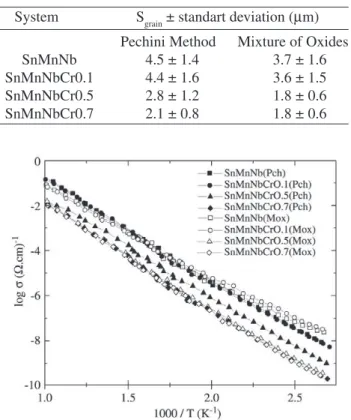
Figure 5. Electrical conductivity normalized to grain size as a func-tion of temperature of system SnMnNbCrx, with 0 ≤ x ≤ 0.7% mol, sintered at 1300 °C for 3 h.
increase in porosity is probably due to the segregation of Cr at the grain boundary region, impairing mass transport dur-ing sinterdur-ing. The ceramics systems are characterized by heterogeneous grain size distribution.
Table 4 shows the variation of Cr concentration on mean grain size. Increasing Cr concentration leads to
microstruc-tures with decreasing mean grain size for both preparation methods. The decrease in mean grain size could be associated to segregation in the grain boundaries.
The dependence of the conductivity on the temperature is shown in Fig. 4. The conductivity decreases with decreas-ing temperature, what is expected for this semiconductor oxide. Normalizing these curves to grain size (Fig. 5), a significant decrease in conductivity for ceramics doped with Cr concentration higher or equal than 0.5 mole% was ob-served. Also, this is probably due to Cr segregation at the grain boundaries, which reduces mean grain size, so that the number of resistive boundaries increases, limiting the passage of current.
4. Conclusion
The relative density results agree with the scanning elec-tron microscopy micrographs. The ceramic microstructure is strongly dependent on the Cr concentration. The Cr forms a phase segregated at the grain boundary and appears to control the sintering and grain growth rates. Thus, excess of it in the chemical composition leads to the formation of porous microstructure, deleterious for electrical conductivity.
Acknowledgments
The financial support of this research by FAPESP, CNPq and CAPES is gratefully acknowledged.
References
1. Jarzebski, Z.M.; Marton, J.P. J. Electrochem. Soc., v. 123, p. 299C-310C, 1976.
2. Chopra, K.L.; Major, S.; Pandya, P.K. Thin Solid Films,
Table 3. Relative density (dR) of green compacts and sintered com-pacts at 1300 °C for 3 h.
Pechini method Mixture of oxides
System Green Sintered Green Sintered
dR(%)* dR(%) dR(%) dR(%)
SnMnNb 50.6 91.8 53.5 98.6
SnMnNbCr0.1 49.5 98.3 54.1 99.4
SnMnNbCr0.5 50.6 94.6 54.0 87.2
SnMnNbCr0.7 51.9 88.5 53.7 81.0
* The relative density was calculated considering the theoretical density of the system.
** P = 100 - dR
Table 4. Mean grain size (Sgrain/µm) of systems sintered at 1300 °C for 3 h.
System Sgrain ± standart deviation (µm)
Pechini Method Mixture of Oxides
SnMnNb 4.5 ± 1.4 3.7 ± 1.6
SnMnNbCr0.1 4.4 ± 1.6 3.6 ± 1.5
SnMnNbCr0.5 2.8 ± 1.2 1.8 ± 0.6
SnMnNbCr0.7 2.1 ± 0.8 1.8 ± 0.6
v. 102, p. 1, 1983.
3. Fagan, J.G.; Amarakoon, V.R.W. Am. Ceram. Soc. Bull.,
v. 72, p. 119-129, 1993.
4. Olivi, P.; Souza, E.C.P.; Longo, E.; Varela, J.A.; Bulhões, L.O.S. J. Electrochem. Soc., v. 140, p. L81, 1993. 5. Varela, J.A.; Longo, E.; Barelli ,N.; Tanaka, A.S.; Mariano,
W.A. Cerâmica, v. 31, p. 241-245, 1985.
6. Duvigneaud, P.H.; Reihard, D. in Science of sintering, P. Vicenzini, ed. Ceramurgia Srl., Faenza, Italy, p. 287-292, 1980.
7. Zuca, S.; Terzi, S.; Zaharescu, M. J. Mater. Sci., v. 26, p. 1673, 1991.
8. Park, S.J.; Hirota, K.; Yamamura, H. Ceramics
Interna-tional, v. 10, p. 115-116, 1984.
9. Pianaro, S.A.; Bueno, P.R.; Longo, E.; Varela, J.A. J.
Mater. Sci. Lett., v. 14, p. 692-694, 1995.
10. Wang, Y.J.; Wang, J.F.; Li, C.P.; Chen, H.C.; Su, W.B.; Zhong, W.L.; Zhang, P.L.; Zhao, L.Y. J. Mater. Sci. Lett.,
v. 20, p. 19-21, 2001.
11. Pianaro, S.A.; Bueno, P.R.; Longo, E.; Varela, J.A. Ce-ramics International, v. 25, p. 1-6, 1999.
12. Pechini, M.P. U. S. Patent, n. 3330697, 1967. 13. Besso, M.M. U. S. Patent, n. 3123120, 1965.