O
RIGINALA
RTICLE Revista Brasileira de FisioterapiaAgreement and reliability of two non-invasive
methods for assessing cervical range of
motion among young adults
Concordância e confiabilidade de dois métodos não-invasivos para a avaliação da
amplitude de movimento cervical em adultos jovens
Lidiane L. Florêncio, Patrícia A. Pereira, Elaine R. T. Silva, Kátia S. Pegoretti, Maria C. Gonçalves, Débora Bevilaqua-Grossi
Abstract
Background: Cervical range of motion (CROM) is a fundamental component of the functional evaluation in physical therapy interventions. The CROM device stands out as a reliable, non-invasive and easy-to-use method, but it is a very expensive tool. In clinical practice, more affordable tools such as Fleximeters are preferred. However, the reliability of Fleximeters for the cervical spine has not been adequately tested. Objectives: To compare the Fleximeters and the CROM device for the analysis of CROM, and to investigate the intra- and inter-examiner reliability of both tools. Methods:Cervical movements (flexion, extension, lateral flexion and rotation) were assessed in 20 asymptomatic young women by three examiners using both tools. The statistical analyses were performed using the intra-class correlation coefficient (ICC). Results: The agreement between the tools was considered moderate for flexion and left rotation (0.71; 0.58) and excellent for all of the other movements (0.76-0.87). The intra-examiner reliability for the CROM device was moderate for flexion and right rotation (0.70; 0.69) and excellent for all of the other movements (0.79-0.88). For the Fleximeter, the agreement was excellent for inclination and right rotation (0.80; 0.77) and moderate for all of the other movements (0.69-0.75). The inter-examiner reliability for the CROM device was excellent for all movements (0.76-0.93) and for the Fleximeter, it was moderate for right and left rotation (0.66; 0.75) and excellent for all of the other movements (0.81-0.88). Conclusions: There was agreement between the CROM assessments using the Fleximeter and the CROM device. Furthermore, both devices showed acceptable reliability for clinical practice.
Key words: cervical range of motion; assessment; reliability; CROM; Fleximeter.
Resumo
Contextualização: A amplitude de movimento (ADM) cervical é fundamental na avaliação funcional e na intervenção fisioterapêutica. O
Cervical Range of Motion (CROM) destaca-se por ser um método confiável, não invasivo e de fácil manuseio, porém de alto custo. Na prática clínica, opta-se por aparelhos mais acessíveis, como o Flexímetro, cuja confiabilidade ainda não foi adequadamente testada para o segmento cervical. Objetivos: Comparar o Flexímetro com o CROM na análise da ADM cervical e verificar a confiabilidade intra e interexaminadores de ambas as ferramentas.Métodos:Os movimentos cervicais de flexão, extensão, inclinação lateral e rotação foram mensurados, com ambas as ferramentas, por três examinadores em 20 indivíduos jovens, do sexo feminino, assintomáticos. A análise estatística foi realizada pelo Coeficiente de Correlação Intraclasse (ICC). Resultados:A concordância entre as ferramentas foi considerada moderada nos movimentos de flexão e rotação esquerda (0,71;0,58) e excelente nos demais movimentos (0,76-0,87). A confiabilidade intraexaminadores com o CROM foi moderada para os movimentos de flexão e rotação direita (0,70; 0,69) e excelente para os demais movimentos (0,79-0,88); com o Flexímetro, foi excelente para inclinação e rotação direita (0,80; 0,77) e moderada para os demais movimentos (0,69-0,75). A confiabilidade interexaminadores com o CROM foi excelente em todos os movimentos (0,76-0,93) e, com o Flexímetro, foi moderada para os movimentos de rotação direita e esquerda (0,66; 0,75) e excelente para os demais movimentos (0,81-0,88). Conclusões: Os valores obtidos na avaliação da ADM cervical feita pelo Flexímetro concordam com aqueles mensurados pelo CROM. Além disso, ambas as ferramentas apresentam confiabilidades aceitáveis para a prática clínica.
Palavras-chave: ADM cervical; avaliação; confiabilidade; CROM; flexímetro.
Received: 09/11/09 – Revised: 21/05/09 – Accepted: 06/08/09
1 Department of Biomechanics, Medicine and Rehabilitation of the Locomotor System, Faculdade de Medicina de Ribeirão Preto, Universidade de São Paulo (FMRP USP) – Ribeirão Preto
(SP), Brazil
Corresponce to: Débora Bevilaqua Grossi, Av. Bandeirantes, 3.900, CEP 14049-900, Ribeirão Preto (SP), Brazil, e-mail: [email protected]
Introduction
The evaluation of the cervical range of motion (CROM), much used in physical therapy practice1 is an important
device for diagnosing musclo-skelical disorders2, to
ana-lyze the progression of diseases3, to evaluate the effects of
different treatments4 and to monitor the progress of
pa-tients during rehabilitation1, 5-7. The limitations of cervical
Range of Movements (ROM) may indicate musculoskeletal disorders, neck pain resulting from trauma or idiopathic8,9,
headaches8,10-12 or some dysfunctions in the
temporo-man-dibular joints and masticatory muscles12-14.
During the analysis of ROM, one should consider the existence of natural variations between individuals, as well as factors which influence this variability, such as gender, age and the nature of movements,either passive or active1. For example, women have greater movement
amplitudes in relation to men12,15-19, and aging leads to less
ROM13,19-21 for about five degrees per decade22.
There is a need to obtain quantitative, objective and reliable measures for physical therapy evaluation. How-ever, the cervical spine shows more complexity due to the associated movements of the high thoracic spine and shoulders12,13 and the lack of precise anatomical marks in
this region18,23.
To accurately measure the ROM, it is essential that it is evaluated by reliable methods and tools, non-invasive and which can be used by different examiners2,24; in addition,
it is desirable that it be easy to use and provides clinically accurate and significant data1,25.
Despite the diversity of instruments cited in the litera-ture for the evaluation of the ROM, there is no consensus among professionals as to which method would be most indicated8,11,26 and which protocol should be followed8. The
method considered the gold standard in the literature is the radiograph, however, it is an impractical tool for the clinical use; considering the need for reevaluation, it might result in excessive exposure of patients to radiation and constant costs for patients and health services15,25,27,28.
There are a variety of available non-invasive methods, such as visual estimations, the goniometer, the inclinom-eter, the potentiominclinom-eter, compasses, videos and electro-magnetic technologies. However, for most of them, the intra- and inter-examiner reproducibility were not prop-erly evaluated29.
The Cervical Range of Motion device (CROM) is a goniometer capable of measuring the ROM of flexion, ex-tension, inclination and rotation of the cervical spine by three inclinometers30. It has the advantage of recording in
all planes without the need for anatomical markers and
the repositioning of the device throughout the assess-ments31. Tousignant et al.7,18,31 assured the validation of this
instrument in symptomatic and asymptomatic patients, compared it with the radiographic techniques7,18 in the
movements of flexion/extension and inclination and with OPTOTRAK31 (non-invasive system for measurements
us-ing the incidence of infrared light) in the rotation move-ments, and found excellent reliability indices (0,82-0,98) .
Youdas Carey and Garret32 showed the index of
intra-class correlation coefficients (ICC) ranging from 0.73 to 0.95 in symptomatic groups and similar data were found by Capuano-Pucci et al.33 in asymptomatic groups.
Bevilaqua-Grossi et al.10 evaluated a female population with
mi-graines and reported an intra-examiner reliability ranging from 0.79 to 0.99 and inter-examiner reliabilities ranging from 0.68 to 0.95. Unlike other instruments, it is a method whose reliability is well established in the literature, since several studies have demonstrated ICC ranging from good to excellent7,10,18,29-33. However, the CROM is less used
be-cause it is an imported equipment with a high cost. The device most commonly used in physical therapy practice is the Fleximeter, a goniometer gravity-dependent instument of low-cost and easy to use, which evaluates ROM of several joint. Its reliability for the evaluation of cervical ROM has not been fully established. Lima et al.34
evaluated only two movements of the cervical spine and demonstrated excellent ICC values (0.79) and moderate (0.55) for rotations and inclinations, respectively. There were not found in the literature, studies which compared this instrument with another techniques of cervical ROM evaluations.
The present hypothesis is that the Fleximeter is able to reproduce the values obtained by CROM, which would indicate that this tool would be reliable for clinical prac-tice. Therefore, the objectives were to verify the correla-tions between cervical ROM measurements obtained with the CROM and with the Fleximeter and, additionally, to verify the intra- and inter-examiner reliability of both tools.
Methods
Randomly, 20 asymptomatic women subjects, with a mean age of 22 years (±2), were evaluated. The three ex-aminers in the study were previously trained in each tech-nique for a period of six hours per week for two weeks.
The exclusion criteria were to be younger than 18 years and demonstrate a history of trauma, surgery or any other dysfunctions of the cervical region. The subjects were
instructed to sit with their feet flat on the floor, with their knees and ankles at 90o of flexion, support their hands
on their thighs and stay in a relaxed position, which was considered the starting position for the individual. Then, familiarization training was performed to demonstate the equipment and the instructions to the subjects about the compensatory movements which were corrected during the active performance of the six measured movements ( flexion, extension, right lateral inclination, left lateral inclination, right rotation and left rotation).
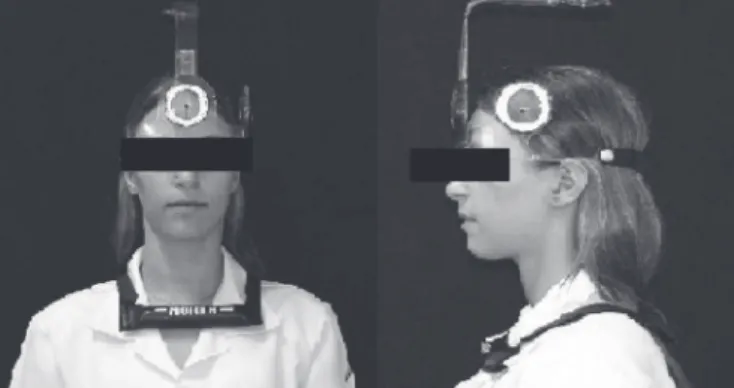
The devices used were the CROM (Figure 1) and the Fleximeter (Figure 2). The first, developed by Performance Attainement Associates (Roseville, MN), measured the ROM of flexion, extension, lateral inclination and rotation of the cervical spine by three inclinometers, whose scales ranged from two to two degrees. These inclinometers are attached to a frame similar to glasses: one, in the frontal plane, to lateral inclination; another, in the sagittal plane, to flexion/extension and the third, in the transverse plane, for rotation. Two of them were gravity-dependent (the frontal and sagittal) and the transverse one was magnetic dependent. A magnetic necklace was placed on the subject to measure the rotation20.
The fleximeter, developed and manufactured in Brazil, patented at the Code Intitute of Research34, consisted of
a gravity-dependent inclinometer, whose the scale was of one grade, attached by a velcro tape. At the end of each movement, the device was repositioned. All movements were measured with the subjects seated, except for the movements of rotation, in which they had to stay in the su-pine position, with their shoulders aligned with the end of the apparatus. So that the individuals would not be inse-cure, the examiner placed a supporting hand on the occipi-tal region, but did not interfere with the active movement of the subject34. This exception was done to maintain the
position of the device favorably for the effects of gravity. The movements of flexion, extension, lateral inclina-tion and rotainclina-tion were evaluated by three different exam-iners with the CROM and with the Fleximeter, randomized to a number sequences slelected by the subjects. For each movement, three repetitions were made, from which the average obtained. There was no interval between assess-ments. The whole procedure described above was re-peated at a one week interval to test the intra-examiner reliability.
All procedures in this study were approved by the Com-mittee of Ethics in Research of the Clinics Hospital of Ri-beirão Preto and the Faculty of Medicine of RiRi-beirão Preto, according to opinion number 5230/2008 and all subjects signed a consent form.
Figure 1. Cervical Range of Motion (CROM, Performance Attainment Associates, St. Paul, MN, USA) in the frontal (A) and sagittal (B) planes.
Figure 2. Fleximeter (ICP) in the frontal (A) and sagittal (B) planes.
Statistical analyses
The comparisons between the two methods was made by the ICC, which verified the degrees of correlations between the measures for each class35. The closer the
coefficient was to 1, the higher was the correlation. The agreement between the tools was classified, in accordance with ICC values, as poor (<0.4), moderate (0.4-0.75) or ex-cellent (>0.75)36. The confidence interval used was 95%.
For each tool, there were also obtained the intra- and inter-examiner reliabilities by ICC using SPSS 10.0 for Win-dows. For the calculation of reliabilities, the average of the three measurements taken for each movement during the evaluation was used. The intra-examiner reliability mea-sures, the accuracy of a device when used more than once by the same examiner, as the ideal tool should not provide different results if the ROM, in fact, has not changed37. The
inter-examiner reliability measured the accuracy of the method when it is used in the same situation by different examiners, as the result of the tool, should not vary from observer to observer37. The classification of reliabilities
should be the same used in the comparisons of the tools described above.
rotation , respectively (Table 1). These values indicated an excellent agreement for most of the movements, ex-cept for flexion and left rotation, which showed moderate agreement.
Intra- and inter-examiner reliability
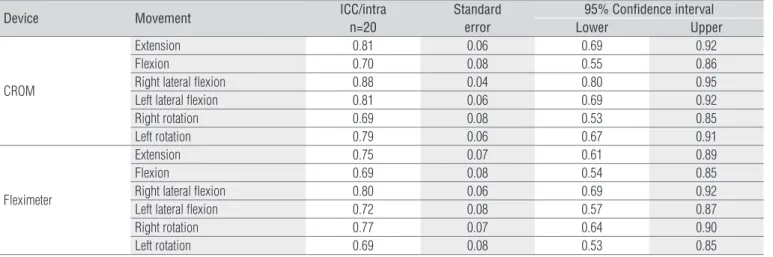
he intra-examiner reliability of the values obtained with the CROM was excellent for the movements of extension, right lateral inclination, left lateral inclination and left rota-tion and moderate for lexion and right rotarota-tion (Table 2). For the values obtained with the Fleximeter, the intra-examiner reliability was excellent for the movements of the right lat-eral inclinations, and right rotations, and moderate for the other assessed neck movements (Table 2).
In the inter-examiner reliability of the values obtained with the CROM, there were excellent values for all assessed cervical movements (Table 3). For the values obtained with the Fleximeter, the inter-examiner reliabilities were
Results
Concordance between the measurements obtained
with the CROM and with the Fleximeter
The ICC values were 0.82; 0.71; 0.87; 0.83; 0.76; and 0.58 for the movements of extension, flexion, right lateral inclination, left lateral inclination, right rotation and left
Movement ICC
n=20
Standard error
95% Confidence interval
Lower Upper
Extension 0.56 0.06 0.47 0.65
Flexion 0.61 0.08 0.52 0.70
Right lateral flexion 0.75 0.04 0.69 0.80 Left lateral flexion 0.49 0.05 0.40 0.59 Right rotation 0.53 0.07 0.41 0.65 Left rotation 0.44 0.10 0.36 0.54
ICC=intra-class correlation coefficient.
Table 1. Comparisons between the two devices using St. Laurent’s coefficient.
CROM=cervical range of motion.
Device Movement ICC/intra
n=20
Standard error
95% Confidence interval
Lower Upper
CROM
Extension 0.81 0.06 0.69 0.92
Flexion 0.70 0.08 0.55 0.86
Right lateral flexion 0.88 0.04 0.80 0.95
Left lateral flexion 0.81 0.06 0.69 0.92
Right rotation 0.69 0.08 0.53 0.85
Left rotation 0.79 0.06 0.67 0.91
Fleximeter
Extension 0.75 0.07 0.61 0.89
Flexion 0.69 0.08 0.54 0.85
Right lateral flexion 0.80 0.06 0.69 0.92
Left lateral flexion 0.72 0.08 0.57 0.87
Right rotation 0.77 0.07 0.64 0.90
Left rotation 0.69 0.08 0.53 0.85
Table 2. Intra-examiner reliability assessed by the Intraclass Correlation Coefficient (ICC).
CROM=cervical range of motion.
Device Movement ICC/ inter
n=20 Standard error
95% Confidence interval
Lower Upper
CROM
Extension 0.91 0.03 0.86 0.97
Flexion 0.85 0.08 0.76 0.94
Right lateral flexion 0.93 0.03 0.89 0.98
Left lateral flexion 0.89 0.04 0.81 0.96
Right rotation 0.76 0.07 0.63 0.90
Left rotation 0.81 0.05 0.70 0.92
Fleximeter
Extension 0.88 0.05 0.80 0.95
Flexion 0.84 0.06 0.74 0.93
Right lateral flexion 0.85 0.06 0.75 0.94
Left lateral flexion 0.81 0.07 0.70 0.92
Right rotation 0.66 0.09 0.49 0.83
Left rotation 0.75 0.08 0.61 0.89
Table 3. Inter-examiner reliability assessed by the Intraclass Correlation Coefficients (ICC).
considered excellent for the movements of extension, lexion, right lateral inclination, left lateral inclination, and moderate for the movements of right and left rotation (Table 3).
Discussion
he CROM is a validated tool, accurate and easy to use; however, has the disadvantage of being expensive and only can be used in measuring cervical ROM. However, the Fleximeter, was more inancially accesible, was capable of measuring the ROM of several joints, but there was a need for it to be reposi-tioned for each measurement, which could become a factor for alterations of the measurements.
In the comparison between the two tools, it was observed that there was excellent agreement for the majority of the cervical movements. hese results indicated that the mea-surements obtained in the cervical assessements with CROM were equivalent to those obtained with the Fleximeter, thus conirming the possibility of using the Fleximeter as a substi-tute for the CROM in clinical practice.
he results of this study demonstrated that the measure-ments performed by the CROM had excellent intra-examiner reliability for most cervical movements, with moderate val-ues only for lexion and right rotations. In turn, in the inter-examiner reliability for this same tool, there were excellent values for all assessed cervical movements. hese results agreed with data described by Cappuano-Pucci et al.33, who
observed an intra-examiner reliabilities ranging from 0.63 to 0.90, classiied from moderate to excellent, and an inter-examiner reliability ranging from 0.80 to 0.87, classiied as excellent. he CROM was, therefore, a reliable instrument for measuring cervical ROM.
In the evaluation carried out with the Fleximeter, the intra-examiner reliability was considered moderate for most cervical movements, except for the values of right lateral inclination, and right rotation, which were con-sidered to be excellent. The inter-examiner reliability was considered moderate only for the movements for right and left rotations, but, for the other movements was classified
as excellent. These results do not agree with the values found by Lima et al.34, who reported excellent reliability
for rotation and moderate for inclination. One probabil-ity for the conflict in these results might be the type of sample because, although both studied populations were asymptomatic, in the study by Lima et al.34 the subjects
who were were evaluated were of different age groups within the same group, a variable which could influence the ROM. Therefore, considering the ICC values for intra- and inter-examiner reliability, the Fleximeter is a device whose use can also be recommended for the evaluation of cervical ranges.
Finally, it can be affirmed that, since the reliability levels found for both tools were classified, either as, as moder-ate or excellent (0.66-0.88), their use is recommended for evaluation of the cervical ROM. The reliability study of the devices, such as these, are useful not only for better stan-dardization in research, but to guide physical therapists as to the validity of using these instruments in their clinical practices. The Fleximeter, is more affordable and accessible, yet can be used for the evaluation of other body segments, different from CROM, which has excellent reliability, but can not be used for other purposes.
A limitation of this study is that the assessment of asymp-tomatic individuals does not guarantee that the reliability of the tools was reproduced when evaluating individuals with a disability in the cervical segment. herefore, further stud-ies are needed on the Fleximeter’s reliability, since there is little information available on the evaluation of symptomatic populations.
Conclusions
he results showed that the values obtained in the evalua-tion of the cervical ROM made with the Fleximeter agreed with the values obtained with the CROM. In addition, both tools had intra- and inter-examiner reliabilities which ranged from moderate to excellent, which proved its potential for use in clinical practice.
2. Mannion AF, Klein GN, Dvorak J, Lanz C. Range of global motion of the cervical spine: intraindividual reliability and the influence of measurement device. Eur Spine J. 2000;9(5):379-85.
1. Agarwal S, Allison GT, Singer KP. Reliability of the spin-T cervical goniometer measuring cervical range of motion in asymptomatic indian population. J Manipulative Physiol Ther. 2005;28(7):487-92.
179
3. Jordan K, Haywood KL, Dzeidzic K, Garratt AM, Jones PW, Ong PW, et al. Assessment of 3-dimensional fastrak measurement system in measuring range of motion in ankylosing spondylitis. J Rheumatol. 2004;31(11): 2207-15.
4. Malmström EM, Karlberg M, Melander A, Magnusson M. Zebris versus Myrin: a comparative study between a three-dimensional ultrasound movement analysis and an inclinometer/compass method: intradevice reliability, concurrent validity, intertester comparison, intratester reliability, and intraindividual variability. Spine (Phila Pa 1976). 2003;28(21):433-40.
5. Assink N, Bergman GJ, Knoester B, Winters JC, Dijkstra PU, Postema K. Interobserver reliability of neck-mobility measurement by means of the flock-of-birds electromagnetic tracking system. J Manipulative Physiol Ther. 2005;28(6):408-13.
6. Morphett AL, Crawford CM, Lee D. The use of electromagnetic tracking technology for measurement of passive cervical range of motion: a pilot study. J Manipulative Physiol Ther. 2003;26(3):152-9.
7. Tousignant M, Duclos E, Laflèche S, Mayer A, Tousignant-Laflamme Y, Brosseau L, et al. Validity study for the cervical range of motion device used for lateral flexion in patients with neck pain. Spine (Phila Pa 1976). 2002;27(8):812-7.
8. Strimpakos N, Sakellari V, Gioftsos G, Papathanasiou M. Brountzos E, Kelekis D, et al. Cervical spine ROM measurements: optimizing the testing protocol by using a 3D ultrasound-based motion analysis system. Cephalalgia. 2005;25(12):1133-45.
9. Jasiewicz JM, Treleaven J, Condie P, Jull G. Wireless orientation sensors: their suitability to measure head movement for neck pain assessment. Man Ther. 2007;12(4):380-5.
10. Bevilaqua-Grossi D, Pegoretti KS, Gonçalves MC, Speciali JG, Bordini CA, Bigal ME. Cervical mobility in women with migraine. Headache. 2009;49(5):726-31.
11. Solinger AB, Chen J, Lantz CA. Standardized initial head position in cervical range-of-motion assessment: reliability and error analysis. J Manipulative Physiol Ther. 2000;23(1):20-6.
12. Ferrario VF, Sforza C, Serrao G, Grassi GP, Mossi E. Active range of motion of the head and cervical spine : a three-dimensional investigation in healthy young adults. J Orthop Res. 2002;20(1):122-9.
13. Sforza C, Grassi GP, Fragnito N, Turci M, Ferrario VF. Three-dimensional analysis of active head and cervical spine range of motion: effect of age in healthy male subjects. Clin Biomech (Bristol, Avon). 2002;17(8): 611-4.
14. Armigo Olivo S, Magee DJ, Parfitt M, Major P, Tie NM. The association between the cervical spine, the stomatognathic system, and craniofacial pain : a critical review. J Orofac Pain. 2006;20(4):271-87.
15. Lind B, Shilbom H, nordwall A, Malchau H. Normal range of motion of the cervical spine. Arch Phys Med Rehabil. 1989;70(9):692-5.
16. Kuhlman KA. Cervical range of motion in the elderly. Arch Phys Med Rehabil. 1993;74(10):1071-9.
17. Alaranta H, Hurri H, Heliovaara M, Soukka A, Harju R. Flexibility of the spine: normative values of gonimetric and tape measurements. Scand J Rehab Med. 1994;26(3):147-54.
18. Tousignant M, de Bellefeuille L, O’Donoughue S, Grahovac S. Criterion validity of the cervical range of motion (CROM) goniometer for cervical flexion and extension. Spine (Phila Pa 1976). 2000;25(3):324-30.
19. Wolfenberger VA, Bui Q, Batenchuk GB. A comparison of methods of evaluating cervical range of motion. J Manipulative Physiol Ther. 2002;25(3):154-60.
20. Hole DE, Cook JM, Bolton JE. Reliability and concurrent validity of two instruments for measuring cervical range of motion: effects of age and gender. Man Ther. 2000;1(1):36-42.
21. Buckwalter JA. Decreased mobility in the elderly: the exercise antidote. Phys Sportsmed. 1997;25(9):127-33.
22. Simpson AK, Biswas D, Emerson JW, Lawrence BD, Grauer JN. Quantifying the effects of age, gender, degeneration, and adjacent level degeneration on cervical spine range of motion using multivariate analyses. Spine (Phila Pa 1976). 2008;33(2):183-6.
23. Chiu TTW, Lo SK. Evaluation of cervical range of motion and isometric neck muscle strength: reliability and validity. Clin Rehabil. 2002;16(8):851-8.
24. Pool JJ, Hoving JL, de Vet HC, van Mameren H, Bouter LM. The interexaminer reproducibility of physical examination of the cervical spine. J Manipulative Physiol Ther. 2004;27(2):84-90.
25. Gelalis ID, De Frate LE, Stafilas KS, Pakos EE, Kang JD, Gilbertson LG. Three-dimensional analysis of cervical spine motion: reliability of a computer assisted magnetic tracking device compared to inclinometer. Eur Spine J. 2009;18(2):276-81.
26. Assink N, Bergman GJ, Knoester B, Winters JC, Dijkstra PU. Assessment of the cervical range of motion over time, differences between results of the Flock of Birds and EDI-320: a comparision between electromagnetic tracking system and an electronic inclinometer. Man Ther. 2008;13(5):450-5.
27. Lantz CA, Chen J, Buch D. Clinical validity and stability of active and passive cervical range of motion with regard to total and unilateral uniplanar motion. Spine (Phila Pa 1976). 1999;24(11):1082-9.
28. Hoving JL, Pool JJ, van Mameren H, Devillé WJ, Assendelft WJ, de Vet HC, et al. Reproducibility of cervical range of motion in patients with neck pain. BMC Musculoskelet Disord. 2005; 6:59.
29. Youdas JW, Garret TR, Suman VJ, Borgard CL, Hallman HO, Carey JR. Normal range of motion of the cervical spine: an initial goniometric study. Phys Ther. 1992;72(11):770-80.
30. Ordway NR, Seynfour R, Donelson RG, Hojnowski L, Lee E, Edwards WT. Cervical sagittal range-of-motion analysis using three methods: Cervical range-of-motion device, 3space, and radiography. Spine (Phila Pa 1976). 1997;22(5):501-8.
31. Tousignant M, Smeesters C, Breton AM, Breton E, Corriveau H. Criterion validity study of the cervical range of motion (CROM) device for rotational range of motion on healthy adults. J Orthop Sports Phys Ther. 2006;36(4):242-8.
32. Youdas JW, Carey JR, Garret TR. Reliability of measurements of cervical spine range of motion: comparison of three methods. Phys Ther. 1991;71(2):98-104.
33. Capuano-Pucci D, Rheault W, Aukai J, Bracke M, Day R, Pastrick M. Intratester and intertester reliability of the cervical range of motion device. Arch Phys Med Rehabil. 1991;72(5):338-40.
34. Lima LAO, Gomes S, Goulart F, Dias RC. Estudo da confiabilidade de um instrumento de medida de flexibilidade em adultos e idosos. Rev Fisioter Univ São Paulo. 2004;11(2):83-9.
35. Snedecor GW, Cochran WG. Statistical Methods. 6ª ed. Iowa: The Iowa State University Press; 1972.
36. Fleiss JL, Levin B, Paik M. Statistical methods for rates and proportions. New Jersey: John Wiley & Sons; 2003.
37. Jordan K. Assessment of published reliability studies for cervical spine range-of-motion measurement tools. J Manipulative Physiol Ther. 2000;23(3):180-95.