Oxalate Determination in Urine Using an Immobilized Enzyme on
Sorghum vulgare
Seeds in a Flow Injection Conductimetric System
Graciliano de Oliveira Netoa*, Matthieu Tubinoa, Oswaldo Espirito Santo
Godinhoa#, Lauro Tatsuo Kubotaa, and João Roberto Fernandesb
a
Instituto de Química da UNICAMP, C.P. 6154, 13083-970 Campinas - SP, Brazil;
e-mail: [email protected] b
Faculdade de Ciências, Depto de Química, UNESP, Av. Luis Edmundo C. Coube s/n,
17033-360 Bauru - SP, Brazil
Re ceived: Feb ru ary 15, 1996; Sep tem ber 7, 1996
Desenvolveu-se um método por injeção em fluxo para determinação de oxalato em urina, baseado na utilização da oxalato oxidase (E.C. 1.2.3.4) imobilizada em sementes trituradas de Sor ghum vulgare, variedade BR-303. Amostras de 200 µL contendo oxalato são introduzidas num fluxo de água deionizada que passa por um reator, em forma de coluna, preenchido com o ma te rial enzimático ativado. O dióxido de carbono produzido pela reação enzimática é conduzido, pelo fluxo, até uma cela de permeação, contendo uma membrana de PTFE, onde permeia para um outro fluxo de água deionizada. Este fluxo passa por uma cela de condutividade. A presença de dióxido de carbono provoca uma diferença na condutividade, proporcional à concentração de oxalato originalmente presente na amostra. Os resultados obtidos mostram uma faixa de linearidade en tre 0,05 e 0,50 mmoldm-3. O método proposto, quando comparado com o procedimento enzimático da Sigma, mostra uma boa correlação (Y = 0,006( ±0,016) + 0,98( ±0,019) X, r = 0,9995, Y = condutividade em µS e X = concentração em mmol dm-3), seletividade e sensibilidade. O novo procedimento de imobilização promove grande aumento de estabilidade da enzima permitindo a determinação de oxalato por cerca de seis meses. Cerca de 13 determinações podem ser realizadas por hora. A precisão do método proposto é bastante satisfatória (d.p.r. = ± 3,2 %).
A flow-injection (FI) method was de vel oped for the de ter mi na tion of ox a late in urine. It was based on the use of ox a late oxidase (E.C. 1.2.3.4) im mo bi lized on ground seeds of the BR-303 Sor ghum vulgare va ri ety. A re ac tor was filled with this ac ti vated ma te rial, and the sam ples (200 µL) con tain ing ox a late were passed through it, car ried by a deionized wa ter flow. The car bon di ox ide pro duced by the en zyme re ac tion per me ated through a microporous PTFE mem brane, and was re ceived in a wa ter ac cep tor stream, pro mot ing con duc tiv ity changes pro -por tional to the ox a late con cen tra tion in the sam ple. The re sults ob tained showed a use ful lin ear range from 0.05 to 0.50 mmoldm-3. The pro posed method, when com pared with the Sigma en -zy matic pro ce dure, showed good cor re la tion (Y = 0.006( ±0.016) + 0.98( ±0.019)X; r = 0.9995, Y = con duc tiv ity in µS, and X = con cen tra tion in mmol dm-3), se lec tiv ity, and sen si tiv ity. The new im mo bi li za tion ap proach pro motes greater sta bil ity, al low ing ox a late de ter mi na tion for 6 months. About 13 de ter mi na tions can be per formed per hour. The pre ci sion of the pro posed method is about ± 3.2 % (r.s.d).
Key words:flow in jec tion, ox a late oxidase, ox a late de ter mi na tion, en zyme im mo bi li za -tion, Sor ghum vulgare, conductimetry
Ar ti cle
In tro duc tion
In re cent years a large num ber of meth ods1-7 have been de vel oped to im mo bi lize en zymes on solid ma tri ces. The most pre dom i nant method is that of car rier bind ing, and many com mer cially avail able im mo bi lized en zymes are found with syn thetic ma tri ces. Crude ma te ri als like Sor -ghum vulgare may con tain many or ganic com pounds, mainly poly sac cha rides, pro teins, and lipids. In this work we have used nat u ral seeds ac ti vated with glutaraldehyde. The ionic in ter ac tion, hydroxyl groups from the poly sac cha rides, and pro teins may be at tracted by hy dro philic re -gions of the en zyme mol e cule, while lipid groups may sup ply ad di tional at trac tion to the hy dro pho bic re gions of the en zyme. In ad di tion, the amino groups of the pro teins may link with glutaraldehyde mol e cules and yield a cross link ing in ter ac tion with the en zyme. With this kind of im mo bi li za tion, the frag ile en zyme mol e cules may be pro -tected by an ap pro pri ate mi cro en vi ron ment, dif fer ent from those ob served when ar ti fi cial sup ports are em ployed. Na -ture was the first to re al ize this, since liv ing or gan isms have many en zymes in the im mo bi lized form.
The de ter mi na tion of ox a late in urine has been very im -por tant for the clin i cal di ag no sis of var i ous forms of hyperoxaluria and uri nary tract stones8,9. Cur rent meth ods for ox a late de ter mi na tions in clude sol vent ex trac tion and pre cip i ta tion9, as well as colorimetric10, fluorimetric11, and chro mato graphic meth ods12-14. All of these meth ods re quire la bo ri ous sam ple pre treat ment due to prob lems of in -ter fer ence. In ad di tion, the ma jor ity of chro mato graphic meth ods in volve HPLC, which pres ents high costs. On the other hand, an im mo bi lized en zyme pro ce dure has many ad van tages, such as se lec tiv ity and sen si tiv ity, low cost and speed15. Gen erally, the pu ri fied en zymes are im mo bi lized on in or ganic ma tri ces or poly sac cha rides. In all of them, ma trix ac ti va tion, sam ple prep a ra tion, and FI man i fold de mand com pli cated steps, in clud ing analyte sep a ra -tion1,2,16-21. For ox a late anal y sis, the most used en zyme has been the ox a late oxidase (E.C. 1.2.3.4) from dif fer ent veg e -ta bles sources such as bar ley3, ba nanas4, amarantus5, sor -ghum6, beets7, etc.
As far as we know, there are no meth ods that use the bi -o l-og i cal sup p-orts f-or en zyme im m-o bi li za ti-on that are -or n-ot em ployed in flow in jec tion anal y sis de scribed in the lit er a -ture. As Sor ghum vulgare seeds pres ent nat u rally im mo bi -lized ox a late oxidase6, the pure en zyme can be eas ily im mo bi lized onto its sur face, in creas ing the en zyme ac tiv -ity, al low ing the use of this ma te rial in the pro posed FI method for ox a late de ter mi na tion. The use of such ma te rial pres ents ad van tages such as high sta bil ity and low cost.
This work de scribes a flow in jec tion (FI) sys tem for the de ter mi na tion of ox a late in urine, us ing a new sup port for en zyme im mo bi li za tion and a flow conductimetric de tec -tor. The use of this nat u ral sup port in creases the sta bil ity
and activity of the enzyme reactor. The carbon di ox ide pro duced was de tected us ing a conductimetric meth od ol ogy.
Ex per i men tal
Ma te rials
All re ac tants used were of an a lyt i cal grade. Ox a late urine con trol, N, and E, ox a late oxidase (E.C.1.2.3.4), were ob tained from Sigma (St. Louis). Stan dard ox alic acid so -lu tions, with con cen tra tions from 0.05 to 1.0 mmoldm-3, w e r e p r e pared i n a 0 . 0 5 m o l d m- 3 s o d i u m dihydrogenophosphate/phos pho ric acid so lu tion (pH = 3.0). Cal i bra tion curves were made daily with these so lu -tions. A 10 mmol dm-3 ox alic acid so lu tion was pre pared, and suit able vol umes were added to pretreated urine spec i -mens by the stan dard ad di tion method. All mea sure ments were per formed us ing deionized wa ter ob tained from a NANOPURE® deionizer (0.056 µS). All data were ex -pressed in millimol (mmol) of ox alic acid in 24 h urine spec i mens.
Ap pa ra tus
Peri stal tic pump - Ismatec mp13 GJ4.
Con duc tiv ity me ter - Micronal model B-331 con nected to a chart re corder, Cole-Palmer 9375 se ries
Spectrophotometer - Sin gle beam Micronal model B-382.
Conductimetric flow cell - as pre vi ously de scribed22. CO2 Per me ation cell - al ready pub lished23.
Sam ple prep a ra tion
Sev eral 24 h urine spec i mens were col lected, and then ap pro pri ate di lu tions were made in 0.05 mol dm-3 so dium dihydrogenophosphate pH 3.0 so lu tion ad justed with phos -pho ric acid. Urine spec i mens were frozen when not in use.
The re sults were com pared with those ob tained by the en zy matic spec tro pho to met ric method (Sigma Cat a log no. 591C/94).
En zyme im mo bi li za tion
S o r g h u m v u l g a r e s e e d s ( B R - 3 0 3 ) f r o m EMBRAPA/BRAZIL were ground with a mor tar and pes -tle and passed through a sieve to get ho mo ge neous par ti cles of about 1mm in size. A 5 g amount was im mersed in aque -ous 25% (w/v) glutaraldehyde so lu tion over night at 5 °C. The supernatant was re jected and the pieces were washed ten times with deionized wa ter and four times with 0.10 moldm-3 glycine so lu tion. Fur ther wash ing with deionized wa ter was per formed to elim i nate the ex cess glycine. Two batches of 1.2 g of ac ti vated Sor ghum vulgare seeds were sub mit ted to im mo bi lize the ox a late oxidase (Sigma O-4127); one with 0.42 µkatal and the other with 0.17
succinate buffer (pH 3.8) were added. Then, the mix tures were stored for a week in a re frig er a tor at 5 °C. Finally these ma te ri als, af ter be ing washed with a 0.05 moldm-3 succinate buffer so lu tion (pH 3.8), were used for the con -struc tion of the en zyme re ac tors.
Method
The en zyme re ac tor (a 100 mm length/2.5 mm i.d. poly -eth yl ene tube) filled with the nat u ral ma te rial, onto which ox a late oxidase was im mo bi lized, was used in a typ i cal FI set-up (Fig. 1). A conductimetric flow cell, with an in ter nal vol ume of 25 µL and a con stant of 0.186 S, was used in all mea sure ments.
When in jected (200 µL sam ple) into the car rier stream which passes through the en zyme re ac tor, the ox alic acid re acts with the en zyme to pro duce car bon di ox ide. This C O2 p e r me ates t h r o u g h t h e s t r e t c h e d polytetrafluoroethylene (PTFE) mem brane into the sec ond wa ter stream chang ing the con duc tiv ity (CO2 + H2O = HCO3- + H+). In or der to ob tain a damp ing sys tem for the flow, the waste tips were im mersed at the same depth in a beaker com pletely filled with wa ter. For com par i son, a non-enzymatic re ac tor was em ployed, us ing a tube with the same di men sions, but hav ing pieces of Sty ro foam®as an in ert filler ma te rial with a size sim i lar to that of the Sor -ghum vulgare.
Re sults and Dis cus sion
The im mo bi lized sor ghum seeds en zyme gave a re ac -tion that showed rea son able sta bil ity for six months, i.e. car ry ing out about 20 as says per day, it re mained at 65% rel a tive ac tiv ity. Ap par ently, the glutaraldehyde used in the im mo bi li za tion pro cess helps pre vent the de com po si tion of the bi o log i cal ma te rial by mi cro or gan isms.
The re ac tor with 0.42 µkatal of en zyme gave a good per for mance and was used in all ex per i ments. As says were car ried out us ing stan dard so lu tions to de ter mine the best FI
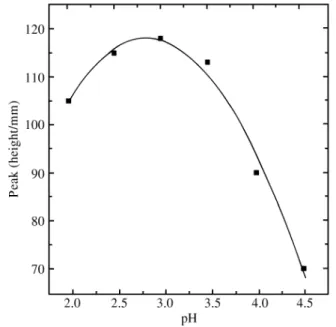
con di tions. In Fig. 2, the in flu ence of pH on the peak height is shown. The best en zyme ac tiv ity oc curs at pH 3.0. Be low this value, the en zyme lost ac tiv ity, al though at higher hydrogenionic con cen tra tions the car bon di ox ide per me -ation through the PTFE mem brane is fa vored. At pH val ues above 3.0, the equi lib rium is dis placed to the right, de creas -ing the amount of CO2 that per me ates through the PTFE mem brane. As a con se quence, a low er ing of the sig nal was ob served.
CO2 + H2O HCO3- + H+
Ta ble 1 shows that the flow rate of 1.1 mL min-1 and 3.5 min for wash ing time were the best con di tions es tab lished ex per i men tally, when a poly eth yl ene loop with a vol ume of 200 µL, (0.7 mm i.d.) was used. De spite the fact that with a flow rate of 0.67 mL min-1 higher sig nals are ob tained than with 1.11 mL min-1, the wash ing time is in creased 3.4 times, de creas ing the sam pling rate to a max i mum of 4 per hour.
Fig ure 1. The conductimetric FI man i fold : A and B, deionized wa ter car rier streams; P, peri stal tic pump; S, sam ple in let loop; ER, en zyme re ac tor; NR, non-enzymatic re ac tor; RI, ion ex change resin clean-up col umn; V, se lec tion valve; SV, sam pling valve sys tem; PM, per me -ation cell; FC, con duc tance flow cell; C, con duc tiv ity me ter; R, chart re corder; and W, waste.
Fig ure 2. The ef fect of pH on the en zyme re ac tor for 0.50 mmol dm-3 ox a late stan dard so lu tion in NaH2PO4/H3PO4 me dia. Tem per a ture con trolled at 25.0 ± 0.5 °C.
Ta ble 1. The re la tion ship be tween flow rate, peak height, and wash -ing time for the FI method.
Flow Rate (mL min-1)
Peak Height (mm)
Washing Time (min)
0.67 192 12.0
0.86 175 6.0
1.11 173 3.5
1.34 160 3.0
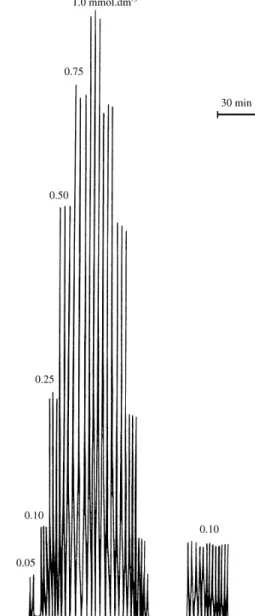
A typ i cal conductimetric FI pro file and the re peat abil -ity for 0.10 mmoldm-3 are shown in Fig. 3. The cal i bra tion curve for ox a late de ter mi na tions, ob tained un der the con di -tions de scribed, pres ents a use ful range be tween 0.05 and 0.50 mmoldm-3 of ox alic acid. This range can be fit ted by a lin ear func tion [Y = 1.1 ( ± 0.77) + 229 ( ± 3) X, r = 0.9997 for n = 5], with a rel a tive stan dard de vi a tion (r.s.d.) of ± 3.2%.
Since urine ma tri ces usu ally change sig nif i cantly, the stan dard ad di tion method was used for all de ter mi na tions, mak ing di lu tions of the sam ples to the work ing range. The ox a late con cen tra tions pres ent in the sam ple can be ob -tained graph i cally by in ter po la tion.
Urine spec i mens from 3 adult male do nors, and E and N con trols from Sigma were an a lyzed, us ing the es tab lished Sigma spec tro pho to met ric method and the method pro -posed in this study. The re sults are shown in Ta ble 2. The sta tis ti cal t-test was used to com pare the re sults ob tained by the two meth ods. It can be ob served that there are no sig nif -i cant d-if fer ences be tween the re sults at a 95% con f-i dence level.
The pro posed FI method is sim pler and less ex pen sive. In ad di tion, the sam ple pre treat ment is elim i nated, as is the in ter fer ence from ascor bic acid. These fea tures are not com monly found in other pro ce dures2,4-7. The new im mo -bi li za tion ap proach ap pears to be very con ve nient since it pre serves the en zyme ac tiv ity at use ful lev els for a lon ger pe riod of time.
The de vel oped flow in jec tion sys tem for ox a late de ter -mi na tion pre sented a use ful con cen tra tion range from 0.05 mmoldm-3 up to 0.50 mmoldm-3. Al though the main spec -tro pho to met ric and amperometric meth ods pub lished show lower de tec tion lim its, they pres ent sev eral in ter fer ence prob lems for bi o log i cal sam ple anal y sis. The pro -posed method shows good per for mance for the de ter mi na tion of ox alic acid in urine with out in ter fer ence, pre sent ing good op er a tional ad van tages.
Fig ure 3. FI cal i bra tion runs for the de ter mi na tion of ox alic acid. From left to right: trip li cate sig nals for ox alic acid stan dard so lu tions (0.05, 0.10, 0.25, 0.50, 0.75, 1.0 mmol dm-3, and the in verse or der), with sev -eral ad di tional sig nals from the 0.10 mmol dm-3 so lu tion for a re peat abil ity
Ta ble 2. A com par i son be tween the val ues ob tained by the Sigma spec tro pho to met ric and the pro posed FI meth ods for ox a late in urine spec i mens us ing the sta tis ti cal stu dent’s t-test24.
Methods
Urines Spec tro pho to met ric
(mmol/24 h) (mmol/24 h)Pro posed Cal cu lated*t-val ues N* 0.29 ± 0.01 0.30 ± 0.01 1.00
E* 1.31 ± 0.02 1.30 ± 0.04 0.30
1 0.30 ± 0.01 0.28 ± 0.01 2.00
2 0.16 ± 0.01 0.18 ± 0.01 2.00
3 1.34 ± 0.02 1.31 ± 0.04 0.91
Ac knowl edg ments
The au thors are in debted to Dr. José Avelino from the Centro Nacional de Pesquisa de Sor go e Milho da EMBRAPA (Sete Lagoas-MG, Brazil) for sup ply ing Sor -ghum vulgare seeds, BR-303 va ri ety, and to FAPESP, CNPq, and CAPES/PICD for fi nan cial sup port.
Ref er ences
1. Almuaibed, A.M.; Townshend, A. Anal. Chim. Acta 1989, 218, 1.
2. Gaetani, E.; Laureri, C.F.; Vitto, M.; Borghi, L.; Elia, G.F.; Novarini, A. Clin. Chim. Acta 1986, 156, 71. 3. Nabi-Rani, M.A.; Guilbault, G.G.; Oliveira-Neto, G.
Anal. Chem. 1986, 58, 523.
4. Fonong, T. Anal. Chim. Acta 1986, 186, 301. 5. Mongkolisirikieat, S.; Srisuwan, C. J. Sci. Soc. Thail.
1987, 13, 169.
6. Pundir, C.S.; Kurchhal, N.K. Phytochem. 1989, 28, 2909.
7. Gla zier, S.A.; Rechnitz, G.A. Anal. Lett. 1989, 22, 2929.
8. Wingaarden, J.B.; El der, T.D. In The Met a bolic of In -herited Dis eases; McGraw-Hill, New York,1960. 9. Hodgkinson; H. In Ox alic Acid in Bi ol ogy and Med i
-cine; Ac a demic Press. Lon don, 1977.
10. Sa linas, F., Mar ti nez-Vidal, J.L.; Gon za lez-Murcia, V. An a lyst 1989, 114, 1685.
11. Zarembski, P.M.; Hodgkinson, A. Biochem. J. 1965, 96, 717.
12. Santos, L.M.; Baldwin, R.P. J. Chromatogr. 1987, 414, 161.
13. Millán, A.; Grases, J.M.; Grases, F. J. Chromatogr. 1990, 529, 402.
14. Brega, A.; Quadri, A.; Villa, P.; Prandini, P.; Wei, J.Q.; Lucarelli, C. J. Chromatogr. 1992, 15, 501. 15. Sharma, S.; Nath, R.; Thind, S.K. Scanning Mi cros
-copy 1993, 7, 431.
16. Varalakshmi, P.; Rich ard son, K.E. Biochem. Int. 1992, 26, 153.
17. Bais, R.; Potezni, N.; Ed wards, J.B.; Rofe, A.M.; Conyers, R.A.J. Anal. Chem. 1980, 52, 508.
18. Potezni, N.; Bais, R.; O’Loughlin, P.D.; Ed wards, J.B.; Rofe, A.M.; Conyers, R.A.J. Clin. Chem. 1983, 29, 16.
19. Matsubara, C.; Sakai, K.; Takamura, K. Bunseki Kagaku 1991, 40, 343.
20. Fogg, A.G.; Alonso, R.M.; Fernandez-Arciniega, M.A. An a lyst 1986, 111, 249.
21. Hansen, E.H.; Winther, S.K.; Gundstrup, M. Anal. Lett. 1994, 27, 1239.
22. Tubino, M. J. Flow In jec tion Anal. 1994, 11, 94. 23. Pasquini, C.; Faria, L.C. Anal. Chim. Acta 1987, 193,
19.
24. Eckschlager, K. In Er rors, Mea sure ments and Re sults in Chem i cal Anal y sis; Van Nostrand Reinhold, New York, 1972.