HRGC Study of Sorption and Desorption of Atrazine, Ametryn
and Metolachlor on Brazilian Soils
Maria Eugênia C. Queiroz and Fernando M. Lanças*
Universidade de São Paulo, Instituto de Química de São Carlos, C.P. 780, 13560-970 São Carlos - SP, Brasil; e-mail: [email protected]
Re ceived: Sep tem ber 27, 1995; Sep tem ber 27, 1996
Os processos de adsorção e dessorção dos herbicidas ametrina, atrazina e metolaclor foram estudados em cinco so los brasileiros com diferentes conteúdos de matéria orgânica, utilizando-se cromatografia gasosa de alta resolução (HRGC). As linhas de regressão geradas apresentaram coeficiente de determinação > 0,964, indicando um bom ajuste dos da dos à equação de Freundlich. O equilíbrio de adsorção foi atingido em aproximadamente 6 h. Histerese foi observada nas isotermas de adsorção e dessorção. Correlações significativas foram encontradas en tre o coeficiente de adsorção, matéria orgânica e capacidade de troca de cátions. Não foram observadas correlações en tre o coeficiente de adsorção dos herbicidas (ametrina, atrazina e metolaclor) e solubilidade em água, pKa e massa mo lec u lar destes compostos, pois estes herbicidas não pertencem à mesma família química. Por este fato, as correlações en tre adsorção e propriedades dos herbicidas citadas acima foram estabelecidas somente en tre as triazinas. O coeficiente de adsorção das triazinas mostrou-se diretamente correlacionado com a solubilidade em água, pKa e massa mo lec u lar destes compostos nos so-los avaliados.
The sorp tion and desorption of her bi cides ametryn, atrazine and metolachlor were stud ied in five Bra zil ian soils with var i ous or ganic mat ter con tents us ing high res o lu tion gas chro ma -tog ra phy (HRGC). The re gres sion lines gen er ated pre sented a co ef fi cient of de ter mi na -tion > 0.964, which in di cates a good fit of the data by the Freundlich equa -tion. Sorp -tion reached an ap par ent equi lib rium in the soils within ap prox i mately 6 h. Hys ter esis was ob served in both sorp tion and desorption iso therms. Sig nif i cant cor re la tions were found among sorp tion of her-bi cides, or ganic mat ter, and cat ion-exchange ca pac ity. No re la tion ship was found be tween ad-sorp tion of the her bi cides (ametryn, atrazine, and metolachlor) and their wa ter sol u bil ity, pKa, and mo lec u lar mass, since these her bi cides do not be long to the same chem i cal fam ily. On account of this, the re la tion ship be tween sorp tion and her bi cide prop er ties cited above was es tab -lished only for s-triazines. The s-triazine ad sorp tion showed a di rect re la tion ship with wa ter sol u bil ity, pKa and mo lec u lar mass of these com pounds on the stud ied soils.
Key words:ad sorp tion, desorption, her bi cides, soils
In tro duc tion
Metolachlor, atrazine and ametryn are widely used as selective pre-and post-emergence herbicides for weed con trol in sugar cane, cit rus fruit, soy beans and other eco nom i cally im por tant crops in Brazil. Res i dues of these her bi cides are fre quently found in en vi ron
men-tal samples of soil and water due to their persistence and rel a tively high wa ter sol u bil ity1,2.
In for ma tion on the ad sorp tion and desorption po ten tial of her bi cides is needed un der cer tain cir cum stances to as-sess move ment and per sis tence in a soil en vi ron ment. Better un der stand ing of these pro cesses will al low more ef-fec tive weed con trol with min i mum res i dues.
Sorption is a general term that ain cludes adsorption (surface binding) and partitioning. Desorption is the re -verse process of sorption3. As soil-applied herbicides are
gen er ally con sid ered to en ter plant roots as sol utes with the soil wa ter, the de gree of ad sorp tion mod i fies the avail abil -ity of her bi cide to plants or the ac tiv -ity of the her bi cide.
Or ganic her bi cides ad sorb on both or ganic and in or -ganic surfaces depending upon the chemical properties of the adsorbents and ad sor bates in volved.
Physical and chemical properties of the herbicides influencing adsorption and desorption processes are the chemical character, shape, configuration, acidity or basicity of molecule (pKa or pKb), water solubility, charge distribution on the organic cation, polarity, mo-lec u lar size and polarizability4.
Some extensive adsorption studies involving a serie of analogous s-triazines have been realized. S-triazines are adsorbed by various soil constituents in strik ingly different degrees. Clay minerals, organic matter and pH are the soil properties mainly responsible for the ad -sorption process in soil5-8. The adsorption of the acetani -lide her bi cides has been shown to in crease with in creases in the or ganic mat ter con tent of the soils, her bi cide con cen tra -tion, and tem per a ture9,10.
This means that the adsorption process is dependent on the type of soil under consideration and the climatic conditions of a given location. The results obtained by researchers in this area are difficult to extrapolate to conditions distinct from those where the data were ob -tained. In addition, data concerning the adsorption processes of pesticides on Brazilian soils is very scarce
11, 12. The in di ca tors of the en vi ron men tal qual ity pres ently
in use were es tab lished with the view to at tend to eco log i cal char ac ter is tics ex ist ing in other coun tries, not nec es sar ily those pre dom i nant in Brazil.
The adsorption processes on soils has usually been determined by radio-tracer techniques (conventional method), us ing14C labeled material diluted with pesti -cides and quan ti ta tive anal y sis by liq uid scin til la tion spec-trom e try13-15.
Lançaset al.16re ported the vi a bil ity of the use of cap illary gas chro ma tog ra phy as an an a lyt i cal method to de ter -mined the ad sorp tion of trifluralin in soils.
Thus, the pur pose of this pa per was to eval u ate the sorp-tion and desorpsorp-tion of her bi cides, two s-triazines (atrazine and ametryn) and one ac et an i lide (metolachlor), on five Bra zil ian soils, un der lab o ra tory con di tions us ing high res-o lu tires-on gas chrres-o ma tres-og ra phy (HRGC). The re la tires-on ship among sorp tion, the physicochemical prop er ties of these her bi cides and soil com po nents was es tab lished.
Ma te rials and Methods
SoilsFive types of soils with no re cent his tory of her bi cide ap pli ca tion and rep re sent ing a good range in or ganic mat ter con tent were used in the sorp tion stud ies. Each soil sam ple was ob tained by the mix ture of twenty dif fer ent col lec tion points from 0 to 20 cm depths. Be fore use, the soils were air-dried and ground to pass a 2.0 mm sieve. Ta ble 1 shows the char ac ter is tics of these soils.
Her bi cides
T e c h n i c a l - g r a d e s a m p l e s o f a m e t r y n [2-ethylamino-4-(isopropylamino)-6-(methylthio)- 1, 3, 5 -triazine],atrazine [2-chloro-4-(ethylamino)-6-(isopropy-
lamino)-1, 3, 5-triazine], and metolachlor [2-chloro- 6’-ethyl - N -(2-methoxy - 1 - m6’-ethyl6’-ethyl) acet - o - toluidide] were obtained in the local trade. The properties of these herbicides are illustrated in Ta ble 2.
Ad sorp tion equi lib rium
To establish when herbicide adsorption reached equilibrium in the soil systems, 10 mL of the herbicide solution, 20µg/mL (in 0.01 Maqueous CaCl2) was added
to 2 g of soils no. 1 and 5 in glass tubes. Du pli cate sam ples plus blanks (no soil) used as con trol stan dards were shaken for 0.25, 1, 3, 6, 12, 24 h. The tubes were cen tri fuged for 15 min at 4000 rpm. The supernatant was fil tered. Suit able aliquots were taken for gas chro mato graphic anal y sis.
Ta ble 1. The chem i cal and phys i cal prop er ties of the soils eval u ated.
Soil Re gion OM(a)% pH(b) C.E.C.(c)
meq/100 g
Clay(d)%* Silt(d)% Cul ture
1 Ponguai SP 0.8 4.3 2.8 8.4 7.04 cit rus
2 Batatais SP 1.6 5.3 5.3 21.5 6.36 cane
3 Aguai SP 2.1 4.2 4.4 9.6 10.39
-4 GuardaMor MG 2.7 4.3 6.3 56.9 32.11 coffe
5 Sales de Oliveira SP 5.1 5.9 16.7 27.0 55.76 cane
Ad sorp tion
Stock solutions of herbicides were made in 0.01 M CaCl2 at concentrations be low that cor re spond ing to their
max i mum sol u bil ity in wa ter (Ta ble 2). The stock so lu tions were di luted with 0.01 M CaCl2 to yield five con cen tra tions
(1, 5, 10, 20, 30µg/mL) that were used in sub se quent
ex-per i ments. Two grams of soil were shaken with 10 mL of each her bi cide so lu tion in a glass tube for 6 h at room tem-per a ture (25± 2 °C). All treat ments were tem-per formed in du-pli cate, and ap pro pri ate blanks (no soil) at each de sired con cen tra tion were run. The tubes were cen tri fuged at 4000 rpm for 15 min and aliquots of the supernatant were fil tered and taken for anal y sis. The amount ad sorbed (mi cro grams of her bi cide per gram of soil) was de ter mined by the dif fer -ence be tween the blank and treat ment val ues; i.e.
A= v −
w(CB Ce ) (1) where A is the amount ad sorbed, v the so lu tion vol ume (mL), w is the mass of soil in grams, C B is the equi lib rium
con cen tra tion of blank (µg/mL), and Ce is the equi lib rium
con cen tra tion in the supernatant (µg/mL). Desorption
Soil sam ples were shaken with so lu tions of atrazine, ametryn and metolachlor as de scribed for ad sorp tion. Af ter centrifugation and re moval of aliquots for gas chro mato -graphic anal y sis, the re main ing supernatant was care fully de canted. Ten mil li li ters of 0.01 M CaCl2 were added to the
tubes, and the sam ples were shaken for 6 h. The tubes were cen tri fuged, and aliquots of supernatant were fil tered and re moved for anal y sis. Desorption, ex pressed as mi cro grams ad sorbed per gram of soil, was de ter mined by dif fer -ence, tak ing to in ac count the so lu tion re main ing in the soil af ter the supernatant was poured off.
Her bi cide anal y sis
The her bi cide con cen tra tions in the supernatant were de ter mined by high res o lu tion gas chro ma tog ra phy (HRGC) us ing the fol low ing con di tions:
Ametryn: SRI - 8610 chromatograph equipped with flame ion iza tion de tec tor (FID); fused sil ica col umn, LM 1 (100% cross-linked dimethyl polysiloxane) — 25 m x 0.53 mm x 1µm; tem per a tures: col umn = 190 °C-6 °C/min
— 240 °C; in jec tor = cold “on col umn” in jec tor, op er ated at the am bi ent tem per a ture (25 °C), de tec tor = 300 °C; car rier gas, H2 at a lin ear ve loc ity of 53. 50 cm/s.
Atrazine: HP 5890 - Serie II chromatograph equipped with flame ion iza tion de tec tor (FID); fused sil ica col umn, LM 5 (5% dimethyl phenyl polysiloxane) - 15 m x 0.32 mm x 0.25 µm; tem per a tures, col umn = 160 °C (10 min)
-8 °C/min - 300 °C, in jec tor = 250 °C, de tec tor = 300 °C; car rier gas H2 at a lin ear ve loc ity of 40 cm/s and split ra tio
of 1:30.
Metolachlor: SRI - 8610 chromatograph equipped with flame ion iza tion de tec tor (FID); fused sil ica col umn, LM 1 (100 % cross-linked dimethyl polyxiloxane) - 25 m x 0.53 mm x 1µm; tem per a tures: col umn, 180 °C-6 °C/min - 220
°C; in jec tor = cold “on col umn” in jec tor, op er ated at the am bi ent tem per a ture (25 °C),de tec tor = 300 °C; car rier gas, H2 at a lin ear ve loc ity of 53. 50 cm/s.
Re sults and Dis cus sion
Gas chro mato graphic anal y sisIn lit er a ture there are few ar ti cles us ing chro ma tog ra -phy meth ods in ad sorp tion stud ies and the ma jor ity of these, use re verse-phase HPLC10,20,26,28. The chro ma tog ra
-phy meth ods are more sen si tiv ity (lower de tec tion lim its) when com pared with ra dio-tracer tech niques (con ven -tional method) and other dis ad van tages of the con ven -tional meth ods are the ne ces sity of the use of14C la belled pes ti
-cides with high radiochemical pu rity, es pe cially in Brazil, where these com pounds are ex pen sive, slow to ob tain due to de pend ence on im por ta tion, and are nec es sary ad e quate dis card.
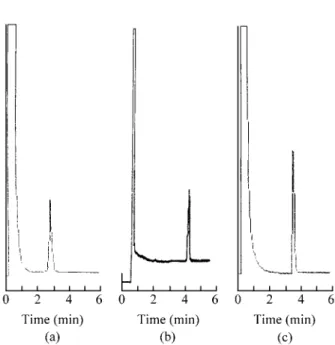
No deg ra da tion of the her bi cides was ob served in the ab sence of ad sor bent ma te rial (soil), since a con stant concen tra tion of her bi cide was ob served through out the ex per -i ment, and no new peak ap peared on the chromatograms. The chromatograms re fer ring to the ad sorp tion phe nom e -non for each in di vid ual her bi cide are shown in Fig. 1.
Ad sorp tion iso therms
On the ba sis of the ki netic ex per i ments, the ad sorp tion of her bi cides by the soils reached an ap par ent equi lib rium af ter 6 h.
The em pir i cal Freundlich re la tion ship was used to de-scribe the re sults of ad sorp tion. The lin ear form of this equa tion is as fol lows:
log x
m=logK+nlogCe 1
(2)
Ta ble 2. Prop erties of the her bi cides stud ied.
Her bi cides Sol u bil ity Water
ppm(a) pKa(a)
Ametryn 193 3.12 227.3
Atrazine 33 1.68 215.7
Metolachlor 500 (b) 283.8
where x/m is the con cen tra tion of the ad sor bate per unit amount of ad sor bent (µg /g), Ce is the ad sor bate con cen
tra-tion in so lu tra-tion af ter equil i bra tra-tion (µg/mL), and K and 1/n
are con stants rel a tive to the af fin ity of ad sor bent for ad sor bate and to the de gree of cur va ture of the iso therm, re spec -tively. The K value can be used to com pare sorp tion of dif fer ent her bi cides on var i ous soils at unit con cen tra tion15.
Log-log plots of her bi cide (ametryn, atrazine, and metolachlor) ad sorp tion on each soil type yielded straight, par al lel lines (Fig. 2). The gen eral shapes of the ad sorp tion iso therms were very sim i lar, sug gest ing that sim i lar ad-sorp tion mech a nisms were in volved.
Freundlich con stants K and 1/n and the cor re spond ing co ef fi cient of de ter mi na tion (r2) are given in Ta ble 3. Most of the re gres sion lines gen er ated had a co ef fi cient of de ter -mi na tion (r2) > 0.964 which in di cated a good fit of the data by the Freundlich equa tion20.
No lim it ing ad sorp tion was ob served within the con-cen tra tions range used. As the con con-cen tra tion of her bi cides was in creased, the amount ad sorbed in creased in al most lin ear fash ion with these con cen tra tions.
Desorption iso therms rep re sent the mi cro grams of her-bi cide still ad sorbed per gram of soil as a func tion of equi-lib rium con cen tra tion af ter one desorption cy cle. Ad sorp tion was par tially re vers ible, the desorption val ues were smaller than those for ad sorp tion (Ta ble 3). Noncoincidence of ad sorp tion and desorption iso therms is called hys ter esis21 and it in di cates that a dif fer ent range or
spec trum of forces are in volved in ad sorp tion than in desorption. Hys ter esis has been ob served in other her bi -cide ad sorp tion stud ies22-24. The re vers ibil ity of ad sorp tion
plays an im por tant role in her bi cide con trol in ag ri cul ture.
Soil prop er ties af fect ing the ad sorp tion phe nom ena
The re la tion ship be tween sorp tion and soil prop er ties was de ter mined through sim ple cor re la tion anal y sis (Ta ble 4). Strong cor re la tions were found among or ganic mat ter
Fig ure 1. Chromatograms re fer ring to the ad sorp tion of her bi cides: (a) ametryn, (b) atrazine, and (c) metolachlor.
Ta ble 3. Freundlich con stants and co ef fi cient of de ter mi na tion (r2) for her bi cide ad sorp tion and desorption.
Ad sorp tion
Ametryn Atrazine Metolachlor
Soils K 1/n r2 (a) Kom K 1/n r2 Kom K 1/n r2 Kom
1 1.54 0.84 0.974 192.50 0.81 0.88 0.938 101.25 0.53 1.05 0.998 66.25
2 5.23 0.91 0.972 326.87 1.98 0.94 0.999 123.75 0.79 1.03 0.999 49.37
3 4.48 0.89 0.965 213.33 1.23 1.28 0.995 58.57 0.71 0.96 0.998 35.23
4 7.45 0.99 0.998 288.88 3.58 0.93 0.972 170.74 1.06 1.02 0.999 39.25
5 10.39 0.89 0.840 223.13 5.75 0.96 0.963 112.74 4.10 1.03 0.999 78.62
∆G = - 3.26(b) ∆G = - 2.79 ∆G = -2.35
Desorption
1 0.46 0.87 0.993 61.25 0.42 0.88 0.978 52.5 0.14 1.05 0.997 17.50
2 0.65 1.16 0.983 50.62 0.80 0.95 0.996 50.0 0.46 1.02 0.997 28.75
3 0.81 0.95 0.892 30.95 1.46 0.84 0.953 69.52 0.26 0.98 0.999 12.38
4 2.13 1.06 0.942 78.88 1.64 0.94 0.986 60.74 0.57 1.03 0.998 21.11
5 3.19 1.10 0.895 62.54 1.60 1.05 0.994 31.37 1.85 0.98 0.995 36.07
∆G = -2.39 ∆G = - 2.34 ∆G = -1.85
con tent (O.M.), cat ion-exchange ca pac ity (C.E.C.), and de-gree of ad sorp tion (K) of the her bi cides eval u ated. The soils with high val ues of O.M. and C.E.C. re quire higher rates of her bi cide ap pli ca tion to main tain a given level of her bi cidal ac tiv ity than do soils with lower val ues of these prop er ties.
The im por tance of or ganic mat ter in ad sorp tion pro-cesses was also re ported by sev eral au thors. Sequiet al.25
re lated that the sorp tion abil ity for atrazine and triluralin were in creased consideralably in soils with high or ganic mat ter con tent. The ad sorp tion of ametryn was pos i tively cor re lated with or ganic mat ter and silt con tent26. These data agree with cor re la tion ob served for this triazine (Ta ble 4).
Weber and Pe ter27 dem on strated that or ganic mat ter was the pri mary ad sorb ing sur face in soils for ac et an i lide her bi cides. Obrigawitch et al.22 cal cu lated the co ef fi cient of de ter mi na tion (r2) val ues for per cent or ganic car bon and clay ver sus the metolachlor Freundlich ad sorp tion con stant (K) for three soils. Or ganic car bon ver sus K re sulted in r2 = 0.92, and clay ver sus K re sulted in r2 = 0.68. The co ef fi cient of de ter mi na tion (r2) value be tween or ganic mat ter con tent and metolachlor K is very sim i lar to the cor re la tion co ef fi -cient r = 0,947 calculed in this work for the same com-pound.
Sig nif i cant cor re la tion was also ob served among or-ganic mat ter and clay con tent of other Bra zil ian soils (from the “cerrado”of the State of São Paulo) and sorp tion co ef fi -cient of aldrin, mal a thion, and para thion28.
The re gres sion equa tions be tween de gree of ad sorp tion (K) of the her bi cides and the con sid ered prop er ties of soils were:
Ametryn
K = - 0.5891 + 2.6273 O.M. - 0.1361 C.E.C. (3) Atrazine
K = - 0.15758 + 1.4740 O.M. - 0.0834 C.E.C. (4) Metolachlor
K = - 0.3662 - 0.1619 O.M. + 0.3085 C.E.C. (5) If the K value in the Freundlich equa tion is re placed by the one found from equa tions 3 to 5, a sim ple re la tion ship may be es tab lished be tween her bi cide (ametryn, atrazine and metolachlor) ad sorp tion and soil prop er ties. This may be use ful for cal cu la tion of the quan tity of her bi cides to be ap plied in or der to achieve greater ef fi ciency29.
Sorp tion re la tion ships be tween her bi cides were il lus -trated in a dif fer ent man ner by nor mal iz ing the Freundlich K con stants to a 1 g or ganic mat ter ba sis. The new con stant, Kom, was av er aged for each her bi cide over the five soil types (Ta ble 3). The or der of in creas ing Kom was sim i lar to that for the sim ple K con stants.
As suming that the her bi cides were ad sorbed mainly by or ganic mat ter, the change in free en ergy for ad sorp tion was cal cu lated for her bi cides by us ing the mean value for K`om10.
∆G = - R T ln K`om (6)
where∆G is the free en ergy change (kcal / mol), R is the
gas con stant (1.986 cal/Kmol), and T is ab so lute tem per a -ture. All∆G for her bi cide ad sorp tion were neg a tive, as
ex-pected for a spon ta ne ous re ac tion (Ta ble 3). In gen eral the nu mer i cally smaller val ues of∆G cor re sponded to the
sam-ples with the lower ad sorp tion ca pac ity.
Her bi cide prop er ties af fect ing ad sorp tion Ta ble 4. Sim ple cor re la tion co ef fi cients (r) be tween K val ues and soil
prop er ties de ter mined.
Her bi cides OM % CEC CLAY
Ametryn 0.939 ** 0.896 ** 0.594*****
Atrazine 0.898** 0.853 *** 0.730 ****
Metolachlor 0.947 ** 0.993 * 0.205 *****
Sig nif i cance at 0.1% level (*), 1% level (**) , 2% level (***), < 10% level (****), and 10% level (*****).
Freundlich iso therms (Fig. 4) showed dif fer ences in ad-sorp tion be tween her bi cides in dis tinct soils. Sorp tion of lindane var ied in dif fer ent Bra zil ian soils12. Felsot and Dahm15 re lated that the vari able Freundlich iso therms for dif fer ent pes ti cides-soil sys tem in di cate that sorp tion is a com plex phe nom e non in volv ing dif fer ent types of ad sorp -tion sites with dif fer ent sur face en er gies
Ametryn (methlymercapto-triazine) was ad sorbed by all the soils more than all oth ers her bi cides in ves ti gated (Ta ble 3).
Weber and Pe ter27 found two to three fold higher ad-sorp tion of prometryn (methylmercapto-triazine) than for the ac et an i lide her bi cides: alachlor, acetolachlor, and metolachlor.
No re la tion ship was found be tween sorp tion of her bi -cides (ametryn, atrazine, and metolachor) and their wa ter sol u bil ity, pKa, and mo lec u lar mass, Ta ble 2. This is what would be ex pected since these her bi cides do not be long to the same chem i cal fam ily. On ac count of this, the re la tion -ship be tween sorp tion and her bi cide prop er ties cited above will be es tab lished only for s-triazines.
The striazine ad sorp tion abil ity showed a di rect re la -tion ship with wa ter sol u bil ity, pKa and mo lec u lar mass of these componds in the soils eval u ated. This re sult sup ports the prem ise that the ad sorp tion in creases with the mo lec u -lar mass of ad sor bate in the same chem i cal fam ily10.
This study sug gests that atrazine (chloro-derivatives) would be ad sorbed in lower amounts by the stud ied soils than ametryn (methylmercapto-derivatives). Anal o gous re sults were ob tained in pre vi ous stud ies when s-triazines were ad sorbed on soil or ganic mat ter7.Ametryn, show ing a pKa value of 3.12, pres ents a more ba sic char ac ter than atrazine, pKa 1.68. The in creas ing ba sic ity can be ex-plained in terms of the pres ence of more nucleophilic groups on the mol e cule. The ba sic ity ap pears to be im por tant in the over all ad sorp tiondesorption re ac tion, es pe -cially if the ad sorbed ma te rial pres ents a ba sic char ac ter. Pro ton trans fer from protonated spe cies ad sorbed on a soil sur face to an un charged mol e cule at the soil sur face has been shown to be de pend ent upon the rel a tive basicities of two in ter act ing com pounds as well as the rel a tive con cen -tra tions or ac tiv i ties of re ac tants and prod ucts4.
In con clu sion, the af fin ity be tween mol e cules of the striazines stud ied and soil par ti cles showed to be de pend -ent upon the chem i cal prop er ties of the soils (or ganic mat-ter, and cat ion-exchange ca pac ity) and the chem i cal prop er ties (wa ter sol u bil ity, pKa, mo lec u lar mass) of the s-triazines in volved.
Ref er ences
1. Huang,L.Q.J. Assoc. off. Anal. Chem.1989,72, 349. 2. Sánchez, C.; Brunete, L.; Mar ti nez, L.; Tadeo, J.L. J.
Agric. Food. Chem.1994,42, 2210.
3. Yeager, R.L.; Halley, B.A.J. Agric. Food. Chem.1990,
38, 883.
4. Bailey, G.W.; White, J.L.Resid. Rev.1970,32, 30. 5. Bailey, G.W.; White, J.L.; Rothberg, T.Soil Sci. of Amer.
Pro ceed.1968,32, 222.
6. Sullivan, J.D.; Felbeck, G.T.Soil Sci.1968,42, 106. 7. Weber, J.B.; Weed, S.B.; Ward, T.M.Weed Sci.1969,17,
417.
8. Weber, J.B.Resid. Rev.1970,32, 93.
9. Kozak, J.; Weber, J.B.; Sheets, T.J.Soil Sci.1983,136, 94. 10. Sato, T.; Kohnosu, S.; Hartwig, J.F.J. Agric. Food. Chem.
1987,35, 397.
11. Lord, K.A.; Helene, C.G.; Ruegg, E.F. Arq. Inst. Biol. 1978,45, 47.
12. Luchini, L.C.; Lord, K.A.; Ruegg, E.F.Ciênc. Cult.1981,
33, 97.
13. Wahid, P.A.; Sethunathan, N. J. Agric. Food. Chem. 1978,26, 101.
14. Yeager, R.L.; Halley, B.A.J. Agric. Food Chem.1990,
38, 883.
15. Felsot, A.; Dahm, P.A.J. Agric. Food. Chem.1979,3, 557.
16. Lanças, F.M.; Vilegas, J.H.Y.; Galiane, M. S.Pesticidas
1994, 4, 39.
17. Raij, B.V.; Quagio, J.A.; Cantarella, H. In Análise Química do Solo Para Fins de Fertilidade; Fundação Cargil, Campinas, 1987.
18. Camargo, O.A.; Moniz, A.C.; Jorge, J.A. InMétodos de Análise Química, Mineralógica e Física de Solos do I n s t i t u t o A g r o n ô m i c o d e C a m p i n a s; I n s t i t u t o Agronômico, Campinas, 1986.
19. Best, C.E. InHer bi cide Hand book; Ed.; Weed Sci ence of Amer ica; Cham paign, IIIinois, 1993.
20. Gennari, M.; Negre, M.; Raimondo, E. J.Agric. Food. Chem.1994,42, 2329.
21. Bow man, B.T.; Sans, W.J. En vi ron. Qual.1985,14, 270. 22. Obrigawitch, T.; Hons, F.M.; Ab er nathy, J.R.; Gipson,
J.R.Weed Sci.1981,3, 332.
23. Swanson, R.A.; Dutt, G.R. Soil Sci. Soc. Amer. Proc. 1973,37, 872.
24. Gilchrist, G.F.R.; Gam ble, D.S.; Khan, S. U.J. Agric. Food Chem.1993,41, 1748.
25. Sequi, P.; Francioso, O.; Bak, E.Sci. of the To tal En vi ron. 1992,123, 503.
26. Lui, L.C.; Cibes-Viadé, H.; Koo, F.K.S.Weed Sci.1970,
18, 470.
27. Weber, J.B.; Pe ter, C.J.Weed Sci. Soc. Am. Abstr.1980,
221, 102.
28. Luchini, L.C.; Hirata, R.; Ruegg, E.F. Pesq. Agropec. Bras.1984, 19, 157.
29. Dios Canela, G.; Romero Taboada, E.; Sánchez Rasero, F.
J. of Soil Sci.1992,43, 99.