Fine Tuning of the Properties of Organically Modified
Heteropolymetalates
F. Pereza, J. P. Baylea, E. Lafontaineb, and P. Judeinstein*c#
aLaboratoire de Chimie Structurale Organique (URA 1384), Université Paris-Sud
- Bât 410, 91405 Orsay Cedex - France
bDGA/CREA, 16, Bis Av e nue Prieur de la Côte d’Or, 91414 Arcueil Cedex - France cLaboratoire d’Electrochimie et Photoelectrochimie (URA 1383), Université Paris-Sud
- Bât 420, 91405 Orsay Cedex - France
Re ceived: July 5, 1996; Sep tem ber 19, 1996
Oxopolimetalatos organicamente modificados do “tipo Keggin”de for mula [R]4[SiW11O40(SiR’)2], (R=Bu4N+, R’ = -C2H5, -C10H21, -CH=CH2, -CH2CH=CH2, -OH,
-C6H5, -C10H7 , -C6H4NH2 (o, p), -C6H4NMe2 (p), -C6H4CH=CH2, -C6H4CF3,
-C6H4CH=CHC6H5) foram sintetizados. O núcleo óxido apresentou propriedades re dox
reversíveis que foram sintonizadas, escolhendo-se o modificador orgânico. As variações nos deslocamentos químicos na RMN de 183W, induzidas pelos modificadores, foram também medidas e ambos os efeitos correlacionados com as propriedades de doação-aceitação eletrônica do rad i cal orgânico. As mag ni tudes destes efeitos foram comparadas com aqueles causados pelo eletrólito.
“Keggin-type” or gan i cally mod i fied oxopolymetalates of for mula [R]4[SiW11O40(SiR’)2],
(R=Bu4N+, R’ = -C2H5, -C10H21, -CH=CH2, -CH2CH=CH2, -OH, -C6H5, -C10H7, -C6H4NH2
(o, p), -C6H4NMe2 (p), -C6H4CH=CH2, -C6H4CF3, -C6H4CH=CHC6H5) were syn the sized.
The ox ide core pre sented re vers ible re dox prop er ties which were tuned by the choice of the or -ganic mod i fier. Par al lel vari a tions of the 183W NMR chem i cal shifts were mea sured and both ef fects might be re lated to the elec tronic do nor-acceptor prop er ties of the or ganic rad i cal. The mag ni tudes of these ef fects are com pared with those com ing from the elec tro lyte it self.
Key words: or gan i cally mod i fied oxopolymetalates, re dox prop er ties, 183W NMR spec tros -copy
In tro duc tion
Over the last de cade, there has been great in ter est in the study of polyoxometallates (POM) as mod els for tran si tion metal ox ides1. These com pact ox ide clus ters of small size (around 10 Å) pres ent unique re dox prop er ties and the abil ity to mimic tran si tion metal ox ide fea tures2. The re -dox prop er ties are sen si tive to the POM com po si tion and struc ture. Strong ef fects are also mea sured with changes of elec tro lyte3. Re cently, the graft ing of or ganic rad i cals to a Keggin-type ox ide core was de scribed4,5,6. Asa first ex am ple of the `mod i fier ef fect’, we re ported pre vi ously the graft ing of polymerizable groups to POM structrures as a pow er ful
way to de velop mixed or ganic-inorganic poly mers with ad just able prop er ties7,8.
In this Pa per, the in ter ac tions be tween the or ganic mod i fier and the ox ide core are mea sured for or gan i cally mod i -fied POM (OMPOM) with var i ous sub stitu ents. Re dox po ten tials (cy clic voltametry) and NMR chem i cal shifts (29Si and 183W) are used as sen si tive probe for such in ter ac -tions.
Ex per i men tal
Syn the sis
Pure Keggin OMPOMs of for mula [R]4[SiW11O40
(SiR’)2] (R=Bu4N+, R’ = -C2H5, -C10H21, CH=CH2, -CH2 Ar ti cle
# Present address: Laboratoire de Chimie Structurale Organique (URA 1384), Université Paris-Sud-Bât 410, 91405 Orsay Cedex - France.
J. Braz. Chem. Soc., Vol. 8, No. 1, 83-86, 1997. © 1997 Soc. Bras. Química
CH=CH2, -OH, -C6H5, -C10H7, -C6H4NH2 (o, p), -C6H4N
Me2 (p), C6H4CH=CH2, -C6H4CF3, -C6H4CH=CHC6H5)
were syn the sized fol low ing two pro ce dures pre vi ously de -scribed5. Trichlorosilane (Cl3SiR’) in wa ter or
trialkoxysilane ((OEt)3SiR’) in acid i fied wa ter were added
to lacunary Keggin POM [SiW11O39]8- (Ta ble 1). The char
-ac ter iza tion of a few OMPOMs has al ready been de tailed by el e men tal anal y sis, IR, time of flight mass spec trom e try,
29Si and 183W NMRs. These anal y ses as sert the graft ing of
two R’ groups, sym met ri cally an chored to the edges of the hole in the lacunar [SiW11O39]8- clus ter, as pro posed by
Knoth9 (Fig. 1). All com pounds were pu ri fied twice by recrystallization in DMF/wa ter or DMF/ac e tone mix tures and the pu rity of these com pounds was shown to be above 95% (main im pu rity is [Bu4N]4[SiW12O40]).
NMR spec tros copy
1H, 13C-{1H} and 29Si-{1H} NMR spec tra were re
-corded to check the pu rity of the com pounds (Bruker AC250 spec trom e ter). 183W NMR spec tra were re corded
on a Bruker AM500 spec trom e ter fol low ing usual pro ce -dures5. OMPOM salts were dis solved in DMF/DMSO-d
6
84 Perez et al. J. Braz. Chem. Soc.
Ta ble 1. Prop erties of [Bu4N]4[SiW11O40(SiR’)2] salts. Syn the sis pro ce dures for the organo-silicon pre cur sor : (a) (OEt)3SiR’ com mer cial, (b)
Cl3SiR’ com mer cial, (c) (OEt)3SiR’ from Si(OEt)4; R’Br; Mg/Ether, (d) (OEt)3SiH com mer cial; H2O, (e) (OEt)3SiR’ from Si(OEt)4; R’Br;
Mg/THF, (f) (OEt)3SiR’ from Si(OEt)4; R’Br; Li/Ether, (g) (Cl)3SiR’ from Si(Cl)4; R’Br; Mg/Ether. In ter me di ates (OEt)3SiR’ and (Cl)3SiR’ were
pu ri fied by vac uum dis til la tion, and char ac ter ized by 1H, 13C and 29Si NMR. [Bu4N]4[SiW11O40(SiR’)2] were checked by IR and 1H NMR
spectroscopies.
29Si and 183W NMR chem i cal shifts in DMSO
d6-DMF. Ref er ences; 29Si : SiMe4; 183W : 1.0 M so lu tion of Na2WO4 (pH = 10). With re spect to the
low sen si tiv i ties of these tech niques, mea sure ments could be only ob tained when suf fi cient quan ti ties of com pounds were avail able. W1, ... W6 la bels are ar bi trary as signed in re gard to the POM struc ture.
Elec tro chem is try: Re duc tion po ten tials (vs. SCE) for the two first re dox stages in Bu4NBF4 (0.1M)/DMF elec tro lytes, scan rate 50 mV/s.
R’ 29Si (ppm)
SiR’ SiO4 183
W chem i cal shifts (ppm) (rel a tive in ten si ties) W1(2) W2(2) W3(1) W4(2) W5(2) W6(2)
JSiR’-W
(Hz)
Ere duc tion
Bu4NBF4:DMF
-CH2CH3 (a)
(ethyl)
-52.9 -83.9 -106.4 -108.4 -112.6 -128.1 -173.0 -252.4 15.9 5.2 -995 -1560
-C10H21(b)
(decyl)
-53.0 -84.9 -105.6 -108.4 -112.1 -127.4 -173.4 -253.5 16.0 5.4 -1000 -1570
-CH2CH=CH2(a)
(allyl)
-57.7 -84.2 -106.2 -107.7 -112.6 -127.3 -171.2 -249.5 16.2 5.5 -965 -1530
-CH=CH2(a)
(vi nyl)
-66.6 -84.5 -106.1 -107.1 -112.5 -126.6 -170.8 -247.1 16.6 5.5 -945 -1520
C6H5(a)
(phenyl)
-66.5 -84.6 -106.1 -106.6 -112.2 -126.3 -169.6 -245.1 16.5 5.5 -930 -1500
-C10H7(c)
(naphtyl)
-64.8 -84.5 -960 -1530
-OH (d) (hydroxyl)
-83.1 -84.8 20.2 4.9 -980 -1540
-C6H4CH=CH2(e)
(styryl)
-66.4 -84.7 -940 -1500
-C6H4NH2, para(f)
(p-aminophenyl)
-64.6 -84.3 16.0 5.5 -1000 (x)
-C6H4N(CH3)2, para(f)
(diMeaminophenyl)
-66.3 -84.2 -1000 (x)
-C6H5NH2, meta(g)
(m-aminophenyl)
-890 (x)
-C6H4CF3, para (c)
trifluoromethylphenyl
-890 (x)
-C6H4CH=CHC6H5(f)
stylbyl
-890 -1250
(80-20) mix tures (0.1 to 0.4 M). Vari a tions of 183W chem i
-cal shifts for the dif fer ent sig nals were less than ±0.1 ppm with changes of OMPOM con cen tra tions and slight changes of sol vent com po si tion. The sig nal of the silicotungstate salt was used as an in ter nal ref er ence. The spec tra of the dif fer ent com pounds ex hib ited six sig nals.
Elec tro chem is try
Elec tro chem is try mea sure ments were per formed in dif -fer ent elec tro lytes, fol low ing usual pro ce dures10. In all ex -per i ments, the con cen tra tion of the elec tro lyte was 0.1 M in sup port ing salt, and the con cen tra tion of OMPOM was fixed to 10-3 M. The work ing elec trode was a 0.07 cm2 disk of glassy car bon, pol ished be fore each mea sure ment (1 µm grain size SiC paste). The ref er ence elec trode was a sat u -rated cal o mel elec trode (SCE), ex cept in acetonitrile where an Ag/Ag+ elec trode had to be used. So lu tions were
degazed with dried ar gon prior to mea sure ments. Cy clic voltammetry ex per i ments were per formed with scan rate from 1000 mV s-1 down to 1 mV s-1 and char ac ter is tic po -ten tials were re pro duc ible within 5 mV. Two suc ces sive monoelectronic re vers ible stages pro ceeded, as shown by the 60 mV mea sured be tween re duc tion and ox i da tion stages, coulometric mea sure ments and the in ten sity-scan rate re la tion ship (I = v1/2).
Re sults and Dis cus sion
Ta ble 1 pres ents the prop er ties of 14 OMPOM as their tetrabutylammonium salts.Vari a tions in the chem i cal shifts of all nu clei can be seen with the na ture of the or ganic mod i fier group. 29Si sig nals are very sharp, and changes in the chem i cal shifts are noted for both the or ganic bonded sil i con atom and the cen tral oxometallate sil i con atom. The first ef fect is due to σ−π in ter ac tions be tween the or ganic group and the sil i con at oms and par al lels those ob served for trichloro or trialkoxy sil anes11. NMR Si-W cou plings were ob served on this first sig nal, and their sim i lar val ues re flect the iden ti cal struc ture of the dif fer ent OMPOMs. The mag ni tude of the ef fect on the sec ond sil i con is much lower and one should as sume a mod er ate vari a tion of the sil i con par tial charge12. Changes in chem i cal shifts are also ob served for all W nu clei. The mag ni tude of this ef fect var ies from 0.8 ppm for W1 to up to 8.4 ppm for W6. As -suming also that this ef fect arises mainly from changes in the par tial charge on the dif fer ent tungstens, the stonger ef -fect mea sured on W5 and W6 as serts the prox im ity of the or ganic groups to these nu clei13.
A sig nif i cant vari a tion in the re duc tion po ten tials, mea -sured in DMF/Bu4NBF4 was ob served for the two first re
-dox steps of the dif fer ent OMPOMs, rang ing from
Vol. 8, No. 1, 1997 Or ganically Mod ified Heteropolymetalates 85
Fig ure 1. Struc ture of the phenyl mod i fied Keggin polymetallate [SiW11O40(SiC6H5)2]4-.
Ta ble 2. Re dox po ten tials in dif fer ent sup port ing elec tro lytes. All data were nor mal ized with the ref er ence re dox cou ple ferrocene/ferricinium (Fc/Fc+) [0.1M in sup port ing salt, 0.001 M in polymetalate ; scan rate: 50 mV/s].
R’ Dimethylformamide Acetonitrile DMSO
Bu4NBF4 NaBPh4 NaBF4 Bu4NBF4 NaBPh4 NaBF4 NaBPh4
-CH2CH3 -1435 -2000 -1370 -1580 -1370 -1590 -1270 -1790 -1040 -1180 -1095 -1260 -1270 -1830
-C10H21 -1440 -2010 -1380 -1580 -1380 -1580 -1285 -1790 -1040 Ixx -1110 xx -1285 -1830
-CH2CH=CH2 -1405 -1970 -1340 -1555 -1340 -1560 -1220 -1740 -1025 -1180 -1080 -1255 -1230 -1770
-CHCH2 -1385 -1960 -1335 -1570 -1330 -1570 -1205 -1735 -1020 -1175 -1065 -1250 -1215 -1765
-C6H5 -1370 -1940 -1315 -1560 -1320 -1560 -1200 -1730 -1025 -1190 -1070 -1260 -1190 -1740
-OH -1420 -1980 -1320 -1530 -1350 -1560 -1200 -1720 -1150 -1340 -1100 xx -1250 -1750
(Bu4N)4 SiW12O40 -1310 -1865 -1270 -1480 -1280 -1490 -1130 -1650 -970 -1085 -1030 -1145 -1095 -1630
H4[SiW12O40] -1085 -1240 -1125 -1290 -1090 -1260 -690 -1290 -580 -970 -630 -1010 -1100 -1260
K4[SiW12O40] -1300 -1690 -1270 -1480 -1280 -1490 -1120 -1540 -1010 -1130 -1035 -1170 -1100 -1640
1000mV (vs. SCE) up to -890 mV. Ta ble 2 re ports the data ob tained for some of these com pounds in dif fer ent sol -vents. The ferrocene/ferricinium (Fc/Fc+) cou ple was used for stan dard iza tion of all mea sure ments in or der to com -pare the re sults on a com mon scale. Se vere vari a tion of the re dox po ten tials was ob served, de pend ing on both the sol -vent and sup port ing salt. Ob vi ously, the sol -vent strongly af fects the re dox po ten tials (it could be parametrized by the ac cep tor num bers14), while the na ture of the sup port ing salt af fects mainly the dif fer ence be tween the re dox stages. How ever, the rel a tive re dox po ten tials of the dif fer ent OMPOMs are not af fected by chang ing the elec tro lyte. This fun da men tal ob ser va tion dem on strates the in trin sic ef fect of the or ganic substituent on the re dox po ten tial, which ap pears to be re lated to the elec tronic ac cep tor/do nor be hav ior of the or ganic substituent. The abil ity to be re -duced is in creased when the ox ide core is elec tron de pleted,
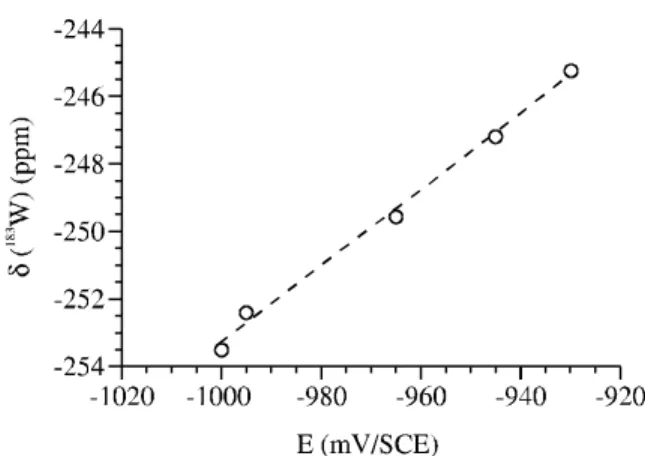
i.e., when the R’ or ganic group is more electronegative15. Fig ure 2 cor re lates the data ob tained from elec tro chem is try and 183W NMR mea sure ments on some of these com -pounds. A strong re la tion ship be tween these two sets of mea sure ments is ev i denced by the par al lel ef fects and both should be re lated to the π-ac cep tor char ac ter of lacunary polyoxometalate16 and the elec tronic ef fect of the or ganic group. The strong π-con ju ga tion be tween both or ganic and in or ganic moi eties is ex alted in com par ing the re dox po ten -tials of para and ortho aminophenyl de riv a tives, re spec -tively -1000 and -890 mV (vs. SCE). Only in the first of these com pounds, the lone pair may be con ju gated with the ox ide core, lead ing to a rather low re duc tion po ten tial.
This work re ports the strong syn ergy be tween or ganic and in or ganic com po nents in a se ries of or gan i cally mod i -fied heteropolymetalates. Two tech niques were used, both mea sur ing the elec tronic charge on the tung sten core. Elec
-tro chem is try av er ages the charge ef fect on the whole ox ide clus ter (EPR of 1e- re duced spe cies dem on strates the elec -tron delocalization at room tem per a ture), while 183W NMR spec tros copy could pro vide a se lec tive map ping of the charge on the dif fer ent tung sten at oms. Mod er ate con ju ga -tion ef fects were mea sured and a fine tun ing of the re dox po ten tial was ob tained by the choice of the mod i fier group. How ever, for these dif fer ent com pounds, the mag ni tude of the intramolecular ef fect is low in com par i son with the sol -vent ef fect. This could be due to the siloxane bond which is cer tainly not the best elec tronic junc tion. Other mod i fi ca tion meth ods of polyoxometallates have al ready been de -scribed2,4,16. They could be a key to ob tain functionnalized mol e cules with un usual be hav ior for the fields of mo lec u -lar elec tron ics and non lin ear op tics.
Acknowledment
This work was sup ported by the CNRS and by the Uni -ver sity of Paris XI.
Ref er ences
1. M.T. Pope, In Heteropoly and Isopolymetallates, In -or ganic Chem is try Con cepts, Eds. Springer, Berlin,
1983.
2. Pope, M.T.; Mul ler, A. Angew. Chem. Int. Ed. Engl.
1991, 30, 34.
3. Keita, B.; Nadjo, L. Mat. Chem. Phys.1989, 22, 77. 4. Keana, J.F.; Ogan, M.D.; Lu, Y.; Beer, M.; Varkey, J.
J. Am. Chem. Soc.1985, 107, 6714.
5. Judeinstein, P.; Deprun, C.; Nadjo, L. J. Chem. Soc., Dal ton Trans.1991, 1991.
6. Ammari, N.; Hervé, G.; Thouvenot, R. New. J. Chem.
1993, 15, 607.
7. Judeinstein, P. Chem. Ma ter.1992, 4, 4.
8. Judeinstein, P. J. Sol-Gel Sci. and Techn.1994, 2, 147. 9. Knoth,W.H. J. Am. Chem. Soc.1979, 101, 759. 10. Keita, B.; Bouaziz, D.; Nadjo, L. J. Electrochem. Soc.
1988, 135, 87.
11. Schraml, J.; Chvalovsky, V.; Mägi, M.; Lippmaa, E.
Col lect. Czech. Chem. Commun.1977, 42, 306. 12. Henry, M.; Gerardin, C.; Taulelle, F. In Mat. Res. Soc.
Symp. Proc. 1992, Vol. 271, 243.
13. Gansow, O.A.; Ho, R.K.C.; Klemperer, W.G. J. Organomet. Chem.1980, 187, C27.
14. Gutmann, V. In Struc ture and Bonding, Springer Verlag Eds., Vol. 15, 1973, 141.
15. Komorowski, L.; Lipinski, J.; Pyka, M.J. J. Phys. Chem.1993, 97, 3166.
16. Rong, C.; Pope, M.T. J. Am. Chem. Soc.1992, 114, 2932.
86 Perez et al. J. Braz. Chem. Soc.
Fig ure 2. Cor re la tion be tween elec tro chem i cal (re duc tion po ten tial in Bu4NBF4/DMF elec tro lyte (vs. SCE)) and 183W NMR chem i cal
![Fig ure 1. Struc ture of the phenyl mod i fied Keggin polymetallate [SiW 11 O 40 (SiC 6 H 5 ) 2 ] 4- .](https://thumb-eu.123doks.com/thumbv2/123dok_br/18988133.459620/3.918.120.414.110.352/fig-struc-ture-phenyl-fied-keggin-polymetallate-siw.webp)