Article
*e-mail: [email protected]
Li
+Distribution into V
2
O
5Films resulting from Electrochemical Intercalation Reactions
Franco Decker,*
,aFrederique Donsanti,
aAnna Maria Salvi,
bNeluta Ibris,
bJames E. Castle,
cFranz Martin,
cDavid Alamarguy,
cAngela Surca Vuk,
dBoris Orel
dand Airton Lourenco
eaDipartimento di Chimica, Università di Roma “La Sapienza”, Roma, Italia
bDipartimento di Chimica, Universita degli Studi della Basilicata, Potenza, Italia
cSchool of Engineering, University of Surrey, Guildford, United Kingdom
dNational Institute of Chemistry, Ljubljana, Slovenia
eInstituto de Fisica “Gleb Wataghin”, Universidade Estadual de Campinas, 13083-970 Campinas-SP, Brazil
Estudamos os efeitos de interface de filmes finos de eletrodos de V2O5 sobre vidros com óxido de índio-estanho (ITO) para intercalação de Li utilizando combinações de métodos: perfil de profundidade por espectrometria de massas de íons secundários (SIMS), inserção-extração eletroquímica de íons lítio por voltametria cíclica de varredura lenta (SSCV) e por técnica de titulação potenciostática intermitente (PITT). Nós demonstramos que a distribuição de Li+ no
interior do filme de óxido é sempre distante de ser considerada homogênea e que diferentes etapas de difusão (paralelas às interfaces e bem como perpendiculares a elas) são consideradas por conter áreas de alguns cm2 em experimentos com eletrodos. A margem exposta pelo corte da placa de
vidro revestida com ITO e recoberta com V2O5 desempenha um papel importante no processo, pelo fato de expor a interface V2O5-ITO ao eletrólito.
We studied interface effects of thin film V2O5 electrodes on top of indium tin oxide (ITO) glass for Li intercalation by means of a combination of methods: depth-profiling by secondary ion mass spectroscopy (SIMS), electrochemical insertion-extraction of lithium ions by slow-scan cyclic voltammetry (SSCV) and by potentiostatic intermittent titration technique (PITT). We show that the Li+ distribution inside the oxide film is always far from homogeneous, and that different
diffusion paths (parallel to interfaces as well as perpendicular to them) have to be considered in experiments with electrodes having areas of few cm2. The exposed edge formed when cutting out
coupons from the coated glass plate supporting the V2O5 electrode plays a significant role in the process, because it exposes the V2O5-ITO interface to the electrolyte.
Keywords: electrochromism, V2O5, Li insertion, SIMS depth profile, ITO
Introduction
V2O5 in the form of thin films is a very interesting material for electrochemical devices like smart windows and microbatteries.1 The intercalation by lithium ions of V
2O5, as
well as of different transition metal oxides, leads to a change in its transparency, a process that is of value in thin-film electrochromic devices. The intercalation is controlled by an applied electropotential so that the lithium ions can be introduced or withdrawn at will - a process that is exactly similar to the operation of lithium ion batteries. The exact distribution of the intercalated ions inside the film and the
whole electrochromic device, however, is not known in detail. The complete device is typically an assembly of separate layers on top of two transparent (usually glass) substrates, with a liquid or solid electrolyte in between. The layers on top of the substrates are, in the order: a1) indium tin oxide (ITO), to give a conducting base to the film, a2) the lithium intercalation, V2O5, for the Li+ inserting cathode; and b1)
ITO to provide the transparent conductor, with an overlying an anodic layer (b2), often tungsten oxide intercalated with lithium ions, to act as an ion storage electrode. We restricted our electrochemical and surface chemistry studies to the V2O5, Li+ inserting cathode, because tungsten oxide has
been widely studied2 and is already considered the best
the electrolyte and the buried one between V2O5 and ITO.6
This accumulation of Li+ is a severe source of error for the
computation of the thin film average stoichiometry from the inserted cation charge, and may have a deleterious influence on device performance due to problems associated with lithium trapping and charge transport across any one of the two interfaces. We have therefore decided to study interface effects by means of a combination of methods: depth-profiling by secondary ion mass spectroscopy (SIMS), electrochemical insertion-extraction of lithium ions by slow-scan cyclic voltammetry (SSCV) and by potentiostatic intermittent titration technique (PITT). SIMS, in fact, has an excellent sensitivity to Li7,8 and in this paper is used to
specifically address the behaviour of lithium ions at the ITO/V2O5 interface. SSCV and PITT results, on the other hand, represent the average electrochemical response of the whole thin film electrode.
An electrochemical setup, newly designed for this investigation, has been implemented to be able to maximize, or to minimize, the influence of the buried interface in the Li+ insertion-extraction electrochemical reaction. As a
result of these findings we can show that the exposed edge formed when cutting out coupons from the coated glass plate supporting the ITO/V2O5 electrode plays a significant role. We can also demonstrate that the Li+ distribution inside
the electrochromic film is always far from homogeneous, and that different diffusion paths (parallel to interfaces as well as perpendicular to them) have to be considered in
experiments with electrodes having areas of few cm2 as
the ones usually in use in laboratory cells.
Experimental
Thin V2O5 films about 150 nm thick were prepared by a sol-gel technique,9 using glass substrates previously coated
either with ITO (deposited by sputtering) or by fluorine doped tin oxide (FTO) layers. After the deposition, the films were amorphous; however after annealing in air at 400 °C during 2 hours the vanadium oxide films became crystalline. The so-prepared samples were divided into smaller electrodes (typically, 1 cm r 3 cm), using a diamond cutter,
sets of samples differing only by the film surface exposed to the electrolyte during insertion-deinsertion reactions. SSCV was used in order to visualize clearly the phase transformation processes of the oxide host matrix, while keeping a quasi-equilibrium condition during the reaction. Data from PITT experiments were treated, as shown in our previous work,3,10 in order to calculate the ionic Li diffusion
coefficient inside the solid electrode. After Li insertion the samples were packaged in an argon atmosphere and transferred from the laboratory in Rome to that in Guildford for SIMS analysis. Li distribution profiles were obtained using time-of-flight secondary ion mass spectroscopy with an IonTof 5 spectrometer. The spectrometer was run at
an operating pressure of 10-9mbar. A pulsed 25 keV Bi+
primary ion source was employed for analysis, delivering 1 pA of current over a 100 r 100 Mm2area. Depth profiling
was performed using a 3 keV Cs+sputter beam giving 20 nA
target current over a 300 r 300 Mm2area. Data acquisition
and post-processing analyses were performed using the IonSpec software. Results are based on the positive ion profile. A set of SIMS profiles were carried out on a set intervals from the centre of the electrochemically treated regions of both types of sample. In the case of a) the influence of the edge would be maximized, whereas in b) there was expected to be a much smaller edge effect. The location of the SIMS profiles taken on different places of the film sample is shown in Figure 2.
Results and Discussion
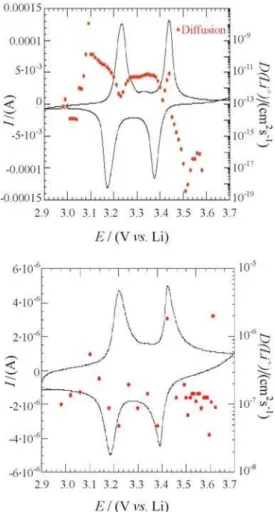
that the electrode area is very small in this case. A precise evaluation of such area is not possible, due to surface tension effects, but we can estimate that it should be at least 100 times less than the electrode surface area when dipping the film electrode in the electrolyte as in Figure 1b. The peaks in the voltammograms are a clear indication (already discussed in the literature) that well defined crystal phases exist as the concentration of the Li ion increases during the scan towards lower potentials. The reversibility of such processes is shown by the positive peaks of sharpness and area comparable to that of the negative ones. The electrochemical reaction promoting the reversible insertion of one equivalent of the alkali ion has as a consequence the reduction of the oxidation state of V, from 5+ to 4+. This change in the oxidation state of V has been already studied by us in the past using XPS.5
In order to calculate the rate of the solid-state diffusion process of the inserted ion inside the oxide host matrix we have performed PITT experiments in the two different electrode configurations already shown above, and we have analyzed the current transients according to the treatment given by Levi et al.11 Typical values of the diffusion
coefficient for Li+ in V
2O5 films are 10-10- 10-11 cm2 s-1, and
this is the results we indeed obtained when inserting the
Li ions from the electrode front surface (see data points in Figure 4a). When the edge of the electrode has been exposed to the solution, on the other hand, the diffusion coefficient
Figure 1. Cell showing the new electrochemical setup, implemented to
be able to maximize, or to minimize the contact between sample and electrolyte. In the two insets: according to micrometer screw position we can have a) only film edge exposed, or b) most of film surface exposed to the electrolyte.
Figure 2. Locations on sample chosen for SIMS profiles on samples
intercalated from their edge.
Figure 3. SSCV at 0.5 mV s-1 taken either with most of film surface
exposed (“classic”), or with only the film edge exposed to the electrolyte (“interface”).
Figure 4. SSCV at 0.5 mV s-1 (solid line) and Li diffusion coefficient
film regions vs. the concentration of V, taken as an internal
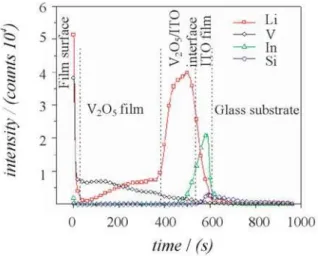
reference. A typical SIMS depth profile from an intercalated sample (Li inserted from the sample surface) is shown in Figure 5. The lithium profile is notable for the broad peak at the interface with ITO, and for a surface enrichment followed by a narrow sub-surface deficiency. This distribution was found on all samples and points to regions in which there is an accumulation of lithium (at the surface and at the internal interfaces), which can be explained with the formation of new Li-rich phases at the film boundaries, in contrast to the bulk of the V2O5 film with a more or less uniform Li concentration. The negative dip in this profile could arise from an electric field in the sub-surface region, consequence of a space charge layer, which would tend to remove the mobile charges (the Li ions) by migration. The vanadium profile, on the contrary, is monotonically decreasing from the surface to the ITO substrate.
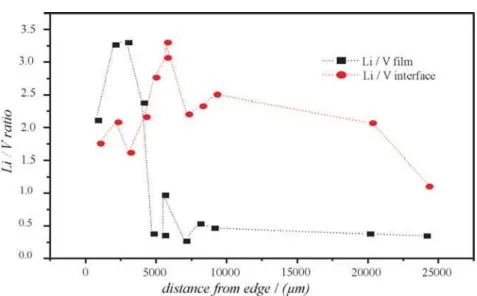
A set of similar SIMS profiles were carried out at intervals from the region exposed to the electrolyte, whose location has been shown in Figure 2 for the sample electrochemically treated from the edge. The depth profiles of Li for the first 9 points are presented in Figure 6. These profiles show that lithium ions accumulate at the interface,
than 25 mm from the edge whereas the film intercalation has dropped to a very low value after only 5 mm. This is in agreement with the PITT data showing an exceptionally high mobility of the Li ions when they are inserted from the sample edge. A much higher diffusion coefficient parallel to the V2O5-ITO interface is explained by the high density of defects expected in this interfacial region. An additional explanation is that a new phase grows throughout this interface after reaction with the inserted Li. In this case there would not be a true insertion of Li+ in the vanadium
oxide and the new phase may form as result of the electrode potential applied to the ITO being directly visible to the electrolyte at the cut edge. In the potential range used for intercalation Li does not intercalate into ITO, no peaks being visible on the cyclic voltammogram when performing the experiment. Possibilities for this new phase would include Li2O or a LiV oxide structure with highly reduced vanadium, possibly V(III) ions. Experimental results shown elsewhere have shown that true intercalation from the front-side of the test piece does not lead to further Li spread via
the internal interface.12 This is a further evidence in favor
of the formation of a new interfacial phase occurring only when the edge of the sample (and therefore also the ITO edge) is exposed to the electrolyte and polarized.
Figure 5. Typical SIMS depth profile of V2O5 thin film intercalated with
Li ions
Figure 6.SIMS depth-profiles from edge intercalated sample. The
Figure 7.Evolution of Li/V ratios from the intercalated edge (only part in contact with solution) to top of the sample.
Conclusions
When a cut edge of a V2O5-ITO-Glass substrate
sandwich is exposed to a LiClO4-PC electrolyte, it is
possible to perform electrochemical experiments on this particular surface. CV has the same overall shape as in standard experiments, where the V2O5 film outer surface is exposed. PITT data show that, differently from the results in standard experiments, there is an exceptionally high mobility of the Li ions when they are inserted from the sample edge. According to SIMS depth profiles, an interface enrichment of Li occurs that extends more than 25 mm from the intercalated zone probably related to the formation of a new, highly defective phase. There is virtually no extension of intercalation within the body of the film, because of the much lower diffusion coefficient of Li in the vanadium oxide bulk film. This shows that the edges of thin film samples when cut from a prior prepared plate offer an easy route to the interfaces in layered samples. This offers the opportunity for direct insertion of Li ions to the interface and thence for lateral diffusion at a high rate throughout the test piece, a transport mechanism that could be advantageously used in an advanced charge-storage device.
References
1. Talledo, A.; Valdivia, H.; Benndorf C.; J. Vac. Sci. Tech. 2003,
21 A, 1494.
2. Granqvist, C. G.; Sol. Energ. Mater. Sol. Cells2000,60, 262.
3. Salvi, A. M.; Decker, F.; Varsano, F.; Speranza, G.; Surf. Interface Anal.2001,31, 255.
4. Alamarguy, D.; Castle, J. E.; Ibris, N.; Salvi, A. M.; J. Vac. Sci. Tech A2007,25, 1577.
5. Ibris, N.; Salvi, A. M.; Liberatore, M.; Decker, F.; Šurca Vuk, A.;Surf. Interface Anal. 2005,37, 1092.
6. Alamarguy, D.; Castle, J. E.; Liberatore, M.; Decker, F.; Surf. Interface Anal.2006,38, 801.
7. Porqueras, I.; Viera, G.; Marti, J.; Bertran, E.; Thin Solid Films 1999,179, 343.
8. Krings, L. H. M.; Tamminga, Y.; Van Berkum, J.; Labhom, F.; Van Veen, A.; Arnoldbik, W. M.; J. Vac. Sci. Tech.1999,A17,
198.
9. Šurca Vuk, A.; Bencic, S.; Orel, B.; Decker, F.; J. Sol-Gel Sci. Technol.2002,23, 53.
10. Varsano, F.; Croce, F.; Decker, F.; Masetti, E.; Electrochim. Acta 2001,46, 2069.
11. Levi, M. D.; Lu, Z.; Aurbach, D.; Solid State Ionics2001,143, 309.
12. Castle, J. E.; Decker, F.; Salvi, A. M.; Martin, F.; Donsanti, F.; Ibris, N.; Alamarguy, D.; 12th European Conference on
Applications of Surfaces and Interfaces Analysys ECASIA’07, Brussels, Belgium, 2007.
Received: October 19, 2007
Web Release Date: March 31, 2008