Knowledge and attitudes of nurses regarding patient rights: a
Corum/Turkey sample
SELEN OZAKAR AKCA1*, YELIZ YELEN AKPINAR2, TURGAY HABBANI3
1MD, Assistant Professor – Hitit University Health School, Corum, Turkey 2Education Director – Association of Public Hospital, Corum, Turkey 3MD, Director – Association of Public Hospital, Corum, Turkey
S
UMMARYStudy conducted at Hitit University Health School, Corum, Turkey
Article received: 9/8/2014
Accepted for publication: 11/3/2014
*Correspondence:
Address: Samsun Cad., 96 Corum – Turkey Postal code: 1259 Phone: +903642230732
Fax: +9036422230730 [email protected] [email protected] [email protected]
http://dx.doi.org/10.1590/1806-9282.61.05.452
Objective: patient rights are defined as the rules of conduct between the people who benefit from health services and the health institutions and personnel who provide them. As the protection and provision of these rights are closely related to the nursing trade, these professionals must have thorough knowledge about this issue. The purpose of this study was to evaluate the acquaintance and atti-tudes of working nurses in Corum/Turkey regarding patient rights and to cre-ate the basis for a planned educational program.
Methods: sample selection was not performed in this study, but all nurses (n=939) who were working in the course of this study constituted the sample. Survey forms were used as data collection tools.
Results: the study revealed that 92.3% had received education about patient rights, 2.2% had never heard anything about this term and 86.6% became aware of it through sources from outside of school. It was established that the atti-tudes of nurses regarding patient rights differ for every patient and that this rate ranges from 35.8 to 98.1%.
Conclusion: there is a requirement for more studies on the subject of patient rights, as they play an important role in the development of health services. In that regard, patient rights centers should be established and carried out accord-ing to the foreseen model set by national and international health systems. Stud-ies aiming to teach health personnel, patients and their relatives about patient rights must be carried out.
Keywords: patient rights, nurses, patient satisfaction.
I
NTRODUCTIONPatient rights are defined as the rules of conduct between people who benefit from health services and the health institutions and personnel who provide them.1,2 As these
rights relate to particular circumstances in human life, it is also defined as third generation human rights and cov-ers the application of human rights and values in health services. Top priorities of patient rights include: to be re-spected as a human being, receive health service in a high level, get information, get confirmation for medical pro-cesses, privacy and respect for private life, while receiving care and treatment continuity.3
The first international document about patient rights was published in 1981 by the World Medical Association (WMA). After that, new notifications were published by
the World Health Organization and the WMA.4,5 In
dif-ferent countries, researches concerning patient rights are made in accordance with international regulations.6
In Turkey, regulations on patient rights have been is-sued in accordance with improvements in the field from all over the world. Many statutes created between 1928 and 1998 included the issue of patient rights; last of all, the Patient Rights Directive (PRD) with the number 23,420 was published on 1st August 1998. In the Guidelines relat-ed to the application of patient rights in Healthcare facilities, pre-pared by the Turkish Health Ministry on October 15, 2003, legal processes were defined and updated according to new requirements established in 2005.7 With proper
guide-lines, the developments in the world concerning patient rights were harmonized on a large scale.8,9 Since there are
coun-try members, we think that more importance will be giv-en to teaching patigiv-ent rights on medical education in the coming years.
Within the execution of patient rights, the claims of patients are important. However, if they will not result in what is best for the individual himself, help is needed. This help is best given by the nursing staff, who is closer to the patient during care and, therefore, are more aware of their individual needs.1,10 Thus, nurses’ knowledge and
attitude towards patient rights are paramount.11
Having analyzed the present literature, it was observed that studies were mostly about specifying the level of knowledge of medical staff members and hospital pa-tients regarding patient rights.2,12-16 The sample in all
stud-ies was small. Our study aimed to determine the attitude of medical staff regarding patient rights and to provide information for educational programs about this issue, which are still being designed.
M
ETHODSThe plan was to realize this study with all nurses current-ly employed in Corum/Turkey (cities and districts includ-ed, n=960) with a descriptive and cross-sectional approach. No sample-selection was made. The sample constituted of nurses (n=939) who were working between the dura-tion (15/2-15/5/2014) of this study and participated vol-untarily. Before the study had begun, the approval (13/2/2014/2367) from the Provincial Public Hospital Association and the Ankara Numune Education and Re-search Hospital Ethics Committee was obtained. In ad-dition to that, a written consent by the volunteer nurses was also obtained and they were informed about the pur-pose of this study.
Questionnaire
This questionnaire, which was developed in accordance with research and literature knowledge, was used in order to col-lect data. The study data was obtained by the filling out of forms by nurses, which happened during a time slot of 10 minutes under the researcher’s observance. The question-naire form consists of two parts. In the first part, there are questions about the nurse’s defining characteristics and, in the second part, there are questions to determine the knowl-edge and attitude of nurses concerning patient rights. The questions in the second part of the questionnaire are ar-ranged as “I agree = 1 point” and “I don’t agree = 0”.
Statistical analysis
The data obtained from this study was evaluated by using appropriate statistical methods. In the distribution of
de-fining characteristics belonging to nurses, number, percent-age and averpercent-age were used. Regarding data about knowledge and attitude concerning patient rights, various methods (Anova, t Test, Mann Whitney U and Kruskal Wallis) were used. p<0.05 was accepted as statistically significant.
R
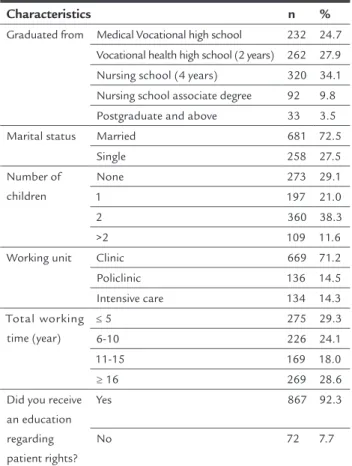
ESULTSIt was determined that most participant nurses were high-school graduates (34.1%), married (72.5%) and had 2 chil-dren (38.3%). 71.2% of the nurses included in the study worked in the clinic, the working time of 29.3% was ≤5years and of 28.6% ≥16 years. Furthermore, it was detected that most of the nurses (92.3%) had received an education con-cerning patient rights. 75.9% of the participant nurses had heard the term patient rights for the first time in the hos-pital. Additionally, the authors found that the first time these nurses recognized the term patient rights before be-ing made aware of it in the hospital was in school, from tele-vision or books (11.2, 4.7 and 2.4%, respectively). However, 2.2% had never heard the term before. Approximately half of the nurses (43.8%) in the study mentioned that they had experienced a problem regarding patient rights (Table 1).
TABLE 1 Distribution according to the characteristics of nurses. (n= 939)
Characteristics n %
Graduated from Medical Vocational high school 232 24.7 Vocational health high school (2 years) 262 27.9
Nursing school (4 years) 320 34.1 Nursing school associate degree 92 9.8 Postgraduate and above 33 3.5
Marital status Married 681 72.5 Single 258 27.5 Number of
children
None 273 29.1
1 197 21.0
2 360 38.3
>2 109 11.6
Working unit Clinic 669 71.2
Policlinic 136 14.5 Intensive care 134 14.3 Total working
time (year)
≤ 5 275 29.3
6-10 226 24.1
11-15 169 18.0
≥ 16 269 28.6
Did you receive an education regarding patient rights?
Yes 867 92.3
No 72 7.7
TABLE 1 (Cont.) Distribution according to the characteristics of nurses. (n= 939)
Characteristics n %
Where did you hear the term patient rights for the first time?
I have never heard it 21 2.2
Book 23 2.4
Television 44 4.7
Internet 8 0.9
School 105 11.2 Hospital 713 75.9 Brochure 13 1.4
Seminar 12 1.3
Have you ever faced any problems concerning patient rights?
Yes 411 43.8
No 528 56.2
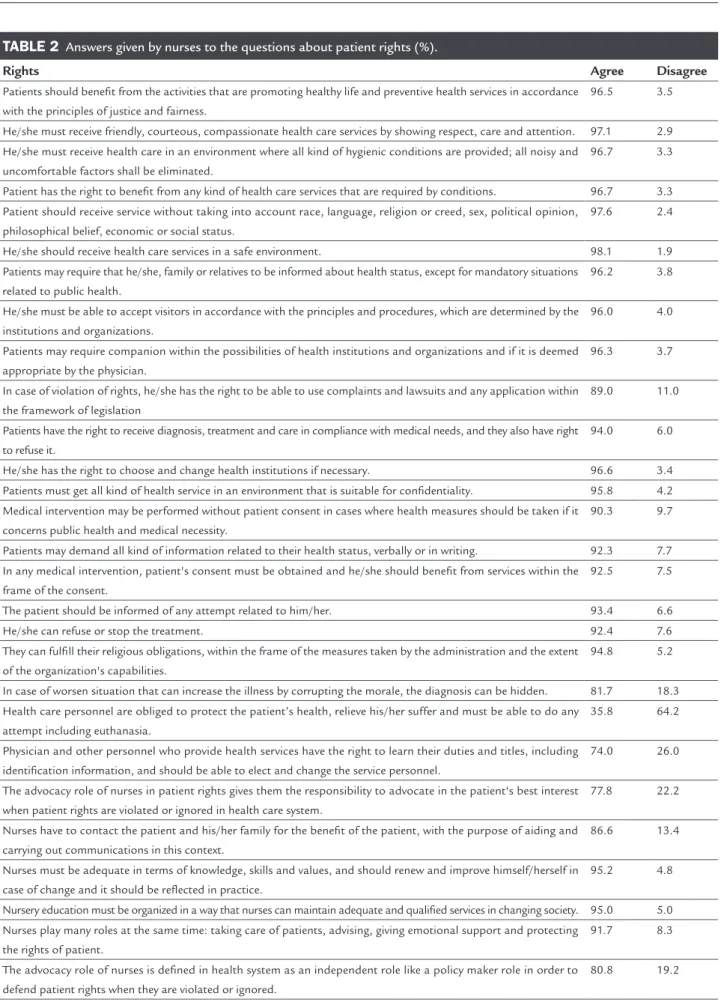
After having analyzed the answers to the questions in or-der to rank the knowledge and attitude concerning patient rights of the participant nurses (Table 2), it was ascertained that most of them marked “agree” to most questions. It was determined that to the question “Health care person-nel are obliged to protect patient health, relieve his/her suf-fer and must be able to do any attempt, including eutha-nasia” 35.8% agreed and 64.2% did not agree.
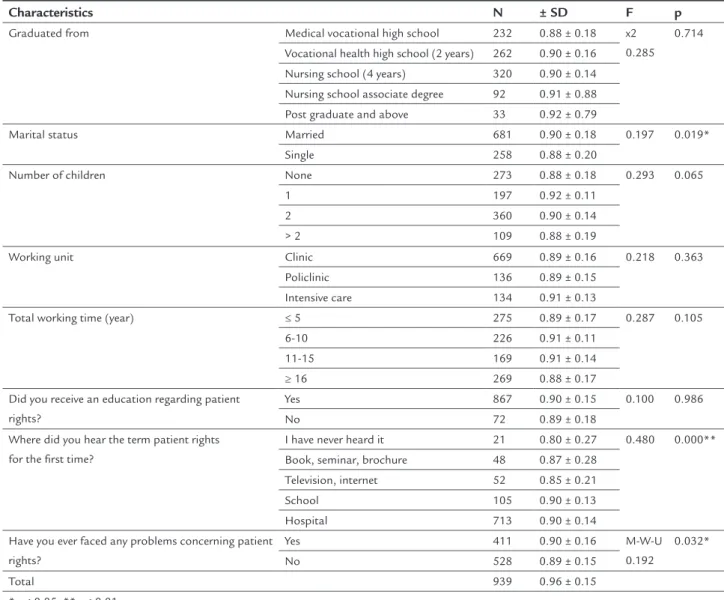
After having analyzed the relation between the knowl-edge and attitude about patient rights and the defining characteristics of the participant nurses (Table 3), it was determined that the relation between the nurses’ marital status, the first place where they had heard the term pa-tient rights, the confrontation with a problem concern-ing patient rights and the knowledge and attitude aver-age points regarding patient rights was statistically significant (respectively; p<0.05, p<0.01, p<0.05). A statis-tically significant difference between the place nurses had first encountered the term “patient rights” and the knowl-edge/attitude average points regarding patient rights (f=0.480, p=0.000) was observed among the groups, be-tween the ones who had heard the term on television or on the internet and who had never heard the term, and the group who had heard the term in school or in the hos-pital. It was established that there is no statistically signif-icant relation between the nurses’ graduation school, num-ber of offspring, working unit, total working time and education about patient rights, and their knowledge and attitude average points concerning patient rights (p>0.05).
D
ISCUSSIONThe data obtained in this study show that a significant part of the nurses did not receive a qualitative education
on patient rights during graduation or after, and that the courses realized by Patient Rights and Education Units did not reach sufficient quality level.
One of the ways to assess health care systems is the eval-uation of patient satisfaction. In view of that, meeting the expectations of patients consists in one of the main purpos-es of the health care system. Patients consider nurspurpos-es’ atti-tudes and behaviors as one of the most important criterion to assess the quality of health care services.17,18 The
expecta-tions of patients in respect to personal rights, good commu-nication and attention, clean and safe environment and a qualitative service consist of basically the attitude and be-haviour that are relevant to the purpose of patients rights.
In providing health service, the appropriate behavior of the service providing personnel, in accordance with the rights and expectations of those receiving the service, is one of the most important factors that influence pa-tient satisfaction. It is reported that, during servicing time, patient rights come into play, especially regarding knowl-edge and attitude of health personnel.1,2,13
In the conducted researches, it was reported that most of health personnel did not receive any education about important topics of patient rights and the ones who had received such education, performed in a unsatisfactory manner regarding this subject.2,19,20 The small rate (7.7%)
of nurses who had not received any kind of education ob-tained in our study is good news. However, the insufficien-cy of the knowledge concerning this subject is comparable with other researches. In those studies, which were con-ducted in order to assess the knowledge level and attitudes of nurses concerning patient rights,2,20 it was seen that most
knowledge about patient rights had been obtained from trainings after graduation. In our study, it was established that most nurses (86.6%) had encountered the term pa-tient rights through sources from outside of school, espe-cially from trainings conducted in hospitals (Table 1). These results show that nurses who pass a significant part of their daily work with patients and are in close communication with them, did not receive sufficient knowledge about pa-tient rights during their formal education and practice, but the subject was emphasized in hospital trainings. It shows, once again, that health personnel need more training re-garding patient rights during their graduation and after.
Patients are exposed to lots of stress within the period of their hospital entry and their leave. Nurses play an irre-vocable role while patients try to cope with that stress.12,21
Nurses perform this role by giving the patient explanato-ry information during treatment process, by protecting patient rights and through fulfilling their own responsi-bility by helping the patient to protect his/her rights.10,22
TABLE 2 Answers given by nurses to the questions about patient rights (%).
Rights Agree Disagree
Patients should benefit from the activities that are promoting healthy life and preventive health services in accordance with the principles of justice and fairness.
96.5 3.5
He/she must receive friendly, courteous, compassionate health care services by showing respect, care and attention. 97.1 2.9 He/she must receive health care in an environment where all kind of hygienic conditions are provided; all noisy and
uncomfortable factors shall be eliminated.
96.7 3.3
Patient has the right to benefit from any kind of health care services that are required by conditions. 96.7 3.3 Patient should receive service without taking into account race, language, religion or creed, sex, political opinion,
philosophical belief, economic or social status.
97.6 2.4
He/she should receive health care services in a safe environment. 98.1 1.9 Patients may require that he/she, family or relatives to be informed about health status, except for mandatory situations
related to public health.
96.2 3.8
He/she must be able to accept visitors in accordance with the principles and procedures, which are determined by the institutions and organizations.
96.0 4.0
Patients may require companion within the possibilities of health institutions and organizations and if it is deemed appropriate by the physician.
96.3 3.7
In case of violation of rights, he/she has the right to be able to use complaints and lawsuits and any application within the framework of legislation
89.0 11.0
Patients have the right to receive diagnosis, treatment and care in compliance with medical needs, and they also have right to refuse it.
94.0 6.0
He/she has the right to choose and change health institutions if necessary. 96.6 3.4
Patients must get all kind of health service in an environment that is suitable for confidentiality. 95.8 4.2 Medical intervention may be performed without patient consent in cases where health measures should be taken if it
concerns public health and medical necessity.
90.3 9.7
Patients may demand all kind of information related to their health status, verbally or in writing. 92.3 7.7 In any medical intervention, patient's consent must be obtained and he/she should benefit from services within the
frame of the consent.
92.5 7.5
The patient should be informed of any attempt related to him/her. 93.4 6.6 He/she can refuse or stop the treatment. 92.4 7.6 They can fulfill their religious obligations, within the frame of the measures taken by the administration and the extent
of the organization's capabilities.
94.8 5.2
In case of worsen situation that can increase the illness by corrupting the morale, the diagnosis can be hidden. 81.7 18.3
Health care personnel are obliged to protect the patient’s health, relieve his/her suffer and must be able to do any attempt including euthanasia.
35.8 64.2
Physician and other personnel who provide health services have the right to learn their duties and titles, including identification information, and should be able to elect and change the service personnel.
74.0 26.0
The advocacy role of nurses in patient rights gives them the responsibility to advocate in the patient's best interest when patient rights are violated or ignored in health care system.
77.8 22.2
Nurses have to contact the patient and his/her family for the benefit of the patient, with the purpose of aiding and carrying out communications in this context.
86.6 13.4
Nurses must be adequate in terms of knowledge, skills and values, and should renew and improve himself/herself in case of change and it should be reflected in practice.
95.2 4.8
Nursery education must be organized in a way that nurses can maintain adequate and qualified services in changing society. 95.0 5.0 Nurses play many roles at the same time: taking care of patients, advising, giving emotional support and protecting
the rights of patient.
91.7 8.3
The advocacy role of nurses is defined in health system as an independent role like a policy maker role in order to defend patient rights when they are violated or ignored.
TABLE 3 Distribution of nurses according to their personal knowledge and their knowledge-attitude concerning patient rights.
Characteristics N ± SD F p
Graduated from Medical vocational high school 232 0.88 ± 0.18 x2 0.285
0.714 Vocational health high school (2 years) 262 0.90 ± 0.16
Nursing school (4 years) 320 0.90 ± 0.14 Nursing school associate degree 92 0.91 ± 0.88
Post graduate and above 33 0.92 ± 0.79
Marital status Married 681 0.90 ± 0.18 0.197 0.019* Single 258 0.88 ± 0.20
Number of children None 273 0.88 ± 0.18 0.293 0.065
1 197 0.92 ± 0.11
2 360 0.90 ± 0.14
> 2 109 0.88 ± 0.19
Working unit Clinic 669 0.89 ± 0.16 0.218 0.363 Policlinic 136 0.89 ± 0.15
Intensive care 134 0.91 ± 0.13
Total working time (year) ≤ 5 275 0.89 ± 0.17 0.287 0.105 6-10 226 0.91 ± 0.11
11-15 169 0.91 ± 0.14 ≥ 16 269 0.88 ± 0.17
Did you receive an education regarding patient rights?
Yes 867 0.90 ± 0.15 0.100 0.986
No 72 0.89 ± 0.18
Where did you hear the term patient rights for the first time?
I have never heard it 21 0.80 ± 0.27 0.480 0.000**
Book, seminar, brochure 48 0.87 ± 0.28 Television, internet 52 0.85 ± 0.21 School 105 0.90 ± 0.13
Hospital 713 0.90 ± 0.14 Have you ever faced any problems concerning patient
rights?
Yes 411 0.90 ± 0.16 M-W-U 0.192
0.032*
No 528 0.89 ± 0.15
Total 939 0.96 ± 0.15
*p < 0.05, **p < 0.01
observed that health personnel faced problems concern-ing patient rights (Table 1). The fact that nurses had faced challenges regarding patient rights in their practice is cru-cial and deserves attention.
The attitude suggestions that were most accepted by nurses are showed in Table 2, as following; “Patients should receive health care services in a safe environment”, “Patients should receive service without taking into account race, lan-guage, religion or creed, gender, political opinion, philo-sophical belief, economic or social status”, “Patients must receive friendly, courteous, compassionate health care ser-vices by showing respect, care and attention” (98.1, 97.6 and 97.1%, respectively). The large acceptance of the proposed suggestions concerning patient rights shows that nurses are aware of patient rights and pay attention to this
the patient’s best interest when patient rights are violated or ignored in health care system”11,23 display that nurses are
insufficiently trained regarding the advocacy subject.
C
ONCLUSIONIn line with the obtained results from the study, studies regarding patient rights play an important role in the de-velopment of health services, and are necessary. There-fore, the Patient Rights Centers’ studies, based on the foreseen model set by national and international health systems, should be implemented. The influence of train-ings for personnel conducted by Patient Rights and Ed-ucation Units should be increased and a knowledge, at-titude and behavior change should be pursued. Studies targeting the training of health personnel and patient’s relatives on patient rights, and the implementation of a patient rights culture should be conducted.
A
CKNOWLEDGMENTSThis study was accepted and presented in The Macro Trend Conference on Health and Medicine, Paris, France, in 19-20 December 2014.
R
ESUMOConhecimentos e atitudes das enfermeiras em relação aos direitos dos pacientes: exemplo de Corum, Turquia
Objetivo: como a proteção dos direitos do paciente e o for-necimento de direitos relativos aos cuidados de saúde estão estreitamente relacionados à profissão de enfermagem, as enfermeiras devem ter um conhecimento impecável sobre o assunto. Este estudo tem como objetivo avaliar os conhe-cimentos e as atitudes das enfermeiras que trabalham na Turquia em relação aos direitos do paciente e criar uma base para um programa educacional a ser planificado.
Métodos: não foi feita uma seleção da amostra para este es-tudo; todas as enfermeiras (n=939) que trabalharam duran-te o período em que o estudo foi efetuado constituíram a amostra. Formulários do questionário foram utilizados como instrumentos de recolhimento de dados.
Resultados: neste estudo, foi constatado que 92.3% recebe-ram formação sobre direitos dos pacientes, 2.2% nunca ou-viram nada sobre o termo e 86.6% tomaram conhecimento do termo por meio de fontes externas à escola. Determinou--se que as atitudes das enfermeiras em relação aos direitos do paciente são diferentes para cada paciente e que essa taxa varia entre 35.8 e 98.1%.
Conclusão: há uma demanda de estudos dedicados aos di-reitos dos pacientes, pois desempenham um papel
impor-tante no desenvolvimento dos serviços de saúde. Nesse sen-tido, centros de direito do paciente devem ser estabelecidos e geridos de acordo com o modelo previsto no sistema de saúde nacional e internacional. Estudos com objetivo de in-formar profissionais de saúde e familiares de pacientes so-bre os direitos dos pacientes devem ser efetuados.
Palavras-chave: direitos do paciente, enfermeiras, satis-fação do paciente.
R
EFERENCES1. Ünsal A, Bulucu GD, Kura E, Ercan Y. The levels of knowledge concerning the rights of patients receiving outpatient services. Fırat Sağlık Hizmetleri Dergisi. 2011; 6:27-40.
2. Teke A, Uçar M, Demir C, Çelen O, Karaalp T. Evaluation of knowledge and attitudes of the nurses working in a training hospital about patients rights. TAF Prev Med Bull. 2007; 6(4):259-66.
3. Erbil N. Developing scale of patient’ rights using attitude. Uluslararası İnsan Bilimleri Derg. 2009; 6(1):825-38.
4. Ozdemir MH, Ergönen AT, Sönmez E, Can IO, Salacin S. The approach taken by the physicians working at educational hospitals in Izmir towards patients rights. Patient Educ Couns. 2006; 61(1):87-91.
5. Kuzu N, Ergin A, Zencir M. Patients’ awareness of their rights in a developing country. Public Health. 2006; 120(4):290-6.
6. Fotaki M. Users’ perceptions of health care reforms: quality of care and patient rights in four regions in the Russian Federation. Soc Sci Med. 2006; 63(6):1637-47.
7. Bostan SA. Reasons of violations of the patients’ rights. Ibni Sina Tıp Dergisi 2005; 10(2-3):65-72.
8. Yürümez Y, Çevik T, Yavuz Y. Do we know the rights of patients? J Acad Emerg Med. 2010; 9:67-71.
9. Önal G, Civaner M. The directive for practice of patient rights: a step to putting into practice the patient rights in Turkey. Turkiye Klinikleri J Med Ethics. 2005; 13:203-8.
10. Williams A. A study of practising nurses perception and experiences of intimacy within the nurse-patient relationship. J Adv Nurs. 2001; 35(2):188-96. 11. Özakar-Akça S, Gözen D. Advocacy role of the pediatric nurse. Florence
Nightingale Hemşirelik Fakültesi Derg 2013; 21: 213-8.
12. Özer N, Özlü ZK, Sarıtaş S. Do the surgical clinic inpatients know their rights? J Anatolia Nurs Health Sci. 2009; 12(4):19-28.
13. Zincir H, Erten ZK. Knowledge levels of the health care employees working at the primary health institutions about patient rights. Int J Hum Sci. 2009; 6(1):885-7. 14. Bostan S. The investigation of health employees attitudes related patient rights: instances of Farabi Hospital. Hacettepe Sağlık İdaresi Dergisi 2007; 10:1-18. 15. Eksen M, Karadağ N, Işıkay C, Karakuş A, Seyhan D, Karanlık M. The levels
of knowledge concerning the rights of patients receiving outpatient services. Int J Hum Sci. 2004; 1:1-12.
16. Ersoy N, Gündoğmuş ÜN. A study of the ethical sensitivity of physicians in Turkey. Nurs Ethics. 2003; 10(5):472-84.
17. Zebiene E, Razgaukas E, Basys V, Baubiniene A, Gurevicius R, Padaiga Z, et al. Meeting patients expectations in primary care consultations in Lithuania. Int J Qual Healt Care. 2004; 16(1):83-9.
18. Uçar M. Ethical aspects of health services in the military context. TAF Prev Med Bull. 2005; 4(1):37-45.
19. Bostan S, Ünal AK. Hospital patients rights practices for employees what does it mean? A case of eastern Black Sea. Turkiye Klinikleri J Med Ethics. 2013; 21(2):65-73.
20. Ozdemir MH, Ergönen AT, Sönmez E, Can IO, Salacin S. The approach taken by the physicians working at educational hospitals in Izmir towards patients rights. Patient Educ Couns. 2006; 61:87-91.
21. McHale J, Gallenger A. Nursing and human rights. London: Heinmann Company, 2003.
22. Royal College of Nursing (RCN-2003). Chaperoning: The role of the nurse and the rights of patients. London: Royal College of Nursing. Available from: http://www.rcn.org.uk/data/assets/pdf_file/0006/78513/ 001446.pdf. 23. Baldwin MA. Patient advocacy: a concept analysis. Nurs Stand. 2003;