(1) Universidade Federal de Santa Maria – UFSM – Santa Maria (RS), Brasil. Financial Aid: CAPES (Doctorate Scholarship)
Conlict of interest: non-existent
Ultrasound images of the tongue prior and post speech therapy
Imagens de ultrasonografia de língua pré e pós terapia de fala
Roberta Michelon Melo(1) Roberta Freitas Dias(1) Helena Bolli Mota(1) Carolina Lisbôa Mezzomo(1)
Received on: September 15, 2015
doi: 10.1590/1982-0216201618114515
ABSTRACT
The aim of this study was to analyze the ultrasound imaging of the tongue movement during the pro-duction of alveolar and velar stops, before and after speech therapy. A boy of a ive year old and with Speech Disorder participated in this study. Were collected the articulatory data (ultrasound imaging of the tongue movement) and perceptive hearing of [t], [d], [k] and [g], before and after the 25 speech therapy sessions. Regarding results obtained in pre-therapy moment, when observing the three repetitions of the tongue curve of velar stops, a gestural indifferentiation was apparently detected, suggesting the presence of a dependency between the organizers of tip and body of the tongue. In the after therapy, a change in the tracing of the tongue gesture of [k] and [g] was veriied. They started presenting a posteriorization of the tongue movement, synchronously with a rise in its body, as the adult standard. Thus, ultrasonographic indings were able to show a possible overcoming of the anteriorization stop velar, detected in the irst perceptual speech analysis. In addition, these results seemed to reinforce the idea of covert contrasts in the speech of children with speech disorders.
Keywords: Speech, Language and Hearing Sciences; Speech Therapy; Speech Disorders; Ultrasonography
RESUMO
O objetivo deste estudo foi analisar a imagem de ultrassonograia do movimento de língua durante a pro-dução de oclusivas alveolares e velares, pré e pós-terapia de fala. Um menino com cinco anos de idade e diagnóstico de desvio fonológico, apresentando o processo de anteriorização de oclusivas velares, par-ticipou da presente pesquisa. Foram coletados os dados articulatórios (imagem de ultrassom do movi-mento de língua) e perceptivo auditivo dos fones [t], [d], [k] e [g], antes e após 25 sessões de terapia. Quanto aos resultados obtidos no momento pré-terapia, aparentemente, foi detectada uma indiferencia-ção gestual ao serem observadas as três repetições da curva de língua das oclusivas velares, sugerindo a presença de uma dependência entre os articuladores de ponta e corpo de língua. No momento pós-Case reports
About phonological disorders, there are discussions about their nature: cognitive, articulatory or both of them.
Phonological disorders are deined as deicit in one of the language subsystems, characterized by dificulty
of speech sounds organization, concerning the phono-logical system4. Children who present these phonology disorders use repair strategies for longer period of time in comparison with children with typical phonological development5.
The repair strategies are mechanisms used by children during their phonological development, as an attempt to produce segments and/or syllabic structures which they do not know or whose production they do not control5. Studies indicate that as higher the disorder severity, higher is the number of used repair strategies (for example, devoicing, anteriorization and cluster reduction)5,6.
Under another point of view, in the case of Articulatory Phonology7 or Gestural Phonology8-11, speech is interpreted as a dynamic task. This theory
suggests that speech dificulty in phonological
disorders occurs, mainly, because of two types of gestural changes: 1) reduction in magnitude (time and space) of individual gestures and; 2) increase of gesture overlap11.
Speech therapy in these cases used several instru-ments to validate actions. It is common the use of
evalu-ation protocols, usually subjective, to deine different
stages and procedures of therapeutic processes. In
the scientiic environment, there is increasing search
for tools and more direct analyzes of phonoarticu-latory organs, aiming at providing more accuracy of evaluative methods, as well as outlining diagnostic hypotheses12,13.
In literature, there are several therapy models for phonological disorders, which differ in relation to theoretical bases, therapeutic procedures and way of application. Most of these models have as premise the reorganization of children’s phonological system, considering the necessity of systematic cognitive reorganization. An example is the therapy model which
was used in the present study: the Modiied Maximal
Opposition Model. This model foresees, if necessary,
been an alternative of instruments application such as electropalatography, nasometry, ultrasound, etc, which have presented positive results in the treatment of several speech alterations15-18.
The articulatory analysis enables the direct detection of articulatory movements, especially in relation to posterior tongue movements19. In case of ultrasound images, they are considered as noninvasive and with minimal interference in the visualization of intraoral movements19,20. The use of ultrasound allows the professional to perform articulatory analysis of evaluated subjects data and of the patient in thera-peutic process15,16,21. It is believed that this resource may contribute, when interpreted with other speech data, to monitor the therapeutic process evolution of children with phonological disorders expressing, or not, evidences of articulatory adjustments in the production of sounds which are stimulated in therapy.
Therefore, the purpose of this study was to analyze ultrasound images of tongue movements during the production of alveolar and velar stops, before and after therapy, in a case of phonological disorder, with the presence of velar stop anteriorization.
CLINICAL CASE PRESENTATION
The present study is a clinical case report, longitu-dinal, qualitative, performed at the school clinic from Federal University of Santa Maria, linked to the Brazilian
Uniied Health System.
The data presented in this case report are part of a research project approved by the university research ethics committee, number 14973013.8.0000.5346. The participant children’s guardians signed the free and
clariied consent term, authorizing data collection and use for scientiic research.
The presented clinical case is a boy, C., who is
ive years old and presents diagnosis of phonological
disorders, and is monolingual Brazilian Portuguese
(BP) speaker. In the irst speech auditory perceptive
analysis, it was observed velar stop anteriorization, and other repair strategies. He had not received any type of previous speech and language therapy.
The diagnosis of phonological disorder was deined
(anamnesis, oral expressive and comprehensive language, stomatognathic system, articulatory exami-nation, speech evaluation through the setting of phonetic and phonological inventories and hearing evaluation) and complementary examinations, otorhi-nolaryngologic and neurological.
The subject was submitted to speech therapy,
through the Modiied Maximal Opposition Model14, broadly applied and referenced by national literature. This model indicated the use of minimal pairs (words that are different from each other only because of a phoneme), which maximally contrast. It means that they differ in one or more distinctive features (/g/ x /r/ à Maga x Mara). In the case of C., the only selected sounds to be stimulated were /g/ x /r/, inserted in the following minimal pairs: Maga x Mara (a proper name); bagulho (stuff) x barulho (noise); paga (pays) x para (stop, for, to). Twice a week, a total of 25 therapy sessions were performed.
For this study, C.’s data from recordings (audio and video) obtained from evaluations of the phonetic and phonological systems and ultra sound images, before and after therapy, were analyzed.
In order to evaluate the phonetic and phonological systems, it was used the Children Phonological
Assessment (CPA)4. This evaluation allows the
achievement of a sample with all sounds of the BP phonological system, in all positions they can occur in syllables and words. After collected, the data were transcribed through the International Phonetic Alphabet and reviewed, in a perceptive way, by two evaluators with experience in phonetic transcription. Then, it was performed contrastive analysis and it was established the C.’s phonetic and phonological systems, through auditory perceptive analysis.
For the ultrasound data recording procedure, the following equipments were used: microphone (Shure – SM48); endocavity transducer (65C10EA) attached to a portable ultra sound machine (Mindray – DP6600); computer; synchronizer; sound box and head stabilizer (Articulate Instruments Ltd).
Before the speech sample collection, it was
requested the subject to ill the oral cavity with water,
modifying, thus, the impedance value in relation to the bone structure, facilitating the hard palate visualization.
So, some seconds of water swallowing were recorded with the aid of ultrasound ecquipment22.
The articulatory data (ultrasound images of the tongue movement) of /t/, /d/, /k/ and /g/ were collected
through spontaneous naming of the words – /’kapə/,
/‘kubo/, /‘tapə/, /‘tubo/, /‘galo/, /‘gulə/, /‘darə/ e /‘duʃə/. These words were represented through pictures and they were presented through computer screen to be named. The subject was instructed to include the target word in the vehicle sentence “Fala ____ de novo” (Say _____ again). Each target word was named six times, however, for the present study, the analyzed words were only words whose consonant is in the context
of the vowel /a/ and only in the three irst repetitions.
Therefore, 12 of C.’s productions were analyzed. During the recording, the subject remained seated, in upright posture, into an acoustic cabin. The ultra-sound transducer was positioned on the
subman-dibular region and ixed, attached to the head stabilizer
(Articulate Instruments Ltd). C. was guided to name
the pictures in usual vocal pattern (intensity, frequency and speed), under supervision of a researcher who remained into the cabin. The collection time of ultra-sound images varied from 15 to 25 minutes, performed in two sessions.
The articulatory analysis of the collected data using ultrasound was performed through the Software Articulate Assistant Advanced (AAA) - (Articulate Instruments Ltd). To do so, it was selected the instants which correspond to the production of each segment (/t/, /k/, /d/ e /g/). It means that based on the spectrogram provided by the program, it was guided by the acoustic register related to the end of the second vowel of the word “Fala” (speech) (last regular cycle of the vowel), to the beginning of the vowel following the stop consonant to be analyzed.
Also using the Software AAA, the tongue movement images were captured and analyzed. It was performed an outline on the tongue surface (on sagittal section) in the instant which corresponds to the consonant midpoint.
However, the articulatory analysis was based on the description of the tongue curve outline in the midpoint of the target consonants production. The interpre-tation of the tongue images was based on gestural descriptors11,23 proposed by the Gestural Phonology. They are supported by the tract variables, which corre-spond to the constriction actions of the vocal tract organs and their reference with the related articulators7. The considered variables were:
• Place of tongue tip constriction (PTTC);
• Degree of tongue tip constriction (DTTC);
• Place of tongue body constriction (PTBC);
• Degree of tongue body constriction (DTBC).
In order to classify the tract variables and conse-quent description of the tongue curve outlines, it was established and agreement among the three Speech
Therapists with experience in the speech ield.
RESULTS
In relation to the data obtained through CPA, or from auditory perceptive analysis of C.’s speech, it was
identiied, before therapy, the presence of velar stops
anteriorization (/k/à[t] and /g/à[d]), and other repair
strategies. In the inal phonological evaluation, or, after 25 therapy sessions, it was veriied overcoming of
observed processes of speech, before starting speech and language therapy.
1 2
3 4
6
Legend: 1 – Acoustic correlative regarding the end of the second vowel /a/ of the word “Fala” (Say) and beginning of the stop /t/; 2 – Acoustic correlative regarding the
end of the stop /t/ and beginning of the vowel /a/ following the stop; 3 – Midpoint of the stop /t/; 4 – Curve of the tongue traced in the midpoint of the production of the stop /t/; 5 – Tongue body; 6 – Tongue tip.
supporting the expected pattern and the initial auditory perceptive analysis, which did not identify the occur-rence of /t/ and /d/ omission and/or substitution in the studied subject’s speech (Figures 2 and 3).
The ultrasound data, analyzed through the Software
AAA before therapy, speciically in relation to the
alveolar stops, revealed tendency to raise the tongue tip in the midpoint of consonant production (analyzed during the production of the words /‘tapə/ and /‘darə/),
articulators of tongue tip and body. This inding was
observed in all three tongue curve repetitions related to the production of both velar stops (Figures 4 and 5). However, in relation to the stops /k/ and /g/, auditorily
produced as /t/ and /d/, it was detected indifferentiation of tongue gestures, suggesting dependence between
Figure 3. Data before therapy, tongue curves traced on the midpoint of the stop /d/, in the three target-words repetitions
On the other hand, in the comparison of data before and after therapy, it was observed change
in the coniguration of the tongue gesture to velar
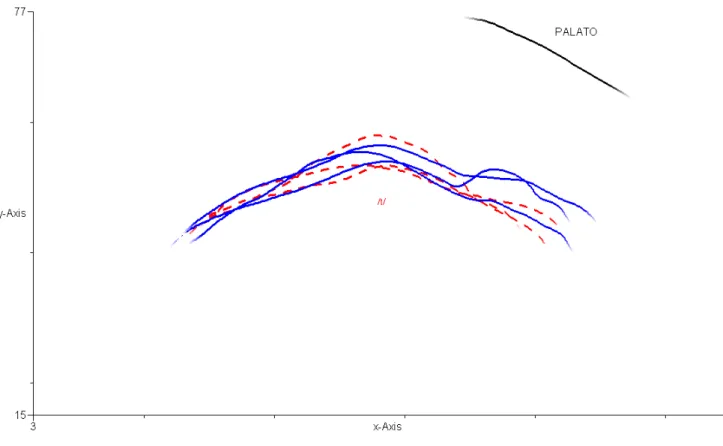
stops. In this moment, it is presented posterization of tongue movement, synchronously to a body elevation, agreeing with the adult pattern understood by human ears (Figures 6, 7, 8 and 9).
Thus, it not possible to categorically state that the tongue curves which correspond to the velar stops treat the same tongue outlines observed to /t/ and /d/. This result suggests the occurrence of a possible “inter-mediate state between the contrastive phones”.
Legend: Dotted line – data before therapy; Continuous line – data after therapy.
Figure 6. Tongue curves traced on the midpoint of the stop /t/ - before and after therapy data
Legend: Dotted line– data before therapy; Continuous line – data after therapy.
Legend: Dotted line– data before therapy; Continuous line – data after therapy.
In the case of C., there seems to be a disadjustment in the implementation of the second stage, mentioned earlier. It is also detected the dependency between the tongue body and tip articulators. These results have already been mentioned in another study which reviewed electropalatography in children with articu-latory/phonological disorders28.
However, after 25 therapy sessions, it was observed change in C.’s tongue gesture pattern, similar to the pattern described to speech without alterations29. It also agrees with what was previously described in relation to the tract variables (tongue body constriction place and degree) involved in the production of a
velar constriction11. Thus, development of gestural
complexity could be observed with the comparison of the outlines of tongue curves, before and after speech therapy.
It is interesting to highlight the importance of the instrumental analysis, as it is not possible to capture the gradient production and the covert contrasts only with auditory analysis. Although the use of this resource, in
the C. case, reafirms the effectiveness of the speech
therapy with phonological basis to overcome the phonological disorders14, factors such as phonological disorders nature are, again, questioned.
Even with therapeutic procedures which are strongly
enshrined in the ield of phonological disorders,
the Speech Therapy area seems to advance in the search for instrumental procedures in clinical practice. Simultaneously with this will, there is the necessity of more research in this scope, for instance, with the insertion of new equipment for visual feedback of the articulators involved in the target-sounds production, as through ultrasound information, as through other types of articulatory investigations.
FINAL CONSIDERATIONS
The articulatory analysis of the studied subject data, through ultrasound, before and after therapy, contributes, with the auditory data, to the evaluation and determination of the prognostic in this case.
The use of this technological apparatus reafirmed
the effectiveness of the therapy model with phono-logical basis, but, on the other hand, it raised issues of the passive articulator (alveolus, in this case), it
is supposed that there is production of a tongue tip
gesture, with closed degree. This tongue curve conig -uration agrees with some of the gestural descriptors proposed by the gestural phonology11.
However, in relation to the velar stops, produced as
alveolar (/k/→[t] and /g/→[d]), according to auditory analysis, it was identiied dependency between the
gestures of tongue tip and body, different from the expected for these segments. Thus, it is possible to infer immaturity of articulatory gestures during /k/ and /g/ production.
In a certain way, the ultrasound indings before
therapy may refer the idea of covert contrast, as the
velar stops, identiied through auditory perceptive
analysis as replaced by alveolar stops, do not corre-spond to the same tongue gestures used in the production of /t/ and /d/.
The existence of gradient productions and covert
contrasts in ‘errors’ which are usually classiied as
categorical has been proved through consistent data8,9-11,24-26.
The identiication of this type of contrast is only
possible through the use of an instrumental method-ology (acoustic and/or articulatory), which enables the understanding of which are, and in which magnitude, the acoustic and articulatory parameters have been employed to distinguish several speech sounds26.
As mentioned earlier, a gestural indifferentiation seems to be occurring during /k/ and /g/ production before the beginning of speech therapy. In speech typical data, using the tract variables to describe the set of articulatory gestures11,23, it would be expected tongue direction to the anterior region of the oral cavity, simultaneously with tip tongue elevation to produce alveolar constriction (/t/ and /d/). During the production of the velar constriction (/k/ e /g/), it would be expected tongue movement posteriorization, associated with tongue body elevation. Even without soft palate images through ultrasound, it is believed that there is gesture production with closed degree11.
such as: would it be possible to afirm the occurrence of
phonemes substitution? In this case, the tongue curves regarding the production of velar stops should not present the same tongue outlines observed during the production of alveolar sounds, should it? The depen-dency of tongue body and tip articulators would not be aiming at the existence of covert contrasts, would it?
Therefore, could the phonological disorder dificulty be related to a dificulty caused by the neuromotor control reining?
As it was previously referred, studies about the use of technologies are innovative to the speech area in Brazil. The topics instigated in this study should keep motivating the research development, so the Speech
Therapy ield could acquire more knowledge to make
the phonological disorders understanding and therapy more effective.
ACKNOLEDGEMENTS
To the research subject and caregivers. To the Post-Graduation Program and to the Institution of promotion and help to the research.
REFERENCES
1. Bressmann T, Radovanovic B, Kulkarni GV, Klaiman P, Fisher D. An ultrasonographic investigation of cleft-type compensatory articulations of voiceless velar stops. Clin Ling Phon. 2011;25(11-12):1028-33. 2. Gibbon FE, Lee A. Using EPG data to display
articulatory separation for phoneme contrasts. Clin Ling Phon. 2011;25(11-12):1014-21.
3. Melo RM, Mota HB, Mezzomo CL, Brasil BC. Produção e discriminação do contraste de sonoridade das plosivas nos casos de desvio fonológico. Rev CEFAC. 2015;17(Supl1):135-44. 4. Yavas M, Hernandorena CLM, Lamprecht RR.
Avaliação fonológica da criança. Porto Alegre: Artes Médicas, 2001.
5. Ghisleni MRL, Keske-Soares M, Mezzomo CL. O uso das estratégias de reparo, considerando a gravidade do desvio fonológico evolutivo. Rev CEFAC. 2010;12(5):766-71.
6. Berticelli A, Mota HB. Ocorrência das estratégias de reparo para os fonemas plosivos, considerando
8. Hodson SL, Jardine BR. Revisiting Jarrod: Applications of gestural phonology theory to the assessment and treatment of speech sound disorder. Int J Speech Lang Pathol. 2009;11:122-34. 9. Berti LC, Ferreira-Gonçalves G. A aquisição
do contraste /t/ e /k/ sob a ótica dinâmica. Rev ABRALIN. 2012;2:139-96.
10. Rinaldi L, Albano E. Contrastes em estabilização em crianças sem queixas fonoaudiológicas. Verba Volant. 2012;3(1):1-23.
11. Berti LC. Investigação ultrassonográica dos erros de fala infantil à luz da Fonologia Gestual. In: Ferreira-Gonçalves G, Brum-de-Paula M. (Eds.). Dinâmica dos movimentos articulatórios: sons, gestos e imagens. Pelotas: Editora UFPel, 2013. p. 127-44.
12. Barberena LS, Brasil BC, Melo RM, Mezzomo CL, Mota HB, Keske-Soares M. Aplicabilidade
da ultrassonograia na Fonoaudiologia. CoDAS.
2014;26(6):520-30.
13. Wiethan F, Ceron MI, Marchetti P, Giacchini V, Mota
HB. O uso da eletroglotograia, eletromiograia, espectograia e ultrassom nos estudos de fala –
revisão teórica. Rev CEFAC. 2015;17(Supl1):115-25. 14. Bagetti T, Mota HB, Keske-Soares M. Modelo de
Oposições Máximas Modiicado: uma proposta de
tratamento para o desvio fonológico. Rev Soc Bras Fonoaudiol. 2005;10(1):36-41.
15. Bernhardt BM, Bacsfalvi P, Adler-Bock M, Shimizu R, Cheney A, Giesbrecht N et al. Ultrasound as visual feedback in speech habilitation: exploring consultative use in rural British Columbia, Canada. Clin Linguist Phon. 2008;22(2):149-62.
16. Modha G, Bernhardt BM, Church R, Bacsfalvi P. Case study using ultrasound to treat /r/. Int J Lang Commun Disord. 2008;43(3):323-9.
17. Preston JL, McCabe P, Rivera-Campos A, Whittle JL, Landry E, Maas E. Ultrassound visual feedback treatment and practice variability for residual speech sound errors. J Speech Lang Hear Res. 2014;57:2102-15.
2011;25(11-12):1034-43.
22. Mielke J, Baker A, Archangeli D, Racy S. Palatron: a technique for aligning ultrasound images of the tongue and palate. In: Jackson S, Siddiqi D. Linguistic Theory at the University of Arizona. Coyote Papers, 2005. p. 96-107.
23. Gafos AIA. Grammar of gestural coordination. Nat Lang Linguist Theory. 2002;20(2):269-337.
24. Goldstein L, Pouplier M, Chen L, Saltzman E, Byrd D. Dynamic action units slip in speech production errors. Cognition. 2007;103(3):386-412.
25. Munson B, Edwards J, Schellinger SK, Beckman ME, Meyer MK. Deconstructing phonetic transcription: covert contrast, perceptual bias, and an extraterrestrial view of vox humana. Clin Ling Phon. 2010;24(4):245-60.
26. Berti LC, Marino VCC. Contraste fônico encoberto entre /t/ e /k/: um estudo de caso de normalidade e de transtorno fonológico. Rev CEFAC. 2011;13(5):866-75.
27. Goldstein L. Articulatory phonology: a phonology for public language use. In: Schiller NO, Meyer AS (Eds.). Phonetics and phonology in language comprehension and production. Mounton de Gruyter, 2003. p. 159-207.
28. Gibbon F. Undifferentiated lingual gestures in children with articulation/phonological disorders. J Speech Lang Hear Res. 1999;42(2):382-97.