STUDY OF THE COMMUNICATIVE PROFILE OF 4- TO
6-YEAR-OLD CHILDREN OF PUBLIC DAY CARE CENTERS
Estudo do peril comunicativo de crianças de 4 a 6 anos
na educação infantil
Lídia Lourenço Cunha Bragança(1), Cláudia Regina Lindgren Alves(2), Stela Maris Aguiar Lemos(3)
(1) Universidade Federal de Minas Gerais, Belo Horizonte,
MG, Brazil.
(2) Pediatric Departmentat Universidade Federal de Minas
Gerais, Belo Horizonte, MG, Brazil.
(3) Speech, Language and Hearing Sciences Department at
Universidade Federal de Minas Gerais, Belo Horizonte, MG, Brazil.
Institution: Speech, Language and Hearing Sciences Depart-ment, Medicine School, Universidade Federal de Minas Gerais. Manuscript based on LLC Braganças’ Dissertation, presented at the School of Medicine, Minas Gerais Federal University
in 2010, entitled “Study of the communicative proile of 4- to
6-year-old children of public day care centers”.
Conlict of interest: non-existent
biological conditions, but is also inluenced by the
different systems where the child is inserted, such
as family and community. In the irst years of life the
bonds, care and incentive supplied by the family, in emotional, physical and social aspects, interfere
signiicantly on the child’s development and growth.
Moreover, family has a role in facilitating the child’s socialization, an essential element of cognitive development. Unfavorable psychosocial practices present in the family environment may harm the child’s language, memory and social skills and generally, be harmful to their full development1,2.
Oral communication inluences the individual’s
social insertion and ascent, learning and self-image from the beginning of their development. Biological maturation for phonological acquisition happens in
constant exchanges with the environment or context
INTRODUCTION
Healthy child development, in physical, mental, psychological and social aspects, depend on innate
ABSTRACT
Purpose: to characterize speech and language development of 4- to 6-year-old children of two day care centers and to discuss interrelations with environmental resources (family and child care). Methods:
60 children were assessed. In order to evaluate the language, an observation roadmap proposed in the literature was applied and performance was rated by Performance Ratios. Assessment of speech was done by deploying a phonemic album and classifying it as either appropriate or inappropriate according to two benchmarks. Characterized family environment by a questionnaire (RAF) and the Day Care Centers by the Infant and Toddlers Environment Rating Scale-Revised. Results were
analyzed as dependent variables considering the Performance Ratios of the communicative proile and speech ratings and as independent variables for age, sex, Day Care facility and RAF Global Index. A signiicance level of p<0.05 was used. Results: the environmental quality of the Day Care Centers was considered satisfactory and both centers had high rates in their communicative performance. There
was a statistically signiicant association between communicative proile and sex and age. Girls and 5-year-old children achieved the highest averages. Also, there was a signiicant association between the communicative proile composite index and the RAF Global Index demonstrating that family environment inluences language development. Conclusions: in this sample there was an association between family environment and speech development. Further studies are needed to investigate risk factors for the development of language and speech and to contribute for the development of actions that will promote child health.
prevention and promotion actions may be carried out from preschool phase13,14.
Seeing that the irst years of life are essential
to child growth and development, there is the need for evaluation of the environments in which the child spends most of the time. A study conducted in day care centers in the city of Belo Horizonte (MG, Brazil) showed relation between environmental
resources and communicative proile of children
aged between 1 and 3 years old, i.e., the more incentives there are in the family environment, the better the performance of children on the emission and reception communicative aspects. According to this study, action planning and development in day care centers contribute to the promotion of communicative environments and improvement of resources that affect child development15.
In Speech, Language and Hearing Sciences there is the need for studies that address the role of family and school in the development of language and speech. Considering the importance ofeffective therapeutic and preventive actions and in contrib-uting to public policies that focus on health education, the present study had as objective to characterize speech and language development in children aged between 4 and 6 years old in two publicday care centers and discuss the interrelations of family and school environmental resources.
METHODS
The study was approved by the Research Ethics Committee of UFMG, report ETIC 202/08.
This is a transversal comparative study with non-probabilistic sample, in which language and speech evaluations were conducted with children
between the ages of 4 years and 5 years 11 months
and 29 days of age, attending two public institutes in Belo Horizonte (Minas Gerais, Brazil). Institute A is situated in the Eastern Region and institute B in the Northeast Region, both working full time. Recruitment to take part in the study was made by letters, where parents received an invite to take part in the research. When approached during the entry or leaving time of the child at the institute, they were informed of the voluntary character of the study, its objectives and repercussions.
Sixty children of both genders were included in the study, aged form 4 to 5 years and 11 months
old, regularly enrolled in the institutions, in the 1st or 2nd period, whose guardians signed the Free and Informed Consent Form (FICF), undertaken the interview with the researchers and completed all stages of the research.
Data collection was performed at the institutes,
in rooms assigned by the headmistress. At irst,
in which the child lives. Environments that are not very constructive and stimulating may negatively interfere in speech development3.
It’s expected that, by the age of ive, children
would be able to produce all of the language’s sounds correctly, but many preschool-aged children
show speech alterations. Such dificulties can
disrupt pedagogical performance, lead to reading
and writing learning dificulties, and future emotional
problems. This fact highlights the importance of early
prevention, identiication and treatment of speech
disorders, avoiding future learning disabilities 3-5.
Language is a higher mental function that inlu -ences the overall development of the child, as it gives the ability to understand their environment
and regulate their own behavior. Language difi
-culties are deicits that undermine the processes of comprehension and verbal expression and interfere
with the communicative interrelations and their environment. Language acquisition happens by the interference of individual and genetic factors, as by characteristics of the environment where the child
lives. The experiences, contact with materials and games, and interactions with adults are signiicant
factors, which may favor language development.
Therefore, another signiicant factor is the early
entry of the child in preschool, since he or she will have access to stimuli different to those observed in the family environment that may also contribute to an appropriate cognitive development 6-9.
The care of children from 0 to 6 years old in day care centers and preschools has been growing in Brazil, becoming, daily, a greater necessity for the population. The majority of the children that attend these institutions stay long hours, which indicates that not only the care of the family environment, but also that of the day care center affects the quality of child development. These institutions are respon-sible for giving assistance to children in the sense of feeding and basic care, but also for contributing with the development of motor, cognitive, emotional, linguistic and social skills 10-12.
Concerns with the quality of these institutions lead to the creation of observation scales for educa-tional environments, in order to verify and control the condition of day care centers, as these environ-ments can have an impact on health and cognitive and social development of children12. These aspects
directly inluence future school performance, as it’s known that prior exposure to childhood education,
along with family support, reduces stress and the
dificulties found in the transition to Elementary
The rule for selection of pictures from the book was the position of phonemes in the word. Audio from the assessment was recorded to perform analysis.
Identiication of speech alterations was conducted
based on the perceptive-auditive analysis of the
examiner. Omissions, distortions and substitutions
presented were listed in a phonemic board from the protocol. Analysis was made through the
quanti-ication of the results on a spreadsheet. Results found were analyzed and classiied as appropriate
or inappropriate according to two references found in literature, where benchmark1 followed the occur-rence criteria proposed in 200019 and benchmark 2 followed the occurrence criteria proposed in 199420. These benchmarks were chosen for they describe the order of occurrence of all phonemes
used in speech therapy, in the ield of Speech,
Language and Hearing Sciences. Finally, the insti-tute’s environment was evaluated according to the ITERS-R (Infant and Toddlers Environment Rating Scale - Revised) scale, adapted version, translated and tested for Portuguese21, and is composed by seven subscales (Space and Furnishings; Personal Care Routines; Listening and Talking; Activities; Interaction; ProgramStructure; Parents and Staff). The seven subscales are described in 43 items and allow analysis of the elements and organization of the environment, as well as subjective aspects. The scores were based on the researcher‘s observation and followed the proposal of the literature.
Each item was rated on the following criteria:
• 1 point – inappropriate, indicating the care
provided doesn’t fulill basic developmental
needs;
• 3 points – minimum, indicating that basic care
fulills basic needs and some other needs of child
care and development;
• 5 points – good, with basic conditions for child
care and development;
• 7 points – excellent, with high-quality care, with
frequent and personalized service, taking into account not only the needs of the group, but also
the speciics of each child.
Using these ratings, the average score for each of the seven subscales was calculated, and then the average general score. Day care centers were
then classiied in three distinct quality levels: low
quality (scores between 1 and 2.9),satisfactory level (scores between 3 and 4.9) and high level (scores
between 5 and 7).
Descriptive analysis of the frequency distribution of categorical variables and analysis of measures of central tendency and dispersion for continuous
variables was performed. To conirm the association between Communicative Proile Composite Index and the independent variables age (4 and 5 years
parents answered an interview conducted by the researcher, which contained questions regarding the child’s family environment. The used instrument was the Inventory onFamily Environment Resources (FER)16. This inventory contains open questions and multiple-choice items, is composed by ten topics, and was applied as a semi-structured interview, where each topic was presented to the mother/ informant orally. Questionnaire was administered following literature recommendation17. The inter-viewer began by asking the open question that intro-duces the topic and noted the items mentioned by the informant in their free answer, then presented the remaining items, one by one, if in the initial answer was informed an item that wasn’t on the list, it would be noted and marked as “other”. The questionnaire was administered at the day care center when the guardian went to leave or pick up the child.
Relative points were calculated for each of the ten subjects and for the complete questionnaire,
according to the formula: raw score/maximum score x10, where raw score is the sum of all noted items and maximum score corresponds to the number of
items.
This was followed by evaluation of the
children. Communicative proile was evaluated in
a classroom at the day care center, in individual
sessions of approximately 30 minutes, using
the Guide for observation of behavior in children
between the ages of 0 and 6 years old16. Language
development was observed for each of the partici-pants, arranged according to two major areas: communicative aspects (reception and emission) and cognitive aspects of the language. Records of
the answers related to expected behaviors at each
age were done on individual records, marking yes or no, respectively, according to the presence or
absence of the item. Development indexes (DI)
were used to qualify the children’s answers18. The DI were calculated for each child, in each area, with
a maximum value of 100%. The cognitive aspect
Performance Ratios (CAPR) where considered the aspects listed by the author on language cognitive aspects, reception Performance Ratios (RPR) and emission Performance Ratios (EPR), the elements of reception and emission of language, respectively.
DI: number of evaluated behaviors –
number of unobserved behaviors x 100
Number of evaluated behaviors
The development of speech in children was assessed by the Application of the Phonemic Album, in a room at the day care center, in individual
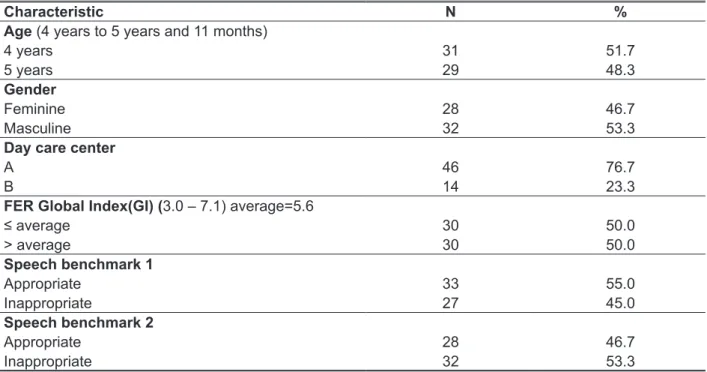
enrolled on day care center A. The characteristics of the evaluated children are presented on Table 1.
For speech evaluations, 45% and 53.3% of
the children were considered having inappro-priate speech, according to benchmarks 1 and 2, respectively.
Table 2 presents the distribution of scoresa-chieved by day care centers A and B, according to the ITERS-R scale. It was noticed that the day care centers had similar and above average overall scores, indicating a satisfactory quality level.
Table 3 shows the Communicative Proile
Performance Ratios observed in the overall sample.
It can be observed that the median in all indexes was high, with values above 80%.
old), Gender (female and male), Day care center
(A and B) and FER Global Index (≤ average and
> average), the Mann Whitney non-parametric test was applied, since data wasn’t normally distributed. Association between speech benchmark 1 and 2 and other variables was performed using Pearson’s Qui-square test. Data analysis was performed using
Minitab v.14 software with p< 0.05 signiicance.
RESULTS
The sample consisted of 60 children aged 4 to
5 years 11 months and 29 days, with the highest
proportion of children being male, the age of 4 and
Table 1 –Sample frequency distribution according to Age, Gender, Institution, FER and speech benchmark variables
Characteristic N %
Age (4 years to 5 years and 11 months)
4 years 31 51.7
5 years 29 48.3
Gender
Feminine 28 46.7
Masculine 32 53.3
Day care center
A 46 76.7
B 14 23.3
FER Global Index(GI) (3.0 – 7.1) average=5.6
≤ average 30 50.0
> average 30 50.0
Speech benchmark 1
Appropriate 33 55.0
Inappropriate 27 45.0
Speech benchmark 2
Appropriate 28 46.7
Inappropriate 32 53.3
N – number
IG –Global Index
Table 2 –Score distribution obtained by the ITERS-R scale
Subscale Day care center A Day care center B
Space and Furnishings 5 3.8
Personal Care Routines 4.1 3.8
Listening and Talking 4.3 4.3
Activities 4.2 4.2
Interaction 4.5 5.0
Program structure 3.2 3.5
Parents and Staff 3.5 5.0
General score 4.1 4.2
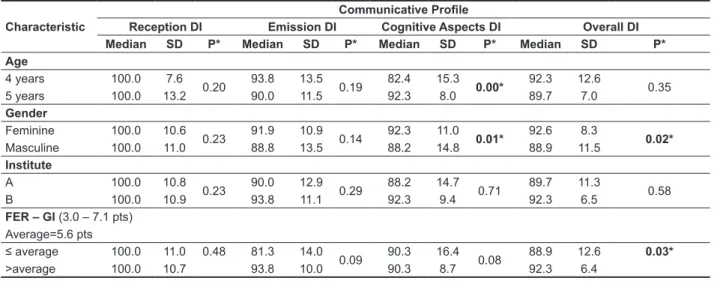
The results of the Communicative Proile
assessment according to age, gender, day care
center and FER Global Index are presented on Table
4. It can be observed that the medians reached by
the communicative proile, both in day care center A
as in day care center B, were high (between 80 and
90%). Association was also found, with statistical
signiicance, between the communicative proile
and child gender, where girls had better medians at CAPR and IDG. Regarding age, there was
statisti-cally signiicant association between CAPR and age of children, and 5-year-oldchildren had higher
medians in this aspect.
Table 3 – Results of the Communicative proile Performance Ratios regarding the general sample (n= 60 children)
Communicative proile Average S.D. Minimum Median Maximum
Performance Ratios on Reception 95.3 10.8 50.0 100.0 100.0 Performance Ratios on Emission 87.0 12.5 43.8 90.0 100.0 Performance Ratios On Cognitive Aspects 86.4 13.6 35.3 90.3 100.0 Overall Performance Ratios 88.6 10.4 43.6 91.0 100.0
centers A and B, 4 and 5 years old). There was high
occurrence of children with inappropriate speech in both day care centers assessed, according to both benchmarks.
When comparing results from speech assess-ments to the children’s characteristics, no association
showed statistical signiicance betweenbench -marks (appropriate, inappropriate) and none of the compared groups (feminine and masculine, day care
Table 4 – Distribution of the Communicative proile Performance Ratios regarding Institution, Gender, Age and Family Environment Resources Global Index
Characteristic
Communicative Proile
Reception DI Emission DI Cognitive Aspects DI Overall DI Median SD P* Median SD P* Median SD P* Median SD P* Age
4 years
5 years
100.0 100.0
7.6 13.2 0.20
93.8 90.0
13.5 11.5 0.19
82.4 92.3
15.3
8.0 0.00* 92.3 89.7
12.6
7.0 0.35
Gender Feminine Masculine
100.0 100.0
10.6 11.0 0.23
91.9 88.8
10.9
13.5 0.14
92.3 88.2
11.0 14.8 0.01*
92.6 88.9
8.3
11.5 0.02*
Institute A B
100.0 100.0
10.8 10.9 0.23
90.0 93.8
12.9 11.1 0.29
88.2 92.3
14.7 9.4 0.71
89.7 92.3
11.3
6.5 0.58
FER – GI (3.0 – 7.1 pts)
Average=5.6 pts ≤ average
>average
100.0 100.0
11.0 10.7
0.48 81.3 93.8
14.0 10.0 0.09
90.3 90.3
16.4 8.7 0.08
88.9 92.3
12.6 6.4
0.03*
*Man-Whitney test
DI – Development Index
SD – Standard deviation
IG –Global Index
Table 5 – Distribution of speech assessment results, according to benchmarks 1 and 2, regarding the variables age, gender and Family Environment Resources global index
Characteristic
Benchmark 1 Benchmark 2
Appropriate
Inappropriate P*
Appropriate
Inappropriate P*
n % n % n % n %
Age
4 years 16 51.6 15 48.4 0.585 15 48.4 16 51.6 0.782
5 years 17 58.6 12 41.4 13 44.8 16 55.2
Gender
Feminine 18 64.3 10 35.7 0.175 15 53.6 13 46.4 0.316 Masculine 15 46.9 17 53.1 13 40.6 19 59.4
Institute
A 24 52.2 22 47.8 0.422 21 45.7 25 54.3 0.775
B 9 64.3 5 35.7 7 50.0 7 50.0
FER – GI (3.0 – 7.1)
Average = 5.6 points
≤ average 15 45.4 15 55.6 0.43 13 46.4 17 53.1 0.60 > average 18 54.6 12 44.4 15 53.6 15 46.9
*Pearson’s Qui-Square test P – pvalue
We observed that girls had higher scores in all
aspects of communicative proile, with statistically signiicant difference for CAPRand IDG. This result conirms a previous study24. A Chilean study, with
children aged 3 to 5 years old, showed that boys
had lower cognitive performance7.
The present study found statistical signiicant link between the communicative proile IDG and the FER Global Index, where children that had FER indexes
below average also showed lower development in language assessment. Similar results were found in Salvador (BA, Brazil), and the study showed that the quality of instigation at the domestic environment has
inluence in child cognitive development2. Several studies have shown that the presence of materials such as toys and books and conducting activities at home are considered important for language acqui-sition and development9,13,23.
Regarding speech assessment, it was noted that a higher percentage of children were considered as having inappropriate speech according to benchmark 2. This benchmark references that children have
5 and half years to comprise a complete phonetic
inventory, while benchmark 1gives 6 years and a half as limit19,20. Similar prevalence of speech delays
(57%) was found in children aged 5 years old in a
study conducted in the city of Canoas (RS, Brazil)3. We observe that there wasa high proportion of children with inappropriate speech on both day care centers, which demonstrates high occurrence of speech inadequacy in the age group of 4 to 6 years old. Other studies, involving preschool children in the cities of Santa Maria (RS, Brazil) and Belo Horizonte (MG, Brazil) also found high prevalence of speech alterations5,25.
There isn’t consensus in literature regarding the age group and gender in which speech alterations would appearmost, some authors found higher prevalence in the male gender5 and other studies
with preschool children didn’t ind signiicant differ -ences between the gender3,25. In Belo Horizonte, a study with 297 school children also didn’t observe difference regarding gender26. In the present study
there was no statistical signiicance association
between gender and occurrence of speech inade-quacies in children.
Studies have demonstrated that phonological
acquisition happens with constant exchanges with the environment or context in which the child
lives and for his or hers interactions with the adult. Therefore, environments that are not particu-larly constructive and stimulating may negatively interfere speech3,8 and language27-30 development.
Nevertheless, no statistically signiicant association
was found between speech development and FER
Global Index.
DISCUSSION
There was a higher proportion of children from
the day care center A in the sample (76.7%), arising
from the higher number of children enrolled in this day care center. Regarding the total sample, it was also observed a higher number of 4-year-old male
children, as the difference is small (6.6% for gender and 3.4% for age), it did not skew the sample.
Giving the characterization of the day care centers, it was shown that both day care centers A and B reached above average scores, indicating a satisfactory quality level, according to the used instrument’s proposal. A study conducted in institu-tions placed in the same regions of Belo Horizonte (MG, Brazil) where this study was performed showed similar results regarding day care center character-ization15. Research performed in other regions of Brazil (Northeast and North), using the same scale, show that part of the publicday care centers in these localities show scores below the recommendation by the authors of the scale12,22.
Regarding language evaluation, it was observed
that the average of the communicative proile
Performance Ratioswas high and similar in day care centers A and B, which indicates that in both day care centers, the children assessed have an appropriate language development and the children in both day
care centers have similar communication proiles.
A study done in Belo Horizonte with children aged between 2 and 6 years old of a publicday care center used the same instrument to assess language and
also veriied that children of this age group received
high averages in all assessed aspects18. However, it is important to highlight that the referred study has a different scope to the present study and deals
with proile comparison of anemic and non-anemic
children. Therefore, comparison of data is limited and resides only within the coincidence of study scenarios (day care center), region studied (State of Minas Gerais) and part of the studied age group.
Several studies indicate the importance of children in preschool age attending educational insti-tutions, as in these environments there are stimuli that contribute towards language development7-9. In the present study, both day care centers assessed
presented satisfactory quality level, conirming other investigations that demonstrated the inluence of
such environment on child development12,21.
Of the evaluated children, 5-year-olds had better
development of cognitive aspects of language. A study where the development of preschool childrenwas evaluated, in the city of Cuiabá(MT,
Brazil), also showed that 5-year-olds had higher
larger samples are necessary, where risk factors for the development of language and speech are inves-tigated, and that contribute to the development of actions that promote child health in school settings.
CONCLUSION
Results of the present study have shown the occurrence of inappropriate speech in children within the institutes, however not revealing
statisti-cally signiicant associations between performance
in speech assessment and the variables gender, institute of origin and age group. It was also found
that there was statistically signiicant association between communicative proile and the gender
variable, where girls had better averages. Regarding
age, there was statistically signiicant association
between the Performance Ratios for language
cognitive aspects and age, where 5-year-olds had
higher scores. It is also worth noticing that there was association between family and school environment resources.
National28,29,31,32 and international33 studies demonstrated the importance of family environment in child development. In this measure it is essential to consider economical, cultural and educational aspects of the family. The literature also indicates that the association between positive family and school environments are associated with better developmental levels in childhood and adolescence. Furthermore, literature indicates the importance of school34,35 in the formation of the subject and the construction of citizenship.
The present study showed that the quality of
the family environment signiicantly inluences
language development. This environment should be rich in stimulating resources30 for language devel-opment, especially in preschool phase, where the child acquires important knowledge and capacities for school, social and emotional development.
The number of children with speech inadequacies
found is worrying, because these dificulties, if
maintained, may interfere with communication and other areas of development. Further studies with
RESUMO
Objetivo: caracterizar o desenvolvimento de fala e linguagem de crianças entre 4 e 6 anos de duas creches públicas e discutir interrelações com recursos ambientais. Métodos: foram consideradas
60 crianças de ambos os sexos. A linguagem foi avaliada utilizando um Roteiro de observação do
comportamento de crianças de 0 a 6 anos, com a classiicação de Índices de Desempenho. A ava
-liação da fala foi realizada com um Álbum fonêmico e categorizada como Adequada ou Inadequada.
Caracterizou-se o ambiente familiar por meio de um Inventário de Recursos do Ambiente Familiar
(RAF) e para observação do ambiente da instituição foi utilizada a escala Infant and Toddlers
Environment Rating Scale-Revised. Os resultados consideraram como variáveis dependentes os
Índices de Desempenho do Peril comunicativo e os dados de avaliação de fala; e as variáveis inde
-pendentes, Idade, Sexo, Creche e Índice Global do RAF. Foi adotado nível de signiicância p<0,05.
Resultados: a qualidade do ambiente das creches foi considerada satisfatória e o desempenho no
peril comunicativo foi alto em ambas. Houve associação com signiicância estatística entre peril comunicativo, o sexo e a idade, sendo que as meninas e as crianças de 5 anos obtiveram maiores médias. Observou-se associação signiicante entre o Índice geral do peril comunicativo e o Índice
Global do RAF. Conclusão: na amostra estudada veriicou-se associação entre ambiente familiar e
desenvolvimento de fala. Houve grande ocorrência de inadequações de fala nas duas creches. São
necessários outros estudos que investiguem fatores de risco para o desenvolvimento de linguagem e fala e possam contribuir com ações promotoras da saúde infantil.
13. Ferreira MCT, Marturano EM. Recursos
da criança, da família e da escola predizem competência na transição da 1ª série. R. Interam. Psicol. 2008; 42(3):549-58.
14. Andrada EGC, Rezena BS, Carvalho GB, Benetti
IC. Fatores de risco e proteção para a prontidão escolar. Psicol. cienc. prof. 2008;28(3):536-47. 15. Dourado JSl Carvalho, SAS, Lemos,SMA
Comunicação e recursos ambientais: análise na faixa etária de 1 a 3 anos. In: Anais do 17º
Congresso Brasileiro de Fonoaudiologia, 21- 24
de outubro; Salvador: Bahia. 2009. Disponível em
http://www.sbfa.org.br/portal/anais2009/
16. Maturano EM. O inventário de recursos
do ambiente familiar. Psicol. Relex. Crit. 2006;19(3):498-506.
17. Chiari BM, Basilio CS, Nakagawa EA, Cormedi MA, Silva NSM, Cardoso RM et
al. Proposta de sistematização de dados da avaliação fonoaudiológica através da observação
de comportamentos de crianças de 0 a 6 anos.
Pró-Fono R. Atual. Cient. 1991;3(2):255-60.
18. Santos JN, Lemos SMA, Rates SPM, Lamounier JA. Anemia em crianças de uma creche pública e as repercussões sobre o desenvolvimento de linguagem. Rev Paul Pediatr. 2009;27(1):67-73. 19. Wertzner HF, Shewer I, Bei-Lopes DM.
Desenvolvimento da linguagem: uma introdução. In: Fonoaudiologia Informação para Formação,
Linguagem: desenvolvimento normal, alterações e distúrbios. Limongi SCO (org.). Rio de Janeiro:
Guanabara Koogan, 2003. p 11-5.
20. Mourão LF, Parlato EM, Silvério KCA, Altmann
EBC, Chiari BM. Descrição da ocorrência dos fonemas da língua portuguesa em pré-escolares.
Pró-Fono R. Atual. Cient. 1994;6(1):27-32.
21. Campos MM, Esposito YL, Bhering E, Gimenes
N, Abuchaim B. A qualidade da educação infantil:
um estudo em seis capitais Brasileiras. Cad. Pesqui.
2011;41(142):20-54.
22. Barros RP, Carvalho M, Franco S, Mendonça R,
Rosalém A. Uma avaliação do impacto da qualidade
da creche no desenvolvimento infantil. Pesq. Planej. Econ.(PPE). [on line] 2011;[citado 2012 Dez 01]
41(2):213-32. Disponível em: http://www.sae.gov.br/
primeirainfancia/Artigo_PPE.pdf
23. Souza SC, Leone C, Takano OA, Moratelli HB.
Desenvolvimento de pré-escolares na educação
infantil em Cuiabá, Mato Grosso, Brasil. Cad Saúde Pública. 2008;24(8):1917-26.
24. Santos JN, Lemos SMA, Vieira T, Lamounier JA.
Fatores favoráveis à recuperação do quadro clínico de crianças anêmicas: um estudo exploratório Rev.
CEFAC. 2011;13(4):617-27.
25. Vitor RM, Martins CC, Desenvolvimento fonológico de crianças pré-escolares da
REFERENCES
1. Nobre FDA, Carvalho AEV, Martinez FE, Linhares MBM. Estudo longitudinal do desenvolvimento de crianças nascidas pré-termo no primeiro ano
pós-natal. Psicol. Relex. Crit. 2009;22(3):362-9.
2. Andrade AS, Darcy NS, Bastos AC, Pedromônico MRM, Filho NA, Barreto ML. Ambiente familiar e desenvolvimento cognitivo infantil; uma abordagem epidemiológica. Rev. Saúde Pública.
2005;39(4):606-11.
3. Chiari BM, Goulart BNG. Prevalência de desordens de fala em escolares e fatores associados. Rev.
Saúde Pública. 2007;41(5):726-31.
4. Cavalheiro LG, Keske-Soares M. Prevalência do desvio fonológico em crianças de 4 a 6 anos de idade. Pró-Fono R. Atual. Cient. 2008; 20(supl.):11-3.
5. Casarim MT. Estudo dos desvios de fala em pré-escolares de escolas públicas estaduais de
Santa Maria – RS. [Dissertação] Santa Maria (RS): Programa de pós-graduação em Distúrbios da Comunicação Humana, Universidade Federal de
Santa Maria; 2006.
6. Prates LPCS, Martins VO. Distúrbios da fala e
da linguagem na infância. Rev. Med Minas Gerais. 2011;21(S3):S54-S60.
7. Schonhaut LG, Maggiolo ML, Herrera MG,
Acevedo KG, García ME. Lenguaje e inteligencia
de preescolares: Análisis de su relación y factores asociados. Rev Chil Pediatr. 2008;79(6):600-6. 8. Mendes JCP, Pandoli MM, Carabetta JV, NNF,
Colombo-Souza P. Fatores associados a alteração
da linguagem em crianças pré-escolares. Rev. soc. bras. fonoaudiol. [on line]. 2012 [citado 2012
Dez 01];17(2):177-81. Disponível em: http://www. scielo.br/scielo.php?script=sci_arttext&pid=S1516-80342012000200013&lng=en. http://dx.doi. org/10.1590/S1516- 80342012000200013.
9. Santos LM, Santos DN, Santos ACS, Assis AMO, Prado MS, Barreto ML. Determinantes do
desenvolvimento cognitivo na primeira infância:
análise hierarquizada de um estudo longitudinal. Cad. Saúde Pública. 2008; 24(2):427-37.
10. Teixeira JBM. Estudo exploratório de dois
instrumentos para a avaliação do desenvolvimento
da linguagem de crianças entre 3 e 6 anos.
[Dissertação]. Itajaí (SC): Universidade do Vale do Itajaí, Programa de Mestrado Acadêmico em Educação – PMAE; 2006.
11. Biscegli TS, Polis LB, Santos LM, Vicentin M.
Avaliação do estado nutricional e do desenvolvimento
neuropsicomotor em crianças frequentadoras de
creche. Rev. Paul Pediatr. 2007;25(4):337-42.
12. Carvalho AM, Pereira AS, Qualidade em
ambientes de um programa de educação infantil
[citado 2012 Set 13]; 14(4):691-6. Disponível em:
http://www.scielo.br/pdf/rcefac/v14n4/197-10.pdf 31. Araújo MAN, Gama FS, Silva U. Creche de ontem
e de hoje: o que os pais esperam dessa instituição?
Revista Psicologia, Diversidade e Saúde [on line].
2013 [citado 2013 maio 15];1(1):3-20. Disponível
em: http://www.bahiana.edu.br/revistas
32. Souza, RCF.Discurso dos educadores frente às
manifestações emocionais de crianças da educação
infantil .Revista Electrónica de Investigación y Docencia (REID) [on line] 2013 [citado 2013 maio
15];9(1):23-37. Disponível em: http://www.ujaen.es/
revista/reid/revista/n9/REID9art2.pdf
33. Barros S, Cruz, O. Participação das mães na
creche e no jardim de infância em portugal. Revista AMAzônica [on line] 2012 [citado 2013 maio 15] ;8(1):8-32. Disponível em: http://dialnet.unirioja.es/
servlet/articulo?codigo=4046090
34. Longarezi, AM,Franco, PLJ. Educação escolar
enquanto unidade signiicado social/sentido pessoal. Nuances: estudos sobre Educação [on line] 2013 [citado 2013 maio 15];25(1):91-108. Disponível em http://revista.fct.unesp.br/index.php/ Nuances/article/view/2157/longarezi
35. Lucisano RV, Pfeifer LI, Pinto, MPP,Santos JLF,. Interações sociais de crianças pré-escolares
com Síndrome de Down durante atividades extracurriculares. Rev Bras Enferm. [citado 2013 maio 15] 2013;66(1):116-22. Disponível em http://
www.scielo.br/pdf/reben/v66n1/v66n1a18.pdf
Região Noroeste de Belo Horizonte. Psicol. R.
2007;13(2):383-98.
26. Rabelo AT, Alves CRL, Goulart, LMH, Friche AA, Lemos SMA, Campos, FR. Alterações de fala em escolares na cidade de Belo Horizonte. J. Soc.
Bras. Fonoaudiol. 2011;23(4):344-5.
27. Filho FL, Medeiros SM, Lamy ZC, Moreira MEL. Ambiente domiciliar e alterações do desenvolvimento em crianças de comunidade da
periferia de São Luís – MA. Ciênc. saúde coletiva.
2011;16(10):4181-7.
28. Scopel RR, Souza VC, Lemos SMA. A inluência
do ambiente familiar e escolar na aquisição e no desenvolvimento da linguagem: revisão de
literatura. Rev. CEFAC. [on line]. 2012 [citado 2013
Mar 01];14(4):732-41. Disponível em: http://www. scielo.br/scielo.php?script=sci_pdf&pid=S1516-18462012000400018&lng=en&nrm=iso&tl
ng=pt
29. Escarce AG, Camargos TV, Souza VC,
Mourão MP, Lemos SMA. Escolaridade materna e
desenvolvimento da linguagem em crianças de 2 meses à 2 anos. Rev. CEFAC [on line]. 2012 [citado
2013 Mar 01] 14(6):1139-45. Disponível em: http://
www.scielo.br/pdf/rcefac/v14n6/43-11.pdf
30. Goulart BNG, Chiari BM. Comunicação humana
e saúde da criança: relexão sobre promoção da saúde na infância e prevenção de distúrbios
fonoaudiológicos. Rev. CEFAC [on line]. 2012 Ago
Received on: January 02, 2013 Accepted on: May 28, 2013
Mailing address:
Stela Maris Aguiar Lemos
Faculdade de Medicina da Universidade Federal de Minas Gerais – Departamento de Fonoaudiologia
Av. Prof. Alfredo Balena, 190, sala 251
Belo Horizonte – MG – Brasil CEP: 30130-100