(1) Faculdade de Filosoia e Ciências da Universidade Estadual Paulista - FFC/ UNESP/Marília – SP, Brasil. (2) Laboratório de Investigação dos
Desvios da Aprendizagem – LIDA do Departamento de Fonoaudiologia da Faculdade de Filosoia e Ciências da Universidade Estadual Paulista - FFC/ UNESP/Marília – SP, Brasil. (3) Departamento de Fonoaudiologia
e Programa de Pós-Graduação em Educação da Faculdade de Filosoia e Ciências da Universidade Estadual Paulista – FFC/UNESP-Marília-SP, Brasil. Aid Source: Foundation for Research Support of São Paulo State - FAPESP (Scientiic Initiation scholarship) process n° 06 / 60016-4
Conlict of interest: non-existent
Students’ performance in letter identification and lexical
process tests
Desempenho de escolares em provas de processo de identificação de
letras e do processo léxico
Adriana Marques de Oliveira(1)
Giseli Donadon Germano(2)
Simone Aparecida Capellini(3)
Received on: December 30, 2015 Accepted on: July 11, 2016
Mailing address: Adriana Marques de Oliveira Av. Hygino Muzzi Filho, 737 Marília, SP
CEP: 17525-000
E-mail: [email protected]
ABSTRACT
Purpose: to describe, compare and correlate the performance of Brazilian students from 2nd to 5th grade of Elementary Schools in public and private institutions for tests of letter identiication and lexical process evaluation.
Methods: 262 students attending Elementary Schools (122 from public school and 140 from private school), in the interior of São Paulo State: Public School – G1 (2nd grade, n=24); G2 (3rd grade, n=33); G3 (4th grade, n=31); G4 (5th grade, n=34) and Private School – G5 (2nd grade, n=37); G6 (3rd grade, n=34); G7 (4th grade, n=34); G8 (5th grade, n=35. Tests of Letter Identiication and the Lexical process from PROLEC were applied.
Results: the students from private school showed superior average performance, except for the same--different test between G1-G5 and G3-G7 groups. The differences were higher among the students up to de 4th grade, due to the frequent use of the phonological route. This suggests differences in teaching the Portuguese alphabetic principles in in private and public schools. For the 5th grade there was no evidence of difference for tests in which words could be read by the lexical route.
Conclusion: the students from private school showed superior performance, except for the tests in which the phonological route was not entirely required. However, in the beginning of literacy, the pho-nological route was more used than the lexical route, regardless of the type of school. This study shows the education system necessity for prioritizing in early literacy the letter-sound relationship, so the stu-dents from public institutions can present better decoding results, which can directly impact reading and comprehension.
Keywords: Reading; Evaluation; Learning; Education, Primary and Secondary
RESUMO
Objetivo: caracterizar, comparar e correlacionar o desempenho de escolares brasileiros do 2º ao 5º ano do Ensino Fundamental do ensino público e particular em provas de avaliação do processo de identiica-ção de letras e do processo léxico.
Métodos: participaram 262 escolares do Ensino Fundamental (público= 122, particular= 140), do inte-rior paulista: Ensino público - G1 (2º ano, n=24); G2 (3º ano, n=33); G3 (4º ano, n= 31); G4 (5º ano, n=34) e Ensino particular - G5 (2º ano, n=37); G6 (3º ano, n=34); G7 (4º ano, n=34); G8 (5º ano, n=35). Aplicadas Provas do processo de Identiicação de Letras e Léxico do PROLEC.
Resultados: os escolares do ensino particular apresentaram desempenho médio superior, com exceção da prova Igual-Diferente entre os grupos G1-G5 e G3-G7. As diferenças foram maiores entre os escolares até o 4º ano devido ao uso frequente da rota fonológica, sugerindo diferença no ensino do princípio alfa-bético entre as escolas públicas e particulares. Para o 5º ano, não houve diferença nas provas em que as palavras podem ser lidas pela rota lexical.
Conclusão: os escolares do ensino particular apresentaram desempenho superior, com exceção das provas em que a rota fonológica não é a unicamente exigida. Contudo, no início da alfabetização, a rota fonológica foi mais utilizada do que a lexical, independente do tipo de ensino. Este estudo mostra a neces-sidade de o sistema de ensino priorizar na alfabetização a relação letra-som, de modo que os escolares de escola pública possam apresentar melhores resultados em decodiicação que podem inluenciar dire-tamente a compreensão e leitura.
1122 | Oliveira AM, Germano GD, Capellini SA
INTRODUCTION
Reading is composed by components for decoding and understanding. Decoding refers to written words recognition processes, while understanding is deined as the process, in which, words, sentences or texts are interpreted1. Learning how to read is a complex process
and requires from scholars the use of phonological, syntactic and semantic components of the language. Understanding the relationship between letters and speech sounds is essential within the alphabetic system. This relationship is known as graphophonemic correspondence, in which each letter corresponds to a grapheme that is represented by a phoneme2-7.
However, in Portuguese language, there are situa-tions in which the same grapheme may correspond to different phonemes, generating dificulties during the reading process2-7. For example, the letter “s” is
represented by the grapheme [s] and the phoneme / s / in the word “sapo”. The word “asa” in turn, although it is represented by the same grapheme, present in the word sapo [s], it is represented by the phoneme /z/. This is due to the orthographic transparency and opacity which feature the alphabetical basis of the Brazilian Portuguese writing system, becoming more transparent towards decoding and more opaque towards coding. Nevertheless, Brazilian Portuguese contains more transparent conformation than other latin languages, such as Spanish and Italian. Orthographic transparency is characterized by the regularity in which a phoneme corresponds to a single grapheme, while orthographic opacity is characterized by the irregu-larity, with graphemes corresponding to more than one phoneme, and phonemes corresponding to several graphemes 3,8-11.
The phonological mediation process, also known as phonological route and the direct visual process (lexical route) make up the dual route process12, widely
described in literature to explain words recognition. Reading via the phonological route is performed by the grapheme and phoneme conversion mechanism to make the word pronunciation, creating a phonological code that will be identiied by the auditory recognition of words system, accessing its meaning. Reading via phonological starts with the identiication and location of the letters in the visual analysis system, which analyzes the graphic symbols written on the page, obtained through the sensory receptors (the eyes), thus constituting the skills to understand, organize and interpret visual stimuli. From this, a set of letters is
formed, which is translated by the grapheme-phoneme conversion process into sequences of phonemes13-17.
Decoding is, therefore, the ability related to graphic symbols recognition, represented by letters and words, having great interference inluence on the reading comprehension process. From the analysis of what has been decoded, it becomes possible for the student to access the meaning and form the orthographic repre-sentation (reprerepre-sentation of the grapheme sequence of an expression of speech and its organization into larger units) of a new word. It is the decoding ability will allow the student, subsequently, read via the lexical route, i.e., perform a meaninful reading1,18-25.
In order to perform the lexical route when reading, it becomes necessary for the reader to know the word to be read, so that it can be visually recognized, having its meaning and pronunciation retrieved 3,13,16,24-28.
The visual lexicon, also denominated as orthographic
input lexicon, is responsible for the visual recognition of words. That is a set of mental representations of the words from the language, in which written words are represented. From this, it becomes possible to have a representation for each words we are able to recognize visually25. In this case, the reader, before a written word,
is able to identify the letters which compose it (visual analysis system), and converts the received information into a letter code. This code is sent to the input visual lexicon in order to activate the corresponding visual recognition unit, resulting into word identiication, which in turn activates its meaning, stored in the semantic system, responsible for activating the speech production unit, stored in the output phonemic lexicon (set of mental representations of the phonological form)13.
Thus, words of different levels of alphabetic regularity can be read without any problems. Reading via lexical route beneits from the frequency of words occurrence in the language, since the higher the frequency, the greater its lexical representation (mental representation of words without specifying the supericial or abstract form or of its content) and easiest the retrieval from the lexicon. When reading, the word recognition process requires fast processing 23-29.
requirement means learning how to use the grapheme-phoneme conversion rules 24-26.
For evaluation of the phonological and lexical routes performance, words and isolated pseudo words are read aloud in this task, so it becomes possible to assess which route is most used by the reader12,24,25,30,31.
This task is recognized in several alphabetic languages as an effective method for reading assessment, being widely studied for its importance in the early learning process13-15,32.
Among the tools available for reading assessment, the PROLEC24 - Reading Process Assessment Tests,
was adapted to the Brazilian reality in order to provide an assessment tool based on criteria and reading development standards. Through this instrument, it is possible to evaluate the different processes and sub-processes that interfere with reading, from letters identiication process to the semantic process. In Letters identiication process there are tests which evaluate the identiication of letters and sounds isolated and words. In the lexicon process, there are lists of real words of different syllabic complexity, frequency and extention and pseudowords of different syllabic complexity, respecting the regular syllabic patterns used for the assessment of phonological and lexical routes, evaluating the recognition of words and their decoding. The syntactical process evaluates the ability to process different types of grammatical structures and the use of punctuation marks. Finally, the semantic process is evaluated, which identiies the meaning extraction process and the integration processes in memory and drawing inferences.
Given the importance of the process of identifying letters and words recognition (lexical process), this study aims to answer the following question: Is there any difference in the performance of Brazilian students from public and private Elementary Schools in tests concerning evaluation of letters identiication process and lexicon process?.
This study aims to characterize, compare and correlate the performance of students from the 2nd to
5th grades of public and private Elementary Schools
performing texts concerning evaluation of letters identi-ication process and lexicon process.
METHODS
Cross-sectional study comprising a random sample, approved by the Ethics Research Committee of the Faculty of Philosophy and Sciences, Universidade
Estadual Paulista “Júlio de Mesquita Filho” - FFC / UNESP / Marilia / SP / Brazil, Protocol no. 3240 / 2006.
Participants
A total of 262 students from Elementary School, Cycle I, 122 from municipal public school and 140 from private school, of a town in the interior of São Paulo state. The students were divided into the following groups:
• Group 1 (G1) - 24 students from the 2nd grade of
Municipal Public Education.
• Group 2 (G2) - 33 students from the 3rd grade of
Municipal Public Education.
• Group 3 (G3) - 31 students from the 4th grade of
Municipal Public Education.
• Group 4 (G4) - 34 students from the 5th grade of
Municipal Public Education.
• Group 5 (G5) - 37 students from the 2nd grade of
Private Education.
• Group 6 (G5) - 34 students from the 3rd grade of
Private Education.
• Group 7 (G5) - 34 students from the 4th grade of
Private Education.
• Group 8 (G5) - 35 students from the 5th grade of
Private Education.
As inclusion criteria, the following aspects were adopted: 1) signature of the Informed Consent by parents or guardians; 2) absence of impaired eyesight and hearing; 3) absence of learning complaint; 4) absence of failure history; 5) absence of intelectual depreciation. And as exclusion criteria: 1) students refusal to participate, although parents or guardians have signed the consent form; 2) students with inter-disciplinary diagnosis of learning disorder, dyslexia disorder and attention deicit hyperactivity disorder; 4) genetic or neurological syndromes diagnoses; 5) alteration of language or speech.
These data were registered in the school form and informed by the teachers of the students. Some students were excluded after collection, due to obser-vation of language and speech alteration during the tests or after students reported being attending speech therapy.
Instruments
Evaluation tests of reading processes - PROLEC24. The tests were given individually in a
them, according to the dual route reading model, that is, to measure the ability of the orthographic represen-tation. Words and pseudo words were presented to the students, and they shouldl indicate whether the words were real or invented, in 30 displayed items. The score ranges from 0 to 30.
4. Reading Words (RW): In this test, the students had to read aloud a list of 30 words, formed by syllables of different complexities, ive of each comprised the following structures: CCV, VC, CVC, CVV, CCVC and CVVC, aiming to measure the ability of the student to read real words. The student was asked to perform reading aloud and the evaluator wrote down, on the answer sheet; 1 for correct answers, 0 for incorrect, totalizing up to 30 points.
5. Reading Pseudowords: Along with test 4, Reading words, this test aims to compare the development of word recognition routes. The task consists of reading a list of 30 pseudowords formed by syllables of different complexity, as presented in test n° four. The score ranges from 0 to 30.
6. Reading words and pseudo words: This test also aims to analyze the degree of development the student has reached with the reading routes. For this, words and merged pseudo words, belonging to six categories are employed: frequent short words, frequent long words, non-frequent short words, non-frequent long words, short and long pseudowords. The list comprises a total of 60 stimuli, belonging to three categories: 20 high-frequency words, 20 low-frequency words and 20 pseudowords. In the three cases, half of the stimuli have short extension (monosyllables and disyllables) and the other half have long extension (trisyllables and polysyllables). The score ranges from 0 to 60 on the total sum; and from 0 to 20 for high frequency, low frequency and pseudowords.
Notes of the answers were written down on the answers notebook, as follows: if the answer given by the studentl was correct, a circle was made around number 1; if the answer was incorrect, a circle was made around number 0 and, in case of error, the answer given by the student was written in the space correspondent to the item. So it was awarded one point for each correct answer; decimal scores were not allowed.
Data analysis
To obtain the results, statistical analysis was performed using SPSS (Statistical Package for Social Sciences), version 13.0, based on the amount of schools, opposite to the period of school class, lasting
20 minutes, on average. According to orientation on the procedure, the tests were applied following the sequence of dificulty. The students were evaluated by the same researcher, following the sequence order. Reading processes Evaluation tests – PROLEC applied, are described below:
- 1st Process: Identiication of letters. Composed of
two tests to assess the ability of the students to identify the letters and their sounds.
1. Name or sound of the letters: aims to verify the ability of the student to name the letters and the sound that they represent. On a sheet of paper, isolated letters are shown, not following the alphabetical order, so that the student may name them or pronouce their corre-sponding sounds.
In this test, the name and the sound of the letter were evaluated separately. Firstly, the student was asked to name the letters and then say which sound corresponded to each letter. The evaluator wrote down on the answer sheet of the instrument; 0 for incorrect answer, and 1 for correct answer; however, as the name of letters and identiication of sound were performed separately, the name of the letters was written down on the answer sheet, and the answers for identiication of sounds, in the back of the sheet. There are 20 letters in total, so the score for this task ranges from 0 to 20.
2. Equal and Different in words and pseudo words: aims to prove whether the student is able to segment the words with their respective letters, using pairs of stimuli that differ in one letter. In half of the cases, these stimuli of the pairs of elements are equal; and on the other half, they differ only in one letter. In such cases, half of the stimuli are words, and the other half are not words or pseudowords.
Pairs of words or equal pseudowords (eg, city - city) or with a different letter (e.g. barrel - barel), so that the student should indicate whether they are equal or different. There are 20 pairs of stimuli and the score ranges from 0 to 20.
- 2nd. Process: Lexicon Process. In this block, lists
are included with isolated words, belonging to different categories, in order to check the performance of the words recognition routes and their sub-processes, i.e., the objective is to evaluate the ability to recognize words.
Mann-Whitney Test was used to compare the groups, aiming to verify possible differences between the performances of the students from municipal public schools and private schools.
RESULTS
Tables 1 and 2 show the employment of
Mann-Whitney Test aiming to verify possible differences between the performances of students from the 2nd
grade and 3rd grade of Elementary schools, public and private, respectively.
correct answers in each test presented by GI and GII. Signiicance level (α) of 5% (0.050) for statistical tests was employed.
Data descriptive analysis, to obtain mean, median, percentile 25 and 75, minimum and maximum values
and standard deviation, was realized. In order to check the matching level between the tests, the Spearman correlation analysis was employed. To classify the degree of association, criteria of Zou et al.33 were
employed.
Table 1. Description and comparison of the performance of students from the 2nd grade of Municipal Public and Private Education, on
tests of sound and letter identiication processes and léxicon
Variable Group n Mean Percentile
25 Median
Percentile 75
Standard
deviation Minimum Maximum P value
Som 15 24 1,3337 11,49 06 120 170 6,302,22 02 206 0,000*
Letra 15 24 19,2537 19,86 1920 19,520 2020 0,350,90 1719 2020 0,001*
ID 15 24 19,0037 19,19 19,1919 1919 2020 1,791,25 1510 2020 0,161
DL 1 24 27,08 25 29 29 3,06 19 30 0,001*
5 37 29,05 29 30 30 1,93 19 30
LP 15 24 27,4637 29,08 2730 2930 3030 2,383,49 1619 3030 0,003*
LPP prov5 15 24 26,2937 28,65 2628 2830 2930 2,713,78 1516 3030 0,000*
LP_AF 15 24 18,5437 19,92 1820 1920 2020 0,362,36 189 2020 0,000*
LP_BF 15 24 17,7937 19,08 16,7519 1820 1920 1,721,84 1413 2020 0,001*
LPP 15 24 17,2137 18,51 1718 17,519 1920 1,892,62 128 2020 0,006*
Mann-Whitney test (α) of 5% (0.050)
Legend: * statistically signiicant, ED: same-different, LD: lexical decision, RW: reading words (test 4), RPW: reading pseudowords (test 5), RW_HF: reading common words, RW_NF: reading non-frequent words, RPW: Reading pseudowords.
In Table 1, there is evidence of difference in all the tests evaluated, with exception of test Equal Different - ED (p = 0.161), that is, there is evidence that the groups present diferences on the evaluated tests,
Table 2. Description and comparison of the performance of students from the 3rd grade of Municipal Public and Private Education, on
tests of sound and letter identiication processes and léxicon
Variable Group n Mean Percentile
25 Median
Percentile 75
Standard
deviation Minimum Maximum P value
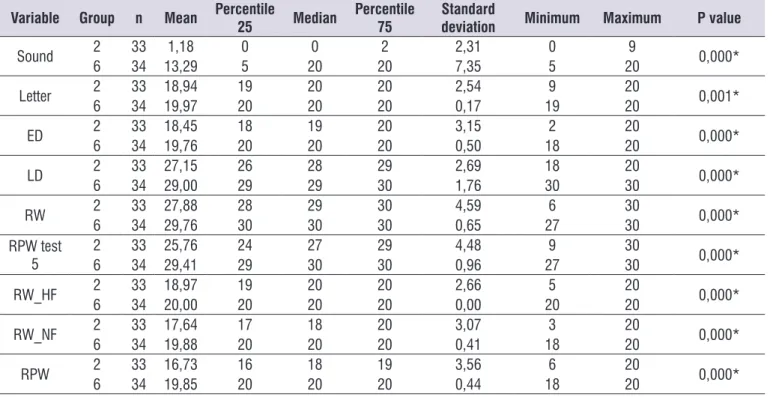
Sound 26 3334 13,291,18 05 200 202 7,352,31 05 209 0,000*
Letter 26 3334 19,9718,94 1920 2020 2020 0,172,54 199 2020 0,001*
ED 26 3334 19,7618,45 1820 1920 2020 0,503,15 182 2020 0,000*
LD 2 33 27,15 26 28 29 2,69 18 20 0,000*
6 34 29,00 29 29 30 1,76 30 30
RW 26 3334 29,7627,88 2830 2930 3030 0,654,59 276 3030 0,000*
RPW test
5 26 3334 29,4125,76 2429 2730 2930 0,964,48 279 3030 0,000*
RW_HF 26 3334 20,0018,97 1920 2020 2020 0,002,66 205 2020 0,000*
RW_NF 26 3334 19,8817,64 1720 1820 2020 0,413,07 183 2020 0,000*
RPW 26 3334 19,8516,73 1620 1820 1920 0,443,56 186 2020 0,000*
Mann-Whitney test (α) of 5% (0.050)
Legend: * statistically signiicant, ED: same-different, LD: lexical decision, RW: reading words (test 4), RPW: reading pseudowords (test 5), RW_HF: reading common words, RW_NF: reading non-frequent words, RPW: Reading pseudowords.
In Table 2, from the statistical test applied, there is evidence of difference between the groups (G2 and G6), that is, the groups differ in the tests evaluated. Through the average score in the applied tests, higher performance of private school students (G6) was observed, in relation to public education students (G2). Observing the standard deviation, G2 students show great variability for responses in relation to G6; this suggests inaccuracy for G2 responses. Except for sound identiication, in which the inaccuracy was higher for G6 students.
Tables 3 and 4 show the application of Mann-Whitney Test, in order to verify possible differences between the performances of students from 4th grade and 5th grades
of elementary schools, respectively.
Evidence of difference is observed between the students of the 4th grade (G3 and G7), ie, the groups differ in the tests evaluated, with exception of ED test – equal- different (Table 3). Through the average score in the applied tests, it was observed higher perfor-mance of private schools students (G7) in relation to public education students (G3), but for the ID test, this difference was not observed. When observing the standard deviation, G3 school show great variability in
the responses, in relation to G7; this suggests impre-cision in G3 responses. However, except for sound identiication, inaccuracy was highest in G7.
Table 4 shows evidence of difference in sound identiication (p =0.000), lexical decision (p = 0.000), reading words (p = 0.000), reading pseudowords (test 5) (p=0.000), reading non-frequent words (p=0.009) and reading pseudowords (p= 0.001), ie, there is evidence that groups G4 and G8 differ in the referred tests. By average score on tests, with evidence of differences between the groups, students from private schools (G8) present superior performance, in relation to public education students (G4). When observing the standard deviation, students from private schools maintain the heterogeneity standard for answers on identiication sound test, but in the other tests, G4 students present imprecision in their answers.
Table 5 presents the employment of the Spearman correlation analysis to check the degree of relationship between the tests, name and sound of the letters of the letter identiication process, and reading tests of words and pseudowords of the lexicon process, of students from the 2nd to 5th grades of public and private
Table 3. Description and comparison of the performance of students from the 4th grade of Municipal Public and Private Education, on
tests of sound and letter identiication processes and lexicon
Variable Group n Mean Percentile
25 Median
Percentile 75
Standard
deviation Minimum Maximum P value
Sound 37 3134 14,940,23 5,50 19,50 200 6,700,72 05 203 0,000*
Letter 37 3134 20,0019,84 2020 2020 2020 0,000,37 1920 2020 0,016*
ED 37 3134 19,8219,55 1920 2020 2020 0,390,68 1819 2020 0,078
LD 3 31 27,39 27 27 29 2,58 19 30 0,000*
7 34 29,91 30 30 30 0,38 28 30
RW 37 3134 29,8829,29 2930 3030 3030 0,411,40 2428 3030 0,016*
RPW test
5 37 3134 29,7927,65 2730 2930 2930 0,882,42 2125 3030 0,000*
RW_HF 37 3134 20,0019,81 2020 2020 2020 0,000,48 1820 2020 0,016*
RW_NF 37 3134 19,9418,55 1720 1920 2020 0,341,52 1518 2020 0,000*
RPW 37 3134 19,9418,16 1820 1920 1920 0,242,00 1019 2020 0,000*
Mann-Whitney test (α) of 5% (0.050)
Legend: * statistically signiicant, ED: same-different, LD: lexical decision, RW: reading words (test 4), RPW: reading pseudowords (test 5), RW_HF: reading common words, RW_NF: reading non-frequent words, RPW: Reading pseudowords.
Table 4. Description and comparison of the performance of students from the 5th grade of Municipal Public and Private Education, on tests of sound and letter identiication processes and léxicon
Variable Group n Mean Percentile
25 Median
Percentile 75
Standard
deviation Minimum Maximum P value
Sound 48 34 1,2935 16,60 15,50 200 200 4,973,29 05 2015 0,000*
Letter 48 34 19,9435 20,00 2020 2020 2020 0,000,24 1920 2020 0,148
ED 48 34 19,3835 19,23 1919 2020 2020 1,481,48 1213 2020 0,603
LD 4 34 28,06 27 28 30 1,72 24 30 0,000*
8 35 29,63 29 30 30 0,65 28 30
RW 48 34 29,2635 29,94 2930 3030 3030 0,341,05 2628 3030 0,000*
RPW test
5 48 34 27,1835 29,57 29,5726 2828 2929 0,852,47 2020 3030 0,000*
RW_HF 48 34 19,8235 19,97 2020 2020 2020 0,170,63 1719 2020 0,279
RW_NF 48 34 18,8835 19,63 19,518 1920 2020 0,811,41 1516 2020 0,009*
RPW 48 34 18,7635 19,71 18,2520 1920 2020 0,621,48 1520 2020 0,001*
Mann-Whitney test (α) of 5% (0.050)
Among the students of 2nd and 3rd grades, there is
evidence of association between the tests, letter (L) and sound (S), letter (L) and reading words (RW), letter (L) and reading pseudoword (RPW), sound (S) and reading words (LP), sound (S) and reading pseudo-words (RPW) and reading pseudo-words (RW) and reading pseudowords (RPW). The better the performance of the students in test identiication letters, the better their performance in sound identiication tests, reading
words and pseudowords. Similarly, the better the performance in test identiication sound, the better the performance in word reading tests and pseudoword, and the better performance in reading words, the better performance in reading pseudowords.
The degree of association presented between the students of the 2nd grade is weakly positive for the tests
L and S (0.363), L and RW (0.346), S and RW (0.368) and S and RPW (0.330) and moderate positive for tests Table 5. Study of the Relationship between the tests name and sound of letters, reading words and pseudo words of PROLEC of students from the 2nd, 3rd, 4th and 5th grades of Elementary School, Cycle I
Variable Statistics S RW RPW
2nd grade
L
Correlation coeficient. (r) 0,363 0,346 0,536
p value 0,004* 0,006* 0,000*
n 61 61 61
S Correlation coeficient. (r)p value -- 0,004*0,368 0,009*0,330
n - 61 61
RW Correlation coeficient. (r)p value __ -- 0,000*0,659
n _ - 61
3rd grade
L
Correlation coeficient. (r) 0,374 0,442 0,587
p value 0,002* 0,000* 0,000*
n 67 67 67
S Correlation coeficient. (r)p value -- 0,017*0,290 0,013*0,303
n - 67 67
RW Correlation coeficient. (r)p value __ -- 0,000*0,651
n _ - 67
4th
L
Correlation coeficient. (r) 0,300 0,383 0,641
p value 0,15* 0,002* 0,000*
n 65 65 65
S Correlation coeficient. (r)p value -- 0,001*0,417 0,4400,98
n - 65 65
RW Correlation coeficient. (r)Sig. (p) __ -- 0,002*0,384
n _ - 65
5th
L
Correlation coeficient. (r) 0,193 0,485 0,508
p value 0,112 0,000* 0,000*
n 69 69 69
S Correlation coeficient. (r)p value -- 0,1290,289 0,2340,053
n - 69 69
RW Correlation coeficient. (r)p value __ -- 0,000*0,542
n _ - 69
Spearman correlation analysis (α) of 5% (0.050)
L and RPW (0.536) and RW and RPW (0.659). But the degree of association presented by the students of the 3rd grade is weakly positive for the tests L and S (0.374),
L and RW (0.442), S and RW (0.290) and S and RPW (0.303) and moderate positive for tests L and RPW (0.587) and RW and RPW (0.651).
The students of the 4th grade presented evidence of
association between tests L and S, L and RW, L and RPW, S and RW, RW and RPW, indicating the better the performance in a test, the better the performance in another test evaluated. The displayed degree of association is weak positive for L and S (0.300), L and RW (0.383), S and RW (0.417), RW and RPW (0.384) and moderate positive for the tests L and RPW (0.641).
In relation to the students from the 5th grade, there
is evidence of association between tests L and RW, L and RPW and RW and RPW. The displayed degree of association is weak positive for L and RW (0.485) and moderate positive for L and RPW (0.508) and RW and RPW (0.542).
DISCUSSION
The results of this study indicate differences concerning the performance of Brazilian students from public and private education of Elementary School in tests which assess the letters identiication process and the lexicon process. Superior performance was presented by students of Private Education in most of the evidence letters Identiication Process and Lexicon Process PROLEC24.
In Brazil, studies related to reading and writing assessment area also found differences between the performances of students from public and private schools 11,34-37. These studies show superior
perfor-mance of students from private schools in reading and writing assessment tests.
Among the students from 2nd to 5th grades of Public
Education, imprecise responses were observed when compared to students of Private Education, demon-strating that responses of Private Education students are more homogeneous, i.e. maintain the same standard (more correct answers). In contrast, for identi-ication of sound test, higher variability of responses was observed among the students of Private Education, although they presented a higher amount of correct answers. This was due to greater knowledge of the alphabetic principle (grapheme-phoneme conversion) by the students of Private Education. Authors explain that the difference between the types of school can also be related to educational practices employed, to
family support with better socio-cultural conditions, and social environment with more stimuli34. This fact, added
to the pressure from parents, regarding the quality of education and school services focused on the market and to competitivity38.
The differences in teaching the alphabetic principle between private and public schools are strengthened by the results found in students of the 4th and 5th
grades. Among the students of private schools, the performance was higher compared to public school students, comprising tests in which the phonological route was most required. With these results, the use of grapheme-phoneme conversion mechanism is more effective among students of private schools. With these results, as observed, the use of grapheme-phoneme conversion mechanism is more effective among students of private schools. These indings are in agreement with the study of Cunha and Capellini23,
in which students of public education had dificulties in words that rely on phonological processing for decoding, but also had dificulty decoding words that require some knowledge on spelling rules, which, in turn, depend on a good phonological processing.
A good reader can use either the phonological route as the lexical while reading, depending on the stimulus presented, however, if the student has dificulty in letter-sound conversion mechanism, higher amount of phonological working memory and attention will be required, and the reading process will become slower and prone to errors, resulting into dificulties concerning phonological information, interfering on the formation of the orthographic lexicon of the words 13,23,24,39.
Tests in which there was no difference in the perfor-mance for public and private education students, the phonological route is not required, the words can be read by the lexical route. The main requirement for reading by the lexical route encompasses visualization of the word for suficient time to form an internal repre-sentation of it, without having to change each letter in its respective sound, while on the phonological route, the main requirement encompasses learning the rules concerning grapheme-phoneme conversion24.
along with the lexical pronunciation, which will cause delay and possible error when reading the word 13,24,40.
When analyzed the direction and correlation strength between the tests L, S, reading words (test 4) and reading pseudowords (test 5), there is evidence of association between the tests for students from the 2nd and 3rd grades, ranging from weak to moderate
positive. These indings clarify that learning to use the grapheme-phoneme conversion rules constitute a prerequisite for learning how to read and the main requirement for using the phonological route 13,23,24. As
students in early literacy tend to use more frequently the phonological route, for having less experience with reading, their performance on the reading tests is linked to the performance on letter and sound identi-ication tasks. Students who know the phonemes, advance more easily and productively in early learning of reading and writing, which relects positively towards the most advanced stages of this learning 24-26.
Among the students of the 4th grade, tests L and
RW, S and RW, L and RPW and RW and RPW and of the 5th grade, the L tests and RW, L and RPW and
RW and RPW showed evidence of association with strength and direction from weak positive to moderate, are the ones which show less dependence of these students on the phonological route, indicating greater use of the lexical route, corroborating the indings in the study of Pontes et al.37, who suggest the lexical
route use by students from the 4th and 5th grades, and,
according to the authors, it indicates the beginning of the most advanced stage of reading acquisition, which guarantees speed and accuracy of this task.
Given the results, as observed, at the beginning of literacy the use of the phonological route overlaps the lexical, while from the 4th grade, due to better
orthographic domain, the lexical route is most used, thus, with education and development, the student learns and stabilizes the orthographic connections, allowing automatic and proper word retrieval and less frequent use of the phonological route. Thus, with experience, the student starts to use the lexical route more frequently, as it beneits from the frequent occur-rence of words in the language, since the higher this frequency, more established will be the lexical repre-sentation and easier the rescue from lexicon14,23-27,40. It
is noteworthy for students that do not develop good phonological processing skills will indt more dificulty in recognizing individual words, leading to dificulty in forming orthographic representations of words in memory23.
This study is important to help educators and other education and health professionals to identify the dificulties of the students in each school grade, and thus assist on the planning of the alphabetic principle teaching during early literacy, regardless of the type of education, public or private. If the education system prioritized teaching letter-sound relationship in the classroom during literacy, considering the alphabetical basis of the writing system of the Brazilian Portuguese, the results of the public school students would, possibly, be higher than those presented in this study, since the teaching of letter-sound relationship, besides accelerating reading acquisition, provides better automaticity for recognition of the word, and hence reading comprehension text.
CONCLUSION
The performance of the Brazilian students of Elementary Schools in tests for assessing the letter identiication process and the lexicon process was different, according to the type of school (public or private). The students of private schools outperformed in most tests, except those in which the phonological route is not exclusively required.
Among the students in early literacy, the use of the phonological route has surpassed the lexical, both in public and in private education. From the 4th grade, the
lexical route became the most used in both types of education.
This study shows the necessity of prioritizing, in literacy, the letter-sound relationship by the educational system, so that the public school students can present better results in decoding, which can directly inluence reading comprehension.
REFERENCES
1. Giangiacomo MCPB, Navas ALGP. A inluência da memória operacional nas habilidades de compreensão de leitura em escolares de 4ª série. Rev Soc Bras Fonoaudiol. 2008;13(1):69-74.
2. Zuanetti PA, Schneck APC, Manfredi AKS. Consciência fonológica e desempenho escolar. Rev. Cefac. 2008;10(2):168-74.
3. Cunha VLO, Capellini SA. Leitura: decodiicação ou obtenção do sentido?. Rev. Teias. 2009;10(19):1-21. 4. Nunes C, Frota S, Mousinho R. Consciência
16. Oliveira AM, Capellini, SA. Desempenho de escolares na adaptação brasileira da avaliação dos processos de leitura. Pró fono R. Atual. Cient. 2010;22(4):555-60.
17. Fusco N. Elaboração de programa de intervenção com as habilidades percepto-viso-motoras em escolares com dislexia do desenvolvimento [mestrado] Marília (SP): Faculdade de Filosoia e Ciências – Unesp. Programa de Pós Graduação em Fonoaudiologia; 2013.
18. Manyak PC, Bauer EB. Explicit code and comprehension instruction for English learners. The Reading Teacher. 2008;61(5):432-34.
19. McQuiston K, O’Shea D, McCollin M. Improving phonological awareness and decoding skills of high schools students from diverse backgrounds. Preventing School Failure. 2008;52(2):67-70.
20. Fletcher JM, Lyons GR, Fuchs LS, Barnes MA. Transtornos de aprendizagem da identiicação à intervenção. Porto Alegre (RS): Artmed; 2009. 21. Korat O. Reading electronic books as a support
for vocabulary, story comprehension and word reading in kindergarten and irst grade. Comp Educ.2010;55(1):24-31.
22. Piasta SB, Wagner RK. Learning letter names and sounds: Effects of instruction, letter type, and phonological processing skill. J Exp Child Psychol. 2010;105(4):324-44.
23. Cunha VLO, Capellini SA. Análise psicolinguística e cognitivo-linguística das provas de habilidades metalinguísticas e leitura realizadas em escolares de 2ª a 5ª série. Rev. CEFAC. 2010;12(5):772-83. 24. Capellini SA, Oliveira AM, Cuetos F. PROLEC:
Provas de avaliação dos processos de leitura. (3ª ed). São Paulo (SP): Casa do Psicólogo; 2014. 25. Cuetos F. Psicología de la lectura. 8ª Ed. Las
Rozas, Madrid: Wolters Kluwer España; 2010.
26. Morais J. Criar leitores: para professores e educadores. Barueri (SP): Minha Editora; 2013. 27. Pinheiro AMV, Lúcio PS, Silva DMR. Avaliação
cognitiva de leitura: o efeito de regularidade grafema-fonema e fonema-grafema na leitura em voz alta de palavras isoladas no português do Brasil. Psicol. Teor. Prát. 2008;10(2):16-30.
28. Nation K, Cocksey J. The relationship between knowing a word and reading it aloud in children’s word reading development. J Exp Child Psychol. 2009;103(3):296-308.
29. Kim YS, Petscher Y, Foorman BR, Zhou C. (2010). The contributions of phonological awareness and embasamento da prática fonoadiológica. Rev.
Cefac. 2009;11(2):207-12.
5. Lonigan C, Anthony J, Phillips B, Purpura D, Wilson S, McQueen J. The nature of preschool phonological processing abilities and their relations to vocabulary, general cognitive abilities, and print knowledge. J Educ Psychol. 2009;101(2):345-58. 6. Melgarejo GM, Maraver MJT, Sage DS. El retraso
en el desarrollo del lenguaje y los problemas de comprensión lectora: una exploración del modelo simple de lectura. Rev. Logop. Foniatr. Audiol. 2013;33(3):136-45.
7. Santos MTM, Navas ALGP. Distúrbios de leitura e escrita: teoria e prática. São Paulo (SP): Manole; 2002.
8. Meires E, Correa J. A relação da tarefa de erro intencional com o desempenho ortográico da criança considerados os aspectos morfossintáticos e contextuais da língua português. Rev. Estud Psicol. 2006;11(1):35-43.
9. Mousinho R, Correa J. Conhecimento ortográico na dislexia fonológica. In: Barbosa T, Rodrigues CC, Mello CB, Capellini SA, Mousinho R, Alves LM, editores. Temas em dislexia. São Paulo (SP):Artes Médicas; 2009. p.33-45.
10. Fernández AY, Mérida JFC, Cunha VLO, Batista AO, Capellini SA. Avaliação e intervenção da disortograia baseada na semiologia dos erros: revisão de literatura. Rev. Cefac. 2010;12(3):499-504.
11. Batista AO. Desempenho ortográico de escolares do 2º ao 5º ano: proposta de elaboração de um protocolo de avaliação da ortograia [mestrado] Marília (SP): Faculdade de Filosoia e Ciências – Unesp. Programa de Pós Graduação em Educação; 2011.
12. Coltheart M, Rastle K, Perry C, Langdon R, Ziegler J. DRC: A dual route cascaded model of visual word recognition and reading aloud. Psychol Rev. 2001;108(1):204-56.
13. Pinheiro AMV. Leitura e escrita: uma abordagem cognitiva. 2ª Ed. Campinas: Livro Pleno; 2006. 14. Pinheiro AMV, Rothe-Neves R. Avaliação cognitiva
de leitura e escrita: as tarefas de leitura em voz alta e ditado. Psicol. Rel. Crít. 2001;14(2):399-408. 15. Lúcio OS, Pinheiro AMV. Vinte anos de estudo
letter-name knowledge to letter sound acquisition – a cross classiied multilevel model approach. J.Educ.Psychol. 2010;102(2):313-26.
30. Sen S. The relationship between the use of metacognitive strategies and reading comprehension. Procedia Soc. Behav. Sci. 2009;1(1):2301-5.
31. Johnson TE, Archibal TN, Tenenbaum G. Individual and team annotation effects on students’ reading comprehension critical thinking, and meta-cognitive skills. Computers in human behavior. Comput Human Behav. 2010;26(6):1496-1507.
32. Graves WW, Binder JR, Desai RH, Humphries, C, Stengel BC, Seidenberg MS. Anatomy is strategy: Skilled reading differences associated with structural connectivity differences in the reading network. Brain Lang. 2014;133:1-13.
33. Zou KH, Tuncali K, Silverman SG. Correlation and Simple Linear Regression. Radiology. 2003; 227(3):617-22.
34. Oliveira AM, Capellini SA. Compreensão leitora de palavras e frases: elaboração de procedimento avaliativo. Psicol. estud. 2013;18(2):293-301.
35. Queiroga BAM, Lins MB, Pereira MALV.
Conhecimento morfossintático e ortograia em crianças do ensino fundamental. Psic.: Teor. e Pesq. 2006;22(1):95-9.
36. Gonçalves TS, Neves TAP, Nicolielo AP, Crenitte PAP, Lopes-Herrera SA. Phonological awareness in children from public schools and particularly during the process of literacy. Audiol.Commun. Res. 2013;18(2):78-84.
37. Pontes VA, Diniz NLF, Martins-Reis VO. Parâmetros e estratégias de leitura e escrita utilizados por crianças de escolas pública e privada. Rev CEFAC. 2013;15(4):827-36.
38. Demo P. Escola pública e escola particular: semelhanças de dois imbróglios educacionais. Ensaio: aval. pol. públ. educ.. 2007;15(55):181-206. 39. Cunha VLO, Silva C, Capellini SA. Correlação entre
habilidades básicas de leitura e compreensão de leitura. Estud. psicol. 2012;29(suppl.1):799s-807s.