One of the main causes of degradation in aquatic ecosys-tems is inadequate land use, which affects the characteristics of drainage basins by modifying the physical and chemical char-acteristics of water bodies and the composition of the aquatic biota (HEPP & SANTOS 2009). Water characteristics are regulated by both natural and anthropogenic factors (BAHAR et al. 2008).
For example, intense urban and agricultural activities increase the input of organic residues, nutrients and metals into rivers and streams (MILESI et al. 2008). Additionally, by removing the riparian vegetation, a very common practice in agricultural ar-eas, anthropogenic activities eliminate a natural protection against erosion, increasing the input of sediments, nutrients and other pollutants (NESSIMIAN et al. 2008) into water bodies.
A common result of urbanization and other anthropic activities in stream ecosystems is a reduction in the number of taxa that are less tolerant to modifications in the water qual-ity, together with an increase in the number of pollution-toler-ant taxa (SMITH & LAMP 2008), often resulting in the local ex-tinction of native species (ROY et al. 2003).
Biomonitoring is a method used to determine water qual-ity using biological communities. Even though a large number of organisms have been used to monitor the effects of pollut-ants in aquatic ecosystems, environmental agencies have con-sistently employed benthic macroinvertebrate communities to monitor water bodies (BACEY & SPURLOCK 2007).
Studies in different parts of the world show that benthic macroinvertebrates are generally good bioindicators of water quality in streams impacted by urbanization (ROY et al. 2003, BACEY & SPURLOCK 2007, SMITH & LAMP 2008), agriculture
(VONDRACEK et al. 2005), pastures (DOLÉDEC et al. 2006, MORI &
BRANCELJ 2006, MCIVER & MCINNIS 2007), ions (DOIet al. 2007,
MILESIet al. 2008) and deforestation (MEGANet al. 2007). In
Bra-zil, large-scale (landscape) biomonitoring studies using macroinvertebrates have been carried out in the Southeastern region of the country. Some examples are the study of OMETTO
et al. (2004) in the Piracicaba River basin, CORBI & TRIVINHO -STRIXINO (2006) in the sugarcane region of São Paulo, BAPTISTA et al. (2007) in the region of Atlantic forest and POMPEU et al. (2005) in the basin of the Velhas River, Minas Gerais. In northern Bra-zil, NESSIMIAN et al. (2008) used macroinvertebrates to evaluate
the effect of different land uses (deforested area)
In a study carried out in southern Brazil, HEPP & SANTOS (2009) evaluated the impact of different land uses on local benthic communities. When streams in conserved areas were compared with streams in urbanized and pasture areas, signifi-cant differences in organism density and taxonomic richness were found: in both urban sites and pastures, macroinvertebrate density was higher and species richness was significantly lower than in conserved areas. These results are consistent with those reported by MOLOZZI et al. (2007), who studied the effects of
different management strategies on the rice fields of Santa Catarina. In their data, species richness was significantly lower in areas where the riparian vegetation had been removed and organic matter input was consequently higher.
Knowing the impacts of anthropic activities on water bodies is crucial for their environmental management, an in-creasingly important activity due to global demand for water resources (DEWSON et al. 2007). The main aim of this study was
Effects of agricultural and urban impacts on macroinvertebrates
assemblages in streams (Rio Grande do Sul, Brazil)
Luiz Ubiratan Hepp
1; Silvia V. Milesi
1; Cristiane Biasi
1& Rozane M. Restello
11 Laboratório de Biomonitoramento, Departamento de Ciências Biológicas, Universidade Regional Integrada do Alto Uruguai
e das Missões. Avenida Sete de Setembro 1621, Caixa Postal 743, 99700-000 Erechim, Rio Grande do Sul, Brasil. E-mail: [email protected]; [email protected]
ABSTRACT. This study evaluates the effects of agricultural and urban activities on the structure and composition of benthic communities of streams in the state of Rio Grande do Sul, Brazil. Benthic macroinvertebrates were collected in streams influenced by urbanization and agriculture and in streams with no anthropogenic disturbances (reference streams). Organism density was superior in urban streams when compared with streams in the other two areas. The taxonomic richness and Shannon diversity index were higher in reference streams. The benthic fauna composition was significantly different among land uses. The classification and ordination analyses corroborated the results of variance analyses demonstrating the formation of clusters corresponding to streams with similar land use. Seasonality was also found to influence the benthic community, though in a lesser degree than land use.
to answer the following question: do different kinds of envi-ronmental impact cause different types of alterations in the composition and structure of macroinvertebrate communities? We believe that the answer to this question can provide impor-tant information to environmental managers and to the pub-lic at large, information that can help in the conservation and recovery of natural resources in the North region of the state of Rio Grande do Sul, Brazil.
MATERIAL AND METHODS
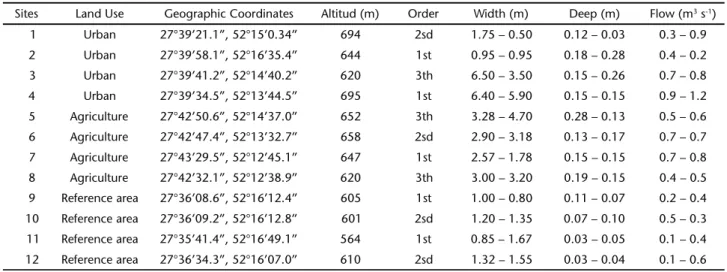
This study was carried out in Erechim, situated in the northern region of the state of Rio Grande do Sul (27°29’6.13” and 27°47’0.97”S; 52°21’3.28” and 52°8’43.3”W). Stretches from first to third orders in the hydrographic basin were selected, corresponding to the different land uses (Tab. I). The geologi-cal formation throughout the basins is basaltic and the typigeologi-cal soil is classified as “Ec” (Erechim Latossol Roxo Distrófico). The density drainage in the various sites (see below) was similar, oscillating from12.53 to 13.01 m ha-1 (RAMPAZZO et al. 2004).
We classified our collecting sites as urban, agricultural, and ref-erence sites, as follows: 1) urban sites consisted of four streams downstream of the urban perimeter. About 90% of the urban perimeter of Erechim is within this hydrographic basin (sites 1, 2, 3 and 4). The substrate is chiefly composed of rocks and leaves; 2) agricultural sites consisted of four sites located within a hydrographic basin where land use ( > 95%) is predominantly agricultural (sites 5, 6, 7 and 8); soy (summer) and wheat (win-ter) are the main crops. The sites are deforested and the sub-strate is composed of rocks and soil; 3) reference sites, chosen based on their environmental integrity (sites 9, 10, 11 and 12) were characterized as follows: absence of anthropogenic dis-turbances, presence of native riparian vegetation, variety of habitats on the stream bed, among other aspects. The distribu-tion of the sampling sites is represented in figure 1.
Table I. Characteristics of the sampling sites in Erechim, Rio Grande do Sul state.
Sites Land Use Geographic Coordinates Altitud (m) Order Width (m) Deep (m) Flow (m3 s-1)
1 Urban 27°39’21.1”, 52°15’0.34” 694 2sd 1.75 – 0.50 0.12 – 0.03 0.3 – 0.9
2 Urban 27°39’58.1”, 52°16’35.4” 644 1st 0.95 – 0.95 0.18 – 0.28 0.4 – 0.2 3 Urban 27°39’41.2”, 52°14’40.2” 620 3th 6.50 – 3.50 0.15 – 0.26 0.7 – 0.8 4 Urban 27°39’34.5”, 52°13’44.5” 695 1st 6.40 – 5.90 0.15 – 0.15 0.9 – 1.2
5 Agriculture 27°42’50.6”, 52°14’37.0” 652 3th 3.28 – 4.70 0.28 – 0.13 0.5 – 0.6 6 Agriculture 27°42’47.4”, 52°13’32.7” 658 2sd 2.90 – 3.18 0.13 – 0.17 0.7 – 0.7
7 Agriculture 27°43’29.5”, 52°12’45.1” 647 1st 2.57 – 1.78 0.15 – 0.15 0.7 – 0.8 8 Agriculture 27°42’32.1”, 52°12’38.9” 620 3th 3.00 – 3.20 0.19 – 0.15 0.4 – 0.5 9 Reference area 27°36’08.6”, 52°16’12.4” 605 1st 1.00 – 0.80 0.11 – 0.07 0.2 – 0.4
10 Reference area 27°36’09.2”, 52°16’12.8” 601 2sd 1.20 – 1.35 0.07 – 0.10 0.5 – 0.3 11 Reference area 27°35’41.4”, 52°16’49.1” 564 1st 0.85 – 1.67 0.03 – 0.05 0.1 – 0.4
12 Reference area 27°36’34.3”, 52°16’07.0” 610 2sd 1.32 – 1.55 0.03 – 0.04 0.1 – 0.6
For characterization of the sites, analysis in triplicate of the following environmental variables was carried out in all streams sampled: current velocity (fluxometer), water tempera-ture and dissolved oxygen (in situ, oximeter), pH (in situ, potenciometric method), electric conductivity (in situ, potencio-metric method), turbidity (nephelopotencio-metric method), ammonia and total phosphorus (espectrofotometric method). The meth-odology used to gather this data is described in Standard Meth-ods (APHA 1998).
The benthic organisms were sampled in different sub-strates (leaves, stones and sand) with a Surber sampler (mesh = 225 µm; area = 0.1 m2) within a 10 m ratio of the chosen site.
The biological samples were fixed in the field with 5% forma-lin and taken to the laboratory for selection and identifica-tion. Identification was carried out to the lowest possible taxo-nomic level based on the available literature (FERNANDEZ & DOMINGUES 2001, MERRITT & CUMMINS 1996). However, according to MELO (2005) and CORBI & TRIVINHO-STRIXINO (2006), family-level identifications of benthic macroinvertebrates for biomo-nitoring purposes do not compromise the results.
Density (organisms.m-2) and taxonomic richness
(repre-sented by the number of macroinvertebrate taxa identified) were calculated for each site. Next, rarefaction curves for the esti-mation of macroinvertebrate taxonomic richness were con-structed. The rarefaction was calculated based on the lowest values of organism density obtained in each stream (GOTELLI & COWELL 2001). The standard sample size used for comparison,
when calculating rarefaction, was 100 organisms. This value, which corresponds to the lower density registered in our data (smallest sample size), was obtained in summer, for site 4. The Shannon Diversity index and Pielou Evenness were also calcu-lated (MAGURRAN 2004). To evaluate the differences among the density, rarefied richness, Shannon Diversity index and even-ness in streams, an Analysis of Variance was used (ANOVA; GOTELLI & ELLISON 2004). To compare the benthic community composition among the different sites,collecting periods, and collecting dates, a Multivariate Analysis of Variance (MANOVA) was applied to the density log (x +1) transformed. With the density previously (log [x + 1]) transformed, a classification analysis was carried out using UPGMA method with the Bray-Curtis coefficient of dissimilarity. The analyses were carried out using the “vegan” package (OKSANEN et al. 2008) of statistical
programs R (R DEVELOPMENT CORE TEAM 2008) and Multiv Beta version 2.5 (PILLAR 2001).
RESULTS
Organism density did not differ among the streams in the winter period. In summer, the urban streams showed the highest densities of organisms (ANOVA, F2,9 = 5.23, p = 0.03).
According to the Tukey test, the differences occurred between the reference and urban streams (SS = 4.46, p < 0.05, Figs 2-5). Streams in reference areas presented higher rarefied richness in winter (ANOVA, F2,9 = 8.88, p = 0.007, Figs 2-5) and summer (ANOVA, F2,9 = 13.8, p = 0.002, Figs 2-5). In winter, differences
Reference Agriculture Urban
0 5000 10000 15000 20000
Density
(org
m
-2)
Winter Summer
Reference Agriculture Urban
0 2 4 6 8 10 12 14 16
Rarefied
taxa
richness
Winter Summer
Reference Agriculture Urban
0.0 0.5 1.0 1.5 2.0 2.5 3.0 3.5
Shannon
Diversity
(bits)
Winter Summer
Reference Agriculture Urban
0.0 0.1 0.2 0.3 0.4 0.5 0.6 0.7 0.8
E
venness
Winter Summer
Figures 2-5. Average values and standard error (± Standard Error) of density (2), richness (3), Shannon Diversity index (4) and Evenness (5) of benthic macroinvertebrates collected in streams with different land uses in Erechim.
2
3
occurred between reference and urban areas (Tukey test, SS = 5.95, p < 0.01). In summer, differences were observed between reference and urban areas (Tukey test, SS = 7.37, p < 0.01) and between agricultural and urban areas (Tukey test, SS = 4.49, p < 0.05). The Shannon diversity index differed among the varied land uses in both seasons (ANOVA, F2,9 = 7.10, p = 0.01 and F2,9
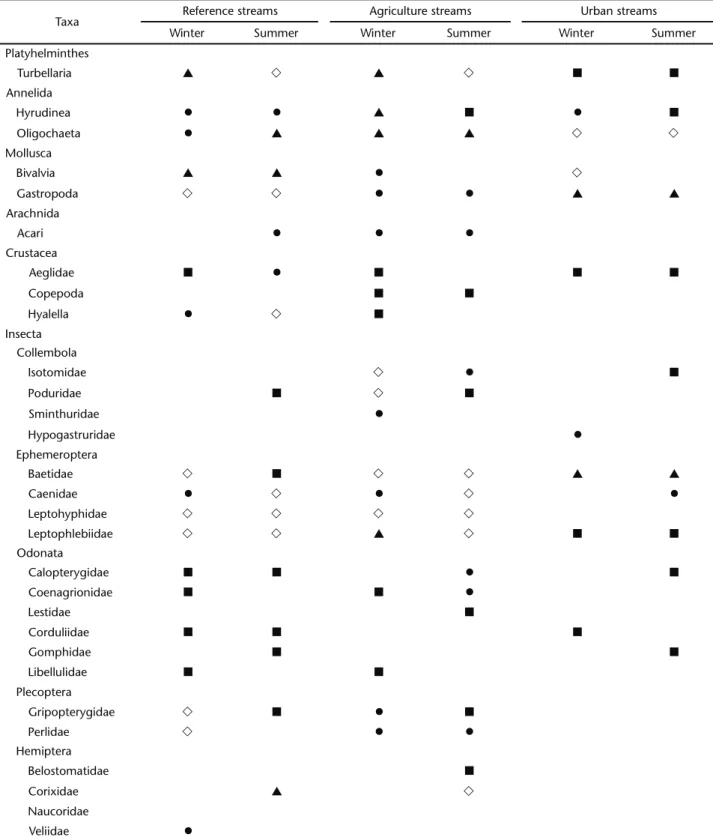
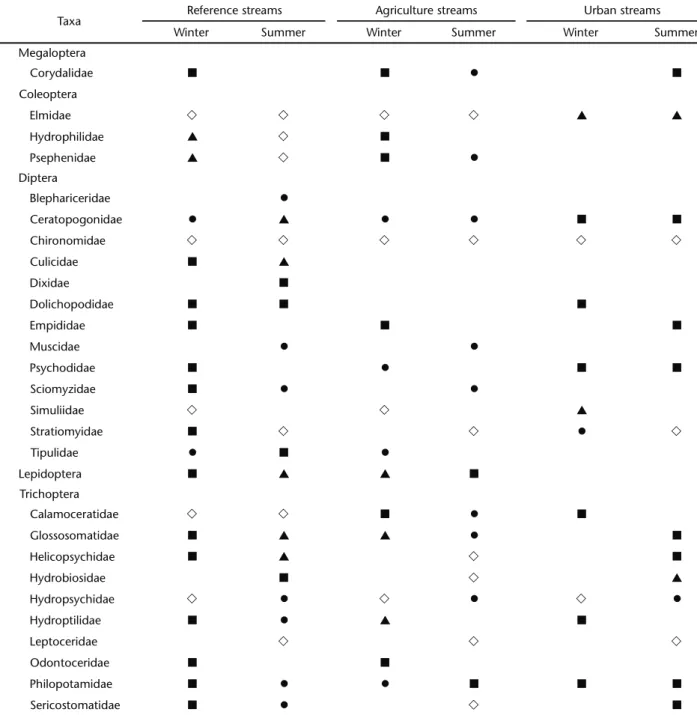
= 11.21, p = 0.004, winter and summer, respectively). In win-ter, the differences occurred between reference and urban ar-eas (Tukey test, SS = 5.24, p < 0.05). In summer, differences occurred between reference and urban areas (Tukey test, SS = 6.62, p < 0.01) and agricultural and urban areas (Tukey test, SS = 4.14, p < 0.05). The evenness showed differences among the land uses in winter (ANOVA, F2,9 = 5.32, p = 0.02) and summer (ANOVA, F2,9 = 11.23, p = 0.004). The Tukey test demonstrated that in winter the differences occurred between reference and urban areas (SS = 4.04, p < 0.05). In summer, the differences were between reference and urban areas (SS = 6.62, p < 0.01) and between agricultural and urban areas (SS = 4.21, p < 0.05). In this study, a total of 58 taxa were identified among the Acarina, Crustacea, Mollusca, Annelida and Insecta. In urban streams, the dominance of Chironomidae (Diptera) and Oligo-chaeta species was evident, accounting for more than 70% of the fauna collected in these streams. The composition of the benthic community showed significant differences among the different land uses in winter (MANOVA, SS = 92.37, p = 0.001, Tab. III) and summer (MANOVA, SS = 121.02, p = 0.002, Tab. III). Accord-ing to “a posteriori” analyses carried out among the three land uses in winter, significant differences were observed (reference x urban areas: SS = 47.7, p = 0.03; reference x agriculture areas: SS = 36.5, p = 0.02, agriculture x urban areas: SS = 54.3, p = 0.02). In summer, differences were significant between reference e urban areas (SS = 69.6, p = 0.03) and reference and agricultural areas (SS = 37.3, p = 0.02). However, urban and agricultural areas did not differ in summer with respect to community composition.
The Cluster analysis revealed groups characterized by land use: a group formed by streams located in reference areas; a sec-ond group formed by a mixture of streams in reference and ag-ricultural areas; a third group with predominance of agag-ricultural streams; and a fourth group formed by urban streams (Fig. 6).
DISCUSSION
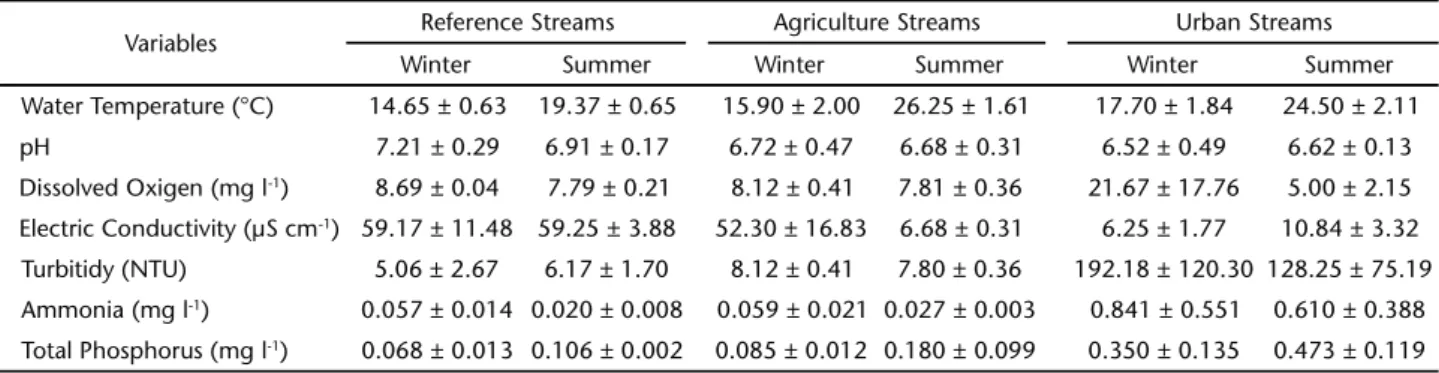
The higher values obtained for nutrients and the lower amounts of dissolved oxygen in urban streams were most likely a consequence of the input of organic materials in the water. Additionally, pollution sources such as sewer discharge and industrial residues seem to have been responsible for the high concentrations of ammonia and total phosphorus. SALOMONIet al. (2007), in a study carried out in the Gravataí River (Rio Grande do Sul), pointed out that changes in that river were a consequence of the increased concentration of nutrients dis-charged in the water column. The contaminants, mainly or-ganic nutrients that are launched in urbanized streams, cause alterations in the physical-chemical characteristics of the wa-ter (BAHAR et al. 2008).
4-w
1-s
3-s 4-s
1-w 3-w
2-w
7-w
6-w
5-w 8-w
7-s 2-s
9-s 11-s 5-s 6-s 8-s
10-s 12-s
12-w
1
1-w
9-w 10-w
0.0
0.2
0.4
0.6
0.8
Figure 6. Dendrogram of grouping (UPGMA, Bray-Curtis) in streams with different land uses influence in Erechim. Numbers = sites, w = winter, s = summer. Urban Sites: numbers 1, 2, 3, and 4; Agri-culture Sites: numbers 5, 6, 7, and 8; Reference Sites: numbers 9, 10, 11, and 12.
Table II. Average values and standard deviation of the environmental variables measured in streams (Erechim, Rio Grande do Sul, Brazil).
Variables Reference Streams Agriculture Streams Urban Streams Winter Summer Winter Summer Winter Summer
Water Temperature (°C) 14.65 ± 0.63 19.37 ± 0.65 15.90 ± 2.00 26.25 ± 1.61 17.70 ± 1.84 24.50 ± 2.11 pH 7.21 ± 0.29 6.91 ± 0.17 6.72 ± 0.47 6.68 ± 0.31 6.52 ± 0.49 6.62 ± 0.13
Dissolved Oxigen (mg l-1) 8.69 ± 0.04 7.79 ± 0.21 8.12 ± 0.41 7.81 ± 0.36 21.67 ± 17.76 5.00 ± 2.15
Electric Conductivity (µS cm-1) 59.17 ± 11.48 59.25 ± 3.88 52.30 ± 16.83 6.68 ± 0.31 6.25 ± 1.77 10.84 ± 3.32
Turbitidy (NTU) 5.06 ± 2.67 6.17 ± 1.70 8.12 ± 0.41 7.80 ± 0.36 192.18 ± 120.30 128.25 ± 75.19
Ammonia (mg l-1) 0.057 ± 0.014 0.020 ± 0.008 0.059 ± 0.021 0.027 ± 0.003 0.841 ± 0.551 0.610 ± 0.388
Table III. Values of organisms density in streams with different land uses influence in Erechim, Rio Grande do Sul state. () < 10, () 11-50, () 51-100, () > 100.
Taxa Reference streams Agriculture streams Urban streams Winter Summer Winter Summer Winter Summer Platyhelminthes
Turbellaria
Annelida
Hyrudinea
Oligochaeta
Mollusca
Bivalvia
Gastropoda
Arachnida
Acari
Crustacea
Aeglidae
Copepoda
Hyalella
Insecta Collembola
Isotomidae
Poduridae
Sminthuridae
Hypogastruridae
Ephemeroptera
Baetidae
Caenidae
Leptohyphidae
Leptophlebiidae
Odonata
Calopterygidae
Coenagrionidae
Lestidae
Corduliidae
Gomphidae
Libellulidae
Plecoptera
Gripopterygidae
Perlidae
Hemiptera
Belostomatidae
Corixidae
Naucoridae
Veliidae
A significant effect on the structure and composition of the benthic macroinvertebrate fauna was observed among the different land uses in this study. The streams located in refer-ence areas with native riparian vegetation, higher diversity of habitats and trophic resources, showed greater taxonomic rich-ness (reflected by the Shannon Diversity index) and lower den-sity of organisms. By contrast, a decreased taxonomic richness
and a correspondingly lower Shannon Diversity index were observed in urban areas (HEPP & SANTOS 2009). In agricultural streams, however, intermediate patterns were observed. NIYOGI
et al. (2007) mentioned that the density of macroinvertebrates significantly increases in places with higher nutrient concen-trations and fine sediments. Streams under urban influence receive considerable amounts of organic residues (ROY et al.
Table III. Continued.
Taxa Reference streams Agriculture streams Urban streams Winter Summer Winter Summer Winter Summer Megaloptera
Corydalidae
Coleoptera
Elmidae
Hydrophilidae
Psephenidae
Diptera
Blephariceridae
Ceratopogonidae
Chironomidae
Culicidae
Dixidae
Dolichopodidae
Empididae
Muscidae
Psychodidae
Sciomyzidae
Simuliidae
Stratiomyidae
Tipulidae
Lepidoptera
Trichoptera
Calamoceratidae
Glossosomatidae
Helicopsychidae
Hydrobiosidae
Hydropsychidae
Hydroptilidae
Leptoceridae
Odontoceridae
Philopotamidae
2003), whereas agricultural streams receive the input of sedi-ments derived from erosion (LENAT & CRAWFORD 1994). Erosion and the consequent input of sediments can be observed in the streams studied and may have contributed to an incremental increase in organism densities.
Reference and urban sites differed in average values for all variables measured in all seasons, except for density in win-ter. The agricultural and urban areas showed differences in rich-ness, Shannon diversity index and evenness only in summer. SMITH & LAMP (2008) studied the benthic community structure in agricultural and urban areas in Montgomery Co. (USA) streams and observed results similar to ours. According to LENAT & CRAWFORD (1994), pollution intolerant organisms are frequent and abundant in regions with a higher availability of habitats. The fauna composition was different among the land uses, a result consistent with the findings of OMETTOet al. (2004),
who demonstrated that urban streams have lower concentra-tions of dissolved oxygen and higher concentraconcentra-tions of am-monia, affecting the distribution and occurrence of Ephemeroptera, Plecoptera and Trichoptera (EPT orders). Sev-eral studies have highlighted the role of the EPT orders as bioindicators (LENAT & CRAWFORD 1994, DOLEDÉC et al. 2006, BACEY & SPURLOCK 2007, MOLOZZI et al. 2007, HEPP & SANTOS 2009), be-cause these organisms tend to decrease in numbers or even disappear in regions where sources of (urban) pollution are introduced.
The Cluster analysis showed a pattern of grouping con-sistent with our expectations. According to SMITH & LAMP (2008), community structure and composition are more strongly in-fluenced by land use than by season. The similar benthic com-position of reference and agricultural streams was likely a re-sult of the EPT richness. The urban areas formed a distinct group because of the physical-chemical characteristics of their streams. The clustering of an urban site with a group predominantly composed of agricultural sites can be an indication of a mixed anthropic disturbance. That urban stream is located in an area within the urban perimeter that releases a lower amount of domestic residues, when compared with the remaining urban regions in our data.
The results of this study show a strong influence of point-pollution sources (urban) and a trend of influence by non-point sources (agriculture) on the benthic community. These results demonstrate that urban and agriculture impacts affect the wa-ter quality and aquatic diversity. Management activities are necessary for the recuperation and maintenance of the envi-ronmental quality in the study region. Our results can contrib-ute to the generation of integrated information about envi-ronmental quality. Traditional evaluation measures based on physical, chemical and bacteriological methods are less effi-cient in the detection of environmental problems of hydro-graphic basins. The utilization of bioindicators makes it pos-sible to generate a more integrated evaluation of aquatic eco-systems.
ACKOWLEDGEMENTS
We thank the Universidade Regional Integrada do Alto Uruguai e das Missões – Campus de Erechim for the Scientific Initiation Scholarship to S.V. MILESI and C. BIASI and the Secre-taria de Ciência e Tecnologia of Rio Grande do Sul State for the financial support.
LITERATURE CITED
APHA. 1998. Standard methods for the examination of water and wastewater. Washington, D.C., American Public Health Association, 20th ed.,1180p.
BACEY, J. & F. SPURLOCK. 2007. Biological assessment of urban and agricultural streams in the California Central Valley. Environmental Monitoring Assessment 130 (1-3): 483-493. BAHAR, M.M.; H. OHMORI & M. YAMAMURO. 2008. Relatioship between river water quality and land use in a small river basin running through the urbanizing area of Central Japan. Limnology 9: 19-26.
BAPTISTA, D.F.; D.F. BUSS; M. EGLER; A. GIOVANELLI; M.P. SILVEIRA & J.L. NESSIMIAN. 2007. A multimetric index based on benthic macroinvertebrates for evaluation of Atlantic Forest streams at Rio de Janeiro State, Brazil. Hydrobiologia 575: 83-94. CORBI, J.J. & S. TRIVINHO-STRIXINO. 2006. Influence of taxonomic
resolution of stream macroinvertebrate communities on the evaluation of different land uses. Acta Limnologica Brasiliensia 18: 469-475.
DEWSON, Z.S.; A.B.W. JAMES & R.G. DEATH. 2007. Invertebrate community responses to experimentally reduced discharge in small streams of different water quality. Journal of the North American Society 26 (4): 754-766.
DOI, H.; A. TAKAGI & E. KIKUCHI. 2007. Stream macroinvertebrates community affected by point-source metal pollution. International Review Hydrobiology 92 (3): 258-266. DOLÉDEC, S.; N. PHILLIPS; M. SCARSBROOK; R.H. RILEY & C.R. TOWSEND.
2006. Comparison of structural and functional approaches to determining landuse effects on grassland stream invertebrate communities. Journal of the North American Society 25 (1): 44-60.
FERNANDES, H.R. & E. DOMINGUES. 2001. Guia para determinación de los artropodos bentônicos Sudamericanos. Tucumán, Universidad Nacional de Tucumán, 282p.
GOTELLI, N.L. & R.K. COWELL. 2001. Quantifying biodiversity: procedures and pitfalls in the measurement and comparison of the species richness. Ecology Letters 4: 379-391. GOTELLI, N.J. & A.M. ELISSON. 2004. A primer of ecological
statistics. Massachussets, Sinauer Assoc., 510p.
HAGEN, E.M.; J.R. WEBSTER & E.F. BENFIELD. 2006. Are leaf breakdown rates a useful measure of stream integrity along an agricultural landuse gradient? The Journal North American Benthological Society 25 (2): 330-343. HEPP, L.U. & S. SANTOS. 2009. Benthic communities of streams
southern Brazil. Environmental Monitoring and Assessment 157: 305-318. [doi 10.1007/s10661-008-0536-7]. LENAT, D.R. & J.K. CRAWFORD. 1994. Effects of land use on water quality and aquatic biota of three North Carolina piedmont streams. Hydrobiologia 294: 185-199.
MAGURRAN, A.E. 2004. Measuring Biological Diversity.Malden, Blackwell, 256p.
MCIVER, J.D. & M.L. MCINNIS. 2007. Cattle grazing effects on macroinvertebrates in an Oregon Mountain stream. Rangeland Ecology & Management 60 (3): 293-303. MEGAN, M.H.; M.S. NASH; A.C. NEALE & A.M. PITCHFORD. 2007.
Biological integrity in mid-Atlantic coastal plains headwater streams. Environmental Monitoring and Assessment 124: 141-156.
MELO, A.S. 2005. Effects of taxonomic and numeric resolution on the ability to detect ecological patterns at a local scale using stream macroinvertebrates. Archiv für Hydrobiologie 164 (3): 309-323.
MERRITT, R.W. & K.W. CUMMINS. 1996. An introduction to the aquatic insects of North America. Iowa, Kendall/Hunt Publishing, 3rd ed., 862p.
MILESI, S.V.; C. BIASI; R.M. RESTELLO & L.U. HEPP. 2008. Efeito de metais Cobre (Cu) e Zinco (Zn) sobre a comunidade de macroinvertebrados bentônicos em riachos do sul do Bra-sil. Acta Scientiarum – Biological Science 30 (3): 283-289.
MOLOZZI, J.; L.U. HEPP & A.S. DIAS. 2007. Influência da cultura de arroz sobre a comunidade bentônica no vale do Itajaí (Santa Catarina, Brasil). Acta Limnologica Brasilensia 19 (4): 383-392.
MORI, N. & A. BRANCELJ. 2006. Macroinvertebrates communities of karst springs of two rivers catchments in the Southern Limestone Alps (the Julian Alps, NW Slovenia). Aquatic Ecology 40: 69-83.
NESSIMIAN, J.L.; E.M. VENTICINQUE; J. ZUANON; P. MARCO-JR; M. GORDO; L. FIDELIS; J.D. BATISTA; L. JUEN. 2008. Land use, habitat integrity, and aquatic insect assemblages in Central Amazonian streams. Hydrobiologia 614 (1): 117-131. [doi 10.1007/s10750-008-9441-x].
NIYOGI, D.K.; M. KOREN; C.J. ARBUCKLE & C.R. TOWNSEND. 2007. Stream communities along a catchment land-use gradient:
subsidy-stress responses to pastoral development. Environ-mental Management 39: 213-225.
OKSANEN, J.; R. KINDT; P. LEGENDRE; R.B. O’HARA; G.L. SIMPSON & M.H.H. STEVENS. 2008. Vegan: community ecology package. R package version 1.13-0. Available online at: http://vegan.r-forge.r-project.org [Accessed: 20/XII/2008]
OMETTO, J.P.; A. GESSNER; L.A. MARTINELLI & M.C. BERNARDES. 2004. Macroinvertebrate community as indicator of land-use changes in tropical watersheds, southern Brazil. Ecohy-drology & Hydrobiology 4: 37-49.
PILLAR, V.P. 2001. Aplicativo MULTIV (multivariate exploratory analysis, randomization testing and bootstrap resampling) versão 2.4.2. Porto Alegre, Universidade Federal do Rio Gran-de do Sul, 42p. Available online at: http://ecoqua.ecologia. ufrgs.br./ecoqua/main.html [Accessed: 10/XII/2008]. POMPEU, P.S.; M. CALLISTO & C.B.M. ALVES. 2005. The effects of
urbanization on biodiversity and water quality in the Rio das Velhas basin, Brazil. American Fisheries Society Symposium 47: 11-22.
R DEVELOPMENT CORE TEAM. 2008. R: A language and environment for statistical computing. Vienna, R Foundation for Statistical Computing, ISBN 3-900051-07-0.
RAMPAZZO, S.E.; J.E. SANTOS; J.R.S. PIRES; A.F. MARQUES. Zoneamento ambiental conceitual para o município de Erechim (RS), p. 351-381. In: J.E. SANTOS; CAVALHEIRO, F; PIRES, J.S.; C. HENKE &
A.M. PIRES (Org.) Faces da policemia da Paisagem: ecolo-gia, planejamento e percepção. São Carlos, Rima, 420p. ROY, A.H.; M.J. ROSEMOND; M.J. PAUL & J.B. WALLACE. 2003. Stream
macroinvertebrate response to catchment urbanization (Georgia, USA). Freshwater Biology 48: 329-346.
SALOMONI, S.E.; O. ROCHA & E.H. LEITE. 2007. Limnological characterization of Gravataí river, Rio Grande do Sul. Acta Limnologica Brasiliensia19 (1): 1-14.
SMITH, R.F. & W.O. LAMP. 2008. Comparison of insect communities between adjacent headwater and main-stem streams in urban and rural watersheds.Journal of North American Benthological Society27 (1): 161-175.
VONDRACEK, B.; K.L. BLANN; C.B. COX; J.F. NERBONNE; K.G. MUMFORD & B.A. NERBONNE. 2005. Land use, spatial scale, and stream systems: lessons from na agriculture region. Environmental Manangement 36: 775-791.