DOI: 10.1590/0004-282X20130221
ARTICLE
Temporo-mandibular disorders are an
important comorbidity of migraine and may
be clinically difficult to distinguish them from
tension-type headache
Desordens temporomandibulares são comorbidade importante da migrânea e podem ser
clinicamente difíceis de distinguir da cefaleia tipo tensional
Ariovaldo Alberto da Silva Júnior1, Karina Viana Brandão2, Bruno Engler Faleiros3, Rafael Mattos Tavares3,
Rodrigo Pinto Lara3, Eduardo Januzzi4, Anísio Bueno de Carvalho4, Eliane Maria Duarte de Carvalho4, João
Bosco Lima Gomes5, Frederico Mota Gonçalves Leite5, Betania Mara Franco Alves6, Rodrigo Santiago
Gómez7, Antônio Lúcio Teixeira8
Headache is a frequent cause of medical consultation at all levels of care. In the general population, headaches
afect nearly 50% of the subjects1. In Brazil, migraine afects
around 10% of the adults, while tension-type headache (TTH)
ABSTRACT
Clinical differentiation between the primary headaches and temporomandibular disorders (TMD) can be challenging. Objectives: To inves-tigate the relationship between TMD and primary headaches by conducting face to face assessments in patients from an orofacial pain clinic and a headache tertiary center. Method: Sample consists of 289 individuals consecutively identified at a headache center and 78 individuals seen in an orofacial pain clinic because of symptoms suggestive of TMD. Results: Migraine was diagnosed in 79.8% of headache sufferers, in headache tertiary center, and 25.6% of those in orofacial pain clinic (p<0.001). Tension-type headache was present in 20.4% and 46.1%, while the TMD painful occurred in 48.1% and 70.5% respectively (p<0.001). Conclusion: TMD is an important comorbidity of migraine and difficult to distinguish clinically from tension-type headache, and this headache was more frequent in the dental center than at the medical center.
Keywords: primary headache, temporomandibular disorders, migraine.
RESUMO
A diferenciação clínica entre as cefaleias primárias e as disfunções temporomandibulares (DTM) pode ser desafiadora. Objetivos: Investi-gar a relação entre DTM e cefaleias primárias conduzindo uma avaliação face a face entre pacientes de um centro de dor orofacial e de um centro terciário de cefaleia. Método: A amostra consistiu de 289 indivíduos avaliados consecutivamente em um centro terciário de cefaleia e 78 indivíduos de uma clínica orofacial. Resultados: A migrânea foi diagnosticada em 79,8% dos pacientes do centro de cefaleia e 25,6% dos pacientes do centro de dor orofacial. A cefaleia do tipo tensional esteve presente em 20,4% e 46,1%, enquanto as DTM dolorosas ocor-reram em 48,1% e 70,5% respectivamente (p<0,001). Conclusão: DTM é uma comorbidade importante da migrânea e difícil de distinguir clinicamente da cefaleia do tipo tensional, tanto que esta cefaleia foi mais frequente no centro odontológico do que no centro médico. Palavras-chave: cefaleia primaria, desordens temporomandibular, migrânea.
Serviço de Neurologia, Hospital das Clínicas, Universidade Federal de Minas Gerais, Belo Horizonte MG, Brazil. Orofacial Pain Clinic- Unifenas-BH, Belo Horizonte MG, Brazil
1Attending Neurologist, Serviço de Neurologia, Hospital das Clínicas, Universidade Federal de Minas Gerais, and Professor of Neurology, Faculdade de Medicina,
Unifenas-BH, Belo Horizonte MG, Brazil;
2Medical student, Faculdade de Medicina, Unifenas-BH, Belo Horizonte MG, Brazil;
3Medical student, Faculdade de Medicina, Universidade Federal de Minas Gerais, Belo Horizonte MG, Brazil; 4 Attending Dentist, Orofacial Pain Clinic-Unifenas-BH, Belo Horizonte MG, Brazil;
5Attending Dentist, Serviço de Neurologia, Hospital das Clínicas, Universidade Federal de Minas Gerais, Belo Horizonte MG, Brazil; 6Attending Physiotherapist, Serviço de Neurologia, Hospital das Clínicas, Universidade Federal de Minas Gerais, Belo Horizonte MG, Brazil; 7Attending Neurologist, Departamento de Clínica Médica, Faculdade de Medicina, Universidade Federal de Minas Gerais, Belo Horizonte MG, Brazil; 8Professor of Neurology, Departamento de Clínica Médica, Faculdade de Medicina Universidade Federal de Minas Gerais, Belo Horizonte MG, Brazil.
Correspondence: Ariovaldo Alberto da Silva Jr. Núcleo de Apoio à Pesquisa, Unifenas-BH, Rua Líbano, 66 / Bairro Itapoã; 31710-030 Belo Horizonte MG - Brasil.
Support: Fundação de Amparo à Pesquisa do Estado de Minas Gerais (FAPEMIG).
Conflict of interest: There is no conflict of interest to declare.
happens in other 38%1,2. In a face-to-face study in which the entire population of a city in Brazil was investigated,
one-year prevalence of headache was 65.4%3, and distribution of
headache types were in alignment with other studies from
Brazil4,5. Headaches are a frequent cause of consultation in
the specialty care6,2.
he temporomandibular disorders (TMD) is a collective term that includes many clinic problems that involve the mticatory muscles, the temporomandibular joint (TMJ) and as-sociated structures or both. he most common symptom is pain, and it can be aggravated by chewing or other jaw
func-tion, and can also restrict the function related to the associated
structures, and articular sounds are frequent. he prevalence of these symptoms can afect until 75% of the adult popula-tion and it is estimated that 40% to 60% of general populapopula-tion
present any signs or symptoms of TMD7. Although the preva
-lence of TMD varies widely, in the Brazilian general population over 40% of subjects have at least one TMD symptom, and 10%
have three or more8. TMJ pain afects from 5-16% of the general population and, as for migraine headaches, women are dispro-portionally afected8-10.
he myofascial pain (MP) is one of the most common TMD and it consists in a painful condition characterized by pain in local areas in the jaw, temples, face, pre auricular area, or inside the ear with the presence of trigger-points (TP). hese (TP) can produce a characteristic pattern of irradiated
pain or autonomic symptoms when stimulated7.
here are many diagnostic systems for TMD of which MP is a part. he Research Diagnostic Criteria for Temporomandibular Disorders (RDC/TMD) was created to provide classiication criteria for the condition that are universally accepted and validated. A diagnosis of MP by the RDC/TMD requires pain to be reported by the subject
in response to palpation of three or more sites of the masti -catory muscles11.
Speciic primary headache syndromes, in special mi-graine, and TMD are comorbid, as demonstrated by clinic-based and population studies. Additionally, TMD is a risk fac-tor for increased headache frequency10,12-20. Nonetheless, as
with many of the identiied risk factors for increased migraine frequency, most of the studies diagnosed both migraine and TMD based on self-reported symptoms or on questionnaires. Accordingly, the aim of this study was to investigate the re-lationship between TMD and headache syndromes by
con-ducting rigorous face to face assessments in patients from an
orofacial pain clinic and a headache tertiary center.
METHOD
Participants of this study consist of 289 individuals con-secutively identiied at the Headache Specialty Center at Universidade Federal de Minas Gerais (Belo Horizonte,
Brazil), as well as 78 individuals who sought care with com-plaints suggestive of TMD at the Odontologic Training and Specializing Center (Belo Horizonte, Brazil). All patients were independently assessed by neurologists with experience in headache medicine. Headaches were diagnosed according to the Second Edition of the International Classiication of
Headache Disorders (ICHD-2)21 after a structured interview
and clinical examination. Headaches of interest included mi-graine, TTH, chronic daily headache (CDH), and medication overuse headache, which was diagnosed only after detoxii-cation, as per the ICHD-2.
Oral and muscular assessments were respectively con-ducted by dentists and physical therapists. Trigger points, threshold for pain and the temporomandibular joint were rigorously assessed. TMD was assessed using the RDC/
TMD22 through an interview and, subsequently, a
physi-cal examination. he RDC/TMD consists of a dual-axis ap-proach (Axis I and II), composed by a questionnaire and a physical examination made by dentists and physioterapists previously calibrated by a gold standart examinator, who provided an overview of all procedures and helped them to practice on each other and other subjects recording and comparing the results from the same subjects evaluated ac-cording to the International RDC/TMD Consortium speci-ications. Additionally, the head and neck muscles were ex-amined and pain sensitivity to 2.0 kg straight pressure was assessed using a Likert pain scale. Examiners were blinded
to each other diagnoses.
Data were summarized using summary tables and de-scriptive statistics. Non-parametric data between groups were compared using the Chi-Squared test or the Fischer test (when anticipated values were small). For continuous vari-ables, the Mann-Whitney test was used. Gaussian variables were contrasted using the T-test.
Protocol and all forms were reviewed and approved by the Investigation Review Board of the Federal University of Minas Gerais, and by the Committee (0500.203.000-10) Research Ethics Unifenas, Belo Horizonte, Brazil (217/2010).
RESULTS
Among individuals with headache (n=289), mean age was 42.7 years, while in individuals with TMD symptoms, it was 37.1 years. Women represented 86.9% of headache suferers and 75.6% in the TMDs group (p=0.015). Most participants had less than 8 years of formal education. Demographic data are presented in Table 1.
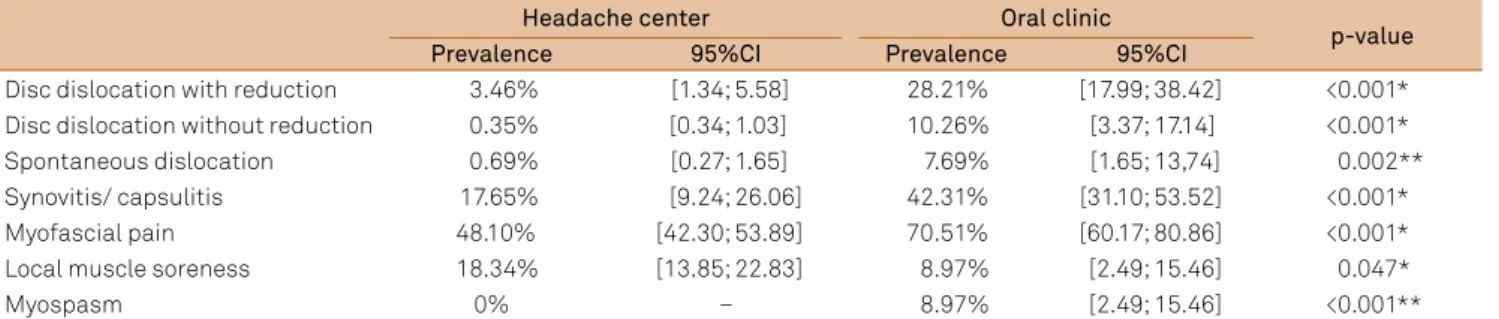
TMD happened in 67.1% of those with headache and 97.4% of those with TMDs. Among the TMD suferers, pain-ful muscular dysfunction happened in 49.5% of those with headache vs. 23.1% in those form the TMDs group (p<0.001). Articular TMD was rarely observed among those from the headache group (1.4%) but happened in 15.4% in those from the TMDs group (p<0.001). Coexisting muscular and articu-lar TMD happened in 59.0% of the TMDs patients (Table 3). TMD with myofascial pain happened in 48.1% of headache suferers and 70.5% of those with TMDs (p<0.001). Local
muscle soreness was more common in the headache sufer-ers than in those with TMDs (p=0.047) (Table 4).
DISCUSSION
Headache and TMD are two painful disorders that are co-morbid and may sometimes be disabled, requiring special-ized treatment. Better characterization of the comorbidity is necessary as a prelude to customized treatment. Our study adds to the ield by formally assessing patients from two spe-cialty clinics using gold-standard diagnostic criteria.
As reported by others, women were more commonly af-fected by both disorders, specially at young adulthood and middle-age1,3-6,8-10,12-14,22, and it seems that the female predomi
-nance is ampliied at the specialty care, relative to commu-nity studies3,6,20,23. Since migraine and TMD have diferent
physiopathology, we did not expect to ind identical gender ratio in both groups. Nonetheless, part of this diference may be justiied by the fact that when TMD and migraine co-oc-cur, migraine tends to be more severe than when they do not, which would channel women with more severe TMD to the
Table 1. Demographic data at the two specialty centers
Headache center (n=289)
Oral clinic
(n=78) p-value
Sex
Women 86.9% (251) 75.6% (59) 0.015**
Men 13.1% (38) 24.4% (19)
Years of school
< 8 years 52.3% (136) 23.2% (16) <0.001* 8-15 years 35.0% (91) 59.4% (41)
> 15 years 12.7% (33) 17.4% (12) (*) Pearson’s Chi-square Test; (**) Mann-Whitney Test.
Table 2. Headache types and frequency as a function of place of enrollment.
Headache center (n=289)
Oral clinic
(n=78) p-value
% 95%CI % 95%CI
Migraine 79.89 [74.16; 83.63] 25.64 [15.73; 35.55] <0.001*
Tension-type headache 20.42 [15.74; 25.09] 46.15 [34.84; 57.47] <0.001*
Chronic daily headache 16.61 [12.29; 20.93] 3.85 [0.52; 8.21] 0.004*
(*) Pearson’s Chi-Square Test.
Table 3. Temporo-mandibular diagnosis as a function of place of enrollment.
Headache center (n=289)
Oral clinic
(n=78) p-value
No TDM 32.9% (95) 2.6% (2) <0.001*
Muscular 49.5% (143) 23.1% (18)
Articular 1.4% (4) 15.4% (12)
Muscular and articular 16.3% (47) 59.0% (46)
TDM: temporomandibular disorders; (*) Pearson’s Chi-Square test;
Table 4. Temporomandibular disorder types as function of place of enrollment.
Headache center Oral clinic
p-value
Prevalence 95%CI Prevalence 95%CI
Disc dislocation with reduction 3.46% [1.34; 5.58] 28.21% [17.99; 38.42] <0.001*
Disc dislocation without reduction 0.35% [0.34; 1.03] 10.26% [3.37; 17.14] <0.001*
Spontaneous dislocation 0.69% [0.27; 1.65] 7.69% [1.65; 13,74] 0.002**
Synovitis/ capsulitis 17.65% [9.24; 26.06] 42.31% [31.10; 53.52] <0.001*
Myofascial pain 48.10% [42.30; 53.89] 70.51% [60.17; 80.86] <0.001*
Local muscle soreness 18.34% [13.85; 22.83] 8.97% [2.49; 15.46] 0.047*
Myospasm 0% – 8.97% [2.49; 15.46] <0.001**
headache center rather to the TMD center10. Furthermore, it
is well established that women are more likely than men to sufer pain episodes as a function of neuroendocrine events
and of the reproductive stage10,24-26. Menstrual migraine is well
known to be more severe and refractory to treatment than
non-menstrual migraine10,24, and a limitation of our study was
not to characterize this migraine subgroup, since this would require longitudinal follow-up and use of dairies.
We found strong association between migraine and TMD pain, as previously described10,12-20. Gonçalves et al., in a
pop-ulation-based study, found that TMD symptoms are more likely to occur among those who present any headache type. When three or more TMD symptoms were present, headache occurred in 72.8% versus 37.9% of those who did not present
any TMD symptoms13, as conirmed by others15. Furthermore,
when assessing a clinic-based sample, they found that the co-morbidity of TMD with migraine, CDH, and TTH, happened
only for the muscular form, and not for the articular type18.
hey also found that severity of TMD correlated with in-creased headache frequency15,18. Our data strongly support
their indings and this is of importance, since Bevilaqua-Grossi et al. reported that TMD with myofascial pain is
strongly associated to increased headache frequency27.
Of interest is the fact that we found more TTH sufer-ers in the TMD clinic than in the headache center. TTH is
the most prevalent of the primary headaches in the general
population, with prevalences ranging from 38-78%1,28. In a
telephone-based interview conducted in Brazil, prevalence was 13%, while probable TTH happened in other 22.6%. hus, further studies should focus on the relationship be-tween TMD and TTH. In another clinic-based study, ind-ings were similar to ours29.
Finally, we also found evidence that CDH and TMD are comorbid, as suggested by others, where painful TMD was strongly associated with speciic CDH types13,14,18,20,27,30.
his study has several limitations, in addition to the lack of controlling for menstrual cycle. First, both groups come from specialty care, without a contemporary control from the pop-ulation. Second, psychiatric comorbidities were not assessed and this is of importance, since they may be related to both headaches and TMD. Finally, patients were not matched by age and gender (since they were consecutively enrolled).
We conducted a study independently identifying patients from two specialty centers, one in headache and one in TMD. We found strong evidence of comorbidity between both dis-orders and we conirmed previous indings about the spec-iicity of TMD pain and of TMD with muscular symptoms in the comorbidity. We also found evidence of an increased cluster of TTH suferers in the TMD clinic, and this inding must be further elucidated.
References
1. Stovner LJ, Hagen K, Jensen R, et al. The global burden of headache: a documentation of headache prevalence and disability worldwide. Cephalalgia 2007;27:193–210.
2. Crystal SC, Robbins MS. Epidemiology of tension-type headache. Curr Pain Headache Rep 2010;14:449-454.
3. Silva-Júnior AA, Krymchantowski A, Moreira P, Vasconcelos L, Gomez RS, Teixeira AL. Prevalence of headache in the entire population of a small city in Brazil. Headache 2009;49:895-899.
4. Queiroz LP, Barea LM, Blank N. An epidemiological study of headache in Florianopolis, Brazil. Cephalalgia 2005;26:122–127.
5. Pahim LS, Menezes AMB, Lima R. Prevalence and factors associated to migraine in adult population, Southern Brazil.Rev Saúde Pública 2006;40:692-698.
6. Silva-Júnior AA, Faleiros BE, Santos TM, Gómez RS, Teixeira AL. Relative frequency of headache types: a longitudinal study in the tertiary care. Arq Neuropsiquiatr 2010;68:878-881.
7. Leite FMG, Atallah ÁN, El Dib RP, et al. Cyclobenzaprine for the treatment of myofascial pain in adults. Cochrane Database of Systematic Reviews 2009, Issue 3. Art. No.: CD006830. DOI: 10.1002/14651858.CD006830.pub3.
8. Gonçalves AGG, Fabbro ALD, Campos JADB, Bigal ME, Speciali JG. Symptoms of temporomandibular disorders in the population: an epidemiological study. J Orofac Pain 2010;24:270-278.
9. Mobilio N, Casetta I, Cesnik E, Catapano S. Prevalence of self-reported symptoms related to temporomandibular disorders in an Italian population. J Oral Rehab 2011;38:884-890.
10. Plesh O, Adams SH, Gansky SA. Temporomandibular Joint and muscle disorder-type pain and comorbid pains in a national US sample. J Orofac Pain 2011;25:190-198.
11. Manfredini D, Chiappe G, Bosco M. Research diagnostic criteria for temporomandibular disorders (RDC/TMD) axis I diagnoses in an Italian patient population. J Oral Rehab2006;33:551–558.
12. Silva-Junior AA, Costa EC, Gomes JB, et al. Chronic headache and comorbidities: a two-phase, population-based, cross-sectional study. Headache 2010;50:1306-1312.
13. Gonçalves DAG, Bigal ME, Jales LCF, Camparis CM, Speciali JG. Headache and symptoms of temporomandibular disorder: an epidemiological study. Headache 2010;50:231-241.
14. Gonçalves DAG, Speciali JG, Jales LCF, Camparis CM, Bigal ME. Temporomandibular symptoms, migraine and chronic daily headaches in the population. Neurology 2009;73:645-646.
15. Ballegaard V, Thede-Schmidt-Hansen P, Svensson P, Jensen R. Are headache and temporomandibular disorders related? A blinded study. Cephalalgia 2008;28:832-841.
16. Fragoso YD, Alves HHC, Garcia SO, Finkelsztejn A. Prevalence of parafunctional habits and temporomandibular dysfunction symptoms in patients attending a tertiary headache clinic. Arq Neuropsiquiatr 2010;68:377-380.
17. Kang JK, Ryu JW, Choi JH, Merrill RL, Kim ST. Application of ICDH-II criteria for headaches in a TMJ and orofacial pain clinic. Cephalalgia 2009;30:37-41.
18. Gonçalves DAG, Camparis CM, Speciali JG, Franco AL, Castanharo SM, Bigal ME. Temporomandibular disorders are differentially associated with headache diagnoses: a controlled study. Clin J Pain 2011;27:611-615. 19. Özkan NÇ, Özkan F. The relationship of temporomandibular disorders
with headaches: a retrospective analysis. Agri 2011;23:13-17. 20. Franco AL, Gonçalves DAG, Castanharo SM, Speciali JG, Bigal ME,
in individuals with temporomandibular disorders. J Orofac Pain 2010;24:287-292.
21. Headache Classification Committee. The international classification of head ache disorders, cranial neuralgia and facial pain. Cephalalgia 2004;2(Suppl 1):S1-S160.
22. Dworkin SF, Sherman J, Mancl L, Ohrbach R, LeResche L, Truelove E. Reliability, validity, and clinical utility of the research diagnostic criteria for temporomandibular disorders axis II scales: depression, non-specific physical symptoms, and graded chronic pain. J Orofac Pain 2002;16:207-220.
23. Felício AC, Bichuetti DB, Santos WA, Godeiro Junior CO, Marin LF, Carvalho DS. Epidemiology of primary and secondary headaches in a Brazilian tertia ry-care center. Arq Neuropsiquiatr 2006;64:41-46. 24. Nappi RE, Berga SL. Migraine and reproductive life. Handb Clin Neurol
2010;97:303-322.
25. Liverman CS, Brown JW, Sandhir R, McCarson KE, Berman NE. Role of the oestrogen receptors GPR30 and ERalpha in peripheral
sensitization: relevance to trigeminal pain disorders in women. Cephalalgia 2009l;29:729-741.
26. Gupta S, McCarson KE, Welch KM, Berman NE. Mechanisms of pain modulation by sex hormones in migraine. Headache 2011;51:905-922. 27. Bevilaqua-Grossi D, Lipton RB, Napchan U, Grosberg B, Ashina S,
Bigal ME. Temporomandibular disorders and cutaneous allodynia are associated in individuals with migraine. Cephalalgia 2010;30:425-432. 28. Queiroz LP, Peres MF, Piovesan EJ, et al. A nationwide population-based study of tension-type headache in Brazil. Headache 2009;49:71-78.
29. Koenig MA, Gladstein J, McCarter RJ, Hershey AD, Wasiewski W, Pediatric Committee of the American Headache Society. Chronic daily headache in children and adolescents presenting to tertiary headache clinics. Headache 2002;42:491-500.