STUDY OF THE APPLICATION OF THE CASHEW NUT SHELL LIQUID IN BITUMINOUS PRIMING OF SANDY BASE LAYERS FROM THE STATE OF CEARÁ,
BRAZIL
Antonio Nobre Rabêlo Federal University of Ceará - Brazil
Suelly Helena de Araújo Barroso Federal University of Ceará - Brazil
Jorge Barbosa Soares Federal University of Ceará - Brazil
jsoares@ det.ufc.br
José Leomar Fernandes Júnior University of São Paulo - Brazil
ABSTRACT
One of the concerns about environmental pollution in the asphalt paving is the volatile organic compounds, whose main pollution source is the cutback asphalts frequently applied to the priming of base layers. The use of cutback asphalts has been restricted in some countries in which the environmental legislation is stricter. That reality has awoken the search for alternative materials to substitute the conventional cutback asphalts. Therefore, we conducted this research with the main objective to investigate the use of the cashew nut shell liquid (CNSL), a crop largely cultivated in the State of Ceará, Brazil, as an asphalt diluent. A mixture was produced (AC/CNSL) for priming services based on the addition of 40% of CNSL to 60% of AC 50/60 (petroleum asphalt cement). We studied the interaction among four sandy soils belonging to the A-1 class of TRB (Transport Research Board) and three different binder types (cutback asphalt, asphalt emulsion and AC/CNSL) based on the conduction of priming tests. The soil samples were compacted with five different moisture contents and primed at a rate of 1.0 l/m2 for each of the three binders, producing a total of sixty test specimens. The results obtained indicated the technical viability of using the mixture of CNSL and AC as an alternative solution for bituminous priming, since those products, besides producing a homogeneous mixture without settling down, caused a reasonable penetration in the soil samples compacted.
1. SOME ENVIRONMENTAL ASPECTS RELATED TO BITUMINOUS PRIMING
Bituminous priming is applied with the purpose of improving the technological qualities of the base layer in a pavement. That improvement consists in producing cohesion and impermeability at the base top, as well as promoting better adherence conditions between that base and the asphalt wearing course that is applied to it. Many researchers recognize the need for the binder used in the priming to penetrate appropriately in the base. The measure of that penetration, according to most of the specialists, occurs in the interval from 4 and 10 mm.
In the pavements having a low traffic volume, in which the wearing course layer usually has a reduced thickness and little or no structural function, the role of priming is even more important for the performance of the pavements because of the almost complete absorption of the efforts coming from the traffic by the base layer.
The cutback asphalts are traditionally applied in priming services of road bases. However because of their emission of volatiles substances into the air, their use is restricted to countries in which the environmental legislation is more rigorous. Partly, the restriction on the use of cutback asphalts is related to the possibility of its direct spill on water resources or of it being dragged by rainwater before its complete curing, when applied in priming services.
of asphalt emulsions and of some emulsified oils with little or no asphalt content for use in priming. The obtained results revealed that the emulsified oils can be used for priming. However, they do not protect the base from the damages caused by the traffic and the rains as much as the cutback asphalts.
The research conducted by MANTILLA and BUTTOM (1994) also highlighted that the asphalt emulsions do not provide appropriate measures of penetration in compacted bases in spite of their multiple advantages. Among those advantages, the authors emphasized the energy saving, the possibility of producing them in great volumes, their easy operation, the absence of fires’ risks, the versatility in different climatic conditions and their high adhesivity to the aggregates. Besides not providing adequate measures of penetration, the emulsions, according to the authors mentioned, are not less pollutant than the cutback asphalts, because of the presence of the emulsifiers added for their production.
In Brazil, the use of alternative materials for use in priming services is limited to the CM Plus emulsion, initially commercialized with the designation of Anti-powder. That emulsion is produced from a schist oil to be applied in priming services of granular bases. According to DANTAS NETO (2001) the CM Plus emulsion, unlike the conventional emulsions, penetrates the soil in a similar way as the cutback asphalt CM-30 and it can satisfactorily be used for priming. That emulsion, according to CASTRO (2003), presents waterproofing properties and penetrates faster in compacted bases.
In the state of Ceará, situated in the Northeast of Brazil, there are no studies related to the application of an alternative material for priming purposes. The non-existence of such studies together with the abundance of the cashew nut shell liquid (CNSL) in the state motivated the realization of this work, which aimed at searching for a less pollutant material to be used in priming of road bases.
2. SOCIOECONOMIC AND ENVIRONMENTAL BENEFITS OF THE USE OF CNSL
The CNSL is a viscous oil extracted from the cashew nut shell which is broadly used abroad for the production of lubricants, dyes, varnishes and other applications of high added value. CNSL is obtained at large-scale as a by-product in the industries of cashew nut processing, being usually exported at very low prices.
The production of CNSL in the state of Ceará in 2006, was of 9,900 tons, while the production estimated for of 2007 is of 14,400 tons. The price of that product in the crude state in the national market in December, 2006 was approximately US$ 350.00 a ton, while in the international market it was around US$ 250.00.
The production and use of CNSL, especially for the Brazilian northeast, has a social advantage, because the cashew crop is drought resistant and can be cultivated by small producers. Besides, one must emphasize the fact that the cashew production occurs in the period between the harvests of the other crops cultivated in the northeastern area, what gives a strategic importance in the reduction in fluctuation in the occupation of the local rural labor force. That way, the production of cashew has a social and economic character, one able to generate wealth and become important as an instrument of settling man in the field.
Recent researches confirmed that CNSL can be used as antioxidant and can be added to fuels and lubricating, promoting an increase in the durability and guarantee of engines’ functioning. The national production of those bio-additives is a way of substituting imports, since Brazil spends around 20 million dollars a year with the import of antioxidants.
derivatives to be largely used in different industries with the advantage of coming from a regional, biodegradable and renewable material.
In spite of the multiple applications of CNSL in the chemical industry in general, one still does not know its application in road paving. Due to the abundance of CNSL in the State of Ceará and its chemical affinity with petroleum asphalt cement (AC), one believes that the production of the cutback asphalt by adding that oil to it is a viable alternative for use in priming, considering the several advantages previously mentioned.
3. OBJECTIVE OF THE WORK
The present work aims to investigate the potential of penetration of the asphalt mixture produced by the addition of CNSL to AC, in order to obtain a less pollutant alternative material for use in bituminous priming.
4. MATERIALS AND METHODS
To investigate the behavior of priming, 4 samples of soils having a sandy characteristic, all of them belonging to the A-1 class of TRB (Transport Research Board), were used. Those samples were designated like this: sample-B, sample-F, sample-H and sample-I. The soils’ collection was conducted in the Agropole of the Lower Jaguaribe River Basin Basin, situated in the northeast of the State of Ceará, shown in Figure 1. That agropole was chosen because of its importance to the economic and social scenario of the State of Ceará.
Figure 1 - Location of the 10 municipal districts belonging to Lower Jaguaribe River Basin, Ceará State.
In the agropole of Lower Jaguaribe River Basin there is a concentration of public and private investments in the areas of the irrigation schemes, therefore demanding the opening of highways and connections for the transportation of the production of fruits and vegetables. According to the collection of data obtained from specialists of SEAGRI (Department of Agriculture and Livestock Production of the State of Ceará), in October, 2005, the priority demand for paving of vicinal roads in the area of the Lower Jaguaribe River Basin is of around 234.77 km.
After collection, the soils were taken to LMP/UFC (Laboratory of Pavements Mechanics of the Federal University of Ceará) and then they went through the compaction, CBR (Califórnia Bearing Ratio) and expansion tests, as well as priming tests.
commercially available for priming in the State of Ceará. The AC/CNSL mixture was studied in order to search for an alternative material for priming which is more environmentally friendly.
The level of 60% of AC and 40% of CNSL were adopted based on the results of the settling test of the mixture, adapted from the method of test of DNER-ME 06-73, originally used for the determination of the settling of asphalt emulsions.
The process adopted for the production of the AC/CNSL mixture was as follows: (a) heating of 600 g of AC 50-70 to 120°C; (b) placement of AC in a mechanical mixer, at 150 rpm (revolutions per minute); (c) rise of the temperature of AC to 130°C; (d) addition of 400 g of CNSL to AC, increasing the mixer’s speed to 200 rpm, for 15 minutes; (e) remove the mixture from the mixer; and (f) cooling of the mixture to room temperature.
For the AC/CNSL mixture, we determined the curve of viscosity × temperature (DNER ME-04-73) and the flash point (MB-50, of the Brazilian Institute of Petroleum). For CNSL, we conducted tests of thermogravimetric analysis and the one of differential exploratory calorimetry.
After the selection of the soils and of the three different binder types, we conducted the compaction of the test specimens through the adaptation of the compaction of the conventional cylinder to the Marshall cylinder, according to the procedures used by RABÊLO (2006), which were based on the DNER-ME 228/94 method.
The experimental scheme adopted to carry out the priming tests consisted in the molding of a total of 60. Each soil was primed with three different types of binder at a rate of 1.0 l/m2 and in five humidity levels (wo - 4%, wo - 2%, wo, wo + 2% and wo + 4%). Therefore, each soil originated a total of 15 test specimens. In Figure 2, we show a summary of the outline adopted for the molding and priming of the 60 test specimens tested.
Figure 2 - Outline of molding of the 60 test specimens primed for conducting the experiment.
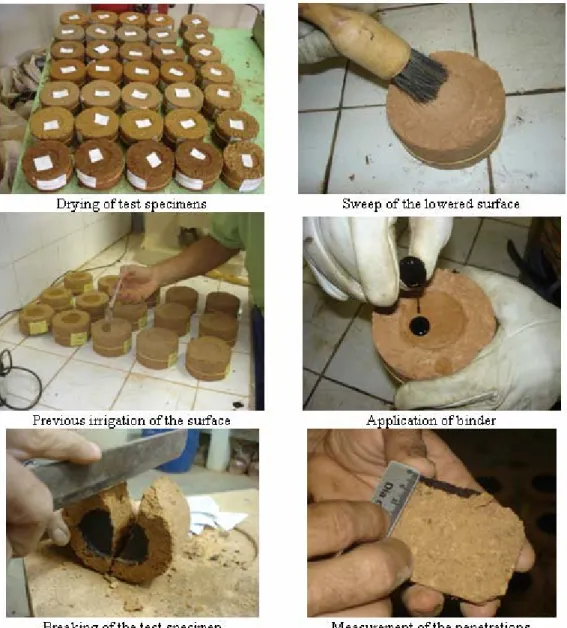
The procedure adopted to conduct the priming tests consisted of the following stages: a) molding of the test specimens;
b) maintenance of the test specimens in the shade until they lose about 50% of their humidity level approximately. In case one has not reached a value close to that, then one must wait a larger time interval or reduce it to prime);
c) sweep of the lowered surface of the test specimens to eliminate the powder occasionally existent; d) homogeneous irrigation of the lowered surface of the test specimens with aid of a syringe; e) priming of the test specimens, 15 minutes after the end of the previous irrigation;
g) breaking of the test specimens longitudinally in disposed sections and with the aid of a beveled ruler and reading the measures of the binder penetration in 5 points equally distant from each other, avoiding measures which are close to the lowered surface wall; and
h) calculation of the arithmetic mean of the 5 measures obtained (with precision of 1.0 mm)
Figure 3 shows the procedure adopted for conducting the priming tests.
Figure 3 - Procedure for conducting the priming tests (RABÊLO, 2006).
5. PRESENTATION AND DISCUSSION OF RESULTS
5.1. Tests of Characterization of Soil Samples
In table 1, we present the results of the tests of granulomety and of the classification of the soil samples studied.
mechanical stabilization or with the use of chemical additives (bitumen, cement, lime, mineral salts, materials made from enzymes, etc) and environmental residues.
Table 1 - Characterization and TRB classification of the samples collected for study.
Samples B F H I
2” 100 100 100 100
1” 90 100 98 98
3/8” 66 81 90 58
Nº 4 51 56 69 45
Nº 10 46 40 54 36
Nº 40 40 16 44 28
GRAD
UATI
ON
Nº 200 23 5 24 20
Range (DERT) D C F D
Class TRB A-1-b A-1-a A-1-b A-1-a
Liquidity Limit ((LL%)) 0 0 21 24
Plasticity Index ((IP (%)) 0 0 6 5
CBR (%) 67 40 35 40
Swelling (%) 0.07 0.0 0.03 0.02
Optimal Humidity (%) 2.65 2.63 2.66 2.58
MASM* (g/cm3) 2.65 2.63 2.66 2.58
* maximum apparent specific mass
5.2. Tests of Characterization of CNSL
5.2.1. Differential Exploratory Calorimetry (DSC)
When submitted to the thermal treatment by Differential Exploratory Calorimetry (DSC), the CNSL presented the exploratory calorimetric curve shown in Figure 4.
Figure 4 - Curves of DSC of CNSL.
5.2.2.Thermogravimetric Analysis (TGA)
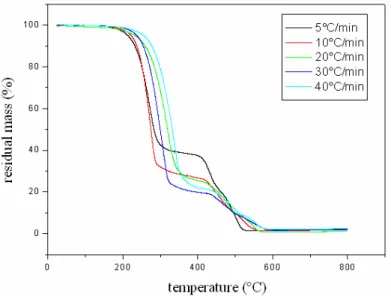
The termogravimetric analysis provides information on the content of the volatile components, such as solvents or water, on the decomposition behavior and content of ashes and thickeners of a substance. The result of the test of termogravimetric analysis of CNSL is shown in Figure 5.
Figure 5 – Curve of termogravimetric analysis of CNSL.
As seen in the graph of Figure 5, CNSL presented a resistance at the temperature of 200ºC without decomposing, demonstrating its good performance in relation to thermal stability and low residue level at heating. This is one of the advantages of the use of CNSL as asphalt diluent of AC, in view of the frequent need for heating of the asphalt binders to reduce the viscosity and to consequently improve the penetration potential in the compacted bases. Besides that advantage, the CNSL still has a flash point close to 140ºC, and can be heated beyond 90ºC, whose temperature was applied to the AC/CNSL mixture in the priming tests of the present experiment.
5.3. Tests of Characterization of the AC/CNSL Mixture
The results of the characterization of the AC/CNSL mixture are shown in table 2 and demonstrate that the AC/CNSL mixture can be heated up to a temperature over 90ºC.
Table 2 - Characterization of the AC/CNSL mixture used in the priming tests.
Characteristics Method Test Result
Saybolt-Furol Viscosity at 50°C (s) P-MB-517 120 Saybolt-Furol Viscosity at 90°C (s) P-MB-517 23
Flash Point (°C) MB 50 - IBP 219
5.4. Measures of the Penetration of Priming as a Function of the Molding Humidity
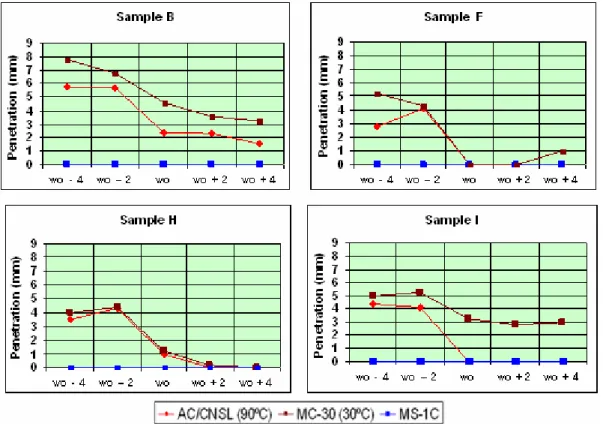
The results of the priming tests are presented in Figure 6. It is worth pointing out that all of the analyses conducted are restricted to the universe under study. We must emphasize that we considered as satisfactory the priming whose penetration reached for optimal humidity minus 2% (wo - 2%) the minimum measure of 4 mm. We suppose that, when that measure is reached, all of the attributes of cohesion, impermeability and conditions of adherence were met.
According to what is shown in Figure 6, one can notice that the AC/CNSL mixture, considering the criterion of minimum penetration of 4 mm, had a good performance as a binder to be used in priming services for bases of sandy characteristics.
The AC/CNSL mixture had a penetration evolution similar to the MC-30 cutback asphalt, generally used in priming of bases, presenting, however, a larger penetration potential for the sample B, which has a more sandy nature.
Still regarding the results presented in Figure 6, the values of the priming penetration for the test specimens molded at the level of humidity wo - 4% were, in some cases, smaller than those of the test specimens molded at the wo - 2% level. BUTTOM and MANTILLA (1994) also came across that situation when carrying out priming tests of test specimens molded with crushed sandstone which passed the 2 mm sieve and primed with some binders. According to those researchers, such a fact occurred because of the increase in surface tension of the water present between the soil grains. .
In general, one observed that the penetration measures are related to the molding humidity of the bases. Therefore, one concludes that, in order to obtain a quality priming, it is necessary the adoption of special care since the preparation of the base, as the uniform distribution of water by water transportation cars in the longitudinal and cross section directions of the layer, since any variation in the level of humidity of the base causes different values of penetration of the binder used. One also points out, by Figure 6, that the measures of the penetrations obtained for the MS-1C emulsion were all equal to zero, what allows one to attest that it is improper, in normal conditions, for use in priming of granular bases.
Figure 6 - Result of the measures of the penetration of priming as a function of the humidity level for each binder used in the experiment.
From the results obtained after conducting the experiment, one can conclude that:
a) The produced AC/CNSL mixture presented itself quite homogeneous, as it formed a homogeneous composition, without settling;
b) The AC/CNSL mixture presented a reasonable penetration potential in the bases of sandy nature; c) The use of CNSL as an asphalt diluent has the advantages of being a renewable, biodegradable and
non-pollutant raw material;
d) The use of CNSL as an asphalt diluent of AC still brings the social benefits as the cashew tree is a crop drought resistant and is produced in the period between the harvests of the other species cultivated in the region, what entitles it as a culture able to generate wealth and to serve as a tool for settling man in the field.
e) The MS-1C emulsion did not penetrate in any of the samples of the soils investigated, showing itself as unsuitable for use in priming services;
f) The measures of the priming penetration depend on some care procedures that must be taken since the preparation of the base, such as the uniform distribution of water in the longitudinal and cross-section directions, because any variation in the level of compaction humidity can produce different values of penetration of the bituminous binder.
We suggest that the research here generated can be tested for materials of different nature, including the loamier soils, as well as tested in the field for a better evaluation.
7. REFERENCES
CARNEIRO, SANDERS, A. L., HILUY FILHO, J. J., MAZZETTO, S. E;, CARIOCA, J. O. B. (2005). 3º Congresso Brasileiro de P&D em Petróleo e Gás. Salvador.
CASTRO C. A. A. (2003) Estudo da Técnica de Antipó com Emulsão de Xisto em Pavimentos para Baixo Volume de Tráfego. Dissertação de Mestrado. Programa de Engenharia Civil. COPPE/UFRJ. 188p. Rio de Janeiro, Brasil.
DANTAS NETO (2001) Materiais Asfálticos Alternativos para Uso em Pavimentação. Dissertação de Mestrado - Universidade de Brasília, Faculdade de Tecnologia, Departamento de Engenharia Civil e Ambiental. Brasília.
DNER (1994) ME 04 – Determinação da Viscosidade Saybolt-Furol de Materiais Betuminosos a Alta Temperatura. MT – Departamento Nacional de Estradas de Rodagem, Brasília, DF.
DNER (1994) ME 06 – Determinação do Resíduo por Evaporação da Emulsão Asfáltica. MT – Departamento Nacional de Estradas de Rodagem, Brasília, DF.
DNER (1994) ME 228 – Determinação da Penetração da Imprimação Betuminosa em Solos Compactados em Equipamento Miniatura. MT – Departamento Nacional de Estradas de Rodagem, Brasília, DF.
MANTILLA, C. A. e J. W. BUTTOM (1994) Prime Coat Methods and Materials to Replace Cutback Asphalt. Research Report TTI 0-1334, Texas Transportation Institute Texas A&M University, November.
RABÊLO, A. N. (2006) Contribuição ao Estudo da Imprimação Betuminosa das Bases Rodoviárias do Estado do Ceará. Dissertação de Mestrado em Engenharia de Transportes. Universidade Federal do Ceará. Fortaleza. Ce. 204 p.
Acknowledgements