Introduction
The removal of CO, unburned hydrocar-bons (HC), and NO from automotive exhaust requires catalytic devices in which these pollu-tants are eliminated. Catalytic combustion offers one of the most efficient means for controlling atmospheric pollution (1). Although noble met-als, such as palladium, platinum, and Rhodium are well known with higher activity (per site than metal-oxide catalysts, they present several disad-vantages, such as higher volatility, high cost, and poor availability. Compared with noble metals, base metal catalysts present a lower but still suf-ficient activity as oxidation catalysts, and have
the advantages of lower costs and the potential market in energy generation systems in domestic and small scale industrial applications. For this reason perovskite type compounds have received wide attention, which have been incorporated into the design of the novel combustors (2,3).
A perovskite-type oxide has an ABO3type crystal structure wherein cations with a large ionic radius have twelve coordination to oxygen atoms and occupy A-sites, and occupy B sites. A and O form a cubic closest packing, and B is con-tained in the octahedral voids in the packing. If the ionic radii are rA, rB and rO, to form a per-ovskite crystal structure, the tolerance factor (t) = (rA+ rO)/ (rB + rO) must lie within the range 0.8 <
www.scielo.br/eq www.ecletica.iq.unesp.br
Volume 34, número 1, 2009
Lanthanum based high surface area perovskite-type oxide
and application in CO and propane combustion.
P. R. N. Silva1, A. B. Soares1,2
1 Universidade Estadual do Norte Fluminense – CCT/LCQUI, Av. Alberto Lamego 2000 – 28013602 Campos dos Goytacazes, RJ 2 Centro Federal de Educação Tecnológica do Espírito Santo, 29040-780 Vitória – ES
Abstract: The perovskite-type oxides using transition metals present a promising potential as catalysts in total oxidation reaction. The present work investigates the effect of synthesis by oxidant co-precip-itation on the catalytic activity of perovskite-type oxides LaBO3(B= Co, Ni, Mn) in total oxidation of propane and CO. The perovskite-type oxides were characterized by means of X-ray diffraction, nitro-gen adsorption (BET method), thermo gravimetric and differential thermal analysis (ATG-DTA) and X-ray photoelectron spectroscopy (XPS). Through a method involving the oxidant co-precipitation it’s possible to obtain catalysts with different BET surface areas, of 33-44 m2/g, according the salts of metal used. The characterization results proved that catalysts have a perovskite phase as well as lan-thanum oxide, except LaMnO3, that presents a cationic vacancies and generation for known oxygen excess. The results of catalytic test showed that all oxides have a specific catalytic activity for total oxi-dation of CO and propane even though the temperatures for total conversion change for each transition metal and substance to be oxidized.
t < 1.0, and rA> 0.090 nm, rB> 0.051 nm. A great many elements can form ideal or modified per-ovskites depending on the tolerance factor. The ideal perovskites structure appears only in a few cases for tolerance factors very close to 1 and at right temperatures In others conditions different distortions of the perovskites structure will appear. Deviations from the ideal structure with orthorhombic, rhombohedral, tetragonal, mono-clinic and trimono-clinic symmetry are known, although the latter three are scarce and poorly character-ized [4]. Nonstoichiometry in perovskites can arise from cation deficiency (in the A or B site), anion deficiency or anion excess. Much attention has particularly been paid to lanthanum – transi-tion metal based perovskites oxides, which were introduced into catalysis some 30 years ago (5,6). but they are available for perovskites in which the metal in position A and/or B has been partly sub-stituted with another metal, thus establishing a large group of active oxides described by the gen-eral formula A1-xA´xB1-yB´yO3±d, where d stands for excess oxygen resulting from non-stoichiom-etry of these species [7].
Lanthanum-based perovskites containing transition metal in B-site, (LaBO3, B = Co, Fe, Ni or Mn), show catalytic activity close to the noble metal, presenting low cost and high thermal stabil-ity [8]. The perovskites type oxides are of interest for catalytic oxidation and reduction reactions asso-ciated with automotive exhaust emission control [9]. They have been tested in oxidation of CO and hydrocarbons, NOx reduction and hydrogenation and hydrogenolysis reactions [7].
In this work, the effect of oxidant - copre-cipitation synthesis on the catalytic activity of perovskite-type oxides LaBO3(B= Co, Ni, Mn) is investigated, using as a model the total oxidation of propane and CO.
Experimental
A number of methods have been used in the synthesis of perovskites; the choice of a par-ticular one depends mostly on the expected use for these oxides. The LaCoO3, LaMnO3 and LaNiO3perovskites oxides were prepared by oxi-dant – coprecipitation. The catalysts were
pre-pared using 20 mmol of aqueous solution (100 mL) of metal’s salts (Co(NO3)2.6H2O to LaCoO3, MnCl2.4H2O to LaMnO3 and Ni(NO3)2.6 H2O to LaNiO3) mixed with 100 mL of aqueous solution of lanthanum nitrate (20 mmol). The mixture was added drop wise to a rapidly stirred (nitrogen stream) solution of sodium hydroxide (7.2g 0.18 mol) in sodium hypochlorite (3.5 M. 30ml). Use of inert atmosphere minimizes carbonate contam-ination in the final product. The resultant gel was washed repeatedly with deionized water (3x200 ml), then washed with acetone (3x 50ml) and dried under vacuum.
The powder was dried at 60 ºC for 12h, after that it was calcinated at 600ºC for 2 hours.
The catalysts were characterized by X-ray powder diffraction (XRD) on a 65- Rich Seifert & Co diffractometer by using CuKaradiation for determination of the final structure. Patterns were recorded between a 2qof 20º and 65º with step size of 0.05º with 30kV and 40mA.
The specific surface areas were obtained by nitrogen adsorption at 77 K, evaluated using the BET equation on an automatic Quantachrome Aparatus, Autosorb – 1 C, in the 0, 05-0,095 rel-ative pressure range. The powders were degassed at 300ºC for 1h before the measurements.
The thermal decomposition with the tem-perature of the powder before heating at 60°C for 12h and passed by a sieve of 200 mesh was per-formed in N2by using a TGA-DTA of Schimadzu and TA Instruments, under N2 flow (50 m l min-1), and 10 0C min-1from room temperature to 600ºC.
The X-ray photoelectron spectra (XPS) were obtained with a VGESCALAB MKII, employing Mg Ka radiation (1253.6 eV) under a high vacuum of 3x10⁻⁸Torr. The binding energies were calibrated by using a C1s peak (284. 6 eV) as a background.
Temperature programmed reduction (TPR) experiments were performed in a system with a thermal conductivity detector. The reduc-ing gas was a mixture of 3% H2/N2(1.8 l/h) and heating 10°C/min was employed.
Before the reaction, the powder is pretreated for 1.5h at 400ºC with synthetic air: O2(20±0.5)% and N2 (80±0.5)%, 1.8 l/h. The feed gas compo-sition was CO (0.97%), C3H8 (0.507%), O2 (2.02%) and N2(balance), 1.8 l/h, on-line contin-uous analysis of reactants and products was per-formed using a gas chromatograph CG 9001 Finnigan, provided with a thermal conductivity detector. For CO and CO2analyses were utilized an independent ND-IR detector.
Results and discussion
The method employed was oxidant-copre-cipitacion, developed by Barnard et al [10] to LaCoO3catalyst synthesis.
The catalyst preparation in basic condi-tions, due to the presence the sodium hydroxide and sodium hypochlorite as oxidant agent, yields probably LaBOH (B= Co, Mn, Ni). This was reported by Vydiasagar et al [11] as the hydroxi-gel to be dehydrated.
The advantage in this method is that the dehydratation of the gel occurs at low tempera-tures (60°C), due to the initial dehydratation in the presence of acetone.
Controlled dehydratation of hydroxi-gel, using water and a miscible solvent, presents pos-itive results in obtain solids with high specific surface areas. The displacement of water by ace-tone allows a reduction of superficial tension and leads a smallest capillary force; producing weak agglomeration and keeping opened the particle structure. The result is a lowest collapse during calcination [12].
The perovskites type oxide LaCoO3, LaMnO3 e LaNiO3 presented specific surface area of the 44, 38 and 33m2/g, respectively.
Figure 1a, 1b and 1c display the TGA and DTA curves of respective catalysts. It can be observed that the samples present endothermic peaks at low temperatures, corresponding to the fisissorved water elimination.
The strong mass loss region from 300 and 500°C was attributed to the decarbonization and dehydratation, process accompanying the per-ovskite structure formation. DTA curves of these samples exhibit essentially only endothermic
peak the range, centered at 318 and 440 0C for LaCoO3, 340 and 420 0C for LaMnO3, 318 and 470 0C for LaNiO
3.This different behavior prob-ably due to the different decomposition mecha-nism of hydroxide gels. In LaNiO3 catalyst, the carbonate quantity is bigger, when compared to another catalyst, due to the catalyst has been stayed more time during the filtration process (72 h), once fine grain was formed, difficulting the filtration process.
The oxides at low temperatures present typical structure of perovskite (Figure 2), what can be confirmed comparing with standard archives JCPDS and literature [13-15]. The cata-lyst LaNiO3and LaCoO3 presented rhombohedri-cal structure and the LaMnO3 presented orthorhombic structure. In the catalysts LaCoO3 and LaNiO3 there’s a peak represented by (*), referring to lanthanum oxide (La2O3), indicating a cationic excess. In the LaNiO3exists a peak (¨), which confirms the presence of NiO, and was reported by others authors [16]. The catalyst LaMnO3doesn’t present a La2O3peak; it is pos-sible that this oxide presents cationic vacancies coming with an excess of negative species of oxygen. This fact can originate a spontaneous transition of 15-30% of Mn3+to Mn4+ to reestab-lish the eletroneutrality of system [17].
data indicate that lanthanum is probably present in trivalent form.
The sign in 779.9 and 795.5 eV corre-sponds to the Co 2p3/2and Co 2p1/2respectively, which is typical when Co3+ is present. On the other hand, the absence of peaks in 785 – 788 eV proves the inexistence of Co2+, and then the the-ory about the existence of cations in trivalent form.
The XPS spectra of LaCoO3, present two O 1s photolines that correspond to two different oxygen species. The lower binding energy, 529.8 eV, can be associated with lattice, while the high-er enhigh-ergy, 532.5 eV, can be associated with the species of absorbed oxygen, although this latter fraction should also contain adsorbed oxygen. The amount of oxygen absorbed-adsorbed can be represented by the species O- and OH-[16].
In the literature [20], the binding energy corresponding to the oxygen species appear in 528.3 and 531.9 eV. For the species OH-, these values are 529.7 and 532.2 eV, respectively. The similarity between OH- binding energies results in that the values presented in this work indicate a higher possibility of this species to exist.
In the catalyst LaMnO3 the absence of peak in high energy value indicates the presence only of the lattice oxygen. Alterations in the crys-talline structure and also in the electronic struc-ture can be responsible by displacement of the peak for higher energy values.
Figure 2. XRD spectra for the LaCoO3 e LaMnO3 and LaNiO3catalysts.
The surface characterization was realized for XPS analysis using C1s as reference. Table 1 contains binding energies values: O 1s, La 3d, Co 2p, Mn 2p and Ni 2p. Several works demonstrate that the majority of cations are present in triva-lent form [18,19].
The analysis date for LaCoO3 and refer-ences to the La 3d5/2 are registrated in 835.3 e 838.8 eV. These values are similar to that pre-sented in the literature [20] for the pure lan-thanum oxide (La2O3) in 834.4 e 837.8 eV. These
The Mn 2p spectra presents three signals which corresponds to Mn3+ (647.40 eV), Mn4+ (658.7 eV) and the presence of a peak, indicating the absence of Mn2+.
The information obtained by XPS is important to compare the stoichiometry of com-pounds (Table 1). The atomic relation La/Co on surface is 1.8. This suggests a lanthanum excess or Co-deficiency on LaCoO3 surface. Some authors have observed the presence of lanthanum excess in the perovskite structure (La/Co >1). Tejuca et al. [19] reported the relation La/Co is 1.2 in the catalyst LaCoO3, obtained by acetate synthesis. The more pronounciated case was observed by O’Connell et al. [20], which pre-pared the catalyst LaCoO3 through precipitation of nitrate solutions of salts, with thetraethilamo-nium hydroxide. In this case the relation La/Co was 4.26, showing the lanthanum excess on sur-face. This excess on surface catalyst is attributed to two phases formation; the first corresponding to the pure perovskite and the second for La/per-ovskite. In the first, the cationic vacancies are compensated by high valences of oxygen and cobalt. In the second, the cationic vacancies are compensated by anionic vacancies, being more interesting for catalysis.
It has been reported by others authors that the LaCoO3is considered as a stoichiometric sys-tem. On the other hand, this system was showed as non-stoichiometric, as reported by Spinicci et al [21]. In the non-stoichiometric system, gener-ally there is a deficiency of net lanthanum, which can be compensated, by increasing the metal valence or by oxygen or by creation of anionic vacancies.
In this work, it can be observed that the lanthanum ions quantity is almost twice of cobalt ions. It is possible to suppose the formation of stoichiometric LaCoO3 with other lanthanum-based compounds, like lanthanum oxide, proved by X-ray diffraction.
In LaMnO3catalyst, the relation La/Mn is 0.79, suggesting the non-stoichiometric lan-thanum manganite phase with lanlan-thanum defi-ciency. To keep the charge equilibrium, the con-version can be considered: Mn3+ ® Mn4+. This transition comes with vacancies formation and presence of oxygen excess. Taguchi et al. [22]
found the relation La/Mn changing from 1.5 to 2, depending on method used to obtain LaMnO3. However, part of lanthanum isn’t incorporated in perovskite, but presented as oxide, and part of this oxide is carbonated.
The peaks of lanthanum and nickel are located in the same energy range (835-855 eV). There is a overlapping for La3d3/2 and Ni2p3/2. The peak near 870 eV is characteristic for Ni2+in NiO, that was reported by Guo et al [23].
The atomic relation La/Ni on surface is near 1.6, which suggests the excess of lanthanum or deficiency of nickel on oxide surface of LaNiO3. In this case, the lanthanum excess is the more probable factor, due to X-ray diffraction, that shows both the nickel oxide and the per-ovskite phases.
Due to this quantity of positive ions in the structure, there is an oxygen ion excess, and part of this oxygen is absorbed in the structure.
The relation between oxygen and total metallic ion [O/(La + B)] in the catalyst LaCoO3 is near to 3.4, according to the result obtained by O’Connell et al [20]. In the catalyst LaMnO3this relation is near 2.5, both higher than that would be expected if the stoichiometry exists. This proved the materials can present oxygen excess in case of LaCoO3;for LaMnO3there are cation-ic vacancies. By the way, there is a catalyst LaCoO3with cobalt deficiency and LaMnO3with manganese deficiency. However, the majority of non-stoichiometric oxygen in LaCoO3 catalyst, when compared to LaMnO3, can indicate the major cationic vacancies in first case. In the LaMnO3, vacancies are minimized by transition of Mn3+® Mn4+. This relation for LaNiO
3is 2.5, which confirms the oxygen excess.
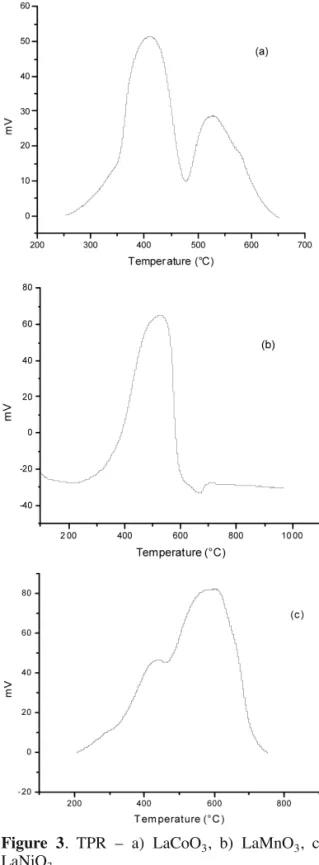
To obtain information about reducibility of studied catalyst and to identify the reduction tem-perature, it was realized a temperature-programmed reduction. The profile is showed on figure 3.
In the figure 3a, which refers to LaCoO3, according to Guo et al. [23], it is observed the cat-alyst reduction in two steps: in the first, the Co3+ to Co2+reduction; in the second, Co2+to Co0.
2 LaMnO3+d+ H2‡LaMnO3+ H2O (1) 3LaMnO3+ 9/2H2‡La2O3+ 3Mn0+ La(OH)
3
+ 3H2O (2)
Figure 3. TPR – a) LaCoO3, b) LaMnO3, c) LaNiO3
In figure 3c, which refers to LaNiO3, it is observed a small shoulder near 451 °C, corre-sponding to La2Ni2O5formation, which results of Ni3+to Ni2+ reduction, and the second peak (600 °C), to Ni2+ to Ni0 reduction. This transforma-tion, reported by Lima & Assaf [11], is according reaction bellow:
2 LaNiO3+ 2 H2‡La2Ni2O5+ 2 H2O (3) and
NiO + H2‡Ni0+ H
2O (4)
La2Ni2O5+ 2 H2 ‡2 Ni0+ La
2O3+ 2 H2O (5)
This shoulder indicates both the NiO pres-ence and the perovskite phase. Through an X-ray diffraction it was possible to identify the NiO phase. Furthermore, the first peak corresponds simultaneously to the Ni3+ to Ni2+ reduction in the perovskite structure, and Ni2+ to Ni0 reduc-tion of the nickel oxide contained in the sample. The second one corresponds to the Ni2+ to Ni0 reduction of La2Ni2O5,according to equation 5.
The conversion results were determined according to the reactions:
CO + ½ O2‡CO2 (6)
C3H8+ 5 O2‡3 CO2+ 4 H2O (7)
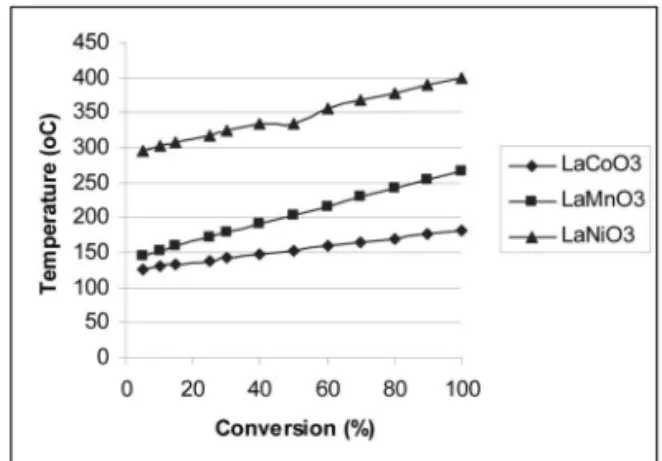
The CO oxidation (Figure 4) occurs at lower temperatures, when compared to propane. According values to CO conversion it was observed that the more efficient catalyst for this reaction was LaCoO3, that started the conversion at 130ºC and presented a maximum under 200ºC, while LaMnO3 presented this maximum near 300ºC. LaNiO3started the conversion near 300ºC that is a high temperature when compared to the others catalysts. The good conversion is men-tioned to the LaCoO3by Shu & Kaliaguine [13]. The results to propane oxidation are pre-sented in figure 5. It shows that conversion grows up according to the temperature for all catalysts. The perovskites LaCoO3and LaMnO3 presented the better conversion than LaNiO3.
that the non-stoichiometric oxygen can be a considerable factor for interpretation of catalyt-ic activity in a perovskite series of transition metals [19]. Therefore, the net chemical struc-ture in the perovskite is very complex, due hexagonal, rhombohedral or tetragonal distor-tions. These deviations can result in a cationic or anionic non stoichiometry.
For lanthanum manganite, the transition Mn3+à Mn4+is accompanied by cationic vacan-cies generations and for known oxygen excess related to necessary stoichiometry.
Conclusions
We have examined co-precipitation of a stoichiometric Co/La, Mn/La and Ni/La mixed
Figure 4. Conversion of perovskite type oxide for CO oxidation.
Figure 5. Conversion of perovskite type oxide for propane oxidation.
hydroxide, in which simultaneous oxidation of Co (II), Mn (III) and Ni (II) was induced by co –addition of an oxidizing agent. High- area sam-ples can be obtained by this method only if the hydroxide gel is dehydrated in a controlled man-ner by washing with a water- miscible nonaque-os solvent. Subsequent calcinations afforded a crystalline LaCoO3, LaMnO3 and LaNiO3 pow-der with perovskite structure and a surface area determined by the calcination temperature.
It was verified that the LaCoO3 catalyst presented more efficiency to oxidation reactions when compared to LaMnO3 and LaNiO3. The LaCoO3presented the highest specific surface.
Acknowledgements
Authors acknowledge FAPERJ for finan-cial support.
Received August 12 2008 Accepted November 22 2008
References
[1]T. V. Choudhary, S. Banerjee, V. R. Choudhary. Appl. Catal. A. 234 (2002)
[2]R. J. H. Voorhoeve, Advanced Materials in Catalysis (H. H. Burton and R. L. Garten, Eds.), p. 127. Academic Press, New York, 1977.
[3 ]S. Irusta, M.P.Pina, M. Melendez, J. Santamaria, Catal. Lett., 54 (1998) 69.
[4] L.G. Tejuca, J.L.G. Fierro, Catal. Rev., 34 (1992) 431. [5]G. Sarcco, I. Cerni, V. Specchia, R. Accornero, Chem. Eng., Sci., 54 (1998) 3599.
[6]K. Poplawski, J. Lichtenberger, F. J. Keil, K. Schnitzlen, M. D. Amiridis. Catal. Today, 62 (2000) 329.
[7] M. A. Peña, J.L.G. Fierro, Chem. Rev., 101 (2001) 1981. [8] V. Szabo, M. Bassir, J. E. Gallot, A. Van Neste, S. Kaliaguine, Appl. Catal. B 42 (2003) 265.
[9] V. Blausin-Aubé, J. Belkouch, L. Monceaux, Appl. Catal. B, 43 (2003) 175.
[10] K.R. Barnard, K. Foger, T.W. Turney, R.D. Williams, J. catal., (1990) 265.
[11] K. Vidyasagar, J. Gopalakrishnan, C.N.R. Rao, Sol. State Chem., 58 (1985) 29.
[12] R.A. Dombro, W. Kirch, Eur. Pat. Application, 110 (1984) 78.
[13] S. Kaliaguine, S. Van Neste, A.V. Szabo, J.E. Gallot, Bassir, M.R. Muzychuk, Appl. Catal. A: Gen., 209 (2001) 345. [14] S. Varma, B.N. Wani, N.M. Gupta, Appl. Catal. A: Gen., 205 (2001) 295.
[17] J. Mizusaki, M. Mori, H. Takai, Y. Yonemura, H. Minamiue, H. Tagawa, M. Dokiya, H. Inaba, K. Naraya, T. Sasamoto, T. Hashimoto, Sol. State ion., 129 (2000) 163. [18] J. Shu, S. Kaliaguine, Appl. Catal. B, 16 (1998) 303. [19] D. Kivana, J. Delval, J. Kirchnerova, J. Chaouki, Appl. Catal. A: Gen., 165 (1997) 171.
[20] M. O’Connell, A.K. Norman, C.F. Hüttermann, M.A. Morris, Catal. Tod., 47 (1999) 123-132p.
[21] R. Spinicci, M. Faticanti, P. Marini, S. De Rossi, P. Porta, J. Mol. Catal.A: Chem., 197 (2003) 147.
[22] H. Tagushi, A. Sugita, M. Nagao, J. Sol. State Chem., 119 (1995) 164.
[23] J. Guo, H. Lou, Y. Zhu, X. Zheng, Mat. Letters, 57 (2003) 4450.