Lobbying on Accounting Regulation: Evidence from the Oil Industry*
Odilanei Morais dos Santos
Ph.D., Accounting Department, Brazilian Capital Markets Institute, Rio de Janeiro E-mail: [email protected]
Ariovaldo dos Santos
Full Professor, Department of Accounting and Actuarial Science, School of Economics, Administration and Accounting, University of São Paulo E-mail: [email protected]
Received on 9.23.2013- Desk acceptance on 9.30.2013- 3rd. version approved on 6.4.2014
ABSTRACT
This work aims to identify the determining factors in the submission of comment letters to the International Accounting Standards Board (IASB) on the discussion paper Extractive Activities as a lobbying strategy in the context of accounting regulation. The results show that size is a determining factor in all models used, indicating that large oil companies are more likely to lobby. This tendency is especially evident for companies that are predominantly opposed to the IASB proposals, which suggests that the IASB’s review/replacement of In-ternational Financial Reporting Standards 6 (IFRS 6) will be a complex process subject to pressure from oil companies to maintain the status quo.
Keywords: Lobbying. Accounting regulation. Oil industry. Accounting choices.
1 INTRODUCTION
In the field of accounting regulation of oil exploration and production activities, the debate over which accoun-ting model best captures economic transactions in the oil industry dates back to the 1960s and 1970s. Even in the U.S., which has been a pioneer in the development of the theoretical and normative frameworks of accounting in the oil industry, both the Securities and Exchange Commission (SEC) and Financial Accounting Standards Board (FASB) have disagreed with each other about the appropriate stan-dards for the oil industry; as a result, two conflicting ac-counting methods have been allowed to coexist in the U.S.: the "successful efforts" method and the "full cost" method (Cortese, Irvine, & Kaidonis, 2009).
This scenario, in which oil companies can freely choose between two different accounting methods, was the result of an intense lobbying campaign by oil and gas compa-nies that effectively pitted the FASB and the SEC against each other. On one side, the FASB defended the successful efforts method in its Statements of Financial Accounting Standard no. 19 - Financial Accounting and Reporting by Oil and Gas Producing Companies (SFAS 19); on the other side, the SEC defended the full cost method in its Regula-tion SX 4-10. The two accounting standards continue to coexist in the U.S. today.
The same situation exists within the context of interna-tional standard setting, wherein attempts since 1998 to de-velop a single international accounting standard for the oil industry have been unsuccessful. In 2004, the International Accounting Standards Board (IASB) issued International Fi-nancial Reporting Standards 6 - Exploration for and Evalu-ation of Mineral Resources (IFRS 6) to provide guidance to extractive companies listed in the European Union, which were required to adopt International Financial Reporting Standards (IFRS) in 2005. Although IFRS 6 provided gene-ral guidelines for the different accounting methods used by international companies in extractive industries, it did not address the merits of each method and did not indicate whi-ch method should be adopted by international companies.
More than six years have passed since the issuance of IFRS 6, and discussions relating to the issuance of defini-tive international accounting standards for extracdefini-tive in-dustries are still ongoing. In this regard, the discussion pa-per Extractive Activities (DPEA), which was published by the IASB as part of its IFRS 6 review/replacement project, presents and discusses ten key questions regarding the re-cognition, measurement and disclosure of financial events relating to extractive activities.
With respect to the accounting regulation process, this study is based on the economic theory of regulation and the proposition of Watts and Zimmerman (1978) that agents have economic incentives to influence regulatory bodies through lobbying to obtain regulatory standards that satis-fy their interests. This study thus aims to answer the follo-wing research question: what are the determining factors in the submission of comment letters to lobby on accounting regulation of the oil industry?
The objective is to identify the determining factors in lo-bbying strategies in accounting regulation of the oil indus-try to ascertain the key features that cause interest groups comprising oil companies’ financial statement preparers to try to influence the IASB by submitting comment letters to public comment period.
To achieve the proposed goal, multivariate data analysis techniques (binomial and multinomial logistic regressions and Poisson regression) are used to ascertain whether the-re is corthe-relation between variables the-repthe-resenting firms' cha-racteristics and the submission of comments on the DPEA to the IASB. The study therefore aims to define the factors that determine the adoption of this lobbying strategy for the oil industry’s accounting regulation process.
Econometric modeling is conducted for a sample comprising both lobbying oil companies (those that submitted comment letters to the IASB) and non-lobbying oil companies (those that did not submit comment letters) to identify the preponderant economic factors involved in the adoption of lobbying strategies by such interest groups (oil companies) before the IASB.
This research strategy has been used to identify the rea-sons for lobbying and the lobbying strategies adopted by va-rious interest groups in numerous studies, including the stu-dies of Dhaliwal (1982), Sutton (1984), Francis (1987), Deakin (1989), Kenny and Larson (1993), Tutticci, Dunstan and Hol-mes (1994), Weetman, Davie and Collins (1996), Georgiou and Roberts (2004), Asekomeh, Russel and Tarbert (2006), Hansen (2011) and Ginner and Arce (2012), among others.
In this regard, it is necessary to clarify that the concept of lobbying employed in this study is very particular and refers to explicit statements contained in comment letters submitted at public consultation on accounting standards, as in the case of the DPEA.
However, analysis of the modus operandi of the IASB in issuing an IFRS, for example, reveals that the lobbying pro-cess does not only occur via the submission of comment letters. A number of lobbying strategies are possible, inclu-ding those listed below:
(a) participation in meetings with board or staff members, whether formal or informal, in-person or remote (e.g., videoconferences);
(b) participation in public sessions (round-tables) or field visits (outreach) during the established public comment period;
(c) appointing members to the sponsor foundation and its various bodies, such as the board and its technical or advisory committees (e.g., the IFRS Advisory Council, IFRS Interpretation Committee and the new Accoun-ting Standards Advisory Forum (ASAF), which is a con-sultative forum wherein members attempt to contribute to the development of globally accepted, high-quality normative standards) or even participation in different working groups;
(d) funding for the sponsors of the regulatory bodies; (e) use of audit firms and professional associations as
(f) other strategies, including surveys and leafleting, among others.
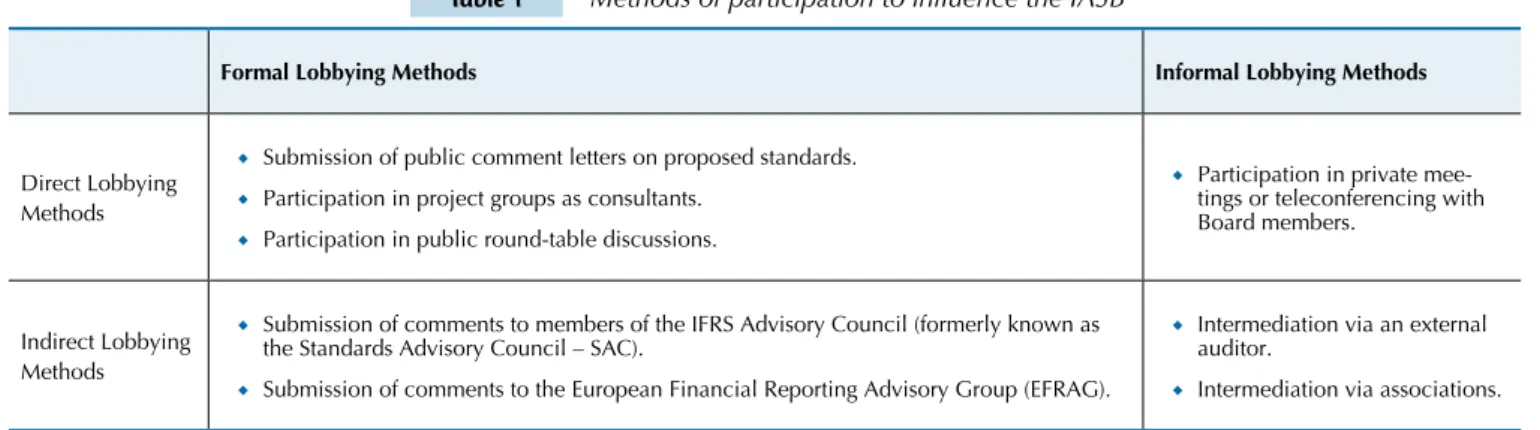
Orens, Jorissen, Lybaert and Tas (2011) developed a
schematic diagram that describes a set of lobbying strate-gies that can be used during different stages of the IASB’s standard-setting process, as shown in Table 1.
Table 1 Methods of participation to inluence the IASB
Formal Lobbying Methods Informal Lobbying Methods
Direct Lobbying Methods
Submission of public comment letters on proposed standards.
◆
Participation in project groups as consultants.
◆
Participation in public round-table discussions.
◆
Participation in private
mee-◆
tings or teleconferencing with Board members.
Indirect Lobbying Methods
Submission of comments to members of the IFRS Advisory Council (formerly known as
◆
the Standards Advisory Council – SAC).
Submission of comments to the European Financial Reporting Advisory Group (EFRAG).
◆
Intermediation via an external
◆
auditor.
Intermediation via associations.
◆
Source: Orens, Jorissen, Lybaert and Tas (2011).
Notwithstanding this acknowledgment that ‘lobbying’ is a much more comprehensive concept in practice, due to metho-dological constraints, this study considers a lobbying strategy to be a strategy that uses the submission of public comment letters in response to public consultation of standard-setting bodies.
In defense of the use of comment letters to assess lobbying activities, Asekomeh et al. (2006) argue that unlike responses to questionnaires, which can be skewed/biased, comment letters provided in response to questions raised in public consultation provide a more accurate picture of lobbying ac-tions because the statements contained in comment letters contribute significantly to the understanding of the position of each agent involved in the standard-setting process.
Georgiou (2004) investigated the effectiveness of multi-ple lobbying methods, including but not limited to comment letters. The results showed that even when parties used other lobbying methods – such as intermediation by audit firms and meetings with the UK’s Accounting Standards Board (UKASB) – these methods were significantly associated with use of comment letters. The author concluded that compa-nies that submitted comment letters were more likely to use other, complementary lobbying methods than companies
that did not submit comment letters (Georgiou, 2004). The selection for this study of the oil industry and, con-sequently, of the accounting standards applicable to the oil industry stems from the fact that historical evidence pro-vided by Collins, Dent and O'Connor (1978); Solomons (1978); Deakin (1979); Collins, Rozeff and Salatka (1982); Deakin (1989); Zeff (2005); and King (2006), among others, has shown that the U.S. regulatory framework applicable to accounting in the oil industry emerged as a result of a strong lobbying system that exerted pressure and influen-ce on the SEC and FASB. This phenomenon was also ob-served with respect to the issuance of IFRS 6 by the IASB. Specifically, Cortese, Irvine and Kaidonis (2010) presented evidence that demonstrated that the international accoun-ting body was captured by the regulated companies, resul-ting in a standard that maintained the status quo (i.e., the free choice of accounting methods), which clearly serves the interests of the oil companies.
In this context, the publication of the DPEA provides ano-ther opportunity to observe lobbying by oil companies to in-fluence the IASB’s regulation of oil industry accounting. This is the basis for this study and the reason why it is important.
2 THEORETICAL FRAMEWORK
According to Viscusi, Harrington and Vernon (2005), the theory of regulation can be viewed from three angles: the public interest theory; the capture theory; and the economic theory of regulation, which is also known as the interest group theory. This study adopts the perspective of the economic theory of regu-lation.
The basic assumption of the economic theory of regulation is that regulation is conducted to meet the needs and contribute to the welfare of the interest groups that exert the greatest pressure on standard set-ters (Viscusi, Harrington & Vernon, 2005). Given this assumption, the economic theory of regulation is also known as the interest group theory. The main
expo-nents of the economic theory of regulation are rese-archers Stigler (1971), Posner (1974), Peltzman (1976) and Becker (1983).
According to the economic theory of regulation, re-gulation is performed to serve the interests of groups that are more politically effective in convincing regu-lators to act on their behalf. Watts and Zimmerman (1978, 1986), in line with Stigler (1971), Peltzman (1976) and Posner (1974), assume that individuals act to maximize their own utility and, therefore, that the process of accounting regulation (standardization) is the result of a political process in which individuals and groups compete for wealth transfers.
theory in the political process focuses on incentives for in-dividuals to come together in groups in order to lobby (in-fluence regulators) for transfers of wealth. Thus, according to Solomons (1978), assuming that the standard-setting process is political, accounting standards are not necessa-rily guided by theoretical or technical issues but by the di-fferent interests of the affected parties, who exert pressure for individual gain.
According to Kothari, Ramanna and Skinner (2010), re-gulators are endowed with their own ideologies, and stan-dards are the joint result of the regulators’ ideologies and the effects of the pressure (lobbying) exerted by special in-terest groups. Under this theory, lobbying is not viewed as an illegal or immoral activity but as a mechanism through which regulators are informed of companies’ policies and practices.
The studies on lobbying in accounting regulation can be considered a subset of the studies on accounting choice (Francis, 1987; Kenny and Larson, 1993) because, accor-ding to Francis (2001), lobbying activities represent only one dimension of accounting choice.
According to Fields, Lys and Vincent (2001), an ac-counting choice is a decision whose primary purpose is to influence (in form or in substance) the output of the accounting system. Based on this definition, the theory of accounting choice is linked with the theory of interest groups because accounting choice is based on various existing economic incentives, and such incentives are present in the regulation process itself. Thus, managers lobby the standard-setting body at the origin of standard development to obtain standards that meet their inte-rests from the outset.
Watts and Zimmerman (1986) formulated three hy-potheses regarding firms’ accounting choices that are relevant to the accounting regulation process: (1) the management compensation hypothesis, which states that managers have incentives to make choices that ma-ximize their compensation; (2) the debt covenant hypo-thesis, which predicts that managers will make choices that avoid violating the terms of a loan; and (3) the po-litical cost hypothesis, which posits that managers make accounting choices that will avoid political and public scrutiny.
More specifically, the management compensation hypothesis, also known as the bonus plan hypothesis, states that managers who receive variable compensation (e.g., bonuses, stock or stock options) often use accoun-ting methods that shift reported earnings from future periods to the current period, thereby increasing their variable compensation for the current period (Watts and Zimmerman, 1986).
Regarding the debt covenant hypothesis, Watts and Zimmerman (1986) argue that managers of compa-nies that have higher degrees of debt are more likely to use accounting methods that increase profits. The assumption is that the higher the debt level, the more
the company will be stifled by restrictions and condi-tions imposed by creditors, and the more stringent the restrictions imposed by creditors, the greater the like-lihood that the company will violate the restrictions. By increasing company profits, managers ultimately relax the restrictions imposed by creditors (Watts and Zimmerman, 1986).
Under the political cost hypothesis, the authors as-sert that large companies tend to use accounting me-thods that reduce profits more often than small com-panies, because size influences the amount of political attention received by a company. The assumption is that higher profits may attract adverse attention from regulators, professional associations, media, environ-mentalists and consumer groups, among others (Watts and Zimmerman, 1986).
Watts and Zimmerman (1978, 1986) argue that regula-tion is performed according to the interests of groups that are more politically effective in convincing the regulator/ standard setter to act on their behalf, which accords with the economic theory of regulation (Stigler 1971, Peltz-man, 1976, Posner, 1974; Becker, 1983).
By aligning accounting choice with the process of accounting regulation, managers have economic in-centives to lobby regulators against or for accounting standards that enable the managers to, e.g., reduce or defer the payment of taxes; reduce political costs and information production (disclosure); or increase the receipt of bonuses.
Watts and Zimmerman (1978) empirically tested the formulated hypotheses using discriminant analysis on a sample of 52 comment letters submitted by companies on the FASB discussion memorandum regarding the accoun-ting standard for general price level adjustments, and they concluded that managers have economic incentives to participate in the standard-setting process by lobbying the regulator.
Ndubizu et al. (1993) investigated the exposure draft step of SFAS 87 using a sample of 1,802 firms, in-cluding 156 lobbying companies who spoke against the exposure draft and 1,646 other (non-lobbying) compa-nies. The results of Ndubizu et al. (1993) differed from those reported by Francis (1987) in that Ndubizu et al. (1993) found that only earnings volatility – a variable not included in the previous study – was relevant in explaining the decision to submit comments on the exposure draft. This result confirmed the formulated hypothesis that companies with high earnings volatility prior to the adoption of a new standard are more likely to lobby.
Deakin's (1989) work sought to study the process of accounting regulation in the oil industry for companies that made submissions to the FASB. The author used a sample of companies that used the full cost method because these companies would be most affected by the FASB proposal. To define the dependent variable, the author classified companies as lobbying (those sub-mitting comments on the FASB discussion memoran-dum or exposure draft) and non-lobbying (those not submitting any comments). The author used a logistic regression model to test hypotheses related to the exis-tence of restrictive financial covenants and performan-ce-based management compensation plans and found that the empirical evidence was consistent with these hypotheses.
Also noteworthy is the study by Georgiou and Ro-berts (2004) that analyzed the behavior of companies that lobbied the UKASB on the "deferred tax" standard. Their results indicated that the size and behavior of a company in past public consultation (frequency of lo-bbying) were key factors in the decision to submit com-ments to the UKASB on deferred taxes. Their results also indicated that companies submitting comments against the proposed standard were more likely to have contracts with debt covenants than companies in favor of the proposed standard.
Finally, their evidence showed that companies with performance-based management compensation plans were more likely to provide comments in favor of the proposal than companies without performance-based management compensation plans (Georgiou and Ro-berts, 2004).
More recently, the process of lobbying on accoun-ting regulation has been studied from the perspective of institutional theory (Bengtsson, 2011; Chatham, Larson and Vietze, 2010; Fogarty, 1992; Giner and Arce, 2012; Kenny and Larson, 1993; Koh, 2011; Lar-son 2002, 2008; LarLar-son and Kenny, 2011). This theory suggests that the actions of organizations should be understood as attempts to obtain legitimacy and to maintain credibility with external constituents (Fo-garty, 1992).
Tavares, Paulo, Anjos and Carter (2013) reiterated Riahi-Belkaouri's (2004) assertion that the promulga-tion of a standard is a social choice that forces regu-lators to adopt a political process aimed at accommo-dating various interests, including their own. In other words, according to institutional theory, the regulator is motivated to adopt strategies that will maintain its power and credibility in the community and facilitate the re-election of its members.
Institutional theory places organizations within a social setting and explicitly recognizes the influen-ce of the external social environment on the internal activities of an organization, which seeks to obtain legitimacy or to retain social acceptance (Kenny and Larson, 1993).
In this context, organizations such as the IASB seek legitimacy from their constituents in order to survive. The solicitation of comments on its products (accoun-ting standards) from interested parties is one strategy employed by the IASB in its quest for legitimacy (Kenny and Larson, 1993).
Consequently, various interest groups, which also seek legitimacy and recognition from their peers, can freely participate in the standard-setting process of these regulatory bodies, even when the interest groups are not directly affected by a normative proposal (Cha-tham et al., 2010).
Given that the standard-setting process is a political one, organizations such as the IASB must continuously monitor the needs of their constituents and adjust their operations to accommodate those needs (Kenny and Lar-son, 1993; Larson and Kenny, 2011).
According to Bengtsson (2011), institutional the-ory has been used in studies on accounting standard setting to complement the explanatory framework of political economy (from which the economic theory of regulation follows), and the focus of these studies has been on how external pressures influence the adoption of accounting standards.
Because this study is based on a discussion paper (the DPEA), it is not yet possible to know which opinions will ultimately be accepted or rejected by the IASB. To understand the accommodations that are made, this study uses the assumptions of institutional theory to complement the notions that participation in the public consultation process (lobbying) is legitimate and that companies seek to promote their accounting choices in the regulatory process. The study then turns to the eco-nomic theory of regulation to identify factors that lead companies to participate in the regulatory process.
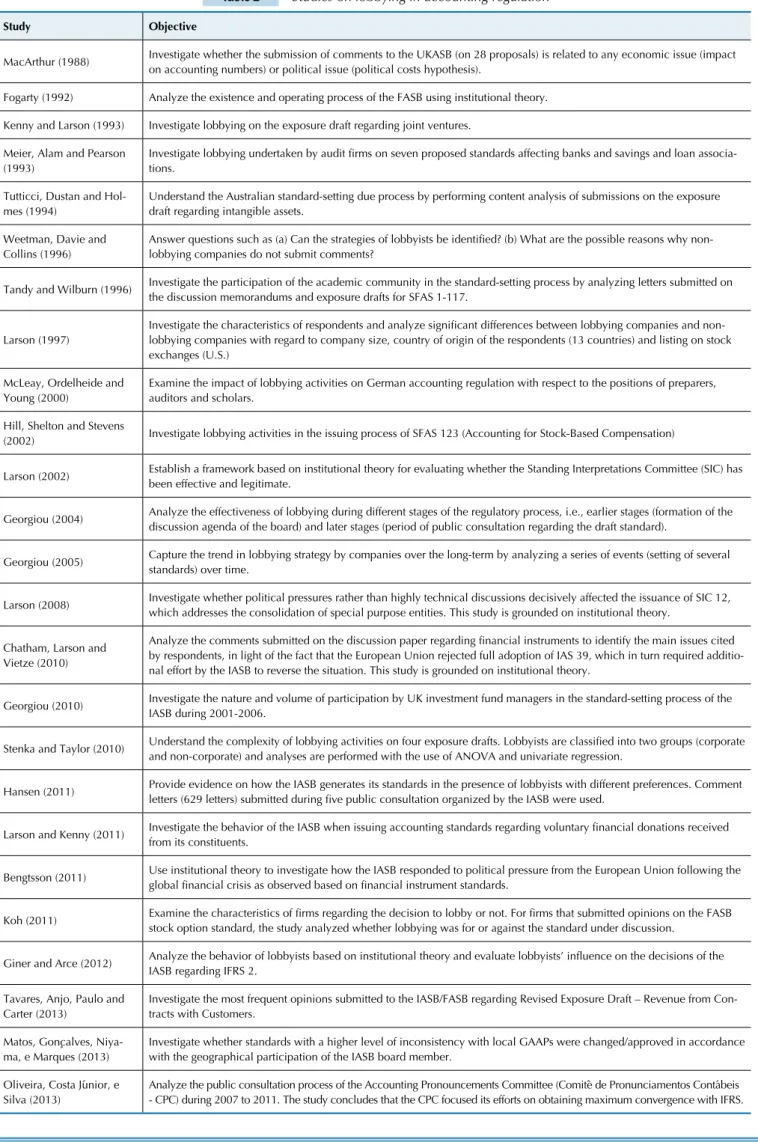
Table 2 Studies on lobbying in accounting regulation
Study Objective
MacArthur (1988) Investigate whether the submission of comments to the UKASB (on 28 proposals) is related to any economic issue (impact on accounting numbers) or political issue (political costs hypothesis).
Fogarty (1992) Analyze the existence and operating process of the FASB using institutional theory.
Kenny and Larson (1993) Investigate lobbying on the exposure draft regarding joint ventures.
Meier, Alam and Pearson (1993)
Investigate lobbying undertaken by audit irms on seven proposed standards affecting banks and savings and loan associa
-tions.
Tutticci, Dustan and Hol-mes (1994)
Understand the Australian standard-setting due process by performing content analysis of submissions on the exposure draft regarding intangible assets.
Weetman, Davie and Collins (1996)
Answer questions such as (a) Can the strategies of lobbyists be identiied? (b) What are the possible reasons why non-lobbying companies do not submit comments?
Tandy and Wilburn (1996) Investigate the participation of the academic community in the standard-setting process by analyzing letters submitted on the discussion memorandums and exposure drafts for SFAS 1-117.
Larson (1997)
Investigate the characteristics of respondents and analyze signiicant differences between lobbying companies and
non-lobbying companies with regard to company size, country of origin of the respondents (13 countries) and listing on stock exchanges (U.S.)
McLeay, Ordelheide and Young (2000)
Examine the impact of lobbying activities on German accounting regulation with respect to the positions of preparers, auditors and scholars.
Hill, Shelton and Stevens
(2002) Investigate lobbying activities in the issuing process of SFAS 123 (Accounting for Stock-Based Compensation)
Larson (2002) Establish a framework based on institutional theory for evaluating whether the Standing Interpretations Committee (SIC) has been effective and legitimate.
Georgiou (2004) Analyze the effectiveness of lobbying during different stages of the regulatory process, i.e., earlier stages (formation of the discussion agenda of the board) and later stages (period of public consultation regarding the draft standard).
Georgiou (2005) Capture the trend in lobbying strategy by companies over the long-term by analyzing a series of events (setting of several standards) over time.
Larson (2008) Investigate whether political pressures rather than highly technical discussions decisively affected the issuance of SIC 12, which addresses the consolidation of special purpose entities. This study is grounded on institutional theory.
Chatham, Larson and Vietze (2010)
Analyze the comments submitted on the discussion paper regarding inancial instruments to identify the main issues cited
by respondents, in light of the fact that the European Union rejected full adoption of IAS 39, which in turn required additio-nal effort by the IASB to reverse the situation. This study is grounded on institutioadditio-nal theory.
Georgiou (2010) Investigate the nature and volume of participation by UK investment fund managers in the standard-setting process of the IASB during 2001-2006.
Stenka and Taylor (2010) Understand the complexity of lobbying activities on four exposure drafts. Lobbyists are classiied into two groups (corporate and non-corporate) and analyses are performed with the use of ANOVA and univariate regression.
Hansen (2011) Provide evidence on how the IASB generates its standards in the presence of lobbyists with different preferences. Comment letters (629 letters) submitted during ive public consultation organized by the IASB were used.
Larson and Kenny (2011) Investigate the behavior of the IASB when issuing accounting standards regarding voluntary inancial donations received from its constituents.
Bengtsson (2011) Use institutional theory to investigate how the IASB responded to political pressure from the European Union following the global inancial crisis as observed based on inancial instrument standards.
Koh (2011) Examine the characteristics of irms regarding the decision to lobby or not. For irms that submitted opinions on the FASB stock option standard, the study analyzed whether lobbying was for or against the standard under discussion.
Giner and Arce (2012) Analyze the behavior of lobbyists based on institutional theory and evaluate lobbyists’ inluence on the decisions of the IASB regarding IFRS 2.
Tavares, Anjo, Paulo and Carter (2013)
Investigate the most frequent opinions submitted to the IASB/FASB regarding Revised Exposure Draft – Revenue from Con-tracts with Customers.
Matos, Gonçalves, Niya-ma, e Marques (2013)
Investigate whether standards with a higher level of inconsistency with local GAAPs were changed/approved in accordance with the geographical participation of the IASB board member.
Oliveira, Costa Júnior, e Silva (2013)
The cited studies, especially those by Watts and Zimmerman (1978), Francis (1987), Deakin (1989), Ndubizu et al. (1993) and Georgiou and Roberts (2004) are methodologically aligned with the objective of this
The following research strategies are used to identify the determinant factors of lobbying activity on accounting regulation in the oil industry.
Based on the 141 comment letters published by the IASB on its website, the first step is to perform content analysis of the letters submitted by oil companies to measure the dependent variable used in the econometric models.
The second step of the study is based on quantitative analysis and uses econometric models to identify the eco-nomic factors that determine the adoption of a lobbying strategy that employs the submission of comment letters.
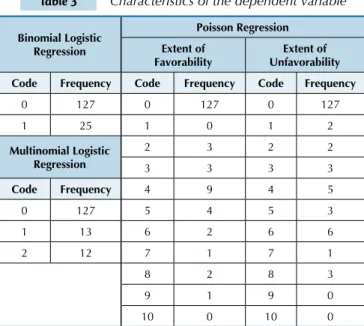
Depending on the characteristics of the dependent va-riable, binomial and multinomial logistic regressions and Poisson regression are used. In the case of binomial regres-sions, the dependent variable takes a value of "1" where comments on the DPEA have been submitted and a value of "0" otherwise.
In multinomial logistic regression, the dependent va-riable is decomposed into three categories: "0" to represent companies that submitted no comments on the DPEA; "1" to represent the companies that submitted predominantly favorable comments; and "2" to represent companies that submitted predominantly unfavorable comments.
Finally, Poisson regression is employed when the depen-dent variable is intended to express the degree of agreement or disagreement with the ten questions presented in the DPEA. Thus, it can take values from zero, in the case of companies that submitted no comments, up to ten, which represents the maximum number of times a company could agree or disa-gree with the proposals addressed in the DPEA questions.
3.1 Definition of Variables and Research
Hypotheses.
As stated earlier, the dependent variable used as a proxy for lobbying refers to the explicit statements contained in comment letters submitted to the public consultation on the DPEA. This model has been widely used in accounting studies on lobbying, including studies by Watts and Zim-merman (1978), Francis (1987), Deakin (1989), Ndubizu et al. (1993) and Georgiou and Roberts (2004).
In this study, lobbying strategies are limited to com-ment letters because the use of other lobbying strategies to measure the dependent variable usually involves private information, which makes modeling difficult to implement (Holthausen and Leftwich, 1983). Although the exclusi-ve use of comment letters is an inherent limitation of the present study, several studies have defended this modeling
Table 3 Characteristics of the dependent variable
Binomial Logistic Regression
Poisson Regression Extent of
Favorability
Extent of Unfavorability Code Frequency Code Frequency Code Frequency
0 127 0 127 0 127
1 25 1 0 1 2
Multinomial Logistic Regression
2 3 2 2
3 3 3 3
Code Frequency 4 9 4 5
0 127 5 4 5 3
1 13 6 2 6 6
2 12 7 1 7 1
8 2 8 3
9 1 9 0
10 0 10 0
approach, including Asekomeh et al. (2006), Chung (1999), Sutton (1984) and Georgiou (2004). Thus, this modeling approach is adopted for the present study.
Accordingly, depending on the type of regression used, the dependent variable has the characteristics listed in Table 3. work, which is to establish the determining factors that led oil companies to submit comments on the DPEA, i.e., to lobby.
3 METHODOLOGY
Regarding the independent variables, size has often been used in the literature on lobbying on accounting re-gulation to express a company's exposure (political cost hypothesis) (Watts and Zimmerman, 1978; Francis, 1987; Deakin, 1989; Ndubizu, Choi and Jain, 1993 and Georgiou and Roberts, 2004).
Size has also been associated with the hypothesis that a lobbying strategy is only adopted if the benefits of lobbying outweigh the costs (Sutton, 1984). In this sense, Koh (2011) states that because large companies have more resources, they usually tend to influence the final result and hence reap the benefits of lobbying.
To operationalize the size variable, the following four proxies were used: net revenue for the period (NETREV); total assets for the period (TOTASS); average net profit for the last three periods (AVPROF); and exploration and de-velopment costs incurred in the period (UPSTREAM). The test hypothesis for size is defined as:
H1: Large oil companies are more likely to lobby, whe-ther for or against the proposed standard, than owhe-ther oil companies.
de-pend on indicators derived from financial information tend to choose accounting models that benefit themsel-ves. In other words, these companies will opt for pro-posed standards that incorporate accounting methods that increase or diminish profits, according to their respective interests.
The second characteristic is the existence of restric-tive debt covenants. This theory holds that managers tend to choose accounting standards that result in the non-violation of those covenants. Thus, the closer the company is to a covenant threshold based on accounting numbers, the greater the probability that the manager will use accounting procedures that increase revenue and/or reduce the level of debt (Holthausen and Leftwi-ch, 1983).
To operationalize these two characteristics, the MAN-COMP and COVENANT binary variables are used, which take the value of "0" in cases in which the company does not have the characteristic of interest and the value of "1" in ca-ses in which the company has the characteristic of interest. These variables are measured by searching the explanatory notes to companies’ financial statements (available on their websites) for references to the existence (or absence) of performance-based management compensation plans and restrictive debt covenants.
These variables can be operationalized in different ways, and the binary coding of "0" or "1" for these variables based on the existence or absence of the testable characteristic is a limitation of the study. This is because the manner in which binary variables are operationalized cannot properly captu-re the magnitude of the characteristic they aim to investiga-te. Deakin (1989), Georgiou and Roberts (2004), Georgiou (2005) and Koh (2011) are examples of studies that offer alternative methods of operationalizing these variables.
The testable hypotheses are:
H2: Oil companies with performance-based manage-ment compensation plans are more likely to lobby, whether in favor of or against the proposed standard, than oil com-panies without performance-based management compen-sation plans.
H3: Oil companies with restrictive debt covenants are more likely to lobby, whether in favor of or against the pro-posed standard, than oil companies without restrictive debt covenants.
To capture the risk of possible changes in the ac-counting regulation of the oil industry, the test model also considers the USLISTING and METHOD variables. Current international accounting regulation applicable to extractive activities is based on the IFRS 6 standard, which states that extractive companies can freely de-fine their respective accounting policies. In practice, IFRS 6 does not mandate any specific method for asset recognition and measurement. As a result, companies subject to international standards ultimately choose between one of the two best-known international
ac-counting methods, namely, the successful efforts and full cost methods, both of which were established by the United States.
Such an attitude can be understood from the perspective of institutional theory and the concept of mimetic isomor-phism in particular. According to the concept of mimetic isomorphism, organizations tend to copy the practices of other organizations, particularly within the same industry, even when the organizations are not required to follow spe-cific standards (Koh, 2011).
The adoption of the successful efforts or full cost me-thod is therefore a global reality and facilitates the publi-cation of financial statements by non-US companies in the U.S. when, for example, non-U.S. companies are traded on the New York stock exchange.
The use of the USLISTING variable aims to capture the risk of possible changes in accounting regulation from the perspectives of both U.S. companies and non-U.S. compa-nies whose stocks are traded on the U.S. market.
In the case of U.S. companies, although there is no clear expectation that the U.S. will adopt the IFRS for U.S. companies, the evidence shows that the partici-pation of U.S. companies in the process of IASB stan-dard-setting is relevant; in some cases, U.S. companies are the parties with the greatest involvement in IASB public consultation (Larson, 1997; Larson and Kenny, 2011; Giner and Arce, 2012).
In the present study, 27 letters (19%) of the 141 letters received by the IASB on the DPEA were from interested U.S. parties. Thus, U.S. parties were second only to Europe-an parties, who submitted 76 letters.
Giner and Arce (2012) analyzed the IFRS 2 issuance process and showed that 264 of the 539 letters received by the IASB were submitted by U.S. companies. They ar-gued that the strong participation by U.S. companies in the IASB’s standard-setting process was motivated by fears about the possibility that the FASB and SEC will change their position regarding the adoption of IFRS for domestic companies (Giner and Arce, 2012).
From the perspective of non-U.S. companies that adopt IFRS, Larson (1997) and Georgiou (2005) argued that changes in international standards can increase transaction costs by requiring accounting adjustments and the disclo-sure of additional information to meet the needs of U.S. investors. Thus, non-U.S. companies have an incentive to lobby the IASB to maintain the status quo.
Therefore, this study considers that U.S. oil compa-nies and oil compacompa-nies that trade on the U.S. stock ma-rket have an incentive to lobby the IASB to maintain the status quo, i.e., to maintain the companies’ freedom to choose between the successful efforts and full cost me-thods, and thereby avoid the possible transaction costs associated with convergence to new standards. The test hypothesis corresponds to:
more likely to lobby against the proposed standard than oil companies not listed on the U.S. stock market.
One of the proposals under consideration by the IASB establishes a new method for asset recognition and measurement applicable to extractive activities and eliminates the choice between the successful efforts and full cost methods.
The IASB's proposal would establish that the legal right to exploit natural resources is the key basis for the recog-nition of assets and that other costs incurred to confirm and ensure the commercial exploitation of resources are enhancements of that legal right. Thus, this scenario is a departure from the experience of companies accustomed to the successful efforts or full cost method.
Zeff (2002) argued that the setting of a new standard that eliminates choice or imposes additional disclosure re-quirements is a trigger for constituents to put pressure on the standard setter to meet their needs. This argument is also found in Saemann (1999), who maintained that such a scenario typically leads interested parties to oppose the standard setter's proposals.
Tavares et al. (2013) argued that regulation restricts ac-counting choice to the extent that the regulator has the po-wer to decide the accounting policies that regulated com-panies should follow.
In this context, the DPEA proposal eliminates oil com-panies’ choice by establishing a single method of asset
re-PROB(LOBBYINGi ) =
1 + e - α0 + β1NETREVi + β2TOTASSi + β3AVPROFi + β4UPSTREAM
+ β5MANCOMPi + β6COVENANTi + β7USLISTINGi + β8METHODi +εi
1
cognition and measurement. Thus, under Zeff 's (2002) theory, companies have an incentive to lobby the IASB to maintain the status quo. This incentive is also supported in Watts and Zimmerman (1978, 1986), who argue that finan-cial statement preparers consider the potential impact of a new accounting approach on expected future cash flows when deciding whether to lobby.
As discussed in Santos, Lopes and Silva (2010), com-panies that follow the successful efforts method would be most affected by the proposal in the DPEA because adop-tion of this proposal would lead to significant changes in the accounting policies of these companies. Accordingly, it is expected that companies using the successful efforts method are more likely to lobby against the proposals in the DPEA.
Thus, the METHOD variable aims to determine whe-ther whe-there is an association between the choice of the suc-cessful efforts method (labeled "1") and the probability of submitting comments against the DPEA. The testable hy-pothesis corresponds to:
H5: Oil companies using the successful efforts method are more likely to lobby against the proposed standard than oil companies using the full cost method.
3.2 Specification of Econometric Models.
The reasoning presented above leads to the following econometric model:
where i represents the company, and LOBBYING takes the value "1" for companies who submitted comments on the DPEA and the value "0" for companies that did not submit comments. The error term of the regression is indicated by parameter ε; α is the intercept; and β1, β2, β3, ..., β8 are the estimated coefficients, which are expected to be statistically significant and positive.
According to Favero, Belfiore, Silva and Chan (2009),
the analysis of the results focuses on the coefficients of the independent variables (β), which must be statistically relevant, and is based on the idea that when the coeffi-cient is greater than zero, the probability of occurrence of the event of interest (i.e., lobbying on the DPEA) is greater, and vice versa.
The multinomial logistic regression has the following specification:
ln = PROB (LOBBYING = 1|X)
PROB (LOBBYING = 0|X) + βα1 + β1NETREVi + β2TOTASSi + β3AVPROFi + β4UPSTREAM
5MANCOMPi + β6COVENANTi + β7USLISTINGi + β8METHODi +εi
where LOBBYING assumes a value of "0" for compa-nies that did not submit comments on the DPEA; "1" for companies that submitted comments that were pre-dominantly in favor of the DPEA; and "2" for compa-nies that submitted comments that were predominantly against the DPEA.
The analyses are conducted by comparing (1)
panies that submitted predominantly favorable com-ments to companies that did not submit comcom-ments and (2) companies that submitted predominantly unfavorable comments to companies that did not submit comments (Favero, Belfiore, Silva and Chan, 2009).
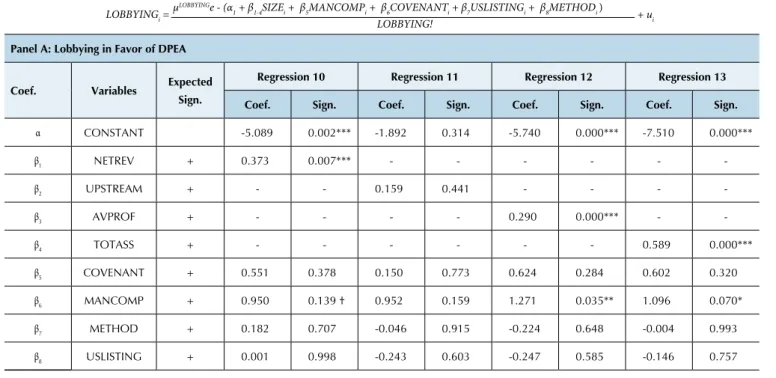
The Poisson regression model uses the following spe-cification:
ln = PROB (LOBBYING = 2|X)
PROB (LOBBYING = 0|X) + βα1 + β1NETREVi + β2TOTASSi + β3AVPROFi + β4UPSTREAM
where LOBBYING assumes values ranging from "0" to "10", with “0” assigned to companies that did not submit com-ments on the DPEA and “10” being the maximum possible value of agreement (or disagreement) with respect to the DPEA.
To exemplify the use of these three models, suppose that a company submitted comments on the DPEA and that the company’s responses to the 10 questions comprised 7 responses against the proposed standards and 3 responses in favor of the proposed standards. In the first model (bi-nomial logistic regression), the company would be coded as "1" (submitted comments); in the multinomial logistic regression model, it would receive code "2" (predominantly against the proposed standards); and, finally, in the Poisson regression it would be coded as "3" in the “lobbying in fa-vor” panel and "7" in the “lobbying against” panel.
3.3 Sample Characteristics.
Because the sample must contain both lobbying and non-lobbying companies, oil companies that submitted comment letters on the DPEA were identified. The IASB received 141 comment letters, of which 39 (28%) were sub-mitted by extractive companies and 33 (23%) were submit-ted by non-governmental entities. The group comprising national issuers, accounting profession entities and ca-pital market regulators contributed 25 letters (18%). The groups comprising investors/individual users, oil industry consulting firms/professional associations and audit firms submitted 17, 12 and 8 comment letters, respectively. Eight other letters were submitted by various stakeholders.
Of the 39 comment letters submitted to the IASB by ex-tractive companies, 28 of the letters were from oil compa-nies and 11 were from mining compacompa-nies. Thus, the initial
focus was on these 28 oil companies, 3 of which could not be used due to the unavailability of information necessary for the study.
The database of Evaluate Energy®, which is a leading con-sultancy firm that provides information about the oil and gas industry, was consulted. Because the DPEA was in public consultation from April to July 2010, industry information for 2009 was used. The Evaluate Energy® database had 2009 information from 262 companies in the oil industry.
Because the Evaluate Energy® database does not include information necessary to operationalize the MANCOMP and COVENANT variables, a random selection from the 237 companies in the database (excluding the 25 already pre-selected to represent lobbying companies) was conduc-ted to select non-lobbying companies.
To define the sample size for the random selection, the expression n = N x n0 / N + n0 was used, in which n0 = 1 / E0, where n0 is the first approximation of sample size; E0 = is the tolerable sampling error; N is the size of target population; and n is the sample size. Thus, for a target population (N) of 237 and tolerable sampling error (E0) of 6%, we arrive at 127 companies, which, when added to the 25 lobbying companies, yields a final sample of 152 oil and gas companies.
The sample comprises companies of different sizes, as shown in Table 4. For example, the average net revenue (NETREV) in 2009 was (in logarithmic values) USD 8.84 million. However, there is considerable variation between the minimum value of USD 2.42 million and the maximum value of USD 12.54 million, which provides a standard de-viation of USD 1.95 million. The same behavior is obser-ved for other variables, such as the average net profit (AV-PROF), which range from a minimum value of USD 1.60 million to a maximum value of USD 20.7 million.
Table 4 Descriptive statistics of continuous variables
Variable (in USD millions) Mean Median Minimum Maximum Standard Deviation KS Test p-value
NETREV 8.843 9.001 2.422 12.536 1.947 0.953
UPSTREAM 0.945 6.338 -20.720 10.083 11.550 0.000
AVPROF 12.787 12.719 1.596 20.703 4.009 0.994
TOTASS 9.520 9.603 4.378 12.694 1.579 0.984
Note: NETREV: net revenue for the period; UPSTREAM: exploration and development costs incurred in the period; AVPROF: average net proit for the last
three periods; TOTASS: total assets for the period; KS test: Kolmogorov-Smirnov test of normality (p-value > 0.05).
Although the assumption of normality of the residuals is not a requirement for logistic regression, the continuous variables were natural-log transformed to achieve a normal distribution in an effort to mitigate possible "scale effects" in the regressions. As shown in Table 4, after transforma-tion, only the UPSTREAM variable remained non-nor-mally distributed.
Regarding the dichotomous variables (Table 5), 25 of the 152 sampled companies provided comments on the DPEA to the IASB, corresponding to 16% of the sam-ple. For the purposes of this study, these 25 companies are characterized as lobbying companies, whereas the remaining companies in the sample are considered non-lobbying companies.
LOBBYINGi = + ui μLOBBYINGe - α1 + β1NETREVi + β2TOTASSi + β3AVPROFi + β4UPSTREAM
+ β5MANCOMPi + β6COVENANTi + β7USLISTINGi + β8METHODi LOBBYING!
2 2
Table 5 Descriptive statistics of dichotomous variables
Variable Value "0" Value "1" Total
LOBBYING 127 25 152
84% 16% 100%
COVENANT 41 111 152
27% 73% 100%
COMPGEN 40 112 152
26% 74% 100%
METHOD 74 78 152
49% 51% 100%
USLISTING 64 88 152
42% 58% 100%
Note: LOBBYING: "0" if no comments were submitted and "1" if comments were submitted; COVENANT: "0" if no covenant is present and "1" if covenant is present; MANCOMP: "0" if no performance-based management compensation plan is present and "1" if performance-based management compensation plan is present; METHOD: "0" if company uses the full cost method and "1" if company uses the successful efforts method; USLISTING: "0" if company does not trades on the U.S. stock market and "1" if company trades on the U.S. stock market.
Regarding the COVENANT and MANCOMP va-riables, the sampled companies have almost the same distribution among those that have covenants (73%) or performance-based management compensation plans
(74%) and those that do not.
As for the accounting methods used by companies in the sample, the results are balanced, with 51% of companies using the successful efforts method and 49% using the full cost method. Companies with stocks tra-ded on the U.S. stock market constitute a majority of the sample, corresponding to 88 companies, or 58% of the sample.
Regarding the correlation between the variables, Table 6 shows that variables relating to size exhibit a reasonably statistically significant association with the dependent variable LOBBYING, with correlation ran-ging from 24% to 42%. Unexpectedly, such association is not observed with the other variables.
The correlation between the explanatory variables allows an inference on the assumption of multicolli-nearity. Specifically, the results show that the variables relating to size feature high degrees of significant asso-ciations, especially among NETREV, AVPROF and TO-TASS, ranging from 77% to 89%, which indicates a pos-sible violation of the assumption of multicollinearity.
Table 6 Pearson correlation matrix
LOBBYING NETREV UPSTREAM AVPROF TOTASS COVENANT MANCOMP METHOD
LOBBYING 1
NETREV 0,335 ** 1
UPSTREAM 0,245 ** -0,004 1
AVPROF 0,422 ** 0,767 ** 0,363 ** 1
TOTASS 0,400 ** 0,894 ** 0,269 ** 0,882 ** 1
COVENANT 0,070 -0,265 ** 0,148 -0,203 * -0,194 * 1
MANCOMP 0,104 -0,197 * 0,084 -0,181 * -0,181 * 0,445 ** 1
METHOD 0,148 0,130 0,363 ** 0,266 ** 0,236 ** 0,031 0,016 1
USLISTING 0,127 -0,236 ** 0,226 ** -0,066 -0,155 0,412 ** 0,489 ** 0,075
Note: LOBBYING: "0" if no comments were submitted and "1" if comments were submitted; NETREV: Net revenue for the period; UPSTREAM: exploration and
development costs incurred in the period; AVPROF: Average net proit for the last three periods; TOTASS: total assets for the period; COVENANT: "0" if no
covenant is present and "1" if covenant is present; MANCOMP: "0" if no based management compensation plan is present and "1" if performance-based management compensation plan is present; METHOD: "0" if company uses the full cost method and "1" if company uses the successful efforts method;
USLISTING: "0" if company does not trades on U.S. stock market and "1" if company trades on the U.S. stock market. Signiicance: ** (1%) and * (5%).
As a result of the above, a model was developed con-taining all proxies for size, and the Variance Inflation Factor (VIF) test was performed to analyze the
assump-tion of multicollinearity. Other models were then cons-tructed with only one of these proxies to provide robus-tness to the analyses.
4 ANALYSIS OF RESULTS
It can be said that oil companies that submitted comment letters (lobbying companies in this study) were in favor of the proposals presented in four of ten the questions in the DPEA (the 1st, 6th, 7th and 8th questions), as shown in Table 7.
Companies were largely in favor of the notion that the scope of an extractive activities IFRS should be li-mited to upstream activities (1st question), and unani-mously agreed that historical cost should be the basis for measuring the assets of the extractive sector, as opposed
Table 7 Analysis of companies' positioning toward the DPEA
QUESTION # 1 QUESTION # 2 QUESTION # 3
Agrees Disagrees NA Total Agrees Disagrees NA Total Agrees Disagrees NA Total
18 2 5 25 9 10 6 25 11 13 1 25
72% 8% 20% 100% 36% 40% 24% 100% 44% 52% 4% 100%
QUESTION # 4 QUESTION # 5 QUESTION # 6
Agrees Disagrees NA Total Agrees Disagrees NA Total Agrees Disagrees NA Total
6 19 0 25 12 12 1 25 25 0 0 25
24% 76% 0% 100% 48% 48% 4% 100% 100% 0% 0% 100%
QUESTION # 7 QUESTION # 8 QUESTION # 9
Agrees Disagrees NA Total Agrees Disagrees NA Total Agrees Disagrees NA Total
14 9 2 25 13 11 1 25 6 19 0 25
56% 36% 8% 100% 52% 44% 4% 100% 24% 76% 0% 100%
QUESTION # 10 SUMMARY MAINTENANCE OF THE StatuS Quo
Agrees Disagrees NA Total Agrees Disagrees NA Total YES NO NA Total
1 23 1 25 115 118 17 250 107 39 4 150
4% 92% 4% 100% 46% 47% 7% 100% 71% 26% 3% 100%
Note: NA - did not answer the question. The list of questions is provided in Annex 1.
The majority of lobbying companies also agreed with the propositions relating to the applicability of the IAS 36 standard (7th question) and the objectives of financial state-ments prepared by extractive companies (8th question).
However, the results show largely unfavorable posi-tions with respect to the question regarding the possible adoption of a new and unique accounting method (and the implied elimination of the successful efforts and full cost methods) (4th question), as well as with respect to questions regarding proposals to increase the level of disclosure in the explanatory notes of financial state-ments (9th and 10th questions).
The main arguments presented by companies oppo-sed to the adoption of a new accounting method and in-creased disclosure requirements were that the concept of assets contained in the DPEA damaged the conceptual framework by allowing costs that are unrelated to future economic benefits to be recognized; that the increased dis-closure requirements would mandate the disdis-closure of too much information; and that the costs of producing the in-formation required to be disclosed under the proposal in the DPEA would outweigh the benefits of its disclosure.
A review of all of the comments shows that there is almost a stalemate, with 115 opinions in favor of the propositions contained in the DPEA and 118 opinions against. However, when considering only the proposi-tions that imply changes in the status quo (the establish-ment of a new asset recognition method, the adoption of the fair value basis, and an increase in mandatory dis-closure items, i.e., the 4th, 5th, 6th, 7th, 9th and 10th ques-tions), the results show that companies lobbied to reject any possibility of changing the status quo. Specifically, 107 opinions (71%) were in favor of maintaining the current situation, and only 39 (26%) argued in favor of the changes proposed in the DPEA.
These findings are consistent with the finding by Kenny and Larson (1993) that lobbying companies act to avoid any change to the status quo, as well as with the
argument of Holthausen and Leftwich (1983) that possi-ble changes to the status quo affect managers’ decisions whether to lobby on accounting regulation.
Therefore, one can infer that the oil companies’ cur-rent asset recognition model and the curcur-rent disclosu-re disclosu-requidisclosu-rements satisfy the needs of the oil companies. Thus, institutional theory suggests that any change to the status quo would have to be well "tailored" by the IASB to accommodate the needs of its diverse consti-tuents, including the constituents most affected by the proposed changes, i.e., the oil companies.
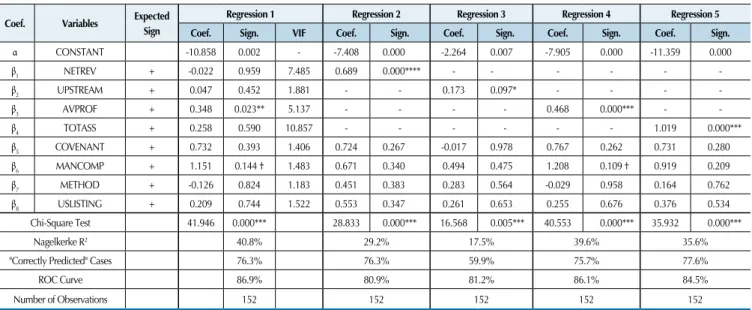
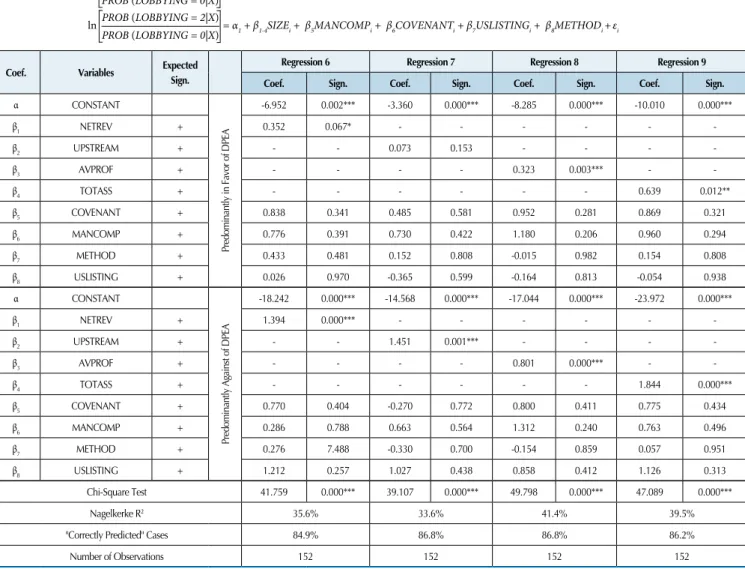
To ascertain the main characteristics that led oil companies to submit comment letters on the DPEA, multivariate data analysis was conducted on the results described above. The logistic regression results are ex-pressed in five regressions (Table 8). The first regression considers all model variables, whereas the remaining re-gressions each consider one of the selected variables for the size hypothesis.
Using a chi-square distribution, which is analogous to the F test for multiple regression, it is clear that the model variables are collectively significant from a statis-tical point of view, with an estimated likelihood ratio of 35.296 and a p-value of 0.000. Therefore, there is at least one nonzero coefficient at the 1% level.
The Nagelkerke measure resembles the R2 of a multiple regression and is used to measure the goodness-of-fit of the model. The result shows that the model has an explanatory power of 40.8%. Because this study is interested in the sta-tistical significance of the coefficients of the variables used, and not necessarily in making predictions, this goodness-of-fit is consistent with the proposed objectives.
Table 8 Results of binomial logistic regression
Coef. Variables Expected
Sign
Regression 1 Regression 2 Regression 3 Regression 4 Regression 5
Coef. Sign. VIF Coef. Sign. Coef. Sign. Coef. Sign. Coef. Sign.
α CONSTANT -10.858 0.002 - -7.408 0.000 -2.264 0.007 -7.905 0.000 -11.359 0.000
β1 NETREV + -0.022 0.959 7.485 0.689 0.000**** - - -
-β2 UPSTREAM + 0.047 0.452 1.881 - - 0.173 0.097* - - -
-β3 AVPROF + 0.348 0.023** 5.137 - - - - 0.468 0.000*** -
-β4 TOTASS + 0.258 0.590 10.857 - - - 1.019 0.000***
β5 COVENANT + 0.732 0.393 1.406 0.724 0.267 -0.017 0.978 0.767 0.262 0.731 0.280
β6 MANCOMP + 1.151 0.144 † 1.483 0.671 0.340 0.494 0.475 1.208 0.109 † 0.919 0.209
β7 METHOD + -0.126 0.824 1.183 0.451 0.383 0.283 0.564 -0.029 0.958 0.164 0.762
β8 USLISTING + 0.209 0.744 1.522 0.553 0.347 0.261 0.653 0.255 0.676 0.376 0.534
Chi-Square Test 41.946 0.000*** 28.833 0.000*** 16.568 0.005*** 40.553 0.000*** 35.932 0.000***
Nagelkerke R2 40.8% 29.2% 17.5% 39.6% 35.6%
"Correctly Predicted" Cases 76.3% 76.3% 59.9% 75.7% 77.6%
ROC Curve 86.9% 80.9% 81.2% 86.1% 84.5%
Number of Observations 152 152 152 152 152
Note: NETREV: net revenue for the period; UPSTREAM: exploration and development costs incurred in the period; AVPROF: average net proit for the last
three periods; TOTASS: total assets for the period; COVENANT: "0" if no covenant is present and "1" if covenant is present; MANCOMP: "0" if no performan-ce-based management compensation plan is present and "1" if performanperforman-ce-based management compensation plan is present; METHOD: "0" if company uses the full cost method and "1" if company uses the successful efforts method; USLISTING: "0" if company does not trades on U.S. stock market and "1" if
company trades on the U.S. stock market. VIF: variance inlation factor test. Signiicance: *** (1%), ** (5%), * (10%) and † (15%).
PROB(LOBBYINGi) =
1 + e - (α0 + β1-4SIZEi + β5MANCOMPi + β6COVENANTi + β7USLISTINGi + β8METHODi +εi ) 1
The ROC (Receiver Operating Characteristic) curve, which measures a model’s discriminatory power, was also used to evaluate model fit. With a value of 86.9%, the final model specification has excellent discrimina-tory power according to the classifications of Favero et al. (2009), who state that an ROC curve less than or equal to 0.5 (50%) indicates no discrimination; an ROC curve between 0.5 and 0.8 (80%) indicates acceptable discri-mination; and an ROC curve greater than 0.8 indicates excellent discrimination.
The results show that only the AVPROF variable is sta-tistically significant within normally used levels. Because the estimated coefficient was greater than zero, the inter-pretation is that the higher the company's average net pro-fit, the greater the likelihood that the company will lobby by comment letter. The estimated coefficient indicates that an increase of USD 1 million in average net profit increases the logit by 0.348 or, calculating the antilogarithm, an in-crease in net profit inin-creases the likelihood of lobbying by a factor of 1.416.
It is also possible to determine that the MANCOMP variable showed marginal statistical significance of 14.4%, which, although it is outside the usual levels, may be consi-dered relevant depending on the risk.
Given the high correlation observed between the in-dependent variables, especially those representing size (as shown in Table 6), the VIF test was used to formally evalu-ate the assumption of multicollinearity. As suspected, this assumption was not met, due to the high VIF values for TOTASS and NETREV. The issue is that highly correla-ted independent variables provide similar information to explain and predict the dependent variable, which makes it difficult to separate the effects of each independent va-riable and causes one of them to lose significance in the
explanation of the phenomenon under analysis (Corrar, Paulo, & Dias Filho, 2007).
Because the presence of multicollinearity tends to distort the estimated slope coefficients, thereby hinde-ring the assessment of the real effect of the independent variable on the phenomenon under investigation, the re-gression results of the first model are biased. This may explain the lack of statistical relevance of some of the independent variables and may even explain the negati-ve sign of NETREV.
To work around this issue, new models were construc-ted, each including only one of the size variables. When va-riables related to size were placed in the model separately, each of them was statistically significant and the sign of the coefficient was as expected, which confirms the effect of multicollinearity.
The general parameters of the regressions remained practically stable from a qualitative point of view, which, when considering all of the variables, suggests that the models are statistically significant, in accordance with the likelihood ratio tests. Nagelkerke's R2 of the models was be-tween 17.5% and 39.6%, and the ROC curves showed ex-cellent discrimination (except for model 2, which had only acceptable discrimination - 66%).
to companies without performance-based management compensation plans.
The results support acceptance of the political cost hy-pothesis developed by Watts and Zimmerman (1978), ac-cording to which large companies tend to lobby on accoun-ting legislation to obtain results that are more favorable to them. The results are also consistent with the findings of Francis (1987), Deakin (1989) and Georgiou and Roberts (2004) regarding size. Thus, there is no evidence to reject hypothesis H1 based on binomial logistic regression mo-deling.
The binomial logistic regression also supports (albeit less convincingly) the theoretical hypothesis presented in the literature that company managers who receive perfor-mance-based compensation that depends on financial in-dicators tend to lobby on legislation to obtain the accoun-ting models that best benefit them.
The econometric model used here and in the majori-ty of the studies on lobbying (Francis, 1987; Deakin, 1989; Ndubizuet al, 1993; Georgiou and Roberts, 2004) has been criticized because the binary dependent variable used in the
model cannot capture the extent of the respondent's posi-tion (Holthausen and Leftwich, 1983). Rather, the variable only captures whether comments are submitted (code 1) or not (code 0), or whether companies were in favor of (1) or against (0) the proposal.
Because the DPEA has ten questions, respondents may have provided comments in response to all of the questions or only to some of them, and may have been in favor of some of the proposals but against others. The-se situations are not captured by the binomial logistic regression model. To address this issue, a multinomial logistic regression model was used, the results of which are shown in Table 9.
The multinomial logistic regressions are arranged in two blocks. The first set contains the results of the compa-rison between oil companies in favor of the DPEA propo-sals and oil companies that did not submit comments on the DPEA, whereas the results of the second block refer to the comparison between oil companies opposed to the proposals in the DPEA and oil companies that did not submit comments.
Table 9 Results of multinomial logistic regression
Coef. Variables Expected
Sign.
Regression 6 Regression 7 Regression 8 Regression 9
Coef. Sign. Coef. Sign. Coef. Sign. Coef. Sign.
α CONSTANT
Pred
omi
nan
tly
in
Favo
r o
f D
PEA
-6.952 0.002*** -3.360 0.000*** -8.285 0.000*** -10.010 0.000***
β1 NETREV + 0.352 0.067* - - -
-β2 UPSTREAM + - - 0.073 0.153 - - -
-β3 AVPROF + - - - - 0.323 0.003*** -
-β4 TOTASS + - - - 0.639 0.012**
β5 COVENANT + 0.838 0.341 0.485 0.581 0.952 0.281 0.869 0.321
β6 MANCOMP + 0.776 0.391 0.730 0.422 1.180 0.206 0.960 0.294
β7 METHOD + 0.433 0.481 0.152 0.808 -0.015 0.982 0.154 0.808
β8 USLISTING + 0.026 0.970 -0.365 0.599 -0.164 0.813 -0.054 0.938
α CONSTANT
Pred
omi
nan
tly
Agai
ns
t o
f D
PEA
-18.242 0.000*** -14.568 0.000*** -17.044 0.000*** -23.972 0.000***
β1 NETREV + 1.394 0.000*** - - -
-β2 UPSTREAM + - - 1.451 0.001*** - - -
-β3 AVPROF + - - - - 0.801 0.000*** -
-β4 TOTASS + - - - 1.844 0.000***
β5 COVENANT + 0.770 0.404 -0.270 0.772 0.800 0.411 0.775 0.434
β6 MANCOMP + 0.286 0.788 0.663 0.564 1.312 0.240 0.763 0.496
β7 METHOD + 0.276 7.488 -0.330 0.700 -0.154 0.859 0.057 0.951
β8 USLISTING + 1.212 0.257 1.027 0.438 0.858 0.412 1.126 0.313
Chi-Square Test 41.759 0.000*** 39.107 0.000*** 49.798 0.000*** 47.089 0.000***
Nagelkerke R2 35.6% 33.6% 41.4% 39.5%
"Correctly Predicted" Cases 84.9% 86.8% 86.8% 86.2%
Number of Observations 152 152 152 152
Note: NETREV: net revenue for the period; UPSTREAM: exploration and development costs incurred in the period; AVPROF: average net proit for the last
three periods; TOTASS: total assets for the period; COVENANT: "0" if no covenant is present and "1" if covenant is present; MANCOMP: "0" if no perfor-mance-based management compensation plan is present and "1" if perforperfor-mance-based management compensation plan present; METHOD: "0" if company uses the full cost method and "1" if company uses the successful efforts method; USLISTING: "0" if company does not trades on the U.S. stock market and
"1" if company trades on the U.S. stock market. Signiicance: *** (1%), ** (5%) and * (10%).
ln = αPROB (LOBBYING = 1|X) 1 + β1-4SIZEi + β5MANCOMPi + β6COVENANTi + β7USLISTINGi + β8METHODi +εi PROB (LOBBYING = 0|X)