Effect of the Adoption of IFRS on the Information Relevance of
Accounting Profits in Brazil
Mateus Alexandre Costa dos Santos
PhD candidate, Multi-institutional and Inter-regional Graduate Program in Accounting Sciences, University of Brasília, Federal University of Paraíba, Federal University of Rio Grande do Norte E-mail: [email protected]
Paulo Roberto Nóbrega Cavalcante
PhD, Comptrollership and Accounting, Federal University of Paraíba E-mail: [email protected]
Received on 1.7.2013 – Desk Acceptance on 1.18.2013 – 4th version accepted on 8.11.2014.
ABSTRACT
This study aimed to assess the effect of adopting the International Financial Reporting Standards (IFRS)in Brazil on the information rele-vance of accounting profits of publicly traded companies.International studies have shown that the adoption of IFRS improves the quality of accounting information compared with domestic accounting standards. Concurrent evidence is sparse in Brazil.Information relevance is understood herein as a multidimensional attribute that is closely related to the quality and usefulness of the information conveyed by accounting profits. The associative capacity and information timeliness of accounting profits in relation to share prices were examined. Furthermore, the level of conditional conservatism present in accounting profits was also analyzed because according to Basu (1997), this aspect is related to timeliness. The study used pooled regressions and panel data models to analyze the quarterly accounting profits of 246 companies between the first quarter of 1999 and the first quarter of 2013, resulting in 9,558 quarter-company observations. The results in-dicated that the adoption of IFRS in Brazil (1) increased the associative capacity of accounting profits; (2) reduced information timeliness to non-significant levels; and (3) had no effect on conditional conservatism. The joint analysis of the empirical evidence from the present study conclusively precludes stating that the adoption of IFRS in Brazil contributed to an increase the information relevance of accounting profits of publicly traded companies.
1 INTRODUCTION
red important by market participants when pricing shares (Ball, 2006; Basu, 1997; Santos & Lustosa, 2010); and (iii) the information content, which in broad terms refers to the impact on share prices caused by the disclosure of ac-counting information (Landsman et al., 2012).
This study examined the associative capacity and the information timeliness of accounting profits. However, in addition to these two aspects, studies have suggested that other factors, for example, conservatism, the exis-tence of few opportunities for earnings management, and profit persistence, may capture key dimensions of the quality of a company’s accounting information (Ball, 2006; Leuz & Wysock, 2008). Thus, these factors may also contribute to information relevance. Therefore, this study also sought to assess the effects of the adoption of IFRS on the level of conditional conservatism present in accounting profits because it is a key characteristic rela-ted to information timeliness.
hus, the present study explored the following research question:
What are the efects of the adoption of IFRS on the in-formation relevance of accounting inin-formation in Brazil as measured by the associative capacity, information timeli-ness, and conservatism of the accounting proits of publicly traded companies?
Importantly, the analysis of this issue excludes an assessment of the information quality generated when adopting IFRS or whether such standards are higher than domestic standards because no comparison what-soever can be established between the criteria prescri-bed by those regulations. Furthermore, the analysis overlooks aspects regarding how this information should be by aiming to instead assess how useful it is (or appears to be) from the viewpoint of participants in the Brazilian stock market.
his article is divided into ive sections, including this introduction. Section 2 provides the theoretical framework, outlines some aspects of the adoption of the convergen-ce proconvergen-cess in Brazil, and examines some previous studies. Subsequently, section 3 describes the methods employed, including the hypotheses and models. Section 4 outlines and discusses the results, and section 5 concludes.
One of the most important motivations for the adop-tion of the Internaadop-tional Financial Reporting Standards (IFRS) is to increase the comparability of accounting in-formation among countries. hus, the IFRS seek to esta-blish a common language for the markets and a favorable environment for smoother capital lows (Ball, 2006; Lima, 2010; Niyama, 2007).
hus, the concepts and the recognition, measurement and disclosure criteria established by the IFRS presuma-bly provide higher information quality, which in turn afects the usefulness of the accounting information ge-nerated (Barth, Landsman, & Lang, 2008; Leuz & Wyso-ck, 2008). International studies, particularly in European countries, have examined this topic and have advanced the understanding of the efects of the adoption of IFRS on accounting information itself and on the users of that information (Ashbaugh & Pincus, 2001; Barth et al., 2008; Garanina & Kormiltseva, 2014; Kargin, 2013; Jarva & Lantto, 2012; Landsman, Maydew, & hornock, 2012; Soderstrom & Sun, 2007).
Given the convergence process recently experienced in Brazil, the assessment of the efects of the adoption of IFRS on the accounting information disclosed by Bra-zilian companies is currently an important issue. Some studies have accordingly been conducted under diferent viewpoints, although the results are still divergent (Costa, 2012; Lima, 2010; Macedo, Machado, Machado, & Men-donça, 2013; Oliveira & Lemes, 2011; Rodrigues, 2012; Santos, Lima, Freitas, & Lima, 2011). he present study falls within this context and aims to assess the efect of the adoption of IFRS on the information relevance of net proits in the Brazilian scenario, thus contributing toward a greater understanding of the subject.
Information relevance is understood as a multidi-mensional attribute that is closely related to the useful-ness of the information provided to the user. his attri-bute comprises: (i) the associative capacity between the accounting information, in this case, the proit, and the market value of the company, commonly known as value relevance (Barth, Beaver, & Landsman, 2001; Ball, 2006); (ii) the timeliness of the information, that is, its capacity to simultaneously represent and express events
2 THEORETICAL FRAMEWORK
2.1 A Brief Comment on the Adoption of IFRS
in Brazil
he IFRS presumably have higher quality than most domestic accounting norms or standards, and studies have reported results accordingly (Ashbaugh & Pincus, 2001; Barth et al., 2008; Costa, 2012; Landsman et al., 2012; Lima, 2010).
When compared with the domestic standards of en-vironments with strong legal, political, and taxation
im-pacts, the IFRS: (i) better relect the economic substance of events; (ii) are more timely; (iii) generate more infor-mative proits; (iv) provide more useful balance sheets; and (v) reduce the manipulation of accounting informa-tion (Ball, 2006).
institutional factors that afect the inancial disclosure in-centives of companies in each country, factors that also afect how the IFRS are implemented and assimilated in each country, generating distinct economic consequences (Soderstrom and Sun, 2007; Niyama 2007; Leuz and Wy-sock, 2008; Lima, 2010).
Brazil has a codiied and extremely legalistic legal sys-tem (code law). Before the convergence, accounting stan-dards were strongly afected by legal directives, especially by tax laws and regulations from government agencies, including the Central Bank of Brazil (Banco Central do Brasil - BC) and the Brazilian Securities Commission (Comissão de Valores Mobiliários - CVM) (Dantas, Ro-drigues, Niyama, & Mendes, 2010; Niyama, 2007).
Professional accounting bodies or institutions repre-sentative of the profession had weak political inluence in the process of establishing accounting procedures (Niya-ma, 2007). Accordingly, accounting information was ru-led by objectivity and veriiability, and the government was the main user, thus providing low relevance for other users, especially participants in the stock market.
The main landmark in Brazil’s process of conver-gence with international accounting standards was the enactment of Law No. 11.638/2007, which amended Laws No. 6.404/1976 (Corporate Law - Lei das Socie-dades por Ações, S.A.) and No. 6.385/1976 to effect this standards conversion in the national legal system. This process has been ongoing since the 1990s and included, for example, institutional efforts by the CVM to improve Brazilian accounting standards through the incorpora-tion of standard precepts of the Internaincorpora-tional Accoun-ting Standards Board (IASB) (Dantas, Rodrigues, Niya-ma, and Mendes, 2010).
he adoption of the IFRS arguably occurred in two stages in the case of publicly traded companies because their adoption only became mandatory in 2010 pursuant to CVM Instruction No. 457/2007, amended by CVM Instruction No. 485/2010. hus, a transition period en-compassed the years 2008 and 2009.
The implementation of the Transition Tax Regime (Regime Tributário de Transição, RTT), established by Provisional Measure No. 449/2008 (subsequently enac-ted into Law No. 11.941/2009) and extinguished by Provisional Measure No. 427/2013, enabled one of the flagship issues in the Brazilian convergence process: tax neutrality.
Another positive factor was the level of development experienced by the Brazilian stock market in recent ye-ars. The Corporate Law (Lei das S.A.) reformulation in 2001, price stability, the liberalization of the stock ma-rket, and the creation of different levels of corporate governance and the new market were significant events that contributed to this development (Lima, 2010).
Thus, given Brazil’s institutional characteristics befo-re and after the convergence, the mandatory and legally binding adoption of IFRS will likely allow at least greater independence for financial reporting. Therefore, greater relevance of accounting information for market
partici-pants may be observed if the IFRS are indeed better than the domestic standards.
2.2 Previous Studies
Previous studies have mostly indicated that the adop-tion of IFRS improves accounting information quality (Soderstrom & Sun, 2007). However, diferent results concerning the information relevance of accounting pro-its, as examined herein, have been observed, especially regarding value relevance, which is one of the attributes that has been extensively examined by prior studies.
For example, Barth, Landsman, and Lang (2008) exa-mined 21 countries and found that companies that adop-ted the IFRS showed a timelier recognition of losses and a higher association between share prices and accounting proits and net worth (value relevance).
In Greece, Karampinis and Hevas (2009) found that the mandatory adoption of the IFRS positively afected the va-lue relevance of accounting proits and book vava-lue of equi-ty, albeit only at the level of consolidated statements.
Conversely, Li (2010) found that European Union companies that began the mandatory adoption of IFRS experienced a reduction of approximately 47% in their cost of capital. According to the author, increased finan-cial reporting and improved intercompany information comparability accounted for this reduction.
Landsman, Maydew, and Thornock (2012) found increased information content of accounting profits in countries that adopted the IFRS compared with coun-tries that maintained domestic accounting standards. This result was found at the level of both countries and companies. The study covered the period from 2002 to 2007 and analyzed 16 countries that had adopted the IFRS and 11 that had not, including Brazil.
Also at a multi-jurisdictional level, Ahmed, Chal-mers, and Khlif (2013) observed a mostly increased as-sociation (value relevance) between accounting profits and share prices, although they noted that the level of as-sociation shown by book value of equity did not vary in the post-IFRS period. These results remained unchan-ged even after controlling for the effects of institutional factors in the analyzed countries.
Conversely, different results were reported by Callao, Jarne, and Laínez (2007), whose evidence suggests that the adoption of IFRS in Spain failed to improve the re-levance of financial reports for participants in the local stock market. The study found that differences between the accounting value and the market value of Spanish companies increased with the adoption of IFRS.
Accordingly, Clarkson, Hanna, Richardson, and hompson (2011) gathered evidence suggesting that adop-ting the IFRS failed to improve the quality of inancial re-porting in Europe and Australia. he evaluation conducted in that study was based on an assessment of associations between share prices, accounting proits, and book value of equity from the viewpoint of the IFRS in relation to both domestic standards and to the legal system of the countries analyzed (customary or consuetudinary).
Conversely, Klimczak (2011) found no evidence that the mandatory adoption of IFRS in Poland afected the information content or the value relevance of accounting proits of Polish companies.
In turn, Jarva and Lantto (2012), when analyzing the IFRS vis-à-vis Finnish accounting standards, noted that proits calculated in accordance with the IFRS are less timely, although they marginally provide a higher pre-dictive capability of future cash lows. Furthermore, the authors noted that assets and liabilities under those stan-dards have a lower association with share prices. One of the reasons suggested for the results was that Finland al-ready had high-quality accounting standards.
Conversely, Kargin (2013) analyzed the efects of the adoption of IFRS in Turkey and found evidence indicating that the adoption of these standards failed to improve the level of association between accounting proits and share prices. Conversely, the results showed that book value of equity was more relevant post-IFRS. According to the au-thor, the application of IFRStends to bring the book value of equity of Turkish companies closer to their market value, which could account for the result.
Garanina and Kormiltseva (2014) observed similar results in Russia. he authors found no evidence of in-creased value relevance of inancial reporting resulting from the adoption of IFRS. he authors argued that the results may be caused by institutional diferences between domestic standards and the IFRS.
The research landscape regarding Brazil is no diffe-rent from what has been observed internationally. The studies conducted thus far also show conflicting results for diverse aspects of accounting information attributes. Lima (2010) examined the effect of adopting the IFRS in 2008 and 2009 on information content and the rele-vance of accounting profits. No evidence of abnormal
reactions of share prices in response to the disclosure of accounting profits post-IFRS was found. However, the results suggested that adopting those standards impro-ved the information relevance of accounting profits.
Conversely, Santos, Lima, Freitas, and Lima (2011), when using the model by Basu (1997) and an adapted version of this model, found no evidence that adopting the IFRS affected the accounting conservatism of accoun-ting profits of companies listed on the BM&FBovespa - Securities, Commodities, and Futures Exchange.
Costa (2012) found evidence that a decrease in fi-nancial and tax compliance occurred in 2009 and 2010 and that after IFRS adoption, the response coefficients of accounting profits were significant, which suggests an increased timeliness of that measure according to the author. However, in contrast to that conclusion, an association between post-convergence accounting pro-fits and stock returns (value relevance) was observed by Lima (2010).
In turn, Rodrigues (2012) found that the adoption of IFRS in Brazil did not increase conditional conserva-tism, partly corroborating Santos et al. (2011), or affec-ted the associative capacity of accounting profits (value relevance), thus contradicting the results of Lima (2010) and Costa (2012).
In contrast to Rodrigues (2012), Macedo, Machado, Machado, and Mendonça (2013) found that IFRS adop-tion increased the associative capacity (informaadop-tion capa-city) of net proits, conferring them greater explanatory power. According to the authors, the fact that the econo-mic reality of companies could be more faithfully depic-ted under the IFRS accoundepic-ted for that improvement. Ho-wever, the results failed to show the existence of efects on the associative capacity of book value of equity.
It is important to note that the differences observed in the prior studies should primarily be analyzed by con-sidering the legal, economic, political, and institutional differences existing between countries because each adoption process represents a unique experience.
However, the methodological differences between the studies concerning the Brazilian environment gain relevance in the analysis of results, especially regarding the model and the econometric method used and the longitudinal and cross-sectional sample size.
3 METHODS
3.1 Hypotheses
he literature has shown that the IFRS incorporate a higher level of quality compared with most domestic re-gulations, with few exceptions. Accordingly, the present study aims to assess the efects of the mandatory adoption of the IFRS on the information relevance of accounting proits for participants in the Brazilian stock market. he
following research hypotheses are tested for this purpose: H1: he adoption of the IFRS in Brazil increased the associati-ve capacity of accounting proits in relation to share prices. H2: he adoption of the IFRS in Brazil increased the
infor-mation timeliness of accounting proits.
3.2 Study Sample
Publicly traded Brazilian companies were the stu-dy object. Only those companies active on 07/18/2013 according to the Economática® database were analyzed. Financial firms were excluded from the sample because they are subject to BC regulation. Data were analyzed on a quarterly basis from the 1st quarter of 1999 to the 1st
quarter of 2013.
Preferred shares were analyzed when possible, given their greater liquidity. Share prices were adjusted for di-vidends according to the criterion used by Economática®.
The accounting variables used were net profit per share (NPPS) and book value of equity per share (BVEPS), which was used as a control. These data were gathered from individual accounting statements. When assessing information timeliness and conservatism, the-se variables were deflated by the share price at beginning of the period (pt-1) to control for possible heteroscedasti-city and maintain similarity with Basu (1997). Further-more, outliers of Rit, NPPSit (associative capacity), and
−
NPPS p
it
t1 (timeliness/conservatism) were excluded from the analysis;thus, values between the first and last per-centiles were included.
Considering the selection criteria, data availability, and the adjustments performed, the inal sample formed an un-balanced panel with 9,558 quarterly observations distribu-ted among 246 companies.
3.3 Models
Pooled regressions and panel data were used. The criterion for the adoption of the method was a joint analysis of parameter stability using the Chow test and
parameter variance using the test for differing group in-tercepts (DGI) and the Hausman test.
The null hypothesis of the Chow test is the absence of structural failure in the estimates. It is suitable when assessing the relevance of estimates using pooled regres-sion. Conversely, DGI tests whether the cross-sectional units have a common intercept. The rejection of this hy-pothesis suggests that the fixed effects model is appro-priate. Finally, the null hypothesis of the Hausman test is the consistency of estimates using Generalized Least Squares, in other words, estimates using the random effects model are appropriate in contrast to those per-formed using the fixed effects model.
Robust estimators were used in the estimations per-formed using the fixed effects model to mitigate possible issues of heteroscedasticity and autocorrelation of resi-duals, as proposed by Arellano (2003).
The associative capacity of accounting profits and share prices was the first functional relationship exami-ned. Return models were used for this task.
Considering the statistical method used (panel data) and the pattern of the data series analyzed, the viable alternative to mitigate the occurrence of a possible scale effect (response coefficient bias and heteroscedasticity, among others) according to the tests performed (pricing model, deflation per pt-1) was the use of an exogenous scale, in this case, BVEPSit., which was used as a control. The BVEPSit is a valuable resource for this purpose ac-cording to Barth and Kallapur (1996), Barth and Clinch (2009), and Gil-Alana, Iniguez-Sanchez, and Lopez-Es-pinosa (2011).
he econometric models used to assess the associative capacity of accounting proits are shown below1:
2
3
Rit =β0+β1NPPSit+β2BVEPSit+εit 1
where
Rit = Return of company i in quarter t;
NPPSit= Net proit per share of company i in quarter t; BVEPSit= Book value of equity per share of company i in
quarter t;
D
itIFRS
= Dummy variable,
D
itIFRS
=1 if t is ater 2007;
D
it
2008 ...
D
it2013
= Dummy variables,
D
it2008 ...
D
it2013 =1 if t is equal to the speciied year;
β´s andδ’s = model parameters; εit = error term of the models.
The existence of a significant association between accounting profits and share prices will result in the identification of a significant and positive β1. However, if the adoption of IFRS increased this capacity, the δ1 and δ2 coefficients in Model (2) and δ1 to δ10 in Model (3) are expected to be positive and show some level of significance.
he pattern of occurrence of structural breaks
throu-1 The estimations performed using the traditional pricing (p =β +βNPPS +ε
i t, 0 1 i t, i t,) or (pi t,=β0+β1NPPSi t,+β2BVEPSi t,+εi t,) and return (
β β ε
= + +
− −
p p
NPPS p i t
i t
i t
i t i t ,
, 1
0 1
,
, 1 ,
) or
( − =β +β − +β − +ε p
p
NPPS p
BVEPS
p i t
i t
i t
i t
i t
i t i t ,
, 1
0 1
,
, 1 2
,
, 1 ,
) models showed no satisfactory results. For example, the pricing model showed an R2 higher than 0.75, which creates doubts regarding its correct it because the
ghout the entire period (from 1/1999 to 1/2013) was also analyzed for all of the models above. he Chow test was used to measure these occurrences.
Models (4), (5), and (6), which were used for timeliness and are based on Beaver, Lambert, and Morse (1980), are shown below:
where pt-1= is the share price measured at the end of the previous quarter (t-1).
he coeicient β1 represents the overall timeliness of accounting proits, whereas the coeicients δ1 and δ2 in Model (5) and δ1toδ10 in Model (6) are related to infor-mation timeliness resulting from the adoption of IFRS.
hose coeicients will tend to be positive and signiicant if the standards render the accounting proits timelier.
Finally, conservatism level was measured using the models proposed by Basu (1997), Model (7); Santos et al. (2011), Model (8); and Model (9), which aims to assess the annual impact post-IFRS:
where DRit = 1 if Rit<0.
he coeicients δ1 and δ2 represent the conditional conservatism of accounting proits, while coeicients δ3 and δ4 in Model (8) and δ3 to δ12 in Model (9) express the efects of adopting the IFRS on conservatism.Changes in the conservatism level will result in the signiicance of those coeicients.
Four estimations were performed using Models (1), (4), and (7) according to a segregation of the time period
analyzed: (i) from the 1st quarter/1999 to the 1st
quar-ter/2013 – total period; (ii) from the 1st quarter/1999 to the
4th quarter/2007 – pre-IFRS; (iii) from the 1st quarter/2008
to the 4th quarter/2009 – transition period; and (iv) from
the 1st quarter/2010 to the 1st quarter/2013 – post-IFRS.
he full adoption of IFRS began in 2010 pursuant to CVM Instruction No. 457/2007, amended by CVM Instruction No. 485/2010, although Law No.11.638/2007 was in efect beginning on 01/01/2008, which explains this segregation.
4 RESULTS
4.1 Associative Capacity of Accounting Profits
Models (1), (2), and (3) were estimated in thissta-ge. Initially, Model (1) was estimated based on the entire period, and the other time periods were analyzed
∑
∑
6β
β
δ
(
δ
)
ε
=
+
τ ττ τ
τ
τ −
+
= +
+ =
NPPS
p
R
D
it
t
it it it it it
1
0 1
2007
1 6
6 2007
1 6
β β ε
= + +
−
NPPS p
R
it t
it it
1
0 1
4
δ δ ε
+ +
it it
IFRS
it IFRS
it it
5
8
=
β
+
β
+
δ
+
δ
ε
7−
NPPS
p
R
D
it
t
it it it it it
1
0 1
9
∑
∑
β
β
δ
δ
δ
δ
ε
(
)
(
)
=
+
+
+
+
τ
τ
τ
τ τ
τ −
+
+
=
+ +
=
NPPS
p
R
D
R
it
t
it it it it it it
it it it it
1
0 1 2
2007 1
6
8
2007 1
6
quently. The results are shown in Table 1.
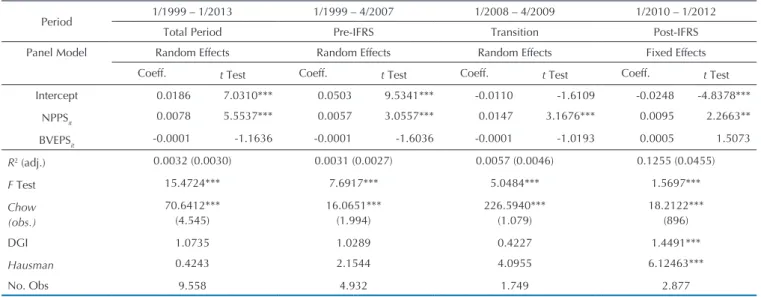
Regarding the total period, the NPPSit was highly significant and had the predicted sign for the proposed
relationship. The model has a satisfactory fit and average explanatory power for this relationship.
Model (1): Rit =β0+β1NPPSit+β2BVEPSit+εit
Period 1/1999 – 1/2013 1/1999 – 4/2007 1/2008 – 4/2009 1/2010 – 1/2012
Total Period Pre-IFRS Transition Post-IFRS
Panel Model Random Effects Random Effects Random Effects Fixed Effects
Coeff. t Test Coeff. t Test Coeff. t Test Coeff. t Test
Intercept 0.0186 7.0310*** 0.0503 9.5341*** -0.0110 -1.6109 -0.0248 -4.8378***
NPPSit 0.0078 5.5537*** 0.0057 3.0557*** 0.0147 3.1676*** 0.0095 2.2663**
BVEPSit -0.0001 -1.1636 -0.0001 -1.6036 -0.0001 -1.0193 0.0005 1.5073
R2 (adj.) 0.0032 (0.0030) 0.0031 (0.0027) 0.0057 (0.0046) 0.1255 (0.0455)
F Test 15.4724*** 7.6917*** 5.0484*** 1.5697***
Chow (obs.)
70.6412*** (4.545)
16.0651*** (1.994)
226.5940*** (1.079)
18.2122*** (896)
DGI 1.0735 1.0289 0.4227 1.4491***
Hausman 0.4243 2.1544 4.0955 6.12463***
No. Obs 9.558 4.932 1.749 2.877
Rit is the return of the i-th share in quarter t, calculated logarithmically. NPPSit represents the net proit of the exercise per share of the i-th company in
quar-ter t. BVEPSit is the book value os equity per share of the i-th company in quarter t. In the Chow test, (obs.) represents the observation where the greatest
magnitude was identiied. The presence of multicollinearity was not detected. Variance inlation factors (VIFs) < 2. *, **, and *** represent signiicance at 10%, 5%, and 1%, respectively.
Table 1 Model (1) Results – Associative Capacity
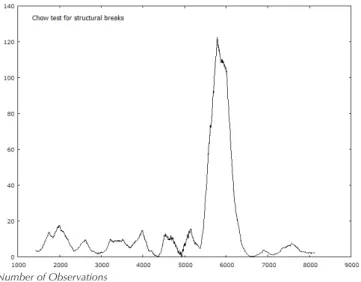
Although over the entire period structural bre-aks were observed both before and after adopting the IFRS, the most significant occurrence (Chow test = 70.6412***) was observed in the 3rd quarter of 2007, a period prior to, albeit very close to the adoption of IFRS. Figure 1 shows this pattern.
Figure 1 Chow Test Pattern – Model (1) Estimation for
the Total Period
Number of Observations
The results from the estimations of the pre-IFRS, transition, and post-IFRS periods indicated an impro-ved association between NPPSit and Rit starting in the transition period. Although the NPPSit coefficient was
positive for the entire period analyzed, as predicted, this coefficient had the smallest magnitude (0.0057) in the pre-IFRS period, and the model also had the smallest adjusted R2. Combined, these figures indicate an
asso-ciative capacity of NPPSit in the pre-IFRS period that was lower than those observed in the following periods.
Conversely, in the transition period, the NPPSit co-efficient became highly significant, and its magnitude increased from 0.0057 to 0.0147. These results indicate that the associative capacity of NPPSit increased signifi-cantly in the transition period. This finding is confirmed by the increase in the adjusted R2, although this statistic
had a low magnitude.
The indication of existing fixed effects in the post--IFRS period is the first striking aspect in the data panel. This result suggests the existence of idiosyncratic cross--sectional components, which is puzzling when compa-red with other periods because all companies mandato-rily began adopting the IFRS in 2010.
A decrease in the magnitude and significance of the NPPSit coefficient is also observed. However, the sta-tistical significance of this relationship was preserved. Moreover, the explanatory power of the model increa-sed significantly, as shown by the increase in adjusted R2
from 0.0046 to 0.0455.
Similar to the Model (1) estimation, the pooled re-gression revealed the occurrence of structural breaks at various times, as shown in Figure 2. However, the most signiicant occurrence was observed in the 4th quarter of 2008, for which the Chow test indicated an F statistic equal to 122.5880.
ding to the Chow and Hausman tests. his estimation showed better results than those assessed using Model (1). he NPPSit was signiicant in the relationship pro-posed. he model had a highly signiicant it and greater explanatory power.
The parameters associated with the variables DIFRS
and DIFRS x NPPS
it were highly significant, and the latter
had a positive sign, as expected. These findings indica-te that the periods of transition and of full adoption of the IFRS and the respective NPPSit were significant in explaining the variations in Rit. This result corrobora-tes the result found using Model (1), estimated based on temporal segregation.
Model (3) was estimated to assess the yearly efect of IFRS adoption, and the results are shown below:
Model (2): β β β δ
δ ε
= + + + +
R NPPS BVEPS D
PPS
it it it it
IFRS
it IFRS
it it
0 1 2 1
2
Coeff. T Test
Intercept 0.0507 14.1105***
NPPSit 0.0061 3.7186***
BVEPSit -0.0001 -2.3416**
DitIFRS -0.0655 -13.0374***
DitIFRS x NPPS
it 0.0087 2.9256***
R2 (adj.) 0.0209 (0.0204)
F Test 50.9628***
Chow (Obs.) 122.5880*** (5.787)
DGI 1.1236*
Hausman 2.8740
No. Obs. 9.558
Estimation performed using the random effects model. Rit is the return of the
i-th share in quarter t, calculated logarithmically. NPPSit represents the net
pro-it of the exercise per share of the i-th company in quarter t. BVEPSit is the book value of equity per share of the i-th company in quarter t. Dit
IFRS is a dummy
variable. Dit
IFRS=1 if t postdates 2007. In the Chow test, (obs.) represents the
observation where the greatest magnitude was identiied. No presence of multicollinearity was detected. Variance Inlation Factor (VIF) < 2. *, **, and *** represent signiicance at 10%, 5%, and 1%, respectively.
Table 2 Model (2) Results – Associative Capacity
Figure 2 Chow Test Pattern – Model (2) Estimation
Number of Observations
he displacement of the time of the greatest structu-ral break in the pre-IFRS period is observed, as assessed in the previous model, to the period subsequent to that event, which results from the greater control exercised by introducing the dummy variable.
he modeling of panel data using the random efects model was more suitable for the data distribution
accor-Model (3): β β β δ
δ ε
= + τ +
τ
τ τ
+
+ +
R NPPS BVEPS D
PPS
it it it it
it it it
0 1 2
2007 6
6 2007 6
Coeff. t Test
Intercept 0.0527 19.0325***
NPPSit 0.0056 2.1352**
BVEPSit -0.0002 -2.1469**
Dit2008 -0.2082 -25.1652***
Dit2009 0.0758 8.9609***
Dit2010 -0.0296 -3.9638***
Dit2011 -0.1151 -15.6283***
Dit2012 -0.0582 -7.4270***
Dit2013 -0.0863 -6.4863***
Dit2008 x NPPS
it 0.0062 1.3050
Dit2009 x NPPS
it 0.0071 1.1417
Dit2010 x NPPS
it -0.0059 -0.9943
Dit2011 x NPPS
it 0.0120 2.5612**
Dit2012 x NPPS
it 0.0172 2.7425***
Dit2013 x NPPS
it 0.0253 2.2336**
R2 (adj.) 0.1135 (0.0891)
F Test 4.6507***
Chow (Obs.) 59.9255 (5.382)
DGI 1.1236*
Hausman 27.9782 ***
No. Obs. 9.558
Estimation performed using the random effects model. Rit is the return of the i-th share in quarter t, calculated logarithmically. NPPSit represents the
net proit of the exercise per share of the i-th company in quarter t. BVEPSit is the book value of equity per share of the i-th company in quarter t. Dit2009...2013 are dummy variables. D
it2008...2013=1 if t is the year indicated. In the Chow test, (obs.) represents the observation where the greatest magnitude
of the test was identiied. No presence of multicollinearity was detected. Variance Inlation Factor (VIF) < 2.
*, **, and *** represent signiicance at 10%, 5%, and 1%, respectively.
Table 3 Model (3) Results – Associative Capacity
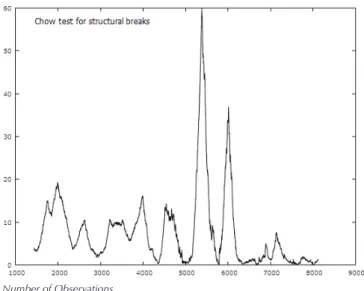
However, the indication of a signiicantly more pronoun-ced structural break occurred in the 3rd quarter of 2008
(Chow test 59.9255), which is illustrated in Figure 3.
post-IFRSperiods may relect the inancial crisis becau-se the average returns for most of thobecau-se years were lower than the average for the pre-IFRS period. Similarly, the marked structural breaks observed in the 3rd quarter 2007
and especially in the 3rd and 4th quarters of 2008 may also
have resulted from the efects of the inancial crisis and not from the adoption of IFRS. A lack of statistical sig-niicance in the NPPSit coeicients is observed for 2008, 2009, and 2010, suggesting that the NPPSit was not asso-ciated with Rit in those years.
The above findings are contrary to the results from Model (1), specifically regarding the transition period. These results allow us to conclude that the increased magnitude and significance of the NPPSit observed in the transition period did not result from the adoption of IFRS but rather from unidentified factors, albeit spe-cific to NPPSit and not necessarily linked to occurrences during the transition and post-IFRS periods. This con-clusion is supported by the statistical significance of co-efficient β1 observed in all of the models.
Regarding the period from 2011 to 2013, the begin-ning of the restoration of significance of the association between NPPSit and Rit was observed in 2011, and signi-ficance was fully restored starting in 2012, when a highly significant association was again observed. The failure to fully adopt the IFRS until 2010, pursuant to CVM Instruction No. 457/2007, amended by CVM Instruction No. 485/2010, and the issuance or revision of several te-chnical pronouncements starting in 2009 are the best possible explanations for these findings. Therefore, the period from 2008 to 2010 may in fact have represented a transition period, and the situation could have reversed starting in 2011.
It is worth highlighting that the low magnitude and lack of statistical signiicance of the NPPSit found in 2010 may explain the decrease of the NPPSit coeicient obser-ved in the Model (1) estimation for the post-IFRS period, given the explanation above.
Finally, the results mostly indicate that the IFRS im-proved the associative capacity of the NPPSit, thereby precluding the rejection of hypothesis H1. hat inding corroborates the results found in the literature and spe-ciically the results reported by Barth et al. (2008), Lima (2010), Costa (2012), and Macedo et al. (2013).
4.2 Information Timeliness
In the irst stage of the analysis of the efects of adop-ting the IFRS on the timeliness of accounadop-ting proits, Mo-del (4) was estimated for both the total period and the IFRS adoption period, as shown in Table 4.
he most adequate panel model for the total period was the ixed efects model, which showed satisfactory it and explanatory power higher than 37%, which may be considered a good level of explanation for this type of relationship. he Rit coeicient showed low signiicance, suggesting that the accounting proit, on average, was not timely throughout the period.
Number of Observations
Figure 3 Chow Test Pattern – Model (3) Estimation
The panel data method was again used, specifically the fixed effects model, given the indication of its ade-quacy by the Hausman test. The NPPSit coefficient was highly significant and had the expected sign. The coe-fficients of the dummy variables had statistical signifi-cances lower than 1%. However, except for 2009, these coefficients were negative, contrary to the prediction. Conversely, significant coefficients for the multiplica-tive variables were only observed for 2011, 2012, and 2013 at 5%, 1%, and 5% significance levels, respectively. The signs of these coefficients are consistent with the predictions.
he estimation exhibited better it and explanatory po-wer than Models (1) and (2), suggesting that the greater control of the temporal efects in the transition and post--IFRS years improved the association. However, the pre-sence of cross-sectional ixed efects was observed, thus requiring estimation using the ixed efects model. his characteristic was also observed in the Model (1) estima-tion for the post-IFRS period.
he results for 2008 and subsequent years provided some level of explanation for the Rit variations. Howe-ver, the explanation only showed some connection to the efects of adopting the IFRS on the NPPSit for 2011 to 2013. his result suggests the existence of temporal efects that are not necessarily linked to the adoption of IFRS.
It is important to note that the adoption of the IFRS in Brazil coincided with the onset of the global inancial crisis, which generated systemic efects on the market value of companies, precluding them from accurately ex-pressing the consensus of market participants regarding expectations of future cash lows.
However, the segregated analysis showed that this con-clusion is not necessarily true. Although the estimates for the transition and post-IFRS periods showed high expla-natory power, the signiicance of the Rit coeicient could not be assessed in the pre-IFRS period. Further details are provided below in the analysis of Model (6).
Table 5 shows the results from the estimations of
Mo-dels (5) and (6).
Model (5) has an explanatory power higher than 37% and a highly signiicant it. However, no signs of timeli-ness were found in this case because none of the coei-cients of the independent variables was signiicant. hus, the introduction of dummy variables did not reveal any additional aspects.
Model (4): =β +β +ε
− NPPS
p
R it
t
it it
1
0 1
Period 1/1999 – 1/2013 1/1999 – 4/2007 1/2008 – 4/2009 1/2010 – 1/2013
Total Period Pre-IFRS Transition Post-IFRS
Panel Model Fixed Effects Random Effects Fixed Effects Fixed Effects
Coeff. t Test Coeff. t Test Coeff. t Test Coeff. t Test
Intercept -0.0866 -15.3300***
-0.1578
-3.3844***
-0.0704
-124.0451***
-0.0377
-68.3835***
Rit -0.0691 -1.8380*
-0.1069
-2.8298***
-0.0374 -0.7956 0.0120 0.3340
R2 (adj.) 0.3932 (0.3773) 0.0000 (0.0002) 0.7164 (0.6713) 0.7653 (0.7438)
F Test 24.6613*** - 15.9091*** 35.6843***
Chow
(Obs.)
17.6892*** (4.313)
3.9795*** (876)
1.4415 (1.037)
36.2557*** (496)
DGI 24.7567*** 15.9411*** 15.9431*** 35.6553***
Hausman 31.7853*** 3.6284* 14.7414*** 5.1710**
No. Obs 9.490 4.884 1.738 2.868
−
NPPS p
it
t1 is the net proit of the exercise per share of the i-th company in quarter t, delated by the share price at the end of quarter t-1. Rit is the return of the
i-th share in quarter t, calculated logarithmically. In the Chow test, (obs.) represents the observation where the greatest magnitude of the test was identiied.
*, **, and *** represent signiicance at 10%, 5%, and 1%, respectively.
Table 4 Model (4) Results – Timeliness
Model (5) Model (6)
Coeff. t Test Coeff. t Test
Intercept -0.1077 -7.8579*** -0.108 -7.9072***
Rit -0.1003 -1.7705* -0.1002 -1.7689*
DitIFRS 0.0459 1.6068 -
-DitIFRS x R
it 0.0966 1.5891 -
-Dit2008 - - 0.0309 0.9562
Dit2009 - - 0.0209 0.5438
Dit2010 - - 0.0684 2.4876**
Dit2011 - - 0.0604 2.0006**
Dit2012 - - 0.0385 1.3137
Dit2013 - - 0.0293 0.9546
Dit2008 x R
it - - 0.0426 0.4907
Dit2009 x R
it - - 0.2004 2.2314**
Dit2010 x R
it - - -0.0474 -0.5496
Dit2011 x R
it - - 0.1332 1.3367
Dit2012 x R
it - - 0.1679 1.9014*
Dit2013 x R
it - - 0.1012 0.9097
R2 (adjusted) 0.3945 (0.3784) 0.3950 (0.3783)
F Test 24.5806*** 23.6397***
Chow (Obs.) 5.4354*** (1.537) 4.9625*** (1.487)
DGI 24.6801*** 24.6047***
Hausman 46.9029*** 69.7238***
No. Obs. 9.490
Estimation performed using the ixed effects model. −
NPPS p
it
t1 is the net proit of the exercise per share of the i-th company in quarter t, delated by the share
price at the end of quarter t-1. Rit is the return of the i-th share in quarter t, calculated in logarithmic form. DitIFRS is a dummy variable. D it
IFRS=1 if t postdates
the adoption of IFRS. Dit2009...2013 are dummy variables. D it
2008...2013=1 if t is the indicated year.
In the Chow test, (obs.) represents the observation where the greatest magnitude of the test was identiied. No presence of multicollinearity was detected. Variance Inlation Factors (VIF) < 2.
*, **, and *** represent signiicance at 10%, 5%, and 1%, respectively.
Conversely, Model (6) shows the existence of tempo-ral effects in 2010 and 2011, which may explain part of
the −
NPPS
p
it
t1 variations, but they are not related to the R
it
variations, that is, they do not express them.
In turn, Rit showed a significant association with
−
NPPS
p
it
t1 in 2009. There is no apparent explanation for this
specific result. In principle, no event specific to 2009 or possibly predating it would have been able to affect the timeliness of accounting profits exclusively in that year.
In combination, the results indicate that adopting the IFRS failed to improve the timeliness of accounting profits. On the contrary, the existing evidence shows a decrease in timeliness during the adoption period, thus requiring the rejection of hypothesis H2.
4.3 Conservatism
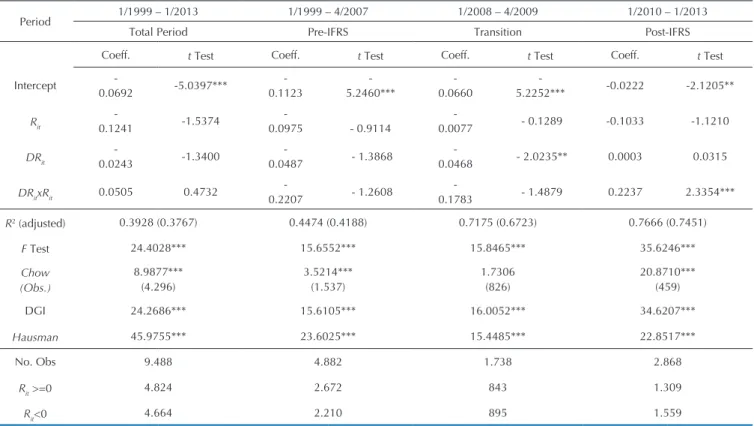
The Model (7) estimation was based on the total pe-riod (1/1999 – 1/2013) and the pre-IFRS – from 1/1999 to 4/2007 – and post-IFRS– from 1/2008 to 1/2013 – pe-riods. Table 6 presents the results.
Model (7):
β β δ δ ε
= + + + × +
−
NPPS
p R DR DR R
it
t
it it it it it
1
0 1 1 2
Period 1/1999 – 1/2013 1/1999 – 4/2007 1/2008 – 4/2009 1/2010 – 1/2013
Total Period Pre-IFRS Transition Post-IFRS
Coeff. t Test Coeff. t Test Coeff. t Test Coeff. t Test
Intercept
-0.0692 -5.0397***
-0.1123
-5.2460***
-0.0660
-5.2252*** -0.0222 -2.1205**
Rit
-0.1241 -1.5374
-0.0975 - 0.9114
-0.0077 - 0.1289 -0.1033 -1.1210
DRit
-0.0243 -1.3400
-0.0487 - 1.3868
-0.0468 - 2.0235** 0.0003 0.0315
DRitxRit 0.0505 0.4732
-0.2207 - 1.2608
-0.1783 - 1.4879 0.2237 2.3354***
R2 (adjusted) 0.3928 (0.3767) 0.4474 (0.4188) 0.7175 (0.6723) 0.7666 (0.7451)
F Test 24.4028*** 15.6552*** 15.8465*** 35.6246***
Chow
(Obs.)
8.9877*** (4.296)
3.5214*** (1.537)
1.7306 (826)
20.8710*** (459)
DGI 24.2686*** 15.6105*** 16.0052*** 34.6207***
Hausman 45.9755*** 23.6025*** 15.4485*** 22.8517***
No. Obs 9.488 4.882 1.738 2.868
Rit >=0 4.824 2.672 843 1.309
Rit<0 4.664 2.210 895 1.559
All estimations were performed using the ixed effects model. t−1 it
p NPPS
is the net proit of the exercise per share of the i-th company in quarter t, delated by the share price at the end of quarter t-1. Rit is the return of the i-th share in quarter t, calculated in logarithmic form. DRit is a dummy variable. DRit=1 if Rit <0. In the Chow test, (obs.) represents the observation where the greatest magnitude of the test was identiied. No presence of multicollinearity was
detected. Variance Inlation Factors (VIF) < 3.
*, **, and *** represent signiicance at 10%, 5%, and 1%, respectively.
Table 6 Model (7) Results - Conservatism
The model shows a highly significant fit and a good explanatory power of approximately 37% for the total period. However, no signs of conditional conservatism are found for the total period, given the non-significan-ce of the coefficient DRitxRit, which was also observed in the pre-IFRS and transition periods.
he estimation for the post-IFRS period shows similar characteristics to the total period. However, the model’s ex-planatory power was higher than 74%, which is considered high. A comparison between these results and those asses-sed in the timeliness analysis – Model (4) – indicates that the control of negative returns enabled by the dummy
va-riables accounts for the increase of this explanatory power. These results indicate the importance of negative returns in the studied relationship. Moreover, reinfor-cing this interpretation, the DRitxRitcoefficient is highly significant, suggesting that the adoption of IFRS increa-sed the level of conditional conservatism of accounting profits when considering the pre-IFRS and transition periods.
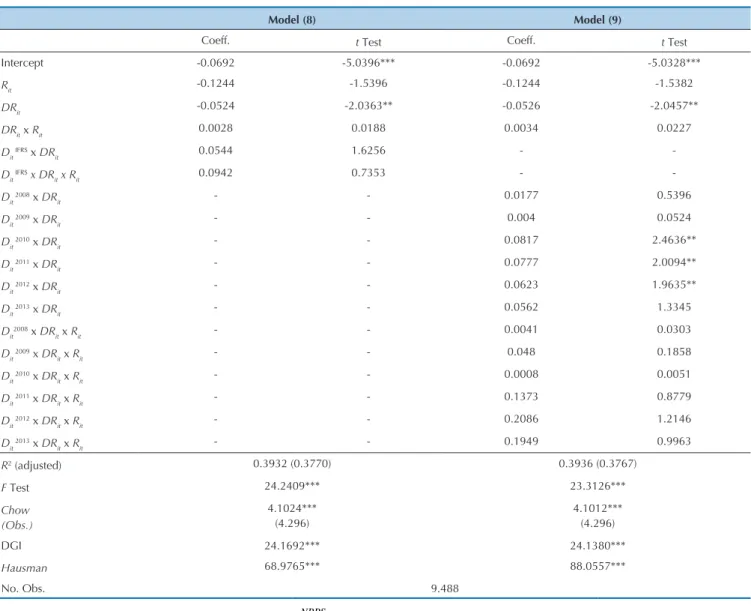
Satisfactory fit and an explanatory power higher than 37% is observed in the estimations. However, none of the models show significant coefficients of variables that are indicative of the presence of conditional conserva-tism, either before or after adopting the IFRS, which contradicts the result obtained using Model (7) for the post-IFRS period and confirms the initial indication of an increased level of conditional conservatism of ac-counting profits in this period.
Considering the results obtained using Models (7), (8), and (9), hypothesis H3 is rejected, which corrobora-tes the findings of Santos et al. (2011), Paulo, Cavalcan-te, and Melo (2012), and Rodrigues (2012).
Conversely, some of these results contradict the fin-dings of a series of studies conducted in Brazil, inclu-ding those of Costa, Costa, and Lopes (2006), Coelho and Lima (2007), Santos and Costa (2008), and Almeida, Scalzer, and Costa (2008). However, the existing metho-dological differences, including the statistical methods
used, sample sizes, and periods, among others, are as-pects that should be considered.
Finally, two other issues also merit comment: (1) pe-riods with negative returns were significant (DRit=1); and (2) the models showed high explanatory power.
The representativity of the periods when negative returns were observed may suggest the occurrence of events not associated with the negative variations of prices and unrelated to accounting profits in the ratio of these variations. Interestingly, the results show that these events were not linked to the adoption of IFRS be-cause the variables representing the interactions betwe-en DRit, Rit, and the dummy variables indicative of this period were not significant.
he high explanatory power shown by the models is atypical when considering domestic studies as well as the seminal study by Basu (1997). However, the use of a model that was more appropriate to the characteristics of the data, namely, the ixed efects model, signiicantly improved the
Model (8) Model (9)
Coeff. t Test Coeff. t Test
Intercept -0.0692 -5.0396*** -0.0692 -5.0328***
Rit -0.1244 -1.5396 -0.1244 -1.5382
DRit -0.0524 -2.0363** -0.0526 -2.0457**
DRit x Rit 0.0028 0.0188 0.0034 0.0227
Dit IFRS x DR
it 0.0544 1.6256 -
-Dit IFRS x DR
it x Rit 0.0942 0.7353 -
-Dit 2008 x DR
it - - 0.0177 0.5396
Dit 2009 x DR
it - - 0.004 0.0524
Dit 2010 x DR
it - - 0.0817 2.4636**
Dit 2011 x DR
it - - 0.0777 2.0094**
Dit 2012 x DR
it - - 0.0623 1.9635**
Dit 2013 x DR
it - - 0.0562 1.3345
Dit2008 x DR
it x Rit - - 0.0041 0.0303
Dit 2009 x DR
it x Rit - - 0.048 0.1858
Dit 2010 x DR
it x Rit - - 0.0008 0.0051
Dit 2011 x DR
it x Rit - - 0.1373 0.8779
Dit 2012 x DR
it x Rit - - 0.2086 1.2146
Dit 2013 x DR
it x Rit - - 0.1949 0.9963
R2 (adjusted) 0.3932 (0.3770) 0.3936 (0.3767)
F Test 24.2409*** 23.3126***
Chow
(Obs.)
4.1024*** (4.296)
4.1012*** (4.296)
DGI 24.1692*** 24.1380***
Hausman 68.9765*** 88.0557***
No. Obs. 9.488
The estimations were performed using the ixed effects model. −
NPPS p
it
t1 is the net proit from the exercise per share of the i-th company in quarter t, delated
by the share price at the end of quarter t-1. Rit is the return of the i-th share in quarter t, calculated in logarithmic form. DRit is a dummy variable. DRit=1 if Rit <0. DitIFRS is a dummy variable. DitIFRS=1 if t postdates the adoption of IFRS. Dit2009...2013 are dummy variables. . Dit2008...2013=1 if t is the indicated year.
In the Chow test, (obs.) represents the observation where the greatest magnitude of the test was identiied. No presence of multicollinearity was detected. Variance Inlation Factors (VIF) < 5.
*, **, and *** represent signiicance at 10%, 5%, and 1%, respectively.
adjusted R2 of models. For example, the estimations of
Mo-dels (7), (8), and (9) using pooled regression based on the period from 1/1999 to 1/2013 showed adjusted R2 values
of 0.0066, 0.0086, and 0.0082, respectively, versus 0.3767, 0.3770, and 0.3767, respectively, that were found when the estimations were performed using the ixed efects model.
5 FINAL CONSIDERATIONS
he present study aimed to assess the efects of the mandatory adoption of the IFRS on the information re-levance of accounting proits for participants in the Bra-zilian stock market. his relevance is represented by the following dimensions: (i) associative capacity with share prices; and (ii) information timeliness. Furthermore, the conservatism level was assessed in the timeliness analysis.
The results indicated that adopting the IFRS increa-sed the associative capacity of accounting profits (non--rejection of H1), which corroborates the evidence re-ported in the domestic and international literature. The results regarding timeliness suggested that adopting the IFRS caused a decline in timeliness (rejection of H2). Fi-nally, the adoption of IFRS had no effect on the level of conditional conservatism (rejection of H3).
The results regarding timeliness indicate that ac-counting profits showed signs of timeliness before the adoption of the IFRS that could not be identified in subsequent periods. This finding is puzzling because although the assumption of competence is a characte-ristic present in both the domestic and IFRS standards, the latter tend to generate timelier information because they are less objectively guided toward the recognition and measurement of a company’s assets and liabilities and performance. This observation merits an in-depth analysis.
The results regarding conservatism corroborated the findings of Santos et al. (2011) and Rodrigues (2012), although the finding that this attribute was absent in the pre-IFRS period differs from other studies. This field of study merits examination beyond the descriptive natu-re of the econometric models used, which is the typical approach of research studies. Further understanding of this phenomenon is necessary to assess more fundamen-tal issues related to accounting standards and the profile of Brazilian stock market investors from an explanatory standpoint.
Jointly, these results suggest that adopting the IFRS failed to increase the information relevance of
accoun-ting profits for market participants. In principle, this finding contradicts the fundamental purpose of those standards: to provide useful information for investors’ decision-making process.
On other hand, given that the associative capacity ex-presses the level of association between variations in com-pany value and variations in accounting proits over time, the evidence shows that accounting proits at least tend to express what afected the company’s value, albeit in an un-timely manner. herefore, the IFRS may presumably have improved the capacity of accounting proits to express what should be recognized from an investor’s standpoint, which is a positive efect of adopting the IFRS.
Moreover, the finding that the absence of conditional conservatism may actually promote information quality and possibly its usefulness, rather than being detrimen-tal to information quality as advocated by much of the literature, requires further analysis because the absence of that conservative bias contributes to information neu-trality, thus enabling it to more reliably represent what it should express.
However, this study only included publicly traded companies, which represent only a portion of the various users of accounting information, and the study assu-med that share pricing represents an unbiased response from market participants regarding company value. In-teractions with legal, institutional, and political factors and their effects on the profit-return-IFRS relationship were not assessed. This approach represents a limitation when analyzing the more structural aspects of this rela-tionship, although to some extent it is acceptable.
Another limitation of the study is the failure to control the efects of the global inancial crisis. Furthermore, a lack of infor-mation content analysis limited the scope of the study because examining the market reaction to the disclosure of accounting proits could provide answers to questions regarding timeliness.
Ahmed, K., Chalmers, K., & Khlif, H. (2013). A meta-analysis of IFRS adoption efects. he International Journal of Accounting, 48 (2), 173-217. Almeida, J. C. G., Scalzer, R. S., & Costa, F. M. (2008). Níveis diferenciados de governança corporativa e graus de conservatism: estudo empírico em companhias abertas listadas na BOVESPA. Revista de Contabilidade e Organizações – FEA-RP/USP, São Paulo, 2 (2), 118-131.
Arellano, M. (2003). Panel data econometrics. Oxford: Oxford University Press. Ashbaugh, H., & Pincus, M. (2001). Domestic accounting standards,
international accounting standards, and the predictability of earnings. Journal of Accounting Research, 39 (3), 417-434.
Ball, R. (2006). International inancial reporting standards (IFRS): pros and cons for investors. Accounting and Business Research, 36 (supplement 1, special issue: International Accounting Policy Forum), 5-27.
Barth, M. E., Beaver, W. H., & Landsman, W. R. (2001). he relevance of the value relevance literature for inancial accounting standard setting: another view. Journal of Accounting and Economics, 31 (1-3), 77-104. Barth, M. E, & Clinch, G. (2009). Scale efects in capital markets-based
accounting research. Journal of Business Finance & Accounting, 36 (3-4), 253-288.
Barth, M. E., & Kallapur, S. (1996). he efects of cross-sectional scale diferences on regression results in empirical accounting research. Contemporary Accounting Research, 13 (2), 527-567.
Barth, M. E., Landsman, W. R., & Lang, M. H. (2008). International accounting standards and accounting quality. Journal of Accounting Research, 46 (3), 467-498.
Basu, S. (1997). he conservatism principle and the asymmetric timeliness of earnings. Journal of Accounting and Economics, 24 (1), 3-37. Beaver, W., Lambert, R., & Morse, D. (1980). he information content of
security prices. Journal of Accounting and Economics, 2 (1), 3-28. Callao, S., Jarne, J. I., & Laínez, J. A. (2007). Adoption of IFRS in Spain:
efect on the comparability and relevance of inancial reporting. Journal of International Accounting Auditing & Taxation, 16, 148-178. Clarkson, P., Hanna, J. D., Richardson, G. D., & hompson, R. (2011). he
impact of IFRS adoption on the value relevance of book value and earnings. Working Paper.Recuperado em 20 fevereiro, 2013, de http:// ssrn.com/abstract=1614362.
Coelho, A. C., & Lima, I. S. (2007). Information quality e conservatism nos resultados contábeis publicados no Brasil. Revista Contabilidade & Finanças - USP, São Paulo, 18 (45), 38-49.
Costa, F. M., Costa, A. C. O., & Lopes, A. B. (2006). Conservatism em cinco países da América do Sul. Revista Contabilidade & Finanças - USP, São Paulo, 17 (41), 7-20.
Costa, P. S. (2012). Implicações da adoção das IFRS sobre a conformidade inanceira e iscal das companhias abertas brasileiras. Tese de doutorado, Universidade de São Paulo, São Paulo, SP, Brasil, 2012. Dantas, J. A., Rodrigues, F. F., Niyama, J. K., & Mendes, P. C. M. (2010).
Normatização contábil baseada em princípios ou em regras? Benefícios, custos, oportunidades e riscos. Revista de Contabilidade e Organizações – FEA – RP/SP, 4 (9), 3-29.
Garanina, T. A., & Kormiltseva, P. S. (2014). he efect of International Financial Reporting Standards (IFRS) adoption on the value relevance of inancial reporting: a case of Russia. In C. N. Albu, & R. V. Mustata (Ed.). Accounting in Central and Eastern Europe (Research in Accounting in Emerging Economies, v. 13, Chap. 8, pp. 27-60), Emerald Group Publishing Limited.
Gil-Alana, L. A., Iniguez-Sanchez, R., & Lopez-Espinosa, G. (2011). Endogenous problems in cross-sectional valuation models based on accounting information. Review of Quantitative Finance and Accounting, 37 (2), 245-265.
Hung, M., & Subramanyam, K. R. (2007). Financial statement efects of adopting international accounting standards: the case of Germany. Review of Accounting Studies, 12 (4), 623-657.
Jarva, H., & Lantto, A. M. (2012). Information content of IFRS versus domestic accounting standards: evidence from Finland. Working Paper. Recuperado em 06 julho, 2012, de http://ssrn.com/ abstract=1588087.
Karampinis, N., & Hevas, D. (2009). he efect of the mandatory application of IFRS on the value relevance do accounting data: some evidence from Greece. European Research Studies, XII (1), 73-100. Kargin, S. (2013). he impact of IFRS on the value relevance of accounting
information: evidence from Turkish irms. International Journal of Economics and Finance, 5 (4), 71-80.
Klimczak, K. M. (2011). Market reaction to mandatory IFRS adoption: evidence from Poland. Accounting and Management Information Systems, 10 (2), 228-248.
Landsman, W. R., Maydew, E. L., & hornock, J. R. (2012). he information content of annual earnings announcements and mandatory adoption of IFRS. Journal of Accounting and Economics, 53 (1-2), 34-54.
Leuz, C., & Wysocki, P. (2008). Economic consequences of inancial reporting and disclosure regulation: a review and suggestions for future research. Working Paper, University of Chicago.
Li, S. (2010). Does mandatory adoption of International Financial Reporting Standards in the European Union reduce the cost of equity capital? he Accounting Review, 85 (2), 607-636.
Lima, J. B. N. (2010). A relevância da accounting information e o processo de convergência para as normas IFRS no Brasil. Tese de doutorado, Universidade de São Paulo, São Paulo, SP, Brasil.
Macedo, M. A. S., Machado, M. R., Machado, M. A. V., & Mendonça, P. H. C. (2013). Impacto da convergência às accounting standards internacionais no Brasil sobre o information content da
Contabilidade. Revista de Educação e Pesquisa em Contabilidade, 7 (3), 222-239.
Niyama, J. K. (2007). Contabilidade internacional. São Paulo: Atlas. Oliveira, V. A., & Lemes, S. (2011). Nível de convergência dos princípios
contábeis brasileiros e norte-americanos às normas do IASB: uma contribuição para a adoção das IFRS por empresas brasileiras. Revista Contabilidade & Finanças, 22 (56), 155-173.
Paulo, E., Cavalcante, P. R. N., & Melo, I. I. S. L. (2012). Qualidade da accounting information na oferta pública de ações e debêntures pelas companhias abertas brasileiras. Brazilian Business Review – BBR, Vitória, 9 (1), 1-26.
Rodrigues, J. M. (2012). Convergência contábil internacional: uma análise da qualidade da accounting information em razão da adoção dos padrões internacionais de contabilidade editados pelo IASB. Tese de doutorado, Universidade de Brasília - UnB, Universidade Federal da Paraíba - UFPB, Universidade Federal do Rio Grande do Norte - UFRN, Brasília, DF, Brasil.
Santos, L. P. G., Lima, G. A. S. F., Freitas, S. C., & Lima, I. S. (2011). Efeito da Lei 11.638/07 sobre o conditional conservatism das empresas listadas BM&FBOVESPA. Revista Contabilidade e Finanças – USP, São Paulo, 22 (56), 174-188.
Santos, L. S. R., & Costa, F. M. (2008). Conservatism contábil e timeliness: evidências empíricas nas accounting statements de empresas brasileiras com ADRS negociados na Bolsa de Nova Iorque. Revista Contabilidade e Finanças – USP, São Paulo, 19 (48), 27-46. Soderstrom, N. S., & Sun, K. J. (2007). IFRS adoption and accounting