Dosimetric evaluation of a combination of brachytherapy
applicators for uterine cervix cancer with involvement
of the distal vagina*
Avaliação dosimétrica de uma combinação de aplicadores para braquiterapia de tumores do colo uterino com acometimento da porção distal da vagina
Roger Guilherme Rodrigues Guimarães1, Heloisa de Andrade Carvalho2, Silvia Radwanski Stuart3, Rodrigo Augusto Rubo4, Rodrigo Migotto Seraide5
OBJECTIVE: To evaluate an alternative brachytherapy technique for uterine cervix cancer involving the distal vagina, without increasing the risk of toxicity. MATERIALS AND METHODS: Theoretical study comparing three different high-dose rate intracavitary brachytherapy applicators: intrauterine tandem and vaginal cylinder (TC); tandem/ring applicator combined with vaginal cylinder (TR+C); and a virtual applicator combining both the tandem/ring and vaginal cylinder in a single device (TRC). Prescribed doses were 7 Gy at point A, and 5 Gy on the surface or at a 5 mm depth of the vaginal mucosa. Doses delivered to the rectum, bladder and sigmoid colon were kept below the tolerance limits. Volumes covered by the isodoses, respectively, 50% (V50), 100% (V100), 150% (V150) and 200% (V200) were compared. RESULTS: Both the combined TR+C and TRC presented a better dose distribution as compared with the TC applicator. The TR+C dose distribution was similar to the TRC dose, with V150 and V200 being about 50% higher for TR+C (within the cylinder). CONCLUSION: Combined TR+C in a two-time single application may represent an alternative therapy technique for patients affected by uterine cervix cancer involving the distal vagina.
Keywords: Cervical cancer; Radiotherapy; Intracavitary brachytherapy; Dosimetry.
OBJETIVO: Avaliar uma alternativa de braquiterapia para tumores do colo uterino acometendo a porção dis-tal da vagina, sem aumentar os riscos de toxicidade. MATERIAIS E MÉTODOS: Estudo teórico comparando três diferentes aplicadores de braquiterapia intracavitária de alta taxa de dose: sonda intrauterina e cilindro vaginal (SC); sonda e anel associado ao cilindro vaginal (SA+C) e um aplicador virtual com sonda, anel e cilindro vaginal em um único conjunto (SAC). Foram prescritas doses de 7 Gy no ponto A e 5 Gy na super-fície ou a 5 mm de profundidade na mucosa vaginal, mantendo as doses nos pontos de reto, bexiga e sig-moide abaixo dos limites de tolerância. Foram comparados os volumes englobados pelas isodoses de 50% (V50), 100% (V100), 150% (V150) e 200% (V200), respectivamente. RESULTADOS: Tanto SA+C quanto SAC apresentaram melhor distribuição de dose quando comparados ao aplicador SC. A distribuição de dose obtida com SA+C foi semelhante à do aplicador SAC, sendo V150 e V200 cerca de 50% maiores para SA+C, todavia, dentro do cilindro. CONCLUSÃO: A utilização de SA+C em uma única aplicação em dois tempos pode ser uma alternativa de tratamento para pacientes que apresentam tumores de colo uterino com acometimento distal da vagina.
Unitermos: Câncer do colo uterino; Radioterapia; Braquiterapia intracavitária; Dosimetria.
Abstract
Resumo
* Study developed at Unit of Radiotherapy, Division of Oncol-ogy – Instituto de Radiologia do Hospital das Clínicas da Facul-dade de Medicina da UniversiFacul-dade de São Paulo (InRad/HC-FMUSP), São Paulo, SP, Brazil.
1. MD, Radiation Oncologist, Service of Stereotactic Radio-therapy – Real e Benemérita Sociedade Portuguesa de Benefi-cência, São Paulo, SP, Brazil.
2. PhD, Radiation Oncologist, Assistant Physician at Unit of Radiotherapy, Division of Oncology – Instituto de Radiologia do Hospital das Clínicas da Faculdade de Medicina da Universi-dade de São Paulo (InRad/HC-FMUSP), São Paulo, SP, Brazil.
3. MD, Radiation Oncologist, Assistant at Unit of Radiotherapy, Division of Oncology – Instituto de Radiologia do Hospital das Clínicas da Faculdade de Medicina da Universidade de São Paulo (InRad/HC-FMUSP), São Paulo, SP, Brazil.
4. Master, Physicist, Unit of Radiotherapy, Division of Oncology – Instituto de Radiologia do Hospital das Clínicas da Faculdade de Medicina da Universidade de São Paulo (InRad/HC-FMUSP), São Paulo, SP, Brazil.
In Brazil, it is estimated that uterine cervix cancer is the third most common ma-lignant neoplasm affecting women, after non-melanoma skin cancers and breast can-cer, and the fourth most common cause of cancer death. According to the Instituto Nacional do Câncer, the estimated inci-dence rate for 2008, was 19 cases per 100,000 women, corresponding to 18,680 of expected new cases(2).
The standard treatment for most patients with invasive cervix cancer is concomitant radiochemotherapy. The global benefit Guimarães RGR, Carvalho HA, Stuart SR, Rubo RA, Seraide RM. Dosimetric evaluation of a combination of brachytherapy applicators for uterine cervix cancer with involvement of the distal vagina. Radiol Bras. 2009;42(4):209–214.
INTRODUCTION
Uterine cervix cancer is the second most frequent malignant tumor in women, with approximately 550,000 new cases being diagnosed every year, and causing 270,000 deaths per year(1).
5. Master, Physicist, Centro de Oncologia Campinas, Campi-nas, SP, Brazil.
Mailing address: Dra. Heloisa de Andrade Carvalho. Serviço de Radioterapia – InRad. Avenida Doutor Enéas de Carvalho Aguiar, 255, Pinheiros. São Paulo, SP, Brazil, 05413-013. E-mail: [email protected]
obtained from this association, as com-pared with radiotherapy alone is about 12%, due to better local control, and over-all and disease-free survival rates(3–7). Therefore, local control represents an im-portant factor impacting the survival of such patients.
Radiotherapy consists of a combination of external pelvic irradiation with intracavi-tary brachytherapy. In spite of the low in-cidence of cases with stage IIIa (FIGO(8)), where the distal third of the vagina is in-volved, many patients in more advanced stages of disease also present infiltration of distal half or third of the vagina(9). Patients presenting involvement of the distal vagina by the tumor are usually submitted to int-racavitary brachytherapy with intrauterine tandem and vaginal cylinder. However, the uterine cervix, where the larger tumor vol-ume is located, is underdosed, if one com-pares this technique with that using intrau-terine tandem and ovoids or ring. On the other hand, with such technique, the lower half of the vagina is underdosed. The ideal situation would be utilizing a gynecologic applicator specially developed for these cases, associating an adequate coverage of the uterine cervix tumor with an appropri-ate treatment of the vaginal disease. For low dose-rate brachytherapy, some proto-types have already been developed(10,11). However, concerning high dose-rate brachytherapy, besides the applicator with the tandem and cylinder, only applicators for individual treatment of either cervical or vaginal diseases are available.
Thus, we decided to study a treatment technique using a combination of two gy-necologic applicators already available (in-trauterine tandem and ring in combination with the vaginal cylinder), where the 100% isodose of brachytherapy would involve more adequately the tumor in the described situation, without increasing the risks of toxicity.
MATERIALS AND METHODS
A theoretical study comparing three high dose-rate brachytherapy techniques was undertaken. The applicators most fre-quently utilized in our daily practice were selected as follows: a 60 mm tandem and 30 mm-diameter cylinder (TC) (Nucletron
BV®; Veenendaal, Netherlands); tandem/
ring applicator – r30i60 (Nucletron®) – 60
mm tandem, 30 mm-diameter ring, and 60° angle, with rectal retractor, associated with the 30 mm diameter vaginal cylinder (in-trauterine tandem and ring + cylinder: TR+C) (Nucletron®). Additionally, a
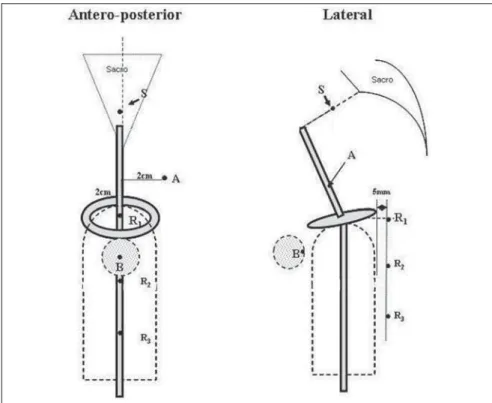
vir-tual applicator was idealized to simulate the 60 mm intrauterine tandem, with ring (30 mm diameter) and vaginal cylinder (30 mm diameter) in a single set (TRC) (Figure 1). Treatments were simulated with each one of these applicators, with a prescribed dose of 7 Gy to point A and 5 Gy to the vaginal mucosa surface or at a 5 mm depth by 6 cm extent. The volumes involved by the 50% (V50), 100% (V100), 150% (V150) and 200% (V200) isodoses, respectively, were evaluated, besides the doses to the organs at risk, according to the ICRU 38 recom-mendations(12).
Besides the reference points A, B, rec-tum and bladder, the following points were also considered: a) a sigmoid point – the midpoint on a straight line from the extrem-ity of the intrauterine tandem to the prom-ontory on the lateral radiographic image and its projection on the center of the pa-tient at the anteroposterior radiographic image; b) two additional points for the rec-tum – 2.5 and 5 cm caudal to the ICRU 38 point and in the same plane (Figure 2). The points for dose evaluation in the vagina
were defined at 15 mm from the cylinder source axis, corresponding to the applica-tor surface/vaginal mucosa surface, and at 20 mm, corresponding to the dose at a 5 mm depth, respectively, throughout the treatment extent of 6 cm.
For the simulations, semiorthogonal ra-diographs of an actual case treated with the selected ring applicator (r30i60) were used. The calculations were performed with the Plato v 13.0 (Nucletron®) 3D planning
sys-tem for brachytherapy.
According to the standard established in our institution, the prescribed dose per frac-tion is 7 or 7.5 Gy to point A, without op-timization, when the ring applicator is used. If necessary, in order to maintain the doses on the organs at risk within the tolerance limits, individualized manual optimization is utilized. In cases requiring irradiation of the whole vagina, the intrauterine tandem with vaginal cylinder (TC) is used, and the calculation of 7 Gy is done at 2 cm from the intrauterine tandem axis, and 5 Gy on the cylinder surface, when there is no mac-roscopic residual disease in the vagina, or at a 5 mm depth if vaginal disease is still present, with “optimization on dose points”. The doses to the points of the or-gans at risk should be kept below 60% to 65% of the dose prescribed for point A, i.e., absolute doses < 4.5 Gy. When the pre-scription is at 5 mm depth in the vaginal
Figure 3. Simulation of isodoses obtained with intrauterine tandem and cylinder.
The volumes involved by the respective treatment isodoses were calculated and compared: V50 (50%), V100 (100%), V150 (150%), V200 (200%), for prescrip-tions of 7 Gy to point A and 5 Gy on the surface or at a 5 mm depth in the vaginal mucosa, respectively.
RESULTS
Tables 1 and 2 present the results ob-tained in the analyzed situations and the re-lationships between the volumes obtained with TC and TRC with TR+C. Among the three simulated treatments, the one utiliz-ing TC presented larger volumes irradiated with low doses and smaller volumes with high doses when the 5 Gy dose was calcu-lated on the vaginal surface. All the vol-umes were larger when this dose was cal-culated at a 5 mm depth. Looking at the dose distribution, the largest irradiated volumes were obtained by the larger irra-diation of the uterine body in relation to the tumor area itself (Figure 3).
By comparing the values obtained with the simulation of TR+C and TRC for the calculation of 5 Gy on the surface of the vaginal mucosa (Table 1), it was observed that, with TRC the 7 Gy volume can be slightly increased (4% to 5%), while the high dose volumes are the lowest (approxi-mucosa, a maximum dose of 5 Gy to the
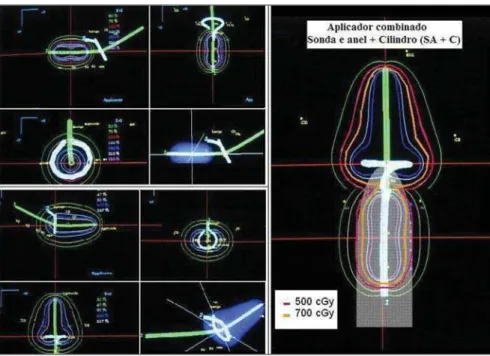
points of the organs at risk is accepted. Therefore, for each applicator, calculations were made with 7 Gy to point A and 5 Gy at the cylinder surface and at 5 mm depth. The calculation for TC followed the previously described steps (Figure 3). The simulation of the TR+C was idealized for a two-phase treatment, in a single applica-tion where, after the treatment with the tan-dem/ring applicator, it would be replaced by the cylinder for vaginal irradiation. A 7 Gy dose was calculated, as usual, on point A with TR, and subsequently, for the load-ing of the vaginal cylinder, the vaginal ex-tent covered by the 5 Gy isodose obtained from the calculation with TR was mea-sured. This extent was subtracted from the proximal loading of the cylinder. The sum of the two plans generated a final isodose of 100%, where point A received 7 Gy and the dose to the vagina was 5 Gy (on the surface or at a 5 mm depth) (Figure 4). The virtual applicator (TRC) was created to simulate an application in a single phase, without the need to change applicators. For the calculation, the same loading scheme obtained with the TR+C combination was adopted, achieving with a single plan, the
same final isodose of 100% (Figure 5). In all situations, if necessary, adjustments in the source dwell times were made by means of manual optimization, in order to keep the doses to the organs at risk below the toler-ance limits.
mately 50% lower than with TR+C). Re-garding the low doses volumes, the ones receiving 5 Gy or 2.5 Gy are also larger with the TRC. However, the volume receiv-ing 3.5 Gy (V50) was larger when the TR+C was used.
On the other hand, when the 5 Gy pre-scription was changed for 5 mm depth, all the 100% or less dose volumes were larger (around 10% to 15%) with the TRC. Again, TR+C presented larger high dose volumes, mainly V200 (12%).
With TR+C or TRC, both the region of the uterine cervix (“tumor”) and the vagi-nal “disease” were appropriately covered by the 100% isodose. The high-dose vol-umes comprised mainly the uterine cervix region at the widest portion of the classi-cal “pear shaped” isodose, at the same time that a great part of these volumes was con-tained within the cylinder, in the vaginal portion (Figures 4 and 5).
DISCUSSION
Uterine cervix tumors, like other neo-plasms, when locally advanced, present a higher probability of recurrence. An ex-tremely important aspect of the treatment and local control of these tumors is the possibility of performing intracavitary brachytherapy, with the delivery of high doses to the tumor volume, at the same time preserving the surrounding healthy tissues, due to the steep dose gradient generated.
Classically, the dose prescription in brachytherapy for uterine cervix cancer is on point A, which does not reflect the dose to the existing tumor volume. In spite of being published for more than 20 years ago, the recommendations of the ICRU report
Figure 4. Isodoses obtained with the tandem and ring applicator, associated with the cylinder.
Figure 5. Isodoses obtained with the virtual applicator: intrauterine tandem, ring and cylinder.
Table 1 Results of volumes (cm3) obtained with the 7 Gy dose in point A
and 5 Gy on the vaginal surface.
Vdose* (Gy)
V2.5 V3.5 V5 V7 V10.5
V14
TC†
674.80 403.11 233.52 92.42 52.35 31.46
TR+C‡
468.40 285.49 169.08 103.76 57.01 34.93
TRC§
508.05 245.99 180.75 107.58 30.66 17.04
TC/TR+C
1.44 1.41 1.38 0.89 0.92 0.90
TRC/TR+C
1.08 0.86 1.07 1.04 0.54 0.49
* Volume receiving the doses of respectively: 2.5 Gy (50% of 5 Gy prescribed to the vagina), 3.5 Gy (50%), 5 Gy (100% on the vagina), 7 Gy (100%), 10.5 Gy (150%) and 14 Gy (200%); † TC: tandem and cylinder; ‡ TR+C: tandem and ring+cylinder (two applicators); § TRC; tandem, ring and cylinder (single applicator).
Table 2 Results of volumes (cm3) obtained with the calculation of 7 Gy at
point A and Gy at 5 mm from the vaginal surface.
Vdose* (Gy)
V2.5 V3.5 V5 V7 V10.5
V14
TC†
798.91 484.00 273.94 164.35 83.73 51.98
TR+C‡
518.84 316.21 188.18 117.30 65.10 40.68
TRC§
597.23 361.89 216.84 128.74 64.74 35.78
TC/TR+C
1.54 1.53 1.46 1.40 1.29 1.28
TRC/TR+C
1.15 1.14 1.15 1.10 0.99 0.88
n. 38(12) still remain as the main reference and guideline for brachytherapy of gyneco-logic tumors(13). However, significant changes have occurred, resulting in devel-opments in the brachytherapy technique, such as improvement in images acquisition, novel 3D planning systems, availability of safer and more reliable equipment, and development of highdose-rate brachy-therapy, among others. In spite of all that, because of the good results achieved and the high cost of this more advanced tech-nology, most centers still perform gyneco-logic brachytherapy based exclusively on 2D planning and dose evaluation in points. However, the dose prescription in one point is attached to some problems, such as the great variation in the dose to the tumor, due to the greater heterogeneity of the pre-scribed dose, and also the difficulties in reproducibility and definition of the point. In cases where the presence of an extensive vaginal lesion is observed in addition to the uterine cervix disease, these problems are even greater, as the whole tumor volume must be appropriately irradiated both in the uterine cervix and in the vaginal area.
In order to improve the brachytherapy quality delivered to the patients with uter-ine cervix tumors, particularly those with involvement of the distal portion of the va-gina, we developed a preliminary theoreti-cal study, based on the prescription on dose points routinely adopted by our institution. Also, a study of the irradiated volumes was associated, although without the appropri-ate imaging studies, but following some evaluation parameters already described for other brachytherapy techniques(14).
We could observe that the treatment with TC is the one that irradiates the larg-est volumes, although with larger irradia-tion of the uterine body and not of the tu-mor volume itself. In other words, in spite of its indication for such cases, it does not represent the best therapeutic option.
The dosimetric study demonstrated that the dose distribution achieved with the combination of two applicators may be similar to that achieved with a single appli-cator especially designed for these cases. The placement of the vaginal cylinder af-ter the treatment with TR to complement the dose to the distal portion of the vagina is simple, feasible and safe. In spite of
eventual inconveniences of changing appli-cators and increased treatment time, pa-tients presenting with uterine cervix cancer extending to the lower vaginal third may potentially benefit from this tech-nique(10,15).
Other authors have developed a similar study combining two gynecologic high dose-rate brachytherapy applicators: in-trauterine tandem and mini-ovoids, and intrauterine tandem and vaginal cylin-der(15). The authors have reported the treat-ment results based on calculations per-formed by a homemade planning software that generates a “galaxy-shaped” isodose. Twenty-two patients with disease at stages IIB to IVA were treated with the technique. With a median 87.4-month follow-up, a disease-free survival rate of 90.7% and overall five-year survival rate of 81.8% were observed, respectively. Grade 2 tox-icity was 4.5% (one patient with proctitis). However, for calculations, two semi-or-thogonal radiographs sets were necessary: one with the intrauterine tandem and vagi-nal cylinder and another with the tandem and colpostates. And, for the treatment, once more, the patient was submitted to the change of applicators. An interesting aspect to be noticed in this study, was the fact that there was a decrease of 10% to 15% in the relative weight in the ovoids loading, to avoid an increase in the prescribed dose in point A.
In the present study, the combination of applicators presented larger high dose vol-umes, mainly due to the overlap of the two plans. However, when the 3D dose distri-bution is considered, a great part of these volumes is contained in the region of high-est risk (uterine cervix), or within the cyl-inder (Figure 4). On the other hand, the virtual applicator presents a steeper dose gradient, with larger low dose volumes. It was possible to keep the values at the points of the organs at risk below the tolerance doses in all the evaluated situations.
However, some considerations regard-ing the methodology of our study should be made.
The high dose volumes were calculated in relation to the prescribed dose at point A (7 Gy). With the prescribed dose of 5 Gy in the vagina, the high dose volumes in this region, besides corresponding to lower
doses (V150 = 7.5 Gy and V200 = 10 Gy), will be within the vaginal cylinder.
Only one model of each applicator was used, and the calculations should be vali-dated for the existing alternatives: differ-ent angles and intrauterine tandem lengths, variations in ring and cylinder diameters, applicators using ovoids, and others.
For the simulation, the radiographs of a real case treated with TR, were used, where the reconstruction of the applicator was based on the corresponding standard appli-cator already described in the planning sys-tem. The tandem of the TR applicator is straight, while the tandem of the TC appli-cator is curved. This fact may have caused a difference, albeit negligible, in the calcu-lations of the respective volumes. How-ever, the dose distribution with TC will never be equivalent to that obtained with ring or ovoids, in relation to the widening of the isodoses in the cervix portion.
Ring and cylinder with the same diam-eter (30 mm) were selected, in accordance with the routine use in our institution. However, the ring diameter is defined in relation to the source axis and its actual external diameter, with the cap, is 40 mm. This fact should be taken into account when selecting the applicator that better fits the patient. Additionally, anatomic varia-tions caused by the replacement of appli-cators could not be evaluated. In this as-pect, perhaps a single applicator could be more appropriate, avoiding changes in the uterus position and distortions of the vagi-nal walls. This would also avoid the uncer-tainty originated from the isodoses overlap-ping for the definition of the cylinder por-tion that needs to be loaded. This aspect could be better evaluated with the use of computed tomography or magnetic reso-nance imaging in a real case, as the repro-ducibility of anatomic variation in a phan-tom might be questionable. The use of ther-moluminescent dosimeters might also add more safety in the validation of the calcu-lations, and allow better optimization. In any instance, the higher dose volumes gen-erated by the isodoses overlapping, would still be within the cylinder, in the vaginal portion.
in point A and “optimization of dose points” for the vagina) were slightly differ-ent, due to the applicators’ characteristics and interaction with the planning system. This fact might also have interfered in the volume calculation, but this is an actual limitation of the currently available system. The applicators with the desired charac-teristics developed for low dose-rate(10,11) had the purpose of minimizing eventual un-certainties of the combination of two appli-cators, besides eliminating the inconve-nience and discomfort of an additional hospital stay for treatment of the vaginal portion. In one of the studies(10), the appli-cator was used clinically, with satisfactory, although preliminary results. For high dose-rate, however, there is not an applica-tor especially designed to provide the de-sired coverage for tumors in such condi-tions. A 3D study, based on magnetic reso-nance imaging, has been already designed for better evaluation of all these aspects.
It is important to emphasize that the clinical validation of the method for later development of an applicator with the ideal configuration, or of an accessory that adapts to applicators currently in routine use, is necessary. This latter alternative would be welcome in the medical environ-ment, considering the cost reduction and easing of the procedure.
CONCLUSION
The combination of two available appli-cators (intrauterine tandem and ring + cyl-inder: TR+C) presented an adequate dose distribution considering the coverage of the tumor and sparing of the organs at risk. Clinical validation is still necessary for implementation of the method in the daily routine.
REFERENCES
1. National Institutes of Health Consensus Develop-ment Conference stateDevelop-ment on cervical cancer. April 1-3, 1996. Gynecol Oncol. 1997;66:351–61. 2. Brasil. Ministério da Saúde. Instituto Nacional de Câncer – INCA. Estimativa de incidência e mor-talidade por câncer. Rio de Janeiro: INCA; 2008.
3. Rose PG, Bundy BN, Watkins EB, et al. Concur-rent cisplatin-based radiotherapy and chemo-therapy for locally advanced cervical cancer. N Engl J Med. 1999;340:1144–53.
4. Whitney CW, Sause W, Bundy BN, et al. Ran-domized comparison of fluorouracil plus cisplatin versus hydroxyurea as an adjunct to radiation therapy in stage IIB-IVA carcinoma of the cervix with negative para-aortic lymph nodes: a Gyne-cologic Oncology Group and Southwest Oncology Group study. J Clin Oncol. 1999;17:1339–48.
5. Peters WA 3rd, Liu PY, Barrett RJ 2nd, et al. Con-current chemotherapy and pelvic radiation therapy compared with pelvic radiation therapy alone as adjuvant therapy after radical surgery in high-risk early-stage cancer of the cervix. J Clin Oncol. 2000;18:1606–13.
6. Green JA, Kirwan JM, Tierney JF, et al. Survival and recurrence after concomitant chemotherapy and radiotherapy for cancer of the uterine cervix:
a systematic review and meta-analysis. Lancet. 2001;358:781–6.
7. Eifel PJ. Chemoradiotherapy in the treatment of cervical cancer. Semin Radiat Oncol. 2006;16: 177–85.
8. Benedet JL, Bender H, Jones H 3rd, et al. FIGO staging classifications and clinical practice guide-lines in the management of gynecologic cancers. FIGO Committee on Gynecologic Oncology. Int J Gynaecol Obstet. 2000;70:209–62.
9. Aisen S. Braquiterapia de alta taxa de dose no tratamento do câncer do colo uterino: resultados de controle local, sobrevida e complicações [tese de doutorado]. São Paulo: Universidade de São Paulo; 2003.
10. Wolfson AH, Wu X, Takita C, et al. A novel ap-plicator for low-dose-rate brachytherapy of gyne-cological cancers. Int J Gynecol Cancer. 2003;13: 532–40.
11. Baker C, Dini SA, Kudrimoti M, et al. Dosimet-ric evaluation of a newly designed low dose rate brachytherapy applicator for treatment of cervi-cal cancer with extension into the lower vagina. J Appl Clin Med Phys. 2007;8:37–46. 12. International Commission on Radiation Units and
Measurements. Dose and volume specification for reporting intracavitary therapy in gynecology. ICRU Report 38. Bethesda: ICRU; 1985. 13. Pötter R, Van Limbergen E, Gerstner N, et al.
Sur-vey of the use of the ICRU 38 in recording and reporting cervical cancer brachytherapy. Radiother Oncol. 2001;58:11–8.
14. International Commission on Radiation Units and Measurements. Dose and volume specification for reporting interstitial therapy. ICRU Report 58. Bethesda: ICRU; 1997.