abstract
Effects of air-polishing powders on color stability
of composite resins
Ahmet Umut GÜLER1, Ibrahim DURAN2, Ali Çağin YÜcEL3, Pelin ÖZKAN4
1- DDS, PhD, Associate Professor, Department of Prosthodontics, Faculty of Dentistry, Ondokuz Mayıs University, Samsun, Turkey. 2- DDS, Research Assistant, Department of Prosthodontics, Faculty of Dentistry, Ondokuz Mayıs University, Samsun, Turkey.
3- DDS, PhD, Associate Professor, Department of Restorative Dentistry, Faculty of Dentistry, Ondokuz Mayıs University, Samsun, Turkey. 4- DDS, PhD, Associate Professor, Department of Prosthodontics, Faculty of Dentistry, Ankara University, Ankara, Turkey.
Corresponding address: Dr. Ahmet Umut GÜLER - Ondokuz Mayıs University, Faculty of Dentistry - Department of Prosthodontics - 55139 - Kurupelit - Samsun - Turkey - Fax: 0090 362 457 60 32 - e-mail: [email protected]
Received: September 24, 2009 - Modiication: April 30, 2010 - Accepted: May 25, 2010
O
bjectives: The purpose of this study was to investigate the effect of different air-polishing powders on the color stability of different types of composite resin restorative materials. Material and methods: Thirty cylindrical specimens (15×2 mm) were prepared for each of 7 composite resin restorative materials. All specimens were polished with a series of aluminum oxide polishing discs (Sof-Lex). The prepared specimens of each composite resin were randomly divided into 3 groups of 10 specimens each, for control (Group-C) and two air-powder applications (Group-CP: Cavitron Prophy-Jet; Group-PS: Sirona ProSmile prophylaxis powder). A standard air-polishing unit (ProSmile Handly) was used. All specimens were air-powdered for 10 s at 4-bar pressure. The distance of the spray nosel from the specimens was approximately 10 mm and angulation of the nosel was 90°. Specimens were stored in 100 mL of coffee (Nescafe Classic) for 24 h at 37°C. Color measurement of all specimens was recorded before and after exposure tostaining agent with a colorimeter (Minolta CR-300). Color differences (∆E*) between the
2 color measurements (baseline and after 24 h storage) were calculated. The data were analyzed with a 2-way ANOVA test, and mean values were compared by the Tukey HSD
test (p≤0.05). Results: According to the 2-way ANOVA results, composite resin restorative materials, air-polishing powders, and their interaction were statistically signiicant (p<0.05) For Aelite Aesthetic Enemal, Filtek Z250, Grandio, CeramX Mono, and Quixil composite resin restorative materials, no signiicant difference was observed between Group-PS and Group-CP (p>.05) and these groups demonstrated the highest ∆E* values. For Filtek Silorane and IntenS, the highest ∆E* values were observed in Group-PS. The lowest ∆E*
values for all composite resin groups were observed in Group-C. When comparing the 7
composite resin restorative materials, Aelite Aesthetic Enemal demonstrated signiicantly less ∆E* values than the other composite resins tested. The highest ∆E* values were observed in Quixil. Conclusion: Except for Quixil, all control groups of composite resins that were polished Sof-Lex exhibited clinically acceptable ∆E values (<3.7). Air-polishing
applications increased the color change for all composite resin restorative materials tested. Composite restorations may require re-polishing after air-polishing.
Key words: Composite resins. Air abrasion. Polishing. Sodium bicarbonate. Color.
INtrODUctION
Composite resins are widely used for the direct restoration of both anterior and posterior teeth because of the esthetic, physical, and mechanical properties of these materials. A resin composite is composed of 4 major components: organic
polymer matrix, inorganic iller particles, coupling
(bis-GMA), urethane dimethacrilate (UDMA), and triethylene glycol dimethacrylate (TEGDMA)22.
In addition, siloranes have been suggested as alternatives to methacrylates as matrix resin components for dental composite because of their physical properties10. Composite resins have been
classiied according to various characteristics such as iller type, iller distribution, average particle size of iller, and physical and mechanical properties
of the materials. Currently, three categories have been proposed for widely used composite resins:
microilled, microhybrid, and nanocomposite24.
Discoloration of restorative materials may lead to patient dissatisfaction and additional expense for replacement. Failure or success of any esthetic
restoration depends irst on the color match and
then on the color stability of the materials. The degree of color change can be affected by a number of factors including diet8 and surface roughness26.
The quantitative evaluation of color difference
(∆E*) with a colorimeter confers advantages such
as repeatability, sensitivity, and objectivity, despite some limitations28.In principle, if a material is
completely color stable, no color difference will be detected after its exposure to the testing
environment (∆E*=0). Various studies have
reported different thresholds of color difference values above which the color change is perceptible
by the human eye. A ∆E* value of 3.7 or less is
considered to be clinically acceptable14,18.
Hygiene maintenance therapy is an integral part of restorative and periodontal treatment. The removal of stains and plaque from all accessible tooth surfaces is a routine part of the maintenance appointment29. The conventional rubber cup
prophylaxis and the air-powder polishing system are both effective professional techniques for plaque and stain removal, without detrimental effects on tooth structure and gingival tissues when correctly used. Since its introduction to the dental marketplace in 1977, air-powder polishing systems have been effective at removing stain and plaque5.
The designs of the various air-powder polishing systems, such as Sirona ProSmile Handly, use a mixture of air, water and sodium bicarbonate to deliver a controlled stream of sodium bicarbonate particles to the tooth surface. Advantages of airpolishers are rapid removal of tooth deposits, less invoked hypersensitivity, less operator fatigue,
and improved access to pits and issures5.
The purpose of this study was to investigate the effect of different air-polishing powders on the color stability of different types of composite resin restorative materials. The research hypothesis was that color stability of the composite resins is affected by the type of composite and the air-polishing powders.
MatErIaL aND MEtHODs
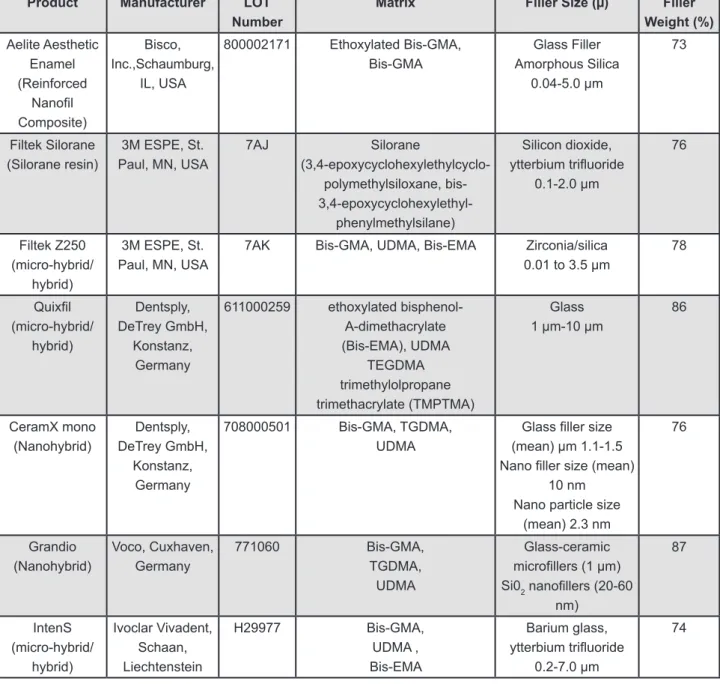
In the present study 7 composite resin restorative materials were investigated. The composite resins used in this study are shown in Figure 1. Thirty cylindrical specimens (15×2 mm) were prepared for each of the 7 composite resin restorative materials using a brass mold. The materials were handled and polymerized according to the manufacturers’ instructions. Light-polymerized specimens were polymerized using a halogen lamp (Astralis 3, Ivoclar-Vivadent, Schaan, Liechtenstein) with a light intensity of 400 mW/cm2 for 20 s and with the light
tip approximately 1 mm away from the specimens for both sides. Both sides of the specimens were wet-ground with 1000-grit silicon carbide abrasive paper for 10 s, on a 300 rpm grinding machine (Buehler Metaserv, Buehler, Germany). All specimens were polished with a series of 12.7-mm-diameter aluminum oxide polishing discs (Sof-Lex; 3M ESPE, St. Paul, MN, USA) with an electric handpiece (K10; Kavo, Leutkirch, Germany) at a speed of 10,000 rpm for 10 s with coarse and medium discs and at a speed of 30,000 rpm for
10 s with ine and superine discs according to
manufacturer’s directions. The specimens were stored for 24 h in distilled water at 37°C prior to subjecting them to air-powder application.
The prepared specimens of each composite resin were randomly divided into three groups of ten specimens each, for control (Group-C) and two different air-powder applications (Group-CP: Cavitron Prophy-Jet, Dentsply, Konstanz, Germany; Group-PS: ProSmile prophylaxis powder, Sirona Dental Systems GmbH, Bensheim, Germany). A standard air-polishing unit (ProSmile Handly, Sirona Dental Systems GmbH) was used for this investigation and installed according to the manufacturer’s instructions. For group CP, the
powder chamber of the air-polishing unit was illed
to a maximum with Cavitron Prophy-Jet containing sodium bicarbonate and specimens were air-powdered for 10 s at 4-bar pressure. The distance of the spray nosel from the composite resin surface was approximately 10 mm and angulation of the nosel to the specimens was 90°. For Group-PS, the specimens were air-powdered with ProSmile prophylaxis powder containing sodium bicarbonate, calcium phosphate, and colloidal anhydrous silica described as Group-CP. All specimens were washed with tap water for 1 minute, ultrasonically cleaned in a water bath for 10 min.
Baseline color measurement of all specimens was recorded before exposure to staining agent with a colorimeter (Minolta CR-300; Minolta Co, Osaka, Japan) using CIE (Commission Internationale de l’Eclairage)12 L*a*b* relative to standard illuminant
lightness coordinate, and with value ranges from zero (black) to 100 (white). The values, a* and b*
are chromaticity coordinates in the red-green axis and the yellow-blue axis, respectively. Positive a*
values indicate a shift to red, and negative values indicate a shift to green. Similarly, positive b* values
indicate the yellow color range, and negative values indicate the blue color range. Measurements were repeated 3 times for each specimen and the mean values of the L*, a*, and b* data were calculated.
After baseline color measurements were made, specimens were stored in 100 mL of coffee (Nescafe Classic; Nestlé Suisse SA, Vevey, Switzerland) for 24 h at 37°C. The coffee (3.6 g) was dissolved in 300 ml of boiling distilled water according to manufacturer’s suggested concentration. After 10
min of stirring, the solution was iltered through a
ilter paper.
After 24 h in the coffee solution, the specimens were rinsed with distilled water for 5 min and blotted dry with tissue paper before color measurement. At this point color readings were made using the colorimeter in the manner described for baseline
readings. The calculation of the color variation ∆E*
between the 2 color measurements (baseline and after 24 h storage) in the 3-d L*a*b* color space is
as follows15,30.
∆E*=[(L
1
*-L
0
*)2+(a 1
*-a
0
*)2+(b 1
*-b
0
*)2]1/2
A two-way analysis of variance (ANOVA) using statistical software (SPSS for Windows, Version 12.0.1; SPSS Inc, Chicago, IL, USA) was used to evaluate the effect of the composite material and air-polishing powder on color stability, including the possibility of interactions between the two factors.
Product Manufacturer LOT
Number
Matrix Filler Size (µ) Filler
Weight (%)
Aelite Aesthetic
Enamel
(Reinforced
Nanoil
Composite)
Bisco,
Inc.,Schaumburg, IL, USA
800002171 Ethoxylated Bis-GMA,
Bis-GMA
Glass Filler
Amorphous Silica
0.04-5.0 μm
73
Filtek Silorane (Silorane resin)
3M ESPE, St. Paul, MN, USA
7AJ Silorane
(3,4-epoxycyclohexylethylcyclo-polymethylsiloxane, bis-
3,4-epoxycyclohexylethyl-phenylmethylsilane)
Silicon dioxide, ytterbium triluoride
0.1-2.0 µm
76
Filtek Z250 (micro-hybrid/
hybrid)
3M ESPE, St. Paul, MN, USA
7AK Bis-GMA, UDMA, Bis-EMA Zirconia/silica
0.01 to 3.5 μm
78
Quixil (micro-hybrid/
hybrid)
Dentsply,
DeTrey GmbH, Konstanz,
Germany
611000259 ethoxylated
bisphenol-A-dimethacrylate
(Bis-EMA), UDMA TEGDMA
trimethylolpropane
trimethacrylate (TMPTMA)
Glass 1 μm-10 μm
86
CeramX mono
(Nanohybrid)
Dentsply,
DeTrey GmbH, Konstanz,
Germany
708000501 Bis-GMA, TGDMA,
UDMA
Glass iller size (mean) μm 1.1-1.5 Nano iller size (mean)
10 nm
Nano particle size
(mean) 2.3 nm
76
Grandio (Nanohybrid)
Voco, Cuxhaven, Germany
771060 Bis-GMA, TGDMA,
UDMA
Glass-ceramic microillers (1 μm) Si02 nanoillers (20-60
nm)
87
IntenS
(micro-hybrid/ hybrid)
Ivoclar Vivadent,
Schaan,
Liechtenstein
H29977 Bis-GMA, UDMA , Bis-EMA
Barium glass, ytterbium triluoride
0.2-7.0 μm
74
The means were then compared by Tukey’s Honestly
Signiicant Difference (HSD) test (α=0.05).
rEsULts
According to the 2-way ANOVA results, composite resin restorative materials, air-polishing powders,
and their interaction were statistically signiicant (p<0.05). Mean ∆E* values, standard deviations
(SD) of color differences, and group differences of the composite resin restorative materials are listed in Table 1.
For Aelite Aesthetic Enemal, Filtek Z250,
Grandio, CeramX Mono, and Quixil, no signiicant
difference was observed between Group-PS and Group-CP (p>0.05) and these groups demonstrated
the highest ∆E* values. The lowest ∆E* values were
observed in Group-C for above composite resin groups.
For Filtek Silorane and IntenS composite resin
restorative materials, the highest ∆E* values
were observed in Group-PS. Group-CP was shown
statistically signiicant lower ∆E* values than
Group-PS and higher ∆E* values than Group-C. The lowest
∆E* values for these composite resin groups were
observed in Group-C (p<0.05).
When comparing the 7 different composite resin restorative materials, Aelite Aesthetic Enemal
demonstrated statistically signiicantly less ∆E*
values than the other composite resin tested
(p<0.05). No signiicant difference was observed
among Grandio, Ceram X Mono, and Filtek Silorane
(p=0.055). The highest ∆E* values were observed
in Quixil (p<0.05).
DIscUssION
On the basis of these data, the hypothesis set as the premises of this study is accepted. Different air-polishing powders affected the color stability of composite resin restorative materials. Although,
new composites integrating nanoiller technology
are being introduced into clinical practice to achieve better polishability and wear resistance, their properties, surface and color changes occurring
after air-polishing are still unknown.
The CIE L*a*b* system for measuring chromacity
was chosen to record color differences because it is well suited for determination of small color differences16,18. The use of the CIE L*a*b* system
is also commonly used in dentistry because L*, a*, and b* are evenly distributed in a perceptual
color space.
Discoloration of tooth-colored, resin-based materials may be caused by intrinsic and extrinsic factors. The intrinsic factors involve the discoloration of the resin material itself, such as the alteration of the resin matrix and of the interface of matrix
and illers. Every component may contribute to this
phenomenon. Extrinsic factors for discoloration include staining by adsorption or absorption of colorants as a result of contamination from exogenous sources20. The staining of polymeric
materials by colored solutions, coffee and tea and beverages has been reported8. In this study, coffee
was used as a colorant agent because of its frequent consumption in daily life. Before the baseline color measurement, specimens were stored in distilled water at 37°C for 24 h. The rehydration simulated
the irst day of service for restorations in the oral
environment. It is known that the type of materials used in this study imbibe most of the water during
the irst day of immersion2.
Staining of composite resin surface is a complex phenomenon that can involve several mechanisms.
Finishing and polishing procedures may inluence
surface smoothness, which is related to early discoloration and rough surfaces mechanically retain surface stains more than smooth surfaces8,26.
Smoother composite resin surfaces are obtained when the material was cured against a polyester matrix32.Despite careful placement of the matrix,
removing excess material and recountouring restorations is often clinically necessary. This
requires some degree of inishing and polishing,
which may alter the smoothness obtained with a matrix32. In addition, according to the results of
previous studies Mylar group showed the highest color change as the oxygen-inhibited layer is not
removed in this group leaving an uncured supericial
Composite Resins
Aelite Filtek Z250 Grandio CeramX Mono Filtek Silorane IntenS Quixil
Group-C 2.02 (0.27) 2.07 (0.49) 2.77 (0.33) 2.89 (0.37) 2.95 (0.43) 3.28 (0.28) 6.37 (0.63)
Group-CP 2.47 (0.18) 3.27 (0.39) 3.89 (0.40) 3.77 (0.22) 4.05 (0.45) 4.55 (0.56) 8.36 (0.70)
Group-PS 2.64 (0.24) 3.60 (0.33) 3.93 (0.62) 4.30 (0.90) 4.73 (0.60) 5.59 (0.72) 8.90 (0.61)
Total 2.38 (0.35) 2.98 (0.78) 3.53 (0.71) 3.65 (0.81) 3.91 (0.89) 4.47 (1.10) 7.88 (1.27)
Table 1- Mean (standard deviation) of color change (∆E) and differences between groups
layer of composite which is prone to discoloration9,21.
Finishing instruments have been designed to produce a smooth surface on dental restorative materials. The aluminum oxide discs have been shown to produce better surface smoothness
because they do not displace the composite illers4.
Berastegui, et al.3 (1992) reported that the illers in
microilled composite resins are so small that their
stiffness is reduced and therefore the aluminum oxide discs are best recommended because their malleability promotes a homogeneous abrasion of
the illers and the resin matrix. The inding of the previous study showed that lexible aluminum oxide
discs (Sof-Lex) yielded the lowest Ra values for
microilled, hybrid, and packable composite resins1.
For these reasons, all the specimens were polished with a series of Sof-Lex aluminum oxide polishing
discs in the present study. A ∆E* value of 3.7 or
less is considered to be clinically acceptable14,18.
Except for Quixil, all control groups of composite
resins that were polished with Sof-Lex exhibited
clinically acceptable ∆E values (<3.7) in the present study. Group-C of Quixil composite resin exhibited higher ∆E value than 3.7. The reason of this may be iller weight and iller size of Quixil
is higher than the other composite resins tested (Figure I). In addition, Group-CP and Group-PS of Grandio, CeramX Mono, Filtek Silorane, and IntenS
composite resins exhibited higher ∆E values than
3.7.
When comparing the 7 composite resin restorative
materials, IntenS exhibited higher mean ∆E* value
than nanohybrid, nanofil, and silorane based
restorative materials tested. The highest ∆E* values
were observed in Quixil composite resin restorative material (p<0.05). Schwartz and Söderholm27
(2004) determined that a composite resin with iner iller particles has smaller interparticle spaces, but also a larger total iller surface area. They stated
that, as a consequence of smaller interparticle
spaces and larger iller surface area, diffusion occurs more slowly in the iner composites. Therefore,
more water uptake and more discoloration caused by immersion in food dyes would have been
expected if larger iller particles had been used.
Staining is directly related to the resin phase of composites23. Urethane dimethacrylate (UDMA)
seems to be more stain resistant than bis-GMA16.
The resin systems of Quixil, CeramX mono, and
Grandio consist of three primary components; bis-GMA, UDMA, and TEGDMA. However, the resin system of Filtek Z250, Aelite Aesthetic Enamel, and IntenS consist primarily of; bis-GMA, UDMA, and bis-EMA. In these restorative systems, the majority of TEGDMA, a somewhat hydrophilic monomer, has been replaced with a blend of UDMA and bis-EMA6.
The low staining susceptibility of Z250 and Aelite Aesthetic Enamel may be related to a low water
sorption rate due to the use of hydrophobic resins. On the other hand, silorane-based materials have shown good chemical stability when exposed to aqueous environments7, as well as lower
water-sorption, solubility and diffusion coefficient19,
which could explain the higher stability of this material. Palin, et al.19 (2005) hypothesize that the
increased synergism between iller particles and
resin matrix, due to experimental silorane-based resin-composites’ decreased viscosity and increased wettability of the new silanizing agent may be responsible for this reduction in water sorption and solubility. In the present study, Filtek Silorane exhibited average color change among the tested
restorative materials and no signiicant difference
was observed between nanohybrid composite resins and Filtek Silorane.
The effect of hygiene procedures on surface roughness was material dependent. Composites are
biphasic, with illers embedded in a resin/polymer
matrix31. During hygiene procedures, the matrix
phase is preferentially removed11,25 as the abrasives
employed in prophylaxis agents are harder than the resin matrix. These abrasives could even be
similar in hardness to the illers of some composite
materials. As the resin matrix is selectively
removed, iller particles are exposed, resulting in
a rough surface25. Johnson, et al.13 (2004) stated
that regardless of the polishing agent used, whether sodium bicarbonate or aluminum trihydroxide, the use of these agents should be avoided on dental restorative materials. Lubow and Cooley17 (1986)
evaluated the effect of an air-polishing system that uses sodium bicarbonate powder on the surface characteristics of various restorative materials. They found that the composite resins underwent the greatest change in roughness17. In the present
study, air-polishing applications increased the color change for all the composite resin restorative materials tested. Except Aelite Aesthetic Enamel
and Filtek Z250, ∆E* values of Group-CP and
Group-PS for all the composite resin restorative materials tested were observed above the clinically
acceptable ∆E value. When compared two different
air-polishing powders, ProSmile prophylaxis powder
exhibited higher ∆E* values than Cavitron
Prophy-Jet. The reason of this may be difference in contents of these two different air-polishing powders. While Cavitron Prophy-Jet contains sodium bicarbonate, ProSmile prophylaxis powder contains calcium phosphate and colloidal anhydrous silica in addition to sodium bicarbonate.
The present study has several limitations. The
specimen surfaces were lat, whereas, clinically,
composite resin restorations have an irregular shape with convex and concave surfaces. Furthermore,
However, there is limited published information
as to how storage conditions relect the clinical
situation. The solution used in this study does not consider all substances to which composite restorative materials may be exposed. In the present study, two different air-polishing powder which have different contents were evaluated and the specimens were air-powdered for 10 s at 4-bar pressure. The distance of the spray nosel from the composite resin surface was approximately 10 mm and angulation of the nosel to the specimens was 90°. The effects of different application times, pressures, distances and angulations of nosel on the color stability of different restorative materials will be carried out in future studies.
cONcLUsION
Within the limitations of the present study, the following conclusions can be drawn:
1- Except for Quixfil, all control groups of composite resins that were polished Sof-Lex
exhibited clinically acceptable ∆E values (<3.7);
2- The highest color change average was
recorded for Quixil, while the lowest color change
was recorded for Aelite Aesthetic Enamel;
3- Filtek Silorane exhibited average color change among restorative materials tested and
no signiicant difference was observed between
nanohybrid composite resins and Filtek Silorane; 4- Comparing the air-polishing powders tested,
ProSmile prophylaxis powder exhibited higher ∆E
values than Cavitron Prophy-Jet;
5- Air-polishing applications increased the color change for all composite resin restorative materials tested. Composite restorations may require re-polishing after air-re-polishing.
rEFErENcEs
1- Barbosa SH, Zanata RL, Navarro MFL, Nunes OB. Effect
of different inishing and polishing techniques on the surface roughness of microilled, hybrid and packable composite resins.
Braz Dent J. 2005;16:39-44.
2- Benington IC, Cunningham JL. Sorption determination of hollow VLC resin obturators. J Dent. 1991;19:124-6.
3- Berastegui E, Canalda C, Brau E, Miquel C. Surface roughness
of inished composite resins. J Prosthet Dent. 1992;68:742-9.
4- Bouvier D, Duprez JP, Lissac M. Comparative evaluation of polishing systems on the surface of three aesthetic materials. J Oral Rehabil. 1997;24:888-94.
5- Brown DM, Barnhart RC. A scientiic foundation for clinical use
of air-polishing systems. Part I. A review of the literature. J Prac Hygn. 1995;4:36-40.
6- Choi KK, Ferracane JL, Hilton TJ, Charlton D. Properties of packable composites. J Esthet Dent. 2000;12:216-26.
7- Eick JD, Smith RE, Pinzino CS, Kostoryz EL. Stability of silorane dental monomers in aqueous systems. J Dent. 2006;34:405-10.
8- Ertas E, Guler AU, Yucel AC, Köprülü H, Guler E. Color stability
of resin composites after immersed in different drinks. Dent Mater J. 2006;25:371-6.
9- Gordan VV, Patel SB, Barrett AA, Shen C. Effect of surface finishing and storage media on bi-axial flexure strength and microhardness of resin-based composite. Oper Dent. 2003;28:560-7.
10- Guggenberger R, Weinmann W. Exploring beyond methacrylates. Am J Dent. 2000;13:82-4.
11- Gutmann MS, Marker VA, Gutmann JL. Restoration surface roughness after air-powder polishing. Am J Dent. 1993;6:99-102.
12- International Commission on Illumination. Colorimetry: oficial
recommendations of the International Commission on Illumination. 2nd ed. Vienna: Bureau Central de la CIE; 1986.
13- Johnson WW, Barnes CM, Covey DA, Walker MP, Ross JAR. The effects of a commercial aluminum airpolishing powder on dental restorative materials. J Prosthodont. 2004;13:166-72.
14- Johnston WM, Kao EC. Assessment of appearance match by visual observation and clinical colorimetry. J Dent Res. 1989;68:819-22.
15- Judd DB, Wyszecki G. Color in business, science and industry. New York: Wiley; 1975. p. 5-90.
16- Khokhar ZA, Razzoog ME, Yaman P. Color stability of restorative resins. Quintessence Int. 1991;22:733-7.
17- Lubow RM, Cooley RL. Effect of an air-powder abrasive instrument on restorative materials. J Prosthet Dent. 1986;55:462-5.
18- Okubo SR, Kanawati A, Richards MW, Childress S. Evaluation of visual and instrument shade matching. J Prosthet Dent. 1998;80:642-8.
19- Palin WM, Fleming GJP, Burke FJT, Marquis PM, Randall RC.
The inluence of short and medium-term water immersion on the
hydrolytic stability of novel low-shrink dental composites. Dent Mater. 2005;21:852-63.
20- Paravina RD, Powers JM. Esthetic color training in dentistry. St. Louis: Mosby; 2004. p. 69-123.
21- Patel SB, Gordan VV, Barrett AA, Shen C. The effect of surface
inishing and storage solutions on the color stability of resin-based
composites. J Am Dent Assoc. 2004;135:587-94.
22- Powers JM, Sakaguchi RL. Craig's restorative dental materials 12th ed. St. Louis: Mosby; 2006. p.189-212.
23- Reis AF, Giannini M, Lovadino JR, Ambrosano GM. Effects of various finishing systems on the surface roughness and staining susceptibility of packable composite resins. Dent Mater. 2003;19:12-8.
24- Ritter AV. Direct resin-based composites: current recommendations for optimal clinical results. Compend Contin Educ Dent. 2005;26:481-2,484-90.
25- Roulet JF, Roulet-Mehrens TK. The surface roughness of restorative materials and dental tissues after polishing with prophylaxis and polishing pastes. J Periodontol. 1982;53:257-66. 26- Saraç D, Saraç YS, Kulunk S, Ural C, Kulunk T. The effect of polishing techniques on the surface roughness and color change of composite resins. J Prosthet Dent. 2006;96:33-40.
27- Schwartz JI, Söderholm KJM. Effects of iller size, water, and
alcohol on hardness and laboratory wear of dental composites. Acta Odontol Scand. 2004;62:102-6.
28- Seghi RR, Gritz MD, Kim J. Colorimetric changes in composites resulting from visible-light-initiated polymerization. Dent Mater. 1990;6:133-7.
29- Shick RA. Maintenance phase of periodontal therapy. J Periodontol. 1981;52:576-83.
30- Wyszechi G, Stiles WS. Color science: concepts and methods, quantitative data and formulas. 2nd ed. New York: John Wiley;
1982. p.13-116.
31- Yap AU, Chew CL, Teoh SH, Ong LF. Inluence of contact
stress on OCA wear of composite restoratives. Oper Dent. 2001;26:134-44.
32- Yap AU, Mok BY. Surface inish of a new hybrid aesthetic