ABSTRACT
(IIHFWVRISODVPDRQSRO\HWK\OHQH¿EHUVXUIDFH
for prosthodontic application
Silvana Marques Miranda SPYRIDES1, Maíra do PRADO2, Joyce Rodrigues de ARAUJO3, Renata Antoun SIMÃO2,
Fernando Luis BASTIAN2
1- Universidade Federal do Rio de Janeiro, Faculdade de Odontologia, Departamento de Prótese e Materiais Dentários; Departamento de Engenharia Metalúrgica e de Materiais, Rio de Janeiro, RJ, Brasil.
2- Universidade Federal do Rio de Janeiro, Departamento de Engenharia Metalúrgica e de Materiais, Rio de Janeiro, RJ, Brasil. 3- Instituto Nacional de Metrologia, Qualidade e Tecnologia, Laboratório de Fenômenos de Superfície, Duque de Caxias, RJ, Brasil.
Corresponding address: Silvana Marques Miranda Spyrides - Cid. Universitária - Faculdade de Odontologia - Rua Professor Rodolpho Paulo Rocco 325/ 2º andar - Ilha do Fundão - Rio de Janeiro - RJ - 22022-970 - Brasil - Caixa Postal 11667 - e-mail: [email protected]
6XEPLWWHG-XQH0RGL¿FDWLRQ$XJXVW$FFHSWHG6HSWHPEHU
P
lasPa tHchnoloJ\ has thH potHntial to iPproYH thH adhHrHncH of ¿EHrs to pol\PHric matrices, and there are prospects for its application in dentistry to reinforce the dental particulate composite. Objectives: This study aimed to investigate the effect of oxygen or argon plasma treatment on polyethylene ¿bers. 0aterial and 0ethods: &onnect, Construct, InFibra, and InFibra treated with oxygen or argon plasma were topographically evaluated by scanning electron microscopy (SEM), and chemically by X-ray photoelectron spectroscopy (XPS). For bending analysis, one indirect composite (Signum) was reinforced with polyethylene ¿ber (Connect, Construct, or InFibra). The InFibra ¿ber was subjected to three different treatments: (1) single application of silane, (2) oxygen or argon plasma for 1 or 3 min, (3) oxygen or argon plasma and subsequent application of silane. The samples (2x2x2 mm), unreinforced and reinforced with ¿bers, were subjected to three-point loading tests to obtain their Àexural strength and deÀection. The results were statistically analyzed with ANOVA and the Bonferroni correction for multiple comparison tests. Results: SEM analysis showed that oxygen and argon plasma treatments promote roughness on the polyethylene ¿ber surface. X-ray photoelectron spectroscopy (XPS) analysis shows that both plasmas were effective in incorporating oxygenated functional groups. Argon or oxygen plasma treatment affected the Àexural strength and deÀection of a ¿ber reinforced composite. The application of silane does not promote an increase in the Àexural strength of the reinforced composites. Conclusions: Oxygen and argon plasma treatments were effective in incorporating oxygenated functional groups and surface roughness. The highest strength values were obtained in the group reinforced with polyethylene ¿bers treated with oxygen plasma for 3 min.Keyw ords: Chemical analysis. Plasma gases. Dental prosthesis. Topography.
I N TRODUCTI ON
Fiber-reinforced composites, initially used in ¿xed partial dentures and periodontal splinting, have been widely used in dentistry. Currently, they are also utilized in complete and partial crowns, root posts, and orthodontic appliances10,23. The mechanical and
physical properties of ¿ber-reinforced composites largely depend on the properties and structure of the matrix¿ber interface. The difference between the elastic properties of the matrix and the ¿bers
inÀuences the load transfer through the interface8.
Fiber-reinforced composites exhibit particular mechanical properties, different from those of neat
¿bers and non-reinforced particulate composites7,9.
Polyethylene ¿ber has speci¿c strength and fracture toughness29. It also has a high elastic
modulus, high tensile strength, low density, good biocompatibility15,16,19, high impact resistance, and
Àexibility12. On the other hand, it has some negative
under compression, and is chemically inert with non-polar surfaces, causing an inadequate interfacial adherence of the fiber with several polymeric matrices12,16,19,28. A good adhesion of the
¿ber-matrix interface is the basic principle for stress distribution in a composite, promoting strength and toughness15,18. Spyrides and Bastian26 (2004)
showed that there were no statistically signi¿cant differences between the Àexural strength and elastic modulus of composites reinforced with ¿berglass or polyethylene ¿bers. The authors also observed that the fracture toughness of the polyethylene
¿ber-reinforced composites was superior to the
¿berglass reinforced composite. In the same study, the polyethylene ¿ber-reinforced composite showed elasto-plastic behavior, and the fracture observed was by delamination, indicating that this material can be improved through interface studies.
Silanization is known to promote the inclusion of functional groups on polyethylene which can promote its adhesion to different matrices2,25. The
treatment of polyethylene ¿bers with gaseous plasma is a process that can also improve their adhesion to polymeric matrices in composites by introducing polar groups containing oxygen or increasing surface roughness12,16,17,24.
Plasma technology has potential to improve the adherence of ¿bers to polymeric matrices, and the possibility of its application in dentistry to reinforce the dental particulate composites encouraged the present study. The aim of this study was to evaluate the effect of induced roughness, as well as the introduction of different chemical species to the polyethylene ¿ber, to improve the mechanical properties of reinforced composites. This was achieved by treating the polyethylene fibers with oxygen or argon cold plasma with or without subsequent silanization. The null
hypotheses tested were: (i) argon or oxygen plasma treatments induced no chemical change; (ii) roughness changes on polyethylene ¿ber surfaces; (iii) exposure time to argon or oxygen plasma treatments had no inÀuence on surface roughness; (iv) silane application induced no chemical change on polyethylene ¿ber surfaces; (v) argon or oxygen plasma treatments, with or without silanization, had no inÀuence on the Àexural strength, and (vi) deÀection of a ¿ber-reinforced composite.
M ATERI AL AN D M ETH ODS
Manufacturers and composition of the tested materials are summarized in Figure 1.
Topographical analysis
Topographical changes were evaluated in six samples (1 cm) of InFibra, Connect, Construct as received, and InFibra treated with oxygen or argon plasma treatment for 1, 3, and 5 min.
The InFibra ¿bers were subjected to oxygen or argon cold plasma treatment for 1, 3, and 5 min with 30 W power and 1.2x10⁻¹ mbar (12
Pa) pressure in a plasma reactor composed of a borosilicate glass tubular chamber wrapped in a seven turns copper coil. The glass tube has a 3 cm diameter and is 30 cm long; the copper coil has a width of 1 cm. Impedance matching with a 13.56 MHz RF power supply was achieved using a variable capacitor matching box. The initial vacuum was achieved using a mechanical pump connected to the upper part of the reactor. Gas was introduced through a needle valve connected to the lower part of the glass tube. Samples were hung inside the reactor, always in the same position, in such a way that the entire surfaces of the ¿bers were exposed to the plasma.
Product General composition Batch Manufacturer
Signum Ceramisa Multifunctional (meth) acrylate acid ester (27 wt%), silicon
GLR[LGHDQGLQRUJDQLF¿OOHUVVLODQL]HGZWPHGLXP SDUWLFOHVL]HPSKRWRLQLWLDWRUVVWDELOL]HUVLQRUJDQLF
pigments, cadmium-free.
10123 Heraeus Kulzer, Germany
Connecta *DVSODVPDWUHDWHGZRYHQSRO\HWK\OHQH¿EHU8+0:3( 2 mm width.
3613616 Kerr Corporation, USA
Constructa *DVSODVPDWUHDWHGVLODQHWHGZRYHQSRO\HWK\OHQH¿EHU (UHMW-PE) 2 mm width
3526345 Kerr Corporation, USA
InFibraa :RYHQSRO\HWK\OHQH¿EHU8+0:3(PPZLGWK 1102 Bioloren, Italy Connect Resina Methacrylate ester monomer/ BisGMA/TEGDMA particulate
FRPSRVLWHZW¿OOHU%D6LOLFDWH6L22)
3616705 Kerr Corporation, USA
Silanea Silane and ethanol X-R-Si(OR)3
n 19903 Angelus, Brazil
a Brand name
BisGMA = 2.2-bis [4-(2-hydroxy-3-methacrylyl-oxyporpoxy) phenyl] propane; TEGDMA = triethyleneglycol-dimethacrylate
All the samples were coated with gold for scanning electron microscopy (SEM) analysis. The
-EO/ (-SM6460/V) microscope, with magni¿cations of 1300x, 3000x, 5000x, 10000x, and 20000x allowed the selection of the best exposition times for the respective gases that induced roughness without inducing major ¿ber damage.
Chem ical analysis
The effect of cold plasma treatment in the InFibra sample was analyzed by XPS. In total, eight samples (1 cm) of each ¿ber per group were analyzed. The groups analyzed were: Connect, Construct, InFibra, InFibra/Silane, InFibra/O 3 min, InFibra/O 3 min/Silane, InFibra/Ar 3 min, and InFibra/Ar 3 min/Silane.
T h e c h e m i c a l c h a r a c t e r i z a t i o n o f t h e polyethylene ¿ber surface was performed using X-ray photoelectron spectroscopy (XPS). The XPS analysis was performed in an ultra-high vacuum station (Escaplus P System, Omicron Nanotechnology, Taunusstein, Hesse, Germany) with a pressure of 10-10 mbar in the measurement
chamber, using an Al X-ray source (.Į 1486.7 eV), with a 12.5 mA power emission, at a voltage of 16 kV. For the individual peak regions, a pass energy analyzer of 20 eV was used. The survey spectrum was measured at 80 eV pass energy. The binding energies were referred to the carbon 1s level, established as 284.6 eV. Analyses of the peaks were performed with CasaXPS software, using a weighted sum of Lorentzian and Gaussian component curves after Shirley background subtraction. The high resolution spectrum was obtained at 20 eV pass energy, with energy steps of 0.05 eV for the C 1s spectra. All spectra were obtained within one day after treatment.
Bending t est s
Test specimens (N=66) with dimensions of 2×2×25 mm were manufactured and distributed into 11 groups with six samples each. Among the groups, one was an unreinforced control group, and 10 were reinforced with ¿bers placed at the base of the test specimen (Table 1). Before manufacturing the bending test specimens, 2.5 cm long InFibra fiber strips were subjected to three different treatments: (1) Cold plasma treatment, in which the ¿bers were exposed to argon or oxygen plasma treatment for 1 or 3 min; (2) Silane application only, in which the ¿bers were brushed with a thin layer of silane and dried after 1 min with cold air jets for 30 s on each side; and (3) Plasma treatment followed by silane application, in which the ¿bers were sequentially subjected to the aforementioned processes 1 and 2.
All ¿bers were impregnated with Connect Resin before the sample preparation. The matrix of the unreinforced test specimens was completely ¿lled in one step with the Signum material (control group). In the reinforced test specimens, a single layer of ¿ber was initially placed, and then, the matrix was ¿lled with Signum material. Photo activation was initially carried out employing a manual photo activator power led Radii-e (SDI - Australia) with 800 mWcm2 and wavelength range from 440 to 480
nm in ten 20 s steps, ¿ve at the top and ¿ve at the base, with the ¿rst in the center and the remaining alternating between the right and left sides until reaching the edge of the specimen. Then, the specimen was removed from the matrix and taken to the UniXS (Heraeus Kulzer, Wehrheim, Hesse, Germany) unit for photo activation for 180 s. All test specimens were subjected to manual sanding with 600-grit sandpaper (3M Co.) and stored in distilled
Group Material: Composite, Fibers, and Fiber treatments
0HDQÀH[XUDOVWUHQJWKLQ03D (S.D.)
0HDQGHÀHFWLRQLQPP6'
1 Signum 123.65 (14.79) C 0.027 (0.003) D
2 Signum/Connect 292.19 (44.15) A 0.059 (0.003) C
3 Signum/Construct 237.62 (35.63) B 0.056 (0.014) CD
4 Signum/InFibra 217.67 (14.65) B 0.076 (0.010) BC
5 Signum/InFibra/silane 211.90 (16.57) B 0.094 (0.015) AB
6 Signum/InFibra/O 1 min 265.93 (10.59) AB 0.109 (0.013) A
7 Signum/InFibra/O 3 min 296.27 (24.74) A 0.103 (0.023) AB
8 Signum/InFibra/O 3 min/silane 252.72 (25.48) AB 0.089 (0.011) AB
9 Signum/InFibra/Ar 1 min 246.90 (28.49) AB 0.082 (0.011) ABC
10 Signum/InFibra/Ar 3 min 258.82 (21.56) AB 0.076 (0.013) BC
11 Signum/InFibra/Ar 3 min/silane 259.61 (24.26) AB 0.080 (0.029) ABC
Table 1-5HSRUWRIJURXSPDWHULDOVPHDQÀH[XUDOVWUHQJWKıLQ03DPHDQGHÀHFWLRQ'LQPPDW¿UVWORDGGURSDQG
water at 37°C for 24 h. The three point bending test was conducted according to ISO 4049:2000(E) in an EMIC DL 2000 material testing machine (test span: 20 mm, crosshead speed of 0.5 mm min-1).
Load-displacement curves were recorded with PC-computer software (Tesc, v. 1.10, EMIC). Failure was considered to occur at the ¿rst load drop higher than 1%, as recommended by the Fracture Mechanics Toughness Test Standard BS 7448 Part 1: 1991 for critical loads in materials presenting pop-ins. From the results of the Àexural tests it was possible to calculate the Àexural strength and
Àexural deÀection using the following equations:
in which ı is the Àexural strength, l is the span length between the supports, b is the sample width,
h is the sample height, and P is the fracture load;
in which D is the deÀection, d is the Àexure displacement, and l is the span length between the supports.
The mean and standard deviations were calculated. The results were statistically analyzed with ANOVA and the Bonferroni correction for multiple comparison tests at a signi¿cance level of p<0.05 using the computer program STATA v.
12.1, 2011.
RESULTS
Topographical analysis
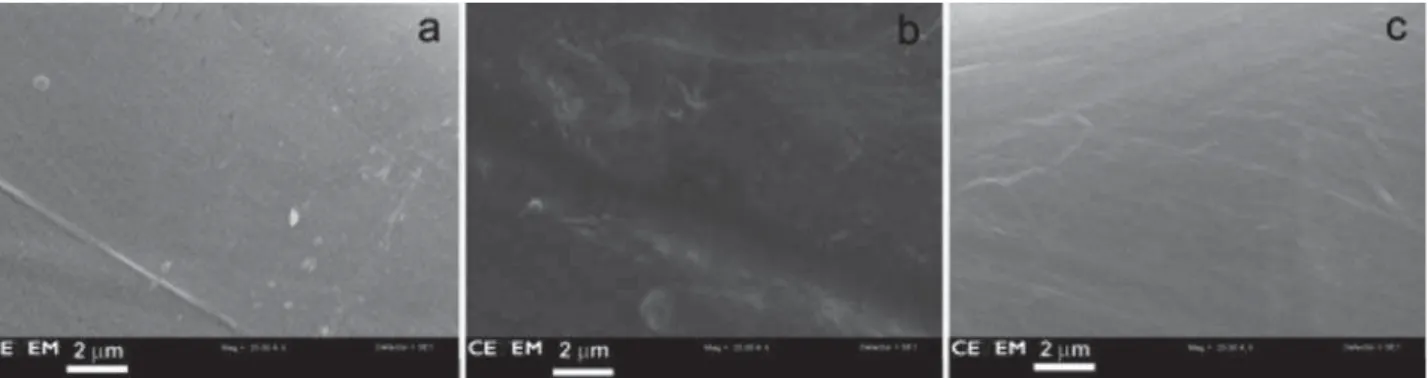
The SEM images with 20000x magni¿cation showed that the surfaces of Connect, Construct, and InFibra ¿bers were very similar and smooth (Figure 2), and that the treatment of InFibra ¿ber with argon or oxygen plasma causes surface roughness. Furthermore, it was observed that oxygen plasma is more effective in creating roughness compared to argon plasma (Figures 3 and 4), and that, as the exposure time to plasma increases, the roughness becomes more accentuated.
The use of oxygen plasma for 5 min caused random cracks on the surface, possibly indicating the beginning of damage (Figure 4C). As a result, the chosen treatment times were then 1 and 3 min for both treatments.
Chem ical analysis
Table 2 shows the atomic concentration, obtained through XPS survey spectra, of different chemical elements present in all analyzed groups. It is worth noting that the amount of carbon is less than 80.0% for the Connect and Construct
¿bers. Both ¿bers exhibit oxygen bound as C-O or C=O, and Construct ¿bers also contain silicon. The untreated InFibra sample is mainly composed
Figure 2- Scanning electron microscopy (SEM) images (x20,000) of (a) Connect, (b) Construct, and (c) InFibra not treated with plasma
Figure 3-6FDQQLQJHOHFWURQPLFURVFRS\6(0LPDJHVRI,Q)LEUD¿EHUVXUIDFHWUHDWHGZLWKDUJRQSODVPD[IRU
(a) 1 min, (b) 3 min, and (c) 5 min 3Pl
ı
(2bh2)
of carbon (93.4%), with small amounts of oxygen that can be associated to a low level of surface contamination or absorbed species. On the other hand, when the InFibra ¿bers were treated with oxygen plasma, a great amount of oxygen-based functional groups (26.1%) were incorporated into the ¿ber surface with the formation of both carbonyl as well as carboxylic groups. Argon plasma induced 14.1% of the incorporation of oxygenated groups to the surface, mainly as C-O.
Table 2 also shows the chemical groups obtained from the ¿t of the C 1s XPS high-resolution peak. In surfaces treated with argon plasma, less than 5% of carbonyl groups were observed, and no carboxylic groups could be distinguished by XPS. This may be an indication that argon plasma is less effective than oxygen plasma in inducing super¿cial oxidation. The incorporation of oxygen into the surface only occurs when the sample is exposed to atmospheric air, and not during the argon plasma processing.
Silane treatment on the InFibra ¿ber led to the incorporation of 7.1% of silicon atoms. Neither oxygen nor argon plasma induced a great increase in this amount. On the other hand, the incorporation of oxygen increases when samples are pre-treated with oxygen or argon plasma and then, silanized: 17.3% of the oxygen was incorporated into the ¿ber surface after silane treatment, and this amount increased to 29.2% and 22.0% for ¿bers pre-treated with oxygen and argon plasma, respectively.
Bending t est s
During the bending tests, the unreinforced Signum material presented elastic behavior, with only one peak of maximum load to fracture. The test specimens presented brittle fracture in the center. All groups of the reinforced beams presented elasto-plastic behavior with the ¿rst maximum load peak followed by displacements associated to load drops and recoveries (Figure 5). All of the test specimens
Figure 4-6FDQQLQJHOHFWURQPLFURVFRS\6(0LPDJHVRI,Q)LEUD¿EHUVXUIDFHWUHDWHGZLWKR[\JHQSODVPD[IRU
(a) 1 min, (b) 3 min, and (c) 5 min
Atomic concentration (%)
Relative area under C 1s envelop
Fiber treatments
At. (%)
C 1s O 1s Si 2p C-Si 283.8eV
C-C/C-H 284.8eV
C-O 285.8eV
C=O 287.0eV
O=C-OH 288.5eV
Connect 79.0 21.0 - - 86.1 8.3 5.6
-Construct 78.9 15.1 6.0 - 86.2 10.7 3.1
-InFibra 93.4 6.6 - - 95.3 2.8 1.9
-InFibra/Silane 75.6 17.3 7.1 31.8 51.1 10.3 3.6 3.2
InFibra/O 3 min 73.9 26.1 - - 34.7 18.5 36.6 10.2
InFibra/O 3 min/Silane
63.3 29.2 7.5 5.9 49.1 25.6 12.9 6.5
InFibra/Ar 3 min
85.9 14.1 - - 77.8 15.5 - 4.7
InFibra/Ar 3 min/Silane
69.2 22.0 8.8 29.7 39.2 18.8 7.4 4.8
Table 2- Report of XPS analysis: atomic concentration and ratio of peak areas for C 1s of as-received Connect, Construct
developed one, two, or more cracks in the center of the sample (Figure 6A). Cracks span along the ¿ber and spread upward, fracturing the Signum material. As the failure process progressed, cracking also occurred close to one of the supports. Then, delamination occurred, separating the Signum material from the ¿ber on one side of the sample (Figure 6B and C). At the ¿rst failure point, where the Àexure strength was calculated, all analyzed samples failed only in the central part. None of the samples showed ¿ber fracture.
The Àexural strength and deÀection characteristics of the specimens are summarized in terms of their mean values and standard deviations in Table 1.
The flexural strength values of all fiber-reinforced groups were signi¿cantly higher than the value of the control group (group 1). The highest strength values were obtained in groups 7 (Signum/ InFibra/O 3 min) and 2 (Signum/Connect). These two groups had signi¿cant statistical differences when compared to the values of groups 4 (Signum/ InFibra), 5 (Signum/InFibra/silane), and 3 (Signum/ Construct).
The treatments of the InFibra ¿ber with argon plasma for 1 and 3 min and oxygen plasma for 1 min promoted an improvement in the behavior of the reinforced material when compared to the material reinforced with untreated InFibra ¿ber, but it is not
statistically signi¿cant.
Silane application on the InFibra ¿ber treated with argon plasma did not change the Àexural strength. Silane application on the InFibra ¿ber not treated or treated with oxygen plasma caused a statistically insigni¿cant reduction in Àexural strength.
The deÀection of the ¿ber-reinforced groups, with the exception of the one reinforced with Construct fiber, was significantly larger than the deÀection of the control group. The groups reinforced with InFibra ¿bers presented a large variation of deÀection values.
The groups reinforced with InFibra fibers treated with oxygen for 1 and 3 min presented the highest deÀection values associated to high Àexural strength values. The same did not occur with the groups reinforced with Connect and Construct fibers, in which high flexural strength values were accompanied by low deÀection values. The deÀection of the samples treated with oxygen for 1 min was signi¿cantly larger than those of groups 4 and 10. The application of silane after oxygen plasma treatment led to a decrease in deÀection values.
The groups reinforced with InFibra ¿ber treated with argon plasma for 1 and 3 min, and argon plasma plus silane presented similar mean deÀection values, and were very similar to the values of group 4, indicating that treatment with argon plasma, treatment duration, and silane application do not cause signi¿cant deÀection changes.
DI SCUSSI ON
As shown in Table 1, the addition of polyethylene fiber results in a significant enhancement of the Àexural performance in comparison to the unreinforced dental composite. All of the reinforced groups presented an elasto-plastic behavior, which remained bonded during testing. Catastrophic failure was not observed. In general, these results are in agreement with the results of several other studies3,5-7,10,11. The fracture of polyethylene ¿bers
was not observed for any group, and this result is in agreement with the work of Karbhari and Strassler10 (2007).
Figure 5- Typical load vs. displacement curves in the
ÀH[XUDOWHVWJURXSXQUHLQIRUFHGDQGJURXSVDQG UHLQIRUFHG ZLWK ¿EHU$UURZV LQGLFDWH WKH ¿UVW ORDG
drop
Figure 6-6SHFLPHQVRI¿EHUUHLQIRUFHGPDWHULDODFORVHWRWKH¿UVWIDLOXUHSRLQWEDIWHUPDMRUIDLOXUHDQGFDIWHUWKH
The composites reinforced with polyethylene
¿bers presented a larger deÀection, at ¿rst load drop, than the unreinforced composite. This was also observed by Karbhari and Strassler10 (2007).
Karbhari and Wang11 (2007) found higher deÀection
values in the materials reinforced with polyethylene
¿bers than those found in the present study. These differences may be attributed to the fact that the authors calculated deÀection values from the displacement values in the ¿nal failure. During the bending tests of the reinforced materials, it was possible to observe the formation of cracks in the composite starting at a certain load. However, the polyethylene ¿bers held the material together, enabling a relatively ductile behavior and causing a gradual load reduction as the cracks opened until delamination. The delamination was observed to occur between the composite and the ¿ber with high strain levels. The same behavior was observed by Karbhari and Wang11 (2007).
The InFibra ¿ber treated with oxygen plasma for 3 min signi¿cantly improved the mechanical behavior of the ¿ber-reinforced composite when compared to the composite reinforced with InFibra
¿ber not treated with plasma, indicating that this treatment promotes a signi¿cant improvement of
¿ber adherence to the Signum material. This result is in agreement with results obtained in other studies19,27.
Nardin and Ward20 (1987) observed that the
adherence of the polyethylene fibers treated with oxygen plasma to the epoxy resin is largely increased due to the rough surface structure and chemical bonds between the ¿ber and the resin. In the present study, utilizing SEM, it was observed that the surface of the untreated InFibra ¿ber is very smooth, and that the treatments with argon and oxygen created roughness, as observed in other studies16,19,28. As the exposure time to each
plasma increased, the roughness became more accentuated19,28. As observed in the present study
by SEM, Connect and Construct fibers, which according to the manufactures are treated with plasma, presented smooth surfaces similar to the surface observed in untreated InFibra ¿bers, which is unexpected and contradicts our results.
In the present study, SEM images showed that oxygen plasma was more effective than argon plasma, both with a 3 min optimal exposure time, in creating InFibra ¿ber surface roughness, and improving Àexural strength of the ¿ber-reinforced composite. This indicates that surface roughness is clearly related to the failure mechanism and adherence increase, which is in agreement with other studies13,14. Unlike the ¿ndings of the present
study, Tosun, et al.28 (2012) veri¿ed that argon
plasma was more effective than oxygen plasma in promoting surface modi¿cations on the polyethylene
¿ber. This distinction may be due to the difference in plasma conditions, since low frequency plasma was used in the work of Tosun, et al.28 (2012).
The silane application caused a reduction in the strength values of composites reinforced with
¿bers. This result is in agreement with Ellakwa, et al.4 (2002) who observed that the impregnation of
Connect ¿ber with ArtGlass liquid, which contains silane in its formulation, caused a reduction of the strength values of reinforced composites. The results of both studies suggest that the use of silane on polyethylene ¿bers not treated or treated with oxygen plasma is not recommended. Unlike these
¿ndings, Choe and -ang1 (1994) veri¿ed that epoxy
resin composites reinforced with polyethylene
¿bers treated with plasma and silane presented an increased formation of hydroxyl groups on the surface and higher Àexural strength values.
The analysis of the InFibra ¿ber surface by XPS showed that the treatment with oxygen plasma was more effective than argon plasma in breaking C-C/ C-H bonds and incorporating oxygen-containing functional groups into the molecular chain of polyethylene surfaces. Results contrary to these were recently reported by Tosun, et al.28 (2012)
for polyethylene surfaces after the same plasma treatments. This difference may be attributed to the low frequency plasma employed by Tosun, et al.28
(2012). Lee, et al.16 (2009) treated polyethylene
surfaces with argon or oxygen plasma and reported a similar oxygen group incorporation into the polyethylene molecular chain, as the one reported in the present work. The great amount of oxygen groups (26.1%) incorporated into the ¿ber surface after oxygen plasma treatment is higher than those presented in the literature12,21,22,24,30.
The oxygen plasma treatment was ef¿cient in forming chemical functional groups on the ¿ber surface: C-O (~18%), C=O (~37%), and O-C=OH (~10%). These chemical groups, associated with the micro erosions observed by SEM, promoted an increase in the fiber surface energy and, consequently, an increase in the interface adherence of the ¿ber to the particulate dental composite. This result was con¿rmed by a signi¿cant increase in Àexural strength in group 7. These results are in agreement with Moon and Jang19 (1998) and
Kusano, et al.12 (2011).
The argon plasma treatment also induced the incorporation of oxygen groups, but in a smaller amount: C-O (~15%) and C=O (~5%). The introduction of oxygen is most likely due to the incorporation of O2 from room air. Similar results were recently reported for polyethylene surfaces16,28.
the Àexural strength values of composites reinforced with ¿bers in any case. These observations could be an indication that silane application on polyethylene
¿bers is not effective.
CON CLUSI ON S
Based on the results of this study, all the null hypotheses were rejected and it can be concluded that:
(1) Both oxygen and argon cold plasma treatments induce roughness on the polyethylene
¿ber surface structures. As the exposure time for the plasma treatment increases, for both oxygen and argon, roughness is accentuated. Oxygen plasma is more effective.
(2) Oxygen and argon cold plasma treatments were effective in incorporating hydroxyl as well as oxygenated functional groups. This incorporation was more signi¿cant for oxygen plasma, in which the oxygen amount was similar to the amount observed for the Connect ¿ber.
(3) The application of silane on polyethylene
¿bers treated with argon or oxygen cold plasma or untreated ¿bers, despite introducing chemical functional groups on the surface, does not promote an increase in Àexural strength of the reinforced composites.
(4) The argon or oxygen cold plasma treatment affected the Àexural strength and deÀection of a
¿ber-reinforced composite. The highest strength values were obtained in the group reinforced with polyethylene ¿bers treated with oxygen plasma for 3 min. The groups reinforced with polyethylene
¿bers treated with oxygen for 1 and 3 min presented the highest deÀection values.
(5) The increase in roughness, as well as the incorporation of oxygenated functional groups, may be the key factor for the signi¿cant increase in the mechanical properties of composites reinforced with polyethylene ¿bers treated with oxygen cold plasma for 3 min.
ACKN OW LEDGEM EN TS
The authors would like to thank Heraeus Kulzer for supplying the Signum material, Dr. Mônica Maria Ferreira Magnanini for assistance with statistical analysis, Dr. Lucianne Cople Maia de Faria for making available the EMIC used in this study and CETEM - Mineral Technology Center for making available the SEM used in part of this study.
REFEREN CES
1- Choe CR, Jang J. Surface modi¿cation of HS/HM polyethylene
¿ber for composite applications (I). Korea Polymer J. 1994;2:126-30.
2- Deshmukh RR, Shetty AR. Modification of polyethylene surface using plasma polymerization of silane. J Appl Polym Sci. 2007;106:4075-82.
3- Dyer RS, Lassila LVJ, Jokinen M, Vallittu PK. Effect of ¿ber position and orientation on fracture load of ¿ber-reinforced composite. Dent Mater. 2004;20:947-55.
4- Ellakwa AE Shortall AC, Marquis PM. InÀuence of ¿ber type and wetting agent on the Àexural properties of an indirect ¿ber reinforced composite. J Prosthet Dent. 2002;88:485-90. 5- Ellakwa AE, Shorthall AC, Marquis PM. InÀuence of ¿bre position on the Àexural properties and strain energy of a ¿bre-reinforced composite. J Oral Rehabil. 2003;30:679-82.
6- Ellakwa AE, Shorthall AC, Shehata MK, Marquis PM. The inÀuence of ¿bre placement and position on the ef¿ciency of reinforcement of ¿bre reinforced composite bridgework. J Oral Rehabil. 2001;28:785-91.
7- Ellakwa AE, Shorthall AC, Shehata MK, Marquis PM. InÀuence of veneering composite composition on the ef¿cacy of ¿ber-reinforced restorations (FRR). Oper Dent. 2001;26:467-75.
8- Ellakwa AE, Shorthall AC, Shehata MK, Marquis PM. InÀuence of bonding agent composition on Àexural properties of an Ultra-High Molecular Weight Polyethylene Fiber-Reinforced Composite. Oper Dent. 2002;27:184-91.
9- Freilich MA, Meiers JC, Duncan JP, Goldberg AJ. Fiber-reinforced composites. Hong Kong: Quintessence Publishing Co; 2000. 10- Karbhari VM, Strassler H. Effect of ¿ber architecture on Àexural characteristics and fracture of ¿ber-reinforced dental composites. Dent Mater. 2007;23:960-8.
11- Karbhari VM, Wang Q. InÀuence of triaxial braid denier on ribbon-based ¿ber reinforced dental composites. Dent Mater. 2007;23:969-76.
12- Kusano Y, Teodoru S, Hansen CM. The physical and chemical properties of plasma treated ultra-high-molecular-weight polyethylene ¿bers. Surf Coat Technol. 2011;205:2793-8. 13- Ladizesky NH. The integration of dental resins with highly drawn polyethylene ¿bres. Clin Mater. 1990;6:181-92.
14- Ladizesky NH, Ward IM. The adhesion behavior of high modulus polyethylene ¿bres following plasma and chemical treatment. J Mater Sci. 1989;24:3763-73.
15- Ladizesky NH, Ward IM. A review of plasma treatment and the clinical application of polyethylene ¿bres to reinforcement of acrylic resins. J Mater Sci Mater Med. 1995;6:497-504.
16- Lee JH, Rhee KY, Lee JH. Effects of reactive gas on shear and fracture behaviors of plasma-treated polyethylene/steel joints. Appl Surf Sci. 2009;256:876-83.
17- Liston EM, Martinu L, Wertheimer MR. Plasma surface modi¿cation of polymers for improved adhesion: a critical review. J Adhes Sci Technol. 1993;7:1091-127.
18- Miller A, Schwartz P. Effects of oven aging on plasma treated ultra high strength polyethylene. Plasmas Polym. 1997;2:115-32. 19- Moon SI, Jang J. Factors affecting the interfacial adhesion of ultrahigh-modulus polyethylene ¿bre vinylester composites using gas plasma treatment. J Mater Sci. 1998;33:3419-3425. 20- Nardin M, Ward IM. InÀuence of surface-treatment on adhesion of polyethylene ¿bres. Mat Sci Technology. 1987;3:814-26. 21- Ogawa T, Mukai H, Osawa S. Effects of functional groups and surface roughness on interfacial shear strength in ultrahigh molecular weight polyethylene ¿ber/polyethylene system. J Appl Polym Sci. 1999;71:243-9.
23- Rashidan N, Esmaeili V, Alikhasi M, Yasini S. Model system for measuring the effects of position and curvature of ¿ber reinforcement within a dental composite. J Prosthodont. 2010;19:274-8.
24- Ren Y, Wang C, Qiu Y. Aging of surface properties of ultra-high modulus polyethylene ¿bers treated with He/O2 atmospheric pressure plasma jet. Surf Coat Technol. 2008;202:2670-6. 25- Sirisinha K, Chimdist S. Comparison of techniques for determining crosslinking in silane-water crosslinked materials. Polym Test. 2006;25:518-26.
26- Spyrides SM, Bastian FL. I n v it r o comparative study of the mechanical behavior of a composite matrix reinforced by two types of ¿bers (polyethylene and glass). Mater Sci Eng C. 2004;24:671-7.
27- Tissington B, Pollard G, Ward IM. A study of the inÀuence of
¿bre/resin adhesion on the mechanical behavior of ultra-high-modulus polyethylene ¿bre composites. J Mater Sci. 1991;26:82-92.
28- Tosun K, Feleko÷lu B, Baradan B. Multiple cracking response of plasma treated polyethylene ¿ber reinforced cementitious composites under flexural loading. Cem Concr Compos. 2012;34:508-20.