ISSN 0102-695X
DOI: 10.1590/S0102-695X2013005000060 Received 25 Jun 2013
Accepted 19 Aug 2013 Available online 13 Sep 2013
cancerous cells
Élica A. C. Guedes,
1Teresinha G. da Silva,
2Jaciana S. Aguiar,
2Lurdiana D. de Barros,
1Laura M. Pinotti,
*,3Antonio E. G.
Sant’Ana
41Instituto de Ciências Biológicas e da Saúde, Universidade Federal de Alagoas, Brazil, 2Departamento de Antibióticos, Universidade Federal de Pernambuco, Brazil,
3Departamento de Engenharias e Tecnologia, Universidade Federal do Espírito Santo,
Brazil.
4Instituto de Química e Biotecnologia, Universidade Federal de Alagoas, Brazil.
Abstract: This paper presents an investigation on the cytotoxic activity in human tumor cell from dichloromethane, chloroform, methanol, ethanol, water extracts, and hexane and chloroform fractions from green, brown and red algae collected at Riacho Doce Beach, north coast of Alagoas, Brazil, against the cancer cells K562 (chronic myelocytic leukemia), HEp-2 (laryngeal epidermoid carcinoma) and NCI-H292 (human lung mucoepidermoid carcinoma) through the MTT colorimetric method. The dichloromethane extract and chloroform fraction of Hypnea musciformis showed the
best cytotoxic activity against K562 (3.8±0.2 μg.mL-1 and 6.4±0.4 μg.mL-1, respectively).
Dichloromethane extracts of Dictyota dichotoma (16.3±0.3 μg.mL-1) and the chloroform
fraction of H. musciformis (6.0±0.03 μg.mL-1) and chloroform fraction of P. gymnospora
(8.2±0.4) were more active against HEp-2 as well as ethanol extracts of P. gymnospora (15.9±2.8 μg.mL-1) and chloroform fraction of H. musciformis (15.0±1.3 μg.mL-1)
against the cell NCI-H292. The constituents with higher anticancer action are present in the extracts of dichloromethane and chloroform and in the chloroform fraction of
H. musciformis, Digenea simplex, P. gymnospora, and D.dichotoma. In the case of the seaweed S. vulgare, the anticancer constituents are present in the aqueous extract.
Keywords:
seaweed cancerous cells cytotoxicity algae extract
Introduction
The quest for promising substances through rational selection of natural products as anticancer drugs source is an alternative subsidy to cancer treatment and have guided numerous research for new medicines (Magalhães, 2005). Algae, fungi, lichens, fungi and vascular plants are major sources for the research of new bioactive molecules through the direct use of secondary metabolites or biosynthesis-derived compounds produced in order to increase effectiveness and absorption or to decrease toxicity (Hostettman et al., 1997).
Extensive researches on the cellular and molecular basis of the carcinogenesis cascade provides a targeted approach for cancer chemoprevention, which aims to halt or reverse the development and progression of precancerous cells through use of non cytotoxic doses of nutrients and/or pharmacological agents (Theisen, 2001; Gamal-Eldeen et al., 2009). The HEp-2 cell (American Type Culture Collection CCL-23), a tumor cell strain derived from human larynx carcinoma grown in monolayers on glass slides, has proved to be an excellent
medium for self-antigens provision in the IIF-ANAtest (antinuclear antibody-immunol uorescence) since 1980. This HEp-2 cell virtually replaced cuts or rodents’ liver imprint in clinical laboratories throughout the world due to its excellent visibility and easy handling for cell culture compared to the maintenance of animal facilities suitable for laboratory breeding routine (Dellavance & Andrade, 2011). NCI-H292 cells correspond to a continuous strain of mucoepidermoid cells obtained from human lung carcinoma, which has been used for isolation and
propagation of Paramyxo virus humano (Morier et al.,
1996). The K562 strain is Ph+erythroleukemic, widely used as a model for studying drugs with anti-proliferative capacity and/or inductors of fetal hemoglobin synthesis (Lozzio & Lozzio 1975).
Anti-tumor cytotoxic substances from marine organisms have been reported over the past 40 years (Ibrahim et al., 2005). Marine organisms are important and promising resources in cancer research and a number of compounds from these organisms have undergone clinical trials as antitumor agents. Shoeib et al. (2004) screened for in-vitro cytotoxic activities using DLD-1 cells of
methanolic extracts of 33 species of British marine algae.
The methanolic extract of Polysiphonia lanosa was the only
one found to have an IC50 value of less than 50 µg.mL-1,
and its chloroform fraction was found to be signiicantly
more active than the parent methanolic extract. P. lanosa
is rich in brominated phenolic compounds.
Harada & Kamei (1997) selected, among 306 seaweed species, those with in vitro cytotoxic potential against L1210 leukemic cells, observing that only
seventeen were active. The methanol extract of Amphiroa
zonata (IC50 20 μg.mL-1) was more eficient against strains of human leukemic cells (L1210 and K562). Testing eight alga species in China with potential antitumor activity, Xu et al (2004) found that chloroform and ethanol
extracts from Polysiphonia urcedata, the ethanolic from
Scytosiphon lomentarius and hexane from Dictyopteris divaricata showed cytotoxic activity against human oral epidermoid carcinoma (KB). Substances isolated from algae, such as fucoidan, laminaran and terpenoids have activity against cancer cell strains (Gerwick & Bernart 1993; Synytsya et al., 2010) and the search for new drugs from these organisms is crescent. In order to be considered effective in treating cancer, it is necessary to a drug have a selective antitumor activity without side effects (Xu et al., 2004). Jolles et al. (1963) were the irst researchers to report the inluence of a sulphated degraded laminarin obtained from seaweed extract in inhibiting the growth of tumor cells.
The use of cells as a tool of biological processes has been stimulated, since several research lines can be addressed such as: gene expression, proliferation, cell-cell interaction, adhesion and carcinogenesis (Perez & Curi, 2005).
This paper presents a study on the screening of some green, brown and red alga species from Riacho Doce
beach, Alagoas, Brazil, by evaluating the in vitro cytotoxic
potential of extracts and fractions of these organisms on three cancer cell strains: NCI-H292 (human lung cancer), Hep-2 (human larynx epidermoid carcinoma) and K562 (chronic myelocytic leukemia).
Materials and Methods
Biological material
Algae were manually collected from the Riacho Doce beach, (9° 34 '0 "S and 35 ° 39' 0" W) during low tide period between October 2007 to July 2009. The collected samples were immediately transported to the Phycology Laboratory of the Biological Sciences Institute, Universidade Federal de Alagoas. Nine species of algae from three divisions were used
for this study: Chlorophyta-Ulva lactuca
Linnaeus-MAC51238, Phaeophyta- Dictyota dichotoma (Hudson)
J.V.Lamouroux-MAC51230; Padina gymnospora
(Kutzing) Sonder-MAC51235 Sargassum vulgare C.
Agardh- MAC 51236 and Rhodophyta- Gracilaria
caudata J. Agardh - MAC51232, Hypnea musciformis
(Wulfen) J.V. Lamouroux-MAC51234, Galaxaura
rugosa (J. Ellis & Solander) J.V.
Lamouroux-MAC51239; Gellidium pusillum (J.Stackhouse)
Le Jolis-MAC51233, Digena simplex (Wulfen) C.
Agardh-MAC51231). The voucher of respected species were deposited in the MAC Herbarium, Environment Institute of the city of Maceió, Alagoas, as internal reference material.
Extracts obtainment
Algae were washed with distilled water, dried in air-circulating ovens (Blue Mod1401440SC, USA) at 45 °C for 5 h and crushed in industrial blender (type TA-2 METVISA model, Brazil). The dried and ground material from each collection and each alga was mixed in equal amounts to dilute any possible seasonal difference in chemical extracts to be obtained. To obtain crude extracts, 500 g samples of dried seaweed were suspended in 1000 mL dichloromethane, chloroform, methanol, ethanol and water and macerated for 72 h with three repetitions. Organic extracts were filtered and roto-evaporated (Rotevaporator Buchii Heating Bath-B490, Switzerland) at 25 and 40 °C, except for the aqueous extract that was lyophilized (Edwards High Vacuum Lyophilizer, ModE2MB, Brazil). The mass from these extracts was measured and stored under refrigeration for subsequent cytotoxicity assays. Dichloromethane
extracts from H. musciformis and P. gymnospora were
selected for fractionation by having higher yields: 11.86 g (2.58%) and 13.96 g (3.04%), respectively. For fractionation by liquid-liquid partition, crude extracts of H. musciformis (2.73 g) and P. gymnospora (1.90 g) were suspended in methanol:water (3:1) and extracted with hexane and chloroform respectively, resulting in hexane and chloroform fractions to test for cytotoxic activities. All solvents used were VETEC-Quimica Fina (RJ-Brazil).
Cytotoxic activity in vitro
Cell strains K562 (Human chronic myelocytic leukemia), NCI-H292 (Human lungmucoepidermoid carcinoma), HEp-2 (Human larynx epidermoid carcinoma) were all obtained from Cell Bank in Rio de Janeiro (Rio de Janeiro, Brazil). Cells were maintained in DMEM
GIBCO® supplemented with 10% fetal bovine serum,
2mM glutamine, 100 U.mL-1 penicillin, 100 µg.mL-1
streptomycin at 37 °C with 5% CO2 (Eagle, 1955).
Cells suspension of 1x10⁵ cells/mL (HEp-2 e
NCI-H292) and 0.3x10⁶ cells/mL (K562) were distributed in
(5% CO2) for 24 h. After 24 h, extracts (6.25, 12.50, 25.0
and 50 µg.mL-1) dissolved in DMSO were added to each
well and incubated for 72 h. Control groups received
DMSO. Etoposide (1.25–20 µg.mL-1) was used as positive
control. The growth of tumor cells was quantiied by the ability of living cells to reduce yellow tetrazolium MTT (3-(4, 5-dimethylthiazolyl-2)-2, 5-diphenyltetrazolium bromide) to a blue formazan product (Mosmann 1983; Alley et al 1988). At the end of 72 h incubation, the plate
was added with MTT (5.0 mg.mL-1). Three hours later, for
suspended cells and two for adherent cells, the formazan product of MTT reduction was dissolved in DMSO and absorbance was measured using a multi-plate reader. The drug effect was quantiied as percentage of control absorbance of reduced dye at 450 nm (Multiplate Reader Thermoplate-Mod TP_Reader). Results were expressed as mean percentage of growth inhibition in 50% of cell population (IC50 growth inhibition) (GI)%±SD).
Results and Discussion
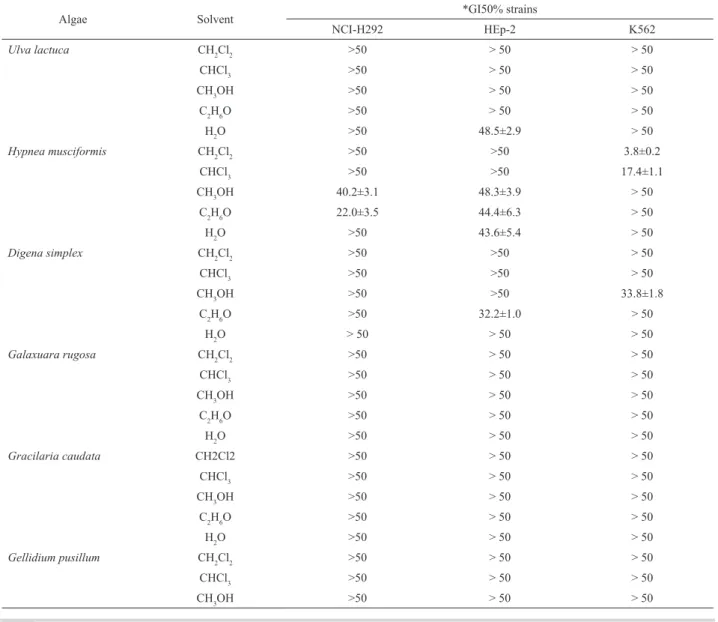
The cytotoxic activity of 48 samples of crude algae extracts and its fractions on human cancer cell strains is presented in table 1. The evaluation was conducted in
accordance with the Protocol of the American Cancer
Institute (NCI), which recommends that IC50 values ≤
30μg.mL-1 should be considered signiicant for crude
extracts of plant origin as well as IC50 values ≤ 4μg.mL-1
for pure substances (Geran et al., 1972). This paper presents the preliminary studies on the effect of crude extracts and fractions of different algal species from the coast of Alagoas on different cancer cell strains, emphasizing that 55.17% of species showed cytotoxic activity, when utilized the method MTT.
Ethanol extracts of H. musciformis (22.0±3.5
μg.mL-1), P. gymnospora (15.9±2.8 μg.mL-1), D.
dichotoma (22.7±4.2 μg.mL-1) and chloroform extracts
Table 1. GI50 values (μg/mL-1) for crude extracts of marine benthic algae against NCI-H292, HEp-2 and K562 tumor cells. Results
are expressed as minimum inhibitory concentration able to destroy 50% population±standard deviation.
Algae Solvent *GI50% strains
NCI-H292 HEp-2 K562
Ulva lactuca CH2Cl2 >50 > 50 > 50
CHCl3 >50 > 50 > 50
CH3OH >50 > 50 > 50
C2H6O >50 > 50 > 50
H2O >50 48.5±2.9 > 50
Hypnea musciformis CH2Cl2 >50 >50 3.8±0.2
CHCl3 >50 >50 17.4±1.1
CH3OH 40.2±3.1 48.3±3.9 > 50
C2H6O 22.0±3.5 44.4±6.3 > 50
H2O >50 43.6±5.4 > 50
Digena simplex CH2Cl2 >50 >50 > 50
CHCl3 >50 >50 > 50
CH3OH >50 >50 33.8±1.8
C2H6O >50 32.2±1.0 > 50
H2O > 50 > 50 > 50
Galaxuara rugosa CH2Cl2 >50 > 50 > 50
CHCl3 >50 > 50 > 50
CH3OH >50 > 50 > 50
C2H6O >50 > 50 > 50
H2O >50 > 50 > 50
Gracilaria caudata CH2Cl2 >50 > 50 > 50
CHCl3 >50 > 50 > 50
CH3OH >50 > 50 > 50
C2H6O >50 > 50 > 50
H2O >50 > 50 > 50
Gellidium pusillum CH2Cl2 >50 > 50 > 50
CHCl3 >50 > 50 > 50
of D. dichotoma (25.2±1.1 μg.mL-1) showed selectivity towards NCI-H292 cells. Regarding HEp-2 cells, the
dichloromethane extract (16.3±0.3 μg.mL-1), chloroform
extract (18.2±0.3) and extract methanolic (20.6±0.7
μgmL-1) of D. dichotoma were active against these cells.
Cytotoxicity showed by Dictyota may be due to the
presence of diterpenes common to Dictyotaceae family, which shows activity against tumor cells (Gedara et al., 2003).
Extracts that showed cytotoxic activity against K562 cells were obtained with dichloromethane (3.8±0.2
μg.mL-1) and chloroform (17.4±1.1 μg.mL-1) of H.
musciformis. Dichloromethane (14.9±0.7 μg.mL-1) and
chloroform (15.5±0.7 μg.mL-1) extracts of P. gymnospora
and dichloromethane extract of D. dichotoma (14.4±0.7
μg.mL-1) were also active for K562 cells. Ktari & Guyot
(1999) evaluated the cytotoxic activity of dichloromethane
extract of Padina pavonica against KB cells and the
results showed signiicant activity (IC50 10μg.mL-1). In
our study, chloroform fraction of the dichloromethane
extract of P. gymnospora showed similar value to that
found by these authors for K562 (IC50 11.0 μg.mL-1)
and HEp-2 (IC50 8.2 μg.mL-1) cells. Abourriche et al.
(1999) determined the cytotoxic activity (20 μg.mL-1)
of dichloromethane extract of Cystoseira tamariscifolia
collected in Morocco (Mexico) which inhibited 30% KB cells. Cytotoxicity results obtained with the chloroform
fraction of dichloromethane extract of H. musciformis
were signiicant for all three tested cell strains: NCI-H292
(IC50 15.0±1.3 μg.mL-1), HEp-2 (IC50 6.0±0.3 μg.mL-1)
and K562 (IC50 6.4±0.4 μg.mL-1) suggesting the existence
of speciic secondary metabolites that can interfere with cellular mitosis (Moo-Puc et al., 2009). The chloroform
fraction of P. gymnospora also showed signiicant values
against NCI-H292 (IC50 20.9±1.1 μg.mL-1), HEp-2 (IC50
8.2±0.4 μg.mL-1) and K562 (IC50 11.0±0.6 μg.mL-1).
Shoeib et al. (2004), evaluating the in vitro cytotoxic
activity of the red alga Polysiphonia lanosa against DLD-1
and HCT-116 cells (human colon carcinoma) showed that the chloroform fraction yielded better results than the methanol extract, which was also observed in our study
regarding chloroform fraction of H. musciformis against
HEp-2 cells (IC50 6.0±0.3 μg.mL-1). Some evidence has
suggested that phenolic compounds inhibit telomerase activity in tumor cells (Naasani et al., 1998; Chakraborty et al., 2006). In most tumors the maintenance of telomeres occurs with the telomerase expression (Akiyama et al., 2002). Moo-Puc et al. (2009) performed a test to evaluate the effect of aqueous and organic (dichloromethane:methanol-7:3) extracts of 27 algal species on three human cancer cell strains (Hep-2, KB and HeLa) and found that most of cytotoxic extracts were organic and from species belonging
to Chlorophyta (Udotea labellum 22.5 μg.mL-1±1.2 and
±1.4 U. conglutinate 22.2 μg.mL-1) and Rhopdophyta
(Bryothamnion triquetrum 8.2±1.3μg.mL-1) divisions
against Hep-2 cells and Phaeophyta division (Lobophora
vairegata 26.2 μg.mL-1±1.3 ±1.2 and Dictyota caribaea
27.9 μg.mL-1) that showed cytotoxic activity against KB
C2H6O >50 > 50 > 50
H2O >50 >50 > 50
Padina gymnospora CH2Cl2 >50 >50 14.9±0.7
CHCl3 40.2±1.9 >50 15.5±0.7
CH3OH >50 >50 30.8±1.7
C2H6O 15.9±2.8 42.1±2.5 >50
H2O >50 >50 >50
Sargassum vulgare CH2Cl2 >50 > 50 > 50
CHCl3 >50 > 50 > 50
CH3OH >50 >50 > 50
C2H6O >50 >50 > 50
H2O >50 18.7±3.8 > 50
Dictyota dichotoma CH2Cl2 41.1±2.3 16.3±0.3 14,4±0,7
CHCl3 25.2±1.1 18.2±0.3 32.5±1.9
CH3OH 40.3±3.0 20.6±0.7 > 50
C2H6O 22.7±4.2 47.6±5.9 > 50
H2O >50 >50 > 50
H. musciformis Fraction CHCl3 15.0±1.3 6.0 ±0.3 6.4±0.4
P. gymnospora Fraction C6H14 > 50 > 50 > 50
P. gymnospora Fraction CHCl3 20.9±1.1 8.2 ±0.4 11.0 ±0.6
strains. Taskin et al. (2010) investigated the antitumor
activity of Padina pavonica and H. musciformis against
breast cancer cells (MCF-7) and several strains of prostate cancer (DU-145, LNCaP and PC3) by in vitro cytotoxicity assay with methanolic extract and found that crude extracts of H. musciformis at 100 μg.mL-1 had low toxicity against
cell strains tested. In this study, methanolic extract of H.
musciformis also showed no cytotoxic activity against cell strains tested; however, it showed promising cytotoxicity for dichloromethane, chloroform and ethanol extracts.
Concerning to aqueous extracts, only S. vulgare showed
activity (IC50 18.7±3.8 μg.mL-1) thus considering that
organic extracts have different constituents in comparison with hydrophilic ones, which have permeability with respect to cell membrane, partly explaining the limited effects of aqueous extracts on cancer cells (Moo-Puc et al., 2009). Wang et al. (2008) tested for proliferative potential of aqueous extract of twelve algae species from Hong Kong in HL-60 cells (promyelocytic leukemia) and MCF-7
(breast cancer) and found that Hydroclathrus clathratus
and Padina arborescens inhibited their growth being also less toxic to normal cells. The extract that showed increased
cytotoxic activity in this study was dichloromethane of H.
musciformis (IC50 3.8±0.2 μg.mL-1) against K562 cells
which is higher than the etoposid control. H. musciformis,
D. simplex, P. gymnospora, S. vulgare and D. dichotoma
were among species considered promising by IC50 values ≤30 obtained from different extracts.
Although the metabolites responsible for the antiproliferative action of algae species studied have not been chemically characterized in this study, the data suggest the occurrence of several secondary compounds with low polarity which are spread more easily in cell membranes than the more polar (Moo-Puc et al., 2009; 2011) once the crude extracts of dichloromethane, ethanol and chloroform fraction concentrated the substances responsible for the most signiicant cytotoxic activity.
Authors’ contributions
EACG and LDB contributed in collecting plant sample and identiication, confection of herbarium, running the laboratory work, analysis of the data and drafted the paper. EACG, JSA (PhD student) and TGS contributed to biological studies. LMP contributed to analysis of the data, drafted the paper and to critical reading of the manuscript. AEGS’A designed the study, supervised the laboratory work and contributed to critical reading of the manuscript. All the authors have read the inal manuscript and approved the submission.
References
Abourriche A, Charrouf M, Berrada M, Bennamara A, Chaib N, Francisco C 1999. Antimicrobial activies and citotoxicity
of the brown alga Cystoseira tamariscifolia. Fitoterapia 70: 611-614.
Alley MC, Scudiere DA, Monks A, Hursey ML, Czerwinski MJ,
Fine D, Abbott BJ, Mayo JG, Shoemaker RH, Boyd, MR 1988. Feasebility of drug screening with panels of human tumor cell lines using a microculture tetrazolium assay.
Cancer Res 48: 589-601.
Akiyama M, Hideshima T, Munshi NC, Anderson KC 2002. Telomerase inhibitors as anticancer therapy. Curr Med Chem Anticancer Agents 2: 567-575.
Chakraborty S, Ghosh U, Bhattacharyya NP, Bhattacharya K, Roy M 2006. Inhibition of telomerase activity and induction of apoptosis by curcumin in K-562 cells.
Asian Pac J Cancer Prev 7: 201-207.
Dellavance A, Andrade LEC 2011. Das células LE às células
HEp-2: perspectiva histórica e avaliação crítica do
teste de imunoluorescência indireta para pesquisa de
anticorpos antinúcleo. Rev Bras Med 68: 7-21.
Eagle H 1955. Propagation in a luid medium of a human
epidermoid carcinoma, strain KB (21811). P Soc Exp Biol Med 89: 362-364.
Gamal-Eldeen AM, Ahmed FE, Abo-Zeid MA 2009. In vitro cancer chemopreventive properties of polysaccharide extract from the brown alga, Sargassum latifolium. Food Chem Toxicol 47: 1378-1384.
Gedara R, Zubía E, Ortega M, El-Sharkavy S, Salama O, Shier T, Halim A 2003. Cytotoxic hydroazulenne diterpenes from the brown alga Dictyota dichotoma. Z Naturforsch 58: 17-22.
Geran RI, Greenberg NH, Macdonald MM, Schumacher AM, Abbott BJ 1972. Protocols for screening chemical agents and natural products against animal tumors and other biological systems. Cancer Chemoth Rep 3: 1-102 Gerwick WH, Bernart MW 1993. Eicosanoids and related
compounds from marine algae In: Zaborski OR, Attaway DH (org) Marine Biotechnology. New York: Plenum Press, p 101-152.
Harada H, Kamei Y 1997. Selective cytotoxicity of marine algae extracts to several human leukemic cell lines.
Cytotechnology 25: 213-219.
Hostettmann K, Wolfender J, Rodriguez S 1997. Rapid detections and subsequent isolation of bioactive constituents of crude plant extracts. Planta Med 63: 2-10.
Ibrahim AMM, Mostafa MH, El-Masry MH, El-Naggar MMA 2005. Active biological materials inhibiting tumor initiation extracted from marine algae. Egypt J Aquactic Res 31: 146-155.
Jolles B, Remington M, Andrews PS 1963. Effects of sulphated
degraded Laminarin on experimental tumor growth. Br J Cancer 17: 109-115.
Ktari L, Guyot M 1999. A cytotoxic oxysterol from the marine
alga Padina pavonica (L.) Thivy. J App Phycol 11: 511-513.
Lozzio CB, Lozzio BB 1975. Human chronic myelogenous
Chromossome. Blood 45: 321-324.
Magalhães FIE 2005. Atividade antitumoral (in vitro e in vivo)
das isalinas B e D isoladas da Physalis angulata LIN.
118p. Dissertação, Universidade do Estado do Ceará. Moo-Puc R, Robledo D, Freile-Felegrin Y 2009. In vitro
cytotoxic and proliferative activities of marine algae from Yucatan, Mexico. Cienc Mar 35: 345-358. Moo-Puc R, Robledo D, Freile-Felegrin Y 2011. Improved
antitumoral activity of extracts derived from cultured
Penicillus dumetosus. Trop J Pharm Res 10: 177-185.
Morier L, Perez L, Cancio R, Savon C, Gonzales Z, Goyenechea
A 1996. Comparacion de lalinea NCI-H292 com otras lineas continuas para la multiplicacion de virus respiratórios. Rev Cubana Med Trop 48: 171-173. Mosmann T 1983. Rapid colorimetric assay for cellular growth
and survival: application to proliferation and cytotoxicity assays. J Immunol Methods 65: 55-63.
Naasani I, Seimiya H, Tsuruo T 1998. Telomerase inhibition, telomere shortening, and senescence of cancer cells by tea catechins. Biochem. Biophys Res Commun 249: 391-396.
Perez CM, Curi R 2005. Como cultivar células. Rio de Janeiro:
Guanabara Koogan.
Shoeib NA, Michael CB, Blunden G, Linley PA, Swaine DJ 2004. In-vitro cytotoxic activities of the major bromophenols of the red alga Polysiphonia lanosa and some novel synthetic isomers. J Nat Prod 67: 1445-1449.
Synytsya A, Kim WJ, Kim SM, Pohl R, Synytsya A, Kvasnicka F, Copikova J, Park Y 2010. Structure and antitumor activity of fucoidan isolated from sporophyll of Korean brown seaweed Undaria pinnatiida. Carbohyd Polym
81: 41-48.
Taskin E, Caki Z, Ozturk M, Taskin E 2010. Assessment of in vitro antitumoral and antimicrobial activities of marine algae harvested from the eastern Mediterranean sea.
African J Biotechnol 27: 4272-4277.
Theisen C 2001. Chemoprevention: what’s in a name? J Natl Cancer Inst 93: 743-774.
Wang SK, Liang PH, Astronomo RD, Hsu TL, Hsieh SL, Burton
DR, Wong CH 2008. Targeting the carbohydrates on HIV-1: Interaction of oligomannose dendrons with human monoclonal antibody 2G12 and DC-SIGN. PNAS, Chemistry Biodiversity 195: 3690-3695. Xu N, Fan X, Yan X, Tseng CK 2004. Screening marine algae
from China for their antitumor activities. J Appl Phycol 16: 451-456.
*Correspondence
Laura Marina Pinotti
Departamento de Engenharias e Tecnologia, Universidade Federal do Espírito Santo
Rodovia BR 101 Norte, km 60, Bairro Litorâneo, 29.932-540