AbstrAct: This study aimed at identifying the prevalence of the negative evaluation of dental services among elderly Brazilians and at investigating whether the prevalence was higher among those using public or philanthropic provider services than among those paying privately or using private health plans. Additionally, factors associated with this negative assessment were identiied. Interview and survey data were collected in the residences of participants by trained and calibrated examiners as part of a national epidemiological survey of oral health conditions of the Brazilian population in 2002/2003. The dependent variable was obtained in response to questions regarding whether the participant had ever used dental services, the frequency of use, and the quality of this service. Potential responses to the questions regarding the quality of service were very poor or poor, fair, and good or very good. The main independent variable was the system of health care used with potential responses being health plan or private, public, and philanthropic services. We conducted univariate (linear tendency χ2 test) and multiple descriptive analyses, and the partial proportional Odds model
for ordinal logistic regression. Among the elderly, 196 (3.7%) evaluated the provided services negatively (very poor or poor). Participants with the following responses were more likely to evaluate the services negatively: those who had used public or philanthropic services, men, those with higher education, the ones who had not received information about preventing dental problems, those who perceived pain in their teeth and gums in the last six months, and those who self-reported their oral health and speech was poor. In conclusion, elderly Brazilian users of public and philanthropic services were more likely than users of private or insurance-based plans to evaluate their dental services negatively, regardless of the other investigated variables.
Keywords: Evaluation. Dental care. Elderly. Oral health. Users.
Is the negative evaluation of dental services
among the Brazilian elderly population
associated with the type of service?
A avaliação negativa dos serviços odontológicos entre
idosos brasileiros está associada ao tipo de serviço utilizado?
Andréa Maria Eleutério de Barros Lima MartinsI,II, Lorena Amaral JardimI, João Gabriel Silva SouzaI,
Carlos Alberto Quintão RodriguesII, Raquel Conceição FerreiraIII, Isabela Almeida PordeusIII OriginAl Article / Artigo originAl
IFaculdades Unidas do Norte de Minas – Montes Claros (MG), Brazil. IIUniversidade Estadual de Montes Claros – Montes Claros (MG), Brazil. IIIUniversidade Federal de Minas Gerais – Belo Horizonte (MG), Brazil.
Corresponding author: Andréa Maria Eleutério de Barros Lima Martins. Avenida Rui Braga, s/n, Vila Mauriceia, CEP: 39401-089, Montes Claros, MG, Brasil. E-mail: [email protected]
Conlict of interests: nothing to declare – Financial support: National Council for Scientiic and Technological Development (CNPq)
INTRODUCTION
The increased longevity of the Brazilian population and the reduced mortality and fecundity rates have changed the demographic proile of the country, which now has
one of the fastest aging populations in the world1. It is estimated that in 2020, Brazil will
have the sixth largest population of elderly people in the world2. The demands and needs
of the elderly Brazilian population are increasing, especially in the health ield3, which
leads to the need for more oral health attention among this population, and this does
not always happen4. Therefore, knowing the needs, determining factors of the use of
services and making the access to qualiied health services viable for the elderly present
as new challenges5. Besides, the evaluation of health services from the perspective of the
users has been used in the attempt to organize and order resources, with the objective of meeting the health needs of the population properly; therefore, this would be an
important tool for the development of management strategies for the sector6.
Studies that evaluated health services stood out in literature, especially in the 1970s, in countries like the United States and England. The improvement of health services is
resumO: Objetivou-se avaliar a prevalência de avaliação negativa dos serviços odontológicos e constatar se ela foi maior entre usuários de serviços públicos ou ilantrópicos do que entre idosos brasileiros usuários de serviços particulares ou de planos de saúde. Além disso, foram identiicados os fatores associados a tal avaliação negativa. Foram utilizados dados do levantamento epidemiológico das condições de saúde bucal da população brasileira de 2002/2003, obtidos por meio de entrevistas e exames conduzidos nos domicílios por examinadores treinados e calibrados. A variável dependente foi obtida a partir das respostas sequenciais às perguntas: “Já foi ao dentista alguma vez na vida?; Há quanto tempo? e Como avalia o atendimento?”, categorizadas em péssimo/ruim; regular e bom/ótimo. A principal variável independente foi o “Sistema de atenção à saúde utilizado (plano de saúde/particular; público/ilantrópico)”. Foram conduzidas análises descritivas, univariadas (prova de tendência linear do χ2) e múltiplas, utilizou-se a regressão logística ordinal de Odds proporcionais parciais. Dentre os
idosos, 196 (3,7%) avaliaram negativamente (péssimo/ruim) os serviços odontológicos. A reação negativa foi superior entre aqueles que usaram serviços públicos/ilantrópicos; homens; com maior escolaridade; que não receberam informações sobre como evitar problemas bucais; que autoperceberam dor nos dentes e gengivas nos últimos seis meses, a saúde bucal e a fala como ruim/péssima. Conclui-se que a avaliação negativa foi maior entre usuários de serviços públicos e ilantrópicos independentemente das demais variáveis investigadas.
reached when one of the goals is user satisfaction. In Brazil, these studies were conducted from the 1990s on, especially with the strengthening social control in the scope of the Uniied Health System (SUS), by means of the participation of the community in planning
and evaluation processes7.
The opinion of users as to the quality of care has been suggested with the objective of promoting subsidies for those who administer such services and for the staf that
provides care, therefore allowing the detected limitations to be overcome8. It helps, since
the participation of users in the assessment of services surpasses its mere passive use, and provides essential information to deine quality standards in the provided services, since this perspective enables to complement the technical quality evaluations with a
shared view of the perception of individuals who receive care9.
The need to assess health services, besides improving the performance of service providers, gives favorable conditions to employees and users, improves working conditions and the quality of life of people, therefore providing more eiciency and efectivity to the
system10. The quality of health services can be considered as a result of several factors,
such as professional competence, accessibility, efectivity, eiciency and user satisfaction11.
In this context, the dental health service should also be assessed. This was irst developed in a representative sample of the elderly population in Brazil, in the epidemiological survey of oral health conditions of the Brazilian population (Project SB Brasil). It was a population-based study conducted by the Ministry of Health (MH) in 2002 and 2003. This study generated a descriptive report about oral health conditions of the Brazilian population, which also contemplated information about dental cavities, periodontal conditions, edentulism, dental and facial anomalies, luorosis, socioeconomic characterization, access to dental services and oral health self-perception. In the mentioned report, it was observed
that 3.9% of the elderly assessed oral services negatively (very poor/poor)12.
No studies characterizing the Brazilian elderly population who assessed the services negatively were identiied. Therefore, identifying if the prevalence of negative evaluation regarding dental services among the Brazilian elderly population was higher among users of public or philanthropic services, as well as factors associated with this analysis, can subsidize changes in public health and assistance policies in the ield, with the
implantation of rehabilitating, preventive and health promotion actions13.
With the assessment of health systems, matters such as accessibility, coverage and equity were evaluated. Quality is frequently seen as a primordial factor to be considered
for the assessment of health services14,15. Dobabedian14 proposes that the best strategy to
assess such services should involve a set of indicators representing the triad: structure-process-results. Structure refers to characteristics involving providers, instruments and resources, as well as physical and organization conditions of services; the process would correspond to the relationship established between professionals and patients during the performed activities; and the results would be the changes observed in health status,
The most publicized theoretical model to analyze the associated factors regardless of
dental services was the one by Andersen and Davidson17. Its expanded version was speciically
developed to assess the use of dental services among adults and elders in the United States, in 1997. This version proposes that primary determinants of oral health (external and personal characteristics of the population and system of oral health care) inluence behavior (use of dental services and personal oral hygiene practices). These on the other hand, inluence oral health outcomes (oral health condition assessed by a professional or self-perceived by individuals and user satisfaction). In this sense, one of the oral health outcomes of the referred model is the assessment of health services from the perspective of the users.
Based on the exposed, this study aimed at identifying the prevalence of negative evaluation of dental services and analyzing if it was higher among users of public or philanthropic services in relation to those who use private or insurance-based plans. It also aimed at identifying the factors associated with the negative assessment of dental services
among the Brazilian elderly population, using data from Project SB Brasil 2002/200312.
The previously described model18 proposed by Andersen and Davidson in 199717 was used
as theoretical reference and considered the triad proposed by Dobanedian16.
METHODS
The project SB Brasil 2002/2003 involved 108,921 individuals living in 250 cities of the give Brazilian macroregions, selected by cluster probability sample by rale. Interviews and examinations were conducted in the households and schools. Data collection was performed by dental surgeons who were trained and calibrated from the Kappa statistics
calculation (≥ 0.61) and/or percentage concordance (variable % according to the assessed
oral condition) This was made in order to allow examiners to go to ield, however, the organizers of SB Brasil 2002/2003 did not publicize the concordance values obtained from calibration. Examinations were conducted under natural lighting, with the assistance
of a mouth mirror, wooden spatulas and periodontal probe12. According to a proposal
by the World Health Organization (WHO)19, besides sociodemographic conditions, as
well as those of evaluation and use of dental services, the survey investigated the self-perceived need for dental care and oral health, as well as health conditions (cavity, need
for treatment, use need for prosthesis, changes in soft tissues) among the elderly12.
In the analysis, 5,349 elderly individuals were examined and interviewed (aged from 65 to 74 years old). This investigation used a piece of the data base, considering elderly people (65 to 74 years old) who used dental services at least once in life and who answered the question about the evaluation of dental services, accounting for 5,013 participants.
The triad proposed by Donabedian16 involves a set of indicators that can be used to assess
The studied dependent variable “Assessment of Dental Services” was obtained from sequential answers to the questions: “Have you ever been to the dentist? How long ago? (have never been to the dentist/less than one year/ from one to two years/ three years or more); How do you evaluate assistance?” (Very poor / Poor / Fair / Good / Very Good). This investigation excluded participants who have never been to the dentist, and therefore, did not evaluate dental services. The answers to the last question were separated into three categories, respectively: positive assessment – those who considered dental services to be good/very good; intermediate assessment – the ones who considered the service to be fair; and negative assessment – as poor/very poor.
The main independent variable was: used health care system (insurance health plan/ private; public/philanthropic). Besides, the variables described as independent proposed in
the theoretical model by Andersen and Davidson17 were the ones gathered in ive groups:
external environment, individual characteristics, health-related behavior, normative and subjective health conditions. External environment included: Brazilian macroregions (Southeast; South; Center-West; Northeast; North) and place of residency (urban; rural zones). The investigated individual characteristics were: age in years (65 to 69; 70 to 74 years old), sex (female; male), race/self-declared color (white and yellow/brown/black/ indigenous), schooling in years (ive years or more; one to four years; zero) and access to information about how to avoid oral problems (yes; no).
The availability of resources was evaluated by per capita household income in reais in
tertiles (R$ 201.00 or more; R$ 100.00 to 200.00; R$ 0.00 to 99.00). The variable referring to health-related behavior included the use of dental services (three years ago or less; more than three years ago). Normative health conditions referred to the presence of changes in soft tissues (no; yes), number of permanent teeth (10 or more; one to nine; zero), number of permanent teeth with cavity (zero; one to three; four or more), edentulism (no; yes) and use of prosthesis (no; yes). Subjective conditions related to oral health included self-perceived pain in teeth and gum in the past six months (no; yes), oral health (very good/good/fair; poor/very poor), appearance of gums (very good/ good/fair; poor/very poor), mastication (very good/good/fair; poor/very poor), speech as to teeth and gums (very good/good/fair; poor/very poor), relationship status due to oral health (does not afect it / afects it a little; afects it more or less/ afects it a lot) and the need for treatment (no; yes).
Statistical analyses were conducted with the statistical softwares Predictive Analytics
Software (PASW®, version 17 for Windows) and Stata (StataCorp LP, version 12.0).
Initially, the Brazilian elderly people were characterized according to the evaluation of dental services, external environment, individual characteristics, health-related behavior, and normative and subjective health conditions. Afterwards, univariate analyses were conducted to identify factors associated with the negative evaluation of dental services
among the Brazilian elderly population, from the χ2 tendency test (signiicance level
≤ 0.25). The score test was used for each independent variable in order to check if the
(p = 0.00503), per capita income (p = 0.02914), self-perceived pain (p = 0.02464, oral health (p = 0.0005), need for dental treatment (p = 0.01075), relationship status (p = 0.00214) and speech (p = 0.00712) variables.
For the other independent variables, p values ranged from 0.1256 and 0.8409. Therefore, the partial proportional Odds model was chosen in the multiple analysis, which was
conducted by using the gologit2 command in Stata21,22. This software tests the assumption
of proportional Odds by means of the autoit option, and adjusts coeicients for the several categories in which this assumption is violated. The model enables independent variables to be modeled by obtaining coeicients for each compared category.
All of the variables that were associated with a 5% signiicance level remained in the models. Correction based on the design efect was made by using the svy command in Stata to analyze data coming from complex samples. This adjustment was necessary because the sample of the project SB Brasil was conducted by clusters, and estimates that do not consider the cluster organization of the sample tend to overestimate the loss of estimation precision. All of the people who were selected to be part of the study signed an informed consent form according to the ethical principles of the Declaration of Helsinki, which are present in the resolution by the National Health Council 196/96, approved by the National Commission of Research Ethics – CONEC (report 581/2000).
RESULTS
Out of the 5,349 elderly participants in the project SB Brasil, 5,013 (93.7%) used dental services and answered the question about the evaluation of dental services, therefore, they were included in this study. Out of the 5,013 elderly people, 196 (3.7%) assessed dental services negatively (poor/very poor), 496 (10.7%), intermediately, and 4,321 (85.6%), positively.
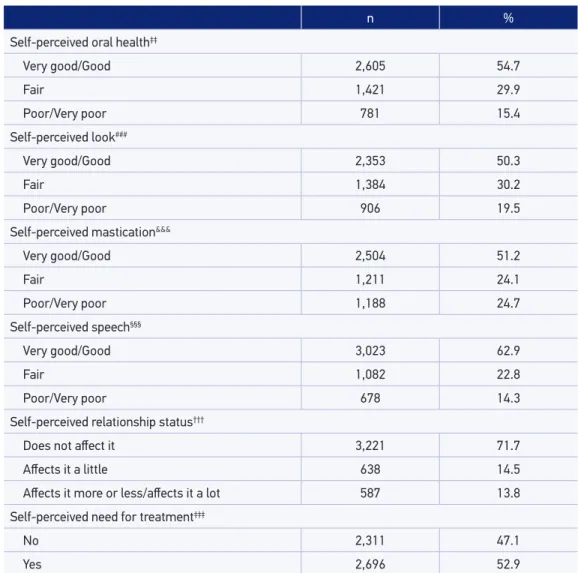
Most elderly participants were female, aged between 65 and 69 years old, who were self-declared as non-white, with one to four schooling years, who had no access to information about how to avoid oral problems, with declared per capita income of R$ 100.00 to 200.00, living in the South and Northeast macroregions of the country, mostly concentrated in the urban zone. From the participants, 31.8% used dental services three years ago or less, and 68.2% of the elderly used it more than three years ago. As to the used health care system, the private type was prevalent (Table 1).
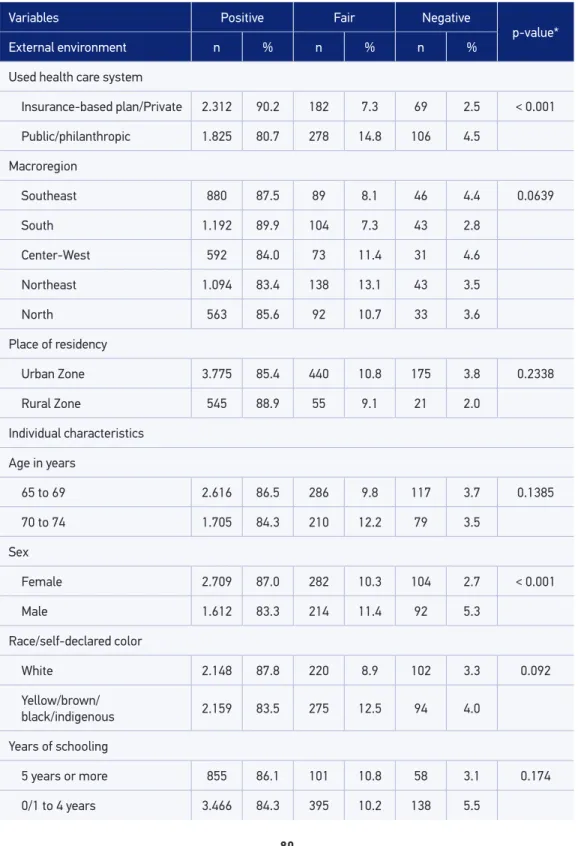
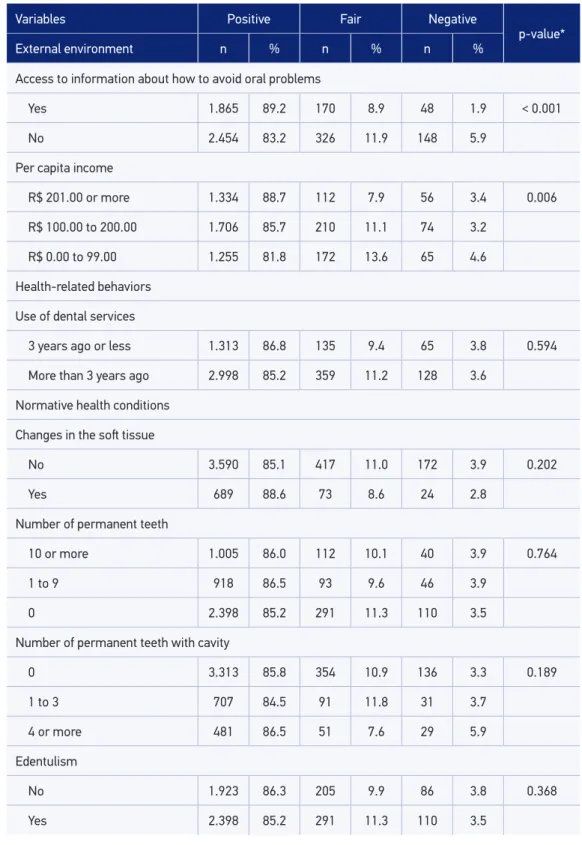
In the univariate analyses, it was observed that several factors were associated with the negative evaluation of dental services with signiicance lower or equal to 0.25, among them, the adopted health care system (Table 2).
Table 1. Characterization of the elderly, according to the evaluation of dental services, external
environment, individual characteristics, health-related behaviors, health conditions normative, and subjective health conditions, SB Brazil, 2002/2003 (n = 5,013).
n %
Evaluation of dental services
Negative (Fair/Poor/Very poor) 692 14.4
Positive (Very good/Good) 4,321 85.6
Evaluation of dental services
Negative (Poor/Very poor) 196 3.7
Positive (Very good/Good/Fair) 4,817 96.3
External environment
Macroregion
Southeast 1,015 21.4
South 1,339 27.4
Center-West 696 14.3
Northeast 1,275 24.9
North 688 12.0
Place of residency#
Urban zone 4,390 91.2
Rural zone 621 8.8
Used health care system&
Insurance-based plan/Private 2,563 56.9
Public/Philanthropic 2,209 43.1
Individual characteristics
Age in years
65 to 69 3,019 61.5
70 to 74 1,994 38.5
Sex
Female 3,095 62.1
Male 1,918 37.9
Race/self-declared color§
White 2,470 50.8
Yellow/brown/black/indigenous 2,528 49.2
Years of schooling
5 or more 1,014 23.6
1 to 4 years 2,287 46.6
n %
Access to information about how to avoid oral problems†
Yes 2,083 40.4
No 2,928 59.6
Per capita income‡
R$ 201.00 or more 1,502 35.1
R$ 100.00 to 200.00 1,990 36.4
R$ 0.00 to 99.00 1,492 28.5
Health-related behaviors
Use of dental services##
3 years ago or less 1,513 31.8
More than 3 years ago 3,485 68.2
Normative health conditions
Changes in the sot tissue&&
No 4,179 85.0
Yes 795 15.0
Number of permanent teeth
10 or more 1,157 24.1
1 to 9 1,057 20.6
0 2,799 55.3
Number of permanent teeth with cavity
0 3,623 73.2
1 to 3 829 16.8
4 or more 561 10.0
Edentulism
No 2,214 44.7
Yes 2,799 55.3
Use of prosthesis§§
No 1,534 28.0
Yes 3,470 72.0
Subjective conditions related to health
Self-perceived toothache or gum in the past six months††
No 3,872 78.9
Yes 1,136 21.1
n %
Self-perceived oral health‡‡
Very good/Good 2,605 54.7
Fair 1,421 29.9
Poor/Very poor 781 15.4
Self-perceived look###
Very good/Good 2,353 50.3
Fair 1,384 30.2
Poor/Very poor 906 19.5
Self-perceived mastication&&&
Very good/Good 2,504 51.2
Fair 1,211 24.1
Poor/Very poor 1,188 24.7
Self-perceived speech§§§
Very good/Good 3,023 62.9
Fair 1,082 22.8
Poor/Very poor 678 14.3
Self-perceived relationship status†††
Does not afect it 3,221 71.7
Afects it a little 638 14.5
Afects it more or less/afects it a lot 587 13.8
Self-perceived need for treatment‡‡‡
No 2,311 47.1
Yes 2,696 52.9
Tabela 1. Continuation.
Number of participants who did not answer the questions: #2, &241, §15, †2, ‡29, ##15, &&39, §§9, ††5, ‡‡206, ###370, &&&110,
§§§230, †††567, ‡‡‡6. Two prevalences of evaluation of the odontologic services were presented, considering the regular
in the negative evaluation as well as in the positive one.
DISCUSSION
The velocity of the demographic and epidemiological transition process brings a series of crucial matters for administrators and researchers of the health system, with repercussions for the society as a whole, especially in a context of severe social inequity,
Table 2. Univariate analysis to identify the factors associated with negative evaluation (bad or poor) of dental services among the elderly, SB Brazil, 2002/2003.
Variables Positive Fair Negative
p-value*
External environment n % n % n %
Used health care system
Insurance-based plan/Private 2.312 90.2 182 7.3 69 2.5 < 0.001
Public/philanthropic 1.825 80.7 278 14.8 106 4.5
Macroregion
Southeast 880 87.5 89 8.1 46 4.4 0.0639
South 1.192 89.9 104 7.3 43 2.8
Center-West 592 84.0 73 11.4 31 4.6
Northeast 1.094 83.4 138 13.1 43 3.5
North 563 85.6 92 10.7 33 3.6
Place of residency
Urban Zone 3.775 85.4 440 10.8 175 3.8 0.2338
Rural Zone 545 88.9 55 9.1 21 2.0
Individual characteristics
Age in years
65 to 69 2.616 86.5 286 9.8 117 3.7 0.1385
70 to 74 1.705 84.3 210 12.2 79 3.5
Sex
Female 2.709 87.0 282 10.3 104 2.7 < 0.001
Male 1.612 83.3 214 11.4 92 5.3
Race/self-declared color
White 2.148 87.8 220 8.9 102 3.3 0.092
Yellow/brown/
black/indigenous 2.159 83.5 275 12.5 94 4.0
Years of schooling
5 years or more 855 86.1 101 10.8 58 3.1 0.174
Tabela 2. Continuation.
Variables Positive Fair Negative
p-value*
External environment n % n % n %
Access to information about how to avoid oral problems
Yes 1.865 89.2 170 8.9 48 1.9 < 0.001
No 2.454 83.2 326 11.9 148 5.9
Per capita income
R$ 201.00 or more 1.334 88.7 112 7.9 56 3.4 0.006
R$ 100.00 to 200.00 1.706 85.7 210 11.1 74 3.2
R$ 0.00 to 99.00 1.255 81.8 172 13.6 65 4.6
Health-related behaviors
Use of dental services
3 years ago or less 1.313 86.8 135 9.4 65 3.8 0.594
More than 3 years ago 2.998 85.2 359 11.2 128 3.6
Normative health conditions
Changes in the sot tissue
No 3.590 85.1 417 11.0 172 3.9 0.202
Yes 689 88.6 73 8.6 24 2.8
Number of permanent teeth
10 or more 1.005 86.0 112 10.1 40 3.9 0.764
1 to 9 918 86.5 93 9.6 46 3.9
0 2.398 85.2 291 11.3 110 3.5
Number of permanent teeth with cavity
0 3.313 85.8 354 10.9 136 3.3 0.189
1 to 3 707 84.5 91 11.8 31 3.7
4 or more 481 86.5 51 7.6 29 5.9
Edentulism
No 1.923 86.3 205 9.9 86 3.8 0.368
Variables Positive Fair Negative
p-value*
External environment n % n % n %
Use of prosthesis
No 1.323 85.0 140 11.0 71 4.0 0.839
Yes 2.990 85.9 356 10.6 124 3.5
Subjective conditions related to health
Self-perceived toothache or gum in the past six months
No 3.418 87.5 340 9.9 114 2.6 < 0.001
Yes 898 78.6 156 13.5 82 7.9
Self-perceived oral health
Very good/Good/Fair 3.536 87.7 379 9.7 111 2.6 < 0.001
Poor/Very poor 620 77.3 85 13.4 76 9.3
Self-perceived look
Very good/Good/Fair 3.295 88.1 144 9.5 55 2.4 < 0.001
Poor/Very poor 716 77.7 105 13.0 85 9.4
Self-perceived mastication
Very good/Good/Fair 3.276 87.8 345 9.7 94 2.5 < 0.001
Poor/Very poor 966 80.6 124 11.9 98 7.5
Self-perceived speech
Very good/Good/Fair 3.605 87.6 382 9.6 118 2.8 < 0.001
Poor/Very poor 535 77.5 80 14.2 63 8.3
Self-perceived relationship status
Does not afect it 2.876 88.3 238 8.3 107 3.4 < 0.001
Afets it a little 513 79.6 94 14.8 31 5.6
Afects it more or less/a lot 486 82.6 76 14.0 25 3.4
Self-perceived need for treatment
No 2.029 87.4 202 9.4 80 3.2 < 0.001
Yes 2.286 84.1 294 11.9 116 4.0
*tendency χ2 test.
Table 3. Multiple analysis of factors associated with negative evaluation of dental services among the elderly, SB Brazil, 2002/2003.
Variables
Model 1 (Very good/Good versus Fair/Poor/Very poor)
Model 2 (Very good/Good/Fair versus Poor/Very poor)
OR (95%CI) p-value OR (95%CI) p-value
Main independent variable
Used health care system
Insurance-based plan/Private 1 1
Public/Philanthropic 2.27 (1.74 – 2.94) < 0.001 2.26 (1.74 – 2.94) < 0.001
Individual characteristics
Sex
Female 1 1
Male 1.44 (1.17 – 1.78) 0.001 1.44 (1.16 – 1.78) 0.001
Years of schooling
0/1 to 4 years 1 1
5 years or more 1.59 (1.12 – 2.25) 0.009 2.77 (1.34 – 5.74) 0.006
Access to information about how to avoid oral problems
Yes 1 1
No 1.77 (1.40 – 2.24) < 0.001 1.77 (1.40 – 2.23) < 0.001
Subjective health-related conditions
Self-perceived toothache or gum in the past six months
No 1 1
Yes 1.70 (1.22 – 2.39) 0.002 1.70 (1.21 – 2.39) 0.002
Self-perceived oral health
Very good/Good/Fair 1 1
Poor/Very poor 1.16 (0.98 – 1.37) 0.087 1.65 (1.24 – 2.20) 0.001
Self-perceived speech
Very good/Good/Fair 1 1
dental services, observing if it is higher among users of public or philanthropic services in comparison to the elderly individuals who use private services or insurance-based plans, as well as identifying the factors associated with the negative evaluation of these services from the perspective of the user are important for the attempt to overcome the limitations of the biomedical service. Since the disease is considered to be a biological process in this model, sociocultural and community questions and the perception of people about their health conditions are not taken into account in the evaluation of the
health-disease process24.
The precariousness of the oral health condition of the elderly and the fact that most
of them need some sort of treatment12 may be responsible for the negative evaluation of
dental services. On the other hand, edentulism that affects more than half of the elderly12
seems to have been accepted as a natural phenomenon. Despite the precarious health
conditions and the fact of being toothless12, most of these elders self-evaluated their oral
health positively25. However, it is important to emphasize that these people come from
a time when losing teeth was normal, and oral health conditions reflected the model of health care adopted in the country, with little accessibility, lack of equity, inefficient basic
care and mutilating treatments26. Therefore, the low prevalence of negative evaluations
observed in this investigation may be based on the acceptance of these precarious oral health conditions, which is based on a cultural matter.
A few studies approached the assessment of dental services. When the accessibility dimension was considered, as well as some aspects involving the physical environment
of dental services, most users were not satisfied27. In this investigation, questions
referring to accessibility and the physical environment were not assessed. When general health services were compared to dental services, most users were mostly
dissatisfied with dental services28. In spite of that, regardless of the several forms of
conceiving and measuring user satisfaction, such as in this investigation, most studies
had low dissatisfaction prevalence27,29,30. This fact is known as the “elevation” effect
of satisfaction rates, and is reported even when expectations about the services are negative. It could be expected that users in developing countries, like Brazil, where access to qualified health care is still precarious, would mostly be dissatisfied with
services that are provided by SUS or by philanthropic organizations28. On the other
hand, the results found in this article can be a consequence of good and resolutive provided dental services offered by health insurances or private entities.
The multiple analysis showed that, from the five groups proposed by Andersen and
Davidson17, only health-related behaviors and normative health conditions were not
associated with the negative evaluation of dental services. Also among the questions related to the structure-process-results triad, which would be important measures
to evaluate these services16, no variable concerning structure was found. With regard to
was assessed according to the proposal by Donabedian16. It is believed that the lack
of statistical significance (and associations) between the dependent variables and those proposed in the theoretical model is due to the absence of variables collected
in the project SB Brasil12 that could represent all of the theoretical dimensions of the
proposed model16. Therefore, it was not possible to evaluate the questions concerning
structure. In the data base of the project SB Brasil, only one question could be assessed to identify the association between the negative evaluation of dental services and the
“process” (access to information about how to avoid oral problems)12. However, it is
known that the assessment of the relationship between professionals and users would require the analysis of other questions, such as respect, waiting time, freedom to ask
questions, among others16.
The evaluation of the quality of health care is an important tool for the planning
and management of health services and systems31. From that perspective, the idea
of good quality in a service is considered when the problem is solved, as well as in situations in which the care provided to the user leads to satisfaction both concerning
physical structure and the relationship between professionals and users16. Some
studies were conducted with the objective of assessing the level of user satisfaction
with the health services6,8,32,33. Approaching this situation means to evaluate the
characteristics of the services, therefore, their quality. Thus, the perspective of users
provides important information to improve the quality of services34. No associations
were found between the negative assessment of services and normative conditions
of oral health. According to the proposal by Donabedian16, such services could be
considered as non-satisfactory, once the results, that is, the oral health of the elderly, were negative. It is important to mention that these conditions are consequences of services provided throughout the lives of the elderly, and that they probably analyzed the services used more recently, since the evaluation of dental services was based on the questions: “Have you ever been to the dentist?”; “How long ago?”; and “How do you evaluate care?”. However, statistically significant associations were observed with subjective questions, which can also be considered as health conditions, that is, results. According to the Health Department of the United Kingdom, oral health involves a set of attributes that guarantees mastication, speech and the socialization of individuals, besides the non-existence of disease or discomfort, aiming at the general
well-being32. Therefore, the consideration of subjective questions is also a type of
health measure. In this context, when the proposal is to evaluate oral health services,
it is necessary to understand the oral health conditions of the users26, as well as their
perception about these conditions.
reception and the acquisition of physical and material resources28. In this investigation,
questions concerning humanization, reception and the acquisition of physical and material resources were not evaluated, which may have compromised the presented results. The restructure of public health services is important to meet the requirements of these
patients, who are extremely in need of care37.
The negative assessment of dental services was higher among men, since this
perception can be influenced by gender28. The male participant points out to oral
health problems as limiting factors in the performance of activities more than
women38, even though women use these services more frequently37-40. The fact that
men use the services and care less for their health can be connected to sociocultural issues, to the difficulty to access assistance networks during working hours and to recognize their health needs. Besides, services and communication strategies are
mostly addressed to women41. It is suggested that the higher prevalence of negative
assessment of dental services among men can be a result of the presented oral health conditions and the restrictions they generate, as well as of the difficulty to access
these services in this stratum during lifetime, once the elderies were investigated39.
It is known that most public or philanthropic services are provided at times when men are at work, therefore, public health policies addressed to men are recommended to ensure the access to such services during the night, which could change this scenario.
Schooling can be reflected on socioeconomic conditions. In this sense, it is believed that income interferes in the evaluation of health services. In this investigation, the higher prevalence of negative evaluation among those with higher schooling may have
been found due to the homogeneity of the population as to income42. It is suggested
that the higher prevalence of negative assessment among those with higher schooling, regardless of the type of used service, is due to the fact that the elderly people with more schooling years are more demanding concerning the provided services. Besides,
the health-related education can influence the evaluation of services16. The elders who
were informed about how to avoid oral problems reported being more dissatisfied with
the provided services43,44. Health-related education contributes with the awareness of
individuals for the valorization of oral health, which would facilitate the practice
of healthy habits and behaviors45. In this investigation, the negative evaluation
was more common among those who were not informed about how to avoid oral problems, regardless of the type of used service. Therefore, the recommendation is that in order for the low percentage of elderly people who negatively assessed dental services (3.7%) to change their perspective, one of the changes to be considered is the improvement of information provided about how to avoid oral problems, especially in public and philanthropic services.
The subjective conditions related to health may interfere in the outcome of
study, three of them were associated with the negative evaluation of dental services. No previous studies were found that identified such associations. However, it is known that self-perception among the elderly is influenced by the perception of several oral
health aspects46-48. The positive perception of oral health, even among elderly people
with precarious oral health conditions, suggests that normative conditions are poor
self-perception predictors48-51. This probably occurs because most oral diseases are
asymptomatic and unknown by the patients, who only consider being sick in face of the
acute manifestation of oral diseases50, or even because normative conditions measure
only the disease, while subjective questions assess human health experiences52.
The limitations in this study refer to the dependent variable that considers the evaluation of dental services from a single question; and the dynamic process of association between the assessment of dental services and the investigated variables, once causes and effects certainly vary throughout life. Since this is a sectional study, it is not possible to establish a temporal relationship between the observed associations. Besides, it is important to mention that in studies with complex samples it is recommended to perform correction based on the design effect, in statistical
analyses53. Such corrections lead to the lower impact in inferential statistics, which
is objective of this investigation, in relation to descriptive ones54, so part of it was
made by the svy command of Stata to analyze data from complex samples. Weighing was not performed since the necessary data to estimate the different probabilities of sample composition were not made available.
CONCLUSIONS
The knowledge about the evaluation of dental services from the perspective of the users should be considered in health policies, in health-promotion, preventive and rehabilitating actions, which try to improve the quality of life of the population. The prevalence of negative evaluation was low, and higher among users of public and philanthropic users, regardless of the other investigated variables. Associations with variables of three from the five subgroups proposed in the theoretical model were found.
ACKNOWLEDGEMENTS
We would like to thank the Oral Health Coordination of the Ministry of Health
and the team of the survey field, Faculdades Unidas do Norte de Minas (FUNORTE/
1. Schmidt MI, Duncan BB, Azevedo e Silva G, Menezes AM, Monteiro CA, Barreto SM, et al. Chronic non-communicable diseases in Brazil: burden and current challenges. Lancet 2011; 377(9781): 1949-61. 2. Lima-Costa MF, Ver as R. Saúde pública e
envelhecimento. Cad Saúde Pública 2003; 19(3): 700-1. 3. Benedetti TRB, Mello ALSF, Gonçalves LHT. Idosos
de Florianópolis: autopercepção das condições de saúde bucal e utilização de serviços odontológicos. Cienc Saúde Coletiva 2007; 12(6): 1683-90.
4. Colussi CF, Freitas SFT. Aspectos epidemiológicos da saúde bucal do idoso no Brasil. Cad Saúde Pública 2002; 18(5): 1313-20.
5. Moreira MM. O envelhecimento da população brasileira em nível regional; 1940-2050. In: XI Encontro Nacional de Estudos Populacionais. Anais... Caxambu: Associação Brasileira de Estudos Populacionais; 1998. p. 3030-3124.
6. Gouveia GC, Souza WV, Luna CF, Souza-Júnior PRB, Szwarcwald CL. Satisfação dos usuários do sistema de saúde brasileiro: fatores associados e diferenças regionais. Rev Bras Epidemiol 2009; 12(3): 281-96. 7. Favaro P, Ferris LE. Program evaluation with limited
iscal and human resources. Cad Saúde Pública 1991; 11(3): 425-38.
8. Robles ACC, Grosseman S, Bosco VL. Satisfação com o atendimento odontológico: estudo qualitativo com mães de crianças atendidas na Universidade Federal de Santa Catarina. Cienc Saúde Coletiva 2008; 13(1): 43-9. 9. Bottan ER, Sperb RAL, Telles PS, Uriarte Neto M.
Avaliação de serviços odontológicos: a visão dos pacientes. Rev ABENO 2006; 6(2): 128-33.
10. Chiavenato I. Gerenciando pessoas: o passo decisivo para a administração participativa. 2 ed. São Paulo: Makron Books; 1994.
11. Gattinara BC, Ibacache J, Puente CT, Giaconi J, Caprara A. Percepción de la comunidad acerca de la calidad de los servicios de salud públicos en los Distritos Norte e Ichilo, Bolivia. Cad Saúde Pública 1995; 14(1): 61-70. 12. Brasil. Ministério da Saúde. Projeto SB Brasil 2003:
condições de saúde bucal da população brasileira 2002-2003: resultados principais. Brasília: Ministério da Saúde; 2004.
13. Silva SRC, Fernandes RAC. Autopercepção das condições de saúde bucal por idosos. Rev Saúde Pública 2001; 35(4): 349-55.
14. Donabedian A. Evaluating the quality of medical care. Milbank Quarterly 2005; 83(4): 691-729.
15. Vuori HV. Quality Assurance of Health Services. Concepts and Methodology. Copenhagen: WHO Regional oice for Europe; 1982.
16. Donabedian A. The role of outcomes in quality assessment and assurance. Quality Review Bulletin 1992; 18: 356-60.
17. Andersen RM, Davidson PL. Ethnicity, aging, and oral health outcomes: a conceptual framework. Adv Dent Res 1997; 11(2): 203-9.
18. Martins AMEL, Barreto SM, Pordeus IA. Características associadas ao uso de serviços odontológ icos entre idosos dentados e edentados no Sudeste do Brasil: Projeto SB Brasil. Cad Saúde Pública 2008; 24(1): 81-92.
19. World Health Organization. Oral health surveys: basic methods. 4 ed. Geneva: ORH/EPID; 1997. 20. Brant R. Assessing proportionality in the proportional
odds model for ordinal logistic regression. Biometrics 1990; 46(4): 1171-8.
21. Williams R. Generalized Ordered Logit/ Partial Proportional Odds Models for Ordinal Dependent Variables. The Stata Journal 2006; 6(1): 58-82.
REfERENCES
support, as well as the participants of the study. Martins is a post-doc scholarship participant from the National Council of Scientific and Technological Development (CNPq); Souza was a scholarship participant of scientific initiation at FUNORTE/
SOEBRAS; Ferreira is a scholarship participant of productivity of Fundação de Amparo à
22. Abreu MNS, Siqueira AL, Caiaffa WT. Regressão logística ordinal em estudos epidemiológicos. Rev Saúde Pública 2009; 43(1): 183-94.
23. Veras R. Envelhecimento populacional contemporâneo: demandas, desaios e inovações. Rev Saúde Pública 2009; 43(3): 548-54.
24. Roseiro MNV, Takayanagui AMM. Novos indicadores no processo saúde-doença. Saude 2007; 33(1): 37-42. 25. Martins AMEBL, Barreto SM, Pordeus IA. Auto-avaliação de saúde bucal em idosos: análise com base em modelo multidimensional. Cad Saúde Pública 2009; 25(2): 421-35.
26. Moreira RS, Nico LS, Tomita NE, Ruiz T. A saúde bucal do idoso brasileiro: revisão sistemática sobre o quadro epidemiológico e acesso aos serviços de saúde bucal. Cad Saúde Pública 2005; 21(6): 1665-75. 27. Lima ACS, Cabral ED, Vasconcelos MMVB. Patient
satisfaction at Specialized Dental Clinics, in Recife, Pernambuco, State, Brazil. Cad Saúde Pública 2010; 26(5): 991-1002.
28. Moimaz SAS, Marques JAM, Saliba O, Garbin CAS, Zina LG, Saliba NA. Satisfação e percepção dos usuários do SUS sobre o serviço Público de Saúde. Physis Revista de Saúde Coletiva 2010; 20(4): 1419-40.
29. Esperedião M, Trad LAB. Avaliação da satisfação de usuários: considerações teórico-conceituais. Cad Saúde Pública 2006; 22(6): 1267-76.
30. Santos SAS, Meneghim MC, Pereira AC. Análise da organização da demanda e grau de satisfação do proissional e usuário de serviço público odontológico do Município de Campos de Goytacazes/RJ/Brasil. Rev Odontol UNESP 2007; 36(2): 169-74.
31. Westaway MS, Rheeder P, Zyl DGV, Seager JR. Interpersonal and organizational dimensions of patient satisfaction: the moderating efects of health status. Int J Qual Health Care 2003; 15(4): 337-44.
32. Oliveira DF, Arieta CEL, Temporini ER, Kara-Jose N. Quality of health care: patient satisfaction in a university hospital. Arq Bras Oftalmol 2006; 69(5): 731-6.
33. Trad LAB, Bastos ACS, Santana EM, Nunes MO. Estudo etnográico da satisfação do usuário do Programa de Saúde da Família (PSF) na Bahia. Cienc Saúde Colet 2002; 7(3): 581-9.
34. Atkinson SJ. Anthropology in research on the quality of health services. Cad Saúde Pública 1993; 9(3): 283-99. 35. United Kingdom. Department of Health. An oral
health strategy for England. London; 1994. 36. Matos DL, Lima-Costa MF, Guerra HL, Marcenes W.
Projeto Bambuí: avaliação de serviços odontológicos privados, públicos e de sindicato. Rev Saúde Pública 2002; 36(2): 237-43.
37. Melo I, Costa D, Maciel SML, Cavalcanti AL. Acesso aos serviços odontológicos e motivos da procura por atendimento por pacientes idosos em Campina Grande – PB. Odontol Clin Cientif 2008; 7(4): 331-5. 38. Pinheiro RS, Viacava F, Travassos C, Brito AS. Gênero, morbidade, acesso e utilização de serviços de saúde no Brasil. Cienc Saúde Colet 2002; 7(4): 687-707. 39. Matos DL, Giatti L, Lima-Costa MF. Fatores
sócio-demográf icos associados ao uso dos serviços odontológicos entre idosos brasileiros: um estudo baseado na Pesquisa Nacional de Amostra de Domicílios. Cad Saúde Pública 2004; 20(5): 1290-7. 40. Baldani MH, Brito WH, Lawder JAC, Mendes YBE,
Silva FFM, Antunes JLF. Determinantes individuais da utilização de serviços odontológicos por adultos e idosos de baixa renda. Rev Bras Epidemiol 2010; 13(1): 150-62.
41. Gomes R, Nascimento EF, Araújo FC. Por que os homens buscam menos os serviços de saúde do que as mulheres? As explicações de homens com baixa escolaridade e homens com ensino superior. Cad Saúde Pública 2007; 23(3): 565-74.
42. Martins AMEBL, Barreto SM, Silveira MF, Santa-Rosa TT, Pereira RD. Autopercepção da saúde bucal entre idosos brasileiros. Rev Saúde Pública 2010; 44(5): 912-22. 43. Oliveira RS, Magalhães BG, Gaspar GS, Rocha RACP, Góes PSA. Avaliação do grau de satisfação dos usuários nos serviços de saúde bucal da Estratégia de Saúde da Família. Rev Bras Pesq Saúde 2009; 11(4): 34-8. 44. Mialhe FL, Oliveira CSR, Silva DD. Acesso e avaliação
dos serviços de saúde bucal em uma localidade rural da região sul do Brasil. Arq Cienc Saúde Unipar 2006; 10(3): 145-9.
45. Saliba NA, Pereira AA, Moimaz SAS, Garbin CAS, Arcieri RM. Programa de educação em saúde bucal: A experiência da Faculdade de Odontologia de Araçatuba – UNESP. Odontol Clin Cientif 2003; 2(3): 197-200.
46. Martins AMEBL, Barreto SM, Pordeus IA. Factors associated to self perceived need of dental care among Brazilian elderly. Rev Saúde Pública 2008; 42(3): 487-96. 47. Ekanayake L, Perera I. Perceived need for dental care among dentate older individuals in Sri Lanka. Spec Care Dentist 2005; 25(4): 199-205.
48. Heft MW, Gilbert GH, Shelton BJ, Ducan RP. Relationship of dental status, sociodemographic status, and oral symptoms to perceived need for dental care. Community Dent Oral Epidemiol 2003; 31(5): 351-60.
50. Reisine ST, Bailit HL. Clinical oral health status and adult perceptions of oral health. Soc Sci Med 1980; 14(6): 597-605.
51. Matthias RE, Atchison KA, Lubben JE, De Jong F, Schweitzer SO. Factors afecting self-ratings of oral health. J Public Health Dent 1995; 55(4): 197-204. 52. Locker D, Slade G. Association between clinical
and subjective indicators of oral health status in an older adult population. Gerodontology 1994; 11(2): 108-14.
53. Queiroz RCS, Portela MC, Vasconcellos MTL. Pesquisa sobre as Condições de Saúde Bucal da População
Brasileira (SB Brasil 2003): seus dados não produzem estimativas populacionais, mas há possibilidade de correção. Cad Saúde Pública 2009; 25(1): 47-58. 54. Narvai PC, Antunes JLF, Moysés SJ, Frazão P, Peres MA,
Glazer K, et al. Validade cientíica de conhecimento epidemiológico gerado com base no estudo Saúde Bucal Brasil 2003. Cad Saúde Pública 2010; 26(4): 647-70.
Received on: 05/23/2012