Carlos Alberto Quintão RodriguesI
Paula Luciana Veloso SilvaII Antônio Prates CaldeiraIII Isabela Almeida PordeusIV Raquel Conceição FerreiraV Andréa Maria Eleutério de Barros Lima MartinsI
I Departamento de Odontologia. Faculdade de Odontologia. Universidade Estadual de Montes Claros. Montes Claros, MG, Brasil II Graduação em Odontologia. Universidade
Estadual de Montes Claros. Montes Claros, MG, Brasil
III Departamento de Saúde da Mulher e da Criança. Faculdade de Medicina. Universidade Estadual de Montes Claros. Montes Claros, MG, Brasil
IV Departamento de Odontopediatria e Ortodontia. Faculdade de Odontologia. Universidade Federal de Minas Gerais. Belo Horizonte, MG, Brasil
V Departamento de Odontologia Social e Preventiva. Faculdade de Odontologia. Universidade Federal de Minas Gerais. Belo Horizonte, MG, Brasil
Correspondence:
Carlos Alberto Quintão Rodrigues Departamento de Odontologia Av. Rui Braga, S/N – Vila Mauricéia 39401-089 Montes Claros, MG, Brasil E-mail: [email protected] Received: 10/29/2011
Approved: 6/28/2012
Article available from: www.scielo.br/rsp
Factors associated with
satisfaction with dental services
among the elderly
ABSTRACT
OBJECTIVE: To analyze the prevalence of elderly users’ satisfaction with dental care and associated factors.
METHODS: Cross-sectional study conducted with 495 elderly individuals aged 65-74 years, without cognitive impairment according to the Mini-Mental State Examination, who used dental services of the municipality of Montes Claros (Southeastern Brazil) from 2008 to 2009. A two-stage cluster, complex probability sample was used. Trained/ calibrated professionals and students conducted tests and household interviews using handheld computers with software developed for this purpose. In the statistical analysis, with correction by design effect, PASW® Statistics 18.0 was utilized. To identify associations between satisfaction and the factors of interest, Poisson regression was conducted, estimating the prevalence ratio and the 95% confi dence interval (PR / 95%CI).
RESULTS: Overall, 91.4% of the elderly were satisfi ed. Greater satisfaction was found among users of services of the Sistema Único de Saúde (SUS – Brazil’s National Health Service) (PR = 1.07; 95%CI 1.01;1.12); those who had access to information on how to avoid oral problems (PR = 1.09; 95%CI 1.02;1.16); those who did not use medicines (PR = 1.05; 95%CI 1.00;1.10); and those who rated the appearance of their teeth and gums as excellent or good (PR = 1.13; 95%CI 1.00;1.28).
CONCLUSIONS: The elderly who access the service offered by SUS have greater satisfaction with dental treatment, as well as those who do not use medicines, those with better self-perception of the aesthetics of teeth and gums and those who have more access to information about how to prevent oral problems. Therefore, health care policies in the SUS have been presenting positive results.
Evaluating the quality of healthcare is an important tool in the planning and management of health services and systems.23 Analysing satisfaction with health services from the service users’ perspective allows healthcare to be better adapted and promoted towards their real needs. Technical evaluations should be complemented by the perceptions of satisfaction of the individuals who receive care with the services provided.5,16 There has been little investigation into subjective aspects of the quality of the programmes and services, including evaluating consumer satisfaction, and this area includes issues that need to be discussed which may be peculiar to each place and setting.21
Interest is increasing in knowing the population’s expectations with regards to the services offered in the development of dental care programmes and strategies. The technical characteristics regarding care itself are used to measure results. Service user satisfaction with their relationship with health service providers should be considered.2,4 Donabedian3 (1988) proposes that health services be evaluated according to structure, the work process, results and user satisfaction. The determinants of user satisfaction with dental services, according to the theoretical model by Andersen & Davidson1 (1997), may infl uence the user’s perception of health services. One of the outcomes for oral health in this model is consumer satisfaction with access, communication and quality of services. Andersen & Davidson1 (1997) divide them into a) exogenous variables (immutable characteristics), belonging to a particular ethnic group or age group; b) primary deter-minants of oral health the external environment, the system of oral health care and personal characteristics; c) oral health habits, personal habits and use of offi cial dental services and d) oral health outcomes, normative and subjective oral health conditions, in addition to the consumer’s own satisfaction.1,11
Faced with the aspects which make up the evaluation of dental care from the users’ point of view, possibilities of transforming dental health care based on reorganising the work process appear. This includes soft technologies to mediate encounters of health professionals among themselves and with the population using these services.
Historically, dental care in Brazil has focussed on treatment, on compartmentalised and fragmented knowledge of the act of healing17 without considering the service users’ point of view in evaluating the service. The dramatic aging process experienced by the Brazilian population and the National Policy for the Elderly highlight the need for expanding the debate on health care for this age group.13 The Statute for the Elderly emphasizes the need for comprehensive health INTRODUCTION
a Ministério da Saúde (BR). Statute for the Elderly. Brasília (DF); 2003.
care for the elderly through the Unifi ed Brazilian Health System (SUS), guaranteeing universal and equal access in integrated and continuous actions and services for the prevention, promotion, protection and recovery of health.a
Dental care for the elderly in Brazil is not impressive, with individuals with precarious oral health conditions, high levels of tooth loss and increasing demand for dentures, which compromises this age group’s quality of life.11 Evaluating dental care from the perspective of the elderly may contribute to improvements in the avail-ability of such services and in the quality of life of the service users. Therefore, this study aims to identify the prevalence and the factors associated with the elderly’s satisfaction with their dental care.
METHODS
This is a cross-sectional study of 495 elderly people aged between 65 and 74 years old, in the municipality of Montes Claros, MG, between 2008 and 2009. The study was carried out as part of a survey of the population’s oral health from 2008 to 2009 (“SBMOC Project”), with a two-stage cluster complex probability sample. The methodology suggested by the World Health Organisation (WHO) was used, with the alterations proposed in the epidemiological survey of the Brazilian population’s oral health.11
We deemed the estimate for incidence of events of illness to be 50% of the population, error of 5.5%, no-response rate to be 2.0, ensuring proportionality by sex and deff (design effect) to be 2.0.11 The clusters were randomly selected. We estimated a sample of 740 elderly people. Of those who agreed to take part, the study was composed of those who reported using dental care and who showed no defi ciency in cognitive capacity, tested using the Mini Mental test version validated for Brazil, with total scores adjusted for the level of Education of the testee.8
b Ware JE, Kosinski M, Keller SK. SF-36 physical and mental health summary scales: a user’s manual. Boston: The Health Institute; 1994. The dependent variable (evaluation of dental services)
was obtained through the questions: Have you ever visited the dentist? How long ago? Where? Why did you go to the dentist? How would you rate the care? The variable was dichotomized based on the responses to this last question: dissatisfi ed (bad, poor or regular) or satisfi ed (good or excellent).
The main covariate considered was the type of service (SUS and other services – private / covered by health agreement / charity). The other independent variables were placed into three groups, with their respective sub-categories, defi ned in the theoretical model previ-ously mentioned: primary determinants of oral health (external environment, oral health systems, personal characteristics), oral health habits (personal habits and use of offi cial dental services and oral health outcomes (normative and subjective oral health conditions.1,11
The exogenous variables in the Andersen & Davidson1 (1997) theoretical model, which concern the age group and the ethnic group to which interviewees stated they belonged (self-reported race), were considered as personal characteristics in the primary determinants of oral health group.
In the external environment area, reported general state of health (reported chronic illness or being on medication), the infl uence of general health on quality of life – using the 12-Item Short – Form Health Survey (SF12) version validated for Brazil, with weighted scores for physical and mental health – and satisfaction with life. Individuals with SF12 higher than 50 and 42 respectively in the physical and mental areas were considered, according to this instrument, to have satisfactory quality of life.b
We analysed the type of dental service used in the system of oral health care and statements of the household being included in the Family Health Strategy (FHS).
We deemed personal characteristics to be: age (dichot-omised based on the median – 68 years old), self-reported race, sex, marital status, level of education (number of years of studies, categorised according to the education system at the time of the study), per capita income and reason for needing dental care.
Personal habits included information on oral hygiene (frequency and method used), oral self-examination and current and past tobacco and alcohol consumption.
The analysis of the use of official dental services covered access to information about preventing dental problems and frequency of visits to the dentist. The covariates of the normative condition of oral health included changes in oral soft tissues (mucous membrane), edentulism, using dentures, The DMFT
(decayed, missing and fi lled teeth) index and norma-tive need for dental treatment, created from the vari-ables: need for dental treatment (restoration of a tooth surface, restoring two or more tooth surfaces, crown for any reason, veneers, pulp treatment and restoration, extraction, remineralisation of white spot lesions and
dental sealant); need for periodontal treatment, defi ned
based on the Community Periodontal Index (CPI) ≥
1 (bleeding on probing) and Periodontal Attachment Loss Index (PALI) ≥ 1 (4 to 5 mm); and the need for dentures (fi xed or removable, partial or total). Those elderly people suffering from one or more of the above were considered to have a normative need for dental treatment.24
The subjective condition of oral health were evaluated by self-perceived oral health, mastication, the appear-ance of the teeth and gums, speech as affected by the teeth and gums and the need for dental treatment, reporting having felt pain in the teeth and gums in the previous six months and the perceived impact of oral health on the physical and psychosocial dimensions, using the Oral Health Impact Profi le(OHIP-14) vali-dated for use in Brazil, categorised by absence or not of impact. Those individuals who responded in the affi r-mative (rarely / sometimes / often / always) to one or more of the 14 questions were classed as experiencing physical or psychosocial impact of oral health.
We used PASW®Statistics 18.0 software to analyse the data. As the study involved complex cluster sampling we adjusted it through the design effect by weighting. The descriptive analysis included absolute (n) and relative (%) frequency and relative frequency adjusted for design effect (%*) for categorical variables, mean
and standard error (SE), adjusted for design effect for the quantitative variables. We used Poisson regression and adjustment for the study’s design effect to estimate the adjusted and unadjusted ratio of prevalence in the bivariate and multivariate analysis of the correlation of the dependent variable and the 95% confi dence intervals (95%CI) adjusted for design effect.
The study adhered to the National Health Council (NHC) ethical principles resolution (n° 196/96) and was approved by the Research Ethics Committee of the Universidade Estadual de Montes Claros (n° 318/06).
RESULTS
questionnaire was completed by 632 eldery people and 20.7% were not included as they demonstrated cognitive problems. The study included 67.25% of those elderly people invited to take part who responded and met the two criteria for inclusion.
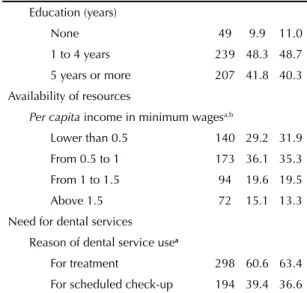
Taking into account adjustment for design effect, 91.4% of the elderly people questioned stated they were satis-fi ed with dental care: 0.7% judged it to be very bad; 1.2% to be bad, 6.8% as regular, 67.1% as good and 29.7 as excellent. The majority of the elderly people did not use services offered by the SUS and reported living in a household included in the FHS. Mean age was 68.4 years old (SE = 0.15), the greater part were female, self-reported black, mixed, indigenous or yellow, stating per capita income of minimum wage or below (67.2%) and with access to information on avoiding oral health problems. Mean DMFT was 28.4 (SE = 0.41) (Tables 1 and 2).
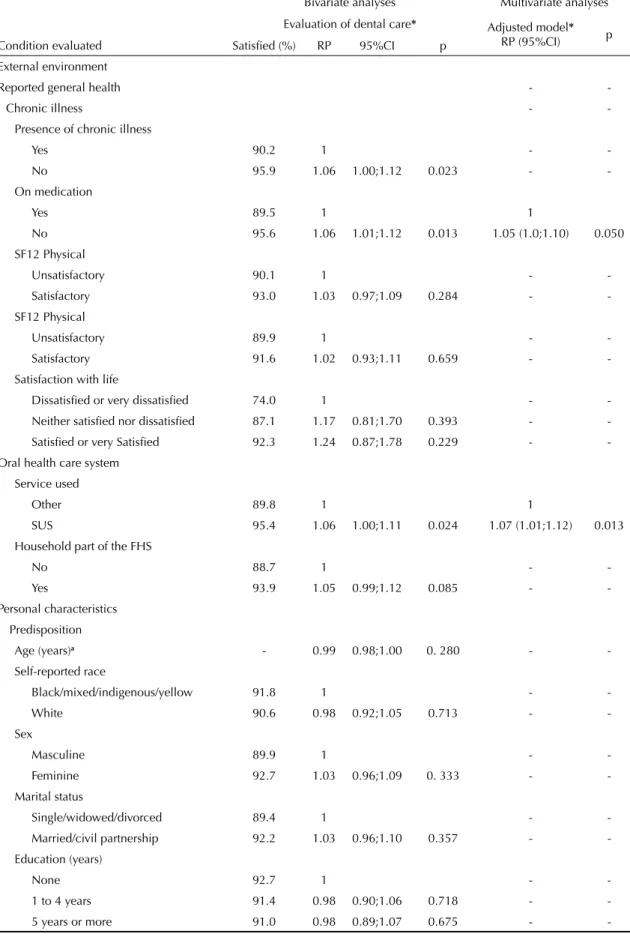
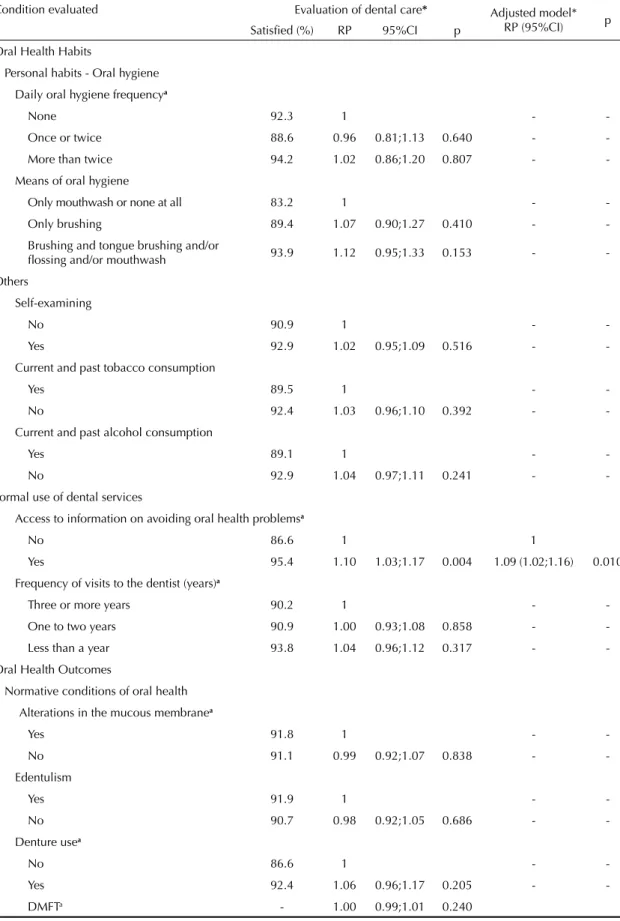
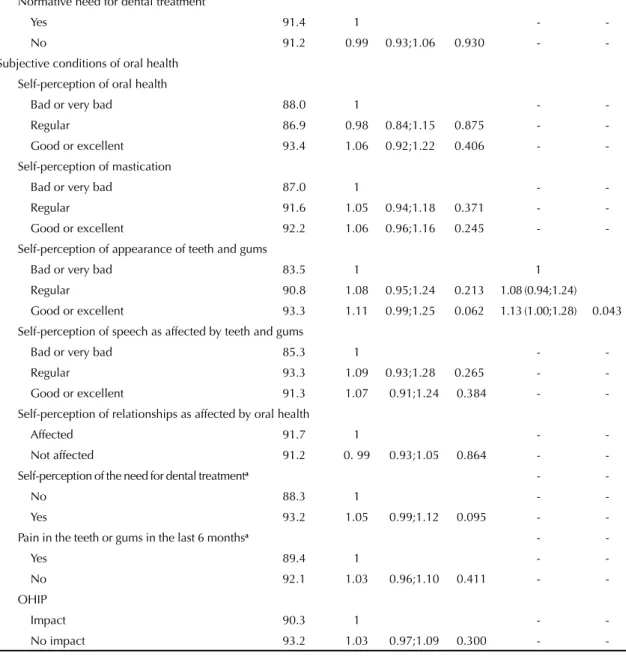
In the bivariate analysis (p ≤ 0.05), satisfaction with dental care was statistically associated with the following variables: chronic illness; being on medi-cation; type of service and access to information on avoiding oral health problems. In the multivariate analysis, the prevalence of satisfaction with the dental care, independent of the other variables, was greater among those elderly people who used the SUS services, who had access to information on avoiding oral health problems, who reported they were not on medication and who classifi ed the appearance of their teeth and gums as excellent or good (Tables 3 and 4).
Table 1. Distribution of the elderly population according to the dependent variable and the primary determiners of oral health. Montes Claros, Southeastern Brazil, 2008/2009. (n = 495)
Variables n % %*
Dependent variable
Satisfaction with dental carea
Satisfi ed 440 90.5 91.4 Dissatisfi ed 46 9.5 8.6 Primary determiners of oral health
External environment Reported general health
Chronic illness
Yes 408 82.4 80.0
No 87 17.6 20.0
On medicationa
Yes 346 70.0 69.1
No 148 30.0 30.9
SF12 physical domain
Unsatisfactory 271 54.7 55.4 Satisfactory 224 45.3 44.6 SF12 mental domain
Unsatisfactory 81 16.4 17.0 Satisfactory 414 83.6 83.0 Satisfaction with life
Dissatisfi ed or very dissatisfi ed 11 2.2 2.2 Neither Satisfi ed nor dissatisfi ed 54 10.9 10.8 Satisfi ed or very Satisfi ed 430 86.9 87.0 Oral health care system
Service useda
Other 365 74.2 72.9
SUS 127 25.8 27.1
Household part of the FHSa
No 243 49.9 44.3
Yes 244 50.1 55.7
Personal characteristics Predisposition
Age group (years)
69 to 74 211 42.6 42.2 65 to 68 284 57.4 57.8 Self-reported racea
Black/mixed/indigenous/yellow 311 63.0 63.3
White 183 37.0 36.7
Sex
Male 232 46.9 47.7 Female 263 53.1 52.3 Marital status
Single/widowed/divorced 171 34.5 30.5 married/civil partnership 324 65.5 69.5 Continue
Table 1. Continuation Education (years)
None 49 9.9 11.0
1 to 4 years 239 48.3 48.7 5 years or more 207 41.8 40.3 Availability of resources
Per capita income in minimum wagesa,b
Lower than 0.5 140 29.2 31.9 From 0.5 to 1 173 36.1 35.3 From 1 to 1.5 94 19.6 19.5 Above 1.5 72 15.1 13.3 Need for dental services
Reason of dental service usea
For treatment 298 60.6 63.4 For scheduled check-up 194 39.4 36.6 * Estimated values with correction for design effect aVariation in n = 495 due to loss of information bBased on minimum wage in 2008 (R$ 415.00)
SSF12: 12-Item Short-Form Health Survey version validated for Brazil
DISCUSSION
The analysis of the elderly people’s satisfaction with their dental care is a sensitive indicator of the quality of service provided, able to support the planning of programs and policies for health and in greater use of services, because it is a measure established by the user. The effectiveness of the health care is determined, up to a point, by the service user’s satisfaction with the service provided, and a satisfi ed consumer is more likely to make use of the health service, follow the recommended treatment and stay in contact with the care provider.20,23 Consumers’ satisfaction with the care received is considered to be a parameter for analysing health service outcomes.5
Table 2. Distribution of the elderly population according to oral health habits and outcomes. Montes Claros, Southeastern Brazil, 2008/2009. (n = 495)
Variables n % %*
Oral health habits
Personal habits - Oral hygiene Daily oral hygiene frequencya
None 11 2.2 2.4
Once or twice 242 49.2 50.8 More than twice 239 48.6 46.8 Means of oral hygienea
Only mouthwash or none at all 28 5.8 5.0 Only brushing 232 47.1 46.6 Brushing and tongue
brushing and/or fl ossing and/
or mouthwash 232 47.1 48.4 Others
Self-examining
No 394 79.6 78.0
Yes 101 20.4 22.0
Current and past tobacco consumption
Yes 175 35.4 35.9
No 320 64.6 64.1
Current and past alcohol consumption
Yes 189 38.2 39.9
No 306 61.8 60.1
Formal use of dental services
Access to information on avoiding oral health problemsa
No 230 46.7 46.8
Yes 262 53.3 53.2
Frequency of visits to the dentist (years)a
Three or more years 277 56.2 57.2 One to two years 84 17.0 15.9 Less than a year 132 26.8 26.9 Oral health outcomes
Normative conditions of oral health Alterations in the mucous membranea
Yes 82 17.2 17.1
No 394 82.8 82.9
Edentulism
Yes 270 54.5 55.5
No 225 45.5 44.5
Denture usea
No 78 15.9 14.5
Yes 414 84.1 85.5
DMFT
32 286 57.8 59.0
27 to 31 68 13.7 12.6 23 to 26 70 14.1 15.1
0 to 22 71 14.4 13.3
Continue
Tabela 2. Continuation
Normative need for dental treatment
Yes 350 70.7 70.2
No 145 29.3 29.8
Subjective conditions of oral health Self-perception of oral health
Bad or very bad 26 5.2 5.3 Regular 137 27.7 28.2 Good or excellent 332 67.1 66.5 Self-perception of mastication
Bad or very bad 71 14.3 14.4 Regular 133 26.9 27.5 Good or excellent 291 58.8 58.1 Self-perception of appearance of teeth and gums
Bad or very bad 67 13.5 13.2 Regular 135 27.3 27.3 Good or excellent 293 59.2 59.5 Self-perception of speech as affected by teeth and gums
Bad or very bad 29 5.8 5.1
Regular 80 16.2 16.6
Good or excellent 386 78.0 78.3 Self-perception of relationships as affected by oral health
Affected 140 28.3 30.9 Not affected 355 71.7 69.1 Self-perception of the need for dental treatmenta
No 213 43.2 39.9
Yes 280 56.8 60.1
Pain in the teeth or gums in the last 6 monthsa
Yes 126 25.6 25.0
No 366 74.4 75.0
OHIPa
Impact 314 63.6 64.0
Table 3. Result of the bivariate and multivariate analyses of the evaluation of dental care among the elderly according to the primary determiners of oral health. Montes Claros, Southeastern Brazil, 2008/2009.
Bivariate analyses Multivariate analyses Evaluation of dental care* Adjusted model*
RP (95%CI) p Condition evaluated Satisfi ed (%) RP 95%CI p
External environment
Reported general health -
-Chronic illness -
-Presence of chronic illness
Yes 90.2 1 -
-No 95.9 1.06 1.00;1.12 0.023 -
-On medication
Yes 89.5 1 1
No 95.6 1.06 1.01;1.12 0.013 1.05 (1.0;1.10) 0.050 SF12 Physical
Unsatisfactory 90.1 1 -
-Satisfactory 93.0 1.03 0.97;1.09 0.284 -
-SF12 Physical
Unsatisfactory 89.9 1 -
-Satisfactory 91.6 1.02 0.93;1.11 0.659 -
-Satisfaction with life
Dissatisfi ed or very dissatisfi ed 74.0 1 -
-Neither satisfi ed nor dissatisfi ed 87.1 1.17 0.81;1.70 0.393 - -Satisfi ed or very -Satisfi ed 92.3 1.24 0.87;1.78 0.229 - -Oral health care system
Service used
Other 89.8 1 1
SUS 95.4 1.06 1.00;1.11 0.024 1.07 (1.01;1.12) 0.013 Household part of the FHS
No 88.7 1 -
-Yes 93.9 1.05 0.99;1.12 0.085 -
-Personal characteristics Predisposition
Age (years)a - 0.99 0.98;1.00 0. 280 -
-Self-reported race
Black/mixed/indigenous/yellow 91.8 1 -
-White 90.6 0.98 0.92;1.05 0.713 -
-Sex
Masculine 89.9 1 -
-Feminine 92.7 1.03 0.96;1.09 0. 333 -
-Marital status
Single/widowed/divorced 89.4 1 -
-Married/civil partnership 92.2 1.03 0.96;1.10 0.357 - -Education (years)
None 92.7 1 -
-1 to 4 years 91.4 0.98 0.90;1.06 0.718 -
-5 years or more 91.0 0.98 0.89;1.07 0.675 -
The level of satisfaction with dental services among the elderly people we evaluated was high, and higher still with those who accesses services offered by the SUS. A high level of satisfaction has previously been observed in both national and international studies,9,14,16,20 inde-pendently of the form in which it was conceived and measured, whether from a quantitative or qualitative approach.5 In this study, of those assisted by SUS, 95.4% were satisfi ed, similar to the value recorded among service users (89%) of the SUS in Belo Horizonte, MG, in the study by Lima-Costa & Loyola Filho.9 However, in this study, the variable ‘satisfaction with the health service used’ was constructed based on the respondent stating they would recommend this service to others.
The higher levels of satisfaction among users of the SUS contrasted with possible infrastructure defi ciencies still present in the health system which could, according to Donabedian3 (1988), negatively infl uence service users’ evaluation of the services.22 On the other hand, possible improvements in access to services and in their quality, due to the oral health policies implemented over the last few years, may have generated feelings of satisfac-tion. The apparent improvement in access may trigger satisfaction with the dental care itself. In the studies by Martins et al10 and Paim et al,15 5.8% of the elderly people reported never having used such services; in this investigation, 1.6% said this.
It should be highlighted that this work took place in the home, not in the environment in which care is delivered by the dental care provider, which minimises possible feelings of recognition and consequent satisfaction. Some health and professional development policies in the municipality such as investments in professional training and qualifi cations, primary health care and giving a more human face to care, as well as wide social participation and greater awareness of the right
to health care, may have infl uenced the evaluation of dental services provided to the elderly by the SUS.7,15,22
The elderly relate higher levels of satisfaction than those of younger service users.9,16,23 A population based national survey, incorporating fi ve thousand Brazilian households, with adults over the age of 18, chosen by random sampling, showed that 27% of the individuals were satisfi ed with the functioning of the country’s health care, without distinguishing the type of service used.19 Marked socioeconomic inequalities, as well as the infl uence of social circumstances on the health of Brazilians, might be directly linked to divergent results, mainly due to regional differences in health care policies.6
There were higher levels of satisfaction with dental care among those who reported they were not on medication. These results are consistent with those of other studies which reported lower levels of satisfaction with the organisational quality of care among consumers with health problems.9,16,23
According to the adopted theoretical model from Andersen & Davidson1 (1997), and that proposed by Donabedian3 (1988), we expected correlations between satisfaction with dental care services and level of education, income and skin colour according to user’s self-reported race. However, in this study and in another carried out in Taiwan, the service users’ levels of education did not correlate with satisfaction with care received.20 In South Africa, both socioeconomic status and race were found to be associated with satisfaction.14 The expected correla-tions were not confi rmed in this research, possibly due to the homogeneity of the population’s income (82.0% earning minimum wage or less per month per capita). Access to information on avoiding oral health problems has been independently associated with satisfaction Table 3. Continuation
Availability of resources
Per capita income in minimum wagesb
Lower than 0.5 89.9 1 -
-From 0.5 to 1 92.2 1.02 0.94;1.11 0.555 -
-From 1 to 1.5 93.4 1.03 0.95;1.13 0.388 -
-Above 1.5 86.9 0.96 0.85;1.09 0.598 -
-Need for dental services Reason of dental service usea
For treatment 92.0 1 -
-For scheduled check-up 90.2 0.98 0.91;1.05 0.581 - -RP: ratio of prevalence; 95%CI: 95% confi dence interval
* Estimated percentage values adjusted for design effect aVariables deemed to be quantitative in the bivariate analyses bBased on minimum wage in 2008 (R$ 415.00)
Table 4. Result of the bivariate and multivariate analyses of the evaluation of dental care among the elderly according to oral health habits and outcomes. Montes Claros, Southeastern Brazil, 2008/2009.
Condition evaluated
Bivariate analyses Multivariate analyses Evaluation of dental care* Adjusted model*
RP (95%CI) p Satisfi ed (%) RP 95%CI p
Oral Health Habits
Personal habits - Oral hygiene Daily oral hygiene frequencya
None 92.3 1 -
-Once or twice 88.6 0.96 0.81;1.13 0.640 -
-More than twice 94.2 1.02 0.86;1.20 0.807 -
-Means of oral hygiene
Only mouthwash or none at all 83.2 1 -
-Only brushing 89.4 1.07 0.90;1.27 0.410 -
-Brushing and tongue brushing and/or
fl ossing and/or mouthwash 93.9 1.12 0.95;1.33 0.153 - -Others
Self-examining
No 90.9 1 -
-Yes 92.9 1.02 0.95;1.09 0.516 -
-Current and past tobacco consumption
Yes 89.5 1 -
-No 92.4 1.03 0.96;1.10 0.392 -
-Current and past alcohol consumption
Yes 89.1 1 -
-No 92.9 1.04 0.97;1.11 0.241 -
-Formal use of dental services
Access to information on avoiding oral health problemsa
No 86.6 1 1
Yes 95.4 1.10 1.03;1.17 0.004 1.09 (1.02;1.16) 0.010 Frequency of visits to the dentist (years)a
Three or more years 90.2 1 -
-One to two years 90.9 1.00 0.93;1.08 0.858 -
-Less than a year 93.8 1.04 0.96;1.12 0.317 - -Oral Health Outcomes
Normative conditions of oral health Alterations in the mucous membranea
Yes 91.8 1 -
-No 91.1 0.99 0.92;1.07 0.838 -
-Edentulism
Yes 91.9 1 -
-No 90.7 0.98 0.92;1.05 0.686 -
-Denture usea
No 86.6 1 -
-Yes 92.4 1.06 0.96;1.17 0.205 -
-DMFTa - 1.00 0.99;1.01 0.240
Table 4. Continuation
Normative need for dental treatment
Yes 91.4 1 -
-No 91.2 0.99 0.93;1.06 0.930 -
-Subjective conditions of oral health Self-perception of oral health
Bad or very bad 88.0 1 -
-Regular 86.9 0.98 0.84;1.15 0.875 -
-Good or excellent 93.4 1.06 0.92;1.22 0.406 - -Self-perception of mastication
Bad or very bad 87.0 1 -
-Regular 91.6 1.05 0.94;1.18 0.371 -
-Good or excellent 92.2 1.06 0.96;1.16 0.245 - -Self-perception of appearance of teeth and gums
Bad or very bad 83.5 1 1
Regular 90.8 1.08 0.95;1.24 0.213 1.08 (0.94;1.24) Good or excellent 93.3 1.11 0.99;1.25 0.062 1.13 (1.00;1.28) 0.043 Self-perception of speech as affected by teeth and gums
Bad or very bad 85.3 1 -
-Regular 93.3 1.09 0.93;1.28 0.265 -
-Good or excellent 91.3 1.07 0.91;1.24 0.384 - -Self-perception of relationships as affected by oral health
Affected 91.7 1 -
-Not affected 91.2 0. 99 0.93;1.05 0.864 -
-Self-perception of the need for dental treatmenta -
-No 88.3 1 -
-Yes 93.2 1.05 0.99;1.12 0.095 -
-Pain in the teeth or gums in the last 6 monthsa -
-Yes 89.4 1 -
-No 92.1 1.03 0.96;1.10 0.411 -
-OHIP
Impact 90.3 1 -
-No impact 93.2 1.03 0.97;1.09 0.300 -
-RP: ratio of prevalence; 95%CI: 95% confi dence interval * Estimated percentage values adjusted for design effect aVariables deemed to be quantitative in the bivariate analyses
with dental care services. Tung & Chang20 reported that satisfaction with health services was associated with educational campaigns on preventing and controlling disease. Donabedian3 (1988) states that the process, i.e. the interpersonal patient-professional relationship, affects evaluations of health services. Haddad7 and Motta & Aguiar13 highlight that the implementation of new curricular guidelines in graduate and post-graduate courses as enabling conceptual changes in the profi le of professionals, focussing on comprehensive care of individuals, families, social groups and communities, in addition to continuing education in preparing human resources for primary health care. It is possible that
professionals at higher levels who work in the Family Health Teams of the municipality of Montes Claros had specialised training, mainly in family and community medicine or with multi-professional residency in family health.18 This could be explained in future research. It is possible that the differentiated training of these profes-sionals has brought about more humanised health care and affected the way users are received, benefi tting the patient-professional-service interaction.
satisfaction could be infl uenced by health outcomes.3 However, the normative situation of oral health we found may refl ect factors related to the conditions of self-care and lifelong dental care. Consequently, it may not imply satisfaction with recently received dental care.
The higher level of satisfaction found among the elderly who had a positive perception of the appearance of their teeth and gums indicated the importance of this parameter for users’ perception of their own health in relation to services received.1,11
There was independent correlation with access to information on avoiding oral health care problems. SUS service users and those who have a positive percep-tion of their own appearance showed higher levels of satisfaction. In the model proposed by Andersen & Davidson1 correlation was found between variables from the four sub groups. This theoretical model1 and that proposed by Donabedian3 (1988) were both confi rmed in this research.
The elderly who used SUS dental services were more satisfi ed with the care, as were those who were not on medication, those who perceived their own teeth and gums in a positive way and those who reported having
more access to information on avoiding oral health problems. We concluded, therefore, that the SUS health policies implemented in the municipality have started to yield the hoped for positive results.
The limitations of this study lie in the construction of the dependent variable and the lack of assessment of the resolution and the structure of health services. We would also like to point out that the process of evaluating dental services and the variables investigated is dynamic. Therefore, cause and effect will certainly vary with the passage of time and, as this is a cross-sectional study, it is not possible to establish a temporal relationship between the associations observed. On the other hand, it is noteworthy that the results are reliable; being a result of random sampling of clusters representative of the elderly of the municipality, and the data analysis was carried out with adjustments for design effect.
ACKNOWLEDGEMENTS
1. Andersen RM, Davidson PL. Ethnicity, aging, and oral health outcomes: a conceptual framework. Adv Dent Res. 1997;11(2):203-9. DOI:10.1177/08959374970110020201 2. Bottan ER, Sperb RAL, Telles PS, Uriarte Neto M.
Avaliação de serviços odontológicos: a visão dos pacientes. Rev ABENO. 2006;6(2):128-33. 3. Donabedian A. The quality of care: how can it be
assessed? JAMA. 1988;260(12):1743-8. 4. Emmi DT, Barroso RFF. Avaliação das
ações de saúde bucal no Programa Saúde da Família no distrito de Mosqueiro, Pará.
Cienc Saude Coletiva. 2008;13(1):35-41. DOI:10.1590/S1413-81232008000100008 5. Esperidião MA, Trad LAB. Avaliação da satisfação
de usuários: considerações teórico-conceituais.
Cad Saude Publica. 2006;22(6):1267-76. DOI:10.1590/S0102-311X2006000600016
6. Gouveia GC, Souza WV, Luna CF, Souza-Júnior PRB, Szwarcwald CL. Satisfação dos usuários do sistema de saúde brasileiro: fatores associados e diferenças regionais. Rev Bras Epidemiol. 2009;12(3):281-96. DOI:10.1590/S1415-790X2009000300001 7. Haddad AE, Morita MC, Pierantoni CR, Brenelli SL,
Passarella T, Campos FE. Formação de profi ssionais de saúde no Brasil: uma análise no período de 1991 a 2008. Rev Saude Publica. 2010;44(3):383-93. DOI:10.1590/S0034-89102010005000015
8. Kochhann R, Varela JS, Lisboa CSM, Chaves MLF. The Mini Mental State Examination: review of cutoff points adjusted for schooling in a large Southern Brazilian sample. Dement Neuropsychol. 2010;4(1):35-41. 9. Lima-Costa MF, Loyola Filho AI. Fatores associados
ao uso e à satisfação com os serviços de saúde entre usuários do Sistema Único de Saúde na região metropolitana de Belo Horizonte, Estado de Minas Gerais, Brasil. Epidemiol Serv Saude. 2008;17(4):247-57. DOI:10.5123/S1679-49742008000400002 10. Martins AMEBL, Barreto SM, Pordeus IA. Uso de
serviços odontológicos entre idosos brasileiros.
Rev Panam Salud Publica. 2007;22(5):308-16. DOI:10.1590/S1020-49892007001000003 11. Martins AMEBL, Barreto SM, Pordeus IA.
Características associadas ao uso de serviços odontológicos entre idosos dentados e edentados no Sudeste do Brasil: Projeto SB Brasil. Cad Saude Publica. 2008;24(1):81-92. DOI:10.1590/S0102-311X2008000100008
12. Martins AMEBL, Rodrigues CAQ, Haikal DSA, Silveira MF, Mendes DC, Oliveira MP, et al. Desenvolvimento de um programa de computador para levantamentos epidemiológicos sobre condições de saúde bucal.
Unimontes Cient. 2012;14(1):30-42 [citado 2012 ago 29]. Disponível em: http://www.ruc.unimontes.br/ index.php/unicientifi ca/article/view/488
13. Motta LB, Aguiar AC. Novas competências profi ssionais em saúde e o envelhecimento populacional brasileiro:
integralidade, interdisciplinaridade e intersetorialidade.
Cienc Saude Coletiva. 2007;12(2):363-72. DOI:10.1590/S1413-81232007000200012
14. Myburgh NG, Solanki GC, Smith MJ, Lalloo R. Patient satisfaction with health care providers in South Africa: the infl uences of race and socioeconomic status. Int J Qual Health Care. 2005;17(6):473-7. DOI:10.1093/intqhc/mzi062
15. Paim J, Travassos C, Almeida C, Bahia L, Macinko J. The Brazilian health system: history, advances and challenges. Lancet. 2011;377(9779):1778-1797. DOI:10.1016/S0140-6736(11)60054-8
16. Rahmqvist M, Bara AC. Patient characteristics and quality dimensions related to patient satisfaction.
Int J Qual Health Care. 2010;22(2):86-92. DOI:10.1093/intqhc/mzq009
17. Santos AM, Assis MMA, Nascimento MAA, Jorge MSB. Vínculo e autonomia na prática de saúde bucal no Programa Saúde da Família.
Rev Saude Publica. 2008;42(3):464-70. DOI:10.1590/S0034-89102008005000025 18. Silva JM, Caldeira AP. Modelo assistencial e
indicadores de qualidade da assistência: percepção dos profi ssionais da atenção primária à saúde.
Cad Saude Publica. 2010;26(6):1187-1193. DOI:10.1590/S0102-311X2010000600012
19. Szwarcwald CL, Viacava F, Vasconcellos MTL, Leal MC, Azevedo LO, Queiroz RSB, et al. Pesquisa Mundial de Saúde - 2003: o Brasil em números.
RADIS. 2004;(23):14-33.
20. Tung YC, Chang GM. Patient satisfaction with and recommendation of a primary care provider: associations of perceived quality and patient
education. Int J Qual Health Care. 2009;21(3):206-13. DOI:10.1093/intqhc/mzp006
21. Uchimura KY, Bosi MLM. Qualidade e subjetividade na avaliação de programas e serviços em
saúde. Cad Saude Publica. 2002;18(6):1561-9. DOI:10.1590/S0102-311X2002000600009 22. Victora CG, Barreto ML, Leal MC, Monteiro
CA, Schmidt MI, Paim J, et al. Health conditions and health-policy innovations in Brazil: the way forward. Lancet. 2011;377(9782):2042-53. DOI:10.1016/S0140-6736(11)60055-X 23. Westaway MS, Rheeder P, Zyl DGV, Seager JR.
Interpersonal and organizational dimensions of patient satisfaction: the moderating effects of health status. Int J Qual Health Care. 2003;15(4):337-44. DOI:10.1093/intqhc/mzg042
24. Woods N, Whelton H, Kelleher V. Factors infl uencing the need for dental care amongst the elderly in the Republic of Ireland. Community Dent Health.
2009;26(4):244-9. DOI:10.1922/CDH_2360Woods06 25. World Health Organization. Oral health surveys: basic
methods. 4.ed. Geneva: ORH EPID; 1997. REFERENCES