ISSN 0100-879X
BIOMEDICAL SCIENCES
AND
CLINICAL INVESTIGATION
www.bjournal.com.br
www.bjournal.com.br
Volume 43 (4) 268-380 April 2011
Braz J Med Biol Res, April 2011, Volume 44(4) 276-282
doi:
The role of the SLAM-SAP signaling pathway in the modulation of
CD4+ T cell responses
M.L.L.V. Vilar, M.S. Frutuoso, S.M. Arruda, D.M. Lima, C.S. Bezerra and M.M.L. Pompeu
10.1590/S0100-879X2011007500038
Faculdade de Medicina de Ribeirão Preto Campus
Ribeirão Preto
Institutional Sponsors
The Brazilian Journal of Medical and Biological Research is partially financed by
analiticaweb.com.br S C I E N T I F I C
The role of the SLAM-SAP signaling pathway
in the modulation of CD4
+
T cell responses
M.L.L.V. Vilar
1,2,3, M.S. Frutuoso
2,3, S.M. Arruda
1,4, D.M. Lima
2,
C.S. Bezerra
5and M.M.L. Pompeu
21Escola Bahiana de Medicina e Saúde Pública/FDC, Salvador, BA, Brasil 2Núcleo de Medicina Tropical, Faculdade de Medicina, Universidade Federal do Ceará, Fortaleza, CE, Brasil
3Curso de Medicina, Faculdade Christus, Fortaleza, CE, Brasil 4Centro de Pesquisa Gonçalo Moniz, FIOCRUZ, Salvador, BA, Brasil 5Instituto Federal de Educação, Ciência e Tecnologia do Ceará, Fortaleza, CE, Brasil
Abstract
The signaling lymphocytic activation molecule (SLAM), present on the surface of hematopoietic cells, can regulate some events of the immune responses. This modulatory action is associated with the capacity of SLAM to interact with an intracytoplasmic adapter, such as SLAM-associated protein (SAP). SLAM is constitutively expressed in most of these cells, is rapidly induced after antigenic or inlammatory stimuli, and participates in the immunological synapse. Defects in the function of the SLAM-SAP pathway contribute to immunological abnormalities, resulting in autoimmune diseases, tumors of the lymphoid tissues and inadequate responses to infectious agents. Initially, the role of SLAM was investigated using an anti-SLAM monoclonal antibody (α-SLAM mAb) identiied as an agonist of the SLAM-SAP pathway, which could induce the production of interferon-γ and could redirect the immune response to a T helper 1 (Th1) cell proile. However, in this review we postulate that the SLAM-SAP pathway primarily induces a Th2 response and secondarily suppresses the Th1 response.
Key words: SLAM; SAP; IFN-γ; Immunoreceptor; Immunomodulation
Introduction
Correspondence: M.M.L. Pompeu, Departamento de Patologia e Medicina Legal, Faculdade de Medicina, Universidade Federal do Ceará, Rua Monsenhor Furtado, s/n, 60441-750 Fortaleza, CE, Brasil. Fax: +55-85-3366-8304. E-mail: [email protected]
Received September 18, 2010. Accepted February 21, 2011. Available online March 25, 2011. Published April 11, 2011.
The response of the cells of the immune system is controlled by the equilibrium of signals received by a large number of cell surface receptors, among them the activa-tion receptors, co-stimulatory molecules and inhibitory molecules (1,2). Binding of immunoreceptors by their ligands induces a tyrosine phosphorylation signal that is essential for cell activation. Although immunoreceptors such as the T cell receptor (TCR) and the B cell receptor have no intrinsic protein tyrosine kinase activity, they associate with subunits bearing immunoreceptor tyrosine-based activation motifs in their intracellular domain (3). Signaling through the im-munoreceptors alone is not suficient for the activation of gene transcription. The ampliication of the signal is also necessary. Therefore, co-receptors and co-stimulatory molecules come into play. Evidence indicates that receptors of the signaling lymphocytic activation molecule (SLAM) family and a group of intracellular adapter proteins, chiely SLAM-associated protein (SAP) among them, are involved in the modulation of the immune responses (2-5).
Fol-lowing the activation of T lymphocytes, the SLAM-SAP signaling pathway exerts an important function in inducing the expression of the T helper 2 (Th2) cytokine (6), in the production of antibodies, in the generation of memory B cells, in the activation as well as the inhibition of natural killer (NK) cells, and in the development of natural killer T (NKT) cells (3).
The family of receptors related to SLAM
The SLAM family of receptors is a subgroup of the im-munoglobulin super family, which regulates the function of T cells, B lymphocytes, macrophages, and mature dendritic cells (2-7), thereby inluencing both the innate and the adaptive immune responses. These families include nine receptors (3,4,6,8-11) (Table 1).
SLAM-SAP signaling pathway in the modulation of T CD4+ cell 277
type 2 Ig-like C-terminal domain (C2), except for CD229 (Ly-9), which has a V-C2domain, a transmembrane re-gion, and a cytoplasmic portion containing tyrosine-based motifs (8).
The action of the SLAM family of receptors results in the phosphorylation of these molecules by protein kinases of the Srcfamily (12). These receptors also function as their own ligands, with the exception of 2B4, which is involved in homotypic and heterotypic cell-cell interactions (8,12). Each receptor initiates a signal whose end result will depend on the disposition of the tyrosine motifs in their cytoplasmic domain, their amino acid sequence and the types of amino acids they contain (13).
The genes encoding the receptors related to SLAM are located on chromosome 1, at the SLAM locus, in both humans and mice, with the exception of CD2, which is located on chromosome 3 (4,14). These receptors have been implicated in the physiopathology of autoimmunity. The Sle1b region confers a greater susceptibility to sys-temic lupus erytematosus in mice, and corresponds to the
region of the gene of the SLAM family (15). Polymorphisms in this particular region have been associated with human systemic lupus erythematosus (16).
The signaling lymphocytic activation
molecule
The SLAM was initially identiied in human cells as IPO-3, a cell surface glycoprotein that was expressed in cells of the immune system (17,18) and was later cloned (A12) and named the SLAM (19). This receptor has a molecular mass of 70 kDa and is made up of 335 amino acids. Its structure includes an extracellular portion containing 202 amino acids, a transmembrane region with 22 amino acids and a cytoplasmic region with 77 amino acids. The cytoplasmic portion has a domain containing three motifs with tyrosine residues Y281, Y307, and Y327. The motif that
contains tyrosine residue Y281 shows a greater afinity
for SAP(20). The tyrosine-based motifs are constituted by the consensus amino acid sequence TxYxxV/I, where
Table 1. Expression, ligands and effects of the signaling lymphocytic activation molecule (SLAM) family of receptors in hemopoietic cells.
SLAM family of receptors Expression Ligand(s) Effects
SLAMF1 (SLAM, CD150, IPO-3)
Thymocytes, macrophages, monocytes, mature dendritic cells, platelets, B cells, T cells, hematopoietic stem cells
Self-ligand, measles virus
CD4+ T cells: ↑ IL-4 secretion
Macrophages: ↑ IL-12, TNF-α production
SLAMF2 (CD48) B cells, T cells, monocytes SLAMF4 T cells: ↓ IL-2, ↓ IFN-γ production and ↓ proliferation
SLAMF3 (CD229, Ly-9) B cells, T cells, some thymocytes, NK cells, NKT cells
Self-ligand T cells: ↓ IL-4 and ↓ proliferation
SLAMF4 (2B4, CD244) NK cells, T cells, memory CD8+ T cells,
monocytes, basophils, eosinophils, mast cells
SLAMF2 NK cells: ↑ IFN-γ and cytotoxicity
CD8+ T cells: immune synapse
formation, ↑ IFN-γ and ↑ IL-2 Eosinophils: ↑ cytotoxicity, ↑ cytokines
SLAMF5 (CD84, Ly-9b) Most thymocytes, B cells, T cells, NKT cells, mast cells, monocytes, macrophages, dendritic cells, neutrophils, basophils, eosinophils, platelets, human hematopoietic stem cells
Self-ligand T cells: ↑ IFN-γ production and ↑ proliferation
Platelet dispersion
SLAMF6 (NTB-A, SF2000) B cells, T cells, NK cells Self-ligand Human NK cells: ↑ IFN-γ production and ↑ cytotoxicity CD4+ T cells: ↓ IFN-γ
SLAMF7 (CRACC, CS1, 19A) B cells, T cells, NK cells, mature dendritic cells Self-ligand NK cells: ↑ IFN-γ production and ↑ cytotoxicity
T cell: ↑ IFN-γ production SLAMF8 (BLAME) Macrophages, dendritic cells Unknown Unknown
SLAMF9 (CD2F-10, SF2001) B cells, T cells, macrophages, dendritic cells Unknown Unknown
T corresponds to threonine, Y to tyrosine, V to valine, I to isoleucine, and x to any other amino acid residue (8). SLAM has the capacity to interact in a homotypic way at the level of its extracellular domains, but with a low afinity (8,12), and functions through a bidirectional signaling after SLAM-SLAM binding (19,21).
Four SLAM isoforms have been identiied thus far, all originating from the selective elimination of exons - splicing. Two of these are composed of 305 amino acids and cor-respond to the transmembrane extension and the other two are cytoplasmic, with one being soluble. The soluble form of SLAM is capable of interacting with SLAM expressed on the cell membrane surface, inluencing the immune response (18).
The expression of SLAM is demonstrated in the cells of innate as well as adaptive immunity (1), such as thymo-cytes, monothymo-cytes, macrophages, dendritic cells, B and T lymphocytes, NK cells, granulocytes, and platelets, in both human and murine models (8,17,18). In the majority of these hematopoietic cells, the expression of SLAM occurs constitutively, being rapidly induced in T and B lymphocytes in viral infections, and in dendritic cells by antigenic (22) or inlammatory stimuli, such as lipopolysaccharide and interleukin-1β (IL-1β) (23), and in macrophages activated by LPS and interferon-γ (IFN-γ) (8,19,24). The expression of this molecule was also observed in hematopoietic cells of the bone marrow, liver of fetal mice (25), ganglia, spleen and tonsils, as well as in a particular subpopulation of endothelial cells (14).
SLAM has been considered to be the principal receptor of measles virus, contributing to the lymphotropic character-istic of this infectious agent, which induces lymphopenia (26) and immunosuppression (27). Other agents, such as morbil-liviruses, also utilize this molecule as a receptor (14).
SLAM promotes the adhesion between T lymphocytes and antigen-presenting cells, participating in the formation of
the immunological synapse, principally in the co-stimulation dependent on TCR (4,12,19). This co-stimulator also modu-lates the production of cytokines by CD4+ T lymphocytes,
macrophages and dendritic cells, where their actions differ depending on the type of stimulus (6). An increase in the expression of SLAM has been observed in autoimmune diseases such as experimental murine lupus (16) and human multiple sclerosis (28). Greater concentrations of soluble forms of SLAM have been detected in the synovial luid of patients with rheumatoid arthritis (29). There is evidence that SLAM causes an ampliication of the secretion of Th2 cytokines in allergic responses (30). Also, a study evaluat-ing patients with tuberculosis showed that the activation of SLAM induces the phosphorylation of the transcription factor cAMP response element-binding protein (CREB) (31) and the production of IFN-γ (32).
The family of adapters related to SAP
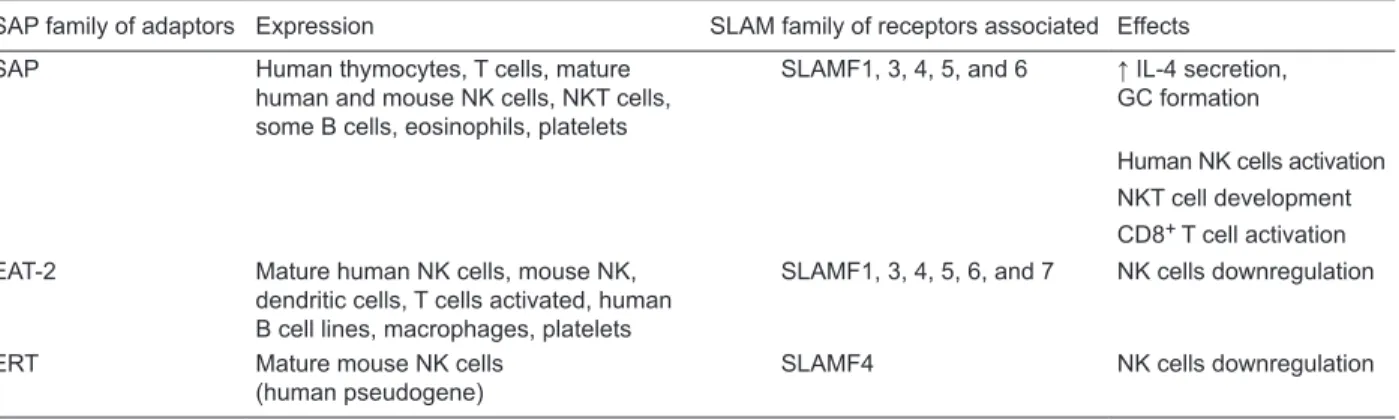
The molecules of adapters related to SAP represents a family of cytoplasmic proteins composed of a single Src homology 2 (SH2) domain and a small carboxy-terminal region (33). It has been suggested that this carboxy-terminal region of SAP can be associated with the stability of this molecule (2). These proteins are involved in the pattern of intracellular signaling, principally in the regulation of the process of lymphocyte activation (11,34), and modulate the activity of various members of the family of SLAM receptors (20).
This family includes 3 members (3,6,9-11) (Table 2). In mice and humans, chromosome 1 harbors the genes encoding EAT-2 in the regions 1q22 and ERT, next to the SLAM locus, while the SAP gene is located on the long arm of chromosome X, in the Xq25 region (33,35).
The expression of SAP, or its mRNA, has been de-tected in thymocytes, T lymphocytes, NK cells, and NKT
Table 2. Expression of the signaling lymphocytic activation molecule (SLAM) family of receptors and effects of the SLAM-associated protein (SAP) family of adaptors on hemopoietic cells.
SAP family of adaptors Expression SLAM family of receptors associated Effects
SAP Human thymocytes, T cells, mature
human and mouse NK cells, NKT cells, some B cells, eosinophils, platelets
SLAMF1, 3, 4, 5, and 6 ↑ IL-4 secretion, GC formation
Human NK cells activation NKT cell development CD8+ T cell activation
EAT-2 Mature human NK cells, mouse NK, dendritic cells, T cells activated, human B cell lines, macrophages, platelets
SLAMF1, 3, 4, 5, 6, and 7 NK cells downregulation
ERT Mature mouse NK cells (human pseudogene)
SLAMF4 NK cells downregulation
SLAM-SAP signaling pathway in the modulation of T CD4+ cell 279
lymphocytes, as well as in platelets, eosinophils (36-38), and some B lymphocytes (36). Other reports have shown this expression in neuronal cells, proliferative nodules of chronic lymphocytic leukemia (39) and germinal centers of angioimmunoblastic T cell lymphoma (40).
The SLAM-associated protein
The SAP has a molecular mass of 15 kDa, is composed of 128 amino acids, with a single SH2 domain (34) and a carboxy-terminal region of 24 to 26 amino acids. The SH2 domain has two binding surfaces; one of the surfaces in-teracts with a tyrosine-based motif, i.e., immunoreceptor tyrosine-based switch motif (ITSM) (41)in the cytoplasmic portion of SLAM, via the region containing an arginine at position 32 (Arg32) (33,35), while the other, with arginine at position 78 (Arg78), binds to the SH3 domain of tyrosine phosphokinase (11,33).
The protein adapter related to SAP binds with high afinity, through its SH2 domains, to tyrosine-based motifs located in the cytoplasmic domains of the receptors of the SLAM family (21,42). SAP is involved in the transduction of intracellular signals, interacting with the cytoplasmic tail of SLAM through its SH2 domain and thereby blocking the binding of proteins with this region, independent of phosphorylation (2,4,5,43). In addition, SAP promotes the recruitment and enzymatic activation of protein tyrosine ki-nase Fyn T, inducing the phosphorylation of the cytoplasmic domain of SLAM and allowing the propagation of events of the signaling cascade (20,42). In neural cells, SAP exerts its role through the recruitment of protein kinases related to tropomyosin (39).
The engagement of SAP in the signaling pathway through SLAM inluences the immune response, result-ing in the production of IL-4, formation of germinal cen-ters, activation of human NK cells, development of NKT lymphocytes, and activation of the regulator of CD8+ T
lymphocytes (6).
Mutations or deletions of the SH2D1A gene lead to an X-linked lymphoproliferative syndrome (4,33,35,44), a primary immunodeiciency characterized by an elevated susceptibil-ity to infection by Epstein-Barr virus (33), with a high risk for the development of fulminant infectious mononucleosis, B cell lymphoma and dysgammaglobulinemia (4,24).
The deletion of the gene that encodes SAP, depending on the immune system cells involved, can result in a reduc-tion of Th2 cytokines, the cytotoxicity of NK and CD8+ cells,
the formation of the germinal centers, and the production of T lymphocyte-dependent antibodies (5,6,36,45,46).
SAP-/- mice show a deiciency in antitumor immunity
and immune responses to viral infection, and can even display a tendency towards hypogammaglobulinemia (5,47). These animals fail to adequately control infections due to the development of defects in cell-mediated immunity such as the increase in the proliferation of antigen-speciic CD4+
and CD8+ lymphocytes. After a stimulus with lymphocytic choriomeningitis virus, Leishmania major or Toxoplasma gondii, these mice display a cytokine response of the Th1 phenotype. Despite surviving the acute infection by lym-phocytic choriomeningitis virus, these animals show high mortality due to the lack of an intense and prolonged Th1 response, as is generally demonstrable in the spleen and liver cells of animals infected with these agents (48).
The SLAM-SAP signaling pathway
TCR activation induces SLAM expression on the mem-brane of immune response cells and SLAM ampliies the TCR signaling trigger (9).
The interaction between SLAM and SAP occurs through the SH2 domain of SAP centered on arginine 32 (Arg32), which binds to ITSM, present in the cytoplasmic portion of SLAM. This binding does not depend on the phosphorylation of Y281, suggesting that SAP is constitutively associated with SLAM. SAP acts as a natural inhibitor, competing with other proteins containing the SH2 domain, such as tyrosine phosphatase (SHP-2), by binding to the same ITSM in SLAM (33). After binding to SLAM, SAP undergoes a conformational change and then binds to and activates Fyn T (49) through another binding surface in the SH2 domain containing arginine at position 78 (Arg78), forming a multiprotein complex. Upon recruiting Fyn T for SLAM, SAP phosphorylates the cytoplasmic portion of SLAM-ITSM, initiating cytoplasmic signal transduction (7,42). Thus, the phosphorylated site in the SLAM serves as the base for the SH2 domain of inositol-containing phosphatase (SHIP), which then phosphorylates and binds to the adapters of docking protein (Dok)-1 and Dok-2. The phosphorylated Dok-2 binds to the SH2 domain of Ras GTPase activating protein (RasGAP) (20). The overall result of this pathway activation is the increasing production of IL-4 and suppres-sion of IFN-γ production (6,9,21) (Figure 1).
The SLAM-SAP signaling pathway can also modulate the immune response through the TCR interaction, while SAP regulates the activation of protein kinase C-teta, B cell lymphoma 10, NF-κB, and GATA-3 (6,50) (Figure 1). The transcription factor GATA-3 acts as positive regulator of the genes of Th2 cytokines, increasing IL-4, IL-5 and IL-13 production. On the other hand, GATA-3 also suppresses IFN-γ genomic programs (51) and at the same time inhibits receptor IL-2 expression (6). Simultaneously, IL-13 inhib-its the IL-12 receptor β’-chain synthesis (52). All of these events together impair the Th1 response. Contributing to this idea, a study with murine thymoma cells showed that the SLAM-SLAM interaction induced the reduction of IFN-γ production (21).
receptors, the type and amount of α-SLAM antibody used, and the substrates involved in the downstream. Models of deicient mice in SLAM family of receptors (SLAM, Ly108 or Ly9) showed a reduction in the production of Th2 cytokines, but this alteration was not as marked as in SAP-deicient mice (53,54). The probable explanation for this phenomenon is the likeli-hood of a redundant expression of the SLAM family receptors in the same cell, which could contribute to overcome or mask the deiciency or absence of the receptor (3,6,31).
Initially, the role of SLAM was investi-gated using anti-SLAM monoclonal antibody (α-SLAM mAb). Several investigators observed that, the TCR stimulation in the presence of α-SLAM mAb induced an increase in IFN-γ production (17,19,21) and cytotoxicity of CD8+
T lymphocytes (55). These indings led to the belief that the α-SLAM mAb was agonistic and that its activation regulated the differentiation of T cell, increasing the production of IFN-γ and redirecting the immune response toward a Th1 proile (17,19).
However, it is possible that the α-SLAM mAb may act by blocking the binding sites of SLAM in its extracellular portion, preventing the activation of the signaling pathway (3,6). Another possibility is that α-SLAM mAb was
bound to SLAM soluble molecules or to be associated with TCR molecules due to electric charge afinity, leading to α-SLAM mAb functional sequestrum, implying in inactiva -tion of SLAM-SAP signaling pathway (9). It was also shown that, in the in vitro sensitization of human lymphocytes with
Leishmania amazonensis, the anti-SLAM antibody induced an important inhibition of IL-13 production, with a slight increase in the production of IFN-γ (56).
These data strengthen the hypothesis that SLAM-SAP signaling pathway is not primarily involved in Th1 dif-ferentiation and that blocking this signaling pathway with the α-SLAM mAb directly undermines the Th2 response. Another important contribution to a better understanding of the SLAM-SAP signaling pathway came from studies with genetically modiied mouse models, or human cells with mutations of SAP, as in X-linked lymphoproliferative disease.
It has been reported that CD4+ T cells of mice deicient
in SAP, when stimulated in vitro, show an increase in the production of IL-2 and IFN-γ, accompanied by a simultane-ous reduction in the secretion of IL-4 and IL-13 (48,57,58), as well as the reduction in the expression of the transcription factor GATA-3 (57). Other studies have also demonstrated that CD4+ T cells of mice deicient in SLAM show a
reduc-tion of IL-4 and IL-13 producreduc-tion, with mild increase in the production of IFN-γ (24,57). The same effect can be seen
in Fyn T-/- mice stimulated with TCR, which show reduction
in the phosphorylation of B cell lymphoma 10 and, as a consequence, a decrease in IL-4 production (50).
The blocking of the SLAM-SAP signaling pathway simulates the effects of the deiciency of both SLAM and SAP since the tyrosine phosphorylation cascade initiated by this pathway exerts its action only if SLAM and SAP are available (21). These results demonstrate the interdepen-dence of SLAM and SAP receptors in this signaling pathway and their action in Th2 differentiation. These indings imply that SLAM is primarily involved in promoting Th2-cytokine secretion.
In summary, the SLAM receptor plays an important role in the immunological synapse, where it is detected in almost all cells of the immune system. Although the results of some studies suggest that SLAM is an inducer of IFN-γ, we agree with the interpretation that the SLAM-SAP interplay can be an important signaling pathway for inducing the synthesis of Th2 cytokines, and exerting a down-modulation of the Th1 immune response. Thus, the defects in the SLAM-SAP pathway could potentially contribute to the various immu-nological abnormalities observed both in humans and in murine models. In addition, advances in knowledge of this signaling pathway may lead to new strategies for the treat-ment and prevention of autoimmune, allergic, neoplastic, and infectious diseases.
SLAM-SAP signaling pathway in the modulation of T CD4+ cell 281
References
1. Veillette A, Dong Z, Latour S. Consequence of the SLAM-SAP signaling pathway in innate-like and conventional lymphocytes. Immunity 2007; 27: 698-710.
2. Latour S, Veillette A. The SAP family of adaptors in immune regulation. Semin Immunol 2004; 16: 409-419.
3. Veillette A. Immune regulation by SLAM family receptors and SAP-related adaptors. Nat Rev Immunol 2006; 6: 56-66. 4. Engel P, Eck MJ, Terhorst C. The SAP and SLAM families
in immune responses and X-linked lymphoproliferative dis-ease. Nat Rev Immunol 2003; 3: 813-821.
5. Nichols KE, Ma CS, Cannons JL, Schwartzberg PL, Tangye SG. Molecular and cellular pathogenesis of X-linked lym-phoproliferative disease. Immunol Rev 2005; 203: 180-199.
6. Ma CS, Nichols KE, Tangye SG. Regulation of cellular and humoral immune responses by the SLAM and SAP families of molecules. Annu Rev Immunol 2007; 25: 337-379. 7. Chan AY, Westcott JM, Mooney JM, Wakeland EK, Schatzle
JD. The role of SAP and the SLAM family in autoimmunity. Curr Opin Immunol 2006; 18: 656-664.
8. Romero X, Zapater N, Calvo M, Kalko SG, de la Fuente MA, Tovar V, et al. CD229 (Ly9) lymphocyte cell surface receptor interacts homophilically through its N-terminal domain and relocalizes to the immunological synapse. J Immunol 2005; 174: 7033-7042.
9. Veillette A, Cruz-Munoz ME, Zhong MC. SLAM family re-ceptors and SAP-related adaptors: matters arising. Trends Immunol 2006; 27: 228-234.
10. Valdez PA, Wang H, Seshasayee D, van Lookeren CM, Gurney A, Lee WP, et al. NTB-A, a new activating receptor in T cells that regulates autoimmune disease. J Biol Chem 2004; 279: 18662-18669.
11. Roncagalli R, Taylor JE, Zhang S, Shi X, Chen R, Cruz-Munoz ME, et al. Negative regulation of natural killer cell function by EAT-2, a SAP-related adaptor. Nat Immunol 2005; 6: 1002-1010.
12. Mavaddat N, Mason DW, Atkinson PD, Evans EJ, Gilbert RJ, Stuart DI, et al. Signaling lymphocytic activation molecule (CDw150) is homophilic but self-associates with very low afinity. J Biol Chem 2000; 275: 28100-28109.
13. Chen R, Relouzat F, Roncagalli R, Aoukaty A, Tan R, Latour S, et al. Molecular dissection of 2B4 signaling: implications for signal transduction by SLAM-related receptors. Mol Cell Biol 2004; 24: 5144-5156.
14. Sidorenko SP, Clark EA. The dual-function CD150 receptor subfamily: the viral attraction. Nat Immunol 2003; 4: 19-24. 15. Wandstrat AE, Nguyen C, Limaye N, Chan AY, Subramanian
S, Tian XH, et al. Association of extensive polymorphisms in the SLAM/CD2 gene cluster with murine lupus. Immunity 2004; 21: 769-780.
16. Shai R, Quismorio FP Jr, Li L, Kwon OJ, Morrison J, Wallace DJ, et al. Genome-wide screen for systemic lupus erythe-matosus susceptibility genes in multiplex families. Hum Mol Genet 1999; 8: 639-644.
17. Castro AG, Hauser TM, Cocks BG, Abrams J, Zurawski S, Churakova T, et al. Molecular and functional characterization of mouse signaling lymphocytic activation molecule (SLAM): differential expression and responsiveness in Th1 and Th2 cells. J Immunol 1999; 163: 5860-5870.
18. Punnonen J, Cocks BG, Carballido JM, Bennett B, Peterson D, Aversa G, et al. Soluble and membrane-bound forms of signaling lymphocytic activation molecule (SLAM) induce proliferation and Ig synthesis by activated human B lympho-cytes. J Exp Med 1997; 185: 993-1004.
19. Cocks BG, Chang CC, Carballido JM, Yssel H, de Vries JE, Aversa G. A novel receptor involved in T-cell activation. Nature 1995; 376: 260-263.
20. Chan B, Lanyi A, Song HK, Griesbach J, Simarro-Grande M, Poy F, et al. SAP couples Fyn to SLAM immune receptors. Nat Cell Biol 2003; 5: 155-160.
21. Latour S, Gish G, Helgason CD, Humphries RK, Pawson T, Veillette A. Regulation of SLAM-mediated signal transduc-tion by SAP, the X-linked lymphoproliferative gene product. Nat Immunol 2001; 2: 681-690.
22. Nanda N, Andre P, Bao M, Clauser K, Deguzman F, Howie D, et al. Platelet aggregation induces platelet aggregate stability via SLAM family receptor signaling. Blood 2005; 106: 3028-3034.
23. Kruse M, Meinl E, Henning G, Kuhnt C, Berchtold S, Berger T, et al. Signaling lymphocytic activation molecule is ex-pressed on mature CD83+ dendritic cells and is up-regulated by IL-1 beta. J Immunol 2001; 167: 1989-1995.
24. Wang N, Satoskar A, Faubion W, Howie D, Okamoto S, Feske S, et al. The cell surface receptor SLAM controls T cell and macrophage functions. J Exp Med 2004; 199: 1255-1264.
25. Kiel MJ, Yilmaz OH, Iwashita T, Yilmaz OH, Terhorst C, Mor -rison SJ. SLAM family receptors distinguish hematopoietic stem and progenitor cells and reveal endothelial niches for stem cells. Cell 2005; 121: 1109-1121.
26. Schneider-Schaulies S, Schneider-Schaulies J. Measles virus-induced immunosuppression. Curr Top Microbiol Im-munol 2009; 330: 243-269.
27. Yanagi Y, Takeda M, Ohno S, Hashiguchi T. Measles virus receptors. Curr Top Microbiol Immunol 2009; 329: 13-30. 28. Ferrante P, Fusi ML, Saresella M, Caputo D, Biasin M,
Tra-battoni D, et al. Cytokine production and surface marker ex-pression in acute and stable multiple sclerosis: altered IL-12 production and augmented signaling lymphocytic activation molecule (SLAM)-expressing lymphocytes in acute multiple sclerosis. J Immunol 1998; 160: 1514-1521.
29. Isomaki P, Aversa G, Cocks BG, Luukkainen R, Saario R, Toivanen P, et al. Increased expression of signaling lym-phocytic activation molecule in patients with rheumatoid arthritis and its role in the regulation of cytokine production in rheumatoid synovium. J Immunol 1997; 159: 2986-2993. 30. Makani SS, Jen KY, Finn PW. New costimulatory families:
signaling lymphocytic activation molecule in adaptive aller-gic responses. Curr Mol Med 2008; 8: 359-364.
31. Detre C, Keszei M, Romero X, Tsokos GC, Terhorst C. SLAM family receptors and the SLAM-associated protein (SAP) modulate T cell functions. Semin Immunopathol 2010; 32: 157-171.
The X-linked lymphoproliferative-disease gene product SAP regulates signals induced through the co-receptor SLAM. Nature 1998; 395: 462-469.
34. Calpe S, Wang N, Romero X, Berger SB, Lanyi A, Engel P, et al. The SLAM and SAP gene families control innate and adaptive immune responses. Adv Immunol 2008; 97: 177-250.
35. Nichols KE, Harkin DP, Levitz S, Krainer M, Kolquist KA, Genovese C, et al. Inactivating mutations in an SH2 domain-encoding gene in X-linked lymphoproliferative syndrome. Proc Natl Acad Sci U S A 1998; 95: 13765-13770.
36. Morra M, Barrington RA, Abadia-Molina AC, Okamoto S, Julien A, Gullo C, et al. Defective B cell responses in the absence of SH2D1A. Proc Natl Acad Sci U S A 2005; 102: 4819-4823.
37. Nagy N, Mattsson K, Maeda A, Liu A, Szekely L, Klein E. The X-linked lymphoproliferative disease gene product SAP is expressed in activated T and NK cells. Immunol Lett 2002; 82: 141-147.
38. Shinozaki K, Kanegane H, Matsukura H, Sumazaki R, Tsuchida M, Makita M, et al. Activation-dependent T cell expression of the X-linked lymphoproliferative disease gene product SLAM-associated protein and its assessment for patient detection. Int Immunol 2002; 14: 1215-1223. 39. Lo KY, Chin WH, Ng YP, Cheng AW, Cheung ZH, Ip NY.
SLAM-associated protein as a potential negative regulator in Trk signaling. J Biol Chem 2005; 280: 41744-41752. 40. Roncador G, Garcia Verdes-Montenegro JF, Tedoldi S,
Paterson JC, Klapper W, Ballabio E, et al. Expression of two markers of germinal center T cells (SAP and PD-1) in angioimmunoblastic T-cell lymphoma. Haematologica 2007; 92: 1059-1066.
41. Li C, Chung B, Tao J, Iosef C, Aoukaty A, Wang Y, et al. The X-linked lymphoproliferative syndrome gene product SAP regulates B cell function through the FcgammaRIIB receptor. Cell Signal 2008; 20: 1960-1967.
42. Latour S, Roncagalli R, Chen R, Bakinowski M, Shi X, Schwartzberg PL, et al. Binding of SAP SH2 domain to FynT SH3 domain reveals a novel mechanism of receptor signal -ling in immune regulation. Nat Cell Biol 2003; 5: 149-154. 43. Zhong MC, Veillette A. Control of T lymphocyte signaling by
Ly108, a signaling lymphocytic activation molecule family receptor implicated in autoimmunity. J Biol Chem 2008; 283: 19255-19264.
44. Purtilo DT, Cassel CK, Yang JP, Harper R. X-linked recessive progressive combined variable immunodeiciency (Duncan’s disease). Lancet 1975; 1: 935-940.
45. Komori H, Furukawa H, Mori S, Ito MR, Terada M, Zhang MC, et al. A signal adaptor SLAM-associated protein regulates spontaneous autoimmunity and Fas-dependent lymphoproliferation in MRL-Faslpr lupus mice. J Immunol 2006; 176: 395-400.
46. Hron JD, Caplan L, Gerth AJ, Schwartzberg PL, Peng SL. SH2D1A regulates T-dependent humoral autoimmunity. J
Exp Med 2004; 200: 261-266.
47. Chung B, Aoukaty A, Dutz J, Terhorst C, Tan R. Signaling lymphocytic activation molecule-associated protein controls NKT cell functions. J Immunol 2005; 174: 3153-3157. 48. Wu C, Nguyen KB, Pien GC, Wang N, Gullo C, Howie D,
et al. SAP controls T cell responses to virus and terminal differentiation of TH2 cells. Nat Immunol 2001; 2: 410-414. 49. Chen R, Latour S, Shi X, Veillette A. Association between
SAP and FynT: Inducible SH3 domain-mediated interaction controlled by engagement of the SLAM receptor. Mol Cell Biol 2006; 26: 5559-5568.
50. Cannons JL, Yu LJ, Hill B, Mijares LA, Dombroski D, Nichols KE, et al. SAP regulates T(H)2 differentiation and PKC-theta-mediated activation of NF-kappaB1. Immunity 2004; 21: 693-706.
51. Jenner RG, Townsend MJ, Jackson I, Sun K, Bouwman RD, Young RA, et al. The transcription factors T-bet and GATA-3 control alternative pathways of T-cell differentiation through a shared set of target genes. Proc Natl Acad Sci U S A 2009; 106: 17876-17881.
52. Bourreau E, Prevot G, Pradinaud R, Launois P. Unrespon-siveness of speciic T cells to IL-12 is associated with active cutaneous leishmaniasis owing to Leishmania guyanensis. Scand J Immunol 2001; 54: 335-339.
53. Graham DB, Bell MP, McCausland MM, Huntoon CJ, van Deursen J, Faubion WA, et al. Ly9 (CD229)-deicient mice exhibit T cell defects yet do not share several phenotypic characteristics associated with. J Immunol 2006; 176: 291-300.
54. Mooney JM, Klem J, Wuling C, Mijares LA, Schwartzberg PL, Bennett M, et al. The murine NK receptor 2B4 (CD244) exhibits inhibitory function independent of signaling lympho-cytic activation molecule-associated protein expression. J Immunol 2004; 173: 3953-3961.
55. Henning G, Kraft MS, Derfuss T, Pirzer R, de Saint-Basile G, Aversa G, et al. Signaling lymphocytic activation molecule (SLAM) regulates T cellular cytotoxicity. Eur J Immunol 2001; 31: 2741-2750.
56. Vilar M. Modulação da resposta imunológica in vitro à Leish-mania amazonensis em indivíduos baixos produtores de IFN-γ. [PhD thesis]. Salvador: Escola Bahiana de Medicina e Saúde Pública, EBMSP/FBDC/FIOCRUZ; 2009. [http:// capesdw.capes.gov.br/capesdw/resumo.html?idtese=2009 1228008014002P6].
57. Davidson D, Shi X, Zhang S, Wang H, Nemer M, Ono N, et al. Genetic evidence linking SAP, the X-linked lymphopro-liferative gene product, to Src-related kinase FynT in T(H)2 cytokine regulation. Immunity 2004; 21: 707-717.